The Pattern Room · a measuring pattern
Cushions for lift-up storage benches: where to split and how to hold them
A lid that lifts will shed any cushion nobody told about it. My checklist for benches, chests and window seats that open: where to split, which edge gets the ties, and what to draw.

 Save
The quick answer
A storage bench cushion should be split at every lid line so each section lifts with its own lid, and a cushion that rides on a lid needs ties on the hinge side only. Give each hinge's position from a named end, its width and a photo. A non-slip base helps in daily sitting but won't hold a cushion on a lifted lid.
Why a lift-up seat changes the whole cushion plan
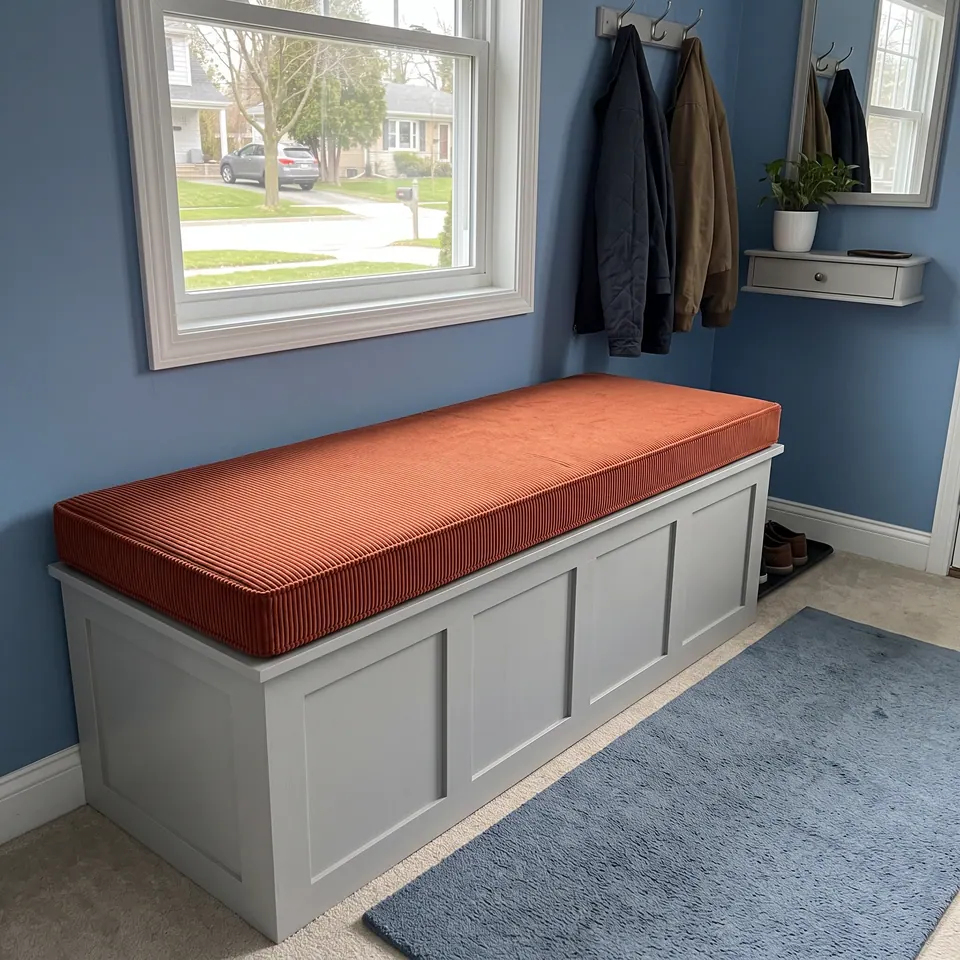
A storage bench cushion has a job a plain bench cushion never faces: it has to survive the lid going up. I learned that on my own mudroom bench, dressed in one handsome long cushion that I then unloaded like a dishwasher whenever someone wanted mittens.
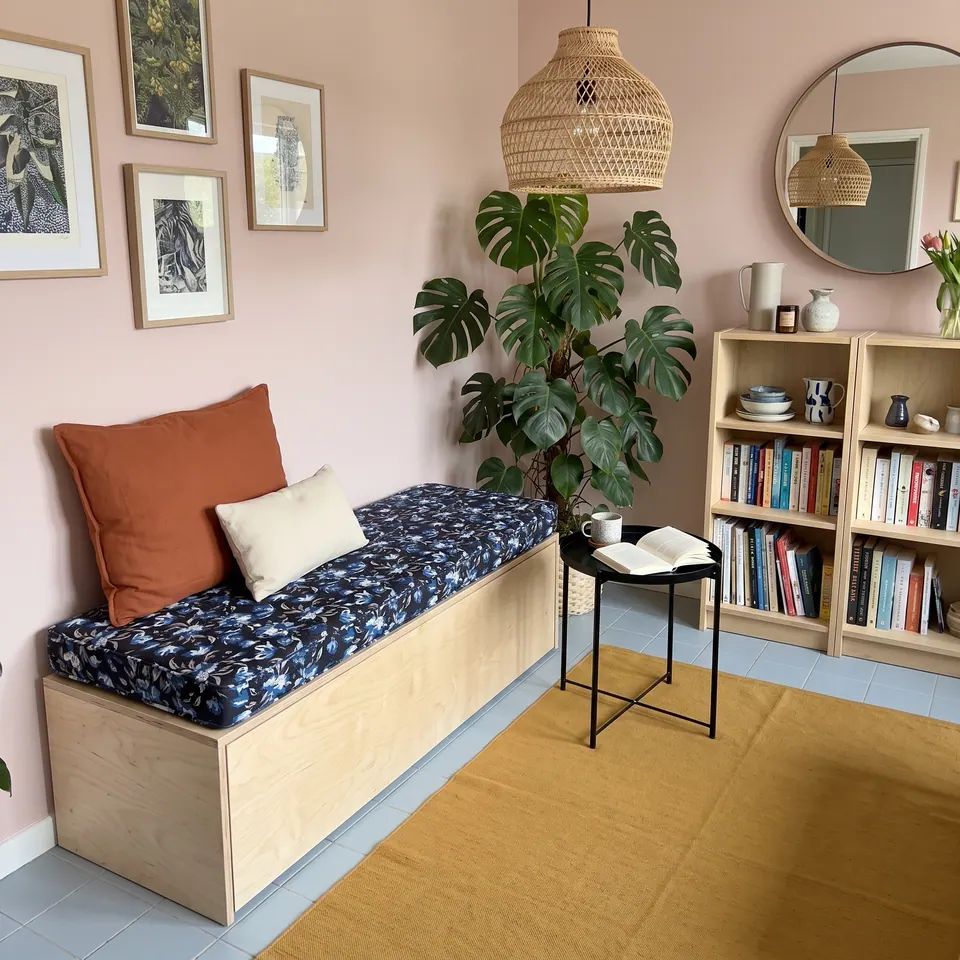
The workshop's rule is short. Split the cushion where the lids split, one section per lid. Three lids, three cushions. It holds for bench cushions in a back hall, for a toy box cushion at the foot of a bed, and for a window seat storage cushion under the glass.
So, what is under your seat: one lid, or a whole row of them?
Seven steps from lid to order form
Count the lids and tape each lid line
Open every lid and run painter's tape across the seat wherever one lid meets the next or a fixed section. Each strip is a cut line. What sits underneath decides the split: a 106 x 15 in (269 x 38 cm) seat over a radiator got two 53 x 15 in (135 x 38 cm) cushions.
Pattern sheet Plan: the cushion fills the inside of the frame, 47 by 17.5 in, measured wood to wood. Front view: 4 in thick. Run to the wall, or stop at the hinge
A cushion that runs over a fixed back strip to the wall must come off before the lid opens, or it stops the lid opening fully. One that stops at the hinge line rides up with the lid.
Measure the lid, then inside the bevel
Measure the bench, not the cushion you used to have. Take each lid's width, and its depth at both ends. On a beveled lid, measure inside the rim: one cedar chest was 44 1/4 x 19 in (112 x 48 cm) outside and 42 x 18 in (107 x 46 cm) inside.
Map every hinge from one named end
Pick the left or the right end, then write each hinge's distance from it and each hinge's width. Say which end you chose, and add a photo of the hinge side.
Pattern sheet Plan: the cushion fills the inside of the frame, 47 by 17.5 in, measured wood to wood. Front view: 4 in thick. Choose how each piece holds on
Ties on the hinge side keep a cushion on an opening lid. A non-slip base grips only while you sit; on RV bench lids it is often preferred to straps.
Draw every section top side up
Sketch each section as seen from above, standing in the room: front, back, both sides and the depth at each end. Sections that aren't twins each get their own drawing.
Put the extras in writing, twice
Write each exact size and "ties on the hinge side" in the personalization note, confirm by message after ordering, and look for the ties on the pre-dispatch photo.
A 77-inch quilt box and four hinges
A buyer in the US came back after an earlier patio swing cushion, this time with a long wooden quilt box: 77 in (196 cm) of hinged lid.
The workshop put ties on the hinge side only, and she sent the four hinge positions: 8 5/8, 29, 48 and 68 1/4 in (22, 74, 122 and 173 cm). The workshop still asked which end she had measured from, for photos of the hinge side, and for each hinge's width, so every tie would land in a gap and not on steel.
Four numbers weren't enough until they had a starting point.
Ties, grip base or a snug fit: what holds on a lid
| Hold | Stays on an opening lid? | Best for |
|---|---|---|
| Ties on the hinge side only | Yes | Quilt boxes, blanket chests, lift-up window seats |
| Non-slip base | No; grips only while you sit | RV bench lids, smooth painted tops |
| Cut inside the lid's bevel | No; framed by the rim, still shed when the lid opens | Antique chests where ties can't clear the hinges |
| Ties on the butting ends | Holds sections to each other | Split runs that drift apart |
Where two sections meet: piping, zippers and the joint
Each section of a split bench cushion is finished on its own, so its piping runs all the way around, and where two sections butt, two welts sit side by side. Lined up, that reads as a deliberate double line; ties on the butting ends keep it that way.
The zipper hides on the back edge or the underside, your choice. Say which edge faces the hinges so ties and zipper placement are planned together.
Not every run is square. A buyer in the US with outdoor storage benches asked for cushions split at the lid lines. One run was about 1.5 in (4 cm) different in depth, so the workshop asked for a full drawing of each piece. The seats were cut 3 in (7.5 cm) thick, and she was told plainly there is no quick-dry foam in the range, so its water-repellent fabric suits a covered porch.
Mistakes the workshop sees often (one of them mine)
- One long cushion over several lids. Split at every lid break.
- "Please add ties" typed into the size box, where it gets overlooked. Ask in writing, then confirm.
- Hinge positions with no starting end.
- Trusting a non-slip base to hold a cushion on an open lid.
- One drawing for sections that aren't identical.
- Slitting the vacuum pack with a knife. Two 77.25 x 22 in (196 x 56 cm) corduroy window-seat cushions fit perfectly and were cut open along with the plastic. Cut only the outer wrap.
A storage bench cushion should split wherever the lid splits: three lids, three cushions, and ties on the hinge side of each one.
Maggie
Lay out the cushion sections before anyone cuts
Before you order a cushion for a storage bench lid, try the layout in the bench cushion builder: one section per lid, then hold the result against your painter's tape. For thickness, 4 in (10 cm) is standard; 3 in (7.5 cm) sits lower and neater on window seats.
Benches that never lift are covered in stopping a bench cushion from sliding, and chest layouts in storage bench and blanket chest cushions. The mudroom and entryway bench cushions and window seat cushions hubs have the rest. Tape, pencil, hinges.
Replacing the pad that came with a store-bought storage bench
Take the old pad off
If it's stapled, glued or strapped to the lid, remove it; stacking a new cushion on top makes the lid heavy and uneven.
Measure the lid top
Length and depth wood to wood. The old pad has usually shrunk and flattened, so don't copy it.
Look for a lip or cut-out
Note any raised edge the cushion must sit inside, and any finger hole or handle slot along the front.
Check the opening arc
With the planned thickness, make sure the lid still clears the wall or window behind it.
Choose how it stays on
Ties on the hinge side only, a non-slip base, or both; say which in the order note.

Have it made
Measured it? Have Maggie’s workshop make it
Numbers first, fabric second, piping last. Jot down what you have, and the workshop will go down the list with you, item by item. — Maggie
Leave your details and the workshop will call you to confirm measurements, fabric, foam and piping. No prices, dates or payment on this page: it is a request, not an order.
Buyer questions: lids, hinges and split seats
- A common question
How do I keep a cushion on a lift-up lid, like a storage chest or an RV bench?
The workshop's answerAsk for ties on the hinge side only, and give each hinge's position from a stated end, its width and a photo so the ties line up; one-sided ties normally carry a small extra charge. If the hinges leave no room, the cushion can sit inside the lid's bevel with a non-slip base, but a lifted lid can still shed it.
- A common question
My window seat has flip-up storage lids. One cushion or several?
The workshop's answerSplit it at the lid lines so each section lifts with its own lid, for example three cushions for three lids. Send photos and a drawing with every edge measured. If sections differ, even by about 1.5 in (4 cm) in depth, each needs its own drawing with the depth at each end.
- A common question
Can two bench cushions be tied together where they meet?
The workshop's answerYes. Ties can go on the butting ends, combined with side ties so the pair is also fixed to the seat. List the ties for every cushion in the order and say which edges meet; each setup is custom, so there are no stock photos of them.
- A common question
Our bench wraps around a bay. Can the cushion be one continuous piece?
The workshop's answerOften, but one piece takes more work and material, costs more and fits less reliably. The workshop suggests sections instead, such as three cushions for a wrap-around bay, or two for a trapezoid seat around 79 in (200 cm) long, which sit neater and are easier to remove and clean.
Quick questions about lid cushions
Will I notice the joint where split cushions meet?
It's a straight line between two finished, piped edges. Ask for ties on the butting ends so the sections can't creep apart, and line up the piping when you set them down.
How thick should a lift-up bench cushion be?
The standard seat is 4 in (10 cm), and most buyers keep it. On window seats and benches, 3 in (7.5 cm) gives a neater, lower profile; outdoor benches usually take 3 to 4 in.
Should an heirloom chest get a non-slip base?
Your call. One cedar-chest owner skipped it to protect the antique finish, relying on a cushion cut to the 42 x 18 in (107 x 46 cm) inside of the bevel, knowing an open lid would still shed it.
Which edge of a lid cushion gets the zipper?
The back edge, facing the wall, or the underside; you choose. On bench covers it often wraps two corners in an L so the foam slides out. Say which edge faces the hinges.
Should I glue or staple a cushion to my storage bench lid?
Not if you want to wash the cover. Glue and staples fix the cushion for good and ruin a zippered cover. Ties sewn on the hinge side, a grippy non-slip base, or a cushion split to match each lid hold it in place and still let the cover come off. Staples only suit a DIY cushion upholstered straight onto a board.
How do I replace the thin pad that came with a store-bought storage bench?
Measure the lid, not the old pad, which has usually shrunk and flattened. Take length and depth wood to wood, note any raised lip the cushion must sit inside and any handle cut-out, and check that the lid still clears the wall when it opens with a thicker cushion on it. If the old pad is stapled or glued down, remove it rather than stacking on top.