Concept Sketches · 9 scenes
Cushions for storage benches, quilt boxes and blanket chests
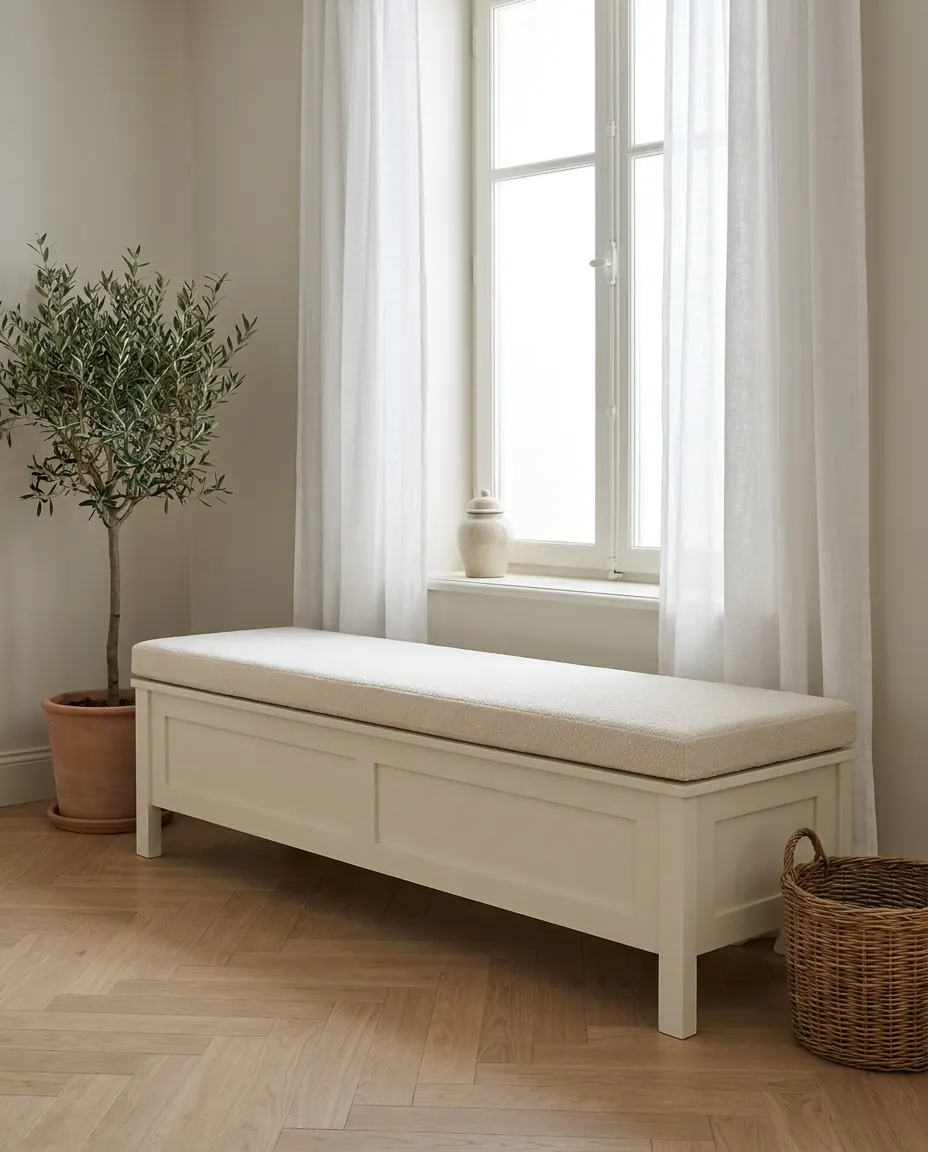
A bench with a lid asks a cushion to do two jobs: sit well, then get out of the way. Nine lift-up seats from past orders, and what each one taught.

 Save
The quick answer
A storage bench cushion should be cut at every lid break, with ties sewn on the hinge side only so it stays on when the lid lifts. Give the exact size of the seat, or ask to round down where a lid must clear. A non-slip base helps in normal use but cannot hold a cushion on a raised lid.
Two jobs for one cushion
A cushion on a blanket chest gets sat on, shoved aside, and sat on again, for as many years as the chest keeps its quilts.
A storage bench cushion has to sit well and then get out of the way. When the lid lifts, the cushion does one of three things: it rides up with the lid, it slides to the floor, or it holds the lid half shut. Every choice on this page decides which.
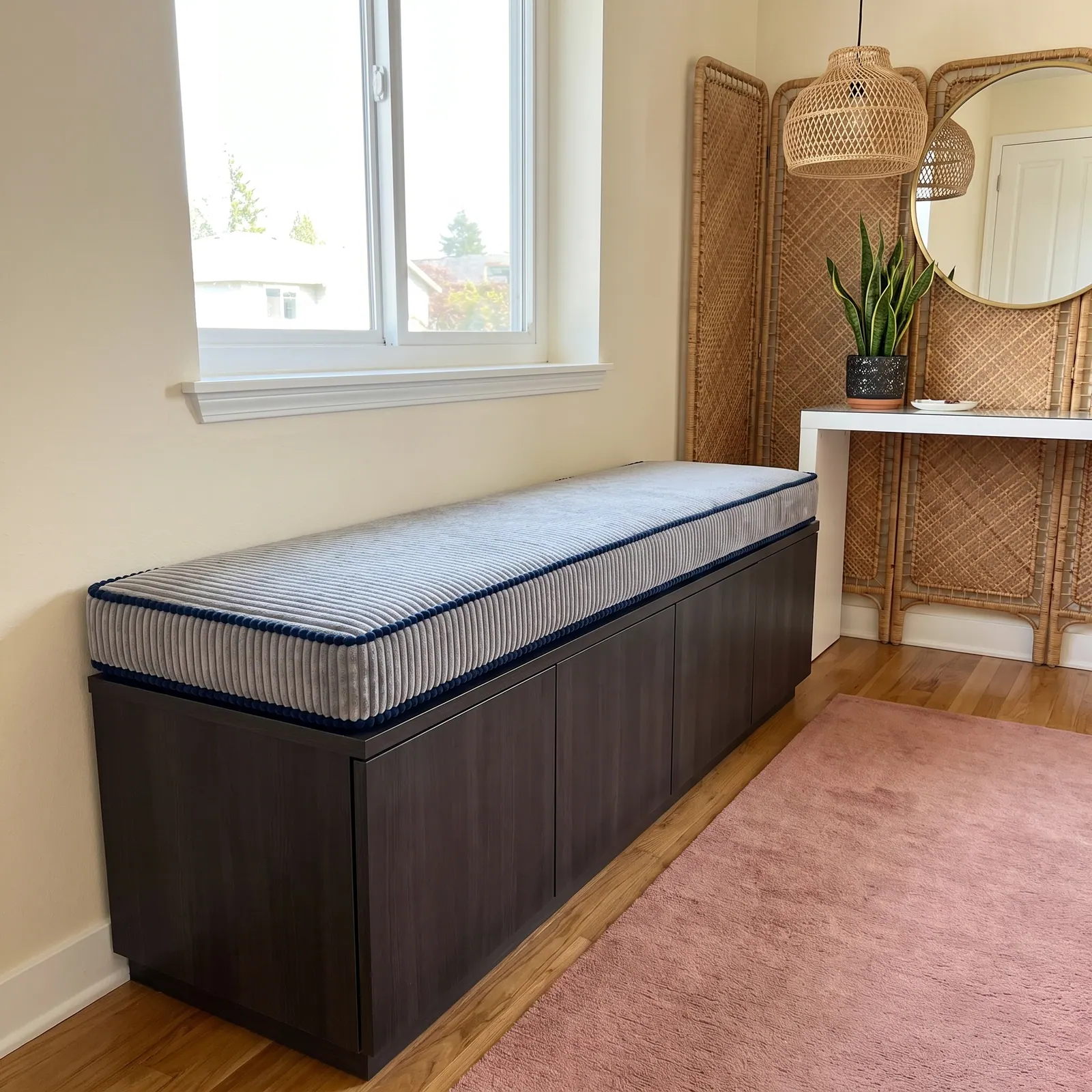
I have watched folks buy a cushion for a bench and forget the bench opens. A seam is a promise, my friend, and on a lift-up seat that promise includes the hinge. The bench cushions hub covers the plain ones; this sketch is for benches that open.
What is inside yours, and how often does the lid come up?
Nine lids, nine lessons
01A past project
A family cedar chest, sized inside the bevel
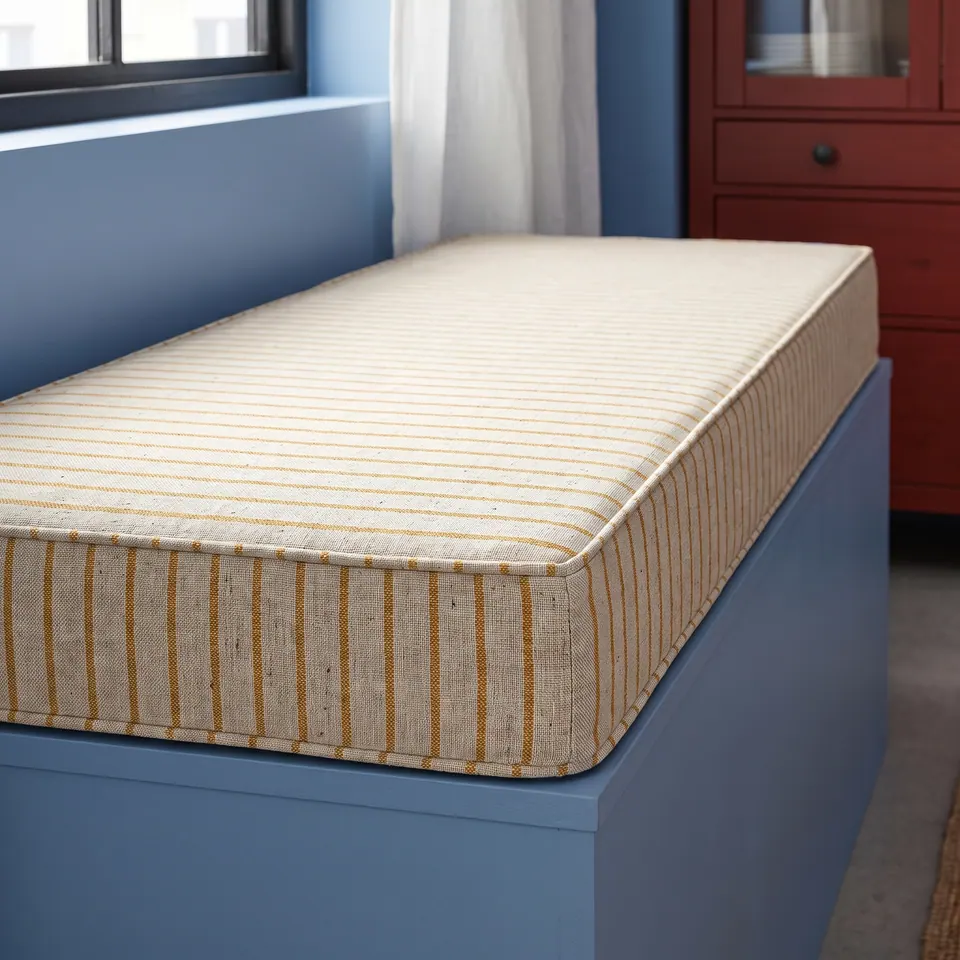
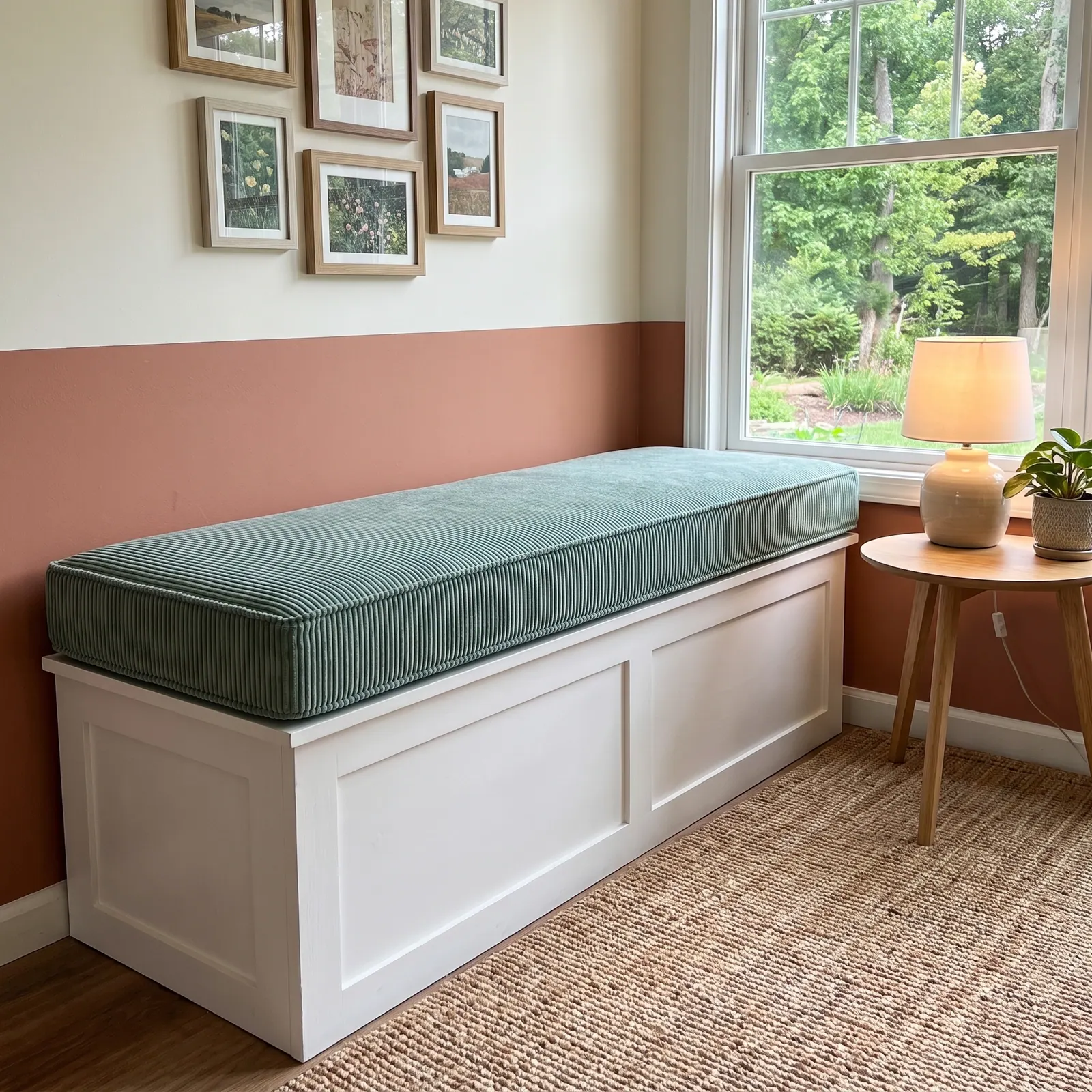
A buyer in the US wanted a tie-on cushion for a family cedar chest, but the hinges left no place for ties. The cushion was sized to the 42 x 18 in (107 x 46 cm) inside of the bevel, not the 44 1/4 x 19 in (112 x 48 cm) outer edge. A non-slip base helps but cannot stop a slide when the lid lifts, so she skipped it to spare the old finish. She chose a linen with self piping.
The takeaway: On a beveled antique, measure inside the bevel, and accept that the lid will still shed the cushion.
02A past project
A 77 in quilt box with four hinges
A returning buyer in the US wanted a cushion for a 77 in (196 cm) quilt box, with ties on the hinge side only. She gave four hinge positions: 8 5/8, 29, 48 and 68 1/4 in. The workshop asked which end she measured from, for photos, and for each hinge's width, so the ties would land between the hardware.
The takeaway: Measure every hinge from one named end, note its width, and send a photo.
03A past project
An angled bench measured along the old cushion
A buyer in the US drew an angled storage bench with a hinged lid: 77 in (196 cm) at the bottom, 34.5 in (88 cm) at the top, 25 in (64 cm) deep, slanted sides of 33 and 33.5 in. The slants came out 1 to 1.3 in long, because the tape had followed the curve of the old cushion. Cut from front, back and depth, the sides came to about 33 in (84 cm).
The takeaway: Trust the straight measurements over the slanted ones. The trapezoid cushion calculator works the slants out from front, back and depth.
04A past project
A 120 in bench whose lid opens in three
One buyer wrote in about a bench of about 120 x 21.5 in (305 x 55 cm) whose lid lifts in three sections, two of them oddly shaped. Three cushions cost more than one, for the extra cutting, sewing and zippers, but they chose three to match the lids, at 4 in (10 cm) thick.
The takeaway: Split the cushion wherever the lid splits.
05A past project
Two lift-up seats, rounded down
A buyer messaged the workshop with two lift-up seats, 40.5 x 17.75 in (103 x 45 cm) and 57.5 x 17.75 in (146 x 45 cm), and asked the workshop to round down where needed so the lids could open. Worried about sliding, they took the non-slip base, and linen piping one shade darker than the body.
The takeaway: Ask to round down, never up, wherever a lid must still open.
06A past project
Two flip-up dining benches with a 2 in gap
A buyer in the US had two flip-up storage benches in a dining nook, 2 in (5 cm) short of meeting at the corner, plus a small corner piece. They chose a lavender soft fabric, since the corduroy does not come in lilac. The workshop advised a close fit with no overhang, 2.5 in (6 cm) thick, three separate pieces, and ties at the bottom back corners. The ties were missed in sewing, so the workshop sent matching fabric and thread.
The takeaway: Ask for ties in writing and check the pre-dispatch photo. Small extras are the ones that slip.
07A past project
A slim backrest for a leather bench
A public welcome center in the US had big fluffy pillows on a 76 in (193 cm) leather storage bench, and every one had to come off before the lid could open. They asked for a slim backrest to fill the 14 in (36 cm) between seat and window. The workshop made it as two half-length pieces, easy to lift away, and declined to mount it on the wall.
The takeaway: A split backrest comes off in two quick moves; a pile of loose pillows does not.
08A past project
The top of a toddler's toy box
A buyer got in touch for a cushion on top of a toddler's toy box, first about 15.7 x 31.5 in (40 x 80 cm), then came back and ordered a larger one.
The takeaway: The cushion is cut to the size written in the personalization note, so measure the lid itself and write that.
09A past project
Two media units made into one built-in seat
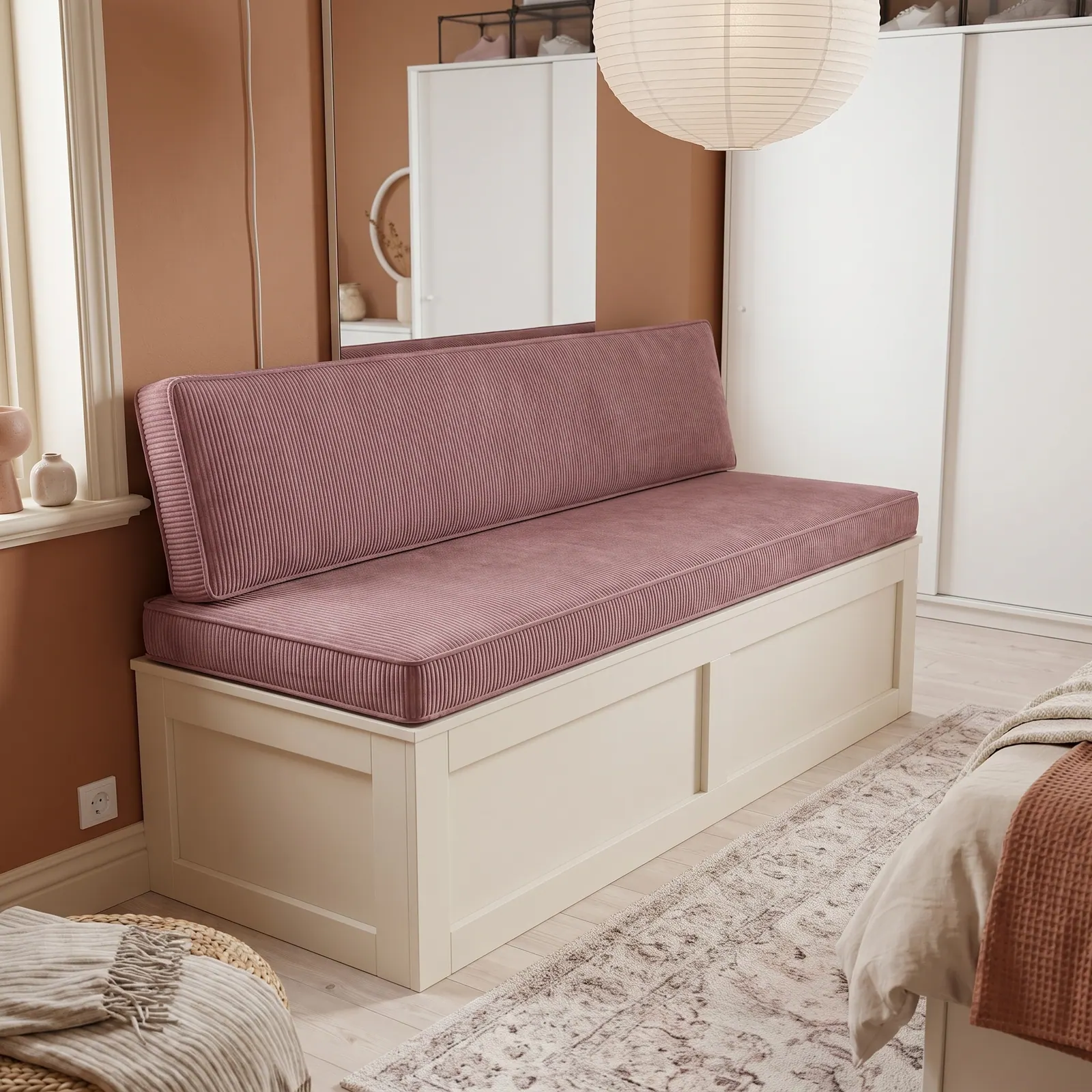
A buyer wrote to the workshop with two storage benches built from IKEA BESTA units, 70.9 x 16.5 in (180 x 42 cm) and 47.2 x 16.5 in (120 x 42 cm), both cushions 2.75 in (7 cm) thick with piping, in maroon or in cream with coffee-brown piping.
The takeaway: Give both benches the same thickness and the same piping, and two units read as one built-in seat.
Ties on the hinge side, or a non-slip base
Both keep a cushion in place on a closed lid. Only one holds it when the lid comes up. The Pattern on ties and non-slip bases has the rest.
| Question | Ties on the hinge side | Non-slip base |
|---|---|---|
| When the lid lifts | The cushion stays attached and rides up with the lid | Cannot hold the cushion; it can slide off |
| What you send | Each hinge position from a named end, its width, and a photo | Nothing extra; choose it in personalization |
| How it holds | Fabric ties sewn into the seams, in any position | A grippy fabric bottom that holds by friction, with no adhesive or residue |
| Cost | A small extra charge for ties on one side | Costs extra; the newer washable version adds about a week |
| Best for | Quilt boxes and chests with room between the hinges | Lids where hinges leave no room for ties, and RV bench lids |
Before you measure a lift-up seat
- Where a lid must still open, ask to round down, never up.
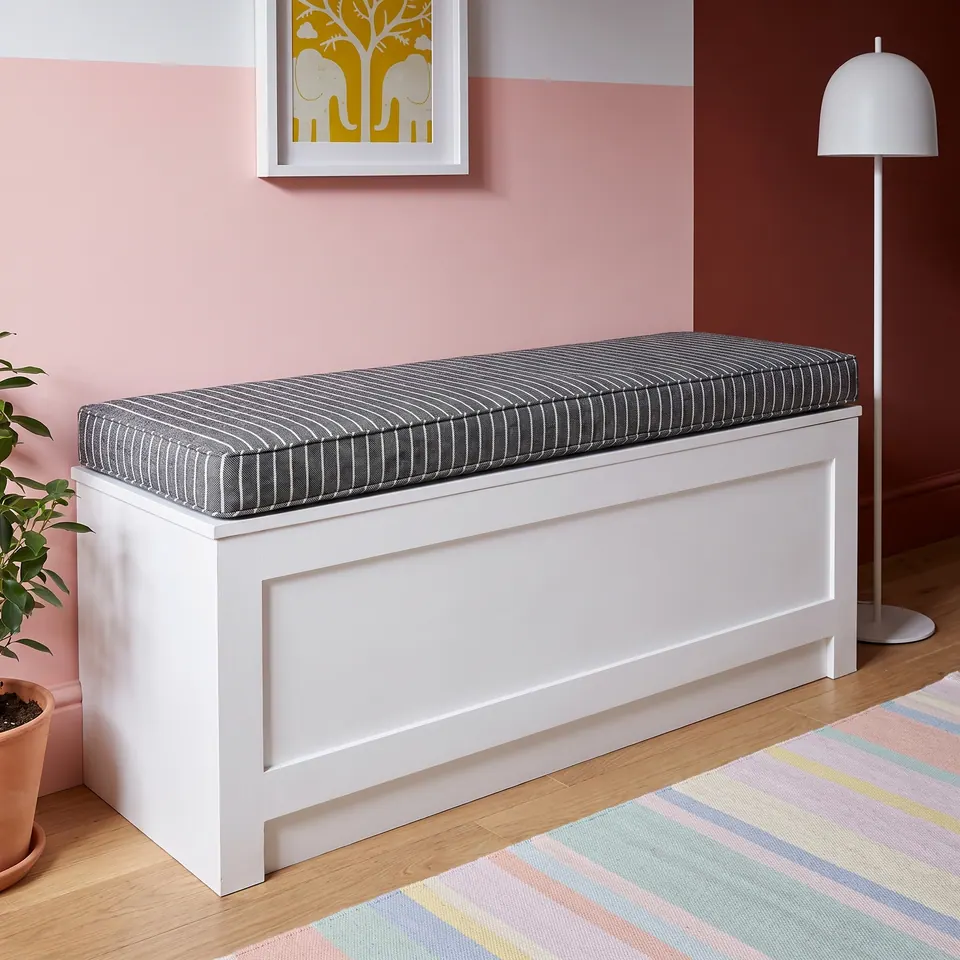
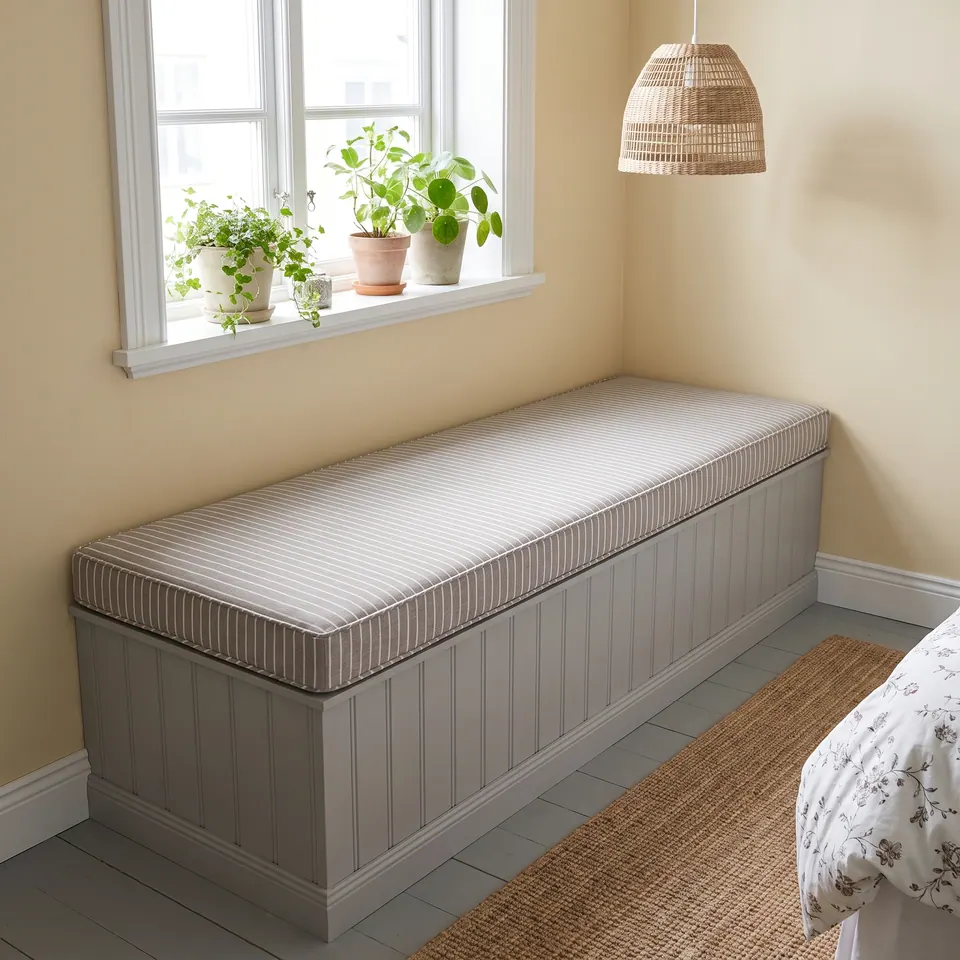
- Cut the cushion at every lid break: one piece per lid.
- Take front, back and depth with a straight tape; slants measured over an old cushion run long.
- Record each hinge from one named end, with its width, and send a photo.
- Write ties or a non-slip base in the personalization note, then message after ordering to confirm.
Linen for the old chest, care with corduroy
A lid cushion gets handled as much as it gets sat on. It is pushed, lifted, leaned against the wall and dropped back.
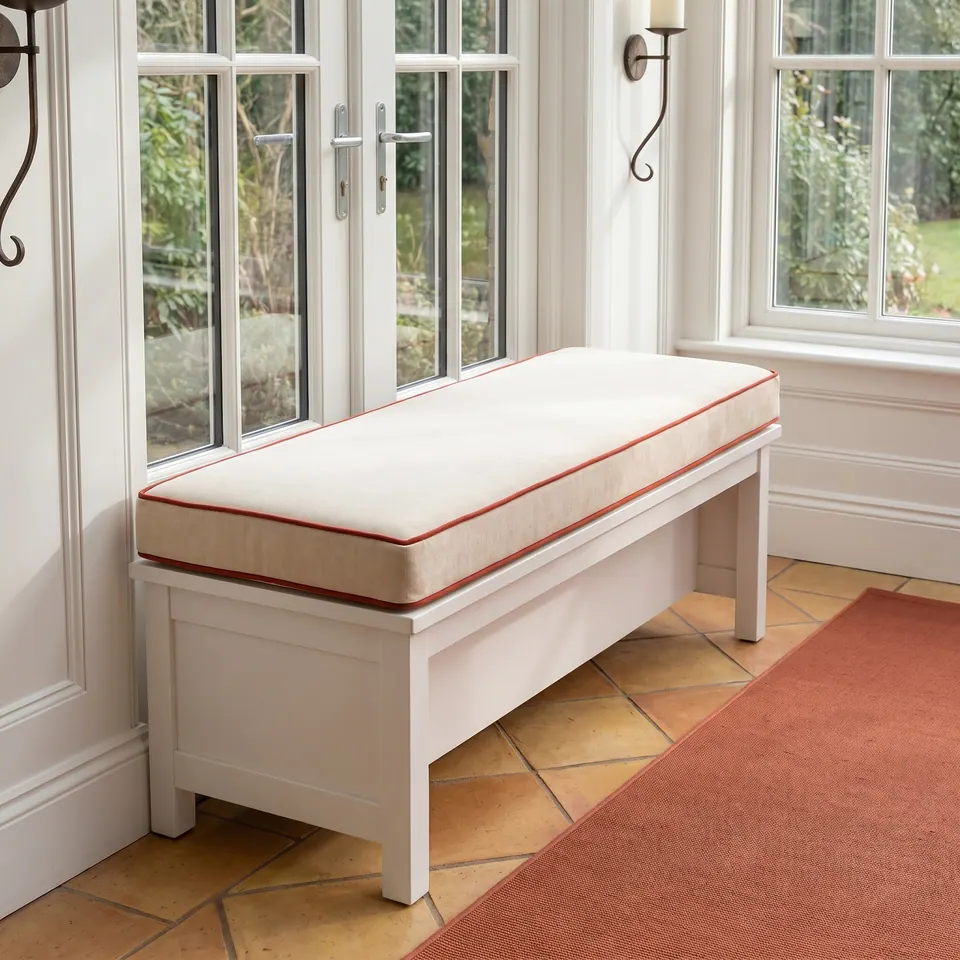
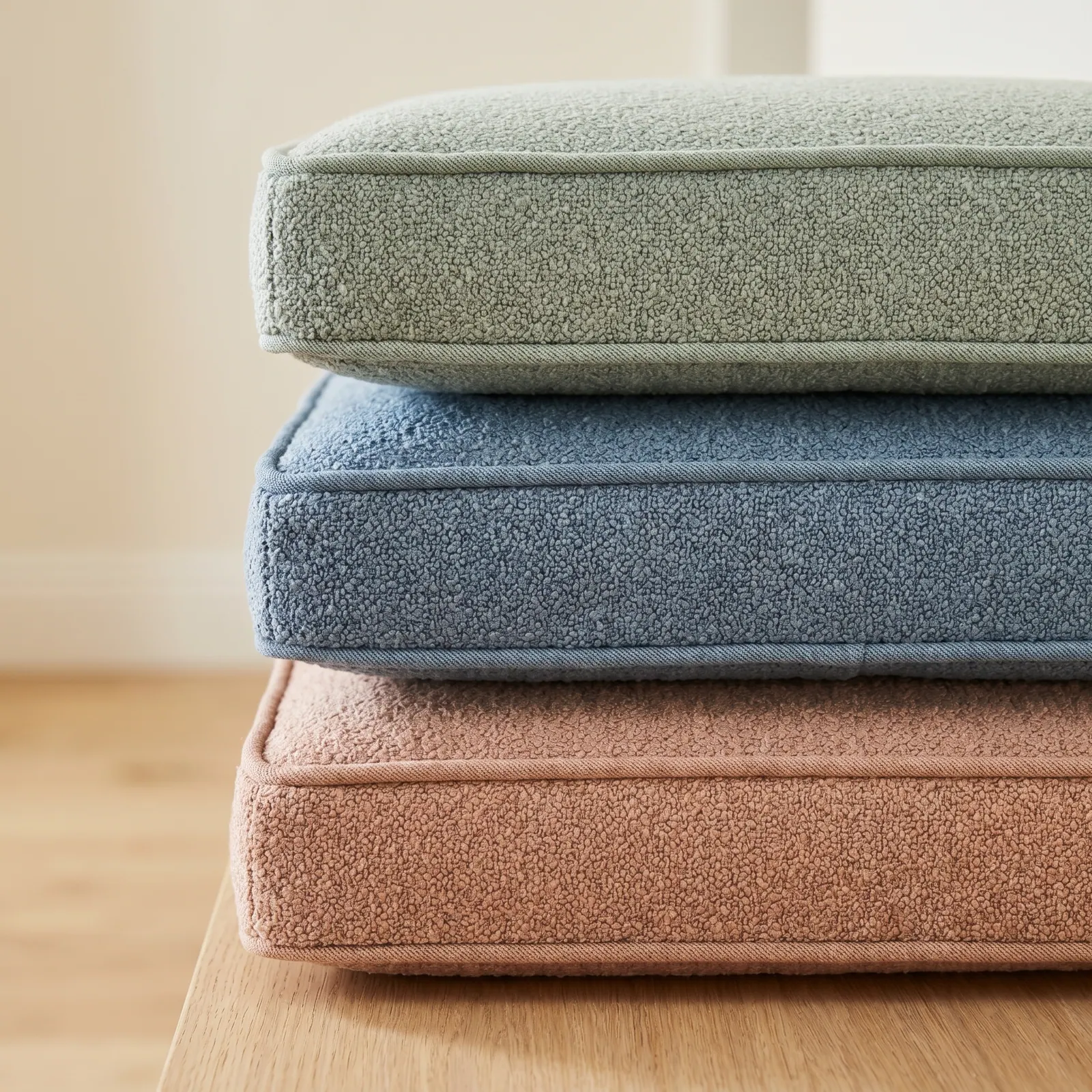
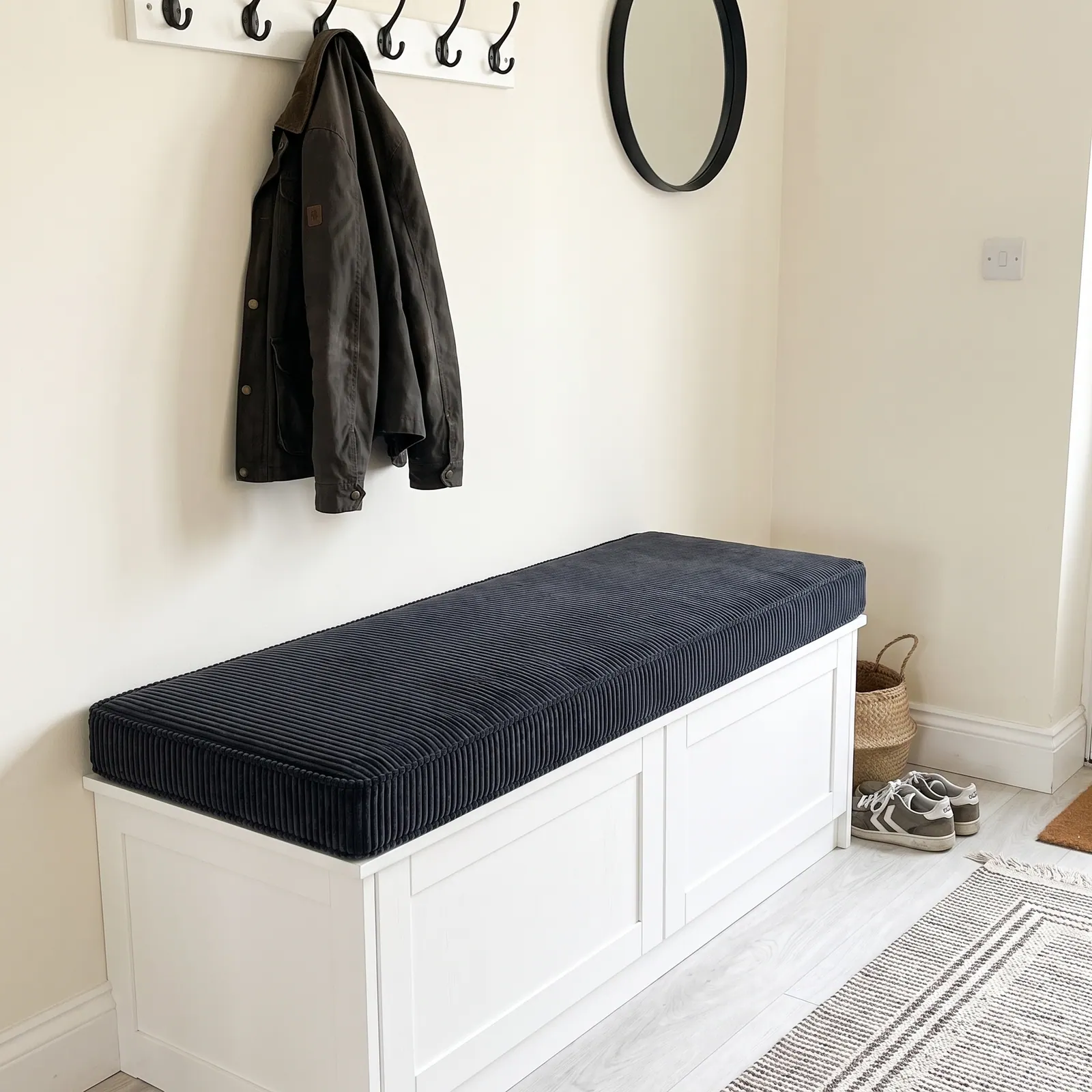
Linen with self piping suits an old chest, because the outline stays quiet against the wood. Corduroy looks rich on an entryway bench, but the ribs can split under hard use, and the workshop has remade split corduroy covers in harder-wearing linen.
The storage bench Pattern covers hinged lids step by step, and the bench cushion builder shows the pieces split at each lid break before you order.
A storage bench cushion with no ties will slide off when the lid lifts, even on a non-slip base. Tie it on the hinge side.
Harlan
Lift-up questions
- A common question
How do I keep a cushion on a lid that opens, like a quilt box or an RV bench?
The workshop's answerAsk for ties on one side only, the hinge side, so the cushion stays attached when the lid opens. Write your exact size and 'ties on the hinge side' in the personalization box, and give each hinge's position from a stated end, its width and a photo so the ties line up. Ties on one side normally carry a small extra charge. If the hinges leave no room, the cushion can sit inside the lid's bevel, for example 42 x 18 in, with a non-slip base. On an RV bench lid, a non-slip fabric bottom is often preferred to straps. Without ties, a raised lid can still let the cushion slide off.
- A common question
Should I order my bench cushion a little smaller than the bench so it fits?
The workshop's answerNo. Give the exact size of the space. The workshop allows for the sewing and makes the cushion to the full dimensions you give, with nothing taken off. A snug fit looks clean; on a dining bench, aim for a close match to the seat rather than an overhang. Write smaller sizes only if you want a visible gap between neighboring cushions, or ask to round down, never up, where a hinged lid must still open. Measure the bench once it is installed.
- A common question
How close to my ordered size will a handmade cushion come out?
The workshop's answerWithin about 1 in (2.5 cm) either way, as the listings state, so a 5 in height can measure anywhere from 4 to 6 in. Long cushions vary most, because foam and fabric behave a little differently. Inch orders are converted to the nearest centimeter for production. If a size is a hard maximum, say so: when a buyer said 24 in was the absolute limit, the cushion was made 23 in. Measure height only after the cushion has fully expanded.
- A common question
My bench size isn't on the size menu. How do I order it?
The workshop's answerPick the size option your measurements fall into, or the closest one, usually the next size up, because the menu only sets the price. Then type your exact dimensions, thickness, fabric code and piping code into the personalization box. The cushion is cut and sewn to the size in that box, not the menu size, and fractions such as 57 5/8 x 15 3/8 in are fine. For several cushions, add each size to the cart as its own item.

Have it made
Have an idea like this made — ask Harlan’s workshop
Old upholsterers will tell you the real cutting happens in the conversation, long before the shears come out. Tell the workshop what you sit on, and they will talk it through with you. — Harlan
Leave your details and the workshop will call you to confirm measurements, fabric, foam and piping. No prices, dates or payment on this page: it is a request, not an order.
Questions buyers ask next
Can a storage bench cushion hang over the front edge?
A close match to the seat looks cleanest, and on a lift-up lid it keeps nothing in the way of opening. If you want an overhang, up to about 2 in (5 cm) is possible when an inner support wrap is added. See overhang in the glossary.
How thick should a cushion on a lift-up bench be?
The benches here ran from 2.5 in (6 cm) on flip-up dining benches to 4 in (10 cm) on a long three-lid bench. For long sitting, 4 in gives the best support. The seat height calculator shows where each thickness puts you.
Where does the zipper sit on a storage bench cushion?
Every foam cushion has a fully removable zippered cover at no extra cost. The zipper hides on the back edge, facing the wall, or on the underside, and you choose which. On bench covers it often wraps around two corners in an L so the foam slides out.
Can I add a backrest to a lift-up storage bench?
Yes. Backrests lean against the wall rather than standing on their own, so they lift off easily when the lid opens. Long benches do better with split backrests: one 76 in bench took two half-length pieces, and an angled bench took three matching foam backrests.