A Reading by MaggieBench Cushions
One striped cushion, and how it remade a long oak hall bench
Maggie reads a taupe wide-stripe cushion on an oak slab bench and works backward through the front hall: what the bench was before, and what one fitted top decided.

 Save
The quick answer
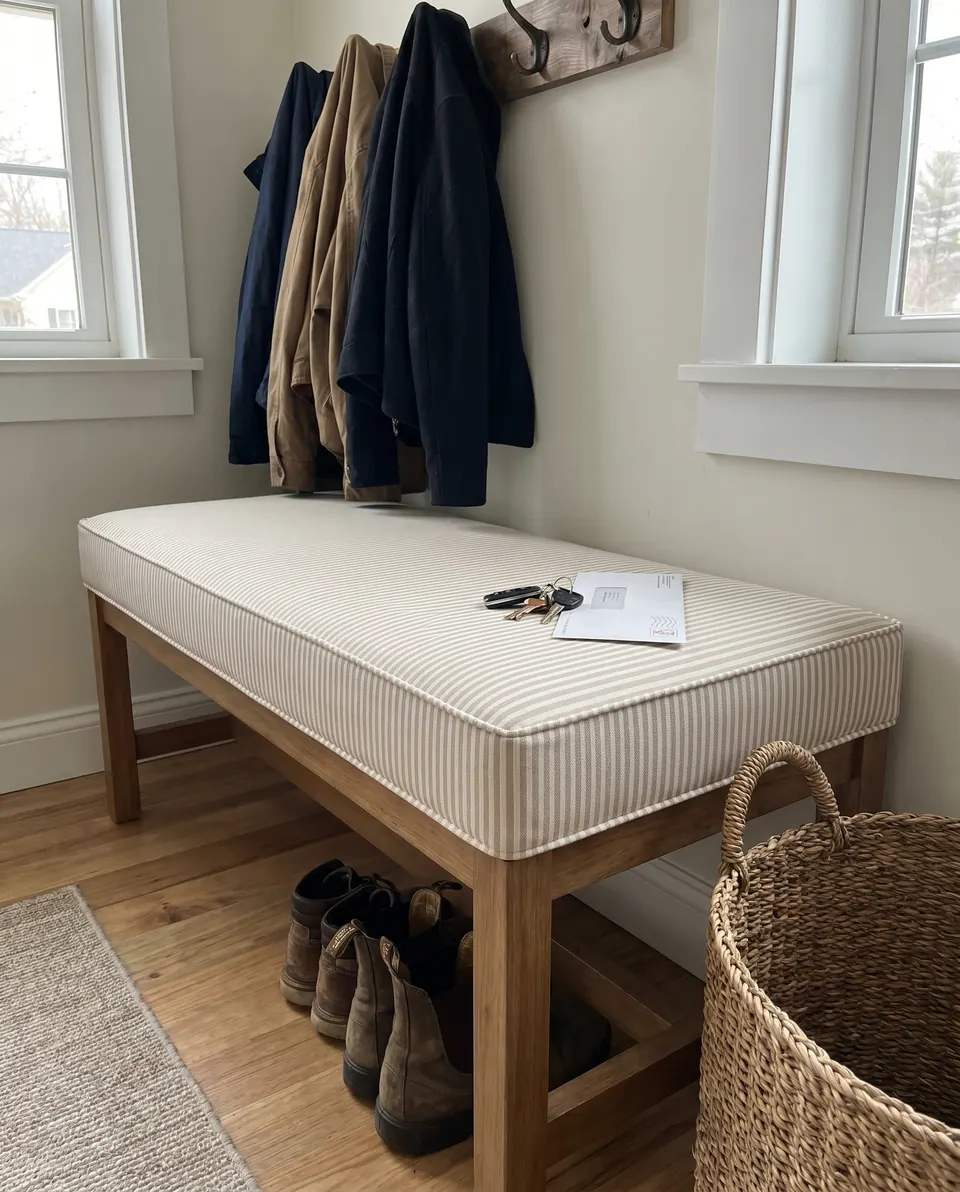
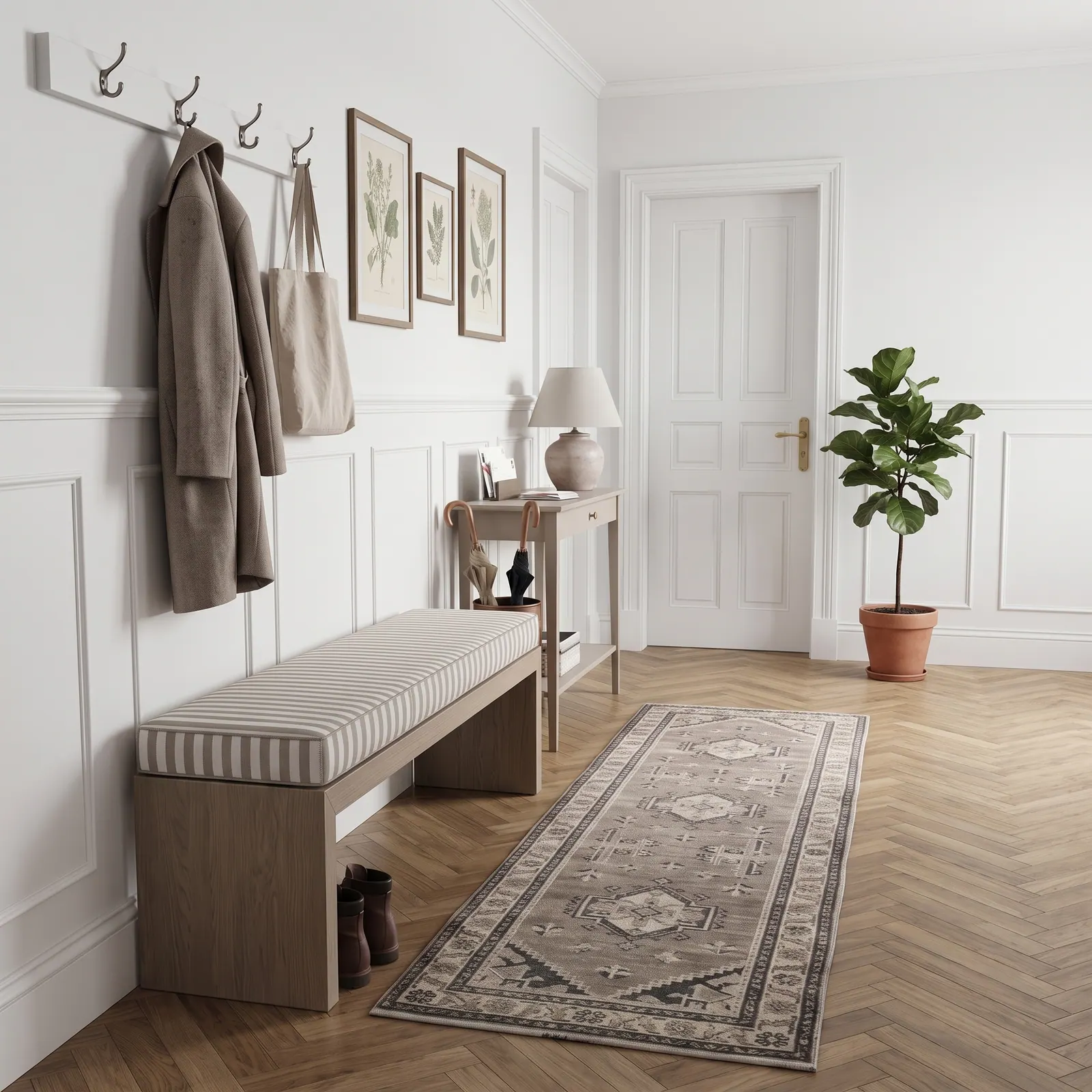
A custom entryway bench cushion changes a front hall more than any other single piece, because it turns a bare bench into a seat and sets the palette for everything around it. Here a taupe and white wide stripe runs front to back and down the box edge, with self piping from the same cloth, so the long oak bench looks tailored rather than covered.
Before: a slab of oak and a pile of coats
A bare oak bench in a front hall is a shelf for coats; put a fitted striped top on it and it becomes a seat.
Picture this hall without the cushion. A long slab-sided oak bench, a white peg rail with iron hooks, a taupe wool coat and a canvas tote, a couple of umbrellas, brown leather boots on a herringbone oak floor. Handsome, and a little stern. Nobody sits on a bare slab to pull on boots; they perch.
Now the after. The custom bench cushion is a taupe and white wide stripe, cut so the stripes run front to back across the seat and then fall straight down the box side without a break. That unbroken line is the tell of a tailored cover. A cover cut to save fabric jogs at the edge, and you notice it every time you walk past.
The piping is self piping from the same stripe, so the pattern rolls around the edge instead of stopping at a cord. The oak ends stay bare, which is why the cushion reads as a top on good furniture rather than a pad hiding it. A straight welt is a kind of honesty, and this one tells the truth from across the hall.
My makeover checklist, in the order I would do it: - Pick the stripe first. It sets the palette. - Keep everything else to two neutrals; the taupe coat and the gray-and-cream runner already obey. - Put height at the far end: the narrow console and ceramic lamp balance the long, low seat. - Fill the empty corner: the fiddle-leaf fig in its terracotta pot keeps the hall from tipping toward the bench. - Hang art at standing eye level, as the three botanical prints are, well clear of shoulders.
More hall benches live under mudroom and entryway cushions, stripes of every width sit on the striped cotton and ticking shelf, and the stripe direction pattern shows the options for your own bench. What does your hall bench carry more of right now, coats or people?
Pinned by Maggie: the striped hall bench, stop by stop
Five pins, from the stripe on the seat to the fig in the far corner, read left to right the way you would walk in the front door.
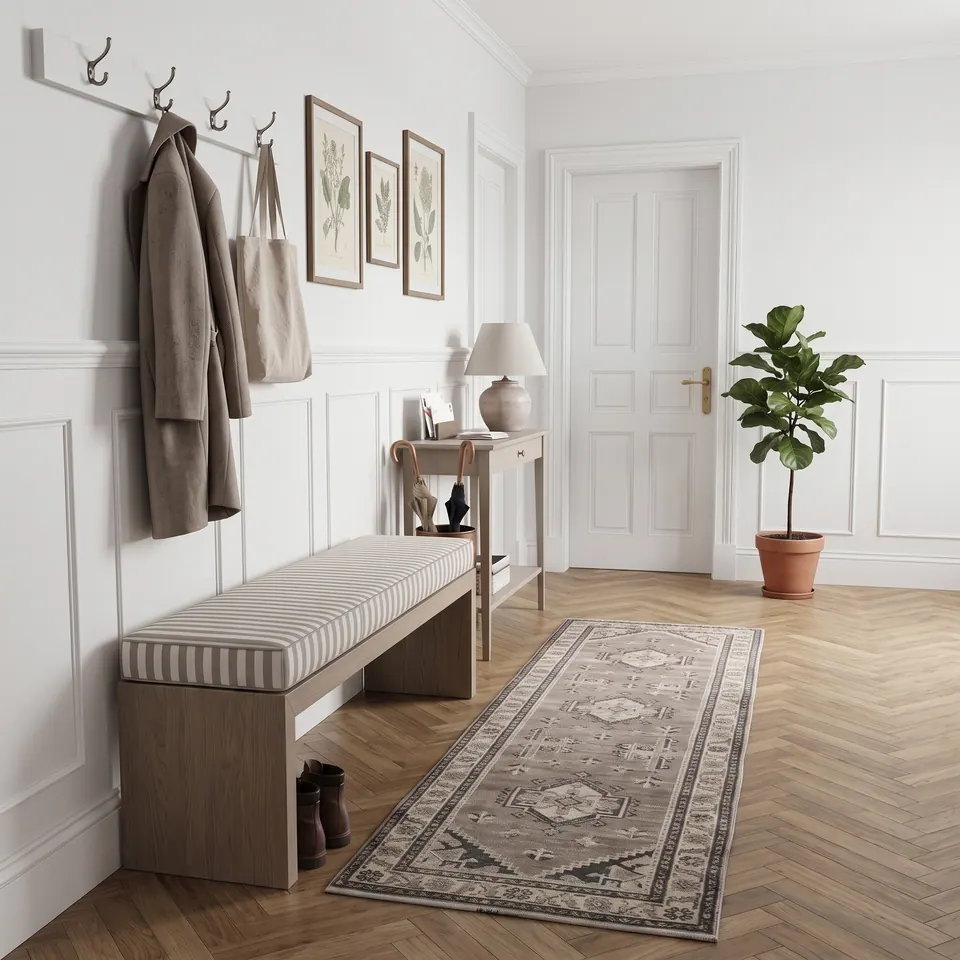
- Taupe wide stripe
Stripes run front to back and fall straight down the gusset, matched at the edge.
- Self-piped front edge
Piping cut from the same stripe keeps the pattern flowing round the box edge.
- Oak slab bench
The slab ends are left bare so the cushion reads as a tailored top.
- Console and lamp
A lamp at the far end balances the long, low bench.
- Fiddle-leaf fig
A tall plant fills the opposite corner so the hall doesn't tip toward the bench.
- Taupe wide stripeStripes run front to back and fall straight down the gusset, matched at the edge.
- Self-piped front edgePiping cut from the same stripe keeps the pattern flowing round the box edge.
- Oak slab benchThe slab ends are left bare so the cushion reads as a tailored top.
- Console and lampA lamp at the far end balances the long, low bench.
- Fiddle-leaf figA tall plant fills the opposite corner so the hall doesn't tip toward the bench.
The oak hall bench before and after its cushion
| What changes | Without the cushion | With the cushion |
|---|---|---|
| How people use it | Perch to pull on boots | Sit down and take a minute |
| What the eye sees | A long, hard plank | A tailored seat with a crisp edge |
| Where color comes from | Oak and white paneling only | A taupe stripe that sets the palette |
| What the rest of the hall must do | Warm up a stern room | Stay quiet in two neutrals |
| Edge detail | Square wood corners | Self piping carrying the stripe around the box |
An L, two straight pieces and a gold rod
A buyer with an L-shaped reading bench saw a photo of a finished cushion in our striped N03 and made a smart call: split the L into two straight cushions, one 70 x 18 in (178 x 46 cm) and one 102 x 18 in (259 x 46 cm). The workshop recommended 3 in (7.5 cm) over 2 in (5 cm).
The backs were the fun part. They wanted cushions hanging from a gold rod, each on two sewn fabric loops: two at 18 x 60 in (46 x 152 cm) and one at 18 x 70 in (46 x 178 cm), 1 to 2 in (2.5 to 5 cm) thick, with loops of about 5 to 6 in (13 to 15 cm). The workshop said yes and priced the set once the sizes were final.
Two lessons for my notebook. Split an L into straight pieces when you can. And for rod-hung backs, write down the loop drop and the strap width, or someone will have to guess. The L-shaped measuring pattern has the diagram.
Buyer questions
- A common question
How do I pick a piping color when I order?
The workshop's answerAny fabric code on the charts can be used for piping, or the same fabric as the body for a clean look, which is what most buyers choose. Write the piping code, or 'same as body', in the personalization box.
- A common question
Can I order only the two L-shaped backrests, without the rest of the sofa?
The workshop's answerYes. The two L-shaped backrest pillows can be ordered on their own, and the covers alone can be ordered for them as well.
- A common question
Could you send close-up photos of a few fabric codes before I choose?
The workshop's answerYes. The shop sends photos and close-ups of any code you ask about, such as P-50, P-51 and P-54, L-18, or the S-09, S-29 and S-30 outdoor fabrics, so you can check texture and tone. Lighting can shift a color a little in photos, but the fabric itself matches the catalog swatch.
Measurement table: the oak hall bench
| Piece | Custom entryway bench cushion, one long rectangle |
|---|---|
| Fabric | Taupe and white wide-stripe cotton |
| Stripe direction | Front to back, carried down the box side |
| Piping | Self, cut from the same stripe |
| Edge | Box |
| Bench | Long oak slab bench, ends left bare |
| Fit | Exact seat length between the slab ends |
| Palette rule | Two neutrals for everything else |
| Best for | Pulling on boots in a front hall |

Have it made
Have this made — ask Maggie’s workshop
I once cut a lovely cushion two inches short, and I have not forgotten it. That is why the workshop goes over your measurements with you on the phone. — Maggie
Leave your details and the workshop will call you to confirm measurements, fabric, foam and piping. No prices, dates or payment on this page: it is a request, not an order.
Choose the bench cushion stripe before the runner, the hooks or the coats; a two-color stripe like taupe and white decides the palette for the whole hall.
Maggie
Questions buyers ask next
Which way should the stripes run on a long hall bench cushion?
Front to back is the classic choice: the stripes cross the short depth and continue down the front face, which reads as tailored. Stripes along the length make a long bench look longer still. Either way, ask for them to be matched at the front edge.
Should the ends of a slab bench be covered by the cushion?
Not on a handsome bench. Leaving the oak ends bare lets the cushion read as a fitted top on good furniture. Measure the seat surface between the ends and order that exact size, with no overhang.
What balances a long, low bench in a narrow front hall?
Height at the far end and weight in the opposite corner. Here a console with a table lamp sits beyond the bench and a tall fiddle-leaf fig fills the other side, so the eye travels the whole hall instead of stopping at the seat.
Stitch straight — Maggie