 Save
A Reading by MaggieBench Cushions
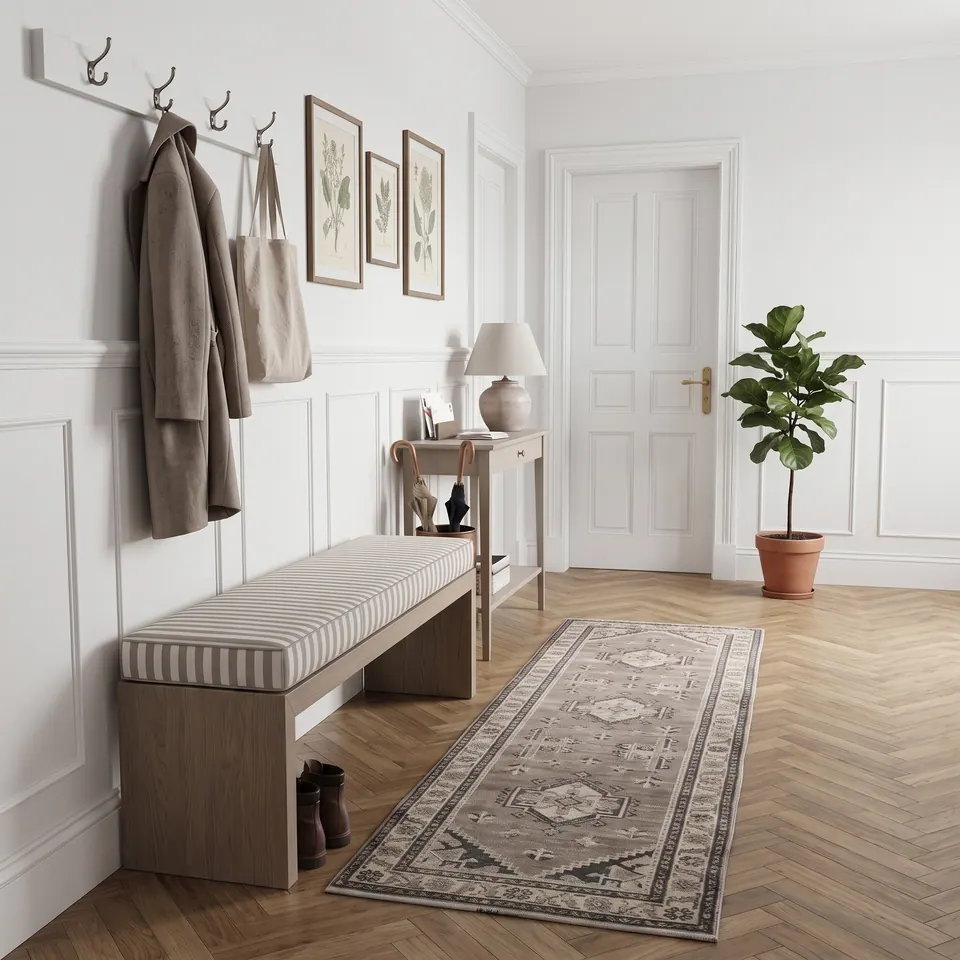
A taupe pinstripe mudroom bench cushion, read from the foam up
Keys land on it, boots come off beside it, and nobody sits for more than two minutes. So here is what goes inside a seat like that, and why the recipe is firm.
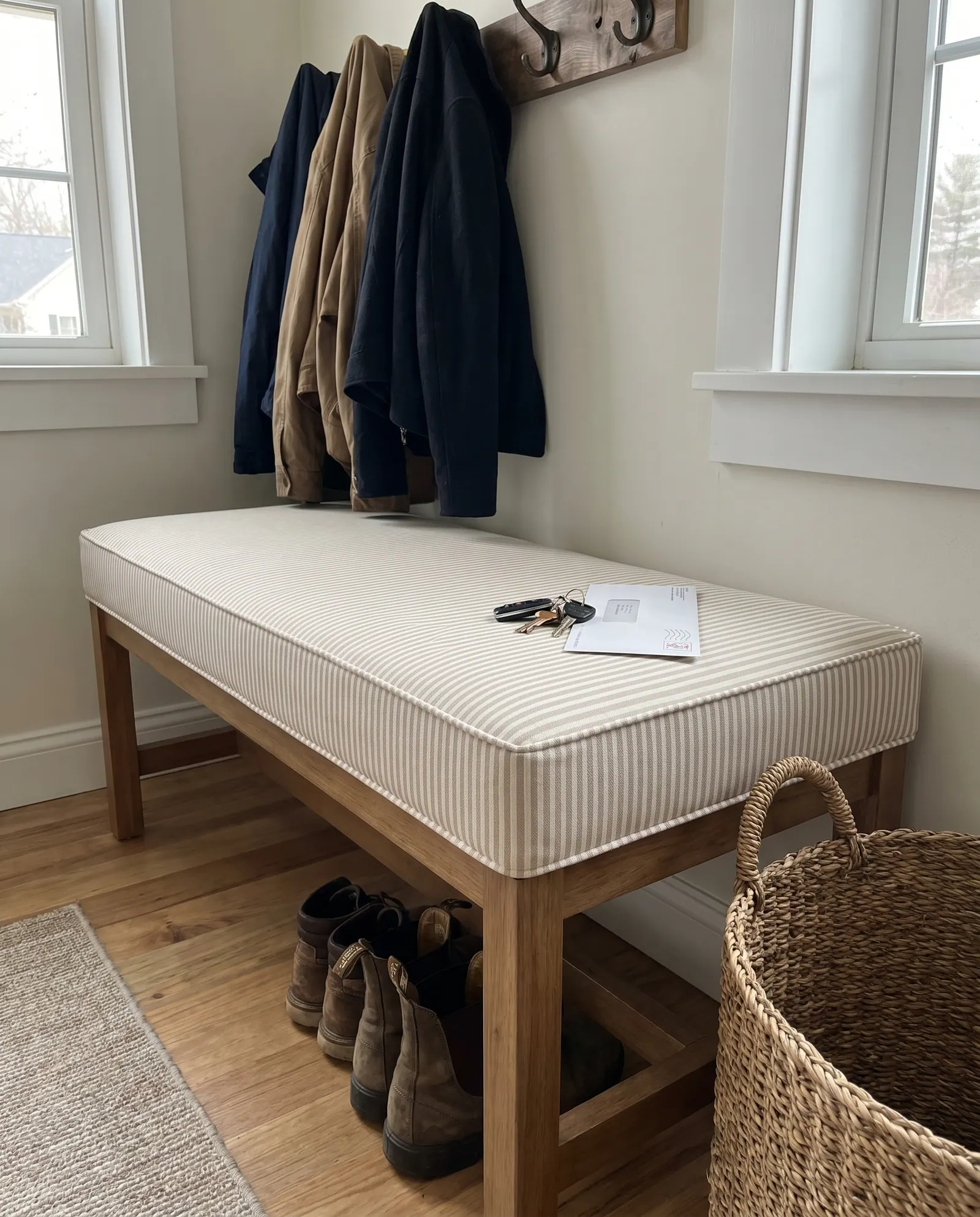
A padded top turns a simple oak entry bench into the place where boots come off and keys land.

The quick answer
A good mudroom bench cushion is about 3 in (7.5 cm) of firm foam under a washable cover. The workshop's seat build is 32-density foam wrapped in polyester fiber: the firm core keeps the front edge level for pulling on boots, the wrap softens the top, and a cover that zips off lets a pale stripe be washed at 86°F (30°C).
Three inches, and not a quarter inch more
The best thing about this mudroom bench cushion is what it leaves alone. At about 3 in (7.5 cm) thick it pads the oak top and stops, so the frame, the lower rail and the boots parked on it all stay in view.
The cloth is a fine taupe pinstripe on cream cotton from the striped cotton and ticking shelf, with a box edge and self piping. No contrast welt. The stripe already draws plenty of lines, and a second color at the edge would only argue with it. A straight welt is a kind of honesty, and on a pinstripe it had better be straight.
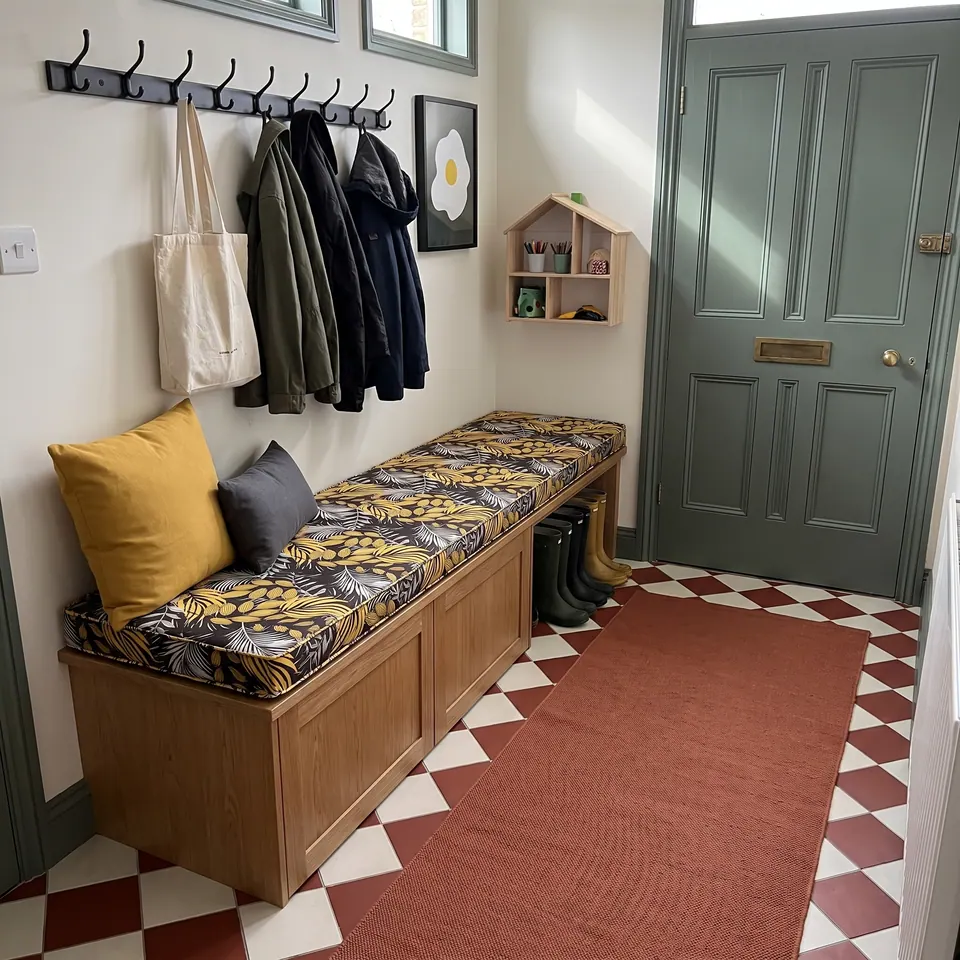
Everything around the seat explains it. Navy and tan coats hang on iron hooks on a reclaimed wood board right above, so this is where coats come off. Keys and envelopes land on the cushion because it is the nearest flat surface. The seagrass basket by the leg catches scarves and gloves, and the jute runner takes the grit before it reaches the seat. Two white-framed windows let in flat winter daylight, the light that shows every mark on a pale cushion. The taupe line forgives some of them.
Measure the bench first, then decide the thickness. That rule holds for all bench cushions and every entryway bench cushion.
Pinned by Maggie: the boots-off bench
Five marks on the entry, from the keys on the seat down to the basket by the leg.
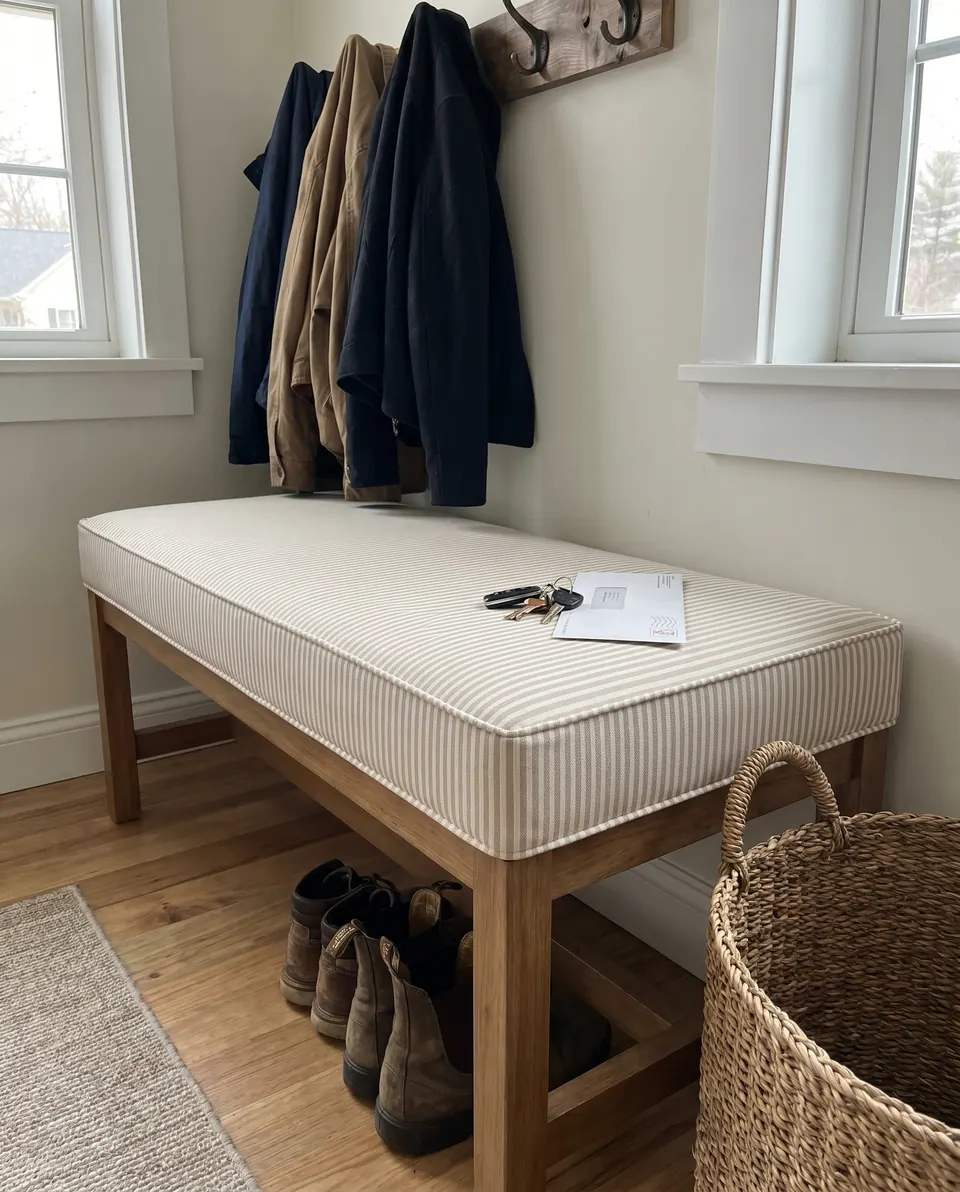
- keys and post
A padded top becomes the natural drop zone for keys, so a washable cover matters here.
- coats on iron hooks
Hooks right above the seat make it the place where coats and shoes come off.
- boots on the stretcher
The cushion covers only the top, leaving the lower rail free for boots.
- seagrass basket
A lidless basket beside the bench catches scarves and gloves.
- self-piped box edge
About 3 in thick, it pads the seat without hiding the oak frame.
- keys and postA padded top becomes the natural drop zone for keys, so a washable cover matters here.
- coats on iron hooksHooks right above the seat make it the place where coats and shoes come off.
- boots on the stretcherThe cushion covers only the top, leaving the lower rail free for boots.
- seagrass basketA lidless basket beside the bench catches scarves and gloves.
- self-piped box edgeAbout 3 in thick, it pads the seat without hiding the oak frame.
What's inside, from the core out
Start at the core. The workshop's seat foam is 32-density, about 2.0 lb/ft³ (32 kg/m³). That is firm enough to take someone landing on the front edge in a hurry, one boot on and one off, without the edge folding forward. My first soft entry seat, years ago, looked like a fallen soufflé by February.
Around the block goes a layer of polyester fiber, the Dacron wrap upholsterers mention. It rounds off the top so the first touch is soft even though the foam underneath is not. Firm core, soft skin. The foam firmness finder will tell you where your household lands.
Then the cover, and here's the part to underline, dear. It zips off. Cotton stripes mark more easily than a polyester linen-look or a velvet, so a pale stripe only makes sense on an entry bench if the cover comes off for an 86°F (30°C) wash. If a dog or wet-footed children come through daily, I'd put the same bench in a pet-friendly performance weave and save the pinstripe for a quieter hall.
So tell me honestly: how long does anyone in your house actually sit on the entry bench?
A reading nook, a wedge, and the foam confirmed in writing
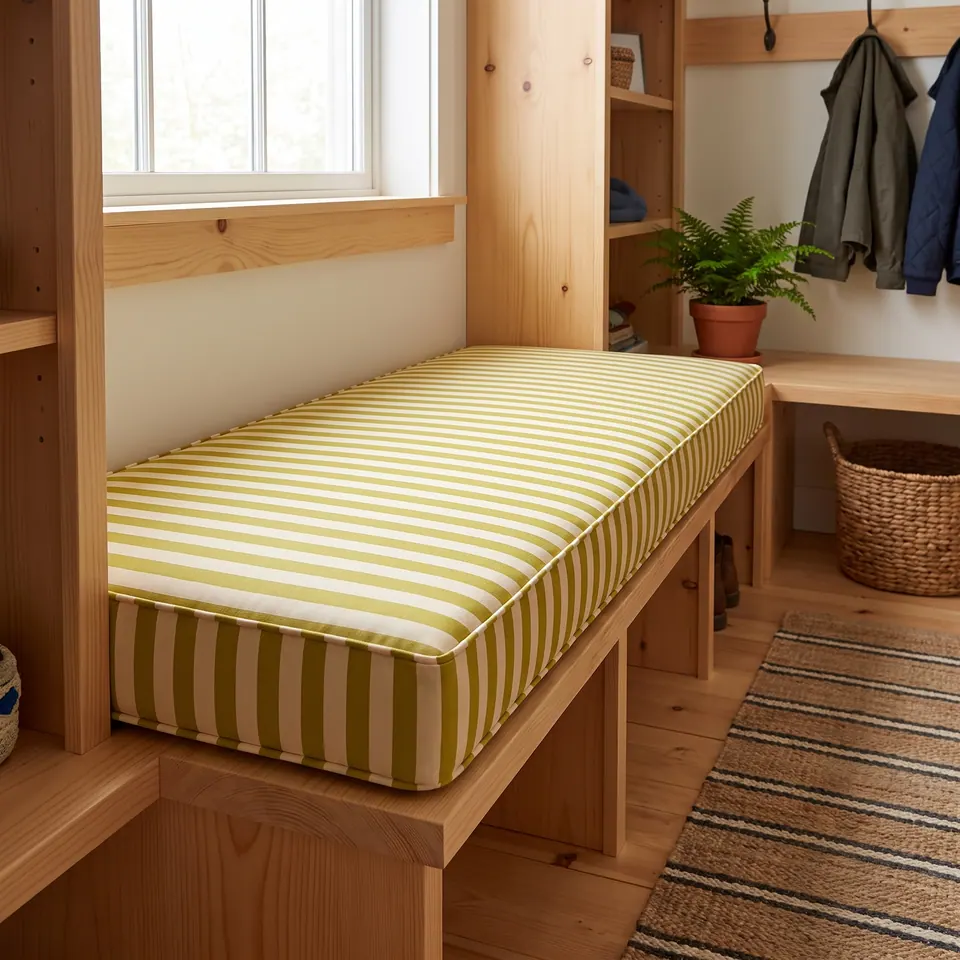
A buyer sent the workshop a marked-up photo of a reading nook. The seat cushion was to be 36 5/8 x 25 5/8 x 2 3/4 in (93 x 65 x 7 cm). Behind it went a wedge backrest 25 5/8 in (65 cm) wide, 27 1/2 in (70 cm) tall and 7 7/8 in (20 cm) deep at the base, both in fabric L-07 with piping.
Before anything was cut, the workshop confirmed the build: 32-density foam wrapped in polyester fiber, vacuum packing for the trip, and a production time of 5 to 10 business days.
The nook seat was slimmer than this mudroom bench, under 3 in; the wedge did the comfort work. Describe a wedge by width, height and depth at the base, add the thickness at the top, and nobody has to guess.
- Sizes
- Seat 36 5/8 x 25 5/8 x 2 3/4 in (93 x 65 x 7 cm); wedge 25 5/8 in wide, 27 1/2 in tall, 7 7/8 in at the base (65 x 70 x 20 cm)
The lesson: Specify a wedge by width, height, and its thickness at the base and at the top.
Buyer questions: wedges, wide seats and a long linen bench
- A common question
Can you make a reading nook seat cushion with a wedge-shaped backrest to go behind it?
The workshop's answerYes. For the wedge the workshop needs four numbers: width, height, and the thickness at the bottom and at the top. One nook set paired a 2 3/4 in (7 cm) seat with a wedge 27 1/2 in (70 cm) tall and 7 7/8 in (20 cm) at the base.
- A common question
My window seat is wider than a roll of fabric. Will I end up with a seam across the top?
The workshop's answerPossibly. Fabric rolls run to about 55 in (140 cm) wide at most, so a very large top or bottom panel may need a join. When one is needed it goes toward the back, or wherever it shows least, and some large pieces need no seam at all.
- A common question
What would a custom 18 x 68 1/4 in linen bench cushion run, and is there any give in the quote?
The workshop's answerEvery custom size is quoted on its own, and on that 18 x 68 1/4 in (46 x 173 cm) linen cushion the workshop did come down a little from its first figure. Custom quotes are written in US dollars.
On the cutting table: the entry bench
| Cushion | Rectangular bench cushion cut to the oak top, box edge |
|---|---|
| Fabric | Taupe pinstripe on cream cotton |
| Piping | Self piping in the same stripe |
| Thickness | About 3 in (7.5 cm) |
| Foam | 32-density seat foam, about 2.0 lb/ft³, in a polyester fiber wrap |
| Cover | Zippered, off for an 86°F (30°C) wash |
| Frame | Oak bench, lower rail left free for boots |
| Tougher option | Pet-friendly performance weave for wet paws |
| Best for | Mudroom and entry benches used for quick sits |

Have it made
Have this made — ask Maggie’s workshop
Numbers first, fabric second, piping last. Jot down what you have, and the workshop will go down the list with you, item by item. — Maggie
Leave your details and the workshop will call you to confirm measurements, fabric, foam and piping. No prices, dates or payment on this page: it is a request, not an order.
A mudroom bench cushion is a perch, not a sofa: about 3 in of firm foam keeps the front edge level while someone pulls on a boot.
Maggie
Questions buyers ask next
Is 32-density foam too firm for a boot bench in a mudroom?
Not for an entry seat. People perch on the front edge for a minute to pull boots on or off, and firm 32-density foam, about 2.0 lb/ft³, keeps that edge level. The polyester fiber wrap around it softens the first touch.
Why does a pale striped entry bench cushion need a zippered cover?
Because the top collects keys, mail, grocery bags and wet mittens. Cotton stripes mark more easily than polyester linen-look or velvet, so a cover that zips off for an 86°F (30°C) wash is what keeps a cream and taupe stripe practical.
Should a mudroom cushion also cover the lower rail where boots go?
No. Cushion the top only. On the oak bench in this Reading the lower rail stays bare so boots can sit on it, and the 3 in seat stops at the edge of the frame so the wood still shows.
Stitch straight — Maggie