The Cushion Atlas · Benches, window seats & banquettes
Window seat cushion ideas for every American house style
Every house style builds its window seat a little differently, and every one hides its own trap for the tape measure. Here are the trap, the thickness and the edge for ten of them.

- 7photographs
 Save
The quick answer
The best window seat cushion ideas start with the house: colonial ledges hide radiators, craftsman bays add short straight returns, Victorian bays need each slant and both diagonals, Cape Cod dormers need clearance for the opening sash, and ranch ledges run long and low. Standard thickness is 4 in (10 cm), with 2 to 3 in (5 to 7.5 cm) where a window or unit limits height.
Shapes to choose from
- Window seat261 readings
- Bay window43 readings
- Trapezoid18 readings
- Bench394 readings
- L-shaped48 readings
- Reading nook146 readings
Every one is cut to your measurements. The number is how many readings the atelier has published for that shape.
Sizes & measuring
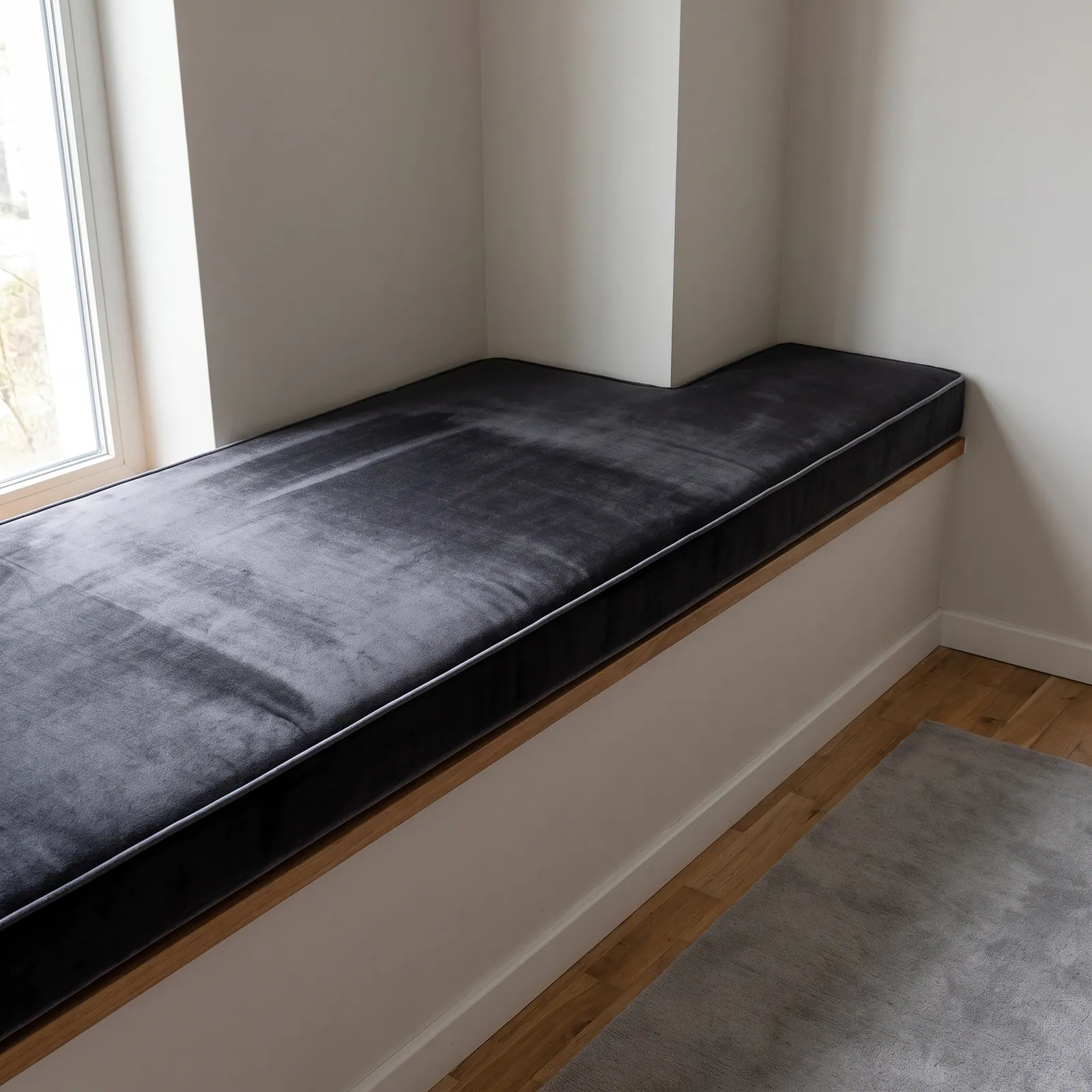
The old-house measuring kit
| Front edge | Wall to wall in a straight line, with a rigid tape |
|---|---|
| Back edge | Along the glass; often shorter than the front |
| Depth | Left and right, straight out from the back wall at 90° |
| Angled sides | Each one separately, corner to corner |
| Diagonals | Both, in any house old enough to have settled |
| Inside a frame | Wood to wood, not the outside of the bench |
| Obstacles | Casings, handles, radiators and columns: width, depth and distance from each end |
| Clearance | Seat to the lowest point of the open sash or handle |
| Thickness | 2, 3, 4 or 5 in (5, 7.5, 10 or 12.5 cm); 4 in is standard |
Fabrics that work
- Linen & Cotton-LinenNatural fibers, relaxed hand
- Striped Cotton & TickingCotton stripes and ticking
- VelvetDense pile, deep color
- CorduroySoft ribs, cozy hand
- Bouclé & TeddyLooped, cloud-soft texture
- Outdoor Acrylic & Solution-DyedMade for sun and weather
Open a family for its swatch book, care notes and neighbors.
Why old-house window seats are rarely square
A corner window seat in a 120-year-old house took three rounds of the tape before its drawing closed within 1/4 in (6 mm). Nobody measured badly. The corner simply wasn't square, and old houses rarely are.
That's the use of window seat cushion ideas sorted by house style: each style builds its seat a particular way and hides a particular trap. Colonials hide radiators. Bungalows add short returns before the angle. Dormers swing the window over your knees. Know the trap and the tape work is ordinary.
Below are ten American house styles, each with its typical seat, its trap, a thickness, an edge and a link to the full Concept Sketch. Plain rectangles live under window seat cushions, and the tape work is in measuring a window seat. Which style is your house, dear, and which seat is giving you trouble?
10 house styles and their window seat cushions
| Style | Typical seat | The trap | Thickness | Edge |
|---|---|---|---|---|
| Colonial | Long ledge under many-paned windows | A radiator underneath; odd lengths | 4 in (10 cm); 3 in (7.5 cm) for a neater line | Self piping in ticking or linen |
| Craftsman bungalow | Shallow bay between bookcases | Short straight returns before the angles | 4 in (10 cm) | Contrast piping to trace the facets |
| Brownstone | Seat inside a deep masonry reveal | A window unit or tight gap limiting height | 2 to 3 in (5 to 7.5 cm) if limited | Velvet piping on linen |
| Cape Cod dormer | Seat between two side walls | The handle and the opening sash | 2 in (5 cm) or more, under the sash | Handles drawn as cut-outs |
| Victorian bay | Three-sided bay with angled cheeks | Cheeks that aren't equal | 4 in (10 cm) | Plain, with bolsters on the cheeks |
| Mid-century ranch | Long, low ledge under ribbon windows | Lengths past the menu; creeping over the edge | 2 to 3 in (5 to 7.5 cm) | Plain box |
| Modern farmhouse | Built-in against shiplap and painted cabinets | Choosing color on a screen | 3 to 6 in (7.5 to 15 cm) | Self piping, or cream on green |
| Curved or bow window | An arc, or facets with no corner | A curve given as one number | 2 to 3 in (5 to 8 cm) on curved benches | Matching piping is more forgiving |
| Spanish Revival | Plaster niche or concrete banco | Plaster that bows; arched ends | 4 in (10 cm) seats, slimmer backs | Outdoor fabric where the banco is outside |
| Beach house | Shiplap nook or bench with lift-up lids | Sandy feet, damp air, hinged lids | 3 in (7.5 cm), split at the lid lines | Stripes run front to back by default |
Colonials, Capes, brownstones and Victorian bays
Colonial. Long ledges, and a radiator under half of them. Split the cushion: a 106 in (269 cm) ledge over a radiator became two 53 in (135 cm) pieces, so heat escapes and each lifts out. Measure the bench, not the cushion you used to have; I learned that one the embarrassing way. See colonial window seats.
Cape Cod dormer. The window gets a vote, so open it and measure. A 21 in (53 cm) deep seat was cut to 16 in (41 cm) because the handle swung into it. A casing overhanging by 0.75 in (1.9 cm) got a notch 96.25 in (244.5 cm) long on a 109.25 in (277.5 cm) seat instead of a shallower cushion. See dormer window seats and notches around casings.
Brownstone. Deep masonry reveals, often a window unit nearby. Two sills in one apartment stayed at 2 in (5 cm) because a unit set the height, and the window seat thickness Pattern explains the trade. Photos taken at an angle make rectangles look like trapezoids, so measure both edges. See brownstone window seats.
Victorian bay. A buyer wrote both cheeks as 43.25 in, the same as the front. Re-measured, they were 21.25 in and 20.75 in (54 and 53 cm). See Victorian bays.
Bungalows, ranches, farmhouses, curves, bancos and beach houses
Craftsman bungalow. A short straight return at each end of the bay can move a slant by more than an inch. One bay written with 31 in slants only closed at 32.5 in (83 cm), and the re-measure agreed. See craftsman bungalow seats.
Mid-century ranch. Long, low and a hair under the ledge. A 16 x 105 in (41 x 267 cm) seat was made in two halves that sit end to end. See mid-century window seats.
Modern farmhouse. White shiplap shows every color at full strength, so hold swatches against the cabinets in morning and evening light. See farmhouse window seats.
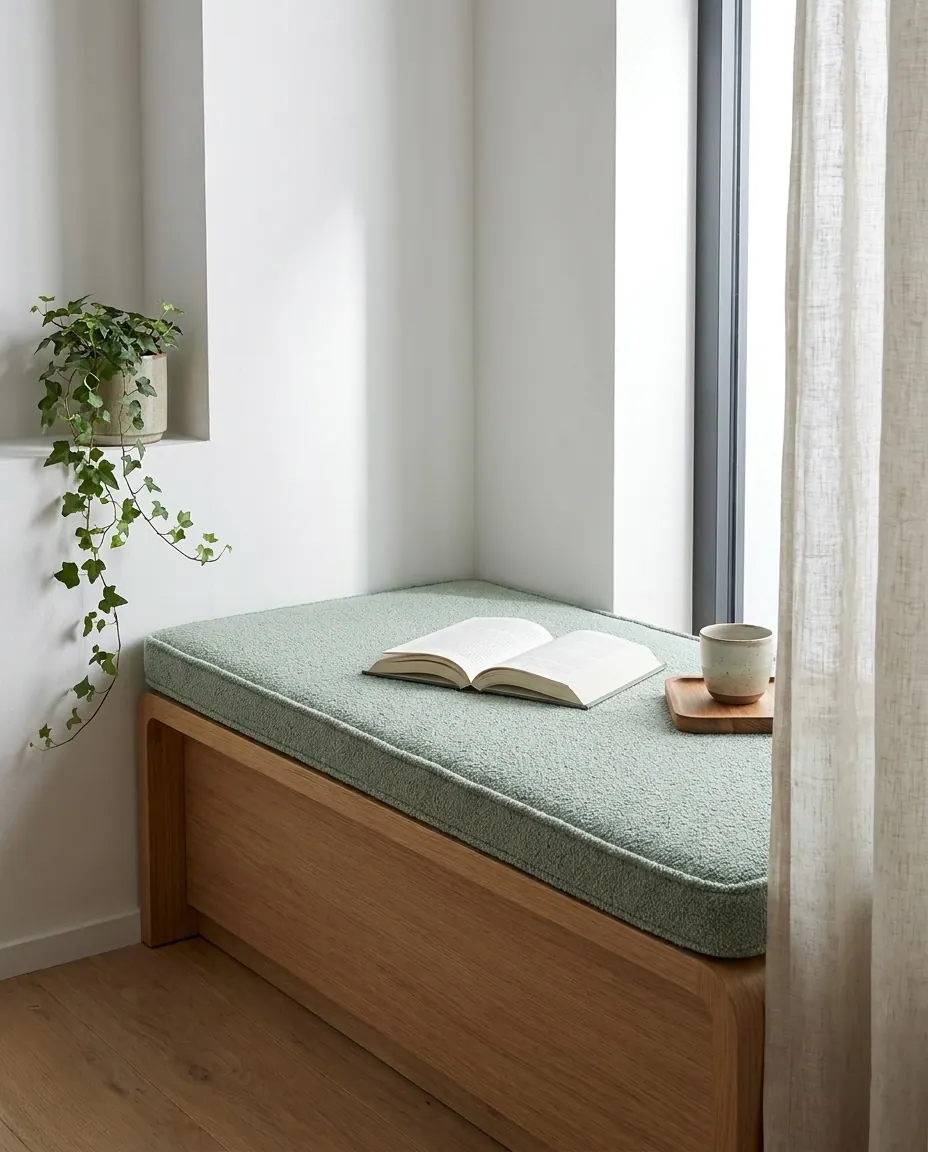
Curved or bow window. A curve isn't read from numbers alone: mark where it starts, where it ends and how deep it runs, or send a paper template. A smooth round bay was declined as too pronounced to fit from a distance. The sage seat in the gallery follows its oak built-in's rounded corner. See curved and bow windows.
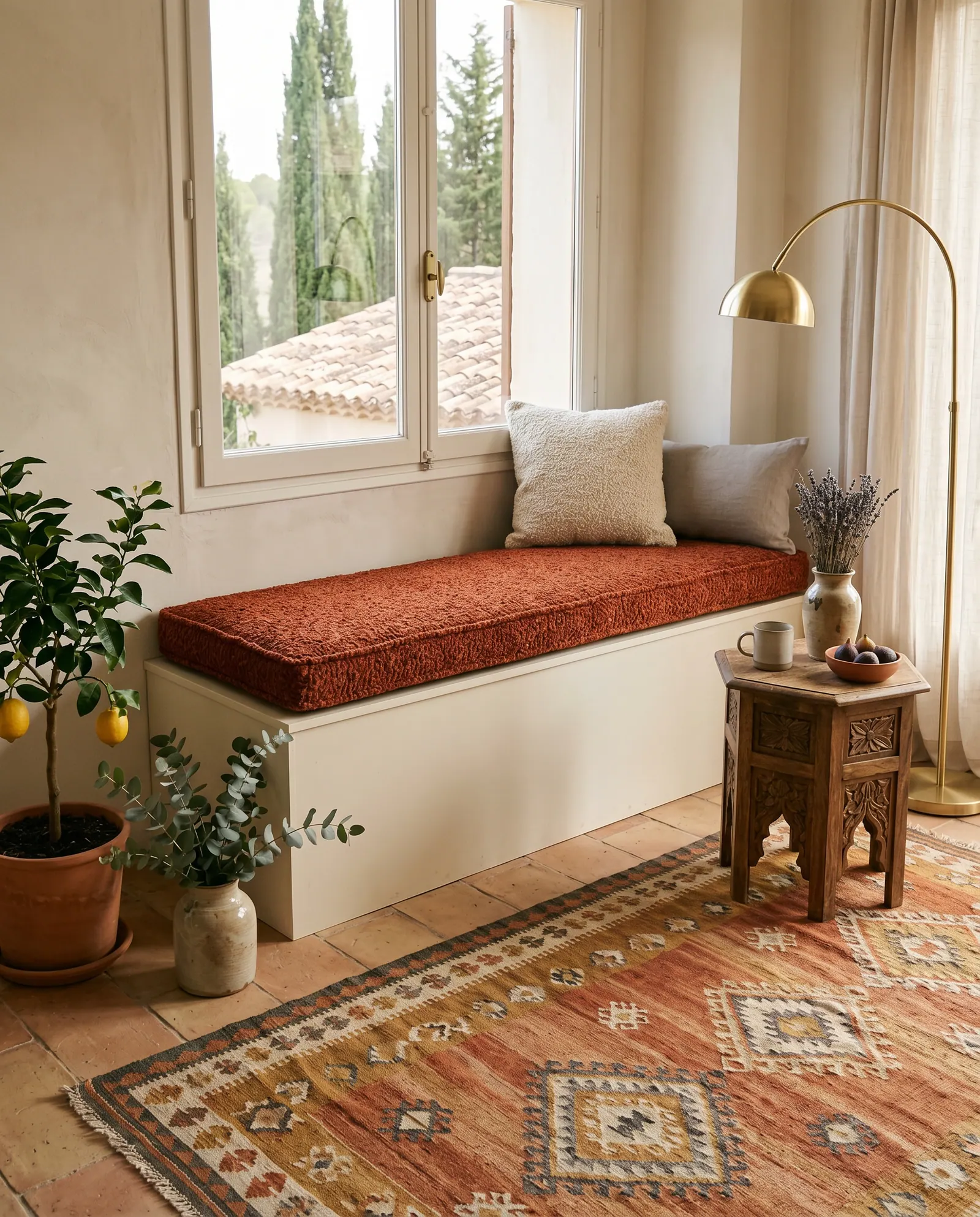
Spanish Revival. Plaster rarely runs straight, so take the depth at both ends and the middle, and trace arched ends. The rust bouclé seat in the gallery sits on a white plinth above terracotta tile. See Spanish Revival bancos.
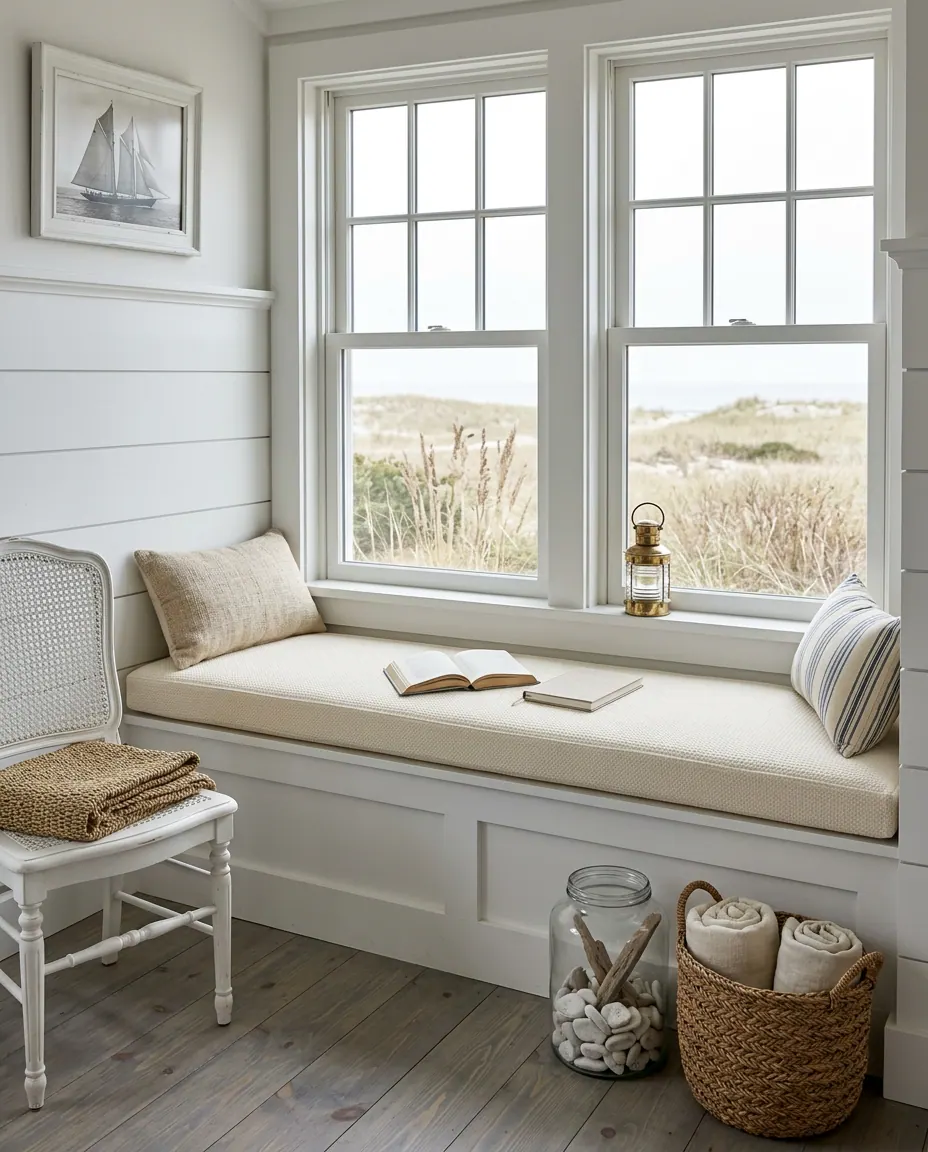
Beach house. Sandy feet and damp air want zip-off covers that wash at 86°F (30°C), and benches with lift-up lids take cushions split at the lid lines. The ivory shiplap nook in the lead photo faces the dunes. See beach house window seats.
Three rounds of the tape in a 120-year-old house
A buyer wrote to the workshop about a corner window seat in a 120-year-old house, notched for a window column and notched again where the trim overhung the seat. The drawing arrived tidy. It didn't close.
So before anything was cut, the workshop asked for re-measurements and both diagonals. It took three rounds. Then the buyer found the answer in the corner itself: it wasn't a true right angle. With the depths set at 18.75 in (47.6 cm) and 19 in (48.3 cm), everything closed within 1/4 in (6 mm), and the set shipped together on 2 in (5 cm) foam.
Three rounds sounds tedious. It is cheaper than one remake. At a true 90°, sides of 50.9 and 50.75 in give a diagonal of about 71.9 in; this corner read 71.125 in, tighter than square.
- Measured
- Seat depths 18.75 in and 19 in; closed within 1/4 in; 2 in foam
- What it taught
- In an old house, measure both diagonals and let each seat's depth follow the real walls.
Photographs from the workbench
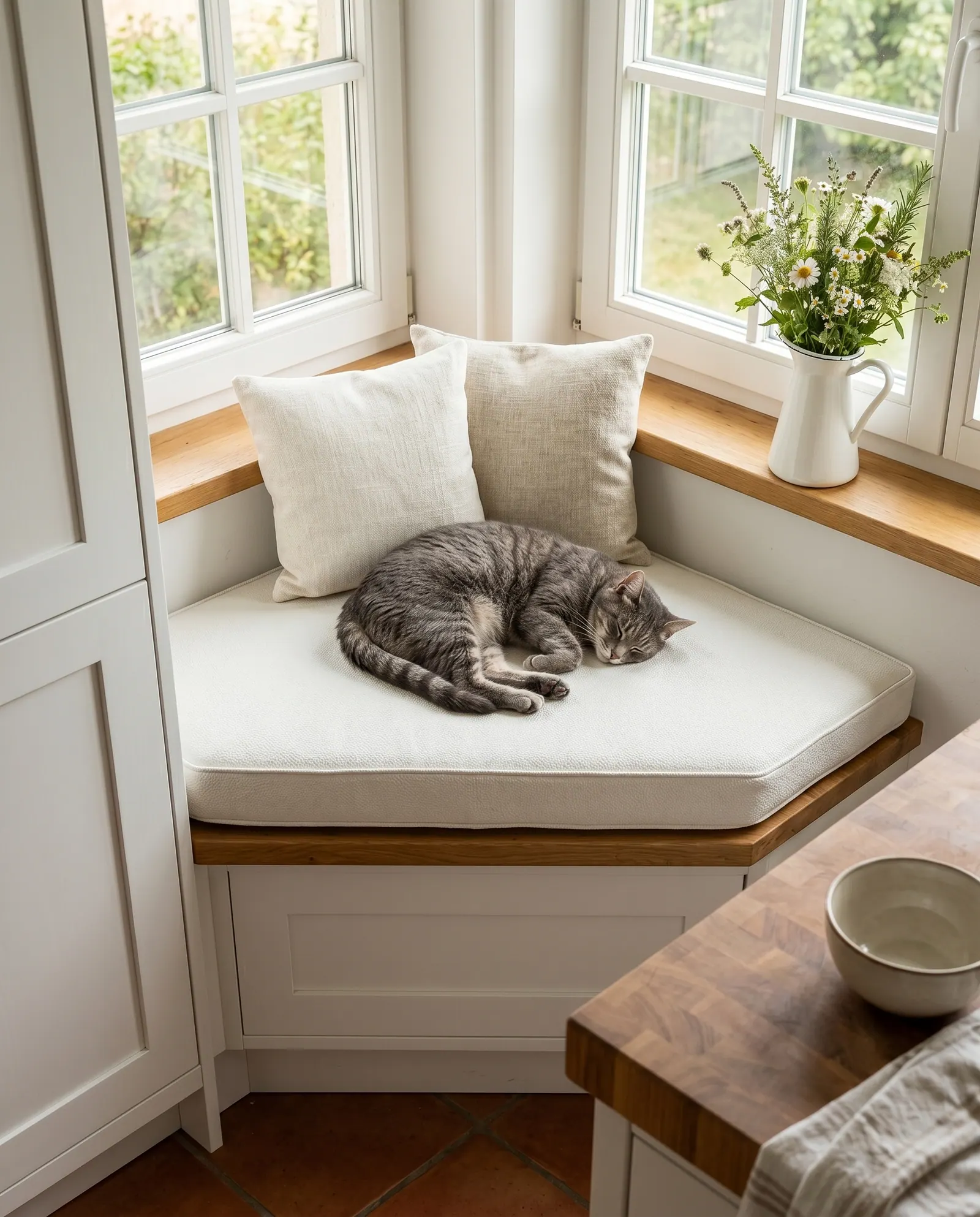
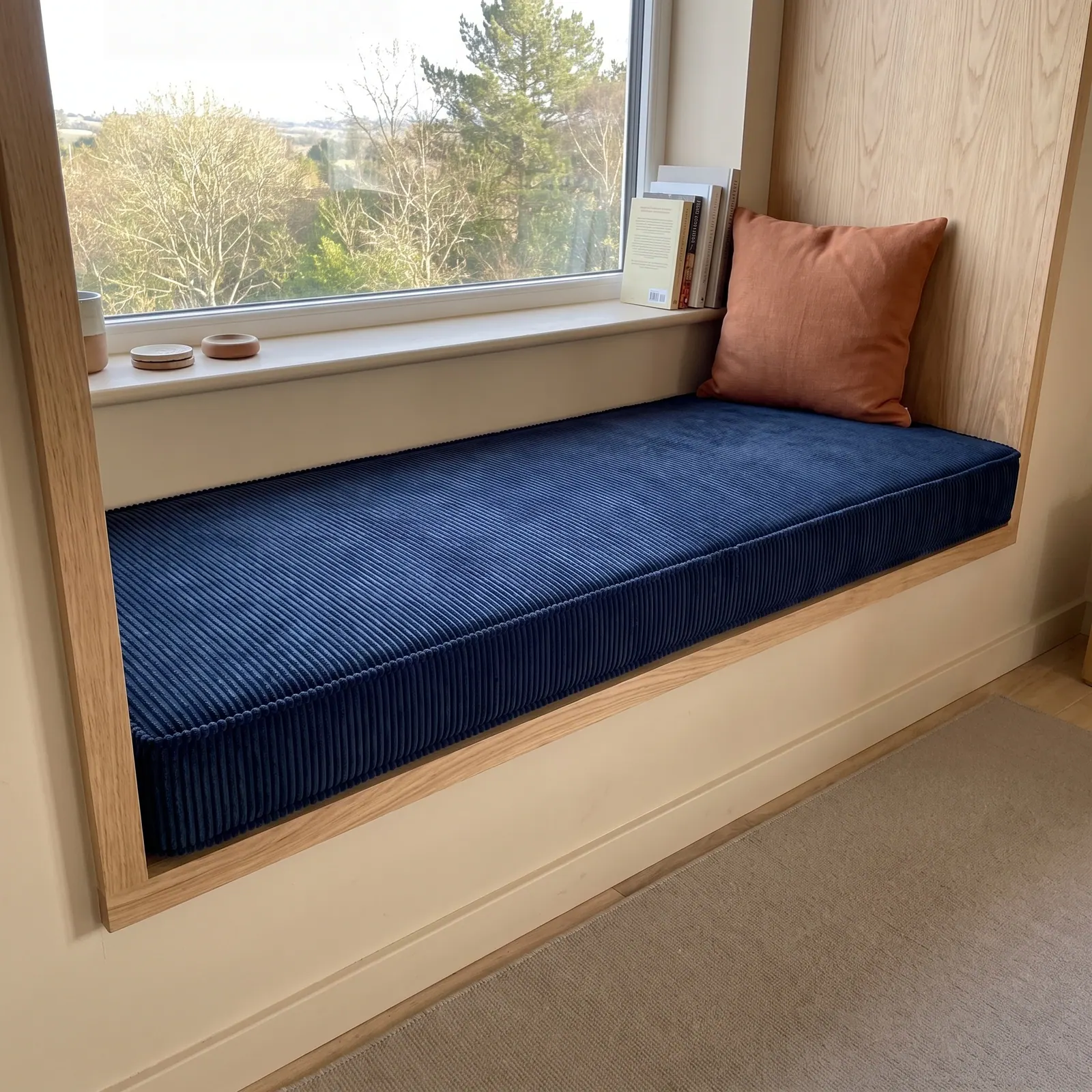
Open any photograph large; each one has its own link and a Save button.
 Save
 Save
 Save
 Save
 Save
 Save
Window seat mistakes I've made or watched
- Writing one number for both cheeks of a bay. They're rarely equal.
- Measuring with the window shut. Open the sash and check the handle.
- Covering a radiator with one long cushion. Split it so heat escapes.
- Shrinking the whole cushion to clear a casing. Notch the back edge instead.
- Ordering an angled seat on the rectangle listing. It gets cancelled and redone with a drawing.
- Measuring a vacuum-packed cushion straight out of the bag. Give the foam 3 to 4 days, then measure.
- Opening the wrap with a sharp knife. On a 154.5 in (392 cm) seat made as two 77.25 in (196 cm) cushions, the blade went through the covers. Cut only the outer plastic.
Window seat cushion ideas start with the house: learn your style's trap, measure every edge and both diagonals, and let the drawing close before anything is cut.
Maggie
Window seat questions
- A common question
What should I measure on our built-in window seat before I order?
The workshop's answerMeasure the seat surface itself with a rigid tape, not the floor, since the two can differ. Take the front edge wall to wall, the back edge along the window, which is often shorter, the depth on both left and right, and each side separately if the walls are angled. Inside a bench frame, measure wood to wood. Send a top-view sketch with a photo; the workshop checks the numbers and confirms the shape.
- A common question
My bay seat has angled ends. Which listing do I order it on?
The workshop's answerThe trapezoid, or custom-shape, listing, not the rectangle one. Choose the size by the depth and overall length, then upload a drawing with every edge, any cut-ins and the depth, plus a photo of the seat; a hand sketch is fine. Asymmetric bays can be traced onto a paper template. An angled shape ordered as a rectangle is cancelled and refunded so you can reorder correctly.
- A common question
Can you make a cushion for an odd nook, like a six-sided seat or one with cut-outs?
The workshop's answerYes: six-sided window seats, stepped benches, curved breakfast nooks, rounded-end benches and seats with L-shaped cut-outs have all been made. Draw the shape with every side measured, including rounded corners, joints and cut-outs such as an indent around an air conditioner, and send a photo of the drawing and the space. The workshop redraws it as a clean diagram to confirm before quoting.
- A common question
What thickness do most people pick for a window seat?
The workshop's answerMost buyers choose 3 or 4 in. 4 in (10 cm) is the standard and the pick for everyday seating and a tailored built-in look; 3 in (7.5 cm) gives a trimmer profile for tight spots, such as a 15 in (38 cm) gap under a windowsill. The firm 32-density foam keeps even 2 to 2.5 in supportive, and the 2, 3, 4 and 5 in options cost the same.
- A common question
Our built-in has a curved end. What do you need from me to cut it?
The workshop's answerA measured sketch that marks where the curve starts and ends and how deep it runs, with the total width and depth and the straight length of each edge before the curve. For a tricky curve, lay wrapping paper on the seat, trace it, cut it out and photograph it flat beside a tape measure. Each cushion gets its own drawing; an arched seat can be drawn as a rectangle plus an arc.

Have it made
Have your window seat cushion ideas made — ask Maggie’s workshop
I once cut a lovely cushion two inches short, and I have not forgotten it. That is why the workshop goes over your measurements with you on the phone. — Maggie
Leave your details and the workshop will call you to confirm measurements, fabric, foam and piping. No prices, dates or payment on this page: it is a request, not an order.
Old-house window seat questions, answered
How much room should a window seat cushion leave below the window?
Measure from the bare seat to the lowest thing above it: the sill, the trim, or the handle of a window that opens inward. One published window-seat guide suggests keeping the seat top at least 6 in (15 cm) below the window's bottom edge. The thinnest standard cushion here is 2 in (5 cm).
Can I add a back cushion to my window seat later and have it match?
Yes. Quote the fabric code from your first order. Standard backs are about 16 in (40 cm) tall and 4 in (10 cm) thick, measured from the top of the seat cushion and made the length of the seat; one buyer added a slimmer window-seat back 90 in long, 11 in high and 3 in deep.
Which fabric suits a bay that gets full afternoon sun?
A sun-resistant one. For a black cushion about 160 in (406 cm) long in a sunny trapezoid bay, the workshop confirmed it stocks sun-resistant fabrics and suggested two pieces for the length. For windows that sweat in winter, velvet or the soft fabric wipes clean, though neither keeps water out.
Does piping suit a period house, or is a plain edge better?
Either, depending on the line you want. Self piping cut from the same ticking or linen keeps a quiet period look, contrast piping traces every facet of a bay, and a plain edge suits a clean mid-century ledge. Piping comes at no extra charge, matching or contrast.
Stitch straight — Maggie
The Pattern Room