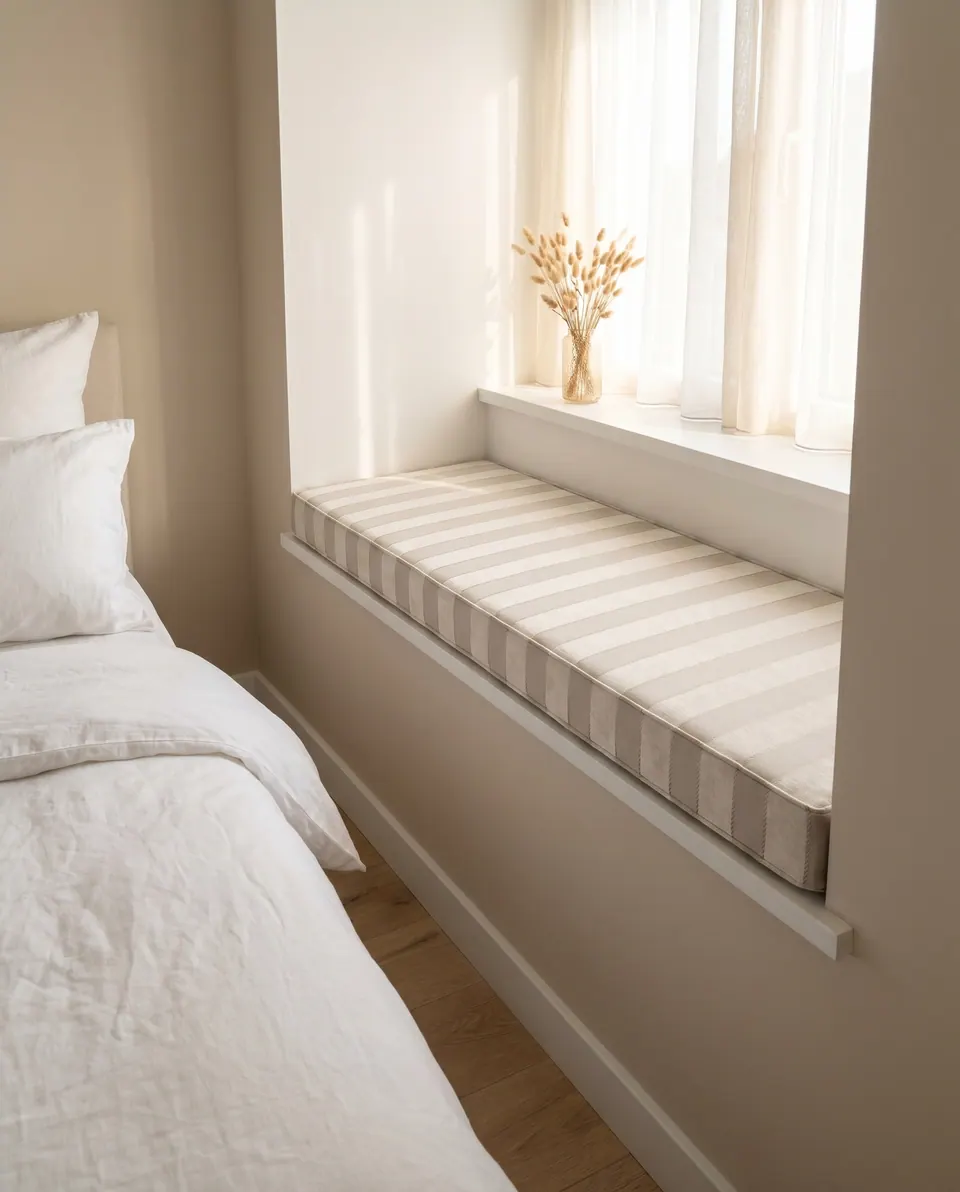
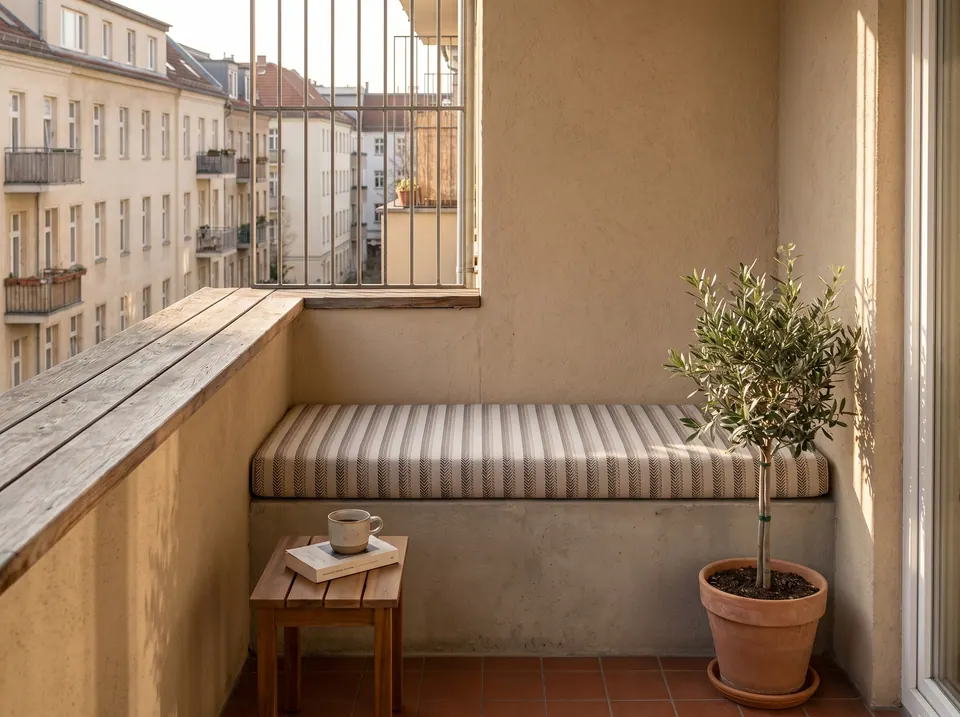
Concept Sketches · 7 scenes
Cushions for plaster niches, arched windows and adobe bancos
Thick walls make deep seats, and deep seats are never quite square. Seven built-ins from past orders, measured the way the wall really runs.
 Save
The quick answer
A banco cushion is cut to a built-in bench of adobe, plaster or concrete, so measure the seat itself at the front, the back and the middle, because plaster walls bow. Trace arched or rounded ends on paper. Use 3 to 4 in (7.5 to 10 cm) of foam, and outdoor fabric wherever rain or patio sun reaches the seat.
Thick walls, deep seats, no square corners
Plaster goes on by hand and gets troweled by eye. The seat it makes won't be square, so your cushion shouldn't pretend to be.
A banco cushion sits on a bench that is part of the house. In Pueblo Revival homes the banco is a solid built-in bench, often plastered, set by a kiva fireplace or run along a garden wall. Spanish Revival houses in California sink window seats into thick stucco walls under arches. Out back, the built-ins turn to concrete.
These seven are past orders, sizes included. They close the series on window seat cushions by house style; climate notes live on Arizona and the Southwest and California. What is yours made of, friend: adobe, plaster over block, or poured concrete?
Seven built-in seats and what each one needed
 Save
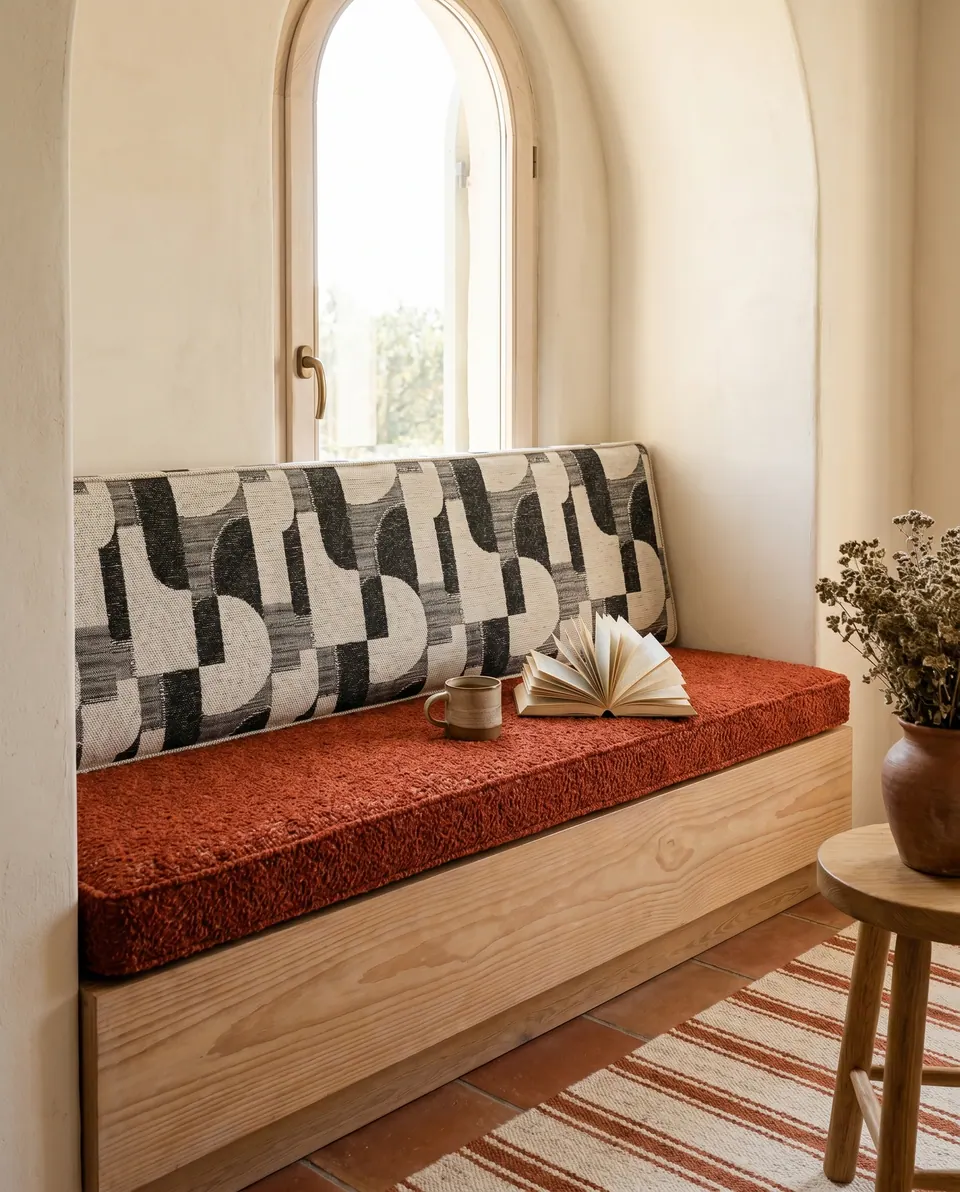
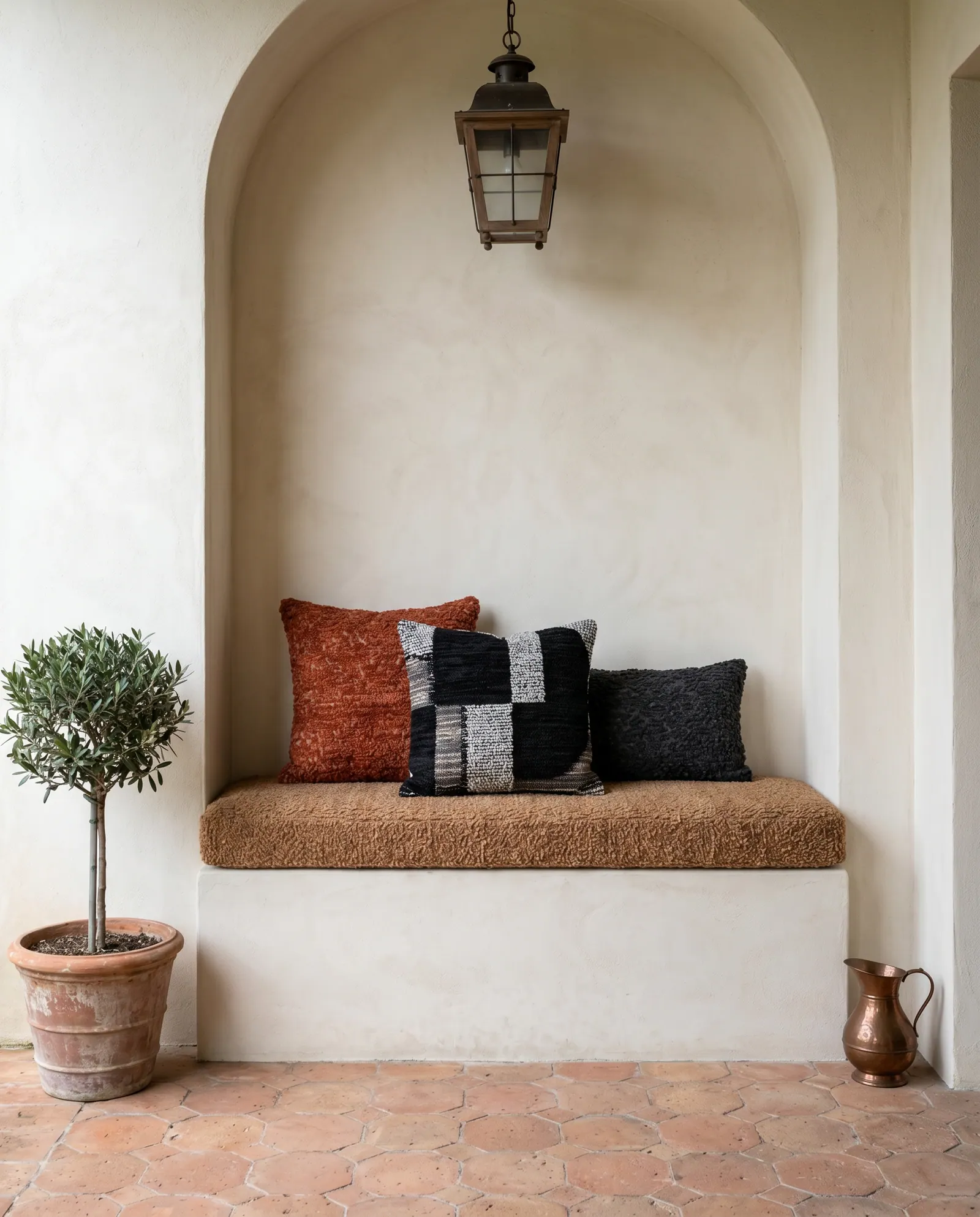
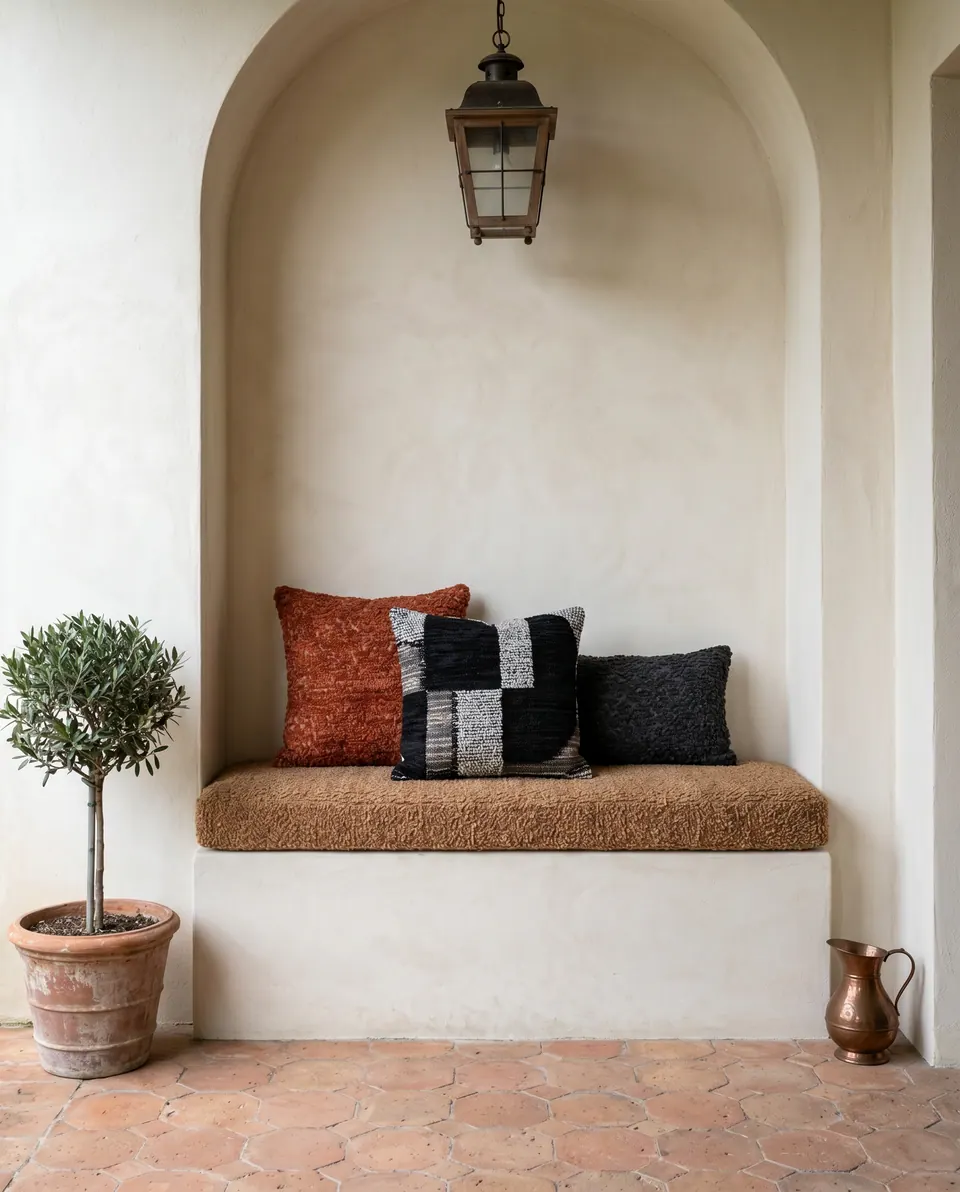
Caramel boucle cushion on a built-in masonry bench in an arched plaster niche 01A past project
A couch poured into the wall
A buyer got in touch with a built-in concrete sofa and nothing soft on it. The quote covered the whole thing: three seats of about 23.5 x 27.5 x 4 in (60 x 70 x 10 cm), a back cushion about 83 x 14 x 2 in (211 x 35 x 5 cm), and two cylinder arms 23.5 in (60 cm) long. They wanted a light green, so the workshop sent daylight photos of mint and beige, noted the small shifts between them, and followed with the linen charts.
The takeaway: Concrete has no give and no frame. Quote seats, back and arms as one set, in one fabric.
 Save
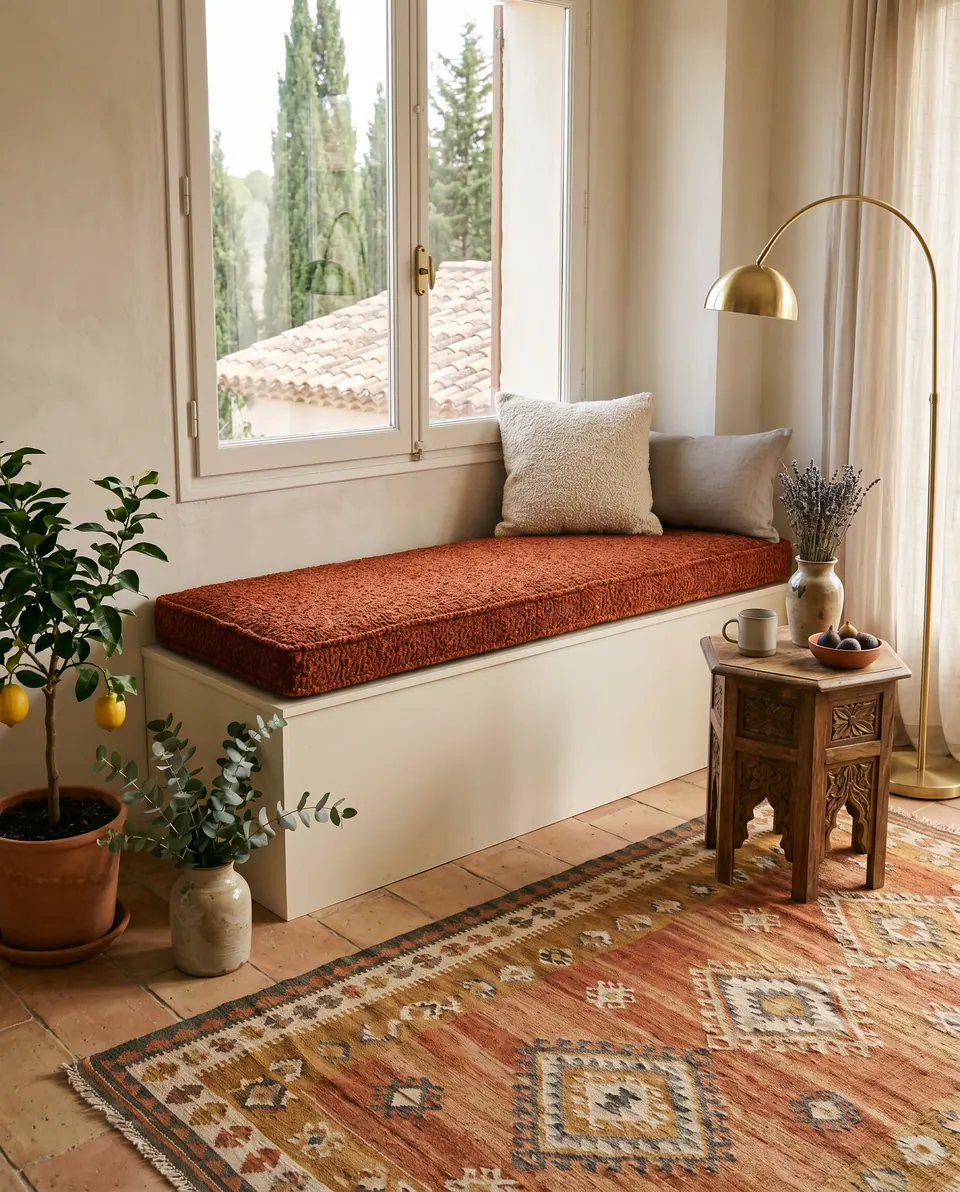
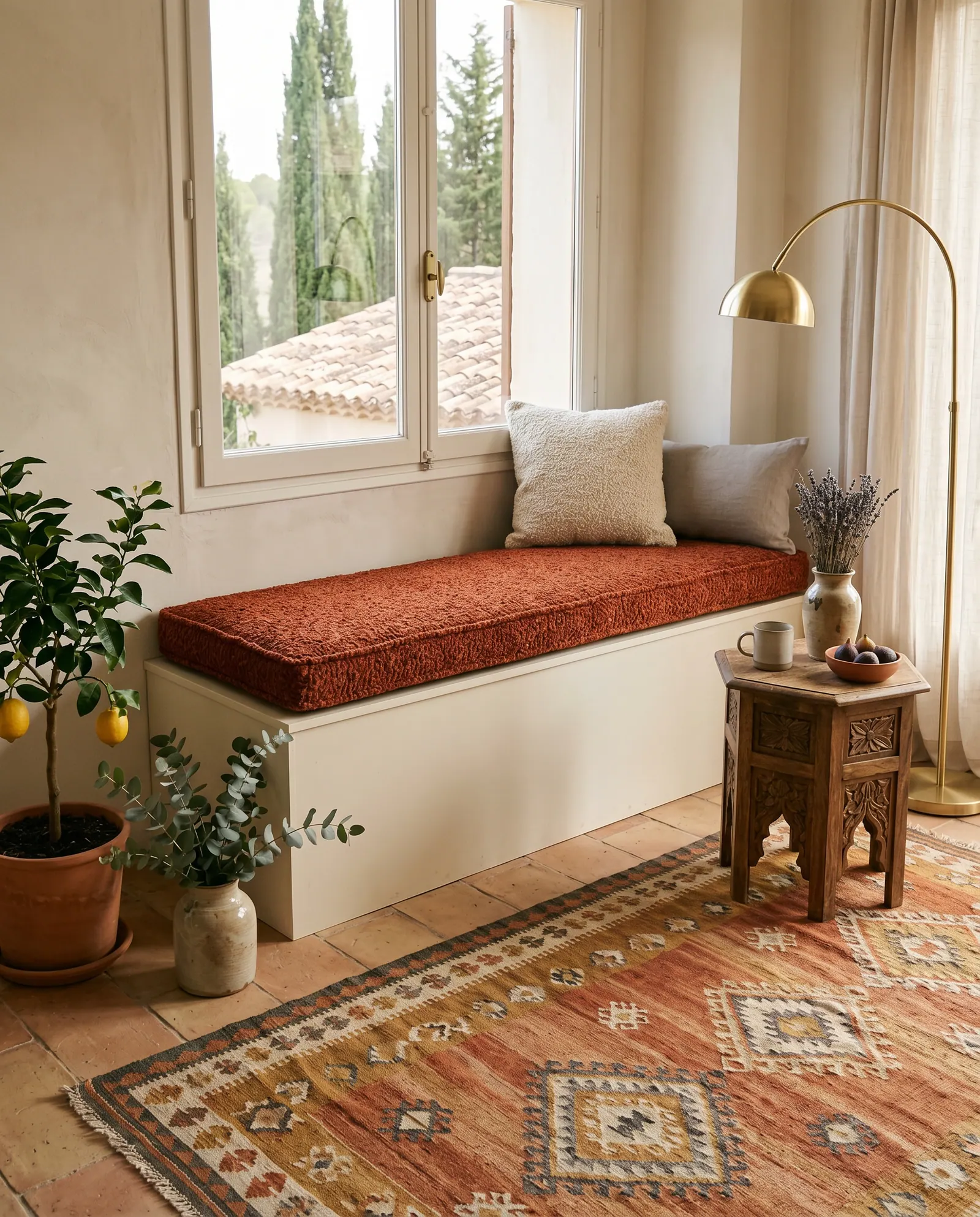
Rust boucle window seat on a white plaster plinth above a terracotta tile floor 02A past project
Two built-ins that only looked alike
A family in the US built two benches into their kitchen as a place to lounge: 55.5 x 27 in (141 x 69 cm) and 56.25 x 27 in (143 x 69 cm). Same builders, same room, three quarters of an inch apart. The workshop quoted the seats alone and full sets with backs and arms, and asked for the color.
The takeaway: Measure every built-in on its own, to the quarter inch, even when two look identical.
 Save
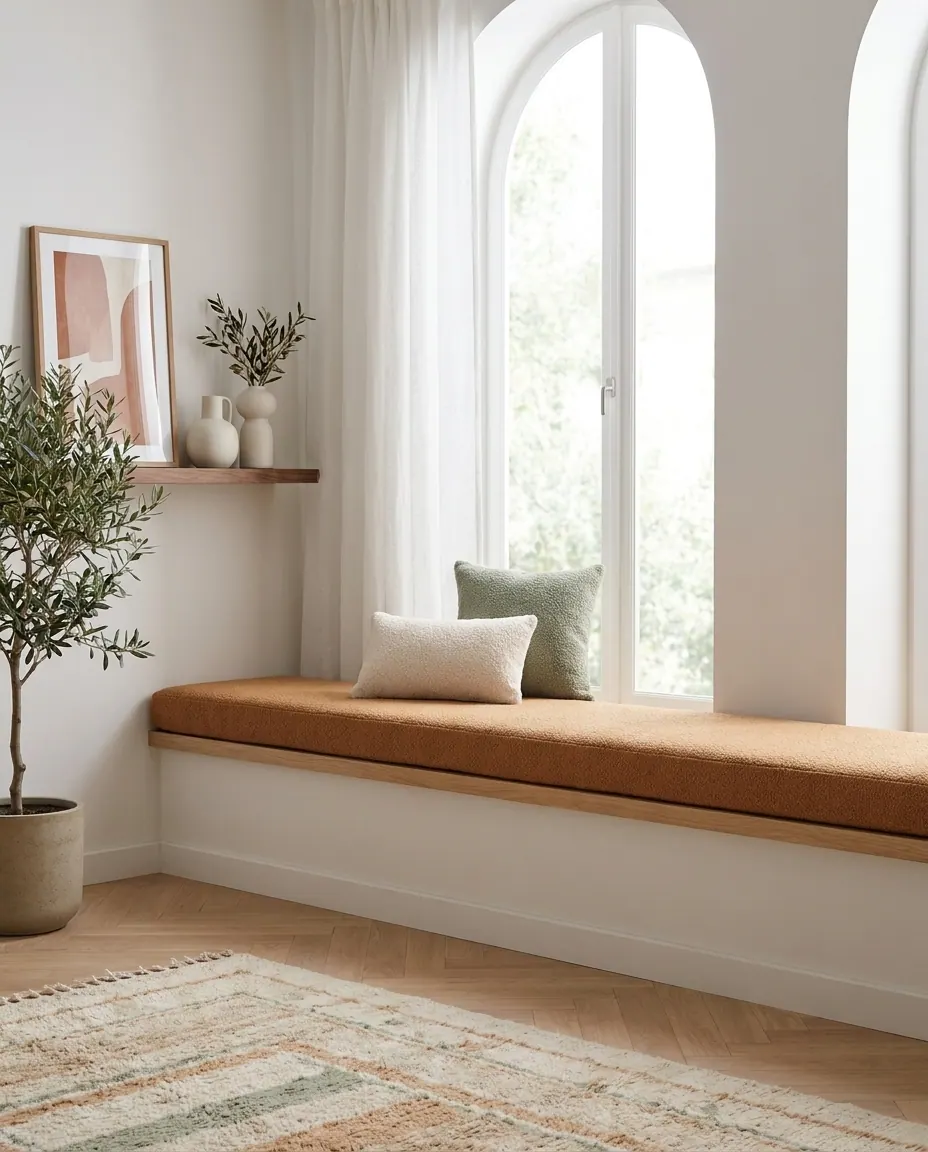
Caramel boucle cushion on a long white window bench beneath tall arched windows 03A past project
154.5 inches under the windows, in two halves
A buyer in the US had a window seat 154.5 in long and 22 in deep (392 x 56 cm). The workshop split it into two identical 77.25 x 22 in (196 x 56 cm) cushions, ordered on the nearest menu size with the exact figures in the note. They fit. The trouble came at unpacking: the cushions arrive tightly shrink-wrapped, and the knife that opened them cut the covers. The workshop offered new covers at cost.
The takeaway: Split a long window seat into equal halves, and cut only the outer plastic when you open the pack.
 Save
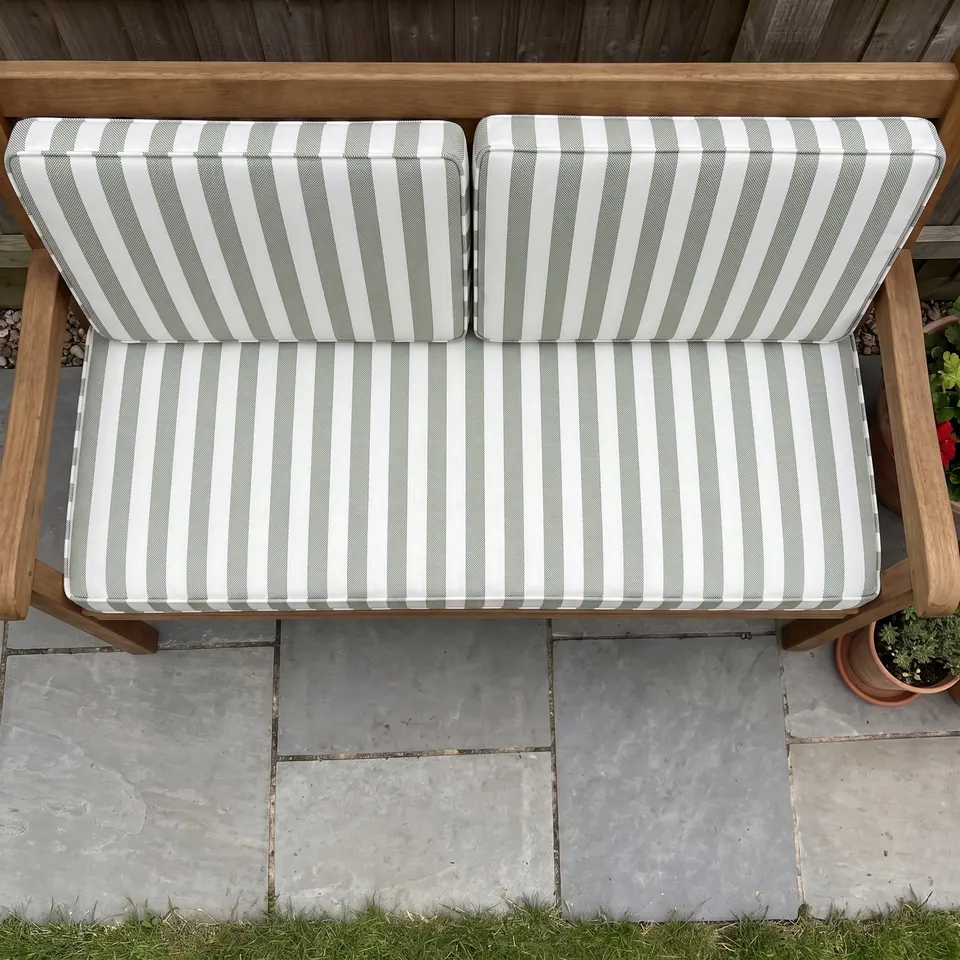
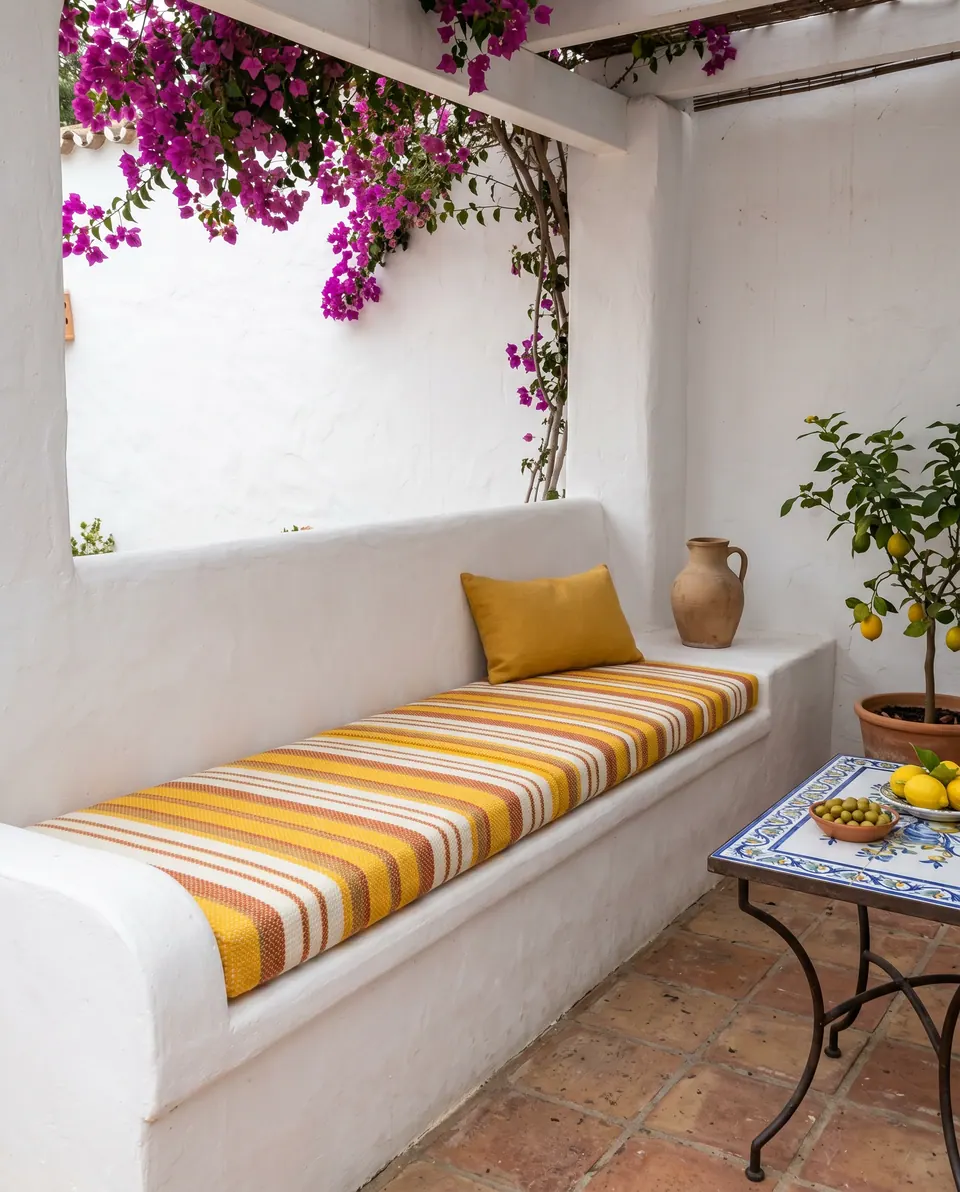
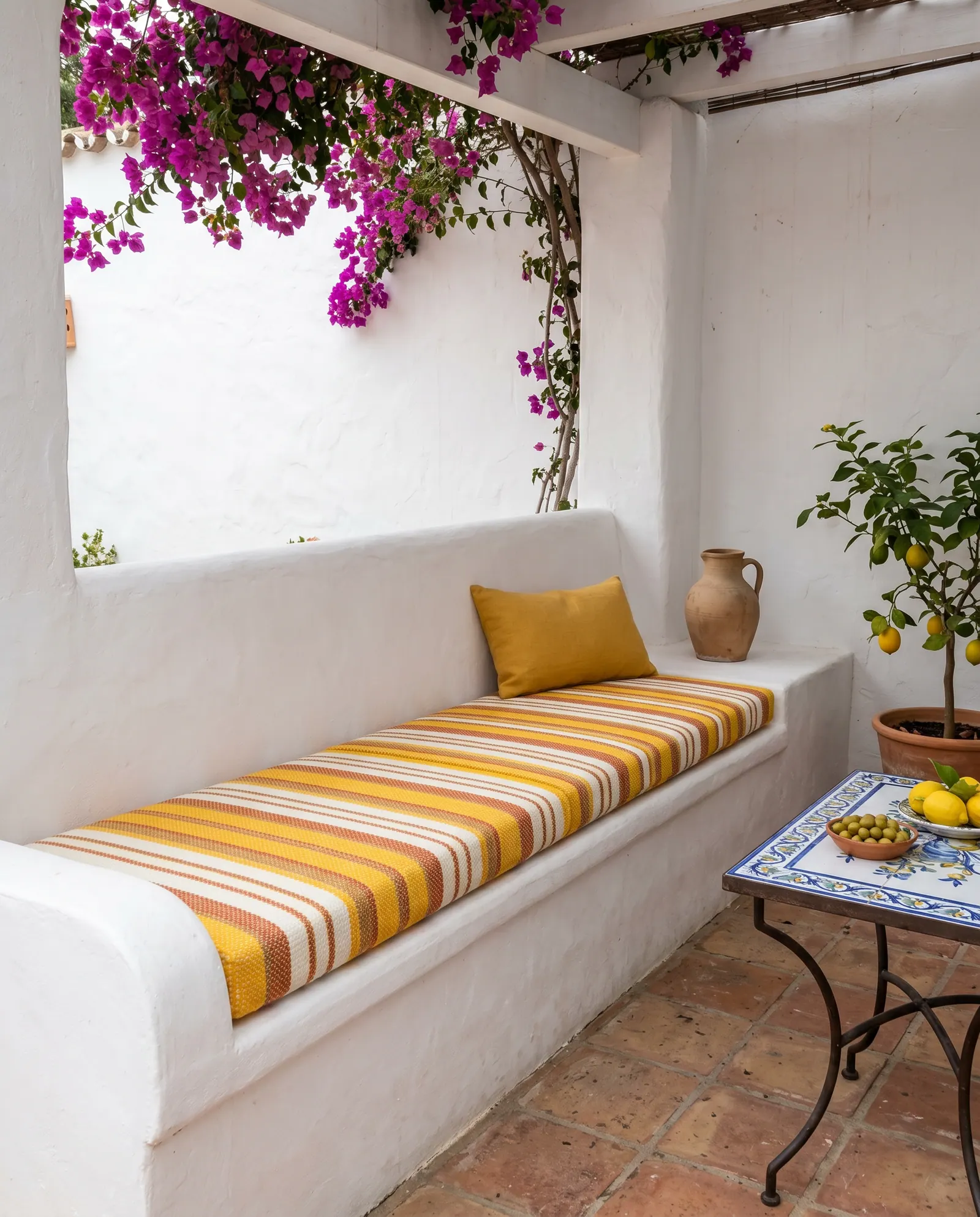
Saffron and rust striped outdoor cushion on a whitewashed masonry bench 04A past project
A concrete L by the fire pit, in stripes
Around one fire pit in the US the seat is a concrete L, 18 in (46 cm) deep. The owner sent a diagram and photos, picked a striped outdoor cloth, and ordered seats without backs, piped in a solid chosen to match the gray in the stripe. The workshop's craftsmen cut the L as two cushions meeting at the corner rather than one bent piece: a snugger fit, and covers that unzip without a fight. The word that came back was perfect.
The takeaway: Seat an L-shaped masonry bench in two cushions that butt at the corner.
Pattern sheet Lay paper on the seat and trace the edge, write the widest width and the front-to-back depth on the template, then photograph it flat from directly above with a tape measure in the picture. 05A past project
An arched seat drawn as a box and a slice
Buyers write to the workshop about benches with a rounded end and window seats that bow out under an arch. The workshop won't guess a curve from numbers alone. One arched window seat was drawn as a rectangle plus an arc of a circle: the straight part measured as usual, the arc given by where it starts, where it ends and how deep it runs. Trickier curves get a paper template.
The takeaway: Mark where each curve starts and ends and how deep it goes, or send a paper template.
Pattern sheet Front, back and depth fix the shape; the slanted sides follow from them. 06A past project
A window seat with one square corner
One buyer wrote in with a window seat measured as a long side of 47 3/4 in (121.5 cm), a short side of 37 in (94 cm) and a depth of 16 in (41 cm). Those three numbers don't close into a shape on their own, so the workshop asked for a sketch. It showed one corner at 90 degrees, and from that the workshop could draw the slanted side. The zipper went on the long side.
The takeaway: Mark every right angle and every obstruction on the sketch. Three numbers don't make a four-sided seat.
Pattern sheet Plan: the cushion fills the inside of the frame, 35.75 by 17 in, measured wood to wood. Front view: 3 in thick. 07A past project
A 15 in niche and a seat at 18
A buyer in the US had a bench niche 17 x 35.75 in (43 x 91 cm), 15 in (38 cm) off the floor, and wanted to sit at 18 in (46 cm). That settled the thickness at 3 in (7.5 cm). The workshop told them to choose the 17 in width, 36 in length and 3 in thickness from the menu and write the exact size in the note.
The takeaway: Work back from the seat height you want to the thickness you order. The seat height calculator does the sum.
Stone keeps the weather longer than you do
Masonry soaks up the afternoon sun and gives it back after dark. After a storm a slab can stay damp under a cushion long after the top looks dry. Rain doesn't negotiate, and concrete holds a grudge.
Give a masonry seat air. Stand outdoor cushions on edge after rain and bring them in when a storm is coming; in Arizona the monsoon season runs June 15 to September 30, when dust and sudden downpours arrive together. Mesh drainage bottoms aren't standard, so ask the workshop if your seat never dries.
The dry Southwest is kind to indoor linen and cotton, and mildew is rare there; on the California coast, fog and marine damp count for more than heat. One curved stone bench around a fire pit in the US was measured with a string, 245 in (622 cm) along the outer curve, and made in four matching segments. Fire pit bench cushions has the rest.
Where your banco sits, and what goes on it
Find the row that matches your seat. Outdoor fabric covers the wet rows, the fading Pattern covers sun through deep glass, and outdoor cushions has the rest.
| The seat | What reaches it | What we'd put on it |
|---|---|---|
| Window seat in a thick plaster wall | Sun through the glass for hours | A fabric that holds its color, flipped each season |
| Banco beside a kiva fireplace | Dry indoor air and the fire's heat | Indoor linen, velvet or soft fabric, kept 3 ft (0.9 m) from the fire |
| Covered portal with a closed roof | Dust and wind, but no rain or direct sun | Indoor fabric can work; outdoor fabric if storms blow in |
| Open courtyard or patio banco | Full sun, monsoon rain, dust | Outdoor fabric, 3 to 4 in (7.5 to 10 cm) thick, brought in before storms |
| Curved or L-shaped fire-pit bench | Rain, sun and smoke | Outdoor fabric in matching sections, measured along both edges |
Colors that sit with terracotta and limewash
Terracotta tile, limewash and black iron already carry a lot of warmth. The photos here lean caramel, rust and saffron for that reason, and they leave the plaster as the brightest thing in the room.
On a sun-facing patio, lighter desert tones stay cooler to sit on and hide fading better than dark ones. Judge any swatch in daylight against the tile or the plaster itself, not against a pillow you might replace.
Plaster is troweled by eye. Measure a banco at the front, the back and the middle, because the wall won't tell you where it bowed.
Callum
Built-in and banco questions
- A common question
How do I measure a window seat set deep into a thick wall?
The workshop's answerMeasure the seat surface with a rigid tape, not the floor. Take the front edge wall to wall, the back edge along the window, which is often shorter, the depth on the left and the right, and each side separately if the side walls are angled. Be exact about depth, send a top-view sketch with a photo, and the shop confirms the shape.
- A common question
Our banco has one rounded end. What do you need from us?
The workshop's answerA drawing or a template, because a curve can't be read from numbers alone. For a drawing, give the total width and depth, the straight length of each edge before the curve starts, where each curve starts and ends, and its depth or radius. For tricky curves, trace the seat on paper, cut it out and photograph it flat beside a tape measure. Each cushion needs its own drawing, and curved shapes go through the custom-shape listing.
- A common question
Is any curve too hard for you to make?
The workshop's answerMild curves are fine, but nothing curved is promised until the craftsmen have reviewed a measured drawing and photos. A round bay window with a very pronounced curve was declined, and so was a shaped rocking-chair seat that needed an exact fit. An S-shaped bench edge was first declined, then accepted once the buyer sent a full template. Complex curves cost more than a plain trapezoid of the same size.
- A common question
The listing I like shows only indoor fabrics. Can it be made in outdoor fabric for a patio banco?
The workshop's answerYes, most cushions can be made in outdoor-rated, water-repellent fabric. The outdoor charts are on the outdoor bench cushion listing and are sent on request. Order the shape you want and write the outdoor code in the personalization box, or order straight from the outdoor listing, so chair pads and square cushions match the bench.

Have it made
Have an idea like this made — ask Callum’s workshop
Tell them where it lives. Porch, deck or boat: the weather picks the fabric and the foam before anyone else does. — Callum
Leave your details and the workshop will call you to confirm measurements, fabric, foam and piping. No prices, dates or payment on this page: it is a request, not an order.
More about banco cushions
How thick should a banco cushion be?
The workshop's standard for seat, bench and outdoor cushions is 4 in (10 cm). A 3 in (7.5 cm) cushion gives a neater, lower line on window seats and bench seats, and 3 to 4 in suits outdoor benches. For curved benches, 2 to 3 in (5 to 8 cm) is the recommendation.
Can I add bolsters to the ends of a banco?
Yes. Cylinder bolsters are quoted from their diameter, their length and how many you need, in the same fabric and piping as the seat. One built-in concrete couch took two 23.5 in (60 cm) cylinder arms. See bolster pillows for sizing.
Can I order the seat now and the back cushions later?
You can, but order everything at once if you are able. Each fabric roll is dyed in its own batch, and a piece cut months later can sit lighter or warmer beside the first. If you must add later, send a photo or offcut of the original and ask for a batch match.