Across the Map · UK & Ireland
Made to measure cushions for Irish homes, from Georgian Dublin to the west
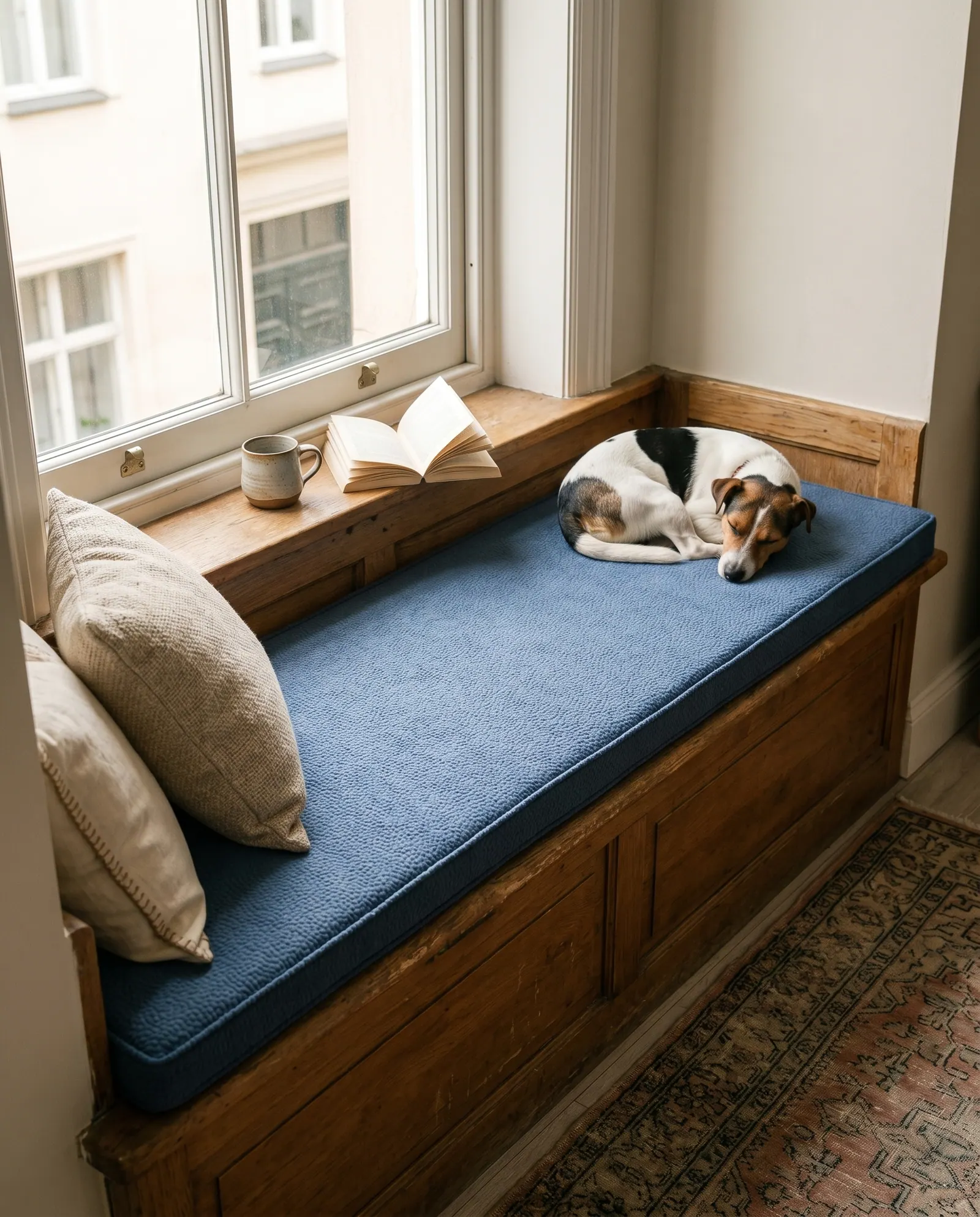
Right, then. Here's the Irish window-seat mistake I can see coming a mile off: a cushion so plump the shutters won't close over it. Measure the shutters first, dear, then the seat.
- Sun & UVGentle
- HumidityHumid
- WinterMild
- CoastSalt air nearby
- Typical seatsGeorgian sash window seat, deep cottage sill seat, 1930s bay window seat

 Save
The quick answer
Made to measure cushions in Ireland should be built for mild, damp weather: zip-off covers that wash at 86°F (30°C), foam that gets aired, and window seats slim enough for Georgian shutters to close. Met Éireann puts yearly rainfall at 30 to 39 in (750 to 1,000 mm) in the east and 39 to 55 in (1,000 to 1,400 mm) in the west, with December the wettest month.
December rain, north-coast gales, and cool summers
Met Éireann's numbers tell you what an Irish cushion is up against. Most of the east gets 30 to 39 in (750 to 1,000 mm) of rain a year, the west 39 to 55 in (1,000 to 1,400 mm), and the mountains more than 79 in (2,000 mm).
December is the wettest month, about 5.6 in (142 mm) on 1991-2020 averages, with October, November and January close behind at 5.1 to 5.5 in (130 to 140 mm). April and May are driest, at 3.2 and 3.1 in (82 and 79 mm). Those are your washing-and-airing months.
Sunshine runs 1,100 to 1,600 hours a year, and December manages 1 to 2 hours a day. Inland summer days reach 64 to 68°F (18 to 20°C). Wind is the other story: fewer than 2 gale days a year at inland places like Carlow, more than 50 at stations on the northern coast.
So made to measure cushions in Ireland rarely fade and often stay damp. Plan for washing, airing and a dry winter shelf. North of the border, see Northern Ireland.
Georgian Dublin: sash, shutter, seat
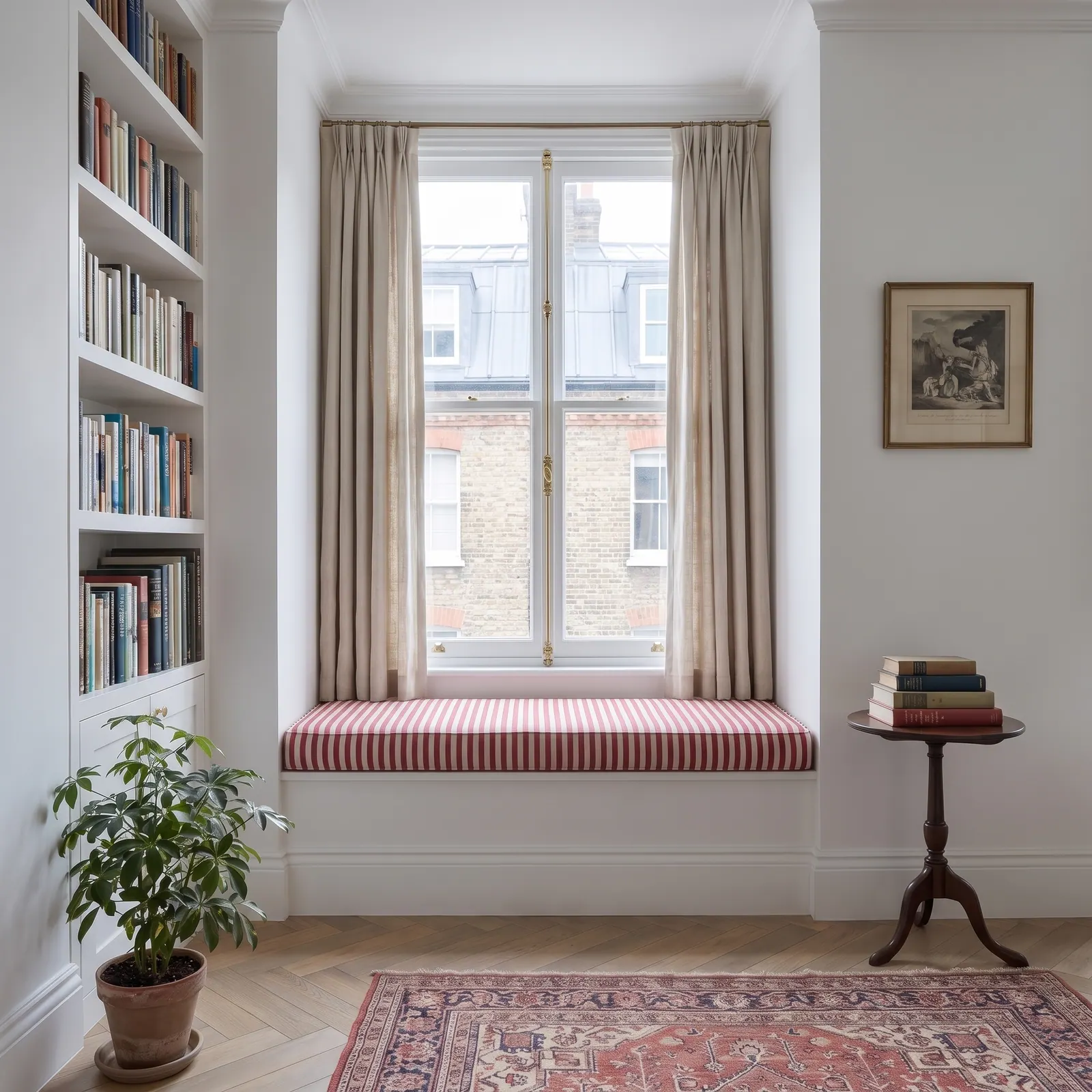
Dublin's Georgian terraces, built between 1714 and 1830 around squares such as Merrion and Fitzwilliam, are known for their almost uniform red brick. In the main rooms the tall windows came down below waist height, and many reveals still hold timber shutters.
Keep them working. The government's advice on historic Irish windows is to use the shutters at night to cut heat loss; they help with insulation as well as security. A window-seat cushion that stops them closing is costing you heat.
My test: close the shutters, then measure from the seat board up to the bottom of the shutter leaves. That gap is the cushion's maximum height, piping included. The same advice notes that condensation gathers on the meeting rails, bottom rails and sill, so keep the cushion's back edge off wet glass.
The thickness guide sets out the trade-offs, how to measure a window seat covers the rest, and window seat cushions shows the shapes.
West-coast cottages, 1930s semis and the angled end
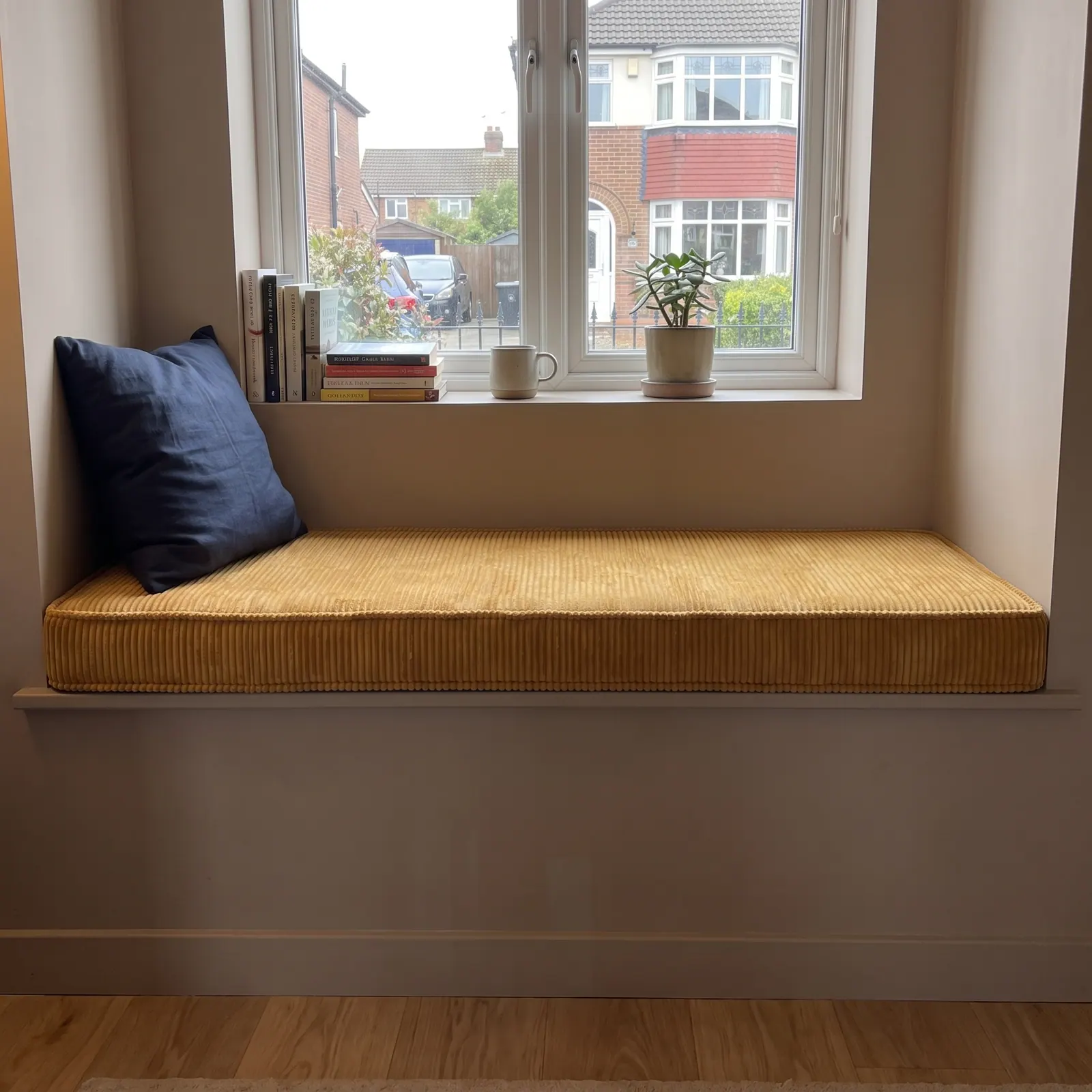
There's been a real revival in restoring old Irish cottages, and a stone cottage in the west usually means thick walls and deep sills. A deep sill makes a fine seat and a cold one; air the cushion weekly in winter.
The 1930s semi usually brings a bay, and a bay is angles. So is any seat with one slanted end. A buyer in Ireland sent the workshop a drawing of a window seat 88.5 in (225 cm) at the back, 100.5 in (255 cm) at the front and 14 in (35 cm) deep. That's a trapezoid, not a rectangle, and it has to be ordered as one with the drawing uploaded. Her first order went through the wrong listing and had to be refunded and redone; the drawing carried the second. Check yours in the trapezoid calculator and see bay window cushions.
What does your seat measure along the back, and along the front?
Sash seat, cottage sill, sunroom, garden: the build sheet
| Seat | Fabric | Foam and build | Piping |
|---|---|---|---|
| Georgian sash window seat | Velvet or corduroy in a zip-off cover | 2 to 3 in (5 to 7.5 cm); height checked against the closed shutters | Contrast piping in a period color |
| Cottage deep-sill seat | Linen-look or a performance weave | 3 in (7.5 cm); lifted weekly in winter | Self piping |
| Sunroom window seat | Outdoor fabric in direct sun; velvet or linen-look in shade | 3 to 4 in (7.5 to 10 cm); turned now and then | Self or tonal |
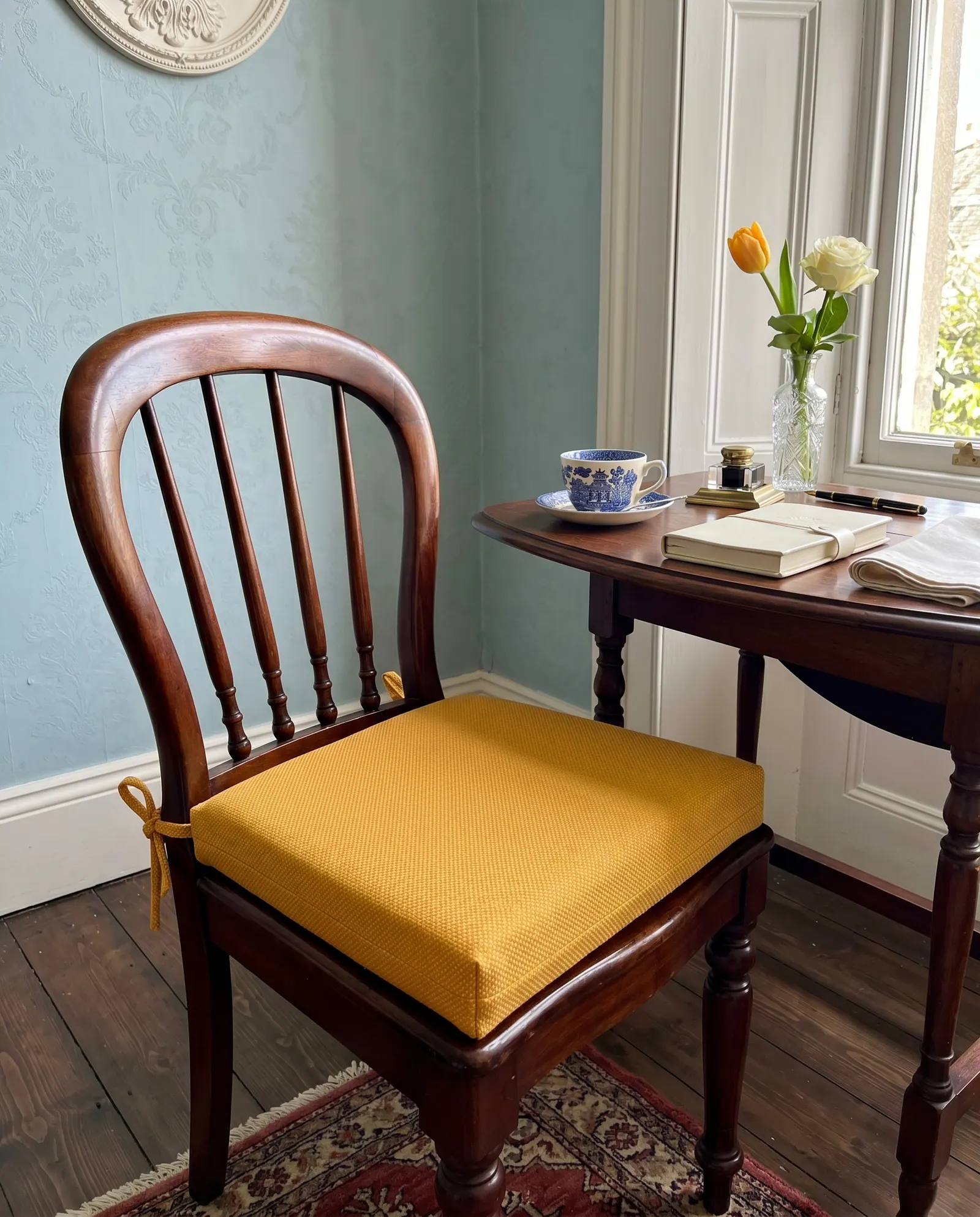
| Garden dining set | Water-repellent, UV-resistant outdoor canvas | Seat pads with ties; stored for winter | Self piping |
The standard seat foam is not quick-dry, and sealed seams or mesh vents aren't offered. Covers zip off and wash at 86°F (30°C) on a gentle cycle.
Eleven covers, and the case against marine sealing
A buyer in Ireland had an outdoor dining and lounge set with good foam and tired covers: a couch, dining armchairs, stools, button-tufted high backs and slanted footstools. Eleven covers in all. The request was fully waterproof fabric with sealed seams and mesh vents.
The workshop was straight about it. Its outdoor neutrals, cream, beige, taupe and oatmeal, repel water, but sealed seams and mesh vents aren't part of how it sews. It offered a sample pack so the colors could be judged in real light.
The buyer settled happily on the standard water-repellent outdoor canvas, because the cushions go into storage for the winter anyway. I'd have said the same. In a country where December brings about 5.6 in (142 mm) of rain, a dry shed does more than any seam tape. The long version is in water-repellent vs waterproof.
- Measured
- 11 replacement covers for existing foam, sizes sent in centimeters
- What it taught
- Water-repellent outdoor fabric plus winter storage beats paying for marine-grade sealing.
The Irish damp-season list
- April and May are the driest months: wash every cover and air every insert then.
- From October, bring garden cushions in dry; December is the wettest month.
- Close the shutters at night, with the window-seat cushion clear of them.
- Wipe condensation from sills and meeting rails in the morning.
- Stand damp foam on its edge in a warm, airy room until it's dry right through.
- Wash covers at 86°F (30°C), gentle cycle, no bleach, and air dry; wipe natural linen with a soapy cloth instead of soaking it.
- Store cushions in breathable bags, never sealed plastic.
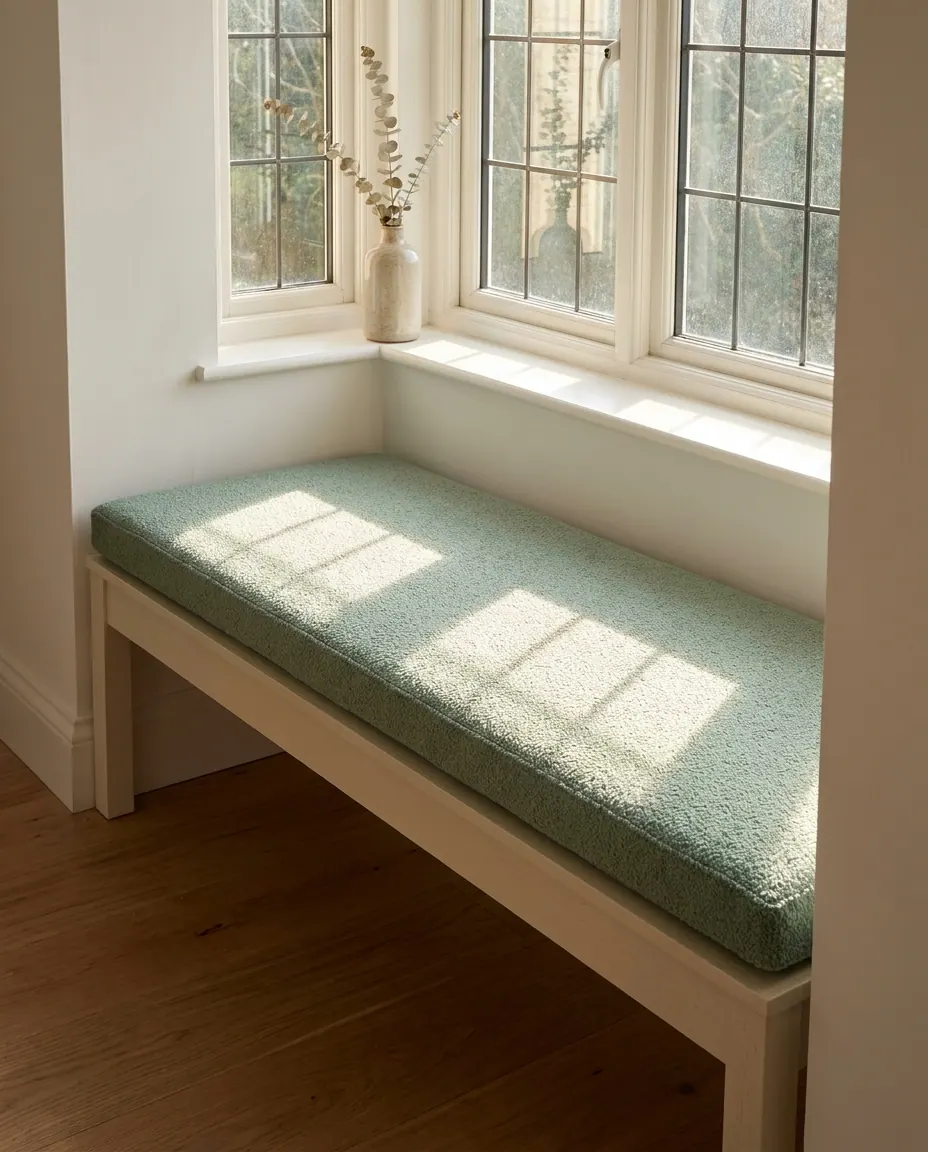
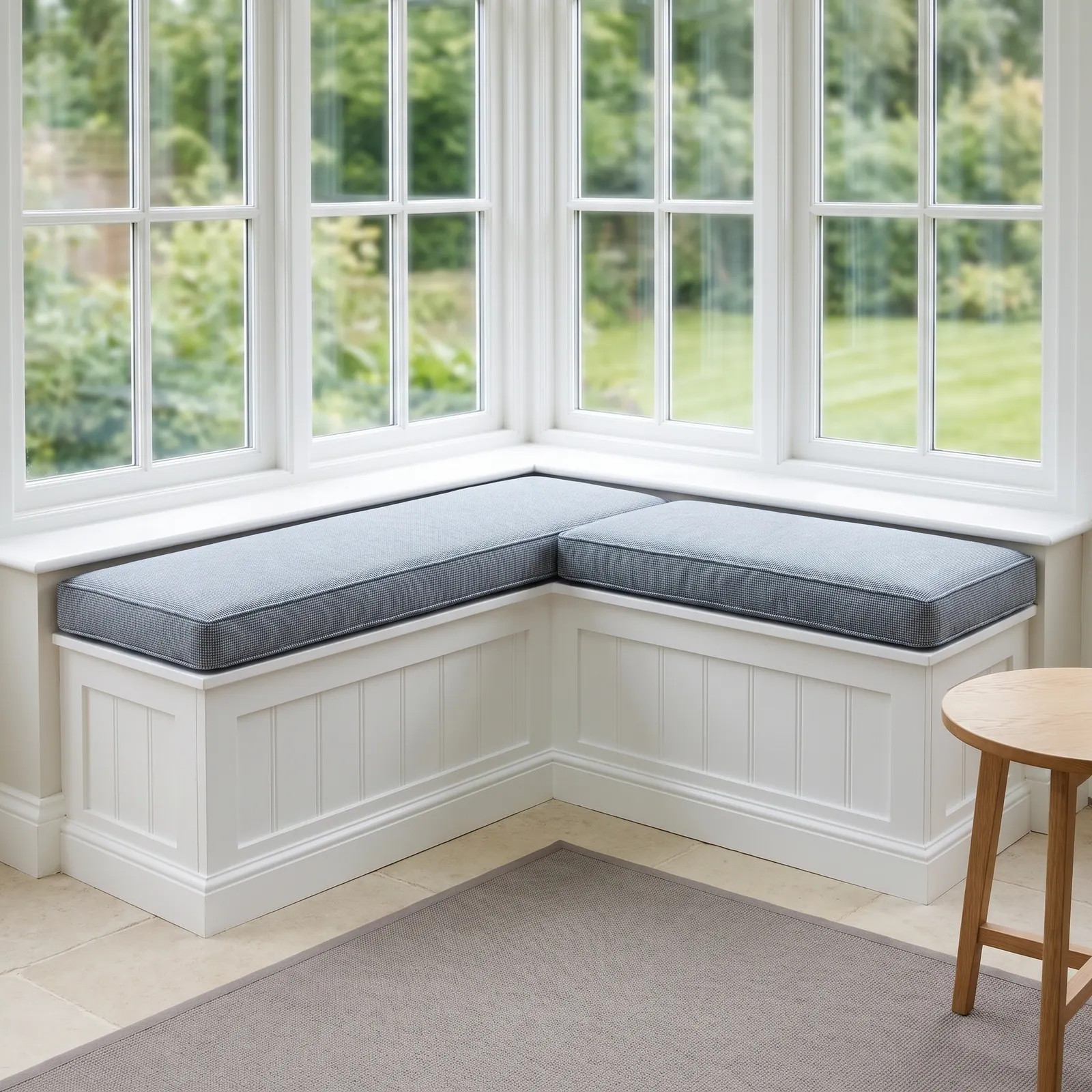
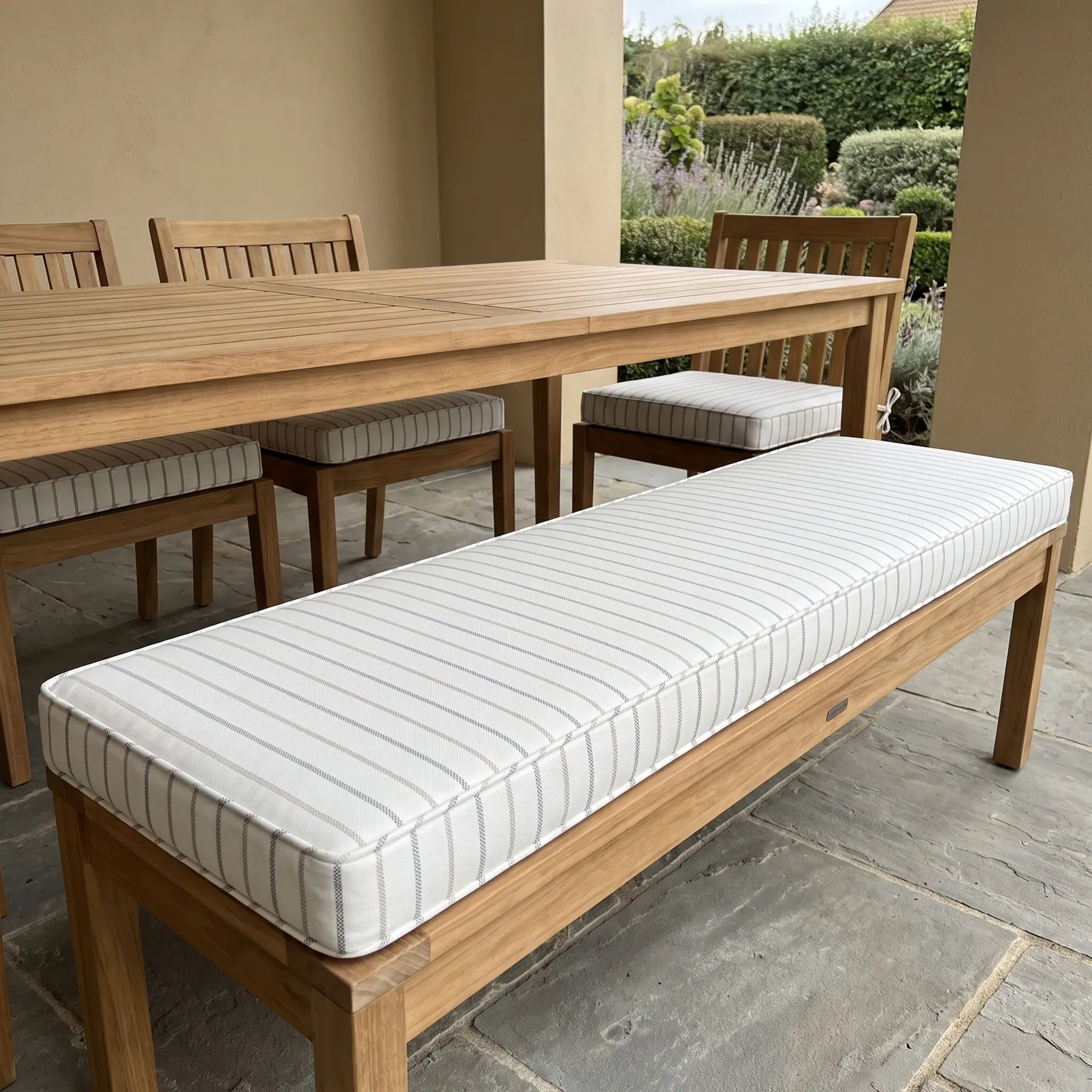
Photographs for homes like these
Open any photograph large; each one has its own link and a Save button.
 Save
 Save
 Save
 Save
 Save
 Save
Color that holds up in December light
With one or two hours of sun a day in December, colors read darker and cooler than they did in the shop. Sage, moss, ochre and rust keep their warmth; icy grays go flat.
Judge swatches beside a window in daylight, not on a screen at night, and send the workshop a daylight photo of the room if you want help matching. A deep velvet catches what light there is. More in screen versus daylight.
In a Georgian room the shutter has seniority. Cut the cushion so it can close.
Maggie
Buyer questions: Irish benches, covers and weather
- A common question
Can you make fully waterproof, marine-grade covers with sealed seams and breathable mesh vents?
The workshop's answerThere's an outdoor fabric chart in cream, beige, taupe and oatmeal neutrals that repels water, but sealed or leak-proof seams and mesh breather strips aren't part of production. Covers are sewn with standard stitching and full zippers, so they're removable and washable; button-tufted backs are confirmed case by case from dimensions and a photo.
- A common question
My L-shaped bench has a pillar in the middle of it. Can you still make the cushion?
The workshop's answerYes. Either one cushion cut with a precise notch around the pillar, or separate sections that butt together, which are easier to place and last longer. Send a photo and full measurements, including where the pillar sits and its width, depth and height, and the workshop will recommend one of the two.
- A common question
Can I order just cushion covers, without the filling?
The workshop's answerTufted cushions only come filled, because the tufting goes through the filling. Plain covers without tufting can be made on their own in your custom sizes.
- A common question
What cushion thickness do you recommend for a window seat?
The workshop's answerAbout 4 in (10 cm) is standard. 3 in (7.5 cm) is the best seller and suits tight spots, such as a 15 in (38 cm) gap between a bench and a windowsill. For curved benches the workshop suggests 2 to 3 in (5 to 8 cm), and 3 to 4 in (8 to 10 cm) for outdoor chair seats.
- A common question
Can you make a window seat cushion with angled ends instead of a plain rectangle?
The workshop's answerYes. Send the measurements of every side and photos of the seat, taken in daylight if you'd like help matching colors. The workshop confirms the shape before quoting.

Have it made
Have it made for your home — ask Maggie’s workshop
I once cut a lovely cushion two inches short, and I have not forgotten it. That is why the workshop goes over your measurements with you on the phone. — Maggie
Leave your details and the workshop will call you to confirm measurements, fabric, foam and piping. No prices, dates or payment on this page: it is a request, not an order.
Questions about cushions in Ireland
How thick can a Georgian window seat cushion be if the shutters must still close?
Close the shutters and measure from the seat board to the bottom of the shutter leaves; that gap, piping included, is your limit. Many reveals end up at 2 to 3 in (5 to 7.5 cm), and the workshop recommends at least 2 in (5 cm) for comfortable sitting.
Do Irish garden cushions need fully waterproof covers?
Usually not. Water-repellent outdoor fabric sheds showers, and the foam stays sound if cushions are stored over winter, when rain peaks in December. Exposure matters more than seams: northern coastal stations average more than 50 gale days a year, inland Carlow fewer than 2.
When is the best time to wash and air cushions in Ireland?
April and May, the driest months, at about 3.2 and 3.1 in (82 and 79 mm) of rain on 1991-2020 averages. Wash covers at 86°F (30°C) on a gentle cycle, dry them outdoors on a breezy day, and stand the foam on edge until it's dry right through.
Should a sunroom cushion in Ireland use outdoor fabric?
If it sits in direct sun, yes: outdoor fabrics are made to be UV- and fade-resistant, and a sunroom traps moisture as well as heat. In a shaded sunroom, velvet or a linen-look weave is fine, as long as you air the cushion and wipe condensation from the glass.
Stitch straight — Maggie
The atelier
Keep going
Across the Map
Nearby places
Close by on the map