Across the Map · UK & Ireland
Made to measure cushions for UK homes, gardens and window seats
I spent twenty years re-covering window seats in drafty old New England houses, so British bays feel like home turf. Same cold glass, same damp, and a lot more rain.
- Sun & UVGentle
- HumidityHumid
- WinterMild
- CoastSalt air nearby
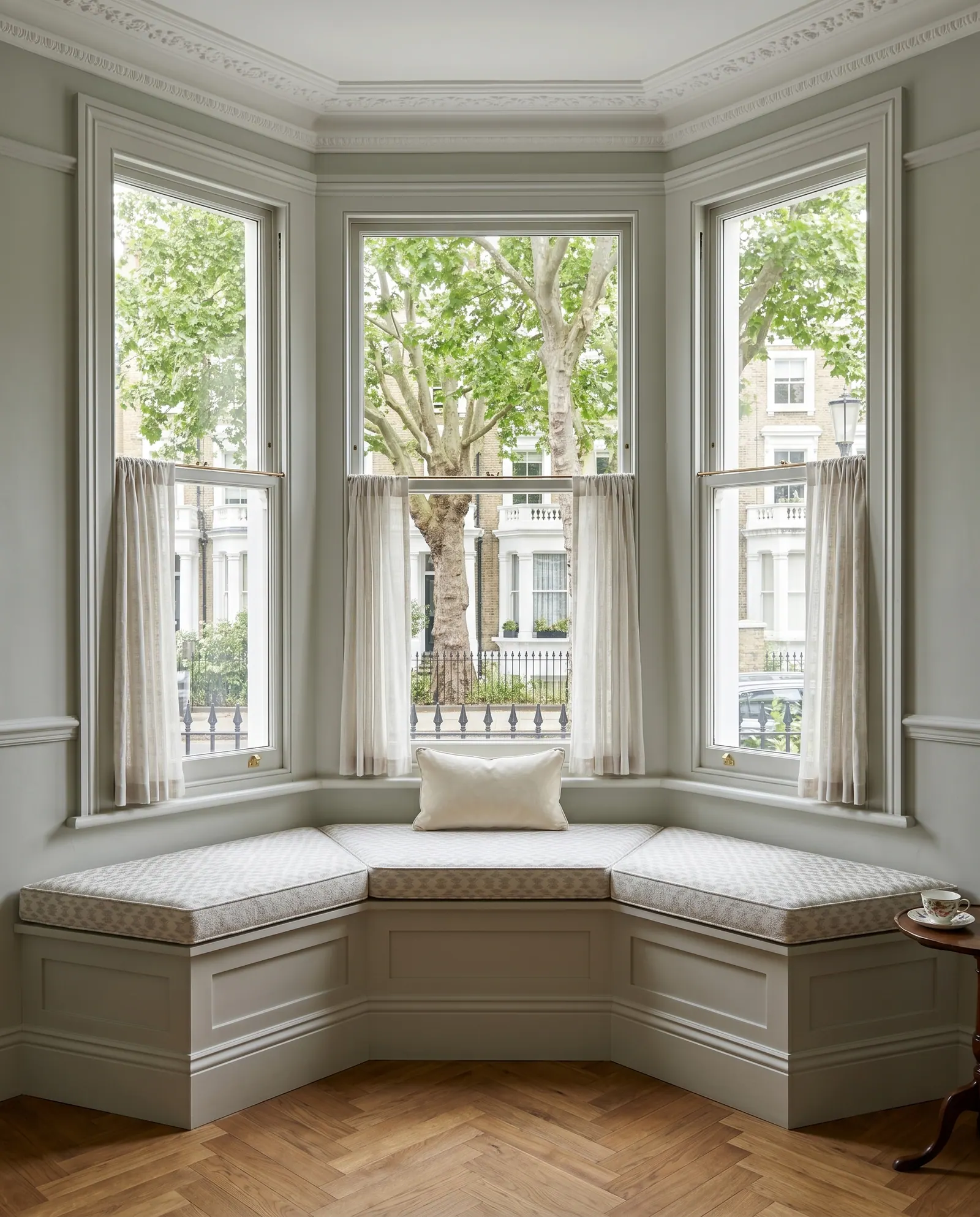
- Typical seatsBay window seat, window seat in a period house, kitchen bench and dining banquette

 Save
The quick answer
Made to measure cushions in the UK should be built for damp rather than heat. Heathrow averages 24.2 in (615 mm) of rain on 112 days a year, and condensation on cold windows is the most common form of household damp. Choose zip-off covers that wash at 86°F (30°C), measure every edge in centimeters, and know that the standard foam is not a fire-retardant grade.
Damp, not heat: what British weather does to a cushion
Britain's cushion trouble is rarely heat. It's damp. At Heathrow, the Met Office's 1991 to 2020 averages give 24.2 in (615 mm) of rain on 112 days a year, 1,675 hours of sunshine and 27 air frosts. Near Glasgow, Paisley doubles the rain: 49.7 in (1,263 mm) over 174 days, with 1,280 hours of sun.
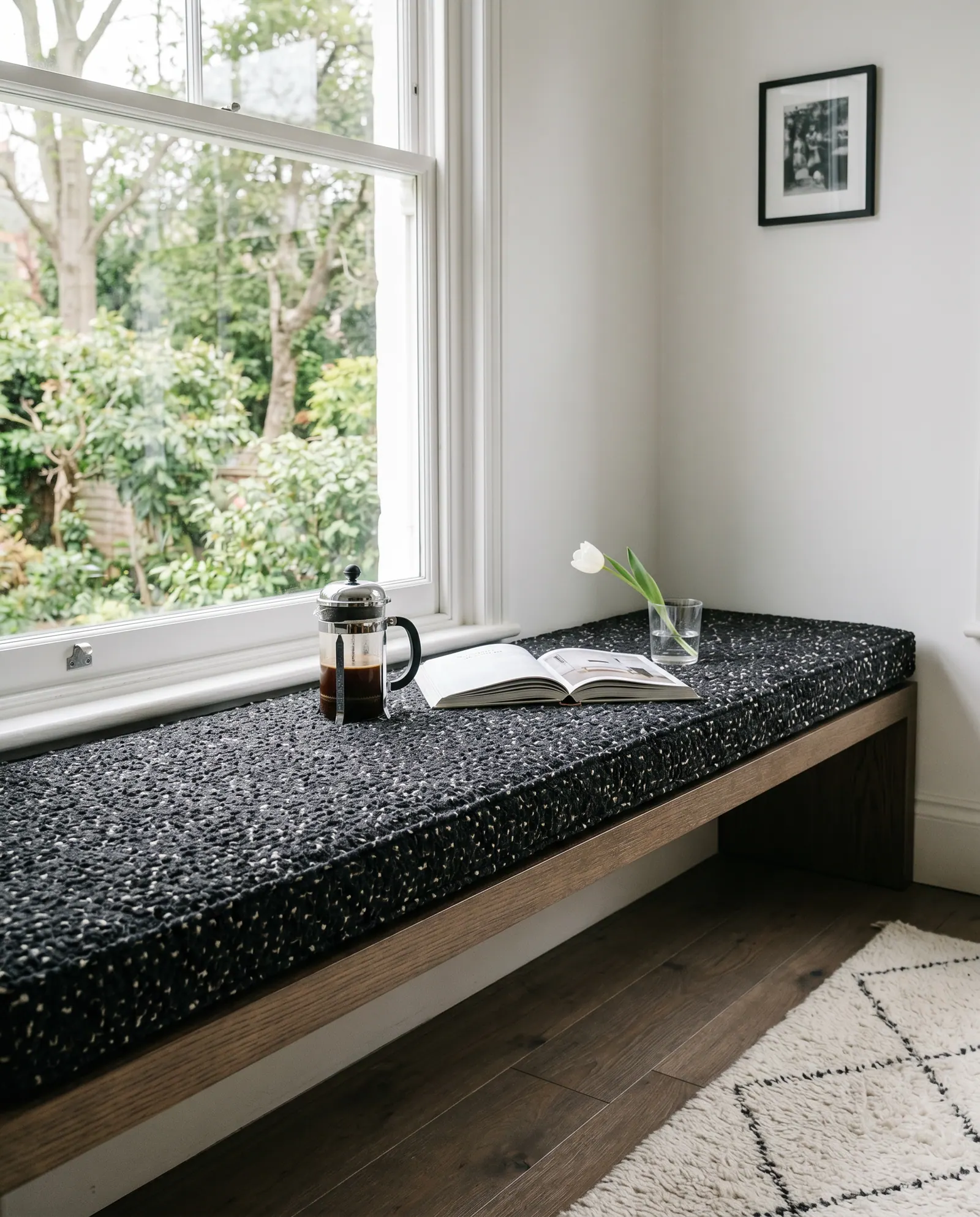
Indoors, government guidance calls condensation the most common form of damp. It forms where moist air cools against window frames and external walls, which is exactly where a window seat cushion lives. Wipe the glass, lift the cushion now and then, and choose a cover that zips off for the wash.
That's the whole brief for made to measure cushions in the UK: sized to the centimeter, washable and aired. The nation pages go further: England for bays and conservatories, Scotland for tenements and stone cottages.
Bays, benches and the conservatory
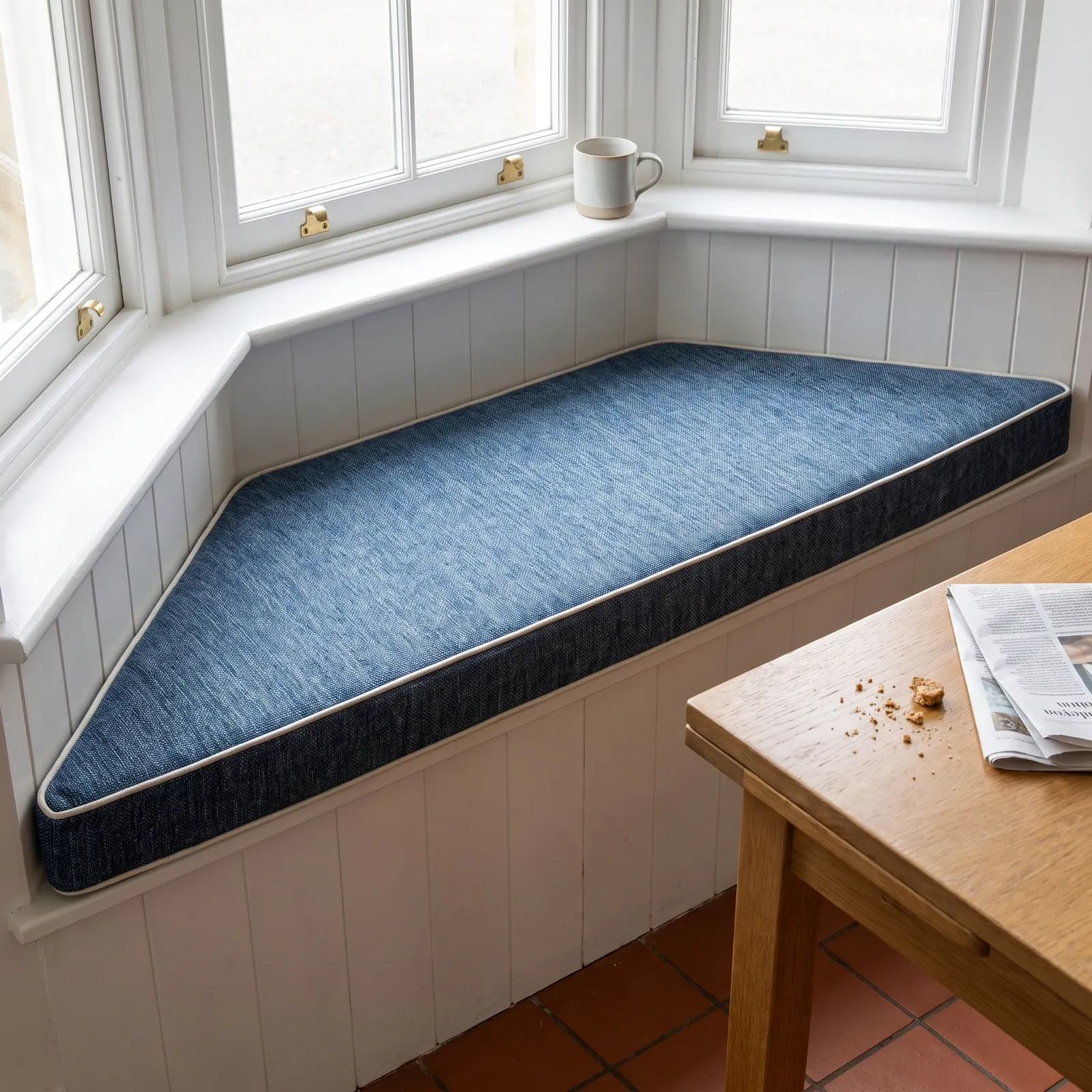
Britain builds its seats into the house. Byelaw terraces alone made up over 15% of the UK's housing stock as recently as 2011, and bay windows turn up on terraces, semis and detached houses alike. A canted bay is an isosceles trapezoid seen from above; a bow window curves instead. Either way, a bay window cushion is a drawing job, not a guess.
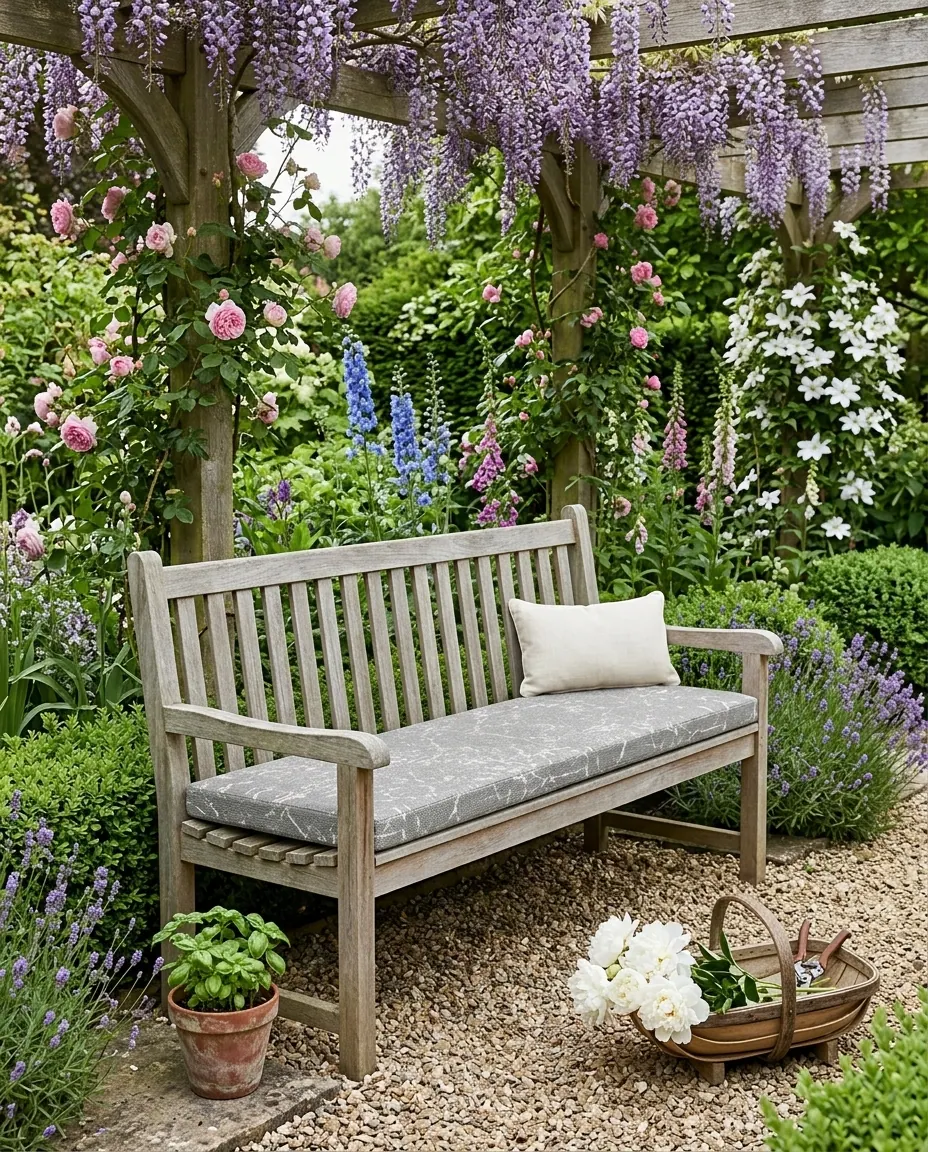
Then there's the rest: the window seat in a period sitting room, the kitchen bench pulled up to the table, the boot-room bench by the back door, and the conservatory, which by the usual UK definition has at least half its side walls and three-quarters of its roof in glass. Out in the garden, a teak bench waits for a seat pad. For long runs and awkward ends, the bench cushion builder gets the numbers down.
What does your bay measure along the back, dear?
The fire label question, answered plainly
UK buyers ask this, and they deserve a straight answer. The Furniture and Furnishings (Fire) (Safety) Regulations 1988 cover furniture ordinarily intended for private use in a dwelling, and they name cushions and pillows. Garden furniture that is also suitable for indoor use is included. A caravan counts as a dwelling; boats and motor vehicles don't.
For foam in a cushion, the rules call for a test under BS 5852 Part 2 with ignition source 5, a small wooden crib, and the foam passes if it loses less than 60 g. Cover fabrics face a separate match test. The display label you see on sofas in shops isn't required on cushions and pillows; a shorter permanent label is.
Now the plain part. The workshop's standard foam is not a fire-retardant grade, and it has told UK buyers it has no fire-retardant foam or fabric. We don't claim these cushions meet the 1988 rules. If you need that, order covers for your own foam and have a local upholsterer fill them with compliant filling. More in flame retardant free cushions. This is a summary, not legal advice.
A corner bench with three rounded corners and two small boys
A family in the UK wrote in about a corner dining bench, about 71 x 47 in (180 x 120 cm) outside and 17.75 in (45 cm) deep, with a rush seat and three rounded corners. Two small boys meant the cushion had to be washable.
The workshop made it in two pieces meeting at the corner and asked her to mark where each curve began: about 7, 8 and 8.75 in (18, 20 and 22 cm) from the corners. Then it sent a template to check.
The bench was already 17 in (43 cm) high, so she chose 2 in (5 cm) instead of the 4 in (10 cm) suggested, which kept the table at a sensible height. Ties went to the spindles. The fabric was olive-green velvet with mustard piping, and I'd have picked exactly that pair myself.
- Measured
- About 71 x 47 in (180 x 120 cm) outside, 17.7 in (45 cm) deep; pieces of 29.5 x 17.25 in (75 x 44 cm) and 53 x 17 in (134 x 43 cm) plus a 17.75 x 17.75 in (45 x 45 cm) corner; 2 in (5 cm) thick
- What it taught
- On dining benches, choose thickness from the seat height and the table, not comfort alone.
Window seat, kitchen bench or garden seat pad: what to choose
| Seat | Fabric | Thickness and build | Piping |
|---|---|---|---|
| Victorian bay window seat | Linen-look or velvet; neither is water-repellent | 3 to 4 in (7.5 to 10 cm); one piece, or one per facet | Contrast piping traces each angle |
| Kitchen bench or banquette | Velvet with a zip-off cover, or a linen-style performance weave | 2 in (5 cm) if the bench is already at seat height, 4 in (10 cm) otherwise; ties to spindles | A contrast welt, like mustard on olive |
| Boot-room bench | Soft poly-cotton in a warm neutral that washes easily | Custom shape around protruding wood, cut from photos | Self piping |
| Garden bench seat pad | Outdoor fabric: water-repellent, UV- and fade-resistant | 3 to 4 in (8 to 10 cm); ties at the back corners | Self or contrast |
Covers zip off and wash at 86°F (30°C) on a gentle cycle. The standard foam is a 32 kg/m³ high-density grade with no fire-retardant treatment.
Before you order: a checklist for British seats
- Measure the bench, not the cushion you used to have, unless the old one fitted perfectly; then send its sizes too.
- Use a rigid tape on the seat top itself and write exact numbers. The workshop decides any allowance.
- Draw bays and angled benches from above, with every edge written on the drawing.
- Note the seat height, radiators, window handles and anything that sticks out.
- Decide on piping now: same fabric, contrast, or none.
- Order swatches and judge them in your own daylight, not on a screen.
- If you need compliant fire-safety filling, plan on covers only and a local upholsterer.
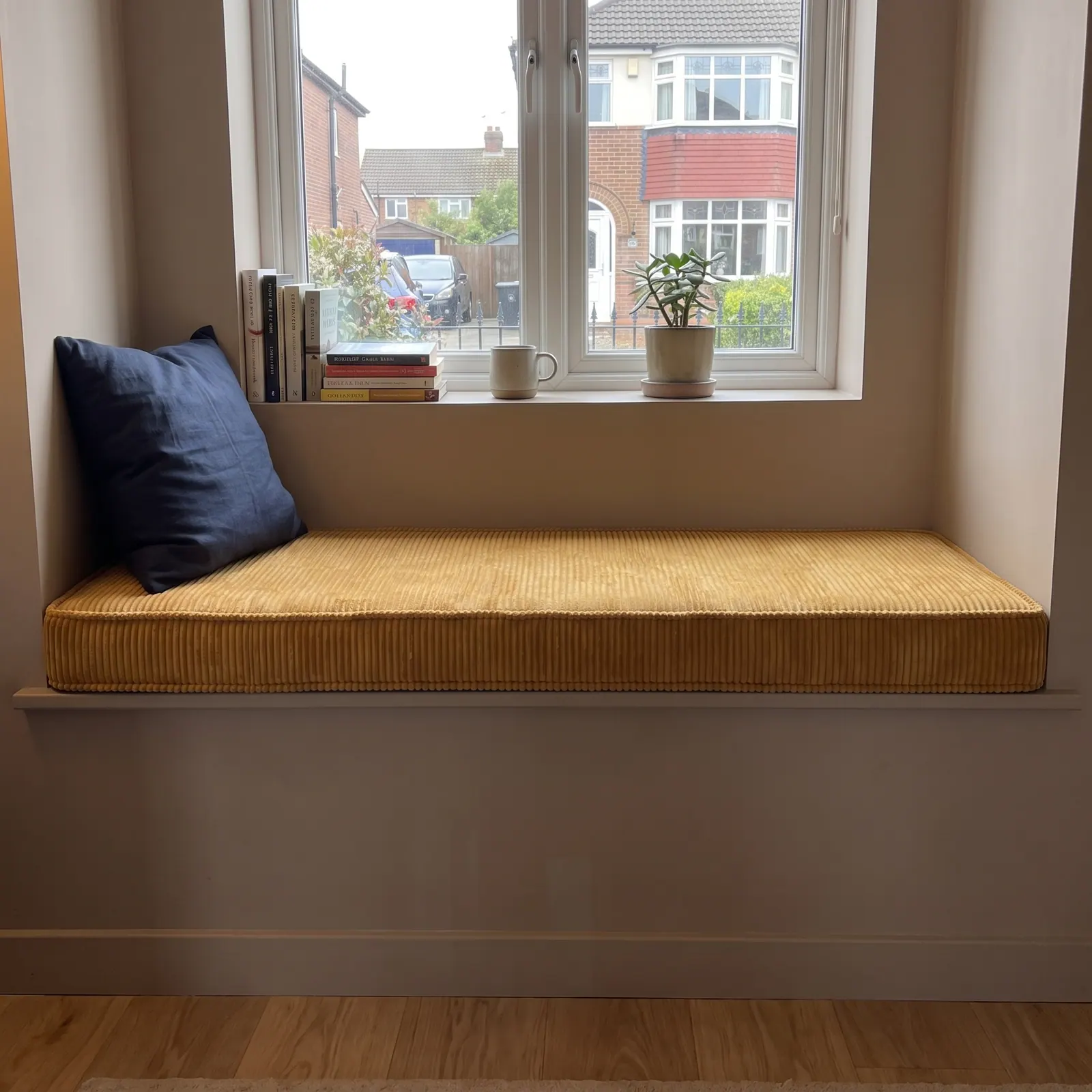
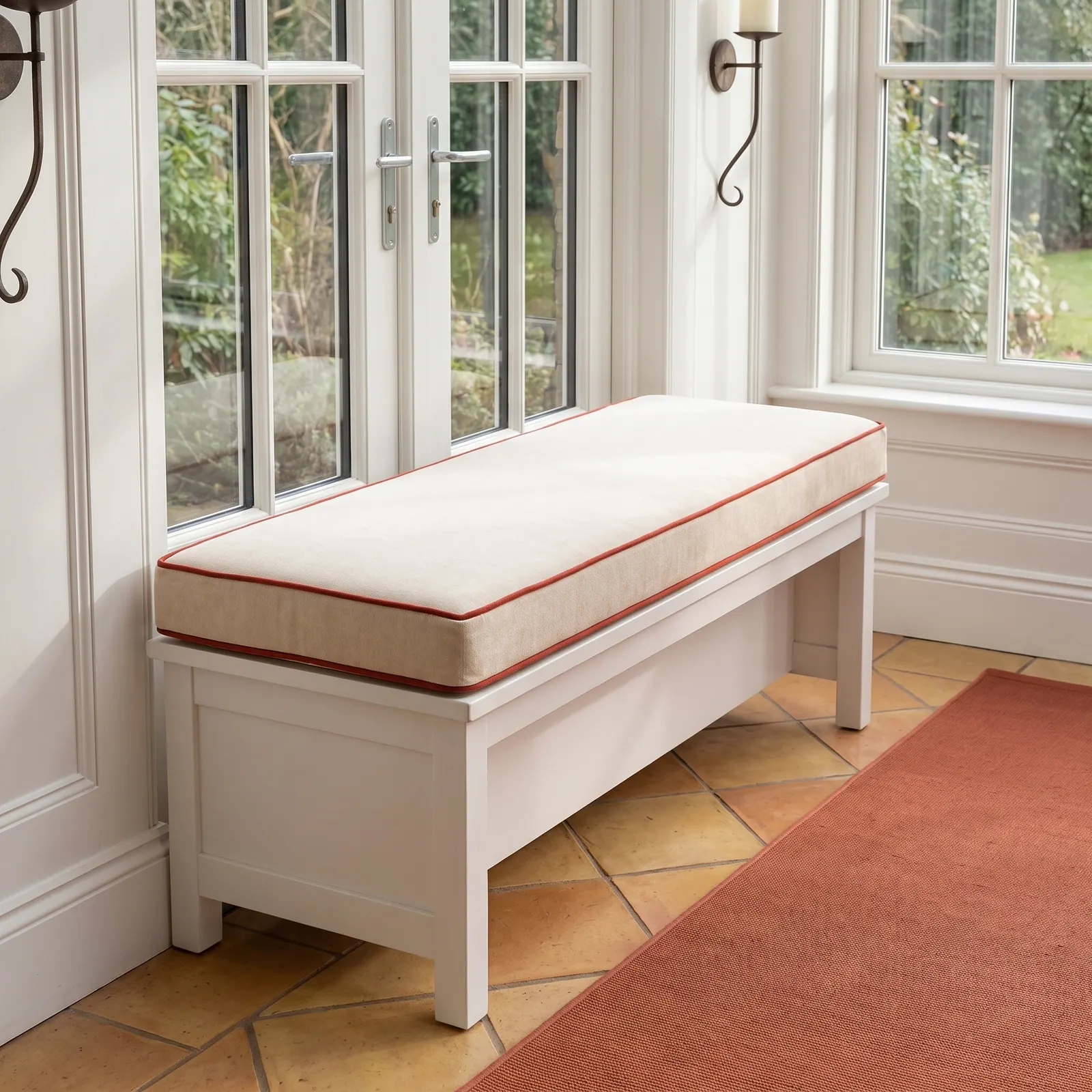
Photographs for homes like these
Open any photograph large; each one has its own link and a Save button.
 Save
 Save
 Save
 Save
 Save
In a British house the enemy isn't the sun. It's cold glass, and the damp that runs down it into your cushion.
Maggie
Buyer questions: fire rules, velvet and a bench at seat height
- A common question
Are the foam and the fabric fire retardant?
The workshop's answerNo. The workshop doesn't have fire-retardant foam or fabric. One UK buyer ordered velvet covers only and had fire-retardant filling put in locally.
- A common question
Our dining bench is already at seat height. How thick should the cushion be?
The workshop's answerThe workshop generally recommends 4 in (10 cm), and 3 in (7.5 cm) is the most popular choice. For a bench already 17 in (43 cm) high, 2 in (5 cm) was chosen to keep the table at the right height; the medium-firm 32 kg/m³ high-density foam doesn't sink much.
- A common question
How do I look after velvet when something gets spilled on it? Does it have a stain repellent, and can it be dry cleaned?
The workshop's answerBlot the spill quickly with a dry cloth. The cover zips off, so you can also machine wash it at 86°F (30°C) on a gentle cycle. The velvet has no stain-repellent coating; the protection comes from the cover being removable and washable. There are no dry-cleaning instructions, and the gentle 86°F (30°C) wash is the recommended care.
- A common question
Should I send the measurements of the bench or of my old cushions?
The workshop's answerIf you're happy with how the current cushions fit, send their sizes. If they don't fit well, or you want a different thickness, send the bench measurements instead.
- A common question
Can the piping be a different color or fabric from the cushion?
The workshop's answerYes. Piping can be cut from any fabric in the charts. Buyers have paired beige linen with forest-green velvet piping, beige linen with bordeaux, and cream soft fabric with gray piping. Write both codes in the personalization box.
- A common question
My window seat has no wall behind it. How do I stop the cushion and bolster from moving?
The workshop's answerA non-slip fabric piece under the bottom cushion stops it sliding, and the workshop can also make two smaller side bolsters to your measurements.

Have it made
Have it made for your home — ask Maggie’s workshop
Have the tape measure handy when they call. Old cushions shrink and sag; the seat underneath does not. — Maggie
Leave your details and the workshop will call you to confirm measurements, fabric, foam and piping. No prices, dates or payment on this page: it is a request, not an order.
UK made to measure cushion questions
Do made to measure cushions fall under the UK furniture fire regulations?
The Furniture and Furnishings (Fire) (Safety) Regulations 1988 name cushions and pillows among the furniture they cover. The workshop's standard foam is not a fire-retardant grade, and we don't claim compliance. If you need it, order covers only and have them filled locally.
What thickness suits a window seat in a Victorian bay?
Usually 3 to 4 in (7.5 to 10 cm). The workshop's standard is 4 in (10 cm), and 3 in (7.5 cm) is its best seller for tight spots, such as a 15 in (38 cm) gap between a bench and the windowsill. Draw the bay from above with every edge written on it.
Can a garden bench seat pad stay outside through a British winter?
Better not. Heathrow averages 112 rain days and 27 air frosts a year, and western Scotland is far wetter. Outdoor fabric is water-repellent, not waterproof, and the standard foam isn't quick-dry, so store seat pads dry and indoors off-season.
Should I give sizes in centimeters or inches?
Either works, but centimeters suit most UK tapes. When a listing shows both, the workshop makes the cushion to the centimeter size once you order; if an exact inch size matters to you, say so in the notes.
Stitch straight — Maggie
Concept Sketches
Sketches for homes like these
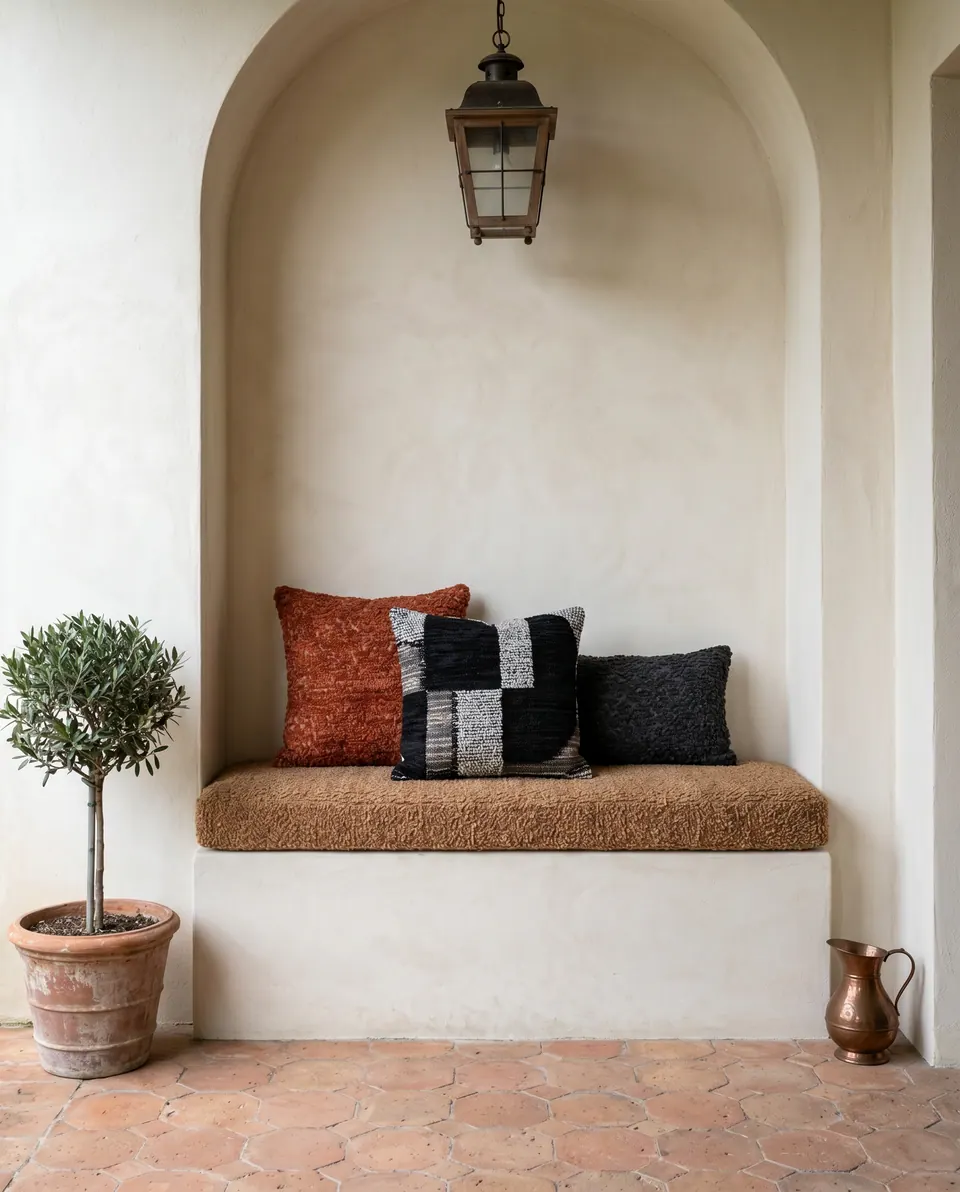
Real projects, drawn up as ideas you can borrow.
The atelier
Keep going
Across the Map
Nearby places
In United Kingdom
Nearby