Across the Map · United Kingdom
Made to measure cushions for cottages, chapels and coastal homes in Wales
Snowdonia collects more than 118 in (3,000 mm) of rain a year. The Pembrokeshire coast collects the sun and the gales. A cushion in Wales has to live with both, and with the damp in between.
- Sun & UVModerate
- HumidityHumid
- WinterMild
- CoastSalt air nearby
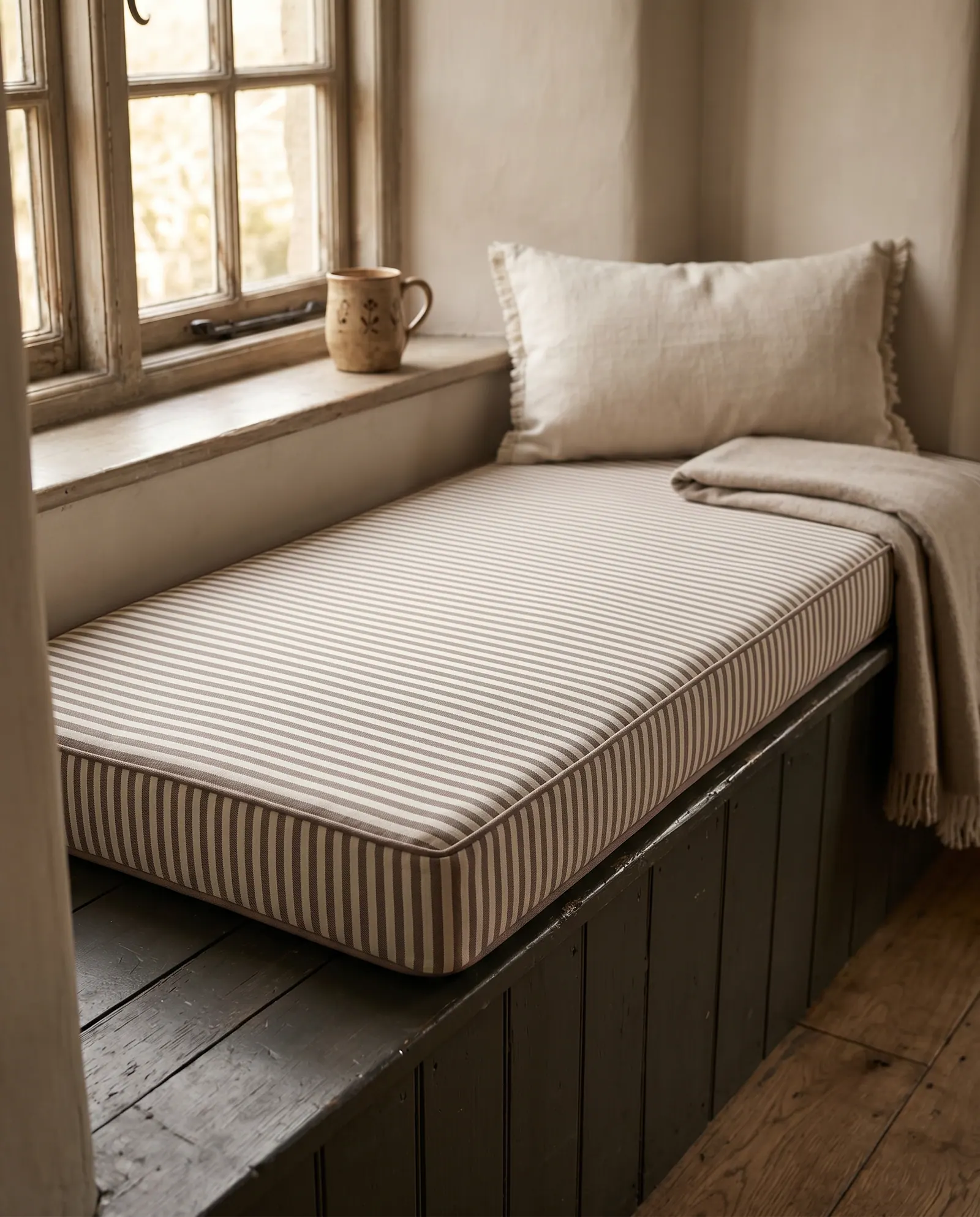
- Typical seatsDeep-reveal cottage window seat, chapel pew, terrace bay window seat
 Save
The quick answer
Made to measure cushions in Wales should be built for damp before sun: zip-off covers that wash at 86°F (30°C), foam that gets aired, and water-repellent outdoor fabric on garden and coastal seats that come inside when the weather turns. Snowdonia averages over 118 in (3,000 mm) of rain a year; most of the coast gets under 39 in (1,000 mm).
Over 118 in (3,000 mm) in Snowdonia, under 39 in on the shore
Wales runs wet from the middle out. The Met Office puts Snowdonia above 118 in (3,000 mm) of rain a year, while most of the coast and the country near the English border get less than 39 in (1,000 mm). October to January is the wet stretch everywhere.
If you own garden cushions, count days, not millimeters. The high ground sees more than 50 wet days in winter and over 35 in summer. Even the driest corners of the east and south get about 40 in winter and 25 in summer.
The southwest coastal strip of Pembrokeshire averages over 1,700 hours of sunshine a year; the mountains get under 1,200. That same corner logs about 30 gale days a year, other coasts 15 or more. And there's salt air along the whole shore: the Wales Coast Path alone runs 870 mi (1,400 km).
So made to measure cushions in Wales fade slowly and soak quickly. The EPA's rule of thumb is to dry wet materials within 24 to 48 hours, before mold gets going. Plan every cushion around how it gets dry.
Slate cottages and window ledges a forearm deep
By the late 1800s the quarries of Wales led the world in slate, and UNESCO listed the Slate Landscape of Northwest Wales in 2021. The cottages built from that stone have thick walls, and thick walls make deep window reveals. Most of them are asking for a cushion.
Measure the ledge, not the old cushion: back edge, front edge, depth at both ends. Old walls are rarely square. If the depth changes by less than ¾ in (2 cm) along the ledge, the workshop averages it to a rectangle; more than that and it's a trapezoid. The window seat measuring guide has the routine.
Keep reveal cushions slim, 2 to 3 in (5 to 7.5 cm), so a casement can still swing. Stone stays cold and winter glass sweats, so lift the cushion on wet mornings and wipe the sill.
In Cardiff and Swansea it's the terrace and its bay. The South Wales valleys filled with terraced streets as coal mining boomed in the 19th century. A bay seat is a set of angles; the bay window calculator turns them into edges, and window seat cushions covers the shapes.
What's the wettest seat in your house, friend?
Chapel conversions: pews, long runs and curved ends
In Wales, "chapel" is the everyday word for a Nonconformist place of worship, and plenty of those buildings are homes now. New owners often keep a pew or two. A pew is a long bench with opinions.
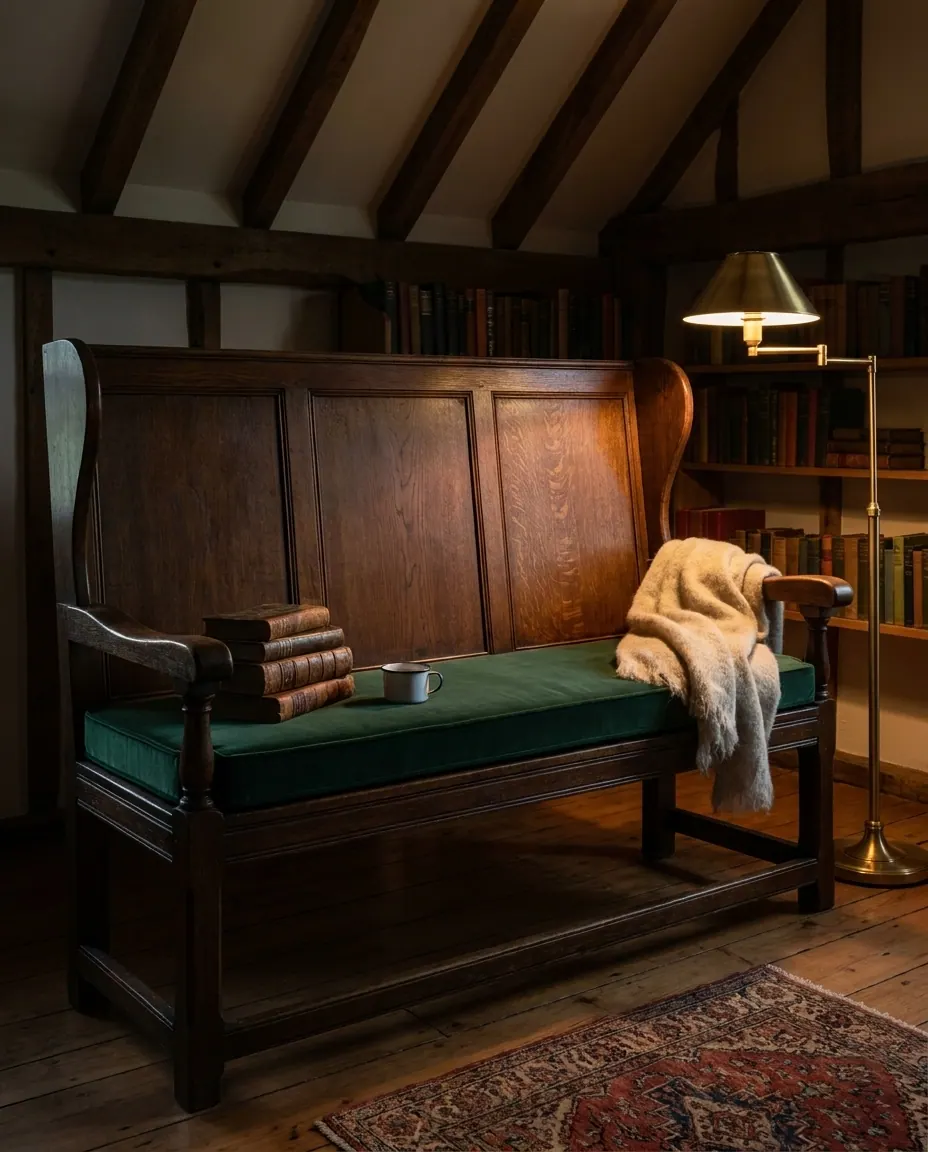
Three rules from the cutting table. Split a long run: the longest single cushion the workshop recommends is about 79 to 91 in (2 to 2.3 m), and pieces that butt together lift out for washing. Draw every curved end on paper; the workshop won't cut a curve from numbers alone. And stop the slide on polished oak with corner ties or a non-slip base, compared in the sliding guide.
For thickness, 2 in (5 cm) is the practical minimum the workshop recommends, and 3 in (7.5 cm) is its best seller. Read one piece or two before you order, and see bench cushions for the rest.
If the chapel is let to guests, read the fire note below and on our United Kingdom page.
Cottage, chapel, coast: fabric, foam and piping
| Seat | Fabric | Foam and build | Piping |
|---|---|---|---|
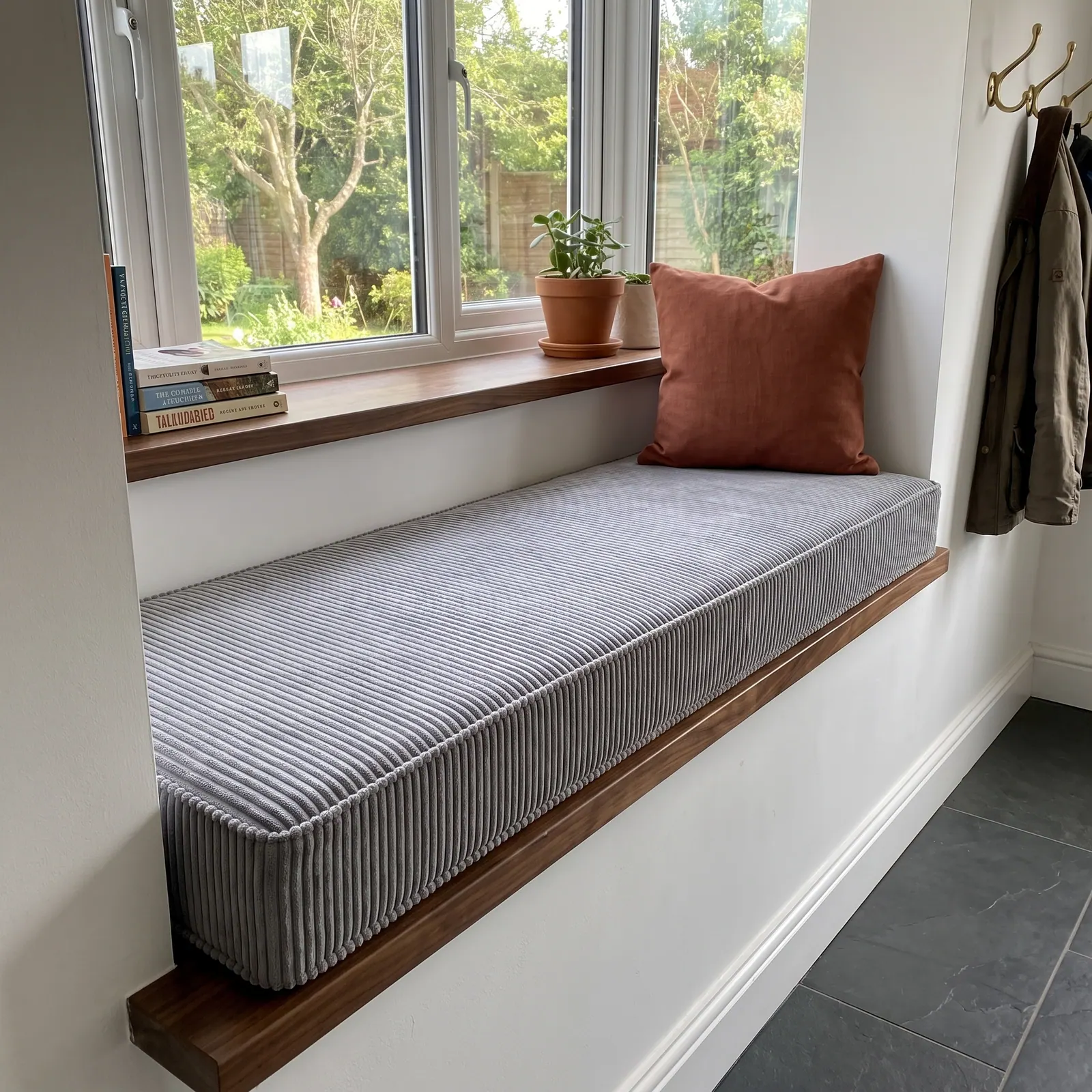
| Deep-reveal cottage window seat | Corduroy or velvet in a zip-off cover that washes at 86°F (30°C) | Standard foam, 2 to 3 in (5 to 7.5 cm); lifted to air | Self piping, or a contrast line to trace the ledge |
| Chapel pew | Linen-look or a performance weave for daily wear | 2 to 3 in (5 to 7.5 cm); runs split at about 79 in (2 m); ties or non-slip base | Self piping keeps the joins quiet |
| Garden bench or coastal deck | Water-repellent, UV-resistant outdoor fabric | Standard foam, 3 to 4 in (8 to 10 cm); carried in when rain sets in | Self piping |
| Static caravan or boat bench | Outdoor fabric | Traced template; non-slip base so it stays put in a gust | Contrast piping reads the shape |
The standard seat foam is about 2.0 lb/ft³ (32 kg/m³) and it is not quick-dry. For a seat that lives in the rain, read the dry-fast foam guide first.
Two swing cushions and a thickness that didn't agree
A couple in the UK wrote in about a garden swing chair. They wanted two deep cushions, 59 in (150 cm) long, in a patterned outdoor fabric that repels water. One line of their message said 4 in (10 cm) thick. Another said 6 in (15 cm).
The workshop didn't guess. It read the sizes back and confirmed both cushions at 6 in (15 cm) before quoting: one at 59 x 19¾ x 6 in (150 x 50 x 15 cm), one at 59 x 15¾ x 6 in (150 x 40 x 15 cm).
Good call. Six inches (15 cm) of foam makes a fine swing seat and a fine sponge. On a hillside in Wales that cushion goes under cover when the cloud comes over the ridge. It dries slower than it soaks. If yours has to live outside, look at dry-fast foam and water-repellent vs waterproof.
- Measured
- 59 x 19¾ x 6 in and 59 x 15¾ x 6 in (150 x 50 x 15 cm and 150 x 40 x 15 cm)
- What it taught
- Read back every dimension, since thickness and width are the numbers people mix up most often.
A damp routine for Wales, October to April
- Bring garden and swing cushions under cover before the autumn gales, not after the first one.
- Stand a soaked cushion on its edge in a dry, airy room and get it dry within 24 to 48 hours.
- Unzip the covers and wash them at 86°F (30°C) on a gentle cycle, no bleach, then air dry.
- Lift window-seat cushions on cold mornings and wipe the sill where condensation gathers.
- After a salty week on the coast, rinse covers and zips with fresh water.
- Store cushions off stone and slate floors in breathable bags, never sealed in plastic.
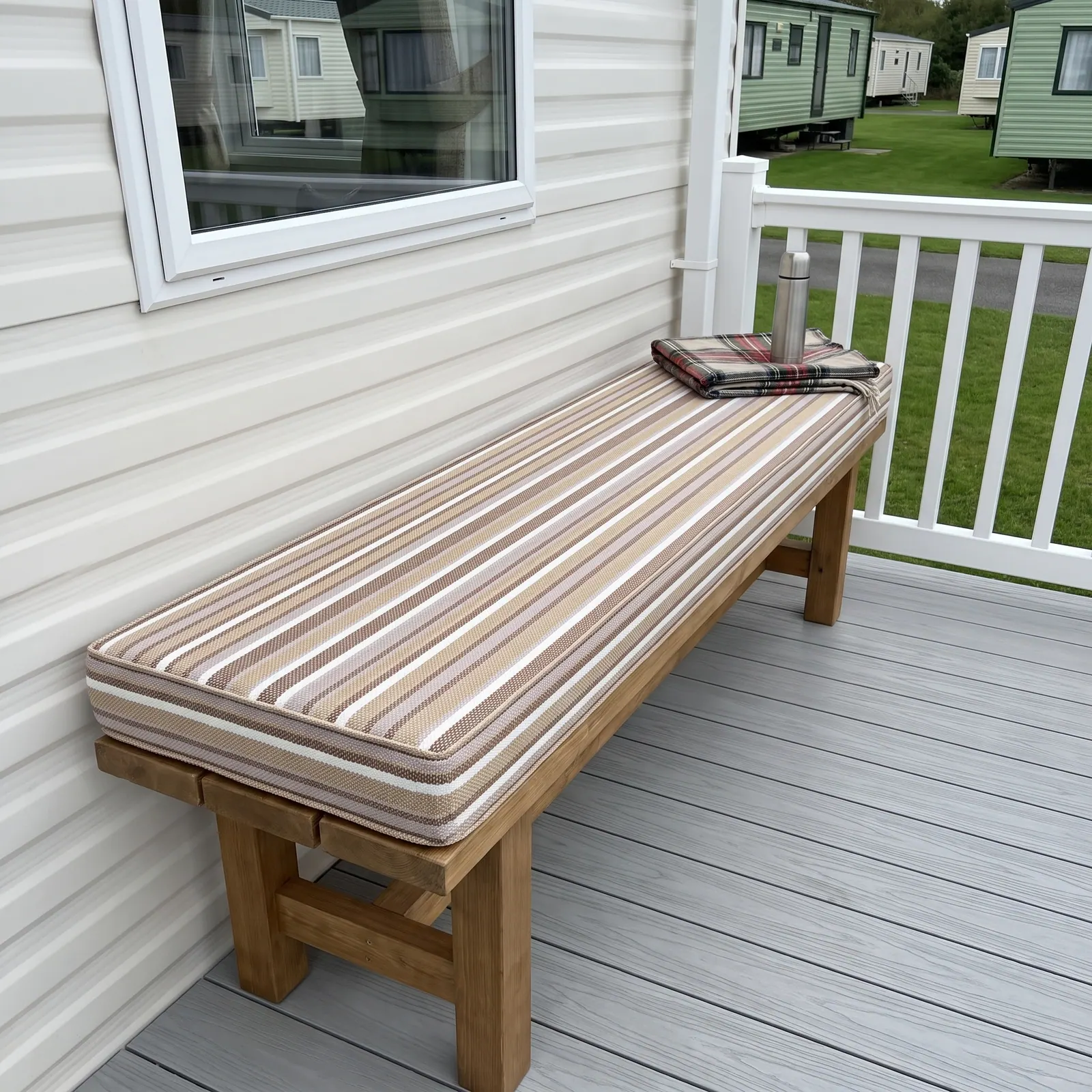
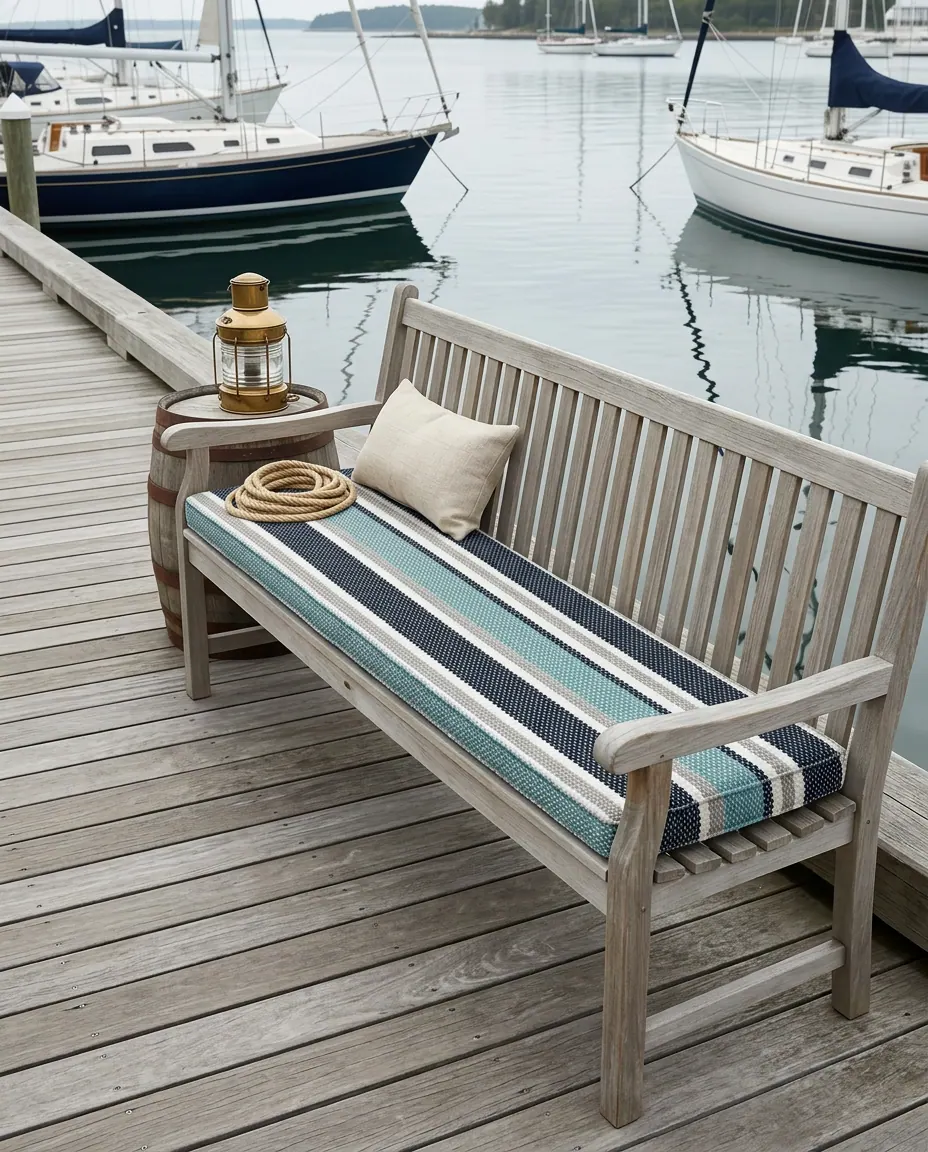
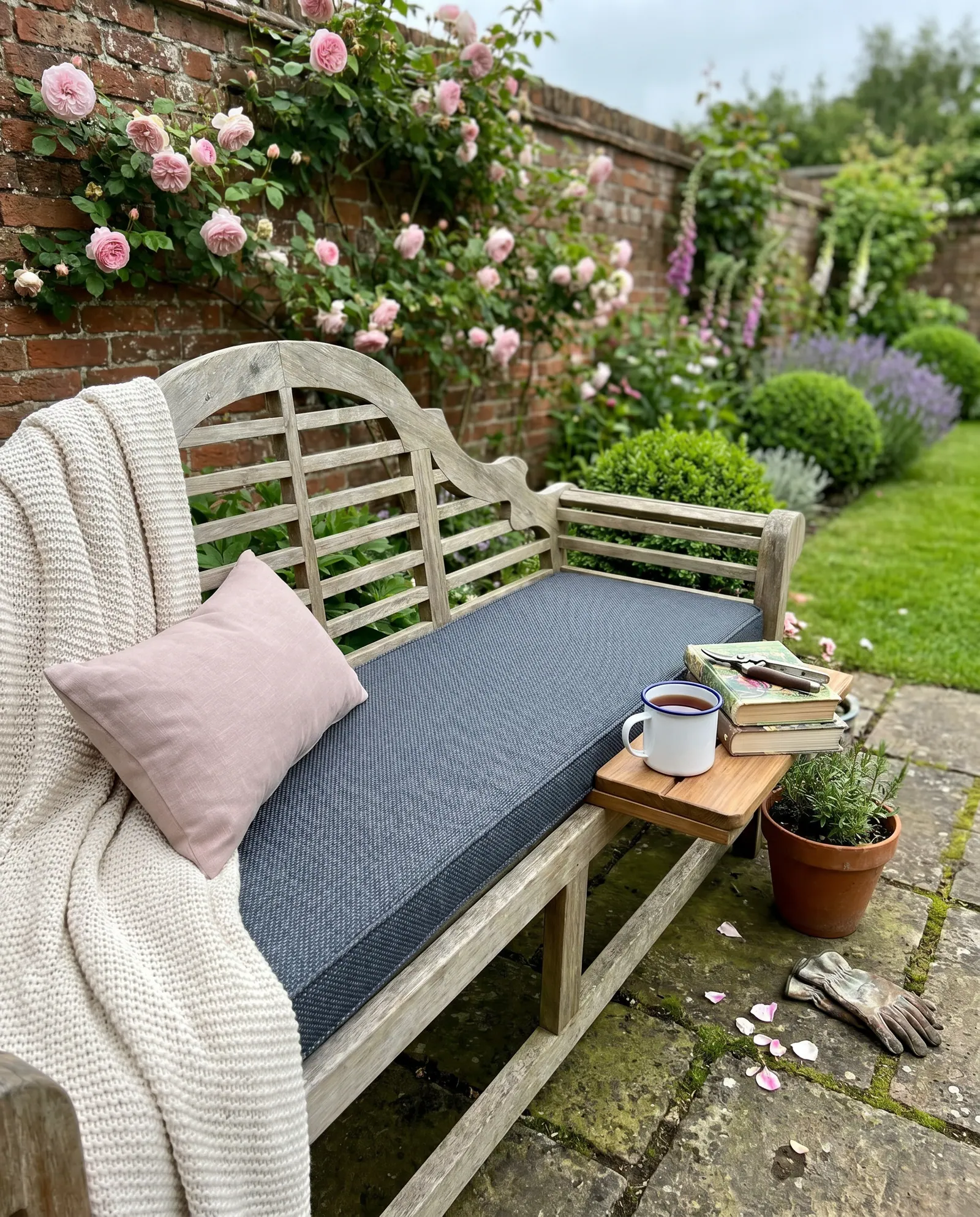
Photographs for homes like these
Open any photograph large; each one has its own link and a Save button.
 Save
 Save
 Save
 Save
 Save
 Save
Color under a wet-slate sky
Welsh light is soft and often gray, and gray light flattens cool colors. A slate-gray cushion under a slate roof simply disappears.
Warm it up instead. Rust, mustard and moss green hold their color on a dull afternoon and hide garden grit better than cream does. If there's a traditional tapestry blanket on the sofa, take one color from it for the piping and let a plain linen-look weave carry the seat. Outside, the same trick works in outdoor acrylic: a quiet body, a bright welt, and nothing that shows every splash.
In Wales the weather sets the schedule. Rain doesn't negotiate, so build every outdoor cushion to come inside.
Callum
Buyer questions: rain, curves and crooked benches
- A common question
Are your outdoor cushions waterproof?
The workshop's answerThey're water-repellent, not waterproof. The outdoor fabrics are premium cloths made for outdoor use, and shedding water is what lets them stand up to the weather. For houses with messy kids there are also fabric charts that are easy to wipe clean.
- A common question
Which outdoor fabrics do you have, and will they stand up to sun and rain?
The workshop's answerThere are four outdoor fabric charts, all water-repellent and UV- and fade-resistant, meant to stay outside through the summer. They're soft woven fabrics that feel like real cloth, not vinyl or a plastic finish, and the workshop sends close-up photos of any code.
- A common question
Can you make a bench cushion with a rounded or curved end?
The workshop's answerYes. Send a simple sketch with the measurements marked, showing where the curve starts and ends; the workshop won't interpret a curve from numbers alone. Once the shape is confirmed, it's ordered as a custom shape, sized by the longest length and the width, with the sketch uploaded.
- A common question
My bench is a slightly different depth at each end. Do I need a special shape?
The workshop's answerUsually not. With ends of 16¼ in (41.5 cm) and 17 in (43 cm), a trapezoid can't keep both 41 in (104 cm) long sides, so the workshop recommended a simple 41 x 16½ in (104 x 42 cm) rectangle for such a small difference.
- A common question
Can I use an indoor fabric for the piping on outdoor cushions if the terrace is covered?
The workshop's answerIndoor fabrics aren't recommended outdoors, but a covered terrace that gets no rain or direct sun is a different case, so yes. Order through the outdoor listing, since the outdoor fabric sets the price, and write the piping code in the personalization box.

Have it made
Have it made for your home — ask Callum’s workshop
Tell them where it lives. Porch, deck or boat: the weather picks the fabric and the foam before anyone else does. — Callum
Leave your details and the workshop will call you to confirm measurements, fabric, foam and piping. No prices, dates or payment on this page: it is a request, not an order.
Questions about cushions in Wales
Can garden cushions stay outside through a winter in Wales?
Not if you want them next summer. October to January is the wettest stretch across Wales, and the coasts average 15 or more gale days a year, about 30 in southwest Pembrokeshire. Store cushions indoors, washed and dry to the core, in breathable bags.
How thick should a cushion be for a deep stone window reveal?
Usually 2 to 3 in (5 to 7.5 cm). The workshop's best seller is 3 in (7.5 cm), which suits tight spots such as a 15 in (38 cm) gap under a sill. Go slimmer only if a casement has to swing over the seat, and not below 2 in (5 cm) for comfort.
What cushion suits a pew in a converted chapel?
A slim seat of 2 to 3 in (5 to 7.5 cm) in a hard-wearing linen-look or performance weave, split into lengths of about 79 in (2 m) or less, with corner ties or a non-slip base. Draw any curved or shaped pew ends on paper before ordering.
Do cushions for a home in Wales have to meet UK fire rules?
The Furniture and Furnishings (Fire) (Safety) Regulations 1988 name cushions: foam fillings face their own ignition test and covers a match test. The workshop's standard foam is not a fire-retardant grade, and we don't claim compliance. For a holiday let, plan on covers only and a local upholsterer.
Fair winds — Callum
The atelier
Keep going
Across the Map
Nearby places
Close by on the map