Across the Map · United Kingdom
Window seat cushions for English bay windows, terraces and conservatories
Most English bays are trapezoids pretending to be rectangles. Give me five honest numbers and I'll give you a cushion that sits flush under every sash.
- Sun & UVGentle
- HumidityHumid
- WinterMild
- CoastSalt air nearby
- Typical seatsCanted bay window seat, square bay window seat, georgian window board

 Save
The quick answer
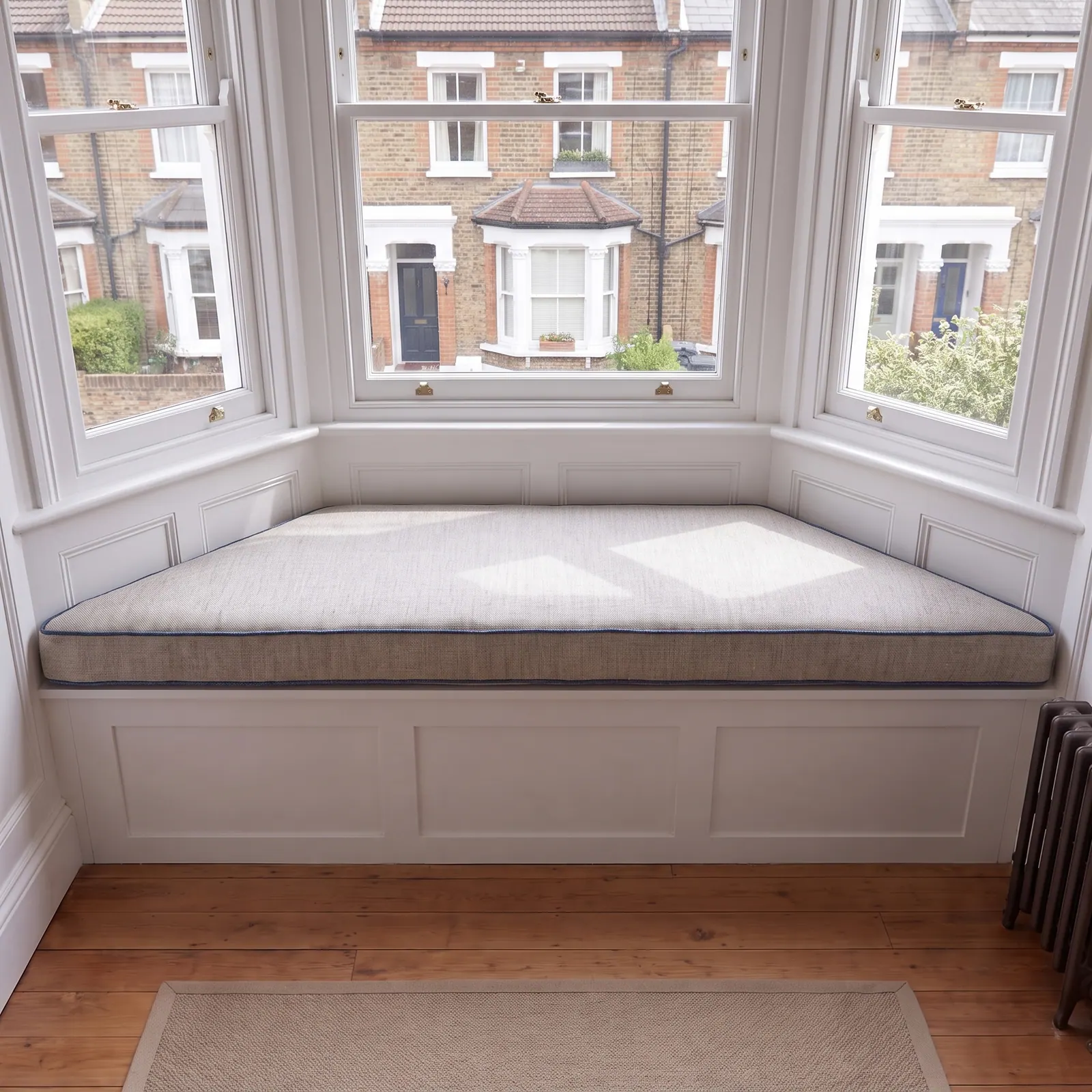
Window seat cushions in England usually sit in canted Victorian or Edwardian bays, which are trapezoids in plan. Measure the back, front, straight depth and both angled sides in centimeters; each angled side must be longer than the depth. Choose 3 to 4 in (7.5 to 10 cm) of foam, zip-off covers, and UV-resistant fabric for south-facing bays and conservatories.
24 in of rain, 112 wet days and a lot of glass
England is an easy place to be a cushion, with two exceptions: cold glass in winter and sun through glass in summer. The Met Office's 1991 to 2020 averages for Heathrow give 24.2 in (615 mm) of rain on 112 days, 1,675 hours of sun and 27 air frosts. July afternoons average 75°F (23.9°C); January ones, 47°F (8.4°C). The driest parts of eastern England get about 20 in (500 mm), and the south coast tops 1,750 hours of sun.
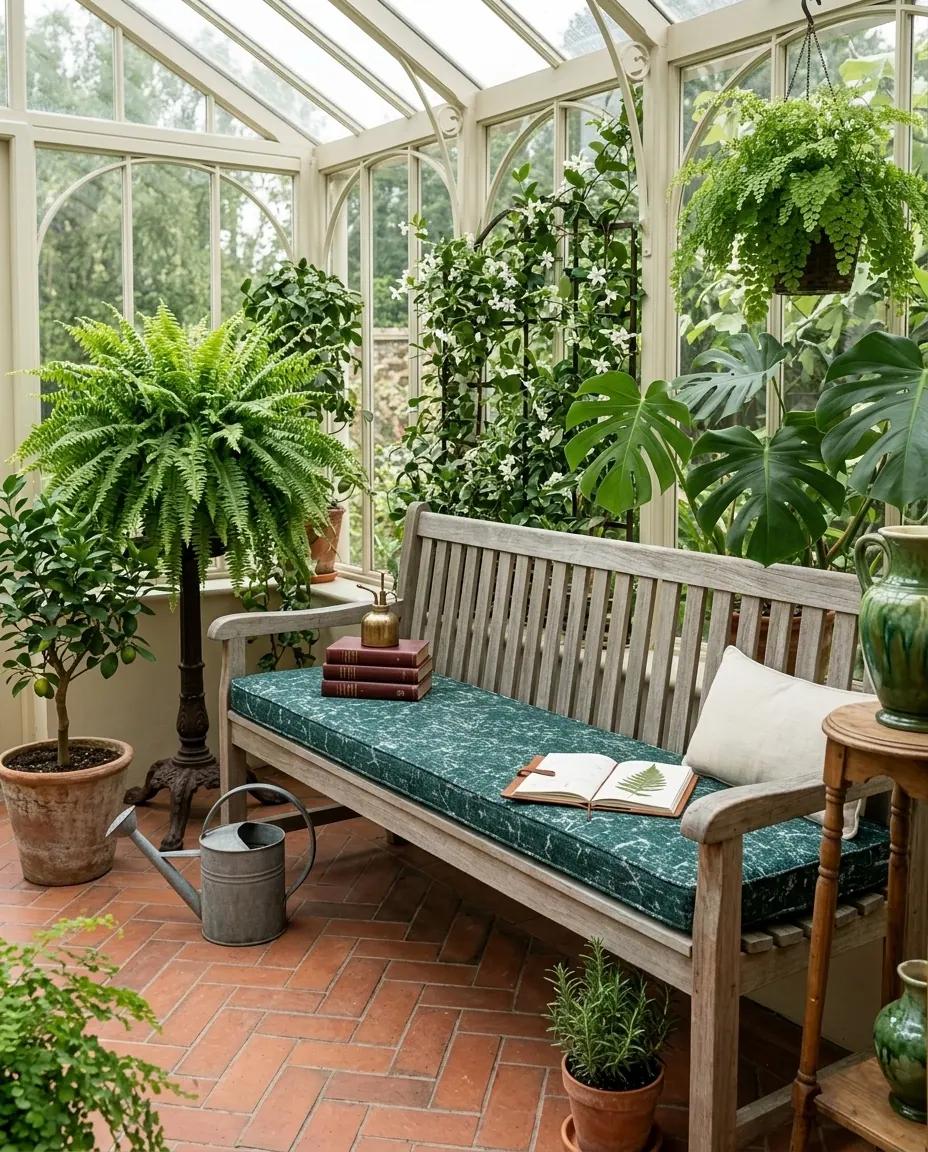
The conservatory is where those numbers collide. The 19th century was its golden age, mainly in England, and domestic ones came back into fashion in the 1970s. A bench under glass takes the whole July sun and the whole January chill. Pick sunroom fabrics for it, and read window seat fading before you put dark velvet in a south-facing bay.
Winter brings condensation, which UK guidance calls the most common form of damp. It collects on window frames, right beside your cushion. The rest of the country is on our UK page.
The canted bay, reduced to numbers
Late Victorian and Edwardian suburban houses in England were built with standard sash units about 4 ft (1.2 m) wide. Put them in a bay and you get the classic seat: a canted bay is an isosceles trapezoid in plan, and its common interior corner angles are 90, 135 and 150 degrees. A square bay is a rectangle with returns. A bow is a curve, and a different conversation.
Georgian houses do it another way: six-over-six sashes, often in deep reveals, where the seat is a window board and 2 in (5 cm) is the practical minimum for sitting.
Angles are just lengths in disguise. On a symmetric trapezoid, each angled side squared equals the depth squared plus half the difference between front and back, squared. So an angled side is always longer than the depth.
A buyer in the UK once wrote a trapezoid as 58 in (147 cm) on top, 89¾ in (228 cm) on the bottom and 17 in (43 cm) deep, with one slanted side of 17 in (43 cm). That can't happen. Both sides were really 22¾ in (58 cm), which puts the true depth near 16¼ in (41.5 cm). The check cost a day. A wrong cut costs a cushion.
Made to measure cushions for a London terrace or a northern semi start the same way. What are your five numbers, partner?
Measuring a canted bay in five moves
Draw it from above
Sketch the seat as seen from the ceiling. Label the back (window side), the front, and the left and right angled sides. For four or more facets, use the bay window calculator.
Measure the seat top
Rigid tape on the board itself, not the floor. Write exact numbers and don't shave anything off; the workshop decides any allowance.
Take the depth square to the front
Measure straight back from the front edge at the center and at both ends. If they differ by more than about 3/8 in (1 cm), write each one down.
Check each side against the depth
Every angled side must come out longer than the depth. If one doesn't, a number is wrong. The trapezoid calculator does the arithmetic.
Photograph the bay and the drawing
Shoot the bay straight on. A bay that looks like a trapezoid in a photo can be a rectangle seen at an angle, and the workshop checks for exactly that. The 3-sided bay guide has a worked example.
A symmetric bay that checked out to the millimeter
A buyer in the UK sent a symmetric bay in millimeters: front 72¾ in (1,847 mm), back 47 in (1,195 mm), depth 22¼ in (565 mm), with 60 degrees at the front corners and 120 at the back. Both slanted sides, which they called diagonals, came to about 25¾ in (652 mm).
I ran it the long way, in the buyer's millimeters. Half the difference between front and back is 12¾ in (326 mm). 326 squared plus 565 squared is 425,501, and the square root of that is 652.3. The drawing agreed with itself, so nothing needed redrawing.
They asked for it 3 in (7.5 cm) thick, with self piping and a non-slip base. That's the whole trick: send enough numbers that they can check each other.
- Measured
- Front 72¾ in (1,847 mm), back 47 in (1,195 mm), depth 22¼ in (565 mm), angled sides about 25¾ in (652 mm); 60° front and 120° back corners; 3 in (7.5 cm) thick
- What it taught
- Front, back and depth plus the angles or the angled sides fully define a symmetric trapezoid; if they agree, the drawing is ready.
Bay, window board, conservatory and garden: fabric, foam and piping
| Seat | Fabric | Thickness and build | Piping |
|---|---|---|---|
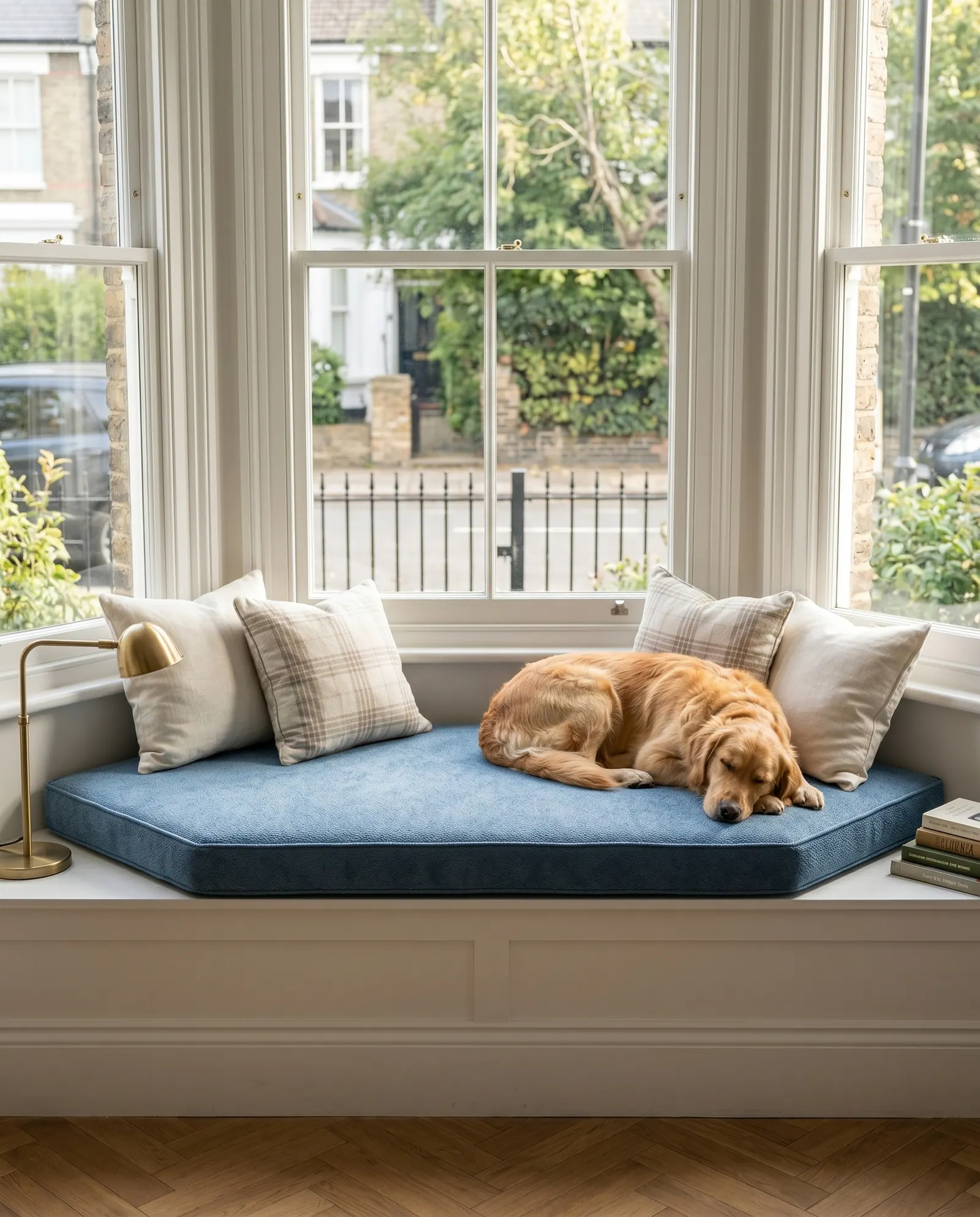
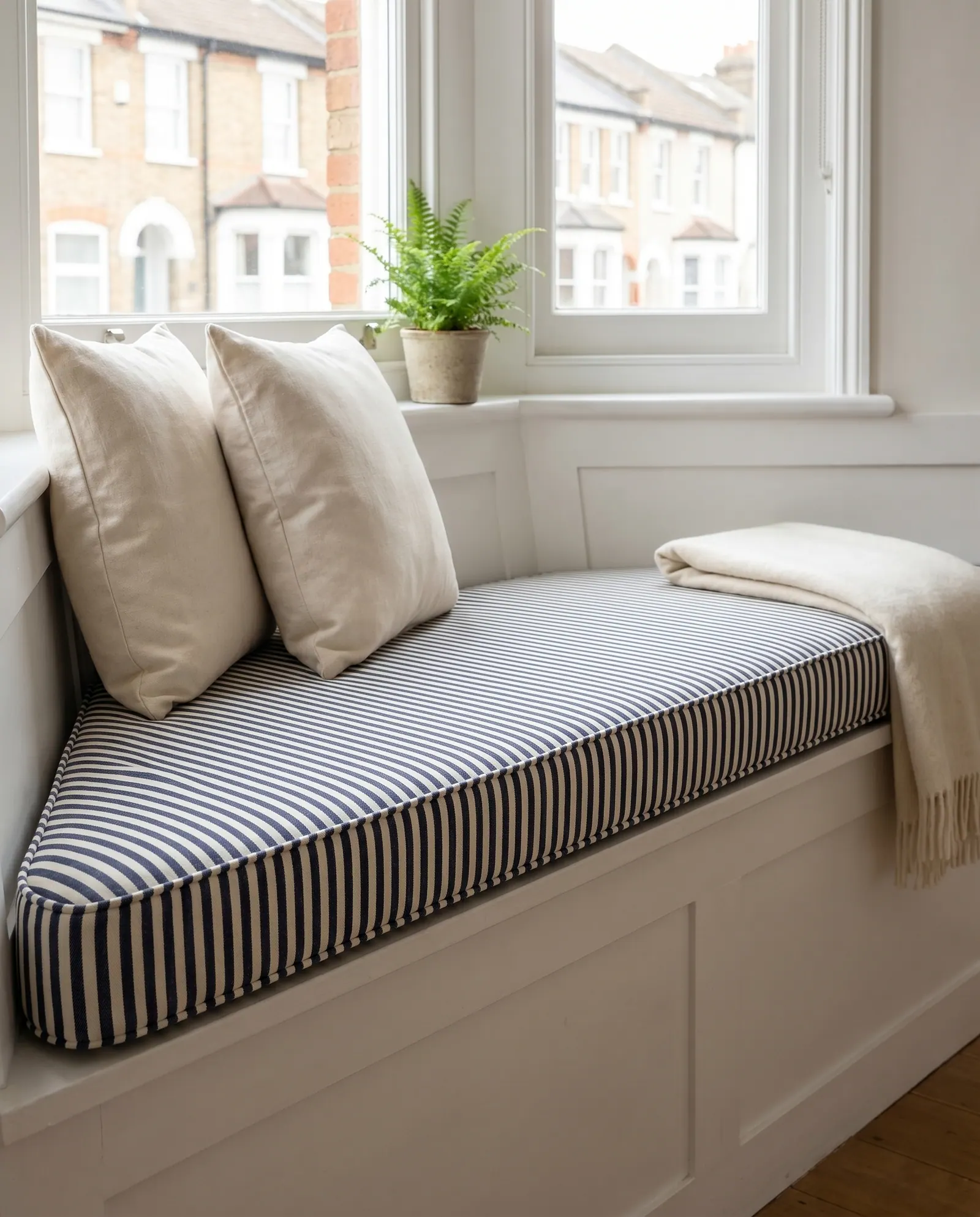
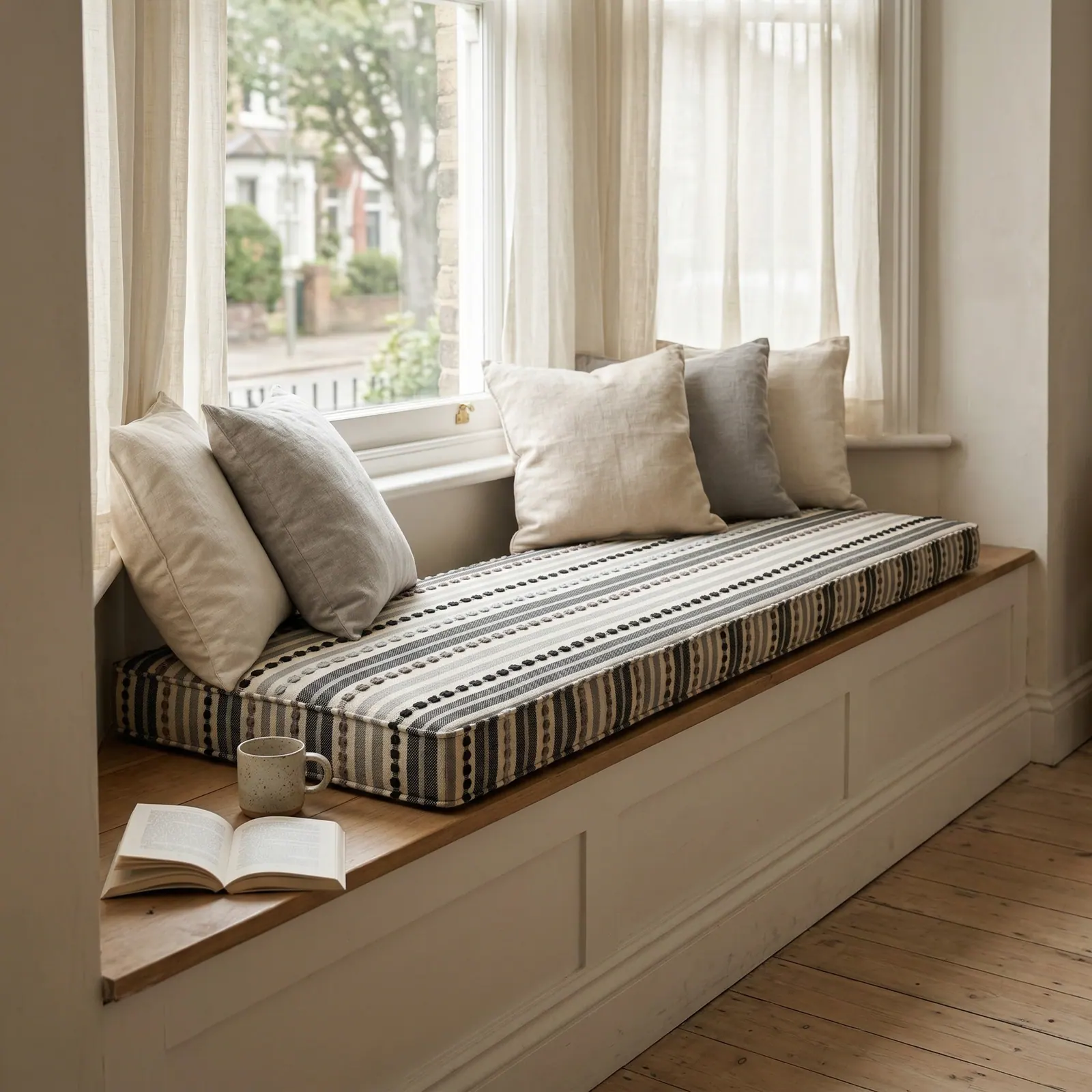
| Canted bay in a terrace | Linen-look, ticking stripe or a performance weave | 3 to 4 in (7.5 to 10 cm); one piece or one per facet | Contrast piping marks each facet |
| Georgian window board | Velvet or corduroy | 2 in (5 cm) minimum; check clearance under the sill lip | Self piping |
| Conservatory bench | Outdoor fabric, UV- and fade-resistant, used indoors | 3 to 4 in (8 to 10 cm); a firmer hand than indoor cloth | Self or contrast |
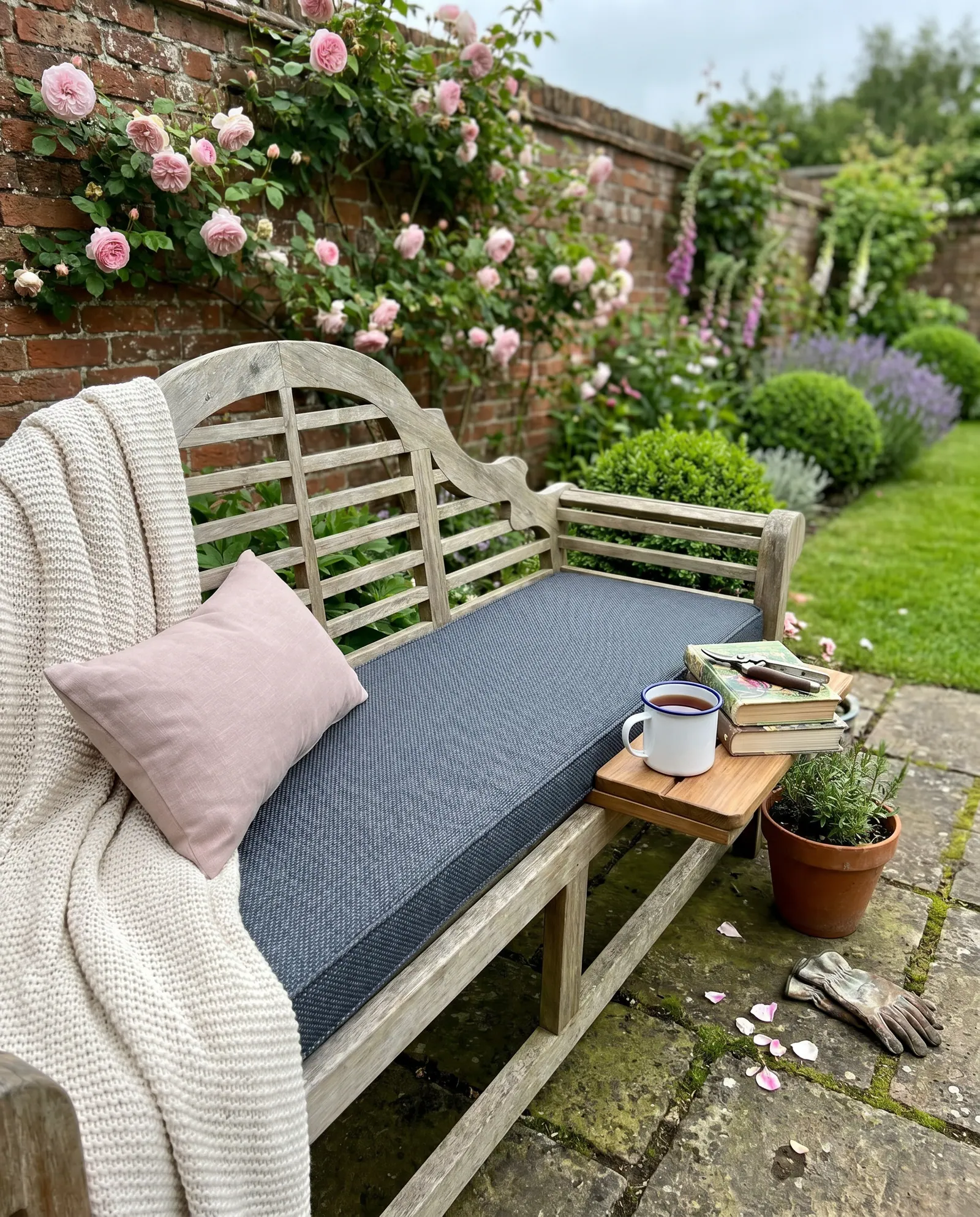
| Garden bench | Outdoor fabric, water-repellent | 3 to 4 in (8 to 10 cm); ties at the back corners | Self piping |
Feather wrap isn't offered; Dacron wrapped around the foam softens a firm edge. Handmade cushions over soft foam can vary by about 3/8 in (1 cm) from the drawing.
An English year for a bay seat and a garden bench
- Spring: bring garden cushions out in a dry spell, and keep them under cover when you can.
- Summer: in south-facing bays and conservatories, draw a blind at midday and rotate cushions so one end doesn't fade alone.
- Autumn: brush off leaves and pollen before storing outdoor cushions; mildew feeds on the dirt.
- Winter: wipe condensation off the glass and window board each morning, and lift the seat cushion weekly to air the underside.
- Any season: covers zip off and wash at 86°F (30°C) on gentle; air dry them.
- Before the frosts, which average 27 a year at Heathrow: store outdoor cushions dry, off the floor, in breathable covers.
Photographs for homes like these
Open any photograph large; each one has its own link and a Save button.
 Save
 Save
 Save
 Save
 Save
A bay window is a trapezoid that forgot to mention it. Five honest numbers, and it can't hide.
Nate
Buyer questions: bays, trapezoids and softer edges
- A common question
How do I measure a bay window seat for a cushion?
The workshop's answerDraw the seat as seen from above, usually a trapezoid or a multi-angled shape. Write on it the back edge against the window, the front edge, the depth from back to front, each angled side, and every edge in order if there are several angles. Send a photo of the drawing and of the bay. The workshop checks the geometry before production; you order by overall length and depth, such as 105 x 18 in (267 x 45.5 cm), and upload the drawing.
- A common question
What measurements do you need for a trapezoid window seat cushion?
The workshop's answerThe front and back lengths plus the straight depth between them. The workshop calculates the two angled sides and sends a diagram to confirm: a bottom of 115 in (292 cm), a top of 82 in (208 cm) and a depth of 20 in (51 cm) gave sides of about 26 in (66 cm). Upload the approved diagram when you order.
- A common question
Should I give you the exact measurements of my window seat, or take off a centimeter to allow for variation?
The workshop's answerGive the exact measurements of the space and don't reduce them. The workshop reviews your diagram and decides any allowance with its production team.
- A common question
Can you make a cushion with an angled end, for under the stairs or a trapezoid bay?
The workshop's answerYes. Send the size and a paper drawing that shows the angle, and the workshop copies the exact shape. It also checks whether a bay that looks like a trapezoid in a photo is really a rectangle seen from an angle.
- A common question
Can I get feather-wrapped foam, about 20% feather, for my bay window seat?
The workshop's answerFeather wrap isn't offered, but the foam can be wrapped in Dacron for extra comfort. That was the answer for a trapezoid bay seat 96 in (244 cm) on the long side, 55½ in (141 cm) on the short side and 19¼ in (49 cm) deep, 4 in (10 cm) thick.

Have it made
Have it made for your home — ask Nate’s workshop
Send the numbers in inches: length × depth × thickness, plus any angle. The workshop checks them with you, because foam has no undo button. — Nate
Leave your details and the workshop will call you to confirm measurements, fabric, foam and piping. No prices, dates or payment on this page: it is a request, not an order.
England window seat cushion questions
What angle is a typical canted bay window?
A canted bay is an isosceles trapezoid in plan, and common interior corner angles are 90, 135 and 150 degrees. Don't assume one: measure the front, back, straight depth and both angled sides, and let the numbers give you the angle.
Can a conservatory bench cushion use outdoor fabric?
Yes. Outdoor fabric is UV- and fade-resistant, which helps under glass. It feels like woven cloth, not vinyl, but it is firmer than indoor upholstery fabric, so sit on a swatch before you commit to it for everyday indoor use.
How accurate is a made to measure window seat cushion?
Expect about 3/8 in (1 cm). The cushions are handmade over soft foam, and small variations of about 3/8 in are within the stated tolerance. Send exact measurements of the space and let the workshop decide any allowance.
Should a long bay cushion be one piece or several?
On a long or many-faceted bay, usually several. Separate pieces are easier to lift, air and flip, and each can sit square to its own window. One piece looks cleaner on a shallow three-sided bay, so decide from the drawing.
± 1/4 in — Nate
Concept Sketches
Sketches for homes like these
Real projects, drawn up as ideas you can borrow.
The atelier
Keep going
Across the Map
Nearby places
Close by on the map