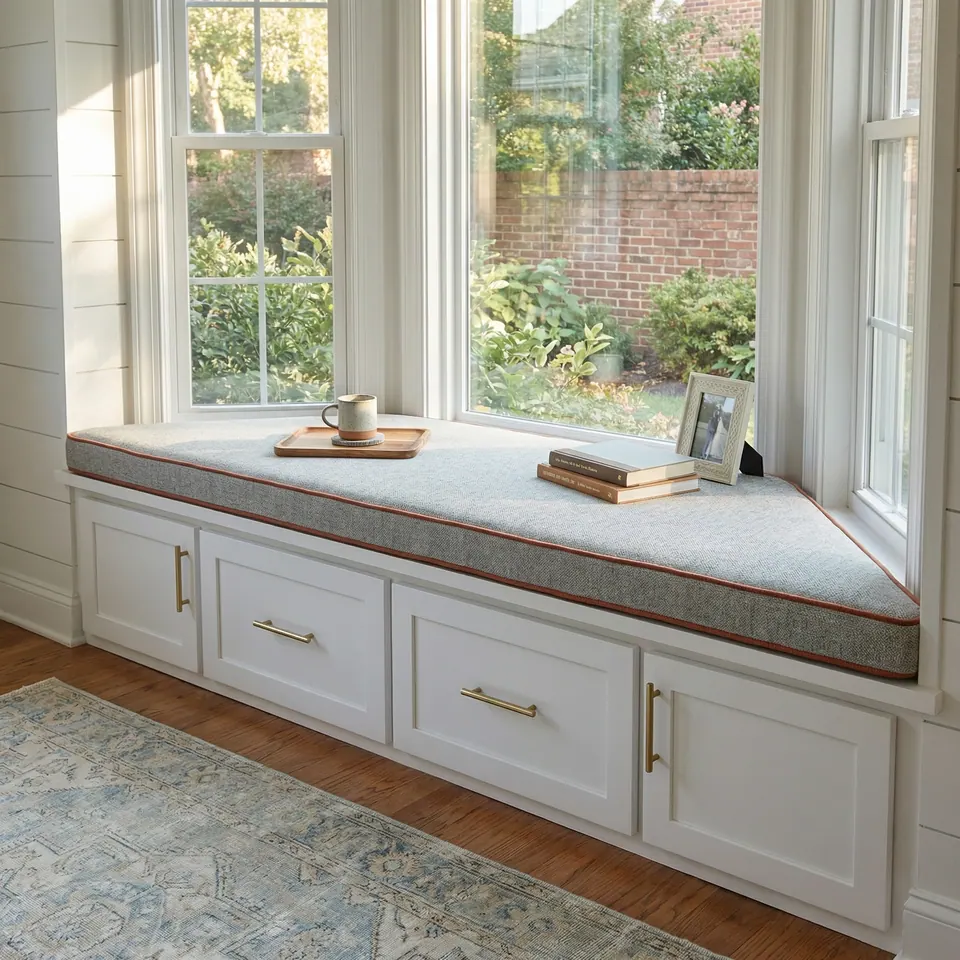
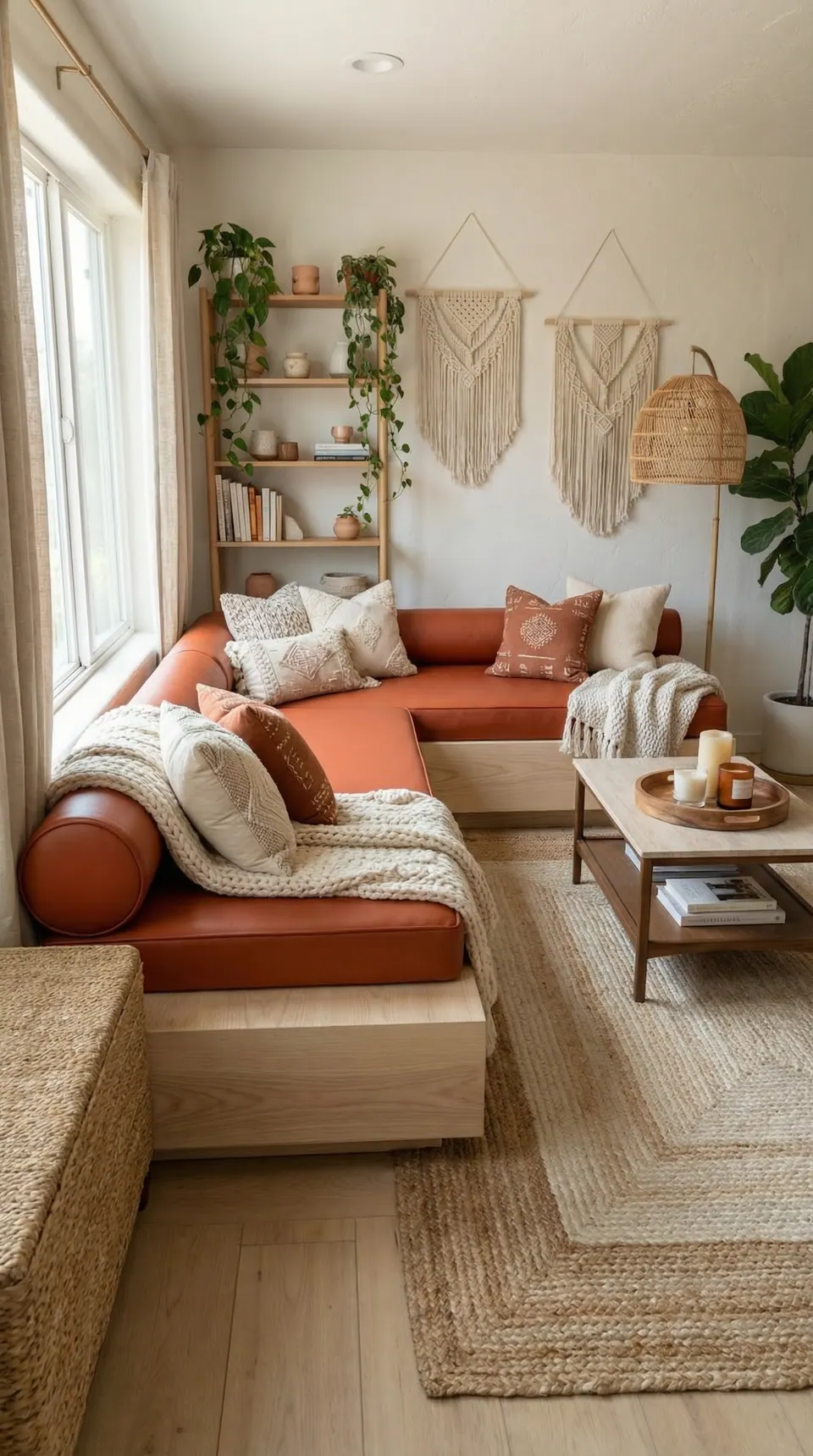
The Pattern Room · a measuring pattern
Cushions for 7-sided and rounded bay window seats in older homes
Old houses love a turret, and turrets love to fool a tape measure. Pull up a chair; we'll take the seat one short wall at a time.

 Save
The quick answer
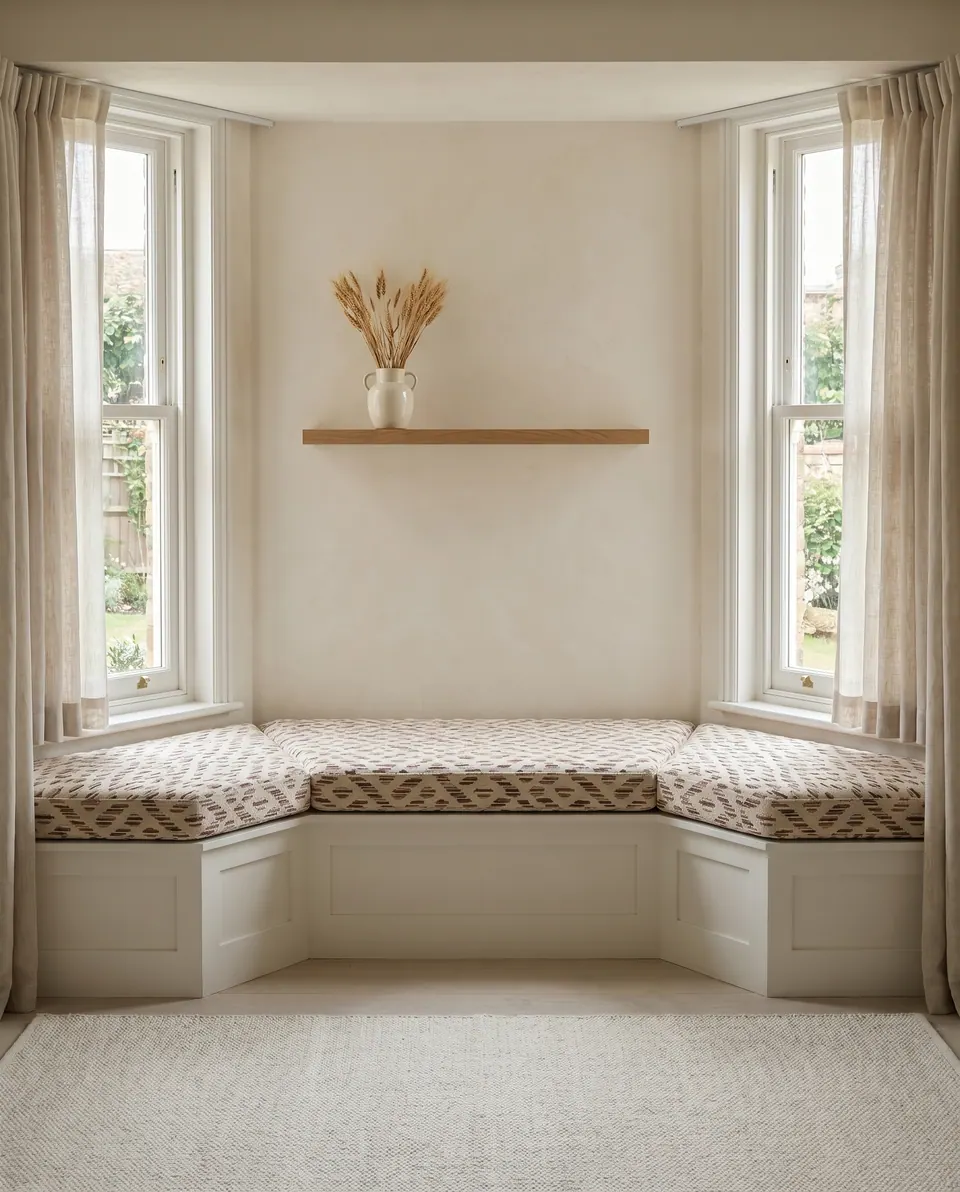
A 7-sided bay window seat cushion is usually made as several angled sections, with a break at each corner, so every piece lifts out on its own. Measure each facet at the face of the trim, number the facets left to right as seen from the room, and add the depth at every corner. A truly round bay needs a paper template, and a strong curve may be declined.
Seven short walls pretending to be a circle
A turret window seat is rarely as round as it looks from the doorway. Up close, it is often a row of short, flat stretches of trim meeting at shallow corners, which is good news for anybody sewing a cushion.
A 7 sided bay window seat cushion is usually made the way the bay was built: as angled sections, each meeting the next at a corner. I've re-covered enough old window seats to know the one everybody fights over has to come apart for cleaning.
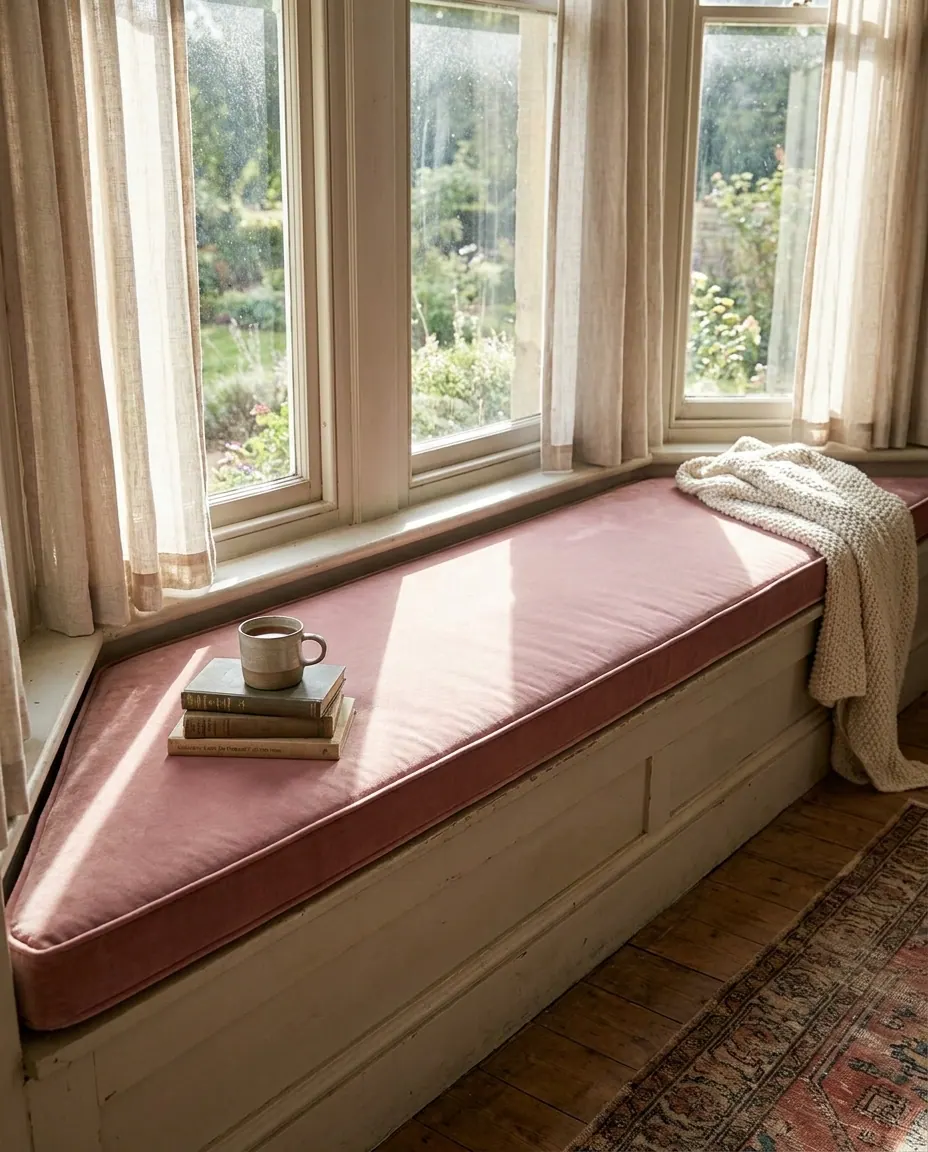
So the first question: does your bay have flat facets, or a true curve wearing trim? The dusty rose velvet seat at the top of this page is the easy case: a straight run cut to an angled end, the building block every bay window cushion starts from.
Facets or a true curve: how each bay gets built
| Your bay | How it's usually made | What to send | Honest odds |
|---|---|---|---|
| Three-sided (canted) bay | One trapezoid or three angled pieces, ordered as a custom shape | Every edge, the depth and a photo | Standard custom work |
| Five- to seven-facet bay | Angled sections that break at the corners | Each facet at the trim, depth at every corner | Made regularly |
| Asymmetric bay | Pieces cut to your exact outline | A sketch with every side measured, or a full-size paper template | Fine, with a few extra measurements |
| Shallow curve or bow | A curve drawn from its start, end and depth, or straight segments | Where the curve starts and ends, its shallowest and deepest depth | Usually possible |
| Truly round turret | Straight segments that follow the trim, or a traced template | Photos plus a template photographed beside a tape measure | May be declined after review |
Measuring a seven-facet bay, corner by corner
Decide: facets or curve
Lay a yardstick flat against each window's trim, one stretch at a time. Flat means a facet; rocking means a curve. If one stretch rocks, draw that stretch as a curve and keep the flat ones as straight lines.
Number the facets left to right, from the room
Stand in the room facing the window and letter each facet A to G, left to right. Use that same order on your sketch, your photos and your message, so the maker's diagram and yours point at the same edge.
Pattern sheet A 7-facet bay seat. Edges A, B, C, D, E, F, G run around the window side; H is the straight front edge. The depth is measured from the front edge straight back to the deepest point. Measure each facet at the face of the trim
Measure from the face of the window trim, not the glass, corner to corner. Measure every facet separately, even the ones that look identical; in older houses they seldom are. Write the exact number and don't subtract anything, because the workshop handles any fitting allowance.
Take the depth at every corner
At each breaking point, measure straight back from the front edge of the seat to the trim, square to the front, not along an angled side. An angled side is always longer than the straight depth, so if yours comes out shorter, measure again.
Add the front edge and both diagonals
Measure the straight front edge from end to end, then both diagonals, corner to far corner, as a check. Old walls are rarely square, and the diagonals tell the maker which way the seat leans. Don't assume 45° corners; measure what you have.
Choose where the breaks go
Put the breaks at the angles, so each section lifts out for cleaning or for the storage lid underneath. Very long pieces, around 78 in (2 m) and up, are suggested in two, and complex shapes are often split into two or three. Over a radiator, split the cushion so heat can escape.
Trace any curve on paper
For a stretch that curves, lay wrapping paper or newspaper on the seat, trace the outline with a marker, cut it out and photograph it flat beside a tape measure. Or draw it, marking where the curve starts and ends and its shallowest and deepest depth. See making a paper template.
Pattern sheet Lay paper on the seat and trace the edge, write the widest width and the front-to-back depth on the template, then photograph it flat from directly above with a tape measure in the picture. Send it, then approve the maker's drawing
Send the sketch, a photo of the whole bay taken from the room, the thickness and the fabric code, and order through the custom-shape route, not the rectangle one. The workshop redraws odd shapes as a clean diagram for you to check. Approve it before anything is cut. More in drawing a custom shape.

Have it made
Measured it? Have Rosa’s workshop make it
Swings sway, rockers rock, dogs circle three times. Tell the workshop what your seat goes through, and they will plan for it. — Rosa
Leave your details and the workshop will call you to confirm measurements, fabric, foam and piping. No prices, dates or payment on this page: it is a request, not an order.
When the curve is too round to promise
Here's the part a maker keen for your order might skip. Mild curves are fine. A strongly curved outline, like a truly round bay, or a seat with too many curves, may be declined after the craftsmen review your drawings and photos. They would rather say no than ship an approximate fit that gaps at every window.
That's why a round turret is often better served by straight segments that follow the trim, or by a full-size template. A template has turned a borderline shape into a yes before: an S-curved bench edge was declined from a drawing, then made once the buyer supplied one. For an asymmetric bay in the US, the buyer offered a template; the workshop asked for a sketch with every side measured, plus a few extra dimensions, and quoted from that.
To draw a gentle curve instead, measure its chord and its rise, the method in curved cushions by chord, rise and radius. Curved and complex shapes go to the most experienced craftsman and take longer to make than plain ones, so leave room on the calendar. For turret ideas, browse Victorian bay window seat cushions and curved and bow window seats.
A floor pillow that curved toward the room
A parent in the US wrote to the workshop about a child's bedroom with a bay of three windows, each section 46 in (117 cm) wide. They didn't want a seat cushion. They wanted a floor pillow that tucked right into the bay, straight against the three windows and curved on the room side, a spot for a child to curl up in the window.
The workshop asked for one thing before anything else: a drawing with every measurement on it. Three straight backs of 46 in, the depth at each corner, and the front curve marked where it starts, where it ends and how deep it runs. From that drawing came a quote in the linen tufted floor-cushion range.
The parent had hoped for a smaller number, and the workshop was honest about why it wasn't: a piece that size, cut to a custom curve, doesn't price like a rectangle. But the drawing is what made the answer fast.
- What it taught
- A simple drawing with every dimension marked is the fastest way to get a custom shape quoted.
Dress it for reading, then test it in the calculator
A turret seat is where somebody reads all Saturday afternoon, so build it for that. The standard thickness is 4 in (10 cm), and most people keep it for a tailored built-in look; for curved benches the workshop has suggested a trimmer 2 to 3 in (5 to 8 cm). Back pillows run about 16 in (40 cm) tall, made the length of the seat, and 8 in (20 cm) round bolsters tuck into the end corners. Fabric ties sewn into the seams hold each section to its stretch of seat. See reading nook cushions and bolsters and the reading nook cushions collection.
A bay takes daylight from several sides at once, so read about window seat fading before you settle on a deep velvet.
Before you write to anyone, put your facet lengths and corner depths into the bay window calculator. If the numbers don't close there, they won't close on the cutting table either. So tell me, neighbor: how many facets does your bay really have once the yardstick has had its say?
Where turret seats go wrong
- Ordering a shaped seat as a rectangle. If front and back lengths differ, or there's a curve, use the custom-shape route. If checkout never asks for a drawing, you're on the wrong one.
- An angled side shorter than the depth. That can't happen. Measure the depth square to the front and each angled side corner to corner.
- Describing a curve with numbers alone. Subtle curves read as square. Draw the curve, or trace a template.
- Measuring on the first morning. Cushions travel vacuum-packed. Wait 3 to 4 days, then measure with the tape flush against a wall. See the first 72 hours.
- Shaving half an inch off to be safe. Send the true size; the maker handles the allowance.
A 7-sided bay window seat cushion is built as angled sections that break at the corners, so every piece lifts out on its own.
Rosa
Buyer questions: bays, curves and odd corners
- A common question
How do I order a cushion for a bay window seat with angled ends?
The workshop's answerUse the custom-shape (trapezoid) order route, not the rectangle one. Choose the size by the depth and overall length, then upload a drawing with every edge, any cut-ins and the depth, plus a photo of the seat. A hand sketch on paper is fine, asymmetric bays are handled the same way, and the cushion is cut to your drawing.
- A common question
Our window seat curves at one end. How do I measure a rounded shape?
The workshop's answerDon't send numbers alone; the workshop won't interpret a curve from numbers. Either sketch it with the total width and depth, the straight length before each curve, and where each curve starts, ends and how deep it runs, or trace the seat onto wrapping paper, cut it out and photograph it flat beside a tape measure. Each cushion gets its own drawing.
- A common question
Can you make a shaped floor cushion to fill a bay nook or a reading corner?
The workshop's answerYes. Before you order, send the shape, the measurements and a few room photos taken from a distance, so everything is agreed. For a quarter-round or curved space the workshop needs the two straight sides to work out the curve. It confirms up front whether any extra customization charge applies, and matching back pillows can be added.
- A common question
What measurements do you need for a bay seat with angled sides?
The workshop's answerEvery edge: the front, the back along the window, both angled sides, any short end or clipped-corner sides, and the depth. Take the depth straight from the deepest point to the front line, and measure each angled side on its own rather than repeating one number. Mark cut-outs such as a window handle, add the thickness, and label the drawing A, B, C, D.
- A common question
Should I take a little off my measurements so the cushion slides in easily?
The workshop's answerNo. Send the true, exact size of the space, end to end, without deducting anything. The workshop makes the cushion to your numbers, and its production team handles any fitting allowance. Piping sits on the seams, so it doesn't change the size either.
- A common question
Our window seat is an odd shape with cut-outs. Can you still make it?
The workshop's answerYes: six-sided window seats, stepped benches, curved nooks and rounded ends have all been made. Measure every side, draw the shape with all sizes on it, including rounded corners, joints and cut-outs, and send a photo of the drawing and the space. The workshop redraws it as a clean diagram for you to confirm, and difficult pieces go to its most experienced craftsman.
Turret and bay questions, briefly
How many pieces should a seven-sided bay cushion be?
Usually several, with the breaks at the corners so each section lifts out. Very long runs, around 78 in (2 m) or more, are suggested in two, and complex shapes are often split into two or three. One piece is possible but harder to fit and to ship.
What thickness suits a turret window seat?
The standard is 4 in (10 cm), and most buyers keep it for a tailored built-in look. Choose 3 in (7.5 cm) for a trimmer profile or a tight gap under a sill. Firm 32 kg/m³ foam keeps either thickness supportive.
Is a quarter-round or round floor cushion an option for a bay nook?
Yes, for a floor nook. Quarter-round corner cushions are sized by their two straight sides, up to 48 in (122 cm) as standard, which gives an arc of about 75.4 in (192 cm). Round floor cushions go up to about 49 in (125 cm) across.
Do I need to know the angles of my bay?
It helps, but it isn't required. Send the length of every facet, the depth at each corner and the angles if you know them; a sketch plus photos is enough for the workshop to draw a template for you to check. Never assume the corners are 45°.
Will a sunny turret fade the cushion?
A bay takes light from several directions, so fading is a fair worry. For a very sunny bay, ask for a sun-resistant fabric; one buyer with a 160 in (406 cm) trapezoid bay chose black sun-resistant cloth. Rotating the sections now and then also spreads the light.