Across the Map · United Kingdom
Made to measure cushions for Northern Ireland homes and coastal cottages
Belfast once led the world in linen and built its streets from red brick, a great many of them with a bay window. The bay seat is where most cushions here go wrong, and where a checklist saves them.
- Sun & UVGentle
- HumidityHumid
- WinterMild
- CoastSalt air nearby
- Typical seatsThree-sided bay window seat, sash window seat, conservatory bench

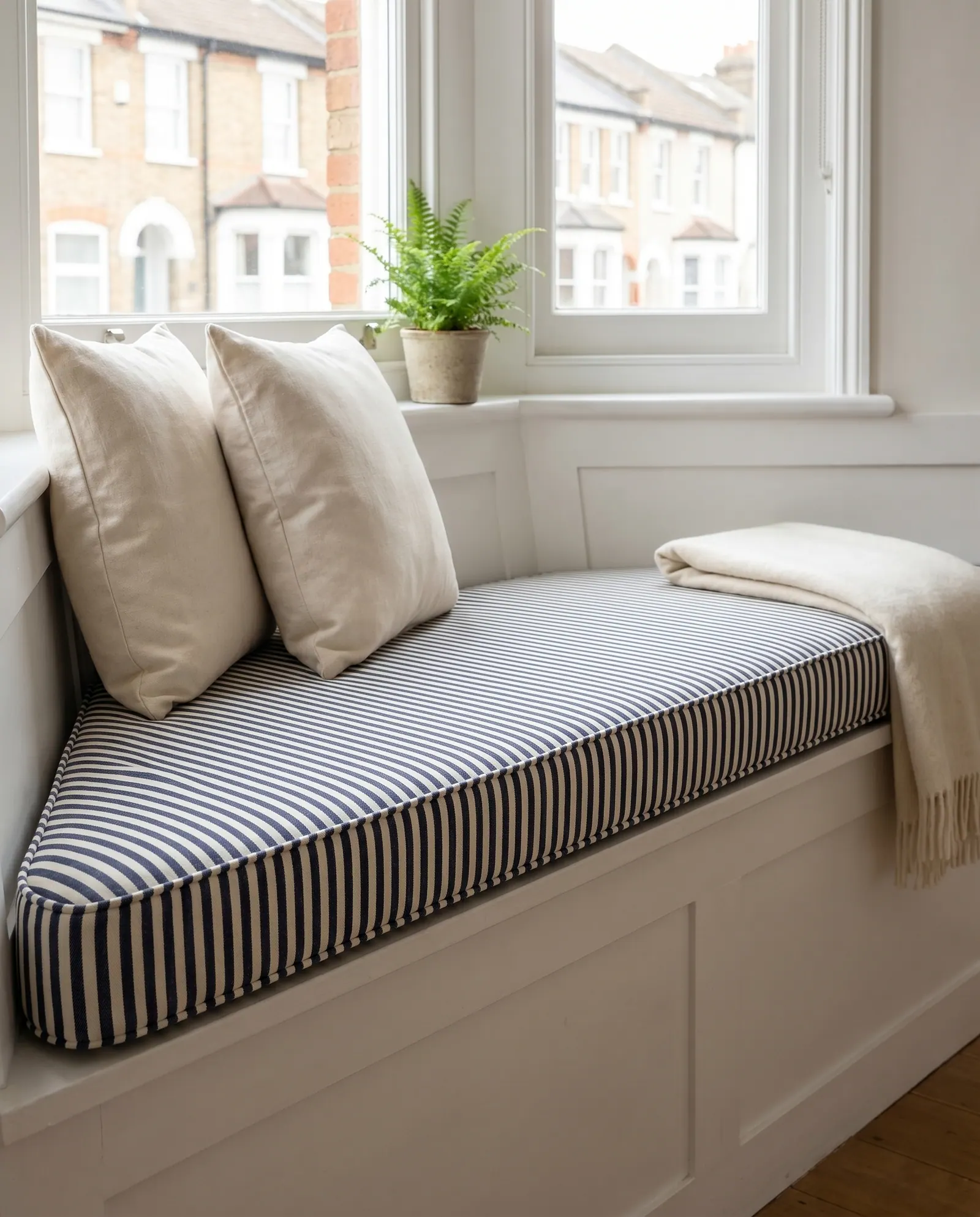 Save
The quick answer
Made to measure cushions in Northern Ireland are mostly for bay windows, window seats and conservatories, so measure every edge of the seat, choose zip-off washable covers, and keep conservatory cushions out of long direct sun and off wet glass. The weather is mild and damp: October to January is wettest, and the Antrim and Down coasts see about 15 gale days a year.
About 31 in of rain by the lough, 63 in the hills
The Met Office sums up Northern Ireland's climate in one word: equability. The Atlantic keeps winters mild and summers cool, and it keeps the rain coming.
The driest ground, around Strangford Lough, the east coast and the shores of Lough Neagh, gets just under 31 in (800 mm) a year. The Sperrin, Antrim and Mourne hills get about 63 in (1,600 mm), and Killeter Forest in west Tyrone about 79 in (2,000 mm). Everywhere, October to January is the wettest stretch, and even the driest areas count about 35 wet days in summer.
Sun is modest. The County Down coast averages over 1,450 hours a year, the northern and western uplands under 1,100, and July and August often cloud over. Most coastal sites see fewer than 20 air frosts.
So made to measure cushions in Northern Ireland live indoors most of the year through a long damp season. Fading is slow; mildew is patient. Build for washing and airing first. The rules that apply across the UK are on our United Kingdom page, and south of the border see Ireland.
Red brick, bay windows, and the bay that isn't square
Belfast's red brick came from the soft clay under the city, and whole districts went up as red-brick terraced streets. Add the Victorian and Edwardian villas and you have more bay windows than one tailor could cover in a lifetime.
A confession, dear: years ago I cut a bay cushion from a front edge, a depth and a guess about the angles. It went back. Side walls in old bays are rarely equal, and the angles are rarely what the builder intended.
Measure the bench, not the cushion you used to have. Write every edge of the seat in order: each run against the glass, the front edge, the depth at the center, and both angled sides. Then check one rule: a slanted side is always longer than the straight depth. If yours isn't, a number is wrong.
The three-sided bay guide walks through it, the bay window calculator checks the geometry, and bay window cushions shows the finished shapes. What does your bay measure along the front?
Linenopolis, and the linen-look cover
When Belfast was made a city in 1888 it was the world's largest center of linen manufacture, nicknamed Linenopolis. People here ask about real linen, and fairly so.
The standard linen weaves are blends, but there are 100% linen and 100% cotton charts beside them. Natural linen is lovely and honest about dirt: pale colors show it, and the workshop's advice for a grubby linen bench is a soapy cloth, not a soak. For a hard-working family bench it recommends its sturdy acrylic linen. The difference is laid out in real linen vs linen-look, with both families in the linen-look and linen and cotton-linen swatch pages.
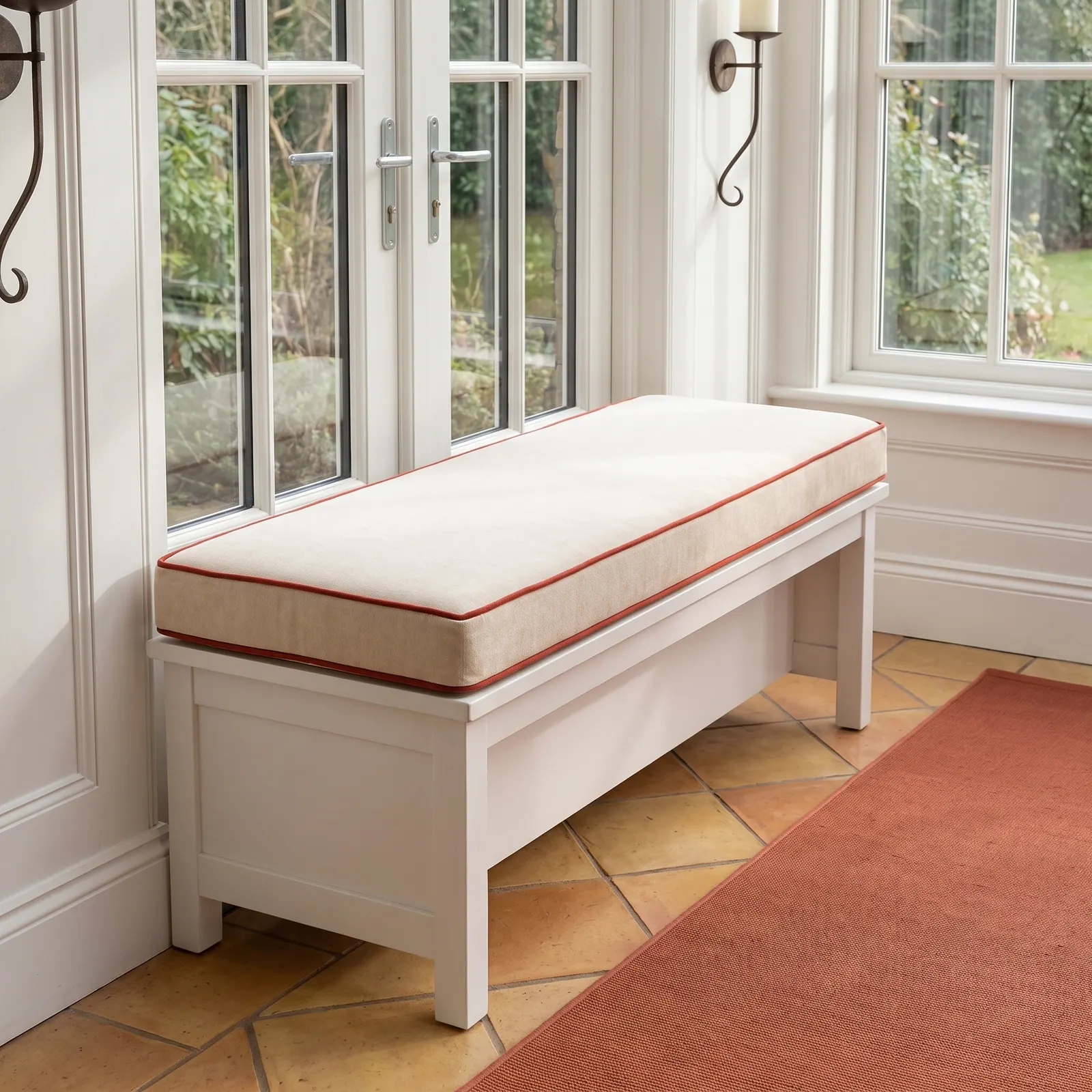
Then spend your attention on the piping. A navy or brick-red welt on an oatmeal seat is what makes a bay cushion look tailored rather than bought.
Conservatories: sun through the glass, water on the inside of it
The conservatory is the one room here where sun and damp both work on a cushion. Glass gathers heat by day and condensation by night.
Indoor fabrics have some UV resistance, but long, intense direct sun will fade them a little over time. If the bench sits in full sun, use an outdoor fabric; those are made to be UV- and fade-resistant. Either way, turn the cushion now and then so one end doesn't bleach.
Wipe condensation off frames and sills in the morning and don't let a cushion lean on wet glass. If one does get soaked, dry it within 24 to 48 hours, the window the EPA gives before mold starts. More in sunroom cushions and sunroom fabric in humidity.
Bay, sash, conservatory, garden: what I'd specify
| Seat | Fabric | Foam and build | Piping |
|---|---|---|---|
| Three-sided bay seat | Performance weave or velvet in a zip-off cover | 3 in (7.5 cm) standard foam, cut from a checked drawing; non-slip base | Contrast piping traces every angle |
| Sash window seat | Corduroy, velvet or linen-look | 2 to 3 in (5 to 7.5 cm); 2 in (5 cm) is the practical minimum | Self piping for a quiet edge |
| Conservatory bench | Outdoor fabric in full sun; linen-look in shade | 3 to 4 in (7.5 to 10 cm); turned now and then | Brick-red or navy contrast |
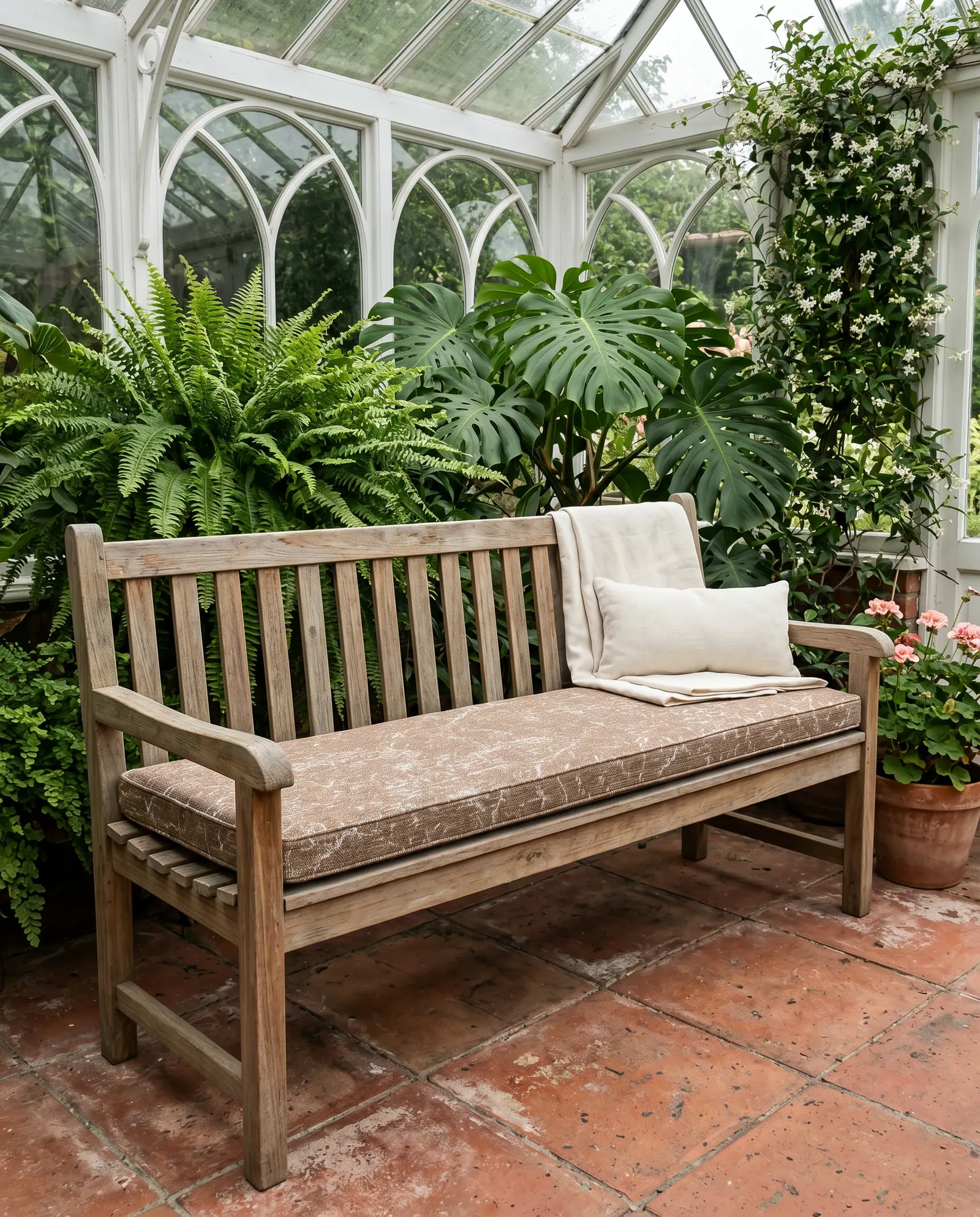
| Garden bench | Water-repellent, UV-resistant outdoor fabric | 3 to 4 in (8 to 10 cm); stored for winter | Self piping |
Covers zip off and wash at 86°F (30°C) on a gentle cycle, no bleach; air dry them. Handmade sizes carry a tolerance of about 3/8 in (1 cm).
Three numbers weren't enough, and the piping had to be honest
A buyer in the UK sent a photo of a trapezoid window seat with three numbers on it: the front, 74 in (188 cm), one slanted side, 28 3/4 in (73 cm), and the depth, 24 1/4 in (61.5 cm). Close, but not a cushion yet.
The workshop asked for the rest: the back edge, 41 3/4 in (106 cm), the other slanted side, 28 3/4 in (73 cm), and the thickness, 4 in (10 cm). Then came the piping. The color the buyer wanted didn't exist in the same fabric type, so the workshop laid out three straight options: self-piping in the cushion's own fabric, a guaranteed match; a close color from another fabric type; or a neighboring shade in the same type.
The buyer chose self-piping. Right choice. A welt that's almost the right color looks like a mistake; a welt in the cushion's own fabric looks like a decision. The piping guide has the full argument.
- Measured
- Front 74 in (188 cm), back 41 3/4 in (106 cm), depth 24 1/4 in (61.5 cm), both slanted sides 28 3/4 in (73 cm), 4 in (10 cm) thick
- What it taught
- When the exact piping color isn't available in the same fabric type, self-piping is the safest match.
Photographs for homes like these
Open any photograph large; each one has its own link and a Save button.
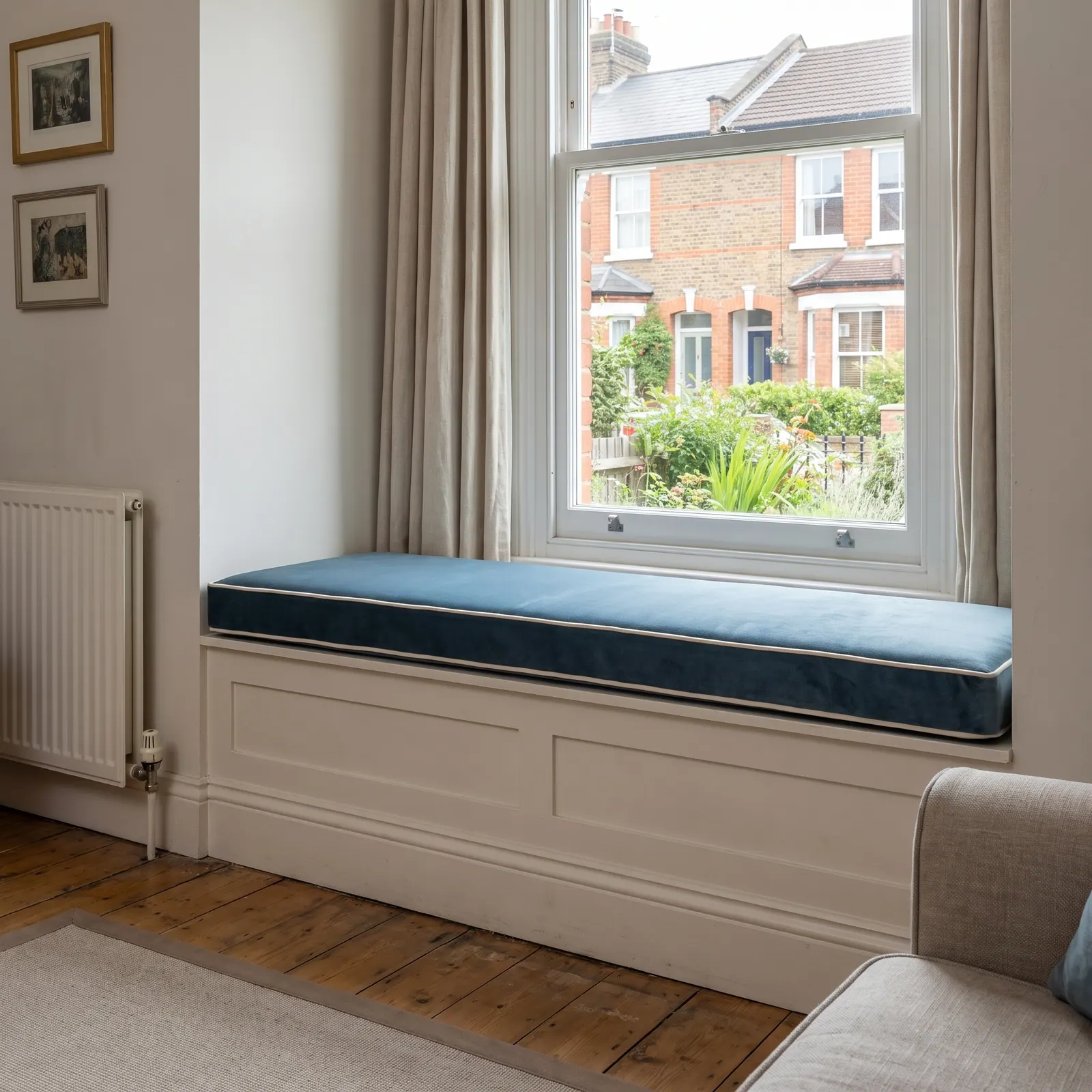 Save
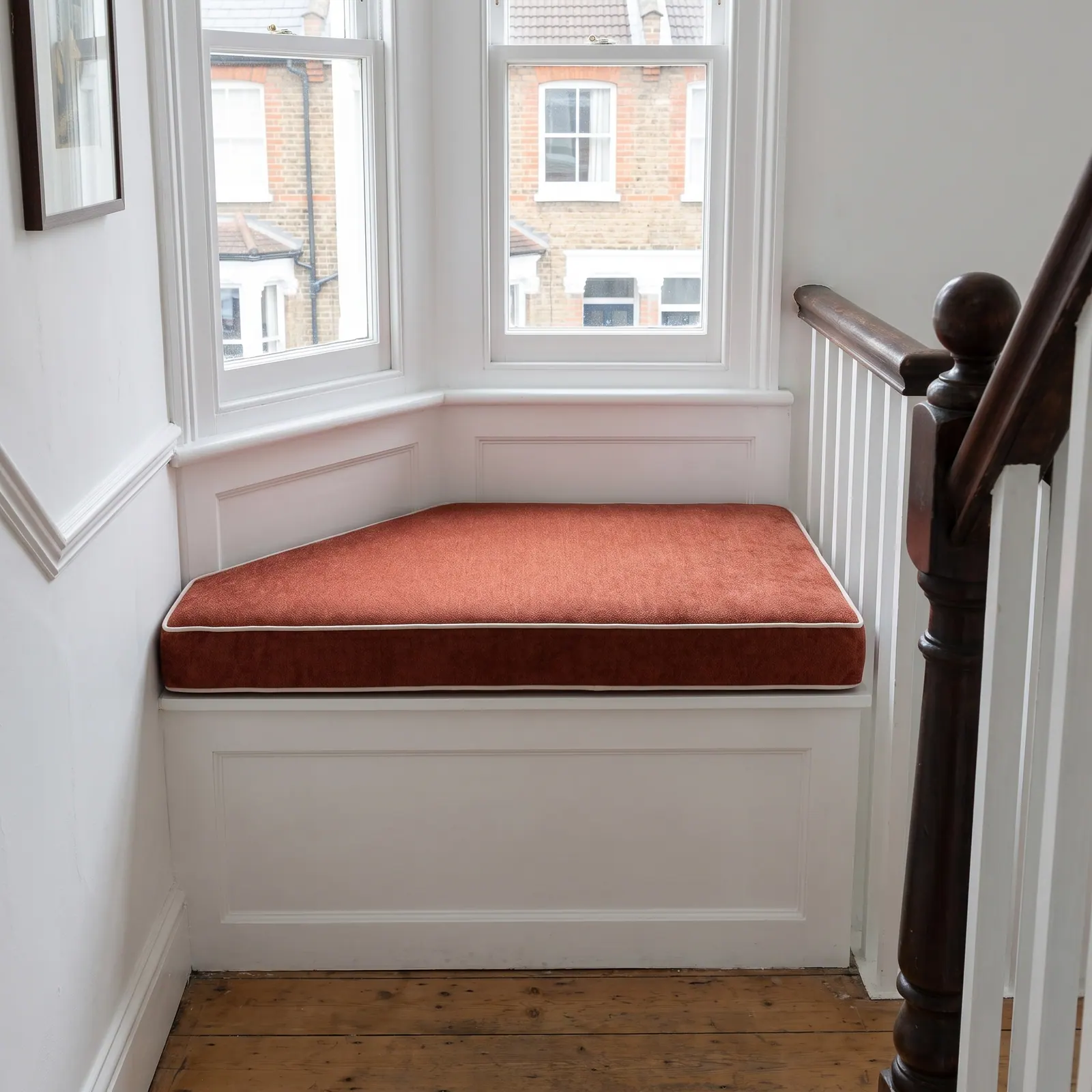 Save
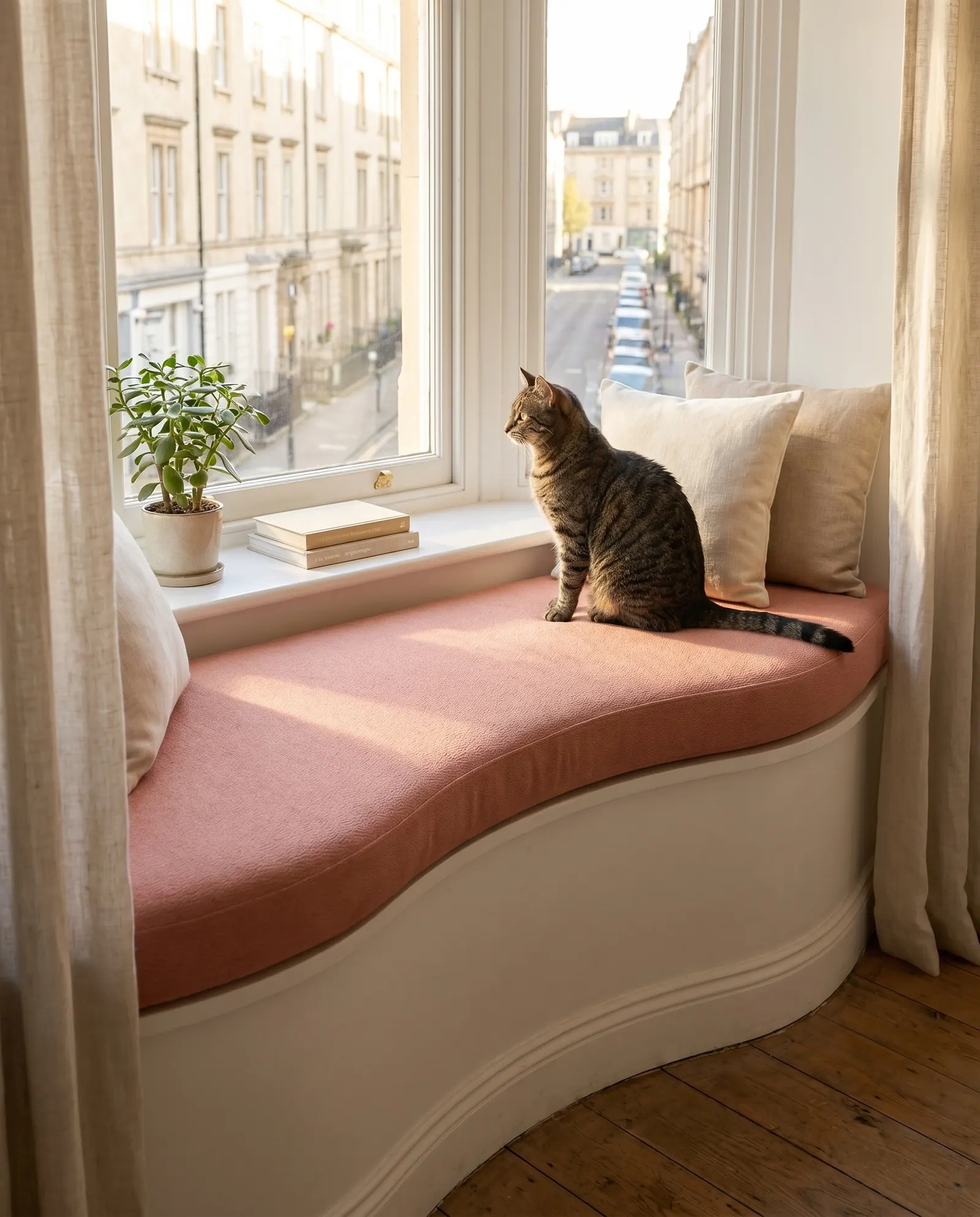 Save
 Save
 Save
Maggie's damp-season checklist
- Bring garden cushions in by mid-autumn, clean and dry; October to January is the wet stretch.
- Wipe condensation from bay and conservatory sills on every morning it appears.
- Lift window-seat cushions weekly in winter so air reaches the underside.
- Take out any non-slip panel, then wash covers at 86°F (30°C), gentle cycle, no bleach.
- Air dry covers fully before they go back on the foam.
- Store spare cushions in breathable bags, never sealed plastic.
- If the house is let to guests, sort out the fire question before the cushions arrive, not after.
A bay window is a set of angles pretending to be a rectangle. Measure every edge and it stops pretending.
Maggie
Buyer questions: bays, sills and matching welts
- A common question
How can I check my trapezoid measurements are right before you cut?
The workshop's answerOn a trapezoid the slanted sides must be a bit longer than the straight depth. When one buyer listed top 57 3/4, bottom 89 3/4, depth 17 and one slanted side as 17 in (147, 228, 43 and 43 cm), the workshop spotted that the depth had been written twice; both sides measured 22 3/4 in (58 cm), giving a true depth of about 16 1/4 in (41.5 cm). Measure each angled edge corner to corner.
- A common question
How slim can a window seat cushion be? Could it be 2 in (5 cm), or even 1 in (2.5 cm), to fit under the sill?
The workshop's answer2 in (5 cm) is available. About 1 in (2.5 cm) can be made, but it's extremely thin for sitting and may not give enough support, so the workshop recommends at least 2 in (5 cm).
- A common question
How should I send the measurements for a window seat or a built-in bench?
The workshop's answerDraw the seat on paper with every dimension and send it. On a built-in bench, measure the bench top, not the floor, since the two can differ, and be exact about depth: 20 in (51 cm) is not 19 3/4 in (50 cm).
- A common question
My window seat has no wall behind it. Can the bolster be fixed so it won't move?
The workshop's answerThe workshop suggested a non-slip fabric piece under the seat cushion to stop it moving, and it can also make two smaller side bolsters to your dimensions.
- A common question
Will a solid piping exactly match a color in my striped or patterned fabric?
The workshop's answerNot always. When the piping comes from a different fabric type the tone may not be identical, so the workshop picks the closest match from hundreds of fabrics. The guaranteed match is self-piping, in the same fabric as the cushion, which is what it recommends; a close code from the same fabric type is another option.

Have it made
Have it made for your home — ask Maggie’s workshop
Numbers first, fabric second, piping last. Jot down what you have, and the workshop will go down the list with you, item by item. — Maggie
Leave your details and the workshop will call you to confirm measurements, fabric, foam and piping. No prices, dates or payment on this page: it is a request, not an order.
Northern Ireland cushion questions
Do the UK furniture fire rules apply to cushions in Northern Ireland?
Yes. The Furniture and Furnishings (Fire) (Safety) Regulations 1988 were made under the Consumer Protection Act 1987, which extends to Northern Ireland, and they name cushions. The workshop's standard foam is not a fire-retardant grade and we don't claim compliance; for a compliant build, plan on covers only and a local upholsterer.
Which months are hardest on garden cushions around Belfast?
October to January, the wettest months across Northern Ireland, and the Antrim and Down coasts also average about 15 gale days a year. Store garden cushions indoors from mid-autumn, clean and completely dry, and bring them out again in late spring, usually the driest part of the year.
Will a conservatory cushion fade in Northern Ireland's light?
Slowly. Even the sunniest coast, in County Down, averages only a little over 1,450 hours of sun a year, but glass concentrates what there is. Indoor fabrics resist UV a little and can fade in long direct sun; outdoor fabrics are made to be UV- and fade-resistant.
Can I have real linen covers rather than a linen-look blend?
Yes. The standard linen weaves are blends, and there are separate 100% linen and 100% cotton charts. Natural linen shows dirt on pale shades, so the workshop suggests wiping it with a soapy cloth; for a hard-working family bench it recommends its sturdy acrylic linen.
Stitch straight — Maggie
The atelier
Keep going
Across the Map
Nearby places
Close by on the map