The Pattern Room · a measuring pattern
How to find cushions without added flame-retardant chemicals
Parents ask about flame retardants more quietly than they ask about color. The answer sits in one small box on a label, in two questions to the maker, and in one thing a certificate does not say.

 Save
The quick answer
To find flame retardant free cushions, read the California law label for the box stating the product contains NO added flame retardant chemicals, then ask the maker in writing about the foam and the fabric separately. An OEKO-TEX fabric certificate does not answer the question. The workshop says its standard foam and fabrics have no added flame retardants, and its foam is not fire-rated.
One small box on a law label
The most useful line on a cushion label is often the smallest one. On the California law label for upholstered furniture, a box is checked beside a statement about flame retardants: the product either contains added flame retardant chemicals, or contains NO added flame retardant chemicals. That box is the plainest answer the paperwork gives.
The label exists because of a smolder test. TB117-2013 tests cover fabric, barrier and filling against a smoldering cigarette. It can be met without flame-retardant chemicals: a compliant barrier around the filling, or a passing cover over a passing filling. Polyester batting often serves as the barrier.
The federal rule, 16 CFR 1640, adopted the same test methods and took effect on June 25, 2021. It covers indoor upholstered seating, separate seat cushions included. Its label states compliance with U.S. CPSC requirements for upholstered furniture flammability. That is a statement about fire behavior. It says nothing about which chemicals are inside. The TB117-2013 guide walks through the test itself.
So the answer lives in two places: the disclosure box, and a written reply from the maker about the foam and the fabric, taken one at a time.
Six checks before a playroom cushion is ordered
Find the disclosure box
On furniture sold with a California law label, look for the checked box about added flame retardant chemicals. A made-to-measure cushion may arrive without that label, so the next steps carry more weight.
Ask about the foam by itself
One question: does the foam have added flame retardants? Ask what the foam is, too. The workshop's standard is ordinary furniture-grade polyurethane foam, about 2.0 lb/ft³ (32 kg/m³) in bench and seat cushions.
Ask about the fabric separately
A cover can carry a flame-retardant finish even when the foam under it does not. The workshop says its standard fabrics have no flame-retardant treatment and no coating.
Ask about backrests and tufted fill
Floor sofa backrests use shredded foam or polyester fiber clusters. Tufted floor cushions have no foam core at all. One reply described a corduroy pouf's filling as latex upholstery foam, so name the exact product when you ask.
Ask whose certificate it is
An OEKO-TEX Standard 100 certificate belongs to the mill that holds it. It limits harmful substances; it does not describe burning behavior, and a certified fabric range can include flame-retardant finishes the standard accepts. The OEKO-TEX guide shows how to read one.
Keep the maker's answer on file
Save the maker's reply with the order. If the room later becomes a rental or a daycare corner, the materials are already on record.

Have it made
Measured it? Have Hana’s workshop make it
Leave your numbers and the height you like to sit at. The rest is a short conversation. — Hana
Leave your details and the workshop will call you to confirm measurements, fabric, foam and piping. No prices, dates or payment on this page: it is a request, not an order.
What each paper tells you about flame retardants
| Label or document | What it speaks to | What it leaves out |
|---|---|---|
| California law label (TB117-2013) | A smolder test, plus a checked box: contains, or contains NO, added flame retardant chemicals | Other materials questions beyond that one disclosure |
| Federal 16 CFR 1640 label | Compliance with the federal smolder rule for indoor upholstered seating | Whether flame-retardant chemicals were used to comply |
| OEKO-TEX Standard 100 (a mill's fabric) | Harmful-substance limits for the certified fabric, by product class | Burning behavior; certified ranges can include accepted flame-retardant finishes |
| A maker's written statement | What that maker says is in the foam, the fill and the fabric | Independent verification; keep it with the order |
| Fire-retardant (FR) fabric chart | A cover fabric made to resist ignition | The filling; the workshop's filling is not FR-certified |
What the workshop has told buyers, and where it stops
The flame-retardant question arrives from two directions. Some buyers, often parents, want none. Others, furnishing rentals or commercial rooms, need rated materials.
Its standard foam is ordinary furniture-grade polyurethane, and the workshop says no flame retardants are added to it. Its standard fabrics have no flame-retardant treatment and no coating. It has also said there is no fiberglass in its products.
Buyers who need rated materials should name the exact standard and ask before ordering. The filling is the hard limit. The workshop has said its filling is not certified fire-retardant and that it has no fire-retardant foam. So nothing on this site describes its foam as fire-rated.
That is the honest edge. The standard build, by the workshop's own account, has no added flame retardants. A certified fire-retardant build is not on offer.
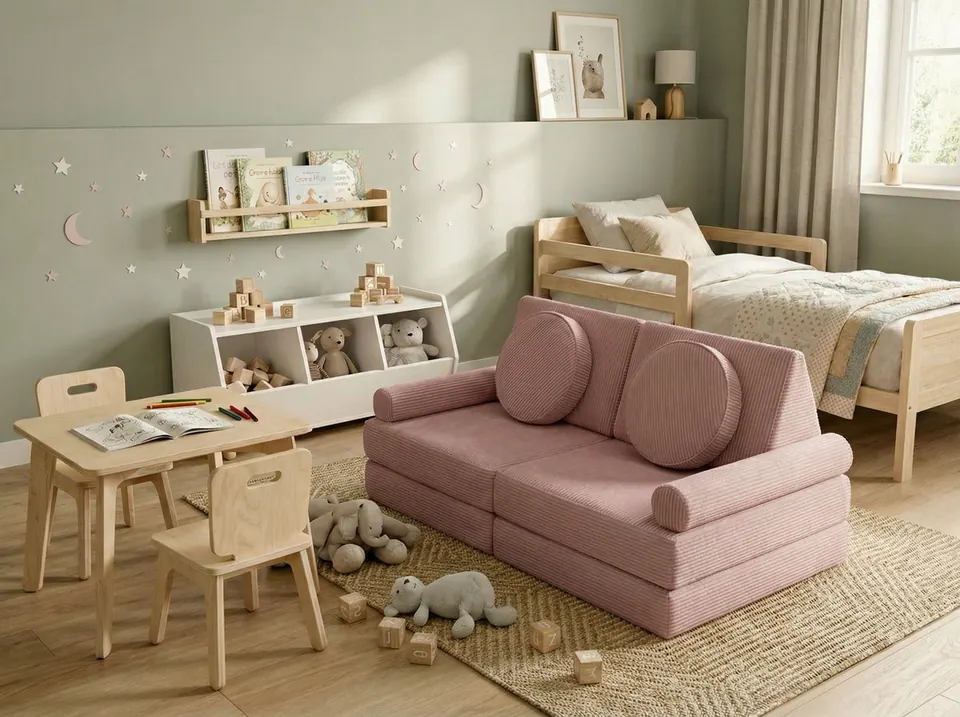
A teddy floor sofa for a toddler playroom
Parents in the US were choosing a teddy floor sofa for their toddler's playroom. Before ordering, they asked two things: what foam is inside, and whether it has flame retardants.
The workshop's answer was short. The fabric is not fire-retardant. Seat mattresses on these floor sofas use a medium-hard, high-density cold foam, most often quoted as 28 density (28 kg/m³, about 1.75 lb/ft³, ILD 42). The backrests hold shredded foam or fiber clusters.
They asked before ordering. That is the part worth copying. For nurseries and playrooms, ask about the fabric and its flame-retardant status up front, while changing the fabric is still easy.
A toddler does not sit on a floor sofa. A toddler lives on it. Children measure comfort with their whole body.
Flame-retardant mistakes to avoid
- Reading an OEKO-TEX certificate as a flame-retardant answer. It limits harmful substances; it does not describe how a fabric burns.
- Asking about 'the cushion' in one question. Foam, fabric and backrest fill are separate materials with separate answers.
- Judging new foam in its first hours. New foam and fabric off-gas for a few days after being sealed in plastic. Unroll the foam in a ventilated room and air it for several days.
- Putting the foam in the washer with the covers. Covers wash out; inserts are too big for a home machine. Wash the zip-off covers on their own.
- Waiting out a smell that does not fade. Report it early; the fix is usually a new insert, not a new cover.
The flame-retardant answer lives in one checked box on the California law label, not on an OEKO-TEX certificate, which limits harmful substances in fabric.
Hana
If polyester is the next question
Some parents move from flame retardants to fibers. The standard corduroy, velvet and soft fabric all contain polyester. The kids' play couch comes in corduroy by default, and natural fabrics can replace it.
The workshop keeps a 100% cotton chart, a pure linen chart and a cotton-linen fabric. Most of its 'linen' is a blend, so ask for the pure chart by name. The natural-fiber guide and the linen and cotton-linen swatches go further. The kids' floor sofas and kids' room cushions show what families order, in the corduroy that comes as standard.
Before anything arrives, read what is normal when new foam smells. The smell is strongest in the first one to three days and eases over one to two weeks. Do not heat the foam to hurry it.
What does your playroom floor need to hold: a nap, a fort, a reading hour?
A label is small. A question is smaller. Both fit before the order.
Buyer questions: foam, fabric and fire
- A common question
Is the foam treated with flame retardants, or anything else? I want to know what my kids will be lying on.
The workshop's answerThe workshop describes the inside as high-density polyurethane upholstery foam and says it has no flame-retardant additives. It says the fabrics carry no flame-retardant finish either. One reply described a corduroy pouf's filling as latex upholstery foam instead, so if allergies or smell concern you, ask which filling your exact product uses.
- A common question
Do your fabrics have flame retardants, PFAS or any other chemical finish on them?
The workshop's answerThe workshop's answer was no: its standard fabrics are not treated with flame retardants and have no added coatings, and there is no fiberglass in its products. The fabrics come from a mill certified to OEKO-TEX Standard 100 (03.T.3239). For strict low-tox requests it can make the piece in a natural fabric from its range, such as cotton.
- A common question
We're furnishing a child's room. What foam goes into the play couch, and is the fabric fire-retardant?
The workshop's answerThe foam is standard furniture-grade foam, and the workshop says no flame retardants are added. The play couch comes in corduroy by default; that standard fabric is not treated to be fire-retardant. Natural fabrics can replace the corduroy, and many families use these pieces in playrooms and kids' rooms.
- A common question
What's inside the tufted floor cushions? Is there a foam core?
The workshop's answerNo foam core. Tufted floor cushions are sewn by hand and packed densely with siliconized polyester hollow-fiber clusters that feel closer to cotton than to foam, and the standard mix often includes some cotton filler. The workshop can send a photo of the filling before you order.
Short answers on flame retardants
Does the federal cushion flammability rule require flame-retardant chemicals?
No. 16 CFR 1640, in effect since June 25, 2021, adopted California's TB117-2013 smolder test methods. Those tests can be passed without flame-retardant chemicals, for example with a compliant barrier around the filling, or with a passing cover over a passing filling.
Which cushions fall outside the US upholstered furniture flammability rule?
The federal rule excludes outdoor cushions, decorative throw pillows not meant for sitting, cushions with less than 1/2 in (1.3 cm) of fill, mattresses and bedding. Separate seat cushions for indoor upholstered seating are covered.
Can a daycare or rental order cushions with fire-retardant foam from the workshop?
Not with fire-retardant foam. The workshop has said its filling is not certified fire-retardant and that it has no fire-retardant foam, so a certified fire-retardant build is not on offer. If a setting names a standard for the cover fabric, ask the workshop about that exact standard before ordering.
How long does new-foam smell usually last after unpacking?
Usually days, not months. Smell peaks in the first one to three days and eases a great deal over weeks one and two. Unroll the foam in a ventilated room, keep cushions apart for 24 to 48 hours, and do not heat it. Report a smell that does not fade.