The Pattern Room · a measuring pattern
Kids' play couch sizes: choosing a floor sofa by age and room
Children measure comfort with their whole body. They sprawl, climb, stack and lie upside down with a book. Size the floor sofa for that, not for the photo.
 Save
The quick answer
A kids floor sofa of about 24 x 50 in suits a 2-year-old, a 32 in (80 cm) corner cushion suits a 4-year-old, and a 47 in (120 cm) corner fits a parent reading alongside. Under a loft bed, 24 x 70 in hosts sleepovers. Choose thick foam with a zip-off cover. Babies under one sleep on a firm, flat, bare surface, never cushions.
Size for who lies there, not for the age alone
A 4-year-old fits on a 32 in corner cushion. A 4-year-old and a parent with a picture book do not.
That is most of what sizing a kids floor sofa comes down to. Kids' pieces are child-scaled, made for sitting, sprawling and climbing. So the first question is not the child's age. It is who else will be lying there.
Before you order, mark the size on the floor with tape and live with it for a day. The shapes are on the kids floor sofas and kids' room cushions pages.
Sizes by age and use
| Who it's for | Size | Notes |
|---|---|---|
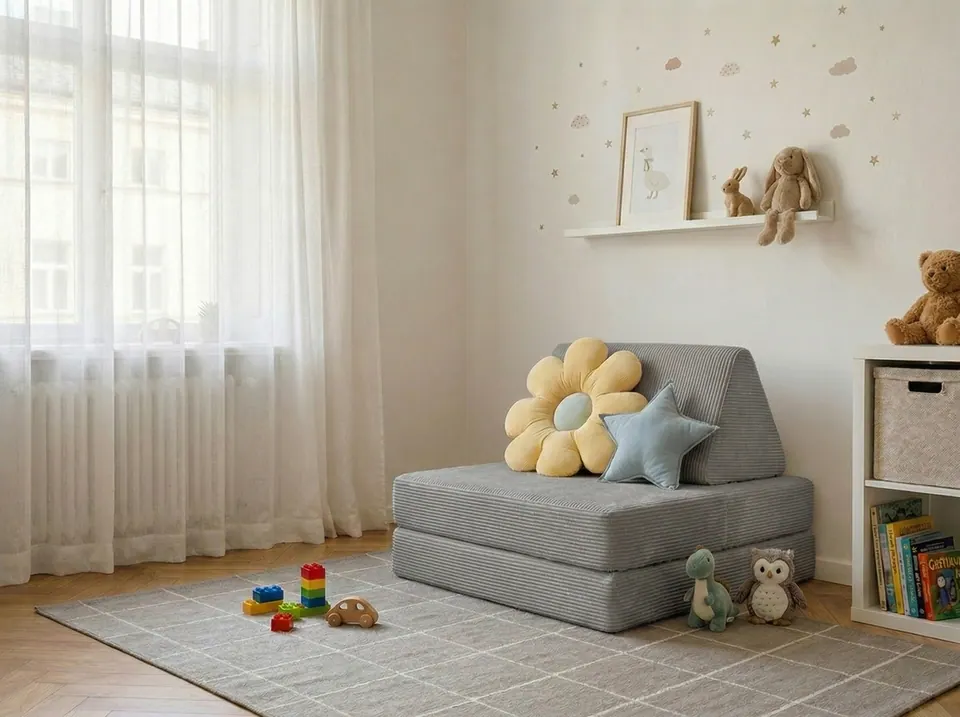
| A toddler of about 2 | 24 x 50 in (61 x 127 cm) floor sofa | Our suggestion when the room has space |
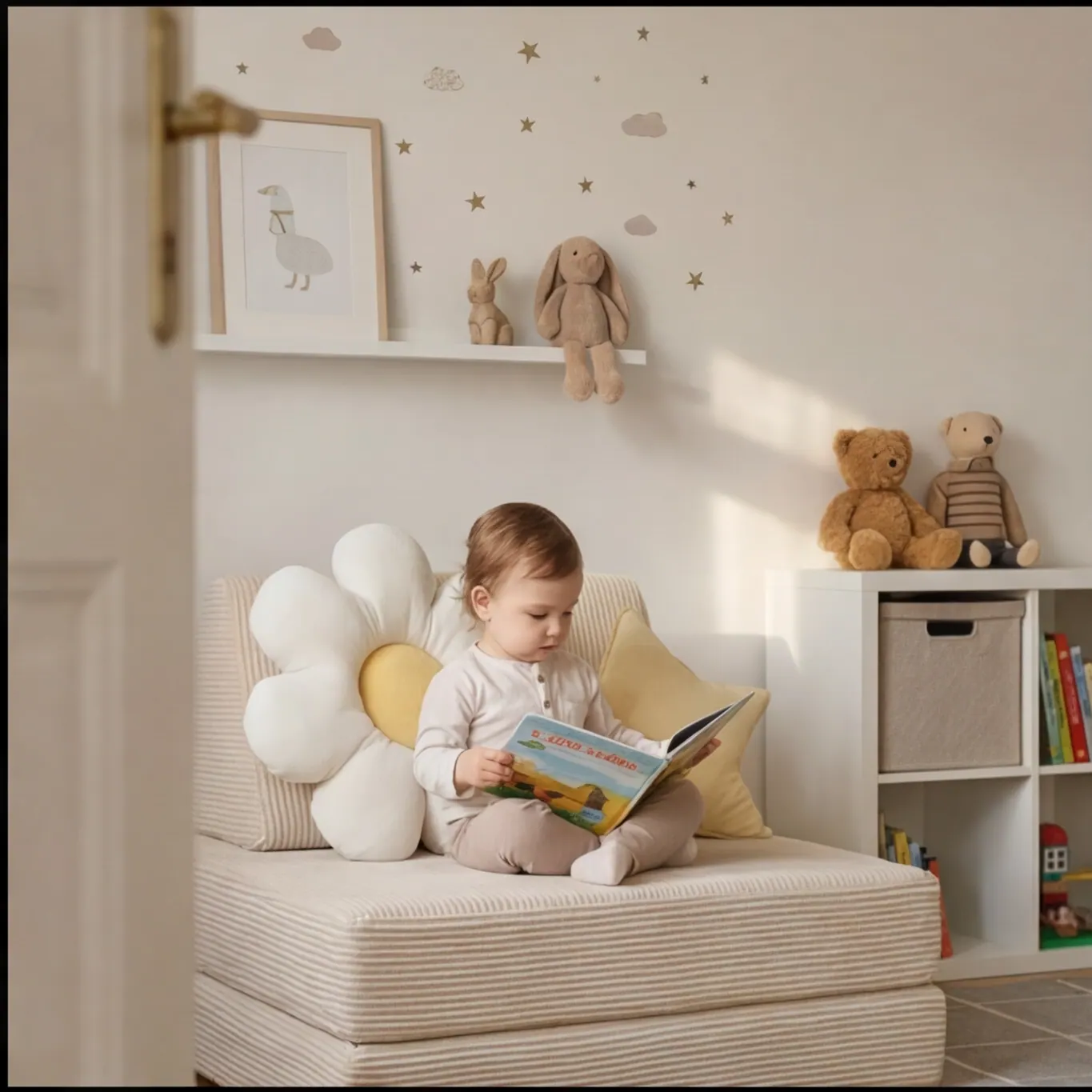
| A toddler's reading corner | About 40 x 40 in (102 x 102 cm) | One child and a pile of books |
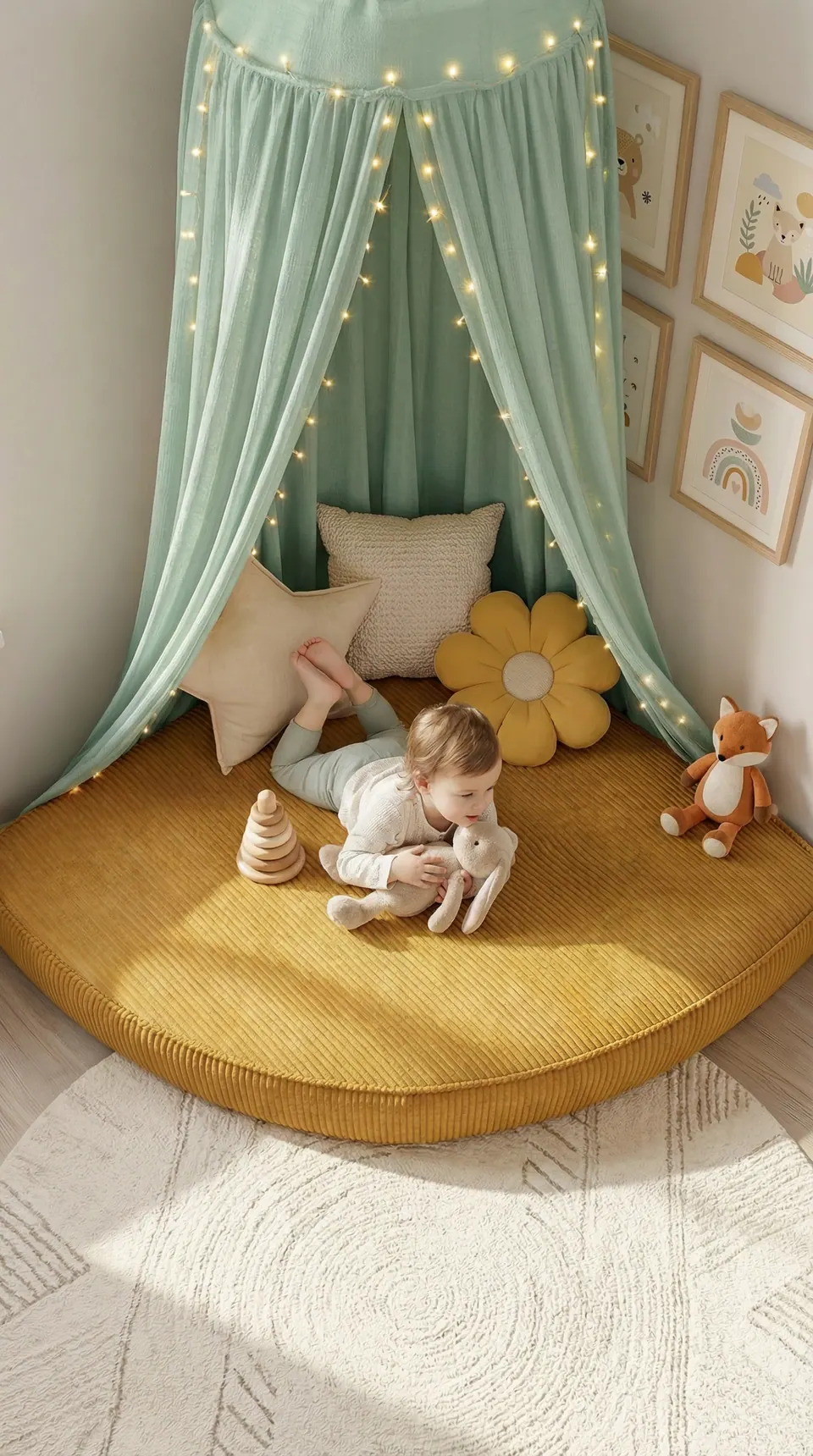
| A child of about 4 | 32 x 32 in (80 x 80 cm) corner, 8 in (20 cm) thick | Cozy for one |
| The middle corner | 39 x 39 in (100 x 100 cm), 8 in (20 cm) thick | Our best-selling corner size |
| A parent reading alongside | 47 x 47 in (120 x 120 cm) corner | Largest standard corner; an adult can lie down |
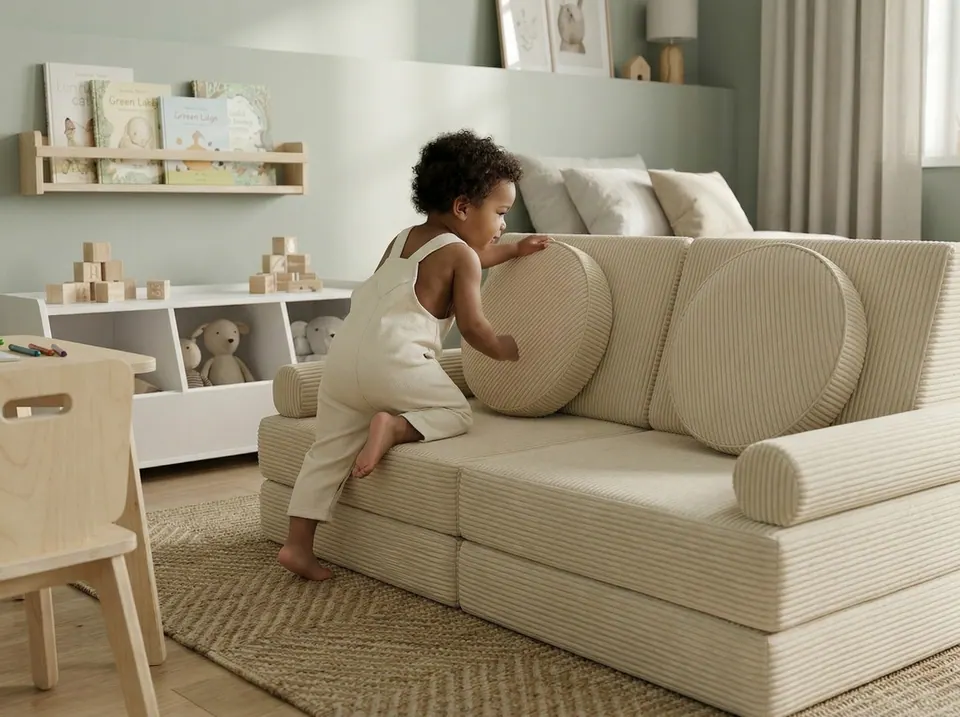
| A big bedtime reading area | 28 x 60 in or 28 x 64 in (71 x 152 or 71 x 163 cm) couch set | Seat, backrest and two armrests |
| Sleepovers under a loft bed | 24 x 70 or 27 x 70 in (61 or 69 x 178 cm) | Lounge by day, guest bed at night |
| A toddler leaving the crib | Kids' foam play bed: 35 x 75, 45 x 75 or 55 x 79 in | Mattress included |
Choosing the size, step by step
Decide who else will use it
A child plus a reading parent needs the largest size. If an adult will lie down too, go straight to the 47 in (120 cm) corner.
Mark the footprint on the floor
Tape the outline where the sofa will go. Leave a path around it. A 47 in square looks small in a photo and large in a nursery.
Match the size to the age
Start from the table: about 24 x 50 in at 2, 32 in at 4, 70 in lengths once sleepovers begin. Any size can be made to measure; corner cushions run from 25 x 25 in (64 x 64 cm) to a standard maximum of 48 in (122 cm) per side.
Choose thickness and foam
The kids' corner cushion is 8 in (20 cm) thick and one solid piece; it does not unfold. The kids play couch uses T28 foam, which can be upgraded to 32 density for a firmer seat. See foam density.
Choose fabric for the life it will lead
For young children the workshop points to a soft microfiber that wipes clean, or velvet, which lets marks lift off easily. Corduroy ribs can split under hard use. Standard fabric is not waterproof; a water-repellent one is available on request. The fabrics come from a mill certified to OEKO-TEX Standard 100 (03.T.3239). More in kid-friendly cushion fabric.
Insist on a zip-off cover, and skip the buttons
The corner cushion's cover comes off and machine washes at 86°F (30°C) or lower on a gentle cycle. Skip button tufting in a playroom: buttons loosen under daily climbing, and a tufted cover does not come off.
Give the foam time after delivery
Kids' sofas travel vacuum-packed. Unpack straight away, lay the pieces flat and keep everyone off for the first 48 hours. Foam needs 48 to 72 hours to recover, sometimes a week, so measure after 3 to 4 days, not on arrival.

Have it made
Measured it? Have Hana’s workshop make it
Measure once, slowly. Write the numbers here. The workshop will go over them with you. — Hana
Leave your details and the workshop will call you to confirm measurements, fabric, foam and piping. No prices, dates or payment on this page: it is a request, not an order.
A toddler floor bed that became a reading loveseat
A parent in the US wrote to the workshop about a wooden toddler floor bed. The platform was 53.5 x 29.5 in (136 x 75 cm), the frame 21 in (53 cm) high, and the child had moved on. They wanted a small loveseat for reading.
They weighed two layouts in linen with contrast piping. A five-piece set: a seat, two back cushions and two side bolsters. Or a seat with a single back bolster. Both fit. The five-piece looks fuller and costs about twice as much.
Only the cushions' own dimensions mattered, the workshop told them, not the height of the frame. They chose 4 in (10 cm) thickness in firm 32-density foam.
Floor beds, play mats and the under-one line
Floor sofas, corner cushions and play couches are for awake time. Reading, building, climbing, a quiet story.
For babies under one year, the American Academy of Pediatrics is clear. Sleep happens on a firm, flat surface with nothing on it: no pillows, toppers, bumpers or loose bedding, and no incline of more than 10°. A cushion, a floor sofa or a lounger is not that surface.
For a toddler leaving the crib, the workshop points parents to its separate kids' foam bed rather than a floor cushion. See crib and toddler mattresses.
Where kids' seating goes wrong
- Sending the frame's height or size instead of the cushion's own dimensions.
- Choosing striped cotton for a playroom; it stains more easily than microfiber or velvet.
- Ordering button tufting for children who climb.
- Measuring the day the box opens, or letting the children on before 48 hours have passed.
- Treating any cushion or floor sofa as a sleep surface for a baby under one.
A cover for the mattress you already have
Sometimes the foam is already in the house. One parent in the US had a mini crib mattress, 37.75 x 23.75 x 3 in (96 x 60 x 7.5 cm), used as a play mat on the floor, and wanted a fully zippered box cover they could wash. The workshop pointed them to the cover order, with the exact size and fabric code in the personalization note. Any foam you own can get a tailored cover; see covers for existing foam.
Another parent wanted a low nursery window bench built from stacked cushions. Stacking only works with foam cores; fiber-filled cushions round off and slide. More builds in playroom corner cushions.
Who else will be lying on yours?
A child grows. The floor stays. Size for the floor, and let the child catch up.
A kids floor sofa for one 4-year-old can be a 32 in (80 cm) corner; add a parent who reads lying down and it needs the 47 in (120 cm) corner.
Hana
What US safe-sleep guidance says about floor cushions
Floor sofas and floor mattresses are made for sitting, playing and, for older children, sleepovers. For babies, the US Consumer Product Safety Commission's safe-sleep guidance is short: bare is best. A baby should sleep on its back in a crib, bassinet or play yard with only a fitted sheet, and a baby who falls asleep on a couch, a floor cushion or any other product should be moved to one of those. Inclined products steeper than 10 degrees should never be used for infant sleep. Play couch makers follow the same line, setting minimum ages of one, two or three years by model and labeling their sets not for sleeping. Size a toddler floor bed for the child who will use it.
Buyer questions
- A common question
What size floor sofa should I get for my 2-year-old?
The workshop's answerIf you have the room, about 24 x 50 in. A larger 28 x 60 in set includes the backrest and armrests. The kids' foam play bed, mattress included, comes in 35 x 75, 45 x 75 and 55 x 79 in.
- A common question
I want to lie down and read with my child. How big should the floor sofa be?
The workshop's answerKids' pieces are child-scaled, so choose the largest: the big kids corner is 47 in. For a large bedtime reading area, a 28 x 64 in couch works well. Sets come as a seat, backrest and two armrests in the size you pick.
- A common question
What sizes does the kids corner cushion come in, and can it go bigger or smaller?
The workshop's answerThree standard sizes, all 8 in (20 cm) thick: about 32, 39 and 47 in (80, 100 and 120 cm) square. The standard maximum is 48 in per side, and small ones go down to 25 x 25 in.
- A common question
Does the kids corner sofa base fold out into a bed?
The workshop's answerNo. It is 8 in (20 cm) tall and one solid piece; it can look like two layers in photos, but it doesn't unfold. For a custom size such as 43 x 43 in (110 x 110 cm), choose the next size up and note the size you want.
- A common question
Which fabric holds up best to little kids and is easiest to clean?
The workshop's answerOur soft fabric, a wipe-clean microfiber a little more durable than linen, or velvet, which is the easiest to spot-clean because marks lift off the pile. We steer families away from the striped cottons.
Parents also ask
Can a kids corner floor cushion be made to fit an alcove?
Usually. The curve is cut from a fixed pattern, so reshaping it is harder; send a drawing with both straight sides, the straight line across the curve and the distance from the curve's center to the corner.
What foam goes inside a kids play couch?
Single-density T28 foam, a medium-hard high-density foam that softens slightly with use, with an upgrade to 32 density, about 2.0 lb/ft³ (32 kg/m³), for a firmer seat.
Is the standard kids' fabric waterproof?
No. It is durable and easy to clean but not waterproof. For a toddler who spills, ask for the water-repellent outdoor fabric or the water-resistant, wipe-clean charts; zippered covers also wash at 86°F (30°C).
Can older children sleep on a floor cushion at a sleepover?
Yes, the cushions are firm enough, and many families use them as sleepover beds. Lengths of 70 to 75 in are made routinely, and a 6 or 8 in thickness sits higher off the floor.