The Pattern Room · a measuring pattern
The best cushion fabric for kids: spills, sticky hands and covers you can wash
Children measure comfort with their whole body. They also measure it with juice. Plan for both, and the cushion stays.

 Save
The quick answer
The best cushion fabric for kids is a tight, smooth performance weave or a polyester velvet, made up as a zippered cover that machine-washes at 86°F (30°C) on a gentle cycle. Both wipe clean between washes. Skip 100% cotton stripes where children eat or play, choose untufted cushions, and add a water-repellent option only where spills happen daily.
Plan for the spill, not the photograph
Every cushion in a child's room will meet a spill. Juice. Yogurt. Paint water. The only question is what happens next.
The best cushion fabric for kids answers calmly: wipe it, or unzip it and wash it. Parents ask this in many forms. The workshop's answer stays the same. A soft, tight performance weave first. Polyester velvet second. Both wipe clean. Both wash.
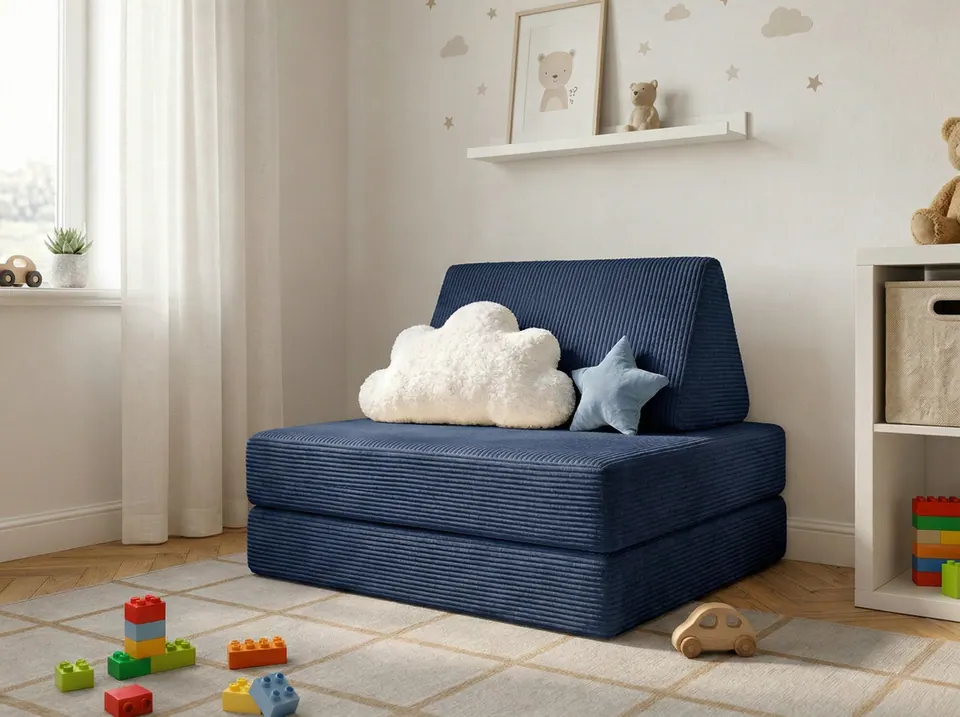
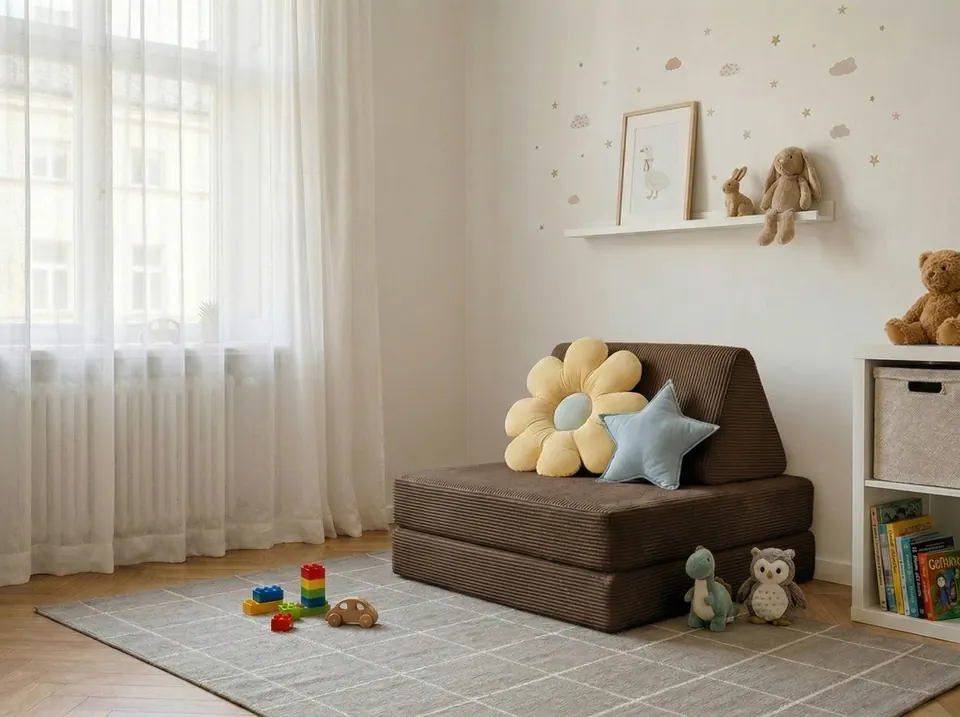
Most of the workshop's kids' floor sofas are bought for children. So the playroom is not an edge case. It is the main case, and kids' room cushions are planned around it.
Seven decisions, in the order they matter
Choose the cover before the color
A zippered, removable cover comes first. Every foam cushion from the workshop has one, hidden on the back edge or the underside. Tufted cushions have no zipper and can only be wiped by hand, so for a playroom or a reading nook, choose untufted.
Pick a tight, smooth weave
The soft performance weave is a microfiber: a little more durable than linen, thinner than velvet, soft to the touch. It doesn't collect dust or lint, and it wipes clean. Velvet stands up to daily child use, and marks lift off its short pile.
Keep 100% cotton stripes for the grown-ups
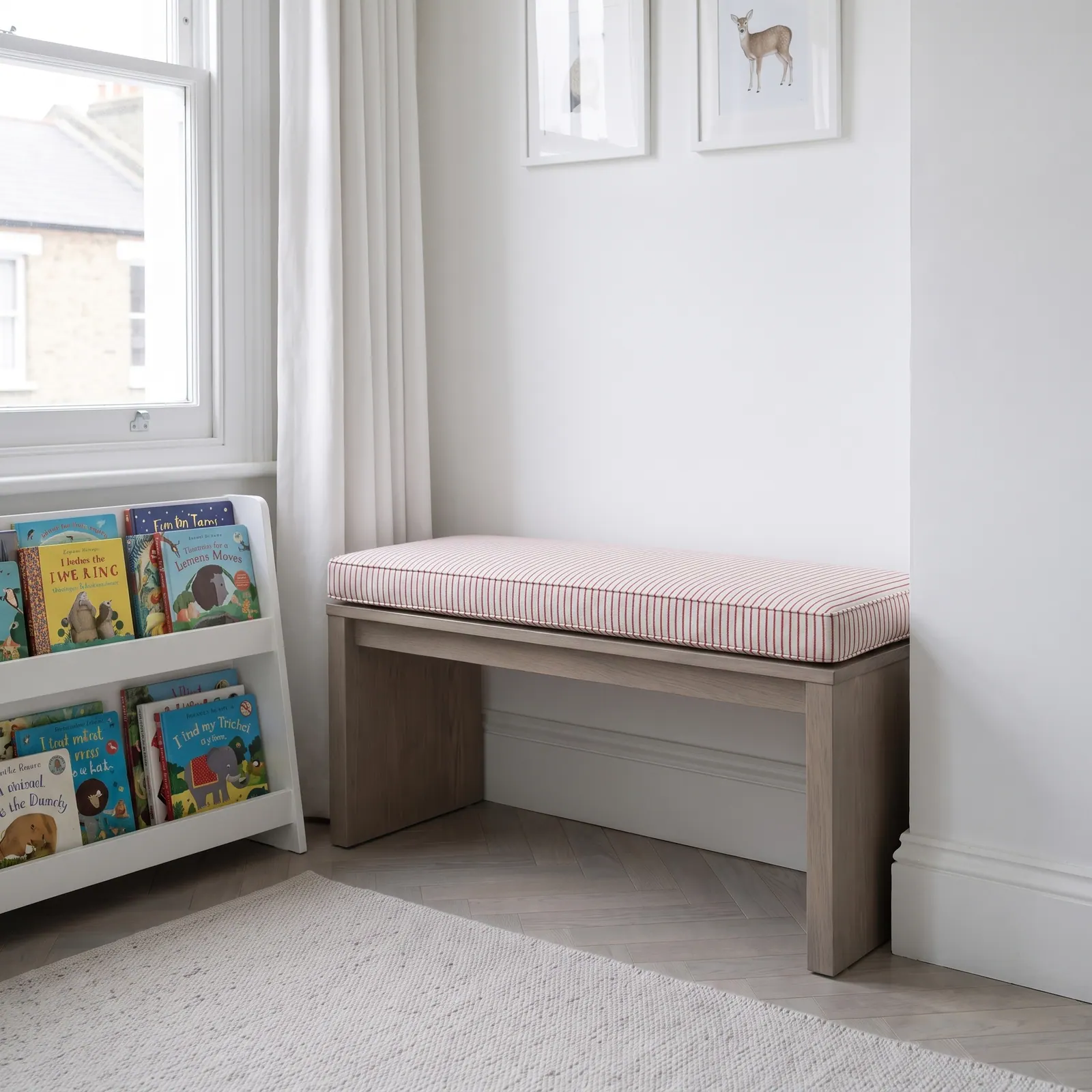
The striped and ticking fabrics are 100% cotton, indoor-only, and they stain more easily than the performance weaves. A pencil stripe on a reading bench is lovely. On a snack bench, it is work. See striped cotton and ticking.
Let tone and texture forgive
Pure white shows everything. A mid-tone in a tight washable weave forgives most days: oatmeal, mocha, charcoal, mustard. Textured surfaces such as teddy, bouclé and velvet hide small marks, though they hold more pet hair. A thick teddy fabric has been suggested for a playroom.
Decide how much liquid protection you need
The standard indoor fabric is not waterproof. It is durable and easy to clean, which is enough for most rooms. For a toddler who spills daily, ask for the water-repellent B19, the water-resistant wipe-clean charts, or a waterproof liner under the cover. The words differ; see water-repellent vs waterproof.
Wash gently, never hot
Unzip, turn the cover inside out, and machine-wash at 86°F (30°C) maximum on a gentle cycle with mild detergent and no bleach. Air-dry. On a floor sofa, take off the white non-slip bottom piece first; it must not go in the machine.
Buy the second cover set early
A floor sofa used every day spends some days in the laundry. Spare cover sets are sold for exactly this reason, so the sofa stays in use while one set dries. See floor sofa replacement covers.

Have it made
Measured it? Have Hana’s workshop make it
A good size is a quiet thing. You notice it only when it is wrong. Let the workshop check yours first. — Hana
Leave your details and the workshop will call you to confirm measurements, fabric, foam and piping. No prices, dates or payment on this page: it is a request, not an order.
Performance weave, velvet, linen-look and cotton stripe for a playroom
| Soft performance weave | Polyester velvet | Linen-look | Cotton stripe | |
|---|---|---|---|---|
| What it is | A smooth microfiber, poly-cotton blend | A short, tight synthetic pile | Usually a polyester or linen blend | 100% cotton, woven stripe |
| Wipes clean | Yes Yes, smooth and lint-free | Yes Yes, marks lift off the pile | Partly Yes, for small spills | No Stains more easily |
| Cover wash | 86°F (30°C), gentle | 86°F (30°C), gentle | 86°F (30°C), gentle | 86°F (30°C), gentle |
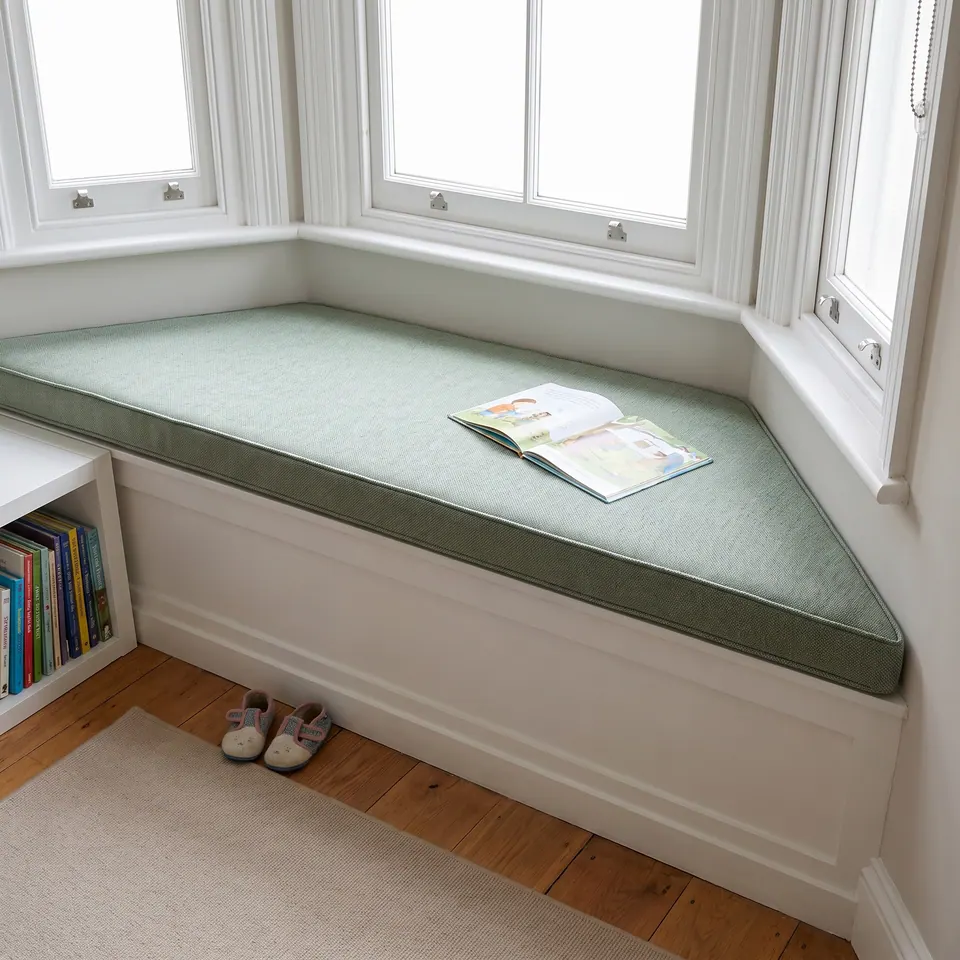
| Best for | Floor sofas, sleepovers, daily play | Benches, window seats, reading nooks | Calm rooms, lighter use | Grown-up benches |
A crash pad cover, one inch larger
A parent in the US wrote about a soft sensory crash pad in the playroom, about 60 x 60 x 9 in (152 x 152 x 23 cm). She wanted a removable, washable cover in light oatmeal.
The workshop sized the cover at 61 x 61 x 10 in (155 x 155 x 25 cm), an inch of room in every direction, and gave it a long zipper so the insert could come out whole. It pointed her to the linen chart for the oatmeal and asked one more question: piping, or none?
The cover does the washing. The crash pad does the crashing. That division is the whole plan.
- What it taught
- Add about 1 in to each dimension of a soft-filled insert so the cover isn't tight.
Two more rooms, the same question
Another US family asked it from the kitchen. Three cushions for a U-shaped breakfast nook, children at every meal, and a navy ticking stripe they loved. The workshop was honest: that ticking is 100% cotton and stains more easily, though every cover washes at 86°F (30°C). The full story is in the kitchen banquette fabric pattern.
A reading nook asked it a third way. A parent wanted a tufted linen floor cushion for small children and asked how to clean it. Tufted cushions can't go in the machine, so the workshop offered the untufted version with a zippered cover instead.
Where do the children in your house actually sit: the floor, the bench, the arm of the sofa? Buy for that spot.
Common mistakes in kids' rooms
- Choosing for looks alone. Fabric picked for the photograph rather than for spills and daily wear is a regret the workshop hears often.
- Tufting in a playroom. Buttons are hand-sewn through the cushion and loosen with heavy use. Choose untufted, or keep the spare buttons and re-sew early. See tufted vs plain cushions.
- A tight cover on a soft insert. Add about 1 in (2.5 cm) to each dimension of a crash pad or other soft fill.
- Hot washes and the dryer. Keep covers at 86°F (30°C) maximum and air-dry them.
- Judging a new floor sofa too soon. Vacuum-packed foam needs 48 to 72 hours, sometimes a week. Wait 3 to 4 days before measuring.
A 100% cotton stripe stains more easily than a tight performance weave, so give the playroom bench a wipe-clean weave and keep the stripes for grown-up rooms.
Hana
What stays true
Covers come off.
Tight weaves wipe.
The cushion outlasts the spill.
Buyer questions: parents ask
- A common question
What's the toughest, easiest-to-clean cushion fabric for a house with young kids?
The workshop's answerTwo ranges: the soft performance weave, a microfiber a little more durable than linen that stays soft and wipes clean, and velvet, which stands up to daily child use and spot-cleans easily because marks lift off the pile. The striped cottons are the ones to avoid.
- A common question
We have kids and a dog. Which fabric should we choose?
The workshop's answerThe soft weave or velvet: velvet is the most stain-resistant, the soft weave the easiest to spot-clean, and both are the most durable in the range. If the dog lives on the cushion, choose from the pet-friendly chart. Covers machine-wash at 86°F (30°C) on a delicate cycle.
- A common question
What fabric works for a floor cushion or window seat in a playroom?
The workshop's answerThe soft performance weave, which the workshop calls very durable and very easy to clean; velvet is the other performance choice. Some floor cushion styles have no zipper, so plan to spot-clean those by hand.
- A common question
Is there a waterproof fabric for a toddler who spills everything?
The workshop's answerThe standard indoor fabric isn't waterproof, but it's durable and easy to clean, and the covers wash at 86°F (30°C) or lower. For real liquid protection, B19 is the water-repellent option, and there are water-resistant wipe-clean charts and a faux leather chart too.
- A common question
Do the floor sofa covers come off for the washing machine?
The workshop's answerYes. Every cover on the modular floor sofa, pouf and bean-bag sofa unzips and machine-washes at 86°F (30°C) maximum on a gentle cycle. Take off the white non-slip bottom piece first. Spare cover sets are sold, and the workshop sends a video if a cover is hard to refit.
Kids' cushions, a few more answers
Is velvet too delicate for a child's room?
No. The workshop's velvet is synthetic, polyester or a poly-cotton blend, which resists crushing, wear and wrinkles better than cotton velvet. It stands up to daily child use, and in several replies it is named the most popular choice for kids' rooms.
How big and how thick is a kids' corner floor sofa cushion?
It is foam-filled, about 8 in (20 cm) thick, with a removable cover, in roughly 31, 39 and 47 in (80, 100 and 120 cm) square sizes; the 39 in size is the best seller. The kids' play couch uses T28 foam that can be upgraded to 32 density.
Can a floor cushion double as a sleepover bed?
Yes. For a space under a loft bed that needed to be seating and a sleepover spot, the workshop suggested 24 x 70 or 27 x 70 in (61 x 178 or 69 x 178 cm). The cushions are very comfortable to sleep on, and the soft weave is the fabric suggested for sleeping.
Are the fabrics OEKO-TEX certified?
The fabrics come from a mill certified to OEKO-TEX Standard 100 (03.T.3239). Read what that label covers, and what it doesn't, before you choose fabric for a nursery or playroom, and ask the workshop about any specific code you have in mind.