The Pattern Room · a measuring pattern
TB 117-2013 and US fire rules for cushions, in plain English
Two questions arrive stapled together: does this cushion meet US fire rules, and is there flame retardant in it? Here's the rule, the label and my checklist for asking any maker, with each question answered on its own.

 Save
The quick answer
TB 117-2013 is a smolder test, using a lit cigarette, for a seat cushion's cover fabric, barrier and filling, and it can be passed without added flame-retardant chemicals. Since June 25, 2021, federal rule 16 CFR 1640 applies those tests nationwide to indoor upholstered seating, including separate seat cushions, but not to outdoor cushions, decorative throw pillows or pads with less than 1/2 in of fill.
Is a TB 117-2013 cushion full of flame retardant?
A seat cushion can pass America's furniture fire test without any added flame-retardant chemical in it. That surprises people, because the two questions nearly always arrive together: does this cushion meet US fire rules, and is there flame retardant in it?
They deserve separate answers. TB 117-2013 is California's smolder standard for upholstered seating, updated from the 1975 version. It checks whether the cover fabric, the barrier and the filling resist smoldering when a lit cigarette is left on them. It is not an open-flame test.
There are two ways through it:
- A compliant barrier wrapped around the filling. Polyester batting often does this job.
- A cover fabric that passes over a filling that passes.
So a fabric alone can't settle the question; the result belongs to the combination, whether it's a living room sofa seat or a loose bench cushion.
Right, then. Which question are you actually asking: fire, chemicals, or both?
What 16 CFR 1640 covers, and what it leaves out
| Item | In scope? | What to know |
|---|---|---|
| Upholstered sofas and chairs for indoor use | Yes | The federal rule adopted the TB 117-2013 test methods nationwide |
| Separate seat cushions for indoor seating | Yes | Loose seat cushions count, not only whole sofas |
| Outdoor cushions | No | Excluded from the rule |
| Decorative throw pillows not meant for sitting | No | Excluded when they're decoration, not seating |
| Cushions or pads with less than 1/2 in (1.3 cm) of fill | No | Thin pads fall outside the rule |
| Mattresses and bedding | No | Excluded from this rule |
Reading the 16 CFR 1640 and TB 117-2013 labels, line by line
16 CFR 1640, often called the SOFFA rule, took effect on June 25, 2021, and the labels followed from June 25, 2022. The upholstered furniture flammability label on a piece that meets it reads: Complies with U.S. CPSC requirements for upholstered furniture flammability.
California's own label goes a step further with a flame-retardant disclosure: a box stating whether the product contains added flame-retardant chemicals or contains none.
One line answers the fire question; the other answers the chemical question. Read them as two separate facts, because they are. The glossary keeps short versions under 16 CFR 1640, TB 117-2013 and flame-retardant.
Seven questions to put to any cushion maker
Say where the cushion will live
Indoor seat, outdoor seat or decorative pillow? Outdoor cushions and throw pillows sit outside the federal rule, and saying indoor or outdoor first also starts the fabric search in the right chart.
Ask for the exact label sentence
If you need a labeled cushion, ask the maker to quote the exact label wording for your piece before you pay. A cheerful 'it should be fine' is not a label.
Ask which parts were tested
Cover, barrier, filling: which passed, and in what combination? A fabric test sheet says nothing about the foam underneath.
Ask the chemical question separately
Is there added flame retardant in the fabric, the barrier or the foam? That answer tells you nothing about the smolder test, and the reverse holds too.
Ask whose name is on the paperwork
A mill's certificate, a converter's test sheet and an accredited lab report are different documents. Lab results relate to the sample tested, so check it's the fabric or foam you're buying.
Don't read OEKO-TEX as a fire rating
OEKO-TEX Standard 100 tests textiles against limits for harmful substances. It isn't a flammability standard and can't stand in for either answer.
For a café or rental, name the exact standard
Commercial rules differ from home rules. One commercial buyer asked for DIN 4102 B1, a building-material class rather than a furniture test. Where a maker's filling isn't certified, order covers only and source the certified insert locally.

Have it made
Measured it? Have Maggie’s workshop make it
I once cut a lovely cushion two inches short, and I have not forgotten it. That is why the workshop goes over your measurements with you on the phone. — Maggie
Leave your details and the workshop will call you to confirm measurements, fabric, foam and piping. No prices, dates or payment on this page: it is a request, not an order.
A toddler playroom and a straight answer
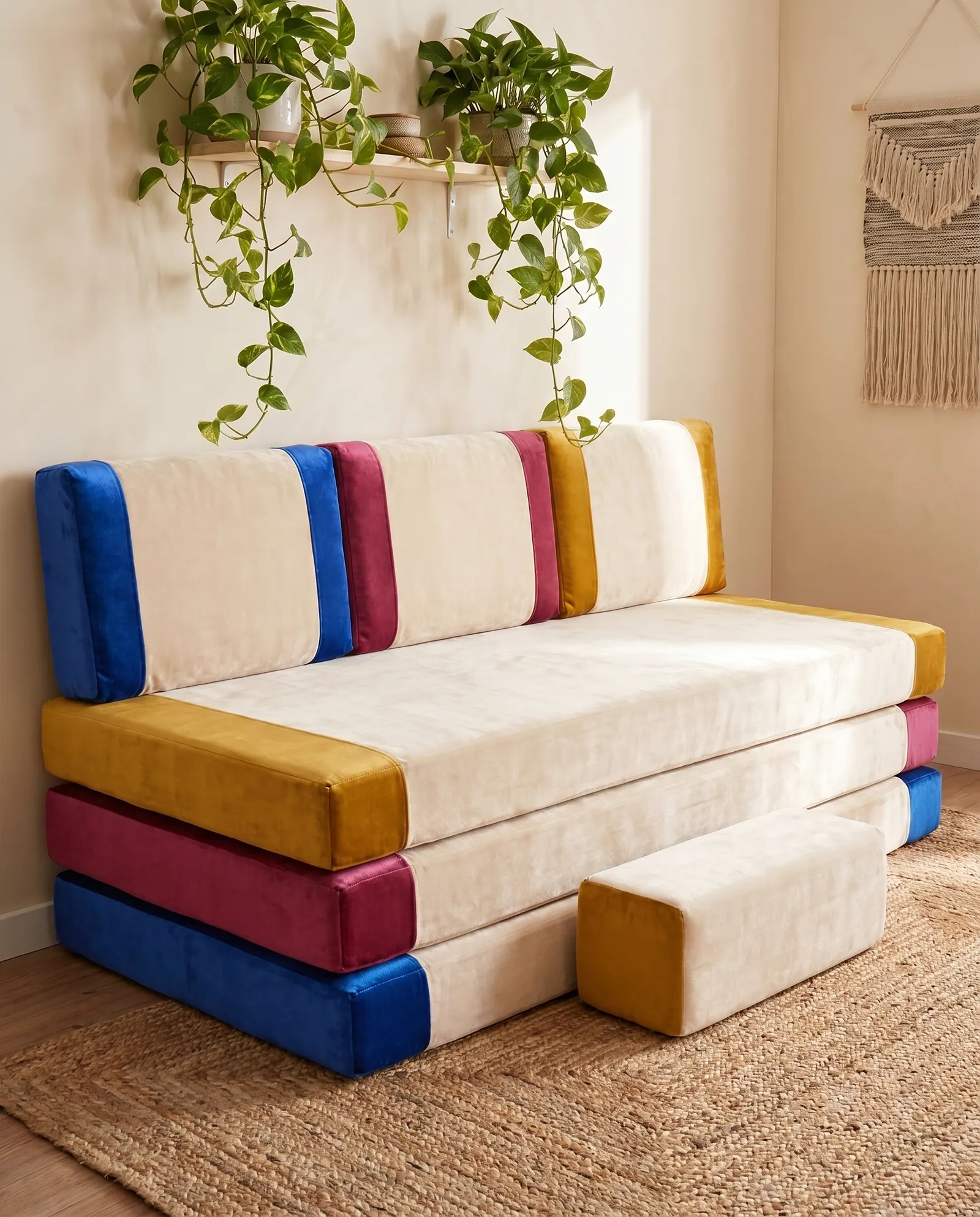
Parents in the US shopping for a teddy floor sofa for their toddler's playroom asked the two questions in one breath: what foam goes inside, and does it have flame retardants?
The workshop answered plainly. The fabric comes from a mill certified to OEKO-TEX Standard 100 (03.T.3239) and isn't fire-retardant treated, and a separate fabric chart for fire-rule projects is available on request. Nobody dressed that up as a fire label, and nobody should.
It's the right order for a nursery or playroom: certification and flame-retardant status up front, before anyone falls for a color. The kids' floor sofas hub, the bouclé and teddy swatches and Hana's playroom pages pick up from there.
Where the partner workshop stands
Nothing on this page is a compliance statement for any cushion, the workshop's included. Here is what the workshop tells buyers who ask:
- Standard cover fabrics have no flame-retardant treatment and no coating.
- The standard foam is ordinary furniture-grade polyurethane with no flame-retardant additives, and the workshop says the filling isn't FR-certified. There is no fire-retardant foam in the range.
- Seat foam is 32-density (about 2.0 lb/ft³) and 4 in (10 cm) thick as standard, wrapped in polyester fiber wadding, and an extra ¾ in (2 cm) layer can be added. None of that is a tested barrier claim.
- A separate chart of cover fabrics for fire-rule projects, including an olive linen, is available on request; ask for the test report for the exact fabric.
If you need a labeled seat, dear, get the label wording in writing before you order, from anyone. If you're shopping for flame retardant free cushions instead, ask that question just as plainly, and file both answers with the receipt.
More on each thread: flame-retardant-free cushions, Prop 65 warnings, OEKO-TEX Standard 100 for cushions and café and rental cushion specs.
Mix-ups I've seen, one of them mine
- Reading OEKO-TEX Standard 100 as a fire rating. It limits harmful substances and says nothing about flammability.
- Asking only about the fabric. The smolder result belongs to cover, barrier and filling together.
- Assuming 'no flame retardants' means 'fails,' or 'passes' means 'full of chemicals.' TB 117-2013 can be met without added flame retardants.
- Skipping the indoor-or-outdoor question. Outdoor cushions sit outside 16 CFR 1640, and the fabric chart changes too.
- Mine, early on: telling a client her throw pillows needed the same label as her sofa seat. Decorative pillows not meant for sitting are excluded.
A seat cushion can pass TB 117-2013 with no added flame retardant: the smolder test covers cover fabric, barrier and filling, and a good barrier can do the work.
Maggie
Buyer questions: flame retardants and fire rules
- A common question
Are your cushion fabrics treated with flame retardants? And is there any fiberglass in the products?
The workshop's answerNo to both, according to the workshop: the standard fabrics carry no flame-retardant treatment or coating, and there's no fiberglass in its products. The fabrics come from a mill certified to OEKO-TEX Standard 100 (03.T.3239), and buyers with strict low-tox requirements can choose a special fabric from the catalog, such as a cotton option.
- A common question
What's the foam inside made of, and does it contain flame retardants?
The workshop's answerIt's high-density polyurethane upholstery foam, and the workshop says it has no flame-retardant additives; the fabrics carry no flame-retardant finish either. The fabrics come from a mill certified to OEKO-TEX Standard 100 (03.T.3239), and the workshop shares the certificate on request.
- A common question
I need fire-retardant materials. Can you make the cushion with fire-retardant fabric and foam?
The workshop's answerFoam, no; fabric, only with paperwork. Standard fabrics and foam aren't fire-retardant, and a separate fabric chart for fire-rule projects is available on request, so ask for the test report for the exact fabric. There's no fire-retardant foam, so one buyer who needed compliant filling ordered covers only and sourced the filling locally.
- A common question
It's for a commercial space that requires certified flame-retardant fabric and filling. Can you supply both?
The workshop's answerOnly the fabric side, and only with paperwork: a separate fabric chart for fire-rule projects is available on request, so ask for the test report for the exact fabric. The filling isn't certified fire-retardant and there's no certified alternative. For projects that need a certified insert, the workshop quotes covers only and the insert comes from elsewhere.
Fire-rule questions, in brief
Do outdoor cushions need a TB 117-2013 label?
No. The federal rule, 16 CFR 1640, excludes outdoor cushions, along with decorative throw pillows not meant for sitting, cushions with less than 1/2 in (1.3 cm) of fill, and mattresses and bedding. Separate seat cushions for indoor seating are in scope.
Is TB 117-2013 an open-flame test?
No. It's a smolder test: a lit cigarette on the cover fabric, barrier and filling. Open-flame match tests belong to other rules, such as the UK's furniture regulations, which also reach scatter cushions and seat pads.
Are cushions flame retardant by law in the US?
The federal rule doesn't call for flame-retardant chemicals. It sets a smolder-resistance test for indoor upholstered seating, and TB 117-2013 can be met without added flame retardants, through the cover, a barrier layer or the filling. Whether a given cushion contains them is a question for its maker.
Does OEKO-TEX Standard 100 say anything about fire?
No. It tests textiles against limits for harmful substances, in product classes from baby articles to decorative items. It isn't a flammability test, an organic label or a performance rating, so the fire question needs its own answer.