The Pattern Room · a measuring pattern
OEKO-TEX Standard 100 on a cushion: what it covers and how to check it
No label is quoted back to me more often, and always with hope. It deserves that attention, and a little precision about whose name is printed on it.
 Save
The quick answer
An OEKO-TEX Standard 100 label means the certified textile was tested against harmful-substance limits for its product class, from class I for babies to class IV for decoration. A certificate lasts one year and is checked by number at the official Label Check. It says nothing about organic status, durability, fire behavior or being free of all chemicals.
The question behind the logo: whose certificate is it?
Most buyers who mention OEKO-TEX ask whether a cushion is certified. The better question is whose certificate it is. An OEKO-TEX Standard 100 certificate is issued to a holder, for a defined scope of articles, and the label license belongs to that holder.
For cushion fabric the holder is usually a mill. Its certificate covers the fabrics it weaves within the stated scope. It does not reach the foam inside, a zipper from another supplier, or the finished cushion, unless each carries certification of its own. A finished product can reuse its components' certificates, but the product itself still needs certifying before it can carry the label.
So on this site the wording is careful on purpose: the workshop's standard fabrics come from a mill certified to OEKO-TEX Standard 100 (03.T.3239). That sentence is about fabric. It is not a certificate for a cushion.
Checking a certificate number in five minutes
Ask for the number, not the logo
A logo on a listing proves little. Ask the maker for the certificate number that covers your fabric, and a copy of the certificate if they have one.
Enter it at the official Label Check
OEKO-TEX runs a Label Check on its own website. Type the number, or scan the QR code on a label. A number that does not exist is reported as such.
Read the holder's name
The result names the certificate owner. A mill means you are reading a fabric certificate. If the holder made the finished product, read the scope to see what it covers.
Read the scope
The certificate lists the articles it covers: woven or knitted upholstery fabric, velour, named fibers and finishes. A velvet cushion needs velvet inside that scope.
Note the class and the annex
Class I is the strictest, written for babies and children up to 36 months. The annex shows which criteria catalog applied; Annex 6 is the optional, stricter one.
Check the date
Certificates are valid for one year. A seamless renewal keeps the same number, so the live result matters more than a saved PDF.
Ask which colors it covers
Makers buy from more than one mill. Ask which of your chosen colors come from the certified mill, and keep the answer with the order.

Have it made
Measured it? Have Élodie’s workshop make it
A fabric reads one way at noon and another at dusk. Mention your light, and the workshop will weigh it with you. — Élodie
Leave your details and the workshop will call you to confirm measurements, fabric, foam and piping. No prices, dates or payment on this page: it is a request, not an order.
The four product classes, read for cushions
| Class | Written for | What it means for cushion fabric |
|---|---|---|
| I | Babies and children up to 36 months; the strictest limits | Tighter limits than an upholstery fabric needs |
| II | Direct skin contact; the standard lists mattresses as an example | Stricter than the upholstery class |
| III | Little skin contact; the standard lists stuffings | Where fillings and stuffings fall |
| IV | Decoration material; the standard lists upholstery fabrics and curtains | The class upholstery fabric needs by default |
What the label says nothing about
Standard 100 tests every component of a certified article, down to thread, buttons and trims, against more than 1,000 harmful substances. That is its whole subject. The standard itself says it is not a quality label.
It does not tell you how a fabric wears. The workshop holds no Martindale or Wyzenbeek test certificates of its own for the standard ranges, so it quotes no rub count for them; Martindale and double rubs explains what those numbers would mean. It does not tell you how a fabric burns: flame retardants are a separate question with a separate label, and Prop 65 warnings are another. It is not an organic standard, and the workshop claims no organic certification.
And it does not mean a fabric is free of every chemical. One buyer wrote back to point that out, gently and correctly. Dye is chemistry. So is polyester. The label sets limits; it does not promise an absence.
A 106-inch bay seat and a request for proof
A designer in the US wrote on behalf of a client with a built-in bay seat: 106 in (269 cm) along the main side, 56 in (142 cm) along the rear, and two 35 in (89 cm) diagonal ends. The designer wanted one professionally upholstered cushion, and proof of OEKO-TEX certification with it.
The workshop checked the geometry first. The numbers closed into a trapezoid about 24.5 in (62 cm) deep, so photos and measurements were enough and no paper template was needed. It suggested 4 in (10 cm) of about 2.0 lb/ft³ (32 kg/m³) foam for a tailored, built-in look, offered a warm oatmeal and a natural flax linen with physical swatches and a zippered cover washable at 86°F (30°C), and sent a certificate number for the fabric.
That last step is where I would add one habit. Put the number into Label Check yourself, read the holder's name and the scope, and make sure the oatmeal you chose is woven inside it. A client deserves the certificate for the actual cloth. The bay window cushions and the three-sided bay guide cover the measuring side.
Six ways the OEKO-TEX label gets misread
- Reading the logo as a fire answer. Standard 100 says nothing about burning behavior.
- Assuming a fabric certificate covers the foam. Foam needs its own document, by number, with its own holder.
- Reading class I as 'made for babies' only. It means the strictest limits; upholstery fabric sits in class IV by default.
- Trusting a PDF without checking the date. Certificates last one year.
- Buying on the certificate alone. Before a large custom order, ask for foam density and which dimensions are fixed; one floor-sectional buyer learned the seat thickness could not change.
- Expecting an organic label. OEKO-TEX limits harmful substances; it is not an organic standard.
Ask whose name is on an OEKO-TEX certificate: a mill's certificate covers the fabric it weaves, not the foam, the zipper or the finished cushion.
Élodie
If polyester is the real worry: cotton and pure linen
Sometimes the certificate question is really a fiber question. The standard corduroy, velvet and soft fabric all contain polyester. For eczema, allergies or a wish to avoid microplastics, the workshop uses its natural-fiber options instead: a 100% cotton chart, pure linen, or a cotton-linen fabric in its own color range. Covers can be ordered without filling.
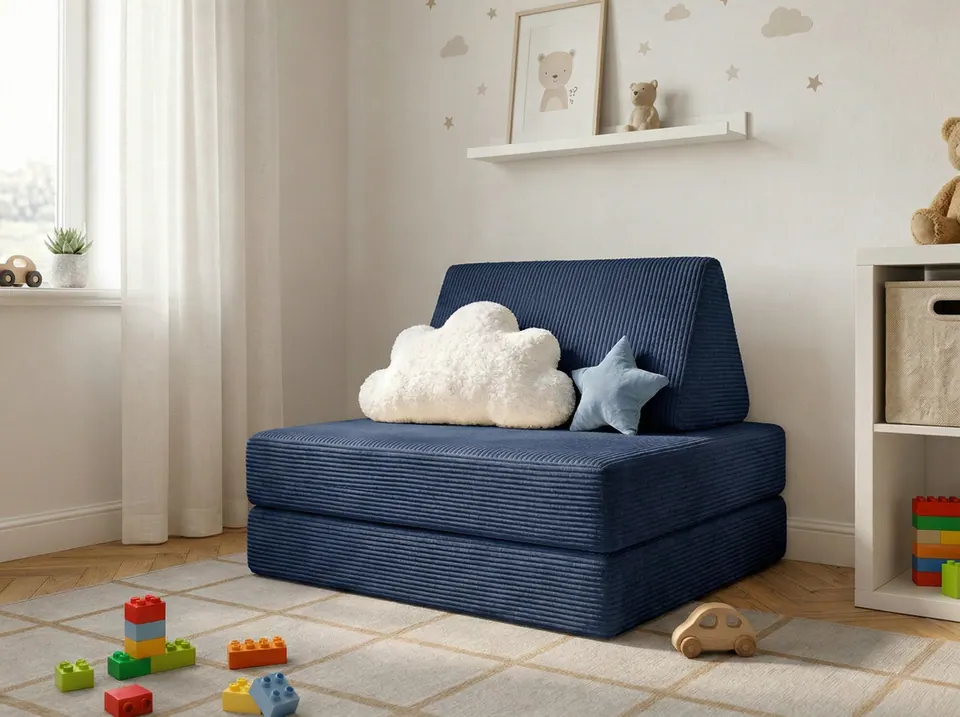
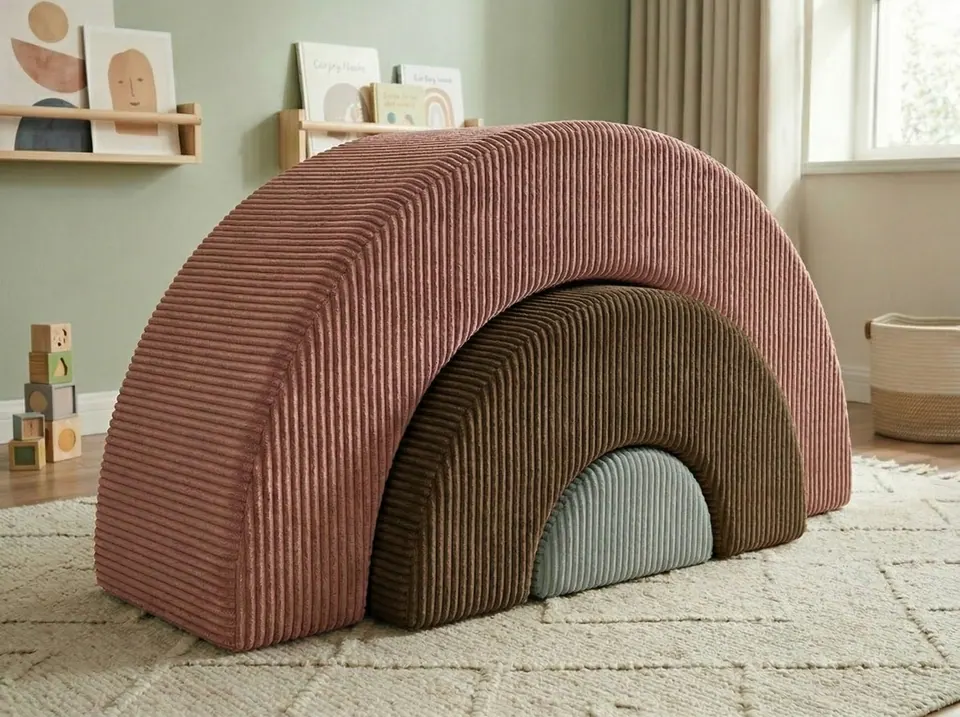
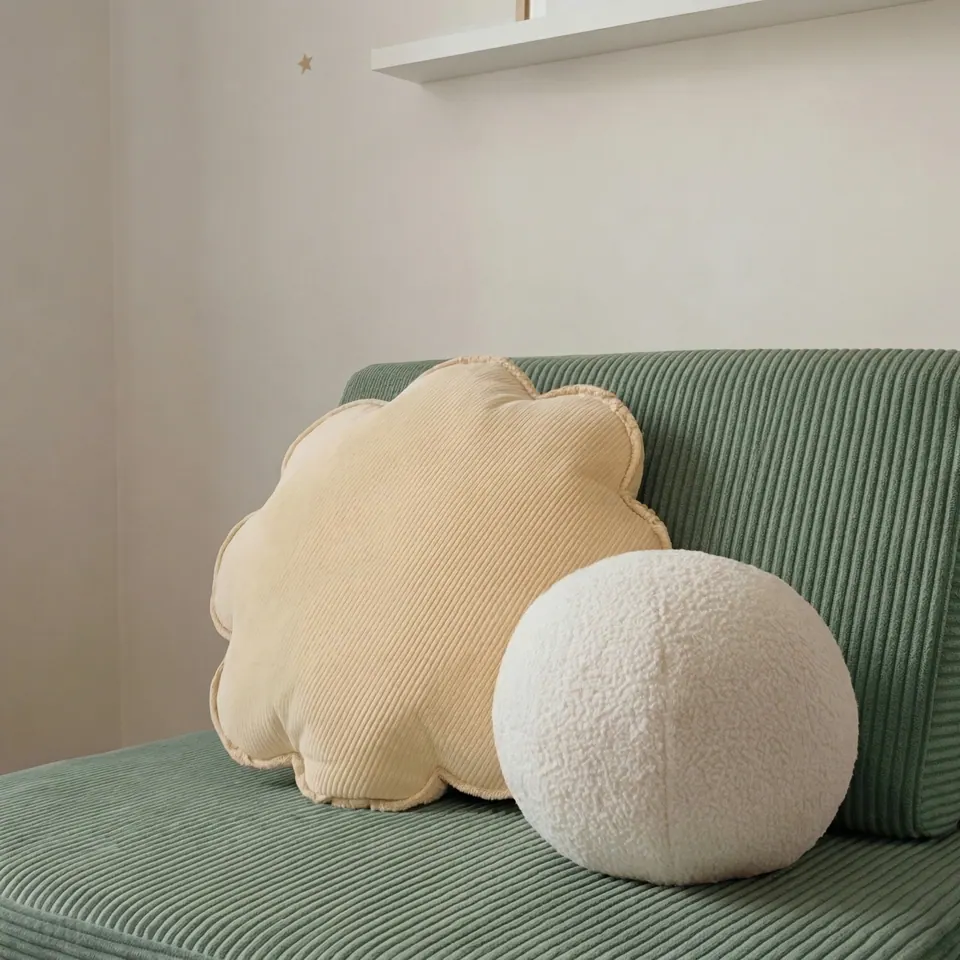
Order swatches first and read them by a window at noon, never on a screen alone; the eye sits down first. The linen and cotton-linen swatches, the natural-fiber guide and the cushion covers go further. For a playroom, the kids' floor sofas show the corduroy that comes as standard.
My friends, what will you ask your maker for first: the number, or the swatch?
Buyer questions: certificates, foam and fiber
- A common question
Is the foam certified too, or only the fabric?
The workshop's answerAsk for the document before you order, and read whose name is on it. The workshop shares certificate documents on request; the verified ones are mills' OEKO-TEX Standard 100 certificates for fabric. For the foam, the workshop describes what it is: about 2.0 lb/ft³ (32 kg/m³) high-resilience cold foam in bench and seat cushions, and 28-density medium-hard foam in floor sofas. If a foam certificate matters to you, ask for it by number.
- A common question
I react to synthetics. Can my cushion be made in 100% cotton or linen?
The workshop's answerYes. The standard corduroy, velvet and soft fabric contain polyester, so for eczema, allergies or avoiding microplastics the workshop uses its 100% cotton chart, pure linen, or a cotton-linen fabric instead. Natural fibers cost a little more; the quote shows the difference. Covers-only orders without filling are fine, and swatches come through the fabric-samples listing.
- A common question
What's the Martindale or double-rub count on your fabric?
The workshop's answerThe workshop has no official Martindale or Wyzenbeek test certificates, so it can't quote a rub count for its standard ranges. The fabrics are heavy-duty upholstery grades chosen for daily bench use, with rare durability complaints; the outdoor fabrics are the toughest, and velvet and soft fabric wear well. A PDF spec sheet is available for the sofa corduroy.
- A common question
Are the materials certified organic?
The workshop's answerNo organic certification is claimed. What the workshop can point to is that its standard fabrics come from a mill certified to OEKO-TEX Standard 100 (03.T.3239), which is a harmful-substance test, not an organic standard. The kids' floor sofa corduroy, for example, is polyester. For natural fiber, ask for the cotton or linen charts.
- A common question
I asked about flame retardants and a Prop 65 warning, and got an OEKO-TEX number back. Does that answer it?
The workshop's answerNot on its own. The number can be verified on the official OEKO-TEX site, where the holder, scope and validity are listed, and the workshop shares the certificate on request. But the standard does not describe burning behavior. On flame retardants the workshop's statement is separate: its standard fabrics have no flame-retardant treatment, and fire-retardant fabrics come from a separate chart.
OEKO-TEX label questions, briefly
How long does an OEKO-TEX Standard 100 certificate stay valid?
One year. A seamless renewal keeps the same number, renewals can use reduced testing, and OEKO-TEX can make unannounced site visits. That is why the date on the live Label Check result matters more than the date on a saved PDF.
What does Annex 6 mean on a textile certificate?
Annex 6 is an optional, stricter criteria catalog. The certificate holder chooses Annex 4 or Annex 6, and the choice is printed on the certificate, so you can read it straight from the Label Check result alongside the product class.
Can a finished cushion carry the OEKO-TEX label when only its fabric is certified?
No. A finished product can reuse its components' certificates, but the product itself still needs certifying to carry the label, and the label license belongs to the certificate holder. A certified fabric makes a certified fabric, not a certified cushion.
Which OEKO-TEX class suits a nursery cushion fabric?
Class I is written for articles for babies and children up to 36 months and sets the strictest limits. Upholstery fabric normally sits in class IV, so a class I fabric meets tighter limits than a cushion cover needs. Check the class on the certificate itself.