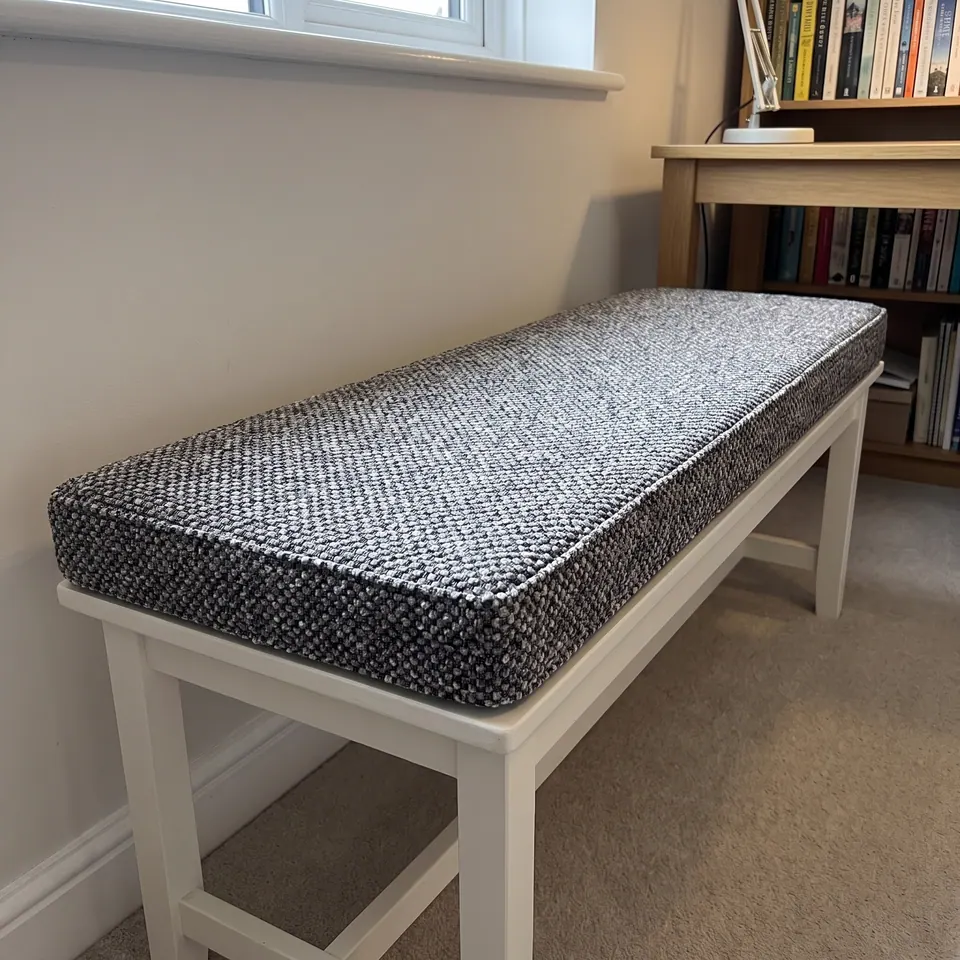
The Pattern Room · a side-by-side pattern
Martindale rub count and double rubs: what the numbers tell you
A rub count is a forecast for one kind of weather: friction. It says nothing about sun, spills or a dog who treats the bench as a launch ramp.
 Save
The quick answer
A Martindale rub count and a Wyzenbeek double-rub count both measure how much rubbing an upholstery fabric survives before it wears through, but they use different machines and cannot be converted into each other. As a rough guide, home seating runs 15,000 to 25,000 Martindale cycles, busy family seats 25,000 to 35,000, and contract seating from about 35,000 to 40,000 up.
Two machines, two sides of the Atlantic
One buyer asked the workshop for a bench cushion fabric rated above 50,000 rubs. Fair ask. The first question back is always the same: rubs on which machine?
There are two abrasion tests, and they grew up on opposite shores. Martindale is the European and British standard. A sample is rubbed under a set load in a figure-eight pattern, and the count is in cycles, or rubs. Wyzenbeek is the North American one. The fabric is rubbed straight back and forth along the warp and the weft, and each forward-and-back pass counts as one double rub.
Both stop when the fabric shows it has had enough. For Martindale that means two broken threads in a woven fabric, or one in a knit. For Wyzenbeek it means two broken yarns or a clear change in appearance.
You'll find summaries online claiming Martindale runs two or three times higher than Wyzenbeek. Don't use them. Different motion, different rubbing surface, different finish line. Compare Martindale with Martindale and double rubs with double rubs. If a fabric only has a Martindale number and your spec asks for double rubs, the honest answer is not tested, not a sum.
Martindale and Wyzenbeek, side by side
| Martindale | Wyzenbeek | |
|---|---|---|
| Where you'll see it | Europe and the UK | North America |
| Standard | EN/ISO, usually ISO 12947 | ASTM D4157 |
| Motion | Figure-eight (Lissajous) rubbing | Straight back and forth, along warp and weft |
| What's counted | Cycles, or rubs | Double rubs: one forward-and-back pass each |
| Rubbing surface | A standard abradant under a 12 kPa load | Cotton duck or a wire screen |
| Stops at | 2 broken threads (woven) or 1 (knit) | 2 broken yarns or a clear change in look |
| Convertible to the other? | No | No |
Key facts
- Martindale rubs in a figure-eight and counts cycles; Wyzenbeek rubs back and forth and counts double rubs.
- The two scales cannot be converted; any fixed multiplier is guesswork.
- Rub counts don't measure pilling, fading, snagging from claws, stains or softness.
- The workshop holds no Wyzenbeek (double-rub) certificates and has no lab Martindale figures for most codes.
- The supplier reports about 88,000 Martindale cycles for the workshop's pet-friendly polyester weave.
Have it made
Measured it? Have Callum’s workshop make it
Tell them where it lives. Porch, deck or boat: the weather picks the fabric and the foam before anyone else does. — Callum
Leave your details and the workshop will call you to confirm measurements, fabric, foam and piping. No prices, dates or payment on this page: it is a request, not an order.
Rub-count bands, from throw pillow to café booth
| Use | Martindale cycles | Wyzenbeek double rubs |
|---|---|---|
| Decorative: throw pillows, backs rarely leaned on | 6,000 to 10,000 | under 3,000 |
| Light home use: occasional seats | 10,000 to 15,000 | 3,000 to 9,000 |
| General home seating | 15,000 to 25,000 | 9,000 to 15,000 |
| Busy homes: kids, pets, a bench used at every meal | 25,000 to 35,000 | 15,000 and up |
| Contract and commercial: cafés, offices | 35,000 to 40,000 and up | 15,000 to 30,000 and up |
Published bands disagree, so these are reconciled ranges from several fabric sources. Each column is its own scale: the rows line up by use, not by conversion.
What a rub count won't tell you
- Pilling. Bobbles are graded on a separate test, from 1 (severe) to 5 (none). Polyester pills tend to hang on rather than break off.
- Fading. Sun gets its own lightfastness scale, blue wool 1 to 8, where 6 is good and 7 or more is excellent. That's the number for a sunny window seat.
- Claws and snags. A snag test is the honest proxy for pets, and weave matters as much as count: tight and flat beats loose and looped.
- Stains and spills. Cleanability comes from fiber, weave and finish, not abrasion.
- Softness and seams. A tough fabric can still feel stiff, and seam strength is tested separately.
- Water. Water-repellent is a promise; waterproof is a contract. Neither shows up in a rub count.
What the workshop can put on paper
Straight answers, since you asked for numbers.
The workshop holds no Wyzenbeek (double-rub) certificates and has no lab Martindale figures for most of its codes, so it won't quote a rub count it can't back. Its fabrics are chosen as heavy-duty upholstery grades for daily seating, with a stated minimum weight of 250 g/m² (about 7.4 oz per square yard). In its experience the outdoor fabrics are the toughest, and velvet and the soft upholstery weave wear well too.
Two figures do exist. Both come from supplier sheets, not from reports verified for these codes:
- The pet-friendly weave. The supplier reports about 88,000 Martindale cycles for this 100% polyester fabric at 370 g/m² (about 10.9 oz per square yard). It is tightly woven with no loops for claws to catch, and it wipes clean. It has a leather-touch finish but isn't leather.
- Contract fabrics. Fabrics rated by their suppliers at 40,000 Martindale are available for commercial projects; the commercial seating guide covers the rest of that spec.
Neither figure makes a cushion immune to a determined dog. No fabric is. For choosing by household, see pet-friendly cushion fabric and the performance and pet-friendly fabrics in the Swatch Library, or browse pet-friendly cushions already made.
Two dogs, an oatmeal room and a question about linen
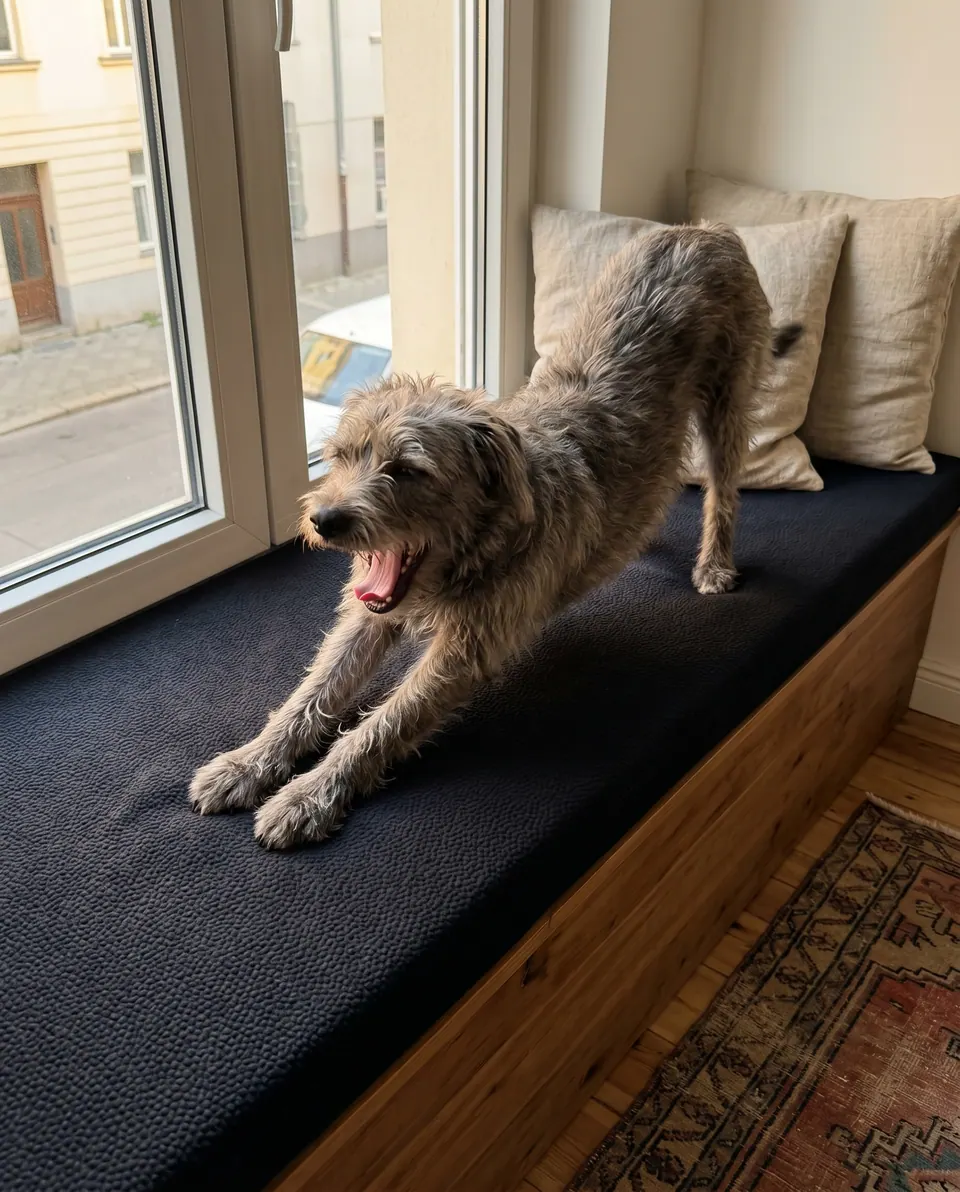
A dog owner in the US wanted cushions for a bench shared with two dogs, in colors to suit an oatmeal-and-charcoal room, and asked whether linen could survive the dogs jumping on and off all day.
Honest answer: wrong gear for that weather. The workshop steered them to its pet-friendly weave, the 100% polyester fabric its supplier rates at about 88,000 Martindale, 370 g/m² and wipe-clean. It matched two shades to oatmeal and one to charcoal, and warned that one of the darker codes reads nearly black.
The buyer chose an oatmeal with contrasting piping and added a non-slip base, so the cushion stays on the bench even when the dogs don't.
For pets, a high-Martindale polyester in a tight weave beats natural linen. The rub count was half the reason. The weave was the other half.
So before you chase a number, friend, think about your own weather. A kitchen bench with two kids and a spaniel is a busy-home job; a throw pillow on a guest bed isn't. What does your seat actually go through in a week?
Four questions before you trust a rub count
- Which test? Martindale cycles or Wyzenbeek double rubs. A bare number with no test name is a rumor.
- Whose number? A supplier's sheet is not the same as an accredited lab report, and a lab report only covers the sample it tested.
- Which fabric? The count belongs to one fabric code, not the whole chart.
- What else was tested? For a sunny bay ask about lightfastness, for pets ask about snagging and weave, and for a café ask about contract-grade specs and fire rules.
A fabric rated at 40,000 Martindale cycles wears thin slowly, but the rub count says nothing about pilling, sun fading or a dog's claws.
Callum Reid
Why rub-count thresholds differ by source
| Source | Home use | Heavy or commercial use |
|---|---|---|
| German institute scale (Martindale) | 10,000 to 15,000 private use | 25,000 to 35,000 office use |
| US fabric distributor (Martindale) | 20,000+ light domestic | 40,000+ commercial |
| US furniture store (Martindale) | 10,000+ light, 20,000+ general | 40,000+ heavy use |
| US fabric distributor (Wyzenbeek double rubs) | About 15,000 residential | 30,000+ heavy commercial |
| US furniture store (double rubs) | 15,000+ light, 25,000+ heavy residential | 50,000+ commercial |
Buyer questions: rub counts and hard-working fabrics
- A common question
I need a bench cushion fabric with a high rub count, ideally above 50,000. What can you tell me?
The workshop's answerThe workshop has no official Martindale or Wyzenbeek test certificates for its standard codes, so it can't quote a rub count. The fabrics are heavy-duty upholstery grades chosen for daily bench use, and durability complaints are rare. The outdoor fabrics are the toughest; velvet and the soft upholstery weave also wear well. A PDF spec sheet with fabric details exists for the sofa corduroy.
- A common question
What is the pet-friendly fabric made of? The swatch looks almost like leather.
The workshop's answerIt's a 100% polyester woven upholstery fabric at 370 g/m², which the supplier rates at about 88,000 Martindale cycles; it hasn't been Wyzenbeek-tested. The leather-touch texture is why it can look like velvet in a photo and like leather in a swatch, but it isn't leather. It wipes clean easily. For real water resistance the outdoor range is the better pick, and homes without pets often find velvet or the soft weave more comfortable.
- A common question
We have a toddler and a dog. Which fabric holds up best?
The workshop's answerVelvet and the soft upholstery weave are the go-to choices: velvet resists stains best, the soft weave is the easiest to spot-clean, and both are among the most durable in the range. The striped fabrics are 100% cotton and stain more easily. If a dog will live on the cushion, choose from the pet-friendly chart. Zippered covers come off and machine-wash at 86°F (30°C) on a delicate cycle.
- A common question
Is there a performance fabric for a kids' bench that gets used hard?
The workshop's answerWhen buyers ask for performance fabric for children, the workshop points to two ranges. The soft weave is a microfiber, a little more durable than linen and thinner than velvet, that stays soft and wipes clean. Velvet stands up to daily wear and is the easiest to spot-clean, because marks lift off the pile more readily than off textured weaves. The striped cottons are harder to keep clean with kids.
- A common question
What's the soft upholstery fabric actually made of?
The workshop's answerIt's the workshop's best-selling upholstery weave: thick, durable and soft to the touch. Most replies describe it as a polyester-cotton blend, earlier ones as 100% polyester; it isn't chenille or 100% cotton. It wipes clean and machine-washes at 86°F (30°C). For natural fiber, cotton-linen is the alternative.
Rub counts, answered on the dock
How many double rubs should a dining bench fabric have?
For a bench used at every meal, look at the heavy-duty end: 15,000 double rubs or more on the Wyzenbeek scale. If the fabric is rated in Martindale instead, 25,000 to 35,000 cycles covers a busy home. Treat them as two separate scales, not one number in two units.
Is a higher rub count always the better buy?
Only up to what the seat needs. Past contract levels, extra cycles add little for a home bench, and the count says nothing about pilling, fading, snags or stains, which often decide how a home cushion ages. Match the band to the use, then ask about those other tests.
Where does contract grade begin on the rub-count scales?
Sources disagree, but contract and commercial seating usually starts around 30,000 to 40,000 Martindale cycles, or roughly 15,000 to 30,000 double rubs and up. The workshop offers fabrics rated by their suppliers at 40,000 Martindale for commercial projects.
Does one rub-count report cover every color on a chart?
No. A rub-count result applies to the sample that was tested, and a report only proves the fabric it names. Ask which code was tested, and whether the figure comes from an accredited lab report or from a supplier's own sheet.
Do outdoor fabrics carry rub counts too?
Many do. Published figures put olefin outdoor fabrics above 30,000 double rubs, and some solution-dyed acrylic upholstery lines claim 100,000 cycles or more. The workshop considers its outdoor range its toughest fabric, though it holds no rub certificates for it.