Across the Map · Europe
Custom cushions for German corner benches, balconies and winter gardens
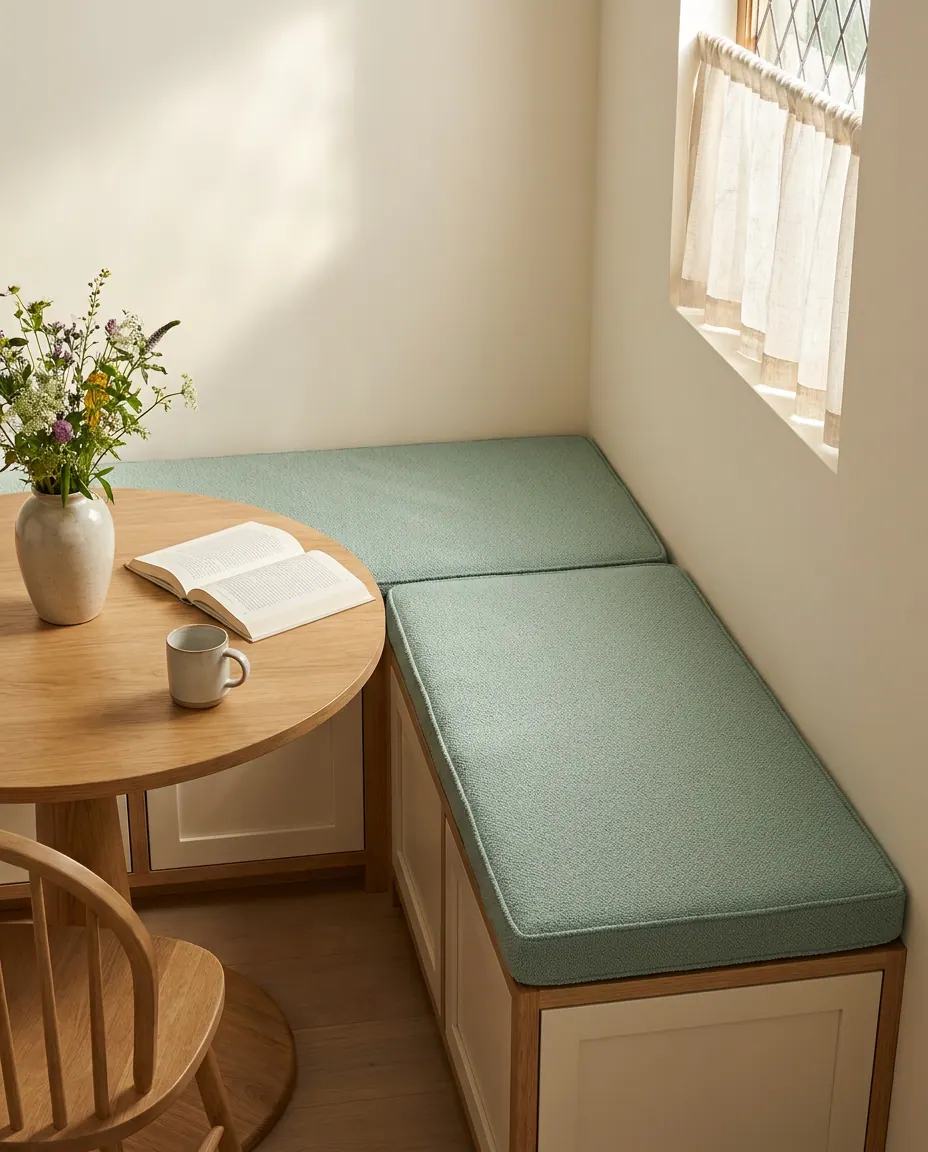
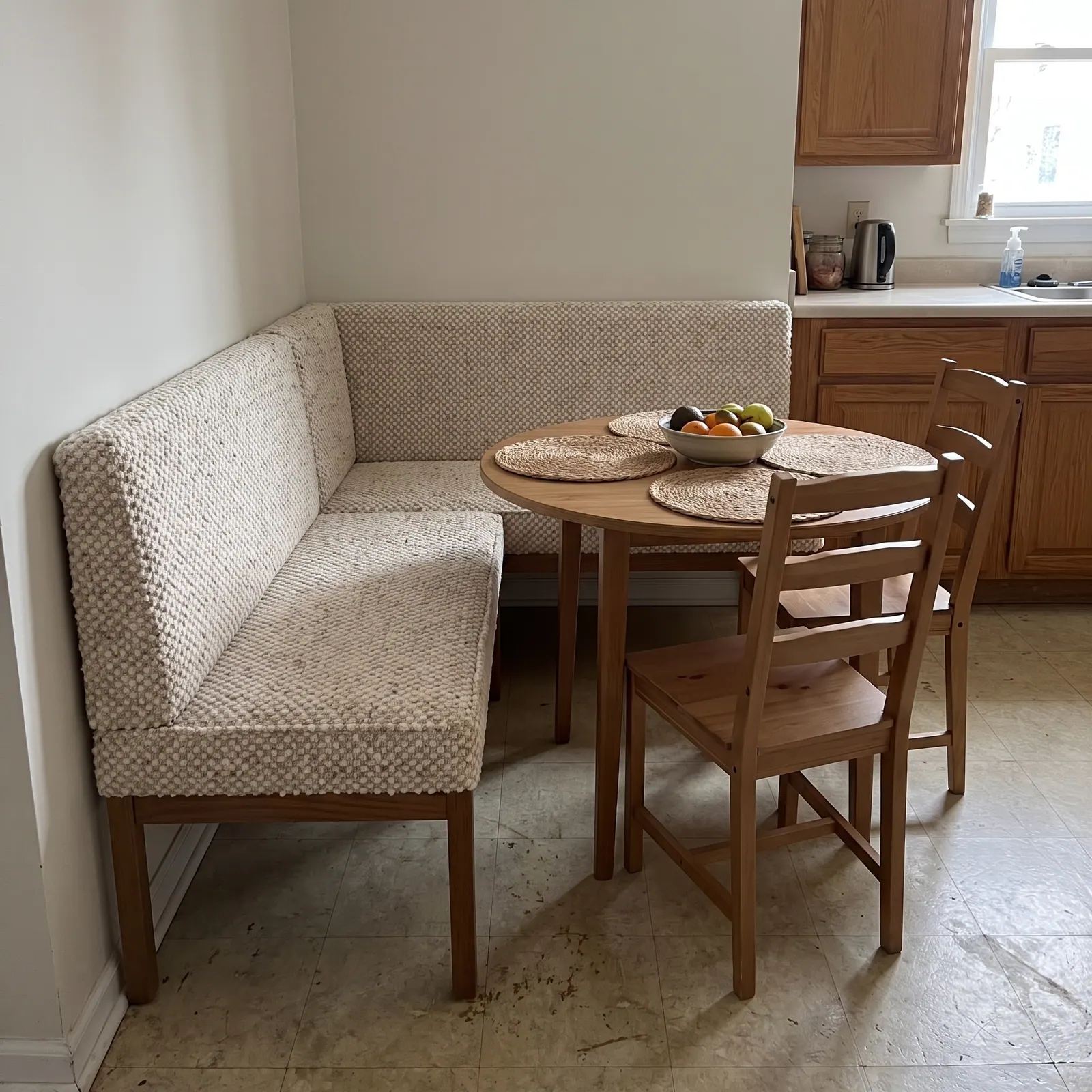
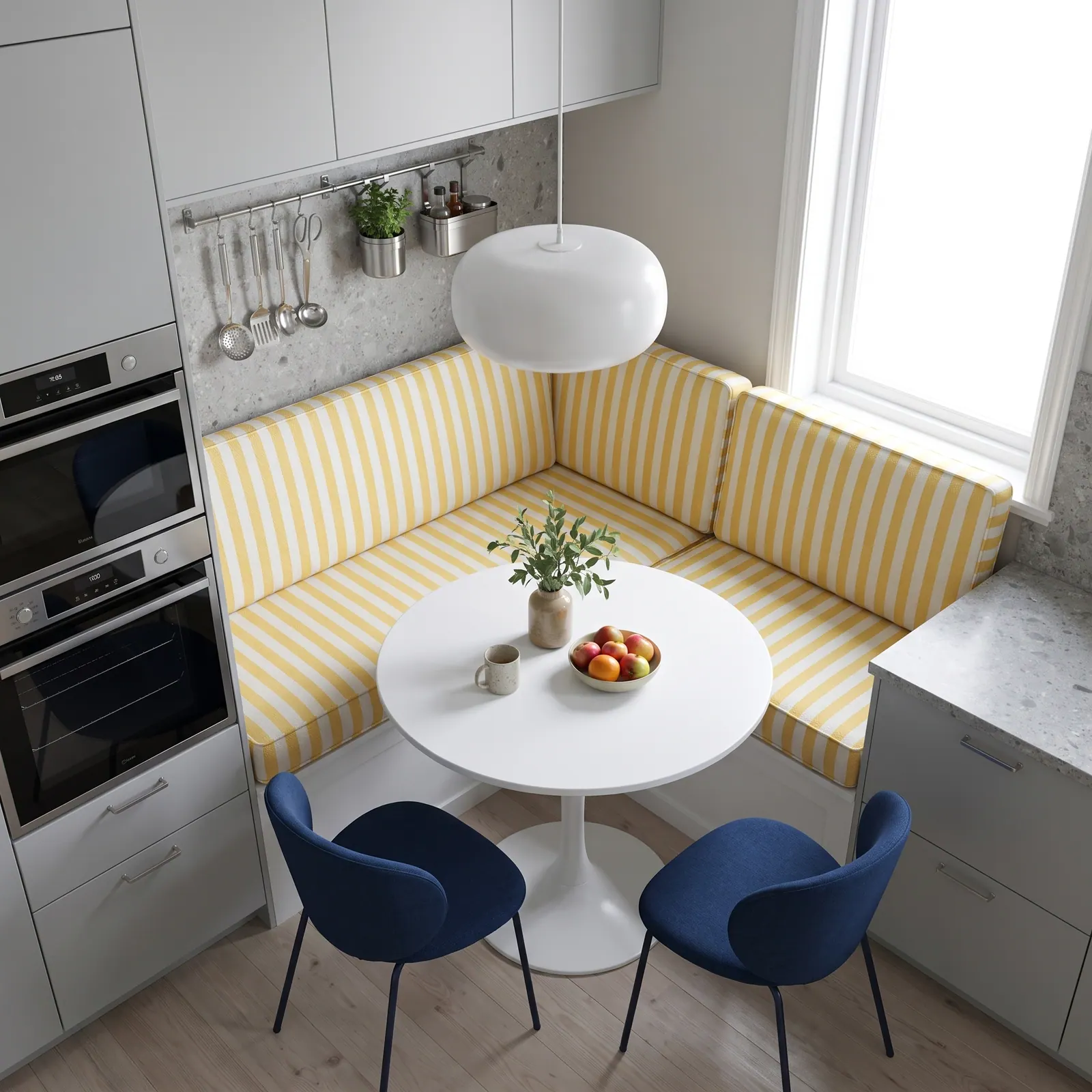
An Eckbank is two benches, one corner and one decision. Make that decision on paper, in centimeters, before anyone cuts foam.
- Sun & UVModerate
- HumidityModerate
- WinterCold
- CoastSalt air nearby
- Typical seatsKitchen eckbank corner bench, altbau window sill seat, balcony bench and chair pads

 Save
The quick answer
Custom cushions in Germany start at the kitchen Eckbank: measure each leg of the L, decide which cushion runs into the corner, subtract the seat thickness from any backrest height and add a non-slip base. Glazed Wintergarten seats need fade-aware fabric and dry air. Balcony cushions need outdoor fabric and a dry shelf indoors from October.
Temperate on paper, changeable in practice
The north and west of Germany are oceanic, with cool winters and warm summers. The east is more continental, with colder winters and dry spells. The south can pass 86°F (30°C) in summer.
Rain and sun split the same way. Hamburg averages about 31 in (793 mm) of precipitation a year and Berlin about 20 in (515 mm). Sunshine runs from roughly 1,582 hours in Hamburg to 2,098 in Freiburg. Two of those numbers matter to a cushion:
- Drying time. A balcony cushion in the damp north dries slower than one in the sunny southwest. Water-repellent fabric sheds a shower; it isn't waterproof. Get a wet cushion dry within 24 to 48 hours, the EPA's window for stopping mold.
- Sun through glass. A Freiburg Wintergarten sees about a third more sunshine hours than a Hamburg one. Indoor fabrics have some UV resistance, not outdoor-grade resistance, so plan fabric by orientation.
Measuring the Eckbank L, step by step
Measure each leg on its own
An Eckbank is two elements at right angles joined by a corner connection. Measure each leg from the wall to its open end, at seat height, to the nearest ¼ in (0.5 cm).
Measure the depth at both ends
Front edge to wall or backrest, at the corner and at the open end. Old plaster drifts. If the two readings differ by more than about ½ in (1 cm), you have a trapezoid, not a rectangle.
Decide which cushion owns the corner
One cushion runs into the corner; the other is shortened by that cushion's depth. A 61 in (155 cm) leg beside a 19 in (48 cm) deep cushion takes a 42 in (107 cm) piece. Pick one, partner, and write it down. Usually the longer leg runs through; which one is longer on yours? The corner joint Pattern compares the options.
Subtract the seat from the backrest
Measure the back height from the seat board, then take off the seat cushion's thickness. A 17¾ in (45 cm) back over a 4 in (10 cm) seat leaves a 13¾ in (35 cm) backrest.
Round down for enclosed ends
If the bench is boxed in by walls or a cabinet, order a few millimeters under your reading: a 24.3 x 76.8 in (61.7 x 195.1 cm) reading is ordered a millimeter or two short each way.
Give every side of an angled piece
For a trapezoid, send all four sides, including the short end sides at the corner, and mark which face is up. The trapezoid calculator checks that your numbers close.
Five velvet cushions and one trapezoid against the oven
A buyer in Germany ordered five velvet cushions for a kitchen corner bench, cream with a fuchsia border: a 68½ x 16 x 2 in (174 x 41 x 5 cm) cushion, back pieces of 68½ x 10½ x 1¼ in (174 x 27 x 3 cm), 16 x 10½ x 1¼ in (41 x 27 x 3 cm) and 36¼ x 10½ x 1¼ in (92 x 27 x 3 cm), and a 2 in (5 cm) trapezoid with parallel sides of 36¼ and 9½ in (92 and 24 cm), a 16 in (41 cm) bench side and a 22½ in (57 cm) side against the oven.
Every piece got a zipper and a non-slip bottom, so the horizontal backrests would stay put instead of sliding off. Four 16 x 16 in (40 x 40 cm) accent pillows rode along.
The buyer was delighted with the quality and the colors. One problem: the trapezoid's non-slip panel ended up on the seating face. A rectangle you just flip. A trapezoid you can't, because flipped, its angles point the wrong way. The workshop remade it right away.
Angles are just lengths in disguise, and so is 'this side up'. On any asymmetric piece, mark the top face on your drawing, right next to the lengths. More in L-shaped cushions and trapezoid cushions.
Altbau sills, balconies, the Wintergarten and the allotment hut
Altbau. Apartments built before 1949 are known for generous ceiling heights and big windows, and many were fitted with Kastenfenster: two sashes, one behind the other. That depth makes a sill seat. If the inner sash swings over it, the cushion has to stay under the handle. About ¾ in (2 cm) is possible without piping and 1¼ in (3 cm) with it, and the foam must be cut evenly or the cover bulges. See window seat cushions.
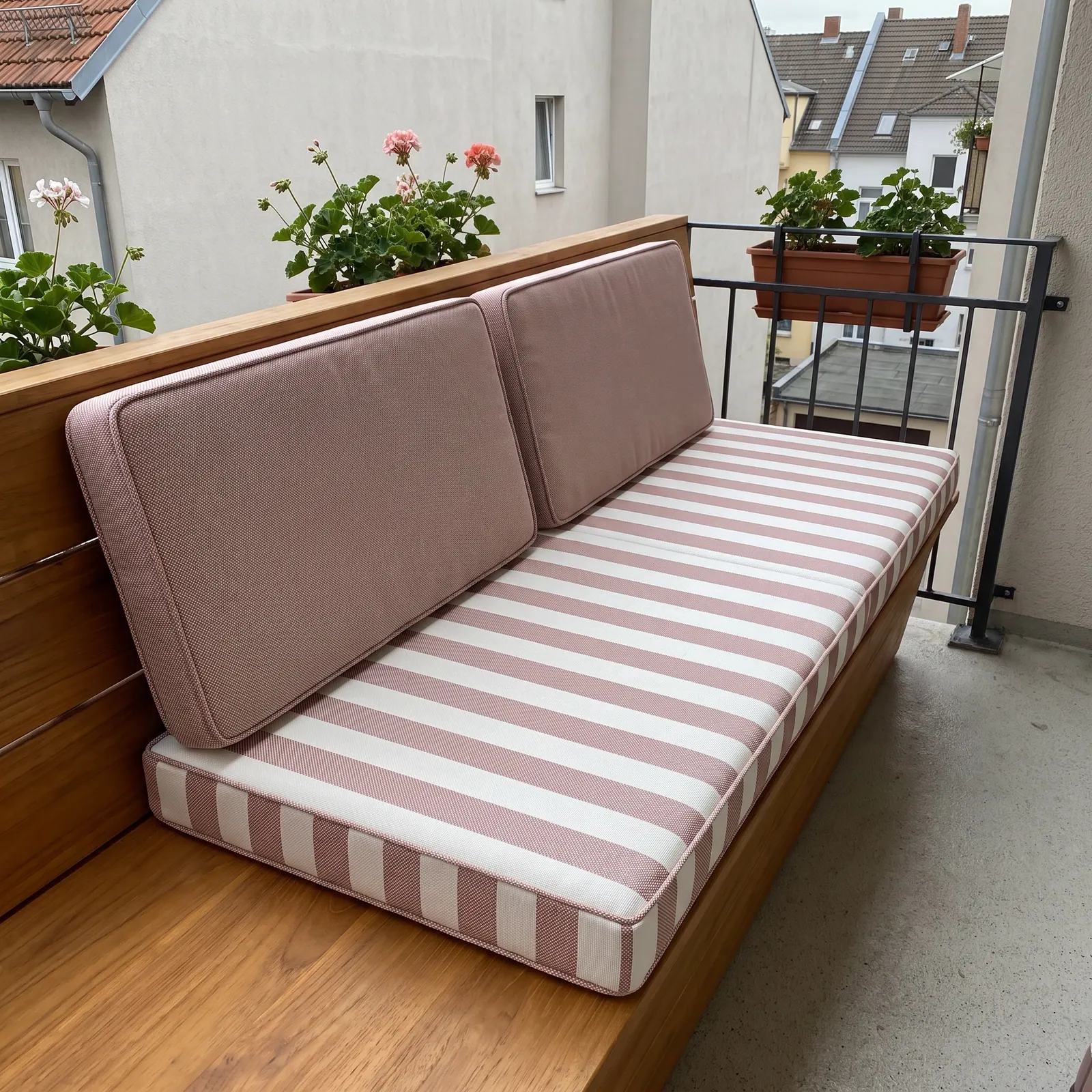
Balcony. Under a solid roof, regular upholstery fabric works, but it is not waterproof. Wherever rain reaches, use water-repellent outdoor fabric and reserve a dry indoor shelf for winter.
Wintergarten. Roof and walls are mostly glass. Warm ones stay above 66°F (19°C) all year, cool ones are heated to 54-66°F (12-19°C), cold ones barely at all. Without ventilation, a glazed room overheats in summer and collects condensation and mold. Cushions go on the bench, never against the glass, and a cold Wintergarten gets outdoor fabric. See sunroom cushions and sunroom fabric and humidity.
Kleingarten. Germany has about 1.4 million allotment gardens. A hut bench cushion is an outdoor cushion with a roof over it: zip-off covers, dry storage, off the floor.
Build sheet by German seat
| Seat | Fabric | Foam and thickness | Detail |
|---|---|---|---|
| Eckbank seat | Performance poly-cotton or velvet | 2-4 in (5-10 cm); high-density cold foam for a firm, smooth top | Non-slip base; zipper on the edge you choose |
| Eckbank backrest | Same fabric as the seat | 1.25-2 in (3-5 cm); height = back minus seat thickness | Non-slip base so it stays upright |
| Altbau box-window sill | Linen blend or velvet | 0.75-1.25 in (2-3 cm) under an opening sash | ¾ in (2 cm) without piping, 1¼ in (3 cm) with |
| Wintergarten bench | Outdoor fabric if unheated; indoor if heated and ventilated | 3-4 in (7.5-10 cm) | Keep clear of the glass |
| Balcony bench and chairs | Water-repellent outdoor fabric | Seat 4 in (10 cm), back and chairs 2 in (5 cm) | Ties or non-slip base; indoors for winter |
| Allotment hut bench | Outdoor fabric | 2-3 in (5-7.5 cm) | Zip-off covers; store dry, off the floor |
A German cushion calendar, by the month
- March: measure balcony and allotment seats while they're empty, to the nearest ¼ in (0.5 cm).
- April to May: order, and check every size on the pre-shipment list before you approve it.
- Summer: wash covers at 86°F (30°C) on a gentle cycle, no bleach, air dry. Zip the foam back in only when both are fully dry.
- After heavy rain: stand wet cushions on edge in moving air and aim for dry within 24 to 48 hours.
- October: bring balcony and hut cushions indoors before the first frost. Water already in the foam is what freezes.
- Winter mornings: check the Wintergarten glass for condensation and keep cushions clear of it.
- Twice a year: flip and rotate window-seat cushions so one face doesn't take all the sun.
Photographs for homes like these
Open any photograph large; each one has its own link and a Save button.
 Save
 Save
 Save
 Save
 Save
An Eckbank has two lengths, one corner and one owner. Write down which cushion owns the corner before anyone cuts foam.
Nate
Buyer questions: benches, backrests and balconies
- A common question
My entryway bench is enclosed on three sides and I measured it with a laser. What size do I write?
The workshop's answerFor a laser reading of 24.3 x 76.8 in (61.7 x 195.1 cm), the workshop said to write it a millimeter or two short, about 24.2 x 76.8 in (61.5 x 195 cm). Handmade cushions vary slightly, but not enough to cause trouble here, and sizes are double-checked before shipping so the cushion never comes out larger than ordered.
- A common question
Do I subtract the seat cushion's thickness when I size the backrest above it?
The workshop's answerYes. Take the seat thickness, for example 4 in (10 cm), off the backrest height so the pieces don't push each other out. A quick sketch helps confirm the final sizes.
- A common question
How do I stop horizontal backrest cushions from sliding off the bench?
The workshop's answerEvery cushion can have a non-slip bottom, backrests included. Say which pieces should get it when you order.
- A common question
I want a firm corner seat I don't sink into, smooth, with no tufting. Which foam?
The workshop's answerHigh-density cold foam. It stays stable, keeps its shape and doesn't wrinkle or sag, and the top can be completely smooth with no buttons. One buyer ordered two velvet pads forming an L, 47¼ x 23½ in (120 x 60 cm) and 51¼ x 23½ in (130 x 60 cm).
- A common question
Will indoor fabric fade on a west-facing window seat?
The workshop's answerIndoor fabrics have some UV resistance but aren't outdoor fabrics, so very intense, long-lasting direct sun can fade the color a little over time. A west-facing window is generally fine.
- A common question
How thick should balcony chair pads and a bench cushion be for an elderly parent?
The workshop's answerFor chairs, 2 in (5 cm) is most suitable, with 3 or 4 in (7.5 or 10 cm) possible. For a bench used for long sitting, 4 in (10 cm) gives the best support (3 in, or 7.5 cm, is the alternative), and back cushions can be thinner, around 2 in (5 cm).

Have it made
Have it made for your home — ask Nate’s workshop
Precision starts on the phone. Give the workshop your measurements and they will read them back to you, edge by edge. — Nate
Leave your details and the workshop will call you to confirm measurements, fabric, foam and piping. No prices, dates or payment on this page: it is a request, not an order.
Cushion questions from Germany
How do I order cushions for a German Eckbank?
Measure each leg of the L separately, decide which cushion runs into the corner, and shorten the other by that cushion's depth. Send lengths, depths and thicknesses in centimeters, backrest heights with the seat thickness already subtracted, and ask for a non-slip base on every piece.
Can balcony cushions stay outside through a German winter?
No. Water-repellent outdoor fabric sheds rain, but it isn't waterproof, and water trapped in foam freezes and thaws without drying out. Bring balcony and allotment cushions indoors in October, dry, off concrete, in something breathable rather than a sealed bag.
Which fabric suits a Wintergarten bench?
It depends on the room. A cold, unheated Wintergarten behaves like a covered terrace, so choose outdoor fabric. A heated, ventilated one can take indoor linen blends or velvet, but hours of sun through glass fade any color, so flip cushions each season and keep them off the glass.
How exact are made-to-measure cushions?
Handmade cushions can vary by about ±½ in (1 cm) in the final dimensions, and fully tufted ones can vary more. That is why enclosed benches are ordered a few millimeters under the measured size, and why your list should stay in the unit you measured in.
± 1/4 in — Nate
Concept Sketches
Sketches for homes like these
Real projects, drawn up as ideas you can borrow.
The atelier
Keep going
Across the Map
Nearby places
Close by on the map