Across the Map · Europe
Custom cushions for Polish apartments, balconies and mountain houses
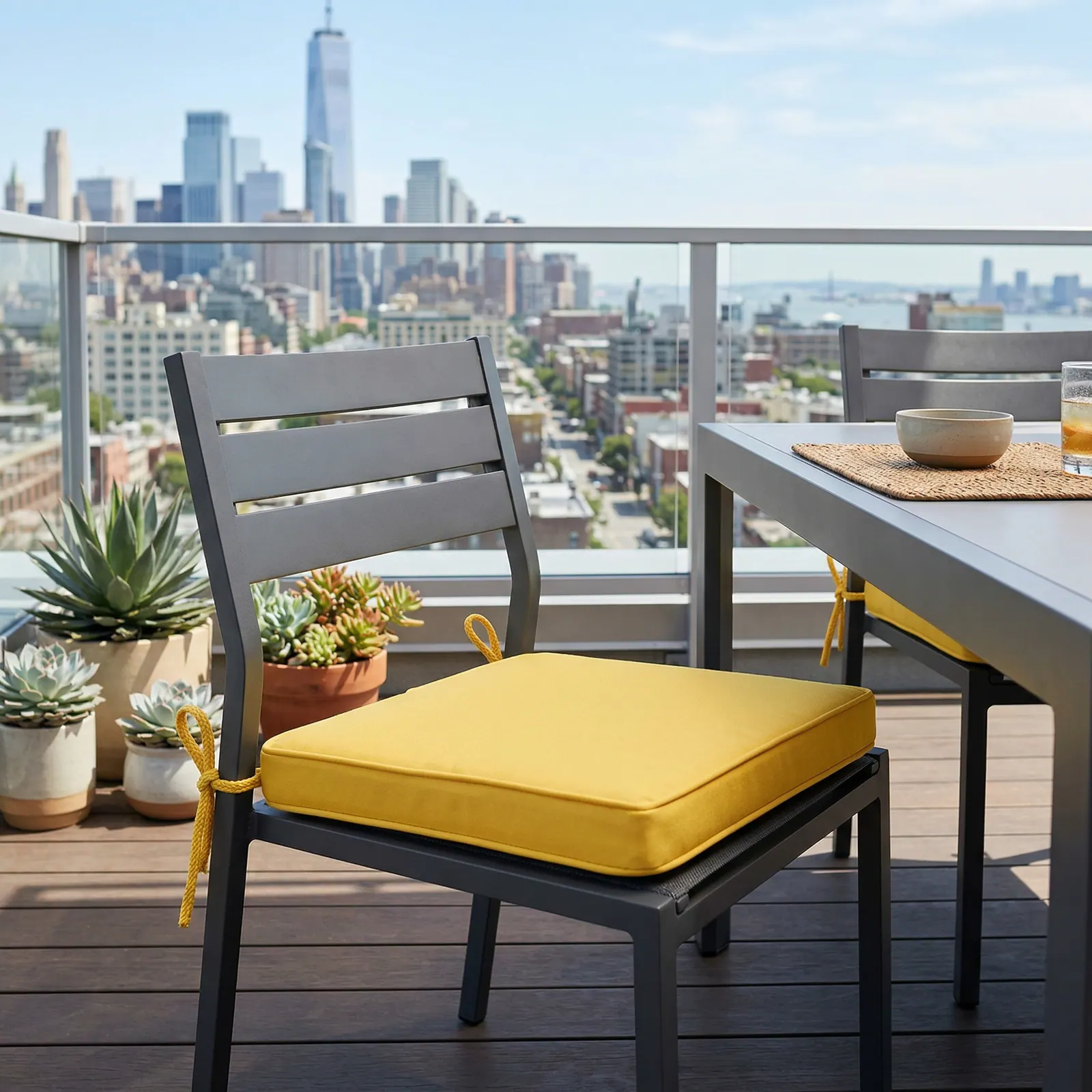
Warsaw's January averages 33.3°F (0.7°C) by day and 24.0°F (−4.4°C) at night. A balcony cushion left out in that is not much of a cushion by March. Measure it, use it, bring it in.
- Sun & UVModerate
- HumidityModerate
- WinterCold
- SettingInland
- Typical seatsApartment balcony bench, balcony chair pads, tenement window niche seat

 Save
The quick answer
Custom cushions in Poland mostly serve three seats: the apartment balcony, the deep window of a prewar tenement, and the bench in an allotment arbor or a wooden mountain house. Measure in centimeters, use 2 in (5 cm) for balcony chairs and 3 to 4 in (7.5 to 10 cm) for benches, choose firm 32 kg/m³ foam, and store outdoor cushions dry from late autumn.
Field notes
Weather and light in Poland
- Sun & UVModerate (level 2 of 4)Sunny spells in summer, short gray days in winter
- HumidityModerate (level 2 of 4)Continental; summer is less humid than winter
- Rain & stormsModerate (level 2 of 4)20.9 in (532 mm) a year in Warsaw; summer about twice as wet as winter
- Snow & freezeRegular (level 3 of 4)Warsaw nights below freezing December to March; snow cover about 179 days a year in Zakopane
Watch for
- Balcony cushions left out below freezing
- Summer thunderstorms on open balconies
- Cushions wintering in an unheated arbor
- Deep window niches that are not square
Plain-language levels from general climate patterns, not measurements. Your own porch, shade and window exposure matter more.
Four seasons of Polish weather, read as a load chart
Poland's meteorological institute, IMGW-PIB, publishes Warsaw's 1981–2010 normals, and they read like a spec sheet. January: 33.3°F (0.7°C) by day, 24.0°F (−4.4°C) at night. July: 76.3°F (24.6°C) by day, 56.6°F (13.7°C) at night. Precipitation: 20.9 in (531.5 mm) a year, on about 159 days.
Two details matter more than the totals. Average nights stay below freezing from December through March. And summer brings about twice the precipitation of winter, in showers and thunderstorms between sunny spells.
The south runs colder and wetter. Kraków's January nights average 22.5°F (−5.3°C). Zakopane, at 2,805 ft (855 m) under the Tatras, gets 45.1 in (1,145 mm) a year, most of it in summer, and has snow on the ground about 179 days a year.
Design loads, then: sun and sudden rain on the balcony; frost and cold glass by the window seat; both, plus wet boots, in the mountains.
Balcony and działka: two outdoor seats, one winter plan
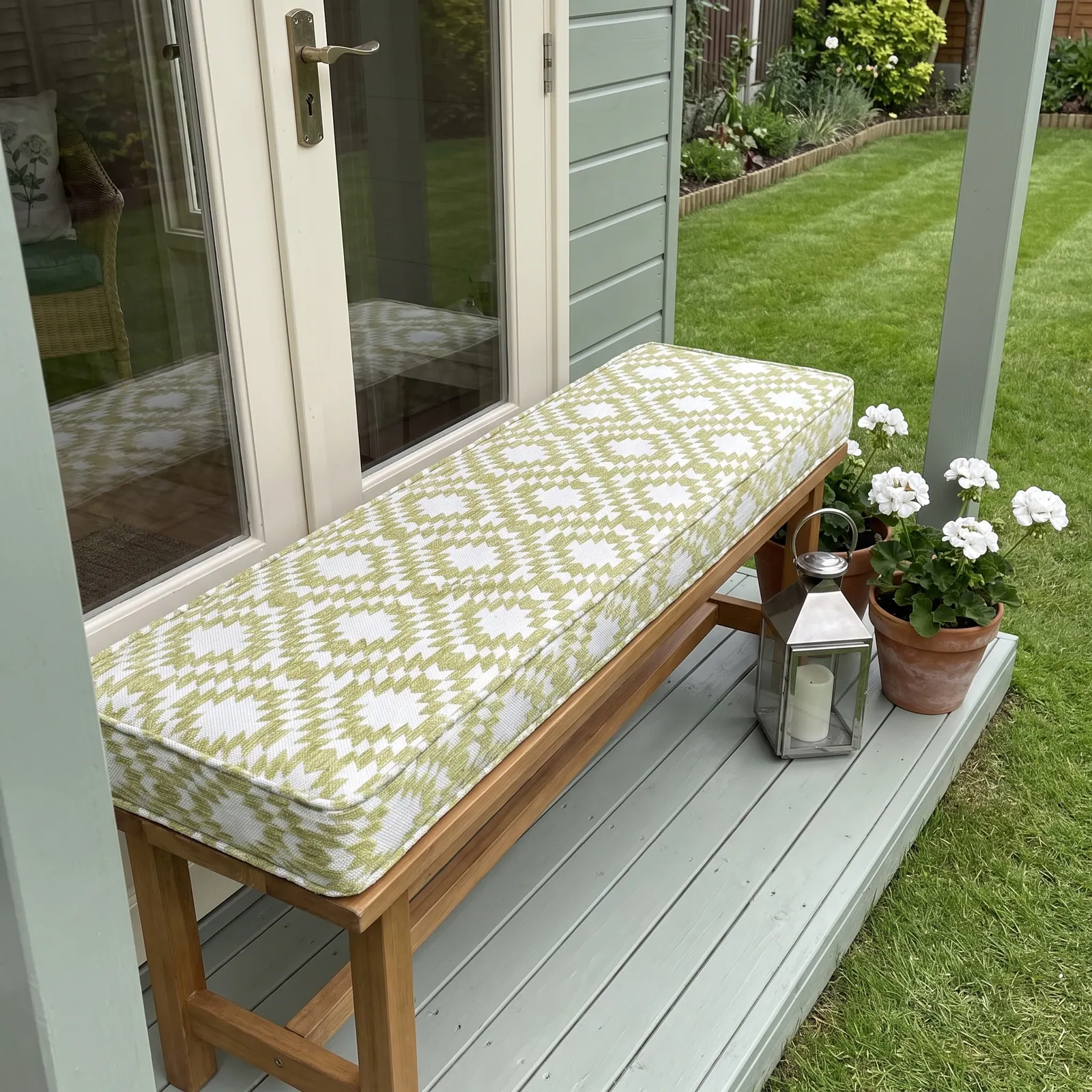
A typical modern Polish balcony is a cantilevered concrete slab reaching up to about 59 in (1.5 m) from the wall, behind a railing 35 to 43 in (0.9 to 1.1 m) high. A small room with a low wall. Plan the seat to it: - Chair pads: 2 in (5 cm); 3 or 4 in (7.5 or 10 cm) for long sitting. - Bench: a 4 in (10 cm) seat and a back cushion of about 2 in (5 cm). - Ties at the back corners. A railing is not a windbreak.
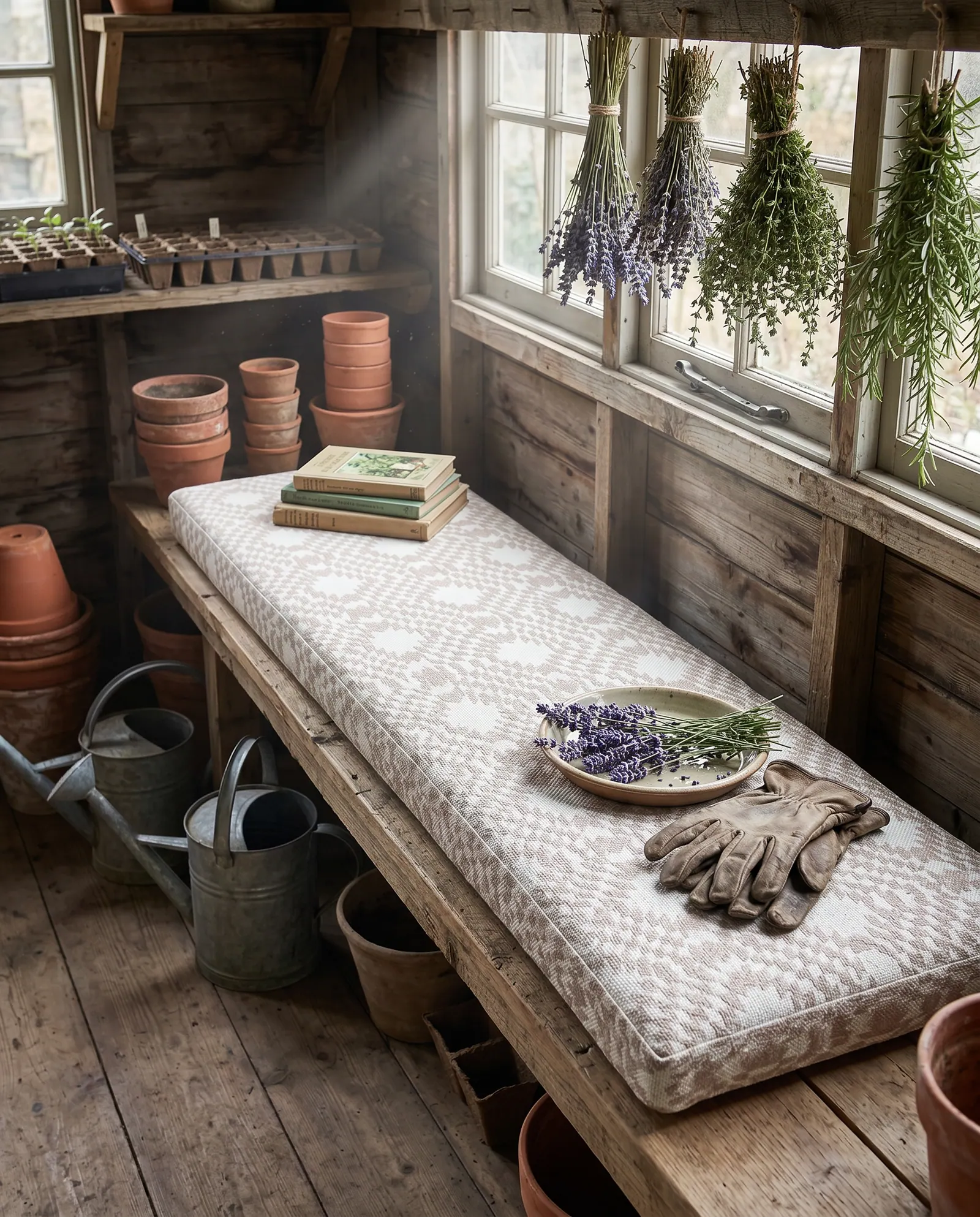
Then there is the działka. Poland has almost 5,000 family allotment gardens, with about 966,000 plots on nearly 44,000 hectares (about 109,000 acres). Building law lets an allotment arbor of up to 377 sq ft (35 m²) go up without a building permit: small, unheated, and damp from late autumn to spring. Cushions should not winter there.
A buyer wrote in with a plan for a garden bench, backs of roughly 71 x 16 and 84 x 16 in (180 x 40 and 213 x 40 cm). The indoor bench fabric they first asked about was not rated for outdoors, so the job moved to outdoor fabric, and the backrests were made foam-filled like the seats. Settle fabric and backrest type first; then follow the winter storage Pattern each November.
Kamienica windows: deep niches, measured in centimeters
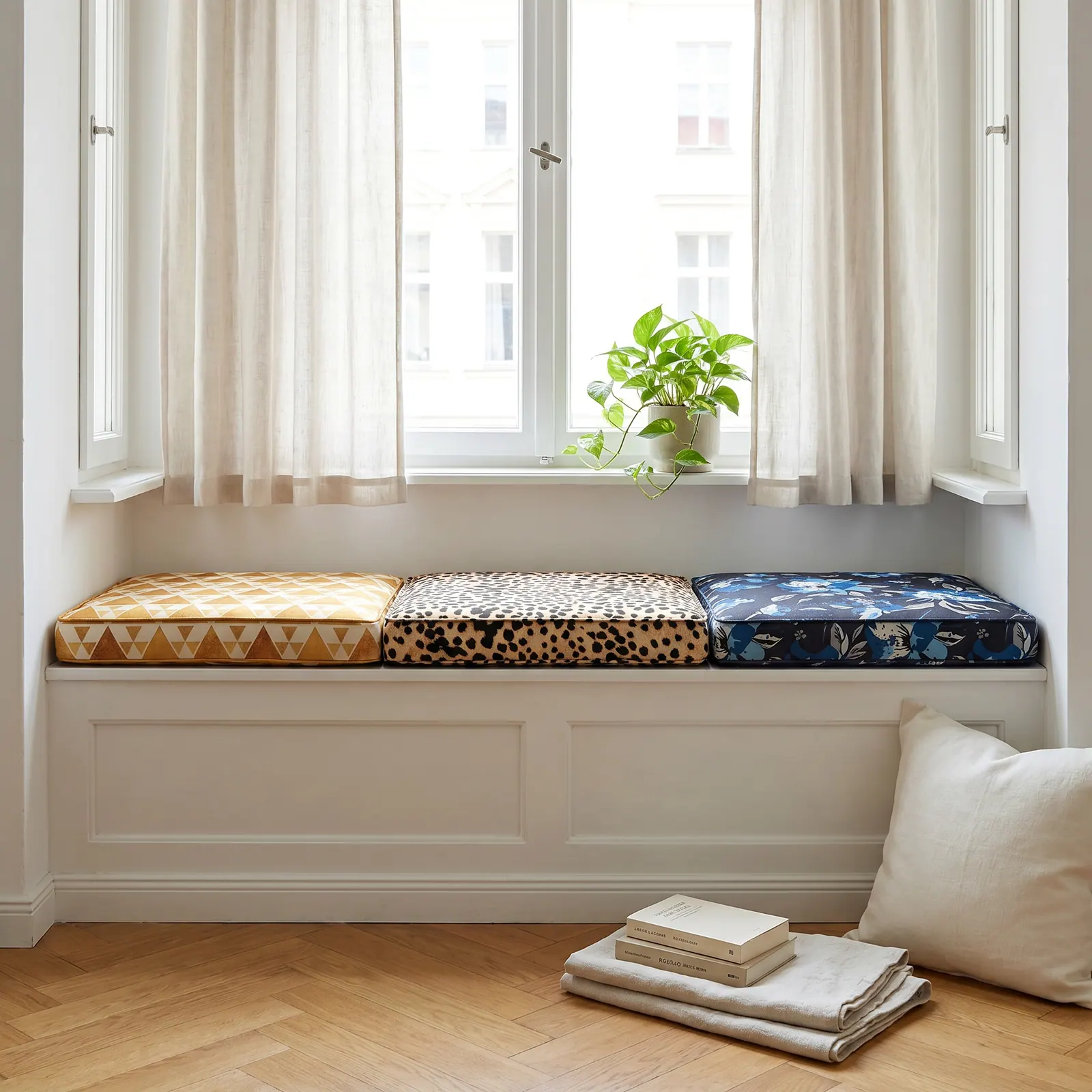
A kamienica is a brick or stone tenement of two floors or more, built wall to wall along the street, so its large windows face the front. Those of the late 19th and early 20th centuries, in Kraków, Warsaw or Łódź, often have high ceilings, and masonry walls thick enough to set the window in a deep niche. For custom cushions in Kraków or Warsaw, that niche is the classic job.
Measure it like a part drawing, partner: 1. Width at the back of the niche and at the front edge. If they differ by more than 3/8 in (1 cm), it is a trapezoid, not a rectangle. 2. Depth at both ends. 3. Clearance from the seat to anything above it: a sill, a handle, an inner sash. 4. Every number in centimeters. No inch conversions, no rounding.
The trapezoid calculator checks that an angled niche closes, and the Pattern on window seat thickness covers thin builds. Czech box windows raise the same questions; see Czechia.
Mountain houses: wood, snow and a firm bench
In the Tatra foothills the Zakopane style still sets the look: wood as the main material, steep roofs, high foundations of split stone, sunburst trim on the gables. A wooden house wants a wooden bench, and a bench wants a cushion.
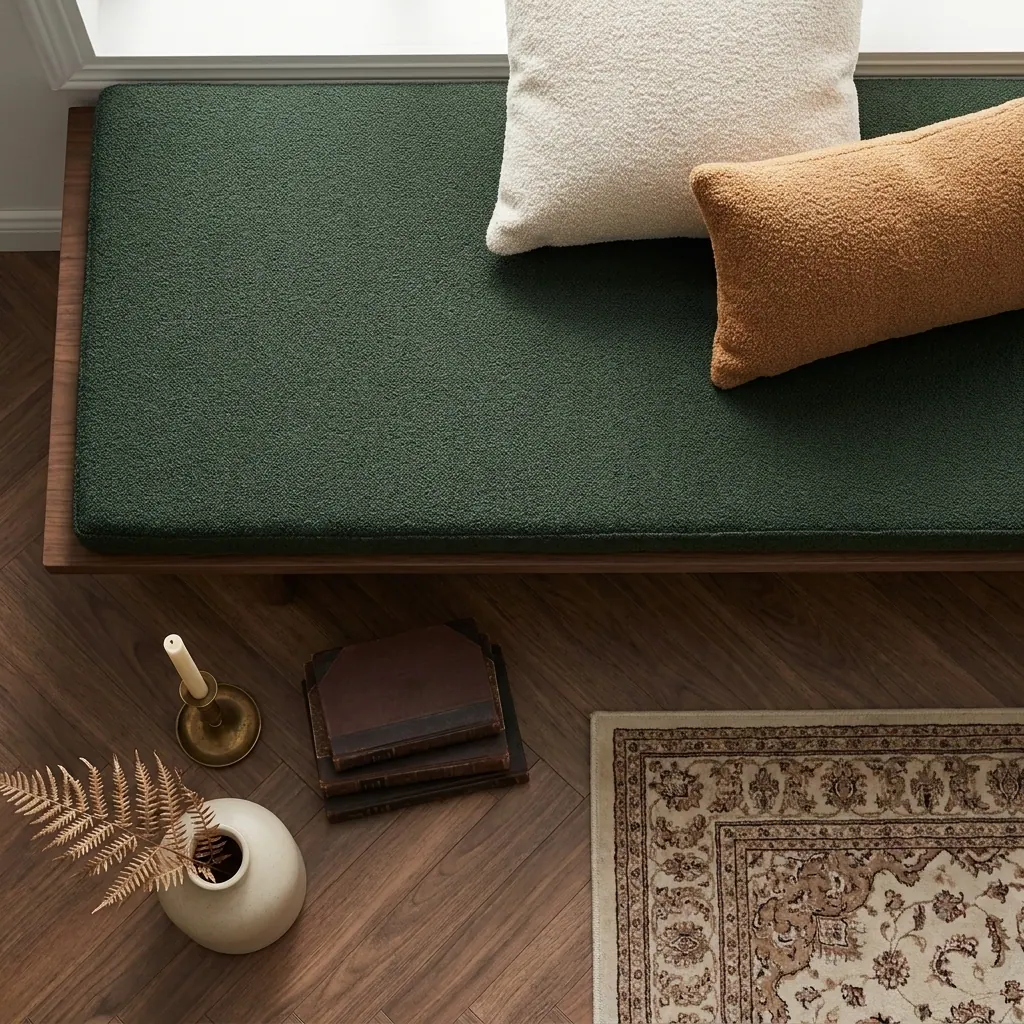
Snow on the ground for about half the year means wet boots and heavy coats on that bench. So: - Firm foam: the standard about 2.0 lb/ft³ (32 kg/m³), medium-firm to firm, about 6 to 7 on a 1-to-10 scale. The foam firmness finder compares grades. - A zip-off cover that washes at 86°F (30°C). - Ties or a non-slip base, so the cushion stays put.
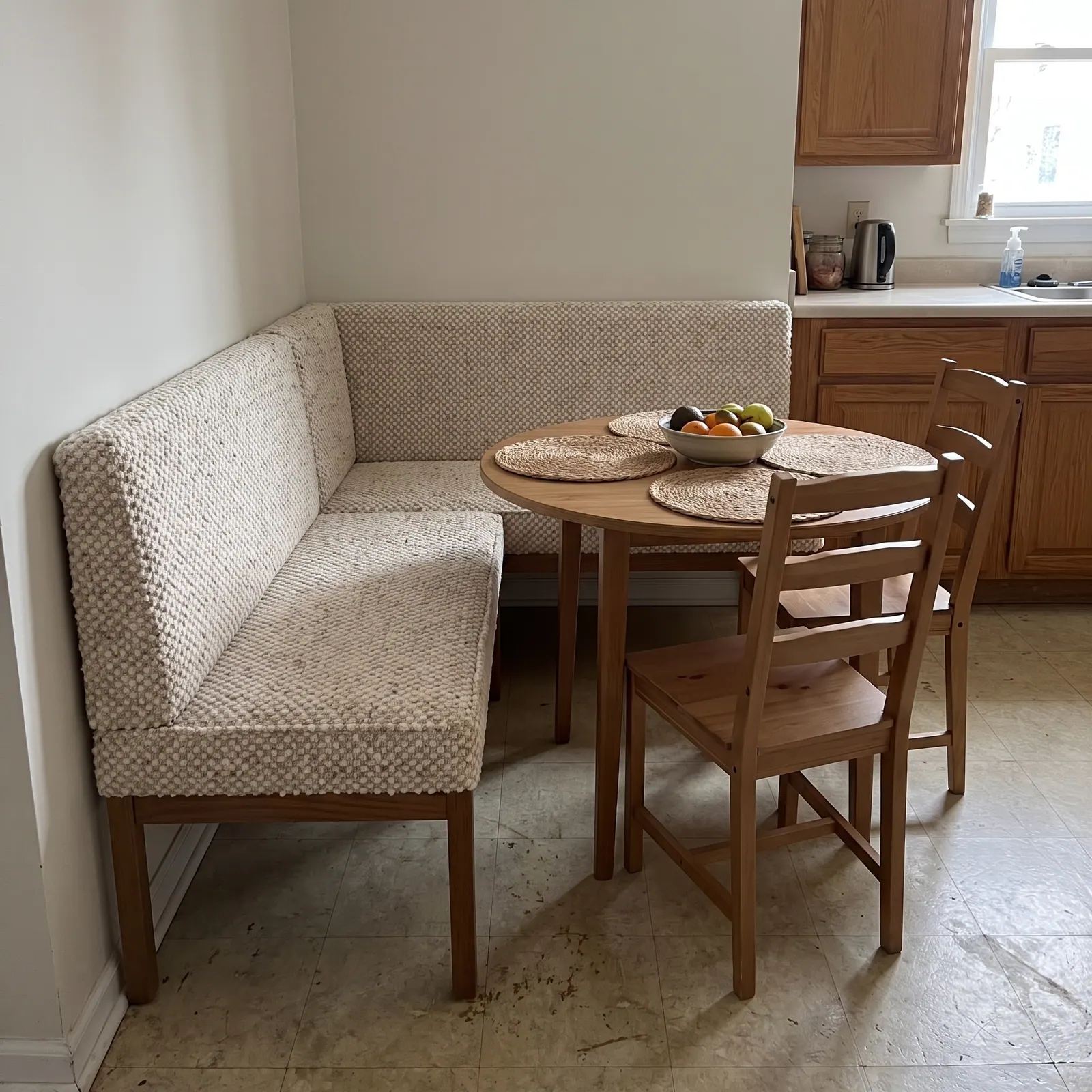
A corner bench is two cushions, not one L: one runs into the corner, the other is shortened by the seat depth. The L-shaped bench Pattern has the arithmetic.
Balcony, niche, arbor, mountain: the numbers
| Seat | Fabric | Thickness | Build and fastening |
|---|---|---|---|
| Balcony chair pads | Outdoor fabric, UV-resistant and water-repellent | 2 in (5 cm); 3 or 4 in (7.5 or 10 cm) for long sitting | Ties at the back corners |
| Balcony bench | Outdoor fabric or water-repellent membrane | 4 in (10 cm) seat, about 2 in (5 cm) back | Ties; indoors before the frost |
| Tenement window niche | Linen-look, velvet or corduroy | 2 to 3 in (5 to 7.5 cm) | Non-slip base; trapezoid if the widths differ |
| Allotment arbor bench | Outdoor fabric; cotton ticking stays indoors | 3 to 4 in (7.5 to 10 cm) | Foam-filled backs; home for winter |
| Mountain-house corner bench | Corduroy, linen-look or performance fabric | 3 to 4 in (7.5 to 10 cm) | Two pieces at the corner; non-slip base |
Seat foam is 32 kg/m³, about 2.0 lb/ft³, wrapped in polyester wadding. Handmade pieces land within about 1/2 to 3/4 in (1 to 2 cm) of the ordered size. Send centimeters, and the workshop cut to them.
Picked for Poland
Seats to start from
Fabric families
Try it in the Studio
Three angled pieces, sent in millimeters
A buyer wrote in about an angled corner sofa built from three pieces, all 3.9 in (100 mm) thick. The measurements came in millimeters, which suits us fine: - Depths: 20.1, 19.6 and 19.9 in (510, 498 and 505 mm). - Top lengths: 32, 80.3 and 32.8 in (813, 2,040 and 832 mm). - Bottom lengths: 23.6, 63.3 and 23.2 in (600, 1,608 and 590 mm).
None of those is a rectangle. Each piece is a trapezoid, and each was priced and cut as one.
Take the middle piece. Top 80.3 in (2,040 mm), bottom 63.3 in (1,608 mm): 17 in (432 mm) shorter. Split evenly, that is 8.5 in (216 mm) per end across a 19.6 in (498 mm) depth, an end that leans about 23 degrees. Angles are just lengths in disguise.
The three depths also differ by up to 0.5 in (12 mm). Real rooms are rarely square, which is why the workshop cut to every number you send.
A kitchen corner or a mountain-house bench is the same geometry. Draw each piece, write every edge, and let the trapezoid calculator check that it closes. How many edges does your corner have?
- Measured
- Depths 20.1/19.6/19.9 in (510/498/505 mm); top lengths 32/80.3/32.8 in (813/2,040/832 mm); bottom lengths 23.6/63.3/23.2 in (600/1,608/590 mm); 3.9 in (100 mm) thick
- What it taught
- Angled sofa and bench cushions are trapezoids; send every edge, and millimeters are welcome.
Photographs for homes like these
Open any photograph large; each one has its own link and a Save button.
 Save
 Save
 Save
 Save
 Save
A Polish year, cushion by cushion
- March: Warsaw's average nights are still below freezing. Keep balcony cushions in a few weeks longer.
- April to May: take cushions to the arbor, air them for a day, check the foam for damp spots.
- Summer: water-repellent buys you time, not immunity. Carry cushions in after a downpour.
- After rain: unzip, stand the foam on edge where air moves, and dry it within 24 to 48 hours.
- Late autumn: wash covers at 86°F (30°C), gentle cycle, no bleach. Air-dry, no tumble dryer.
- Before the first hard frost: balcony and allotment cushions home, dry, off the floor, in breathable bags.
A balcony cushion is a seasonal part. Install in spring, remove before the frost, store dry.
Nate
Buyer questions: parcels, fabric codes and a size that grew
- A common question
How big and heavy are the parcels a floor sofa comes in?
The workshop's answerCushions and floor sofas travel vacuum-compressed. A floor sofa ships as two roll-packs of about 12 x 12 x 47 in (30 x 30 x 120 cm) and 33 lb (15 kg) each, plus a 15.75 x 15.75 x 2 in (40 x 40 x 5 cm) box of about 9 lb (4 kg), roughly 77 lb (35 kg) in all. The sofa itself weighs about 66 to 73 lb (30 to 33 kg).
- A common question
Why hasn't my order started? I haven't picked a fabric yet.
The workshop's answerProduction waits for the fabric code. The foam can be cut and ready, but the cover is not sewn until the code arrives, so choose your fabric when you order to avoid a delay.
- A common question
I ordered a smaller size than I actually need. Can I upgrade?
The workshop's answerYes, by paying the difference through a payment link. Upgrades have gone, for example, from 12 x 12 in to 22 x 22 in, and up to 23.5 x 79 in (60 x 200 cm) or 27.5 x 65 in (70 x 165 cm).
- A common question
If I buy covers only, how much filling do the backrests and pillows need?
The workshop's answerFor the standard floor sofa with ottoman, plan on about 180 to 200 liters of polyester fiber in total for the backrests and about 20 to 25 liters per throw pillow. Order a little extra for a fuller look.

Have it made
Have it made for your home — ask Nate’s workshop
Every edge and both diagonals, to the nearest 1/4 in. If the numbers do not close, the workshop will say so on the call. — Nate
Leave your details and the workshop will call you to confirm measurements, fabric, foam and piping. No prices, dates or payment on this page: it is a request, not an order.
Questions buyers ask next
Can balcony cushions stay out over a Polish winter?
Better not. Warsaw's average nights are below freezing from December to March, and a cushion that freezes damp takes a long time to dry. Wash the covers, dry the foam completely and store everything indoors, off the floor, until spring.
What thickness suits an allotment arbor bench?
For seats, 3 to 4 in (7.5 to 10 cm). Measure the bench, not the arbor: length, depth, and whether a back cushion rests on the seat. Use outdoor fabric on the plot and take the cushions home for the winter.
How do I measure a deep window niche in a tenement?
Measure the width at the back and at the front, the depth at both ends, and the clearance to anything above the seat, all in centimeters. If the widths differ by more than about 3/8 in (1 cm), order it as a trapezoid.
Which foam suits a bench in a mountain house?
Firm, high-density foam: the standard about 2.0 lb/ft³ (32 kg/m³), medium-firm to firm. It holds its shape under heavy winter use. Pair it with a zip-off cover that washes at 86°F (30°C), and ties or a non-slip base.
± 1/4 in — Nate
The atelier
Keep going
Across the Map
Nearby places
Close by on the map