Across the Map · Europe
Custom cushions for Austrian corner benches, chalets and Vienna flats
An Eckbank is two benches that meet at one corner, and the corner is where orders go wrong. Here is the arithmetic, in centimeters, the way the workshop wants it.
- Sun & UVStrong
- HumidityModerate
- WinterCold
- SettingInland
- Typical seatsEckbank corner bench, box-window niche seat, wooden chalet balcony bench

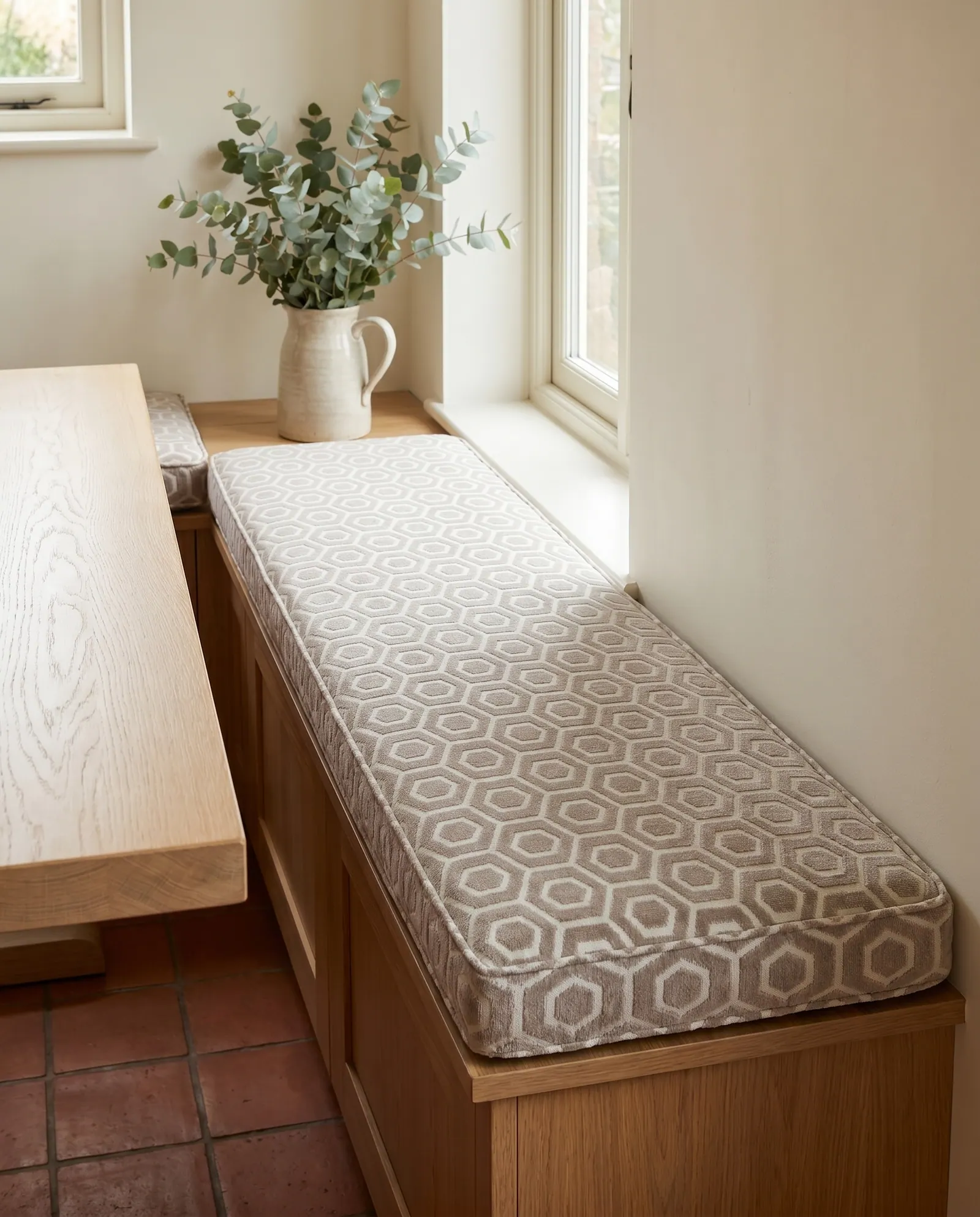 Save
The quick answer
Custom cushions in Austria usually mean an L-shaped Eckbank corner bench, a window-niche seat in a Vienna Altbau flat, or balcony cushions that come inside for winter. Measure in centimeters, decide which run claims the corner, subtract the seat thickness from any backrest height, and keep niche cushions low enough for inward-opening sashes to swing over.
26.8 hot days in Vienna, 136 snow days in Seefeld
GeoSphere Austria's 1991-2020 normals describe two very different jobs. Vienna's Innere Stadt averages 26.8 days a year at 86°F (30°C) or more and 79.9 days at 77°F (25°C) or more; July's mean daily high is 80°F (26.9°C). The city gets 2,047.9 hours of sun and 26 in (669 mm) of precipitation.
Go up and winter takes over. Seefeld, at 3,878 ft (1,182 m), has snow on the ground about 136 days a year and 167 frost days; St. Anton am Arlberg, at 4,278 ft (1,304 m), about 132 snow days. Even Vienna's Hohe Warte averages 31.8 days of snow cover.
Altitude adds UV. WHO puts the rise at roughly 10% per 3,281 ft (1,000 m), and fresh snow almost doubles exposure, so a sunny balcony above a snowfield works a fabric hard. We apply the same rule on our Colorado page.
For custom cushions in Austria that splits the work three ways: fade resistance for balconies, winter storage for anything outside, and exact geometry for the benches indoors.
The Eckbank: two runs and one honest corner
In older Austrian houses the Eckbank sits under the Herrgottswinkel, the corner with the crucifix that you see from the Stube table, and tradition puts the family on that bench. Structurally it's simple: two runs at a right angle, meeting at one corner joint.
Angles are just lengths in disguise, and a right angle is the easy case. One run claims the corner and goes full length; the other is shortened by the seat depth so the two butt together. For runs of 63 3/4 in and 63 in (162 and 160 cm) measured from the back corner, 15 3/4 in (40 cm) deep, that's one cushion of 15 3/4 x 63 3/4 in (40 x 162 cm) and one of 15 3/4 x 47 1/4 in (40 x 120 cm). My routine:
- Measure each run along the back wall, from the inside corner to the open end.
- Measure seat depth at both ends of each run; under 3/4 in (2 cm) of difference, average it to a rectangle.
- For an angled corner piece, give all four sides, including both short end sides. Those are the ones people forget.
- Backrest height = frame back height minus the seat cushion's thickness.
- Mark radiators, pillars and table legs, and label which face is the top.
- Write the real measurements. Don't shave anything off; allowance is handled in production, within about ±3/8 in (1 cm).
The corner joint guide and the bench cushion builder do the drawing, and L-shaped cushions shows finished sets.
Vienna box windows: the inner sash swings over your cushion
Vienna's Altbau flats are full of Kastenfenster, box windows with two separate sashes and an air space between them. In the Viennese type both sashes open inward, and the outer one is built smaller so it passes through the inner. The Graz type opens the outer sash outward, which leaves the inner reveal free and the niche easy to use.
So check your window before you choose a thickness, partner. If the inner sash swings in over the niche, the cushion's height limit is the gap between the niche board and the underside of the open sash, cover included.
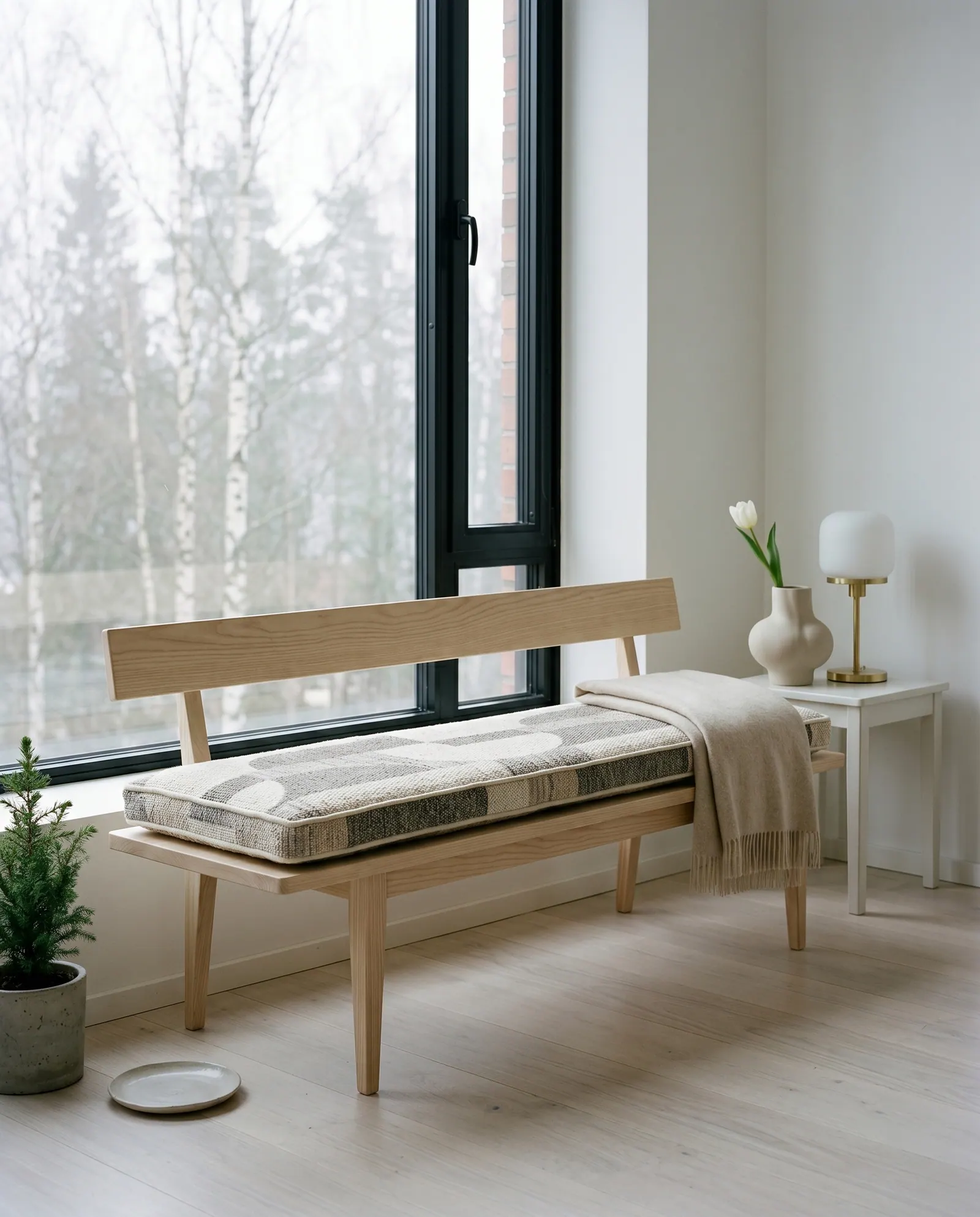
Very thin is possible. The workshop makes 3/4 in (2 cm) cushions for exactly this, without piping; 1 1/4 in (3 cm) can carry piping. At that height the foam has to be cut evenly and a touch under the limit, or it bulges. More in the thickness guide and window seat cushions.
Balconies and garden benches: summer seat, winter guest
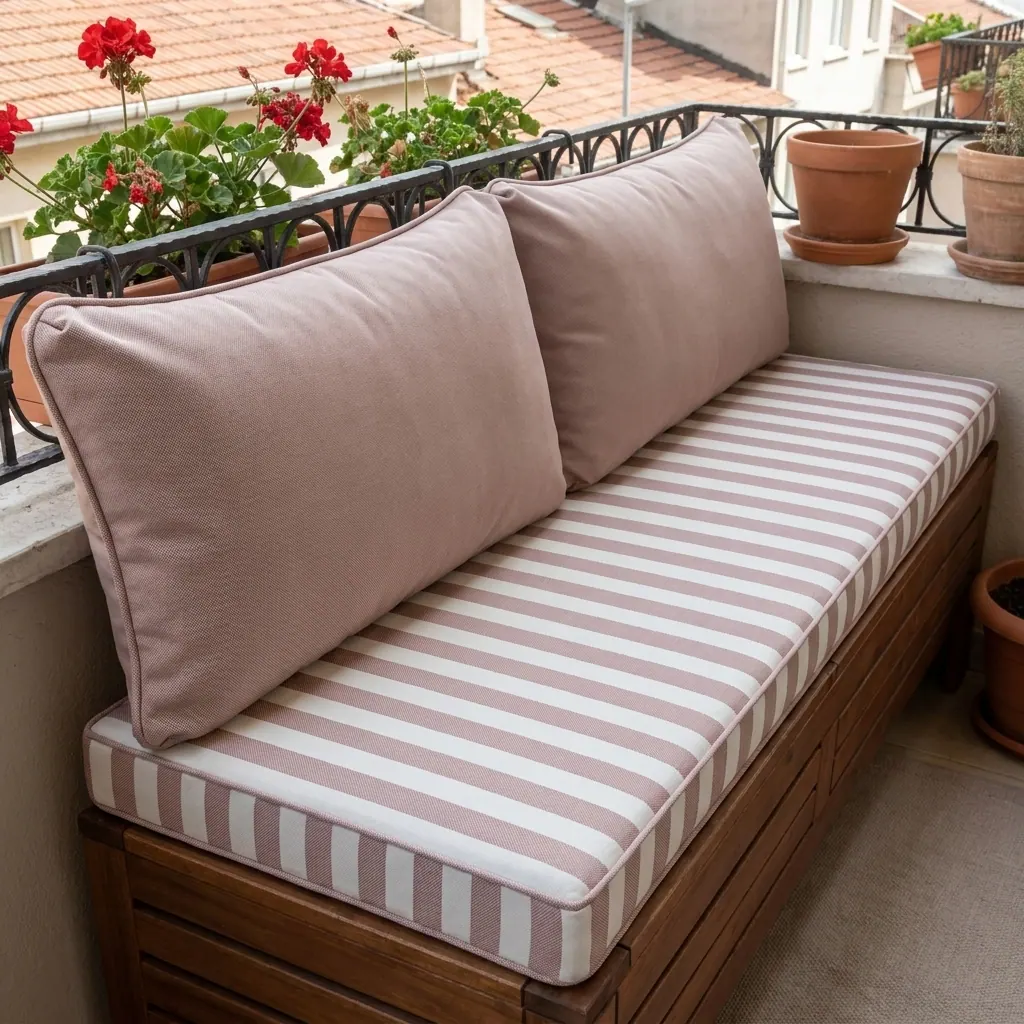
Chalets carry wooden balconies and city flats have balconies and loggias, and both get used hard from late spring into autumn. A covered loggia can take the regular indoor fabric, since rain doesn't reach it, though that fabric isn't waterproof. An open balcony wants outdoor fabric that resists UV and repels water.
A buyer in Austria sent the plan of a custom garden bench with seat and backrest cushions, the backs roughly 71 x 16 and 84 x 16 in (180 x 40 and 213 x 40 cm). The first question was whether the indoor bench-with-bolster fabric could live outside. It can't, so the order moved to the outdoor line, and the backrests were made foam-filled like the seats rather than soft like pillows.
That's the right order of decisions: outdoor-rated fabric first, foam or pillow backs second, and only then compare quotes. When the first snow comes, the whole set comes in. See outdoor cushions and back cushion height.
Eckbank, niche, balcony: fabric, foam and piping
| Seat | Fabric | Foam and build | Piping |
|---|---|---|---|
| Eckbank seat | Velvet, corduroy or a performance weave, zip-off | High-density foam, about 2.0 lb/ft³ (32 kg/m³), 2 to 4 in (5 to 10 cm); non-slip base | Contrast piping traces the L |
| Eckbank backrest | Same fabric as the seat | 1 1/4 to 2 in (3 to 5 cm); non-slip base so it can't slide down | Self piping |
| Box-window niche | Linen-look or velvet | 3/4 to 2 in (2 to 5 cm); foam cut under the sash clearance | None at 3/4 in (2 cm); possible from 1 1/4 in (3 cm) |
| Balcony bench | Outdoor fabric, UV-resistant and water-repellent | 4 in (10 cm) seat; 2 in (5 cm) back and chair pads | Self or a matching contrast |
Handmade sizes vary by about ±3/8 in (1 cm). Covers zip off and wash at 86°F (30°C) on a gentle cycle, no bleach; air dry them.
78 x 41 1/4 in (198 x 105 cm), four notches, and the arithmetic
A buyer in Austria needed one big cushion for a sofa-style seat, with a 2 1/4 x 2 1/4 in (6 x 6 cm) square notch cut from each corner. Check the sums: 78 in (186 + 6 + 6 = 198 cm) one way, 41 1/4 in (93 + 6 + 6 = 105 cm) the other. Clean drawing, honest numbers.
The first payment went through the rectangle listing, so the workshop refunded it in full and sent the custom-shape listing instead, the one that asks for the drawing at checkout. The 41 1/4 in (105 cm) depth was over that listing's 40 in (102 cm) maximum. The answer: select the largest range, because production follows the uploaded drawing and the range only sets the price. The reorder went straight into production.
A notch is just a rectangle you subtract. Draw it, dimension it, upload it. The notch and cut-out guide shows how to mark posts and casings.
- Measured
- 78 x 41 1/4 in overall (198 x 105 cm, from 186 + 6 + 6 by 93 + 6 + 6 cm), with 2 1/4 x 2 1/4 in (6 x 6 cm) notches at all four corners
- What it taught
- Notched or cut-out shapes belong on the custom-shape listing with a drawing; the size range only sets the price.
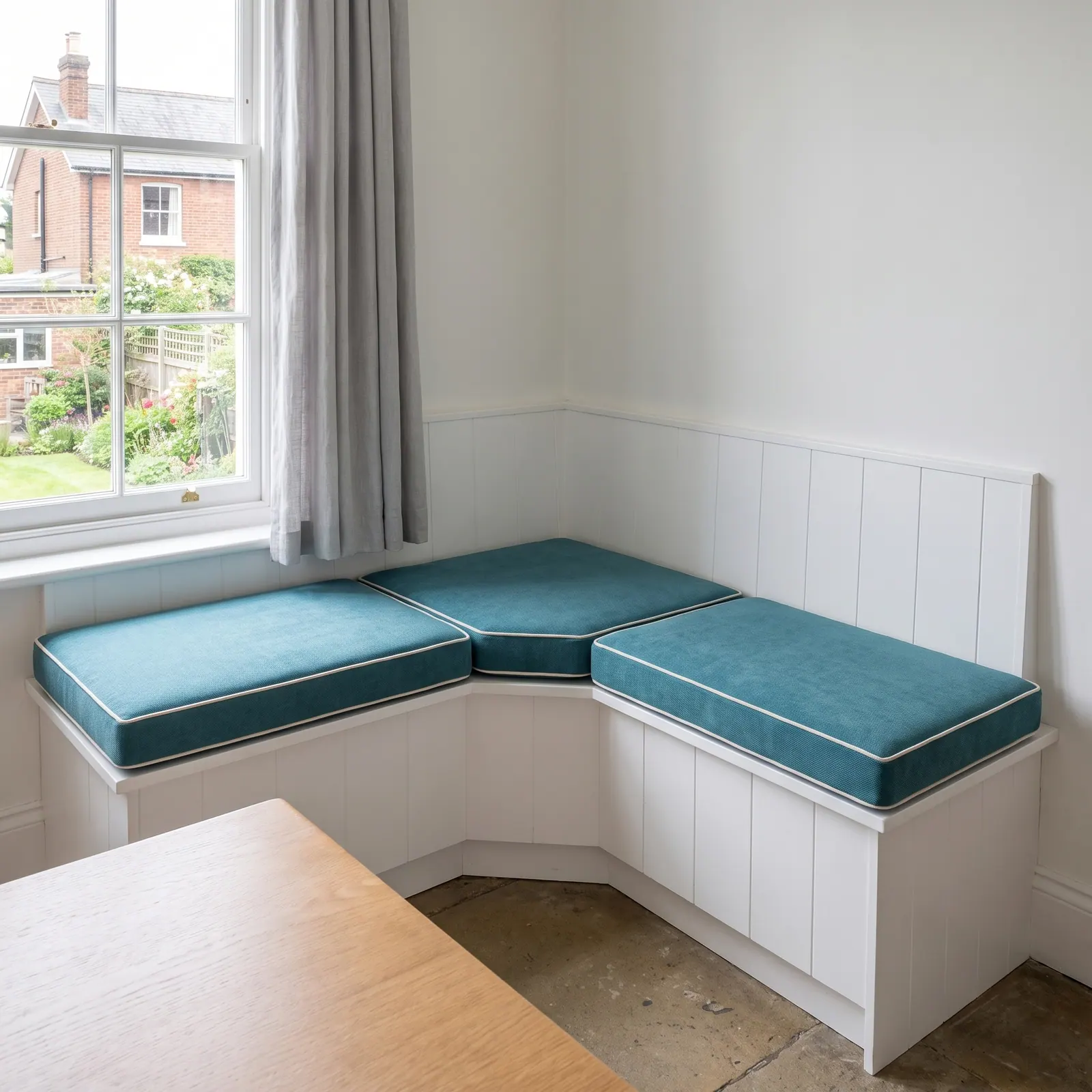
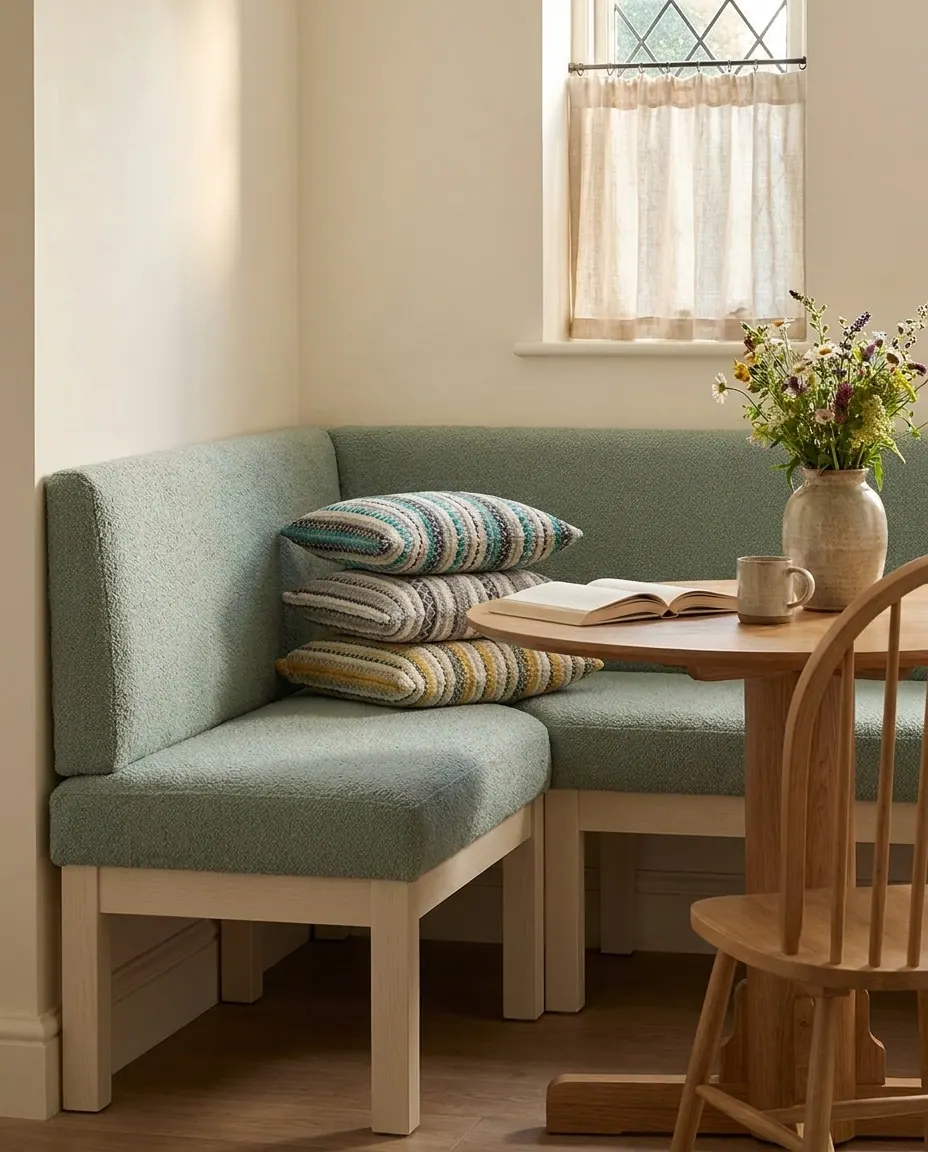
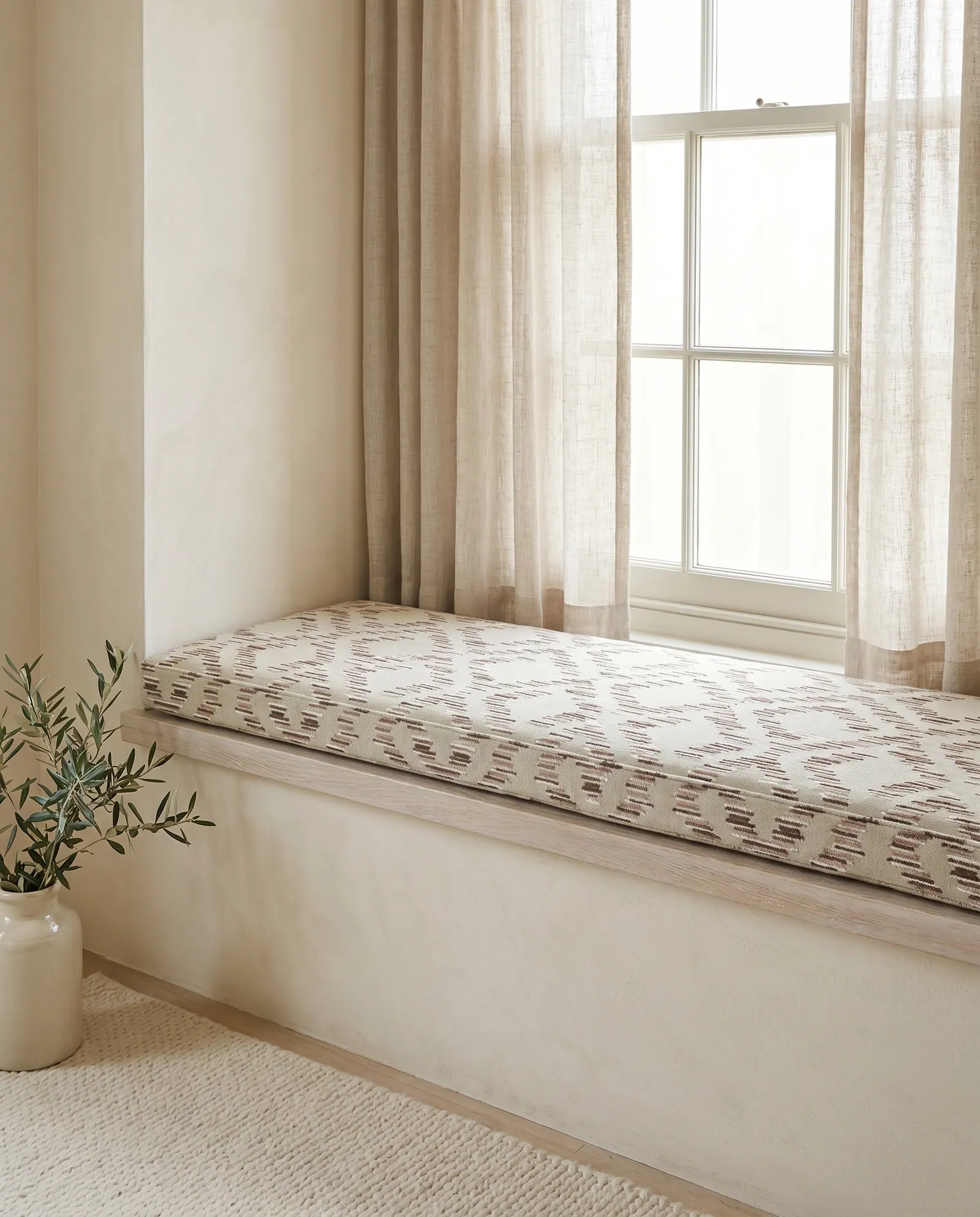
Photographs for homes like these
Open any photograph large; each one has its own link and a Save button.
 Save
 Save
 Save
 Save
 Save
The Austrian cushion year
- Spring: bring balcony cushions out once the snow is gone for good; in Alpine valleys that can be late.
- Summer: on a Vienna balcony, move cushions out of the midday sun on the hottest days.
- Autumn: wash covers at 86°F (30°C), gentle cycle, no bleach, air dry, and store the inserts dry before the first snow.
- Winter: vacuum the Eckbank corner joint weekly, where the crumbs collect.
- Any season: open the inner sash now and then to be sure the niche cushion still clears it.
An L-shaped bench is two rectangles that agree on who gets the corner.
Nate
Buyer questions: corner benches, thin niches and balcony pads
- A common question
Can you make trapezoid cushions for a large corner bench?
The workshop's answerYes, but the workshop needs every side of each trapezoid, including the short end sides at the corners, and a plan drawing helps. One set of three trapezoid cushions for a large corner bench was about 26 3/4 in (68 cm) deep.
- A common question
I want a firm seat I don't sink into, with a clean look and no tufting. Which foam do you recommend?
The workshop's answerHigh-density cold foam. It stays stable, keeps its shape and doesn't wrinkle or sag, and the cushions can be made completely smooth with no quilting or buttons. Two velvet seat pads forming an L, 47 1/4 x 23 1/2 in (120 x 60 cm) and 51 1/4 x 23 1/2 in (130 x 60 cm), were made this way.
- A common question
What's the thinnest cushion you can make? Is 2 inches the minimum?
The workshop's answerThe thinnest standard option is 2 inches (5 cm), but thinner is possible. 3/4 in (2 cm) and 1 in can only be made without piping, while 1 1/4 in (3 cm) can still have piping. The workshop can send photos of 3/4 in and 2 in (2 cm and 5 cm) cushions to compare.
- A common question
Can you make a very thin cushion, like 2 in (5 cm), for a windowsill?
The workshop's answerYes. One windowsill cushion was made 2 in (exactly 5 cm) high so the window above it could still close.
- A common question
Is the regular fabric fine for a covered outdoor area?
The workshop's answerYes, if the area is covered, but the standard fabric isn't waterproof. Water-repellent outdoor fabrics are available; if you don't specifically need that, the soft fabric is the nicer choice under cover.
- A common question
How thick should outdoor chair pads and a bench cushion be for an elderly person?
The workshop's answerFor chairs, 2 in (5 cm) is the most suitable, with 3 or 4 in (7.5 or 10 cm) possible. For a bench used for long sitting, 4 in (10 cm) gives the best support, 3 in (7.5 cm) is the alternative, and back cushions can be thinner, around 2 in (5 cm).

Have it made
Have it made for your home — ask Nate’s workshop
Precision starts on the phone. Give the workshop your measurements and they will read them back to you, edge by edge. — Nate
Leave your details and the workshop will call you to confirm measurements, fabric, foam and piping. No prices, dates or payment on this page: it is a request, not an order.
Questions about cushions in Austria
How do I split an Eckbank cushion at the corner?
Let one run claim the corner at full length and shorten the other by the seat depth so the two butt together. Runs of 63 3/4 and 63 in (162 and 160 cm) measured from the back corner, 15 3/4 in (40 cm) deep, become cushions of 15 3/4 x 63 3/4 in (40 x 162 cm) and 15 3/4 x 47 1/4 in (40 x 120 cm).
How thin can a cushion be in a Viennese box-window niche?
3/4 in (2 cm) is possible without piping, and 1 1/4 in (3 cm) can take piping. If the inner sash opens inward over the niche, measure the gap to the open sash and have the foam cut slightly under it so the cover can't bulge.
Can balcony cushions stay out through an Austrian winter?
No. Seefeld averages about 136 days of snow cover a year and even Vienna's Hohe Warte 31.8, on GeoSphere Austria's 1991-2020 normals. Wash the covers, dry the inserts right through and store everything indoors before the first snow.
Do Alpine balconies need more UV-resistant fabric than city ones?
Yes. UV rises by roughly 10% for every 3,281 ft (1,000 m) of altitude and fresh snow almost doubles exposure, according to WHO. Choose a UV-resistant outdoor fabric for an open chalet balcony; indoor fabrics can fade a little in long, direct sun.
± 1/4 in — Nate
Concept Sketches
Sketches for homes like these
Real projects, drawn up as ideas you can borrow.
The atelier
Keep going
Across the Map
Nearby places
Close by on the map