Across the Map · Europe
Custom cushions for Hungarian apartments, balconies and lake houses
A Budapest window can be two windows deep. That ledge between the panes and the room is where a cushion earns its keep, from a frosty January to a hot July.
- Sun & UVModerate
- HumidityModerate
- WinterCold
- SettingInland
- Typical seatsDeep-sill window seat, courtyard gallery chair, apartment balcony bench

 Save
The quick answer
Custom cushions in Hungary follow a continental year of hot summers and cold winters. In Budapest, measure deep-sill window seats between the reveals and keep them thin where a sash swings over; use outdoor fabric on courtyard galleries and balconies. At Lake Balaton, choose water-repellent cushions that go indoors before the lake freezes. Folk reds and blues work best as one strong color.
A continental year: 84°F in July, below freezing in January
Hungary sits where continental and oceanic weather meet, and the continental side wins most arguments. Budapest's 1991-2020 normals give an average July high of 84°F (28.8°C), an average January low of 30°F (−1.2°C), 20.7 in (526.2 mm) of precipitation and about 1,928 hours of sunshine a year. Sunshine climbs toward the southeast: Sopron in the west gets about 1,700 hours, Szeged 2,068.
For a cushion, that means two seasons of risk. Summer sun through tall south- and west-facing windows fades color, slowly but surely, so turn window cushions and draw a sheer at midday. Winter brings damp air and cold glass: Budapest's mean humidity climbs from about 54 percent in April to about 77 percent in December. Keep window cushions dry and off the pane, and get anything wet dry within 24 to 48 hours, the EPA's window for stopping mold.
Outdoors, the rule is simple. Balcony and gallery cushions work hard from May to September and come inside before the first frost.
Courtyard galleries, windows two panes deep, and the lake
Many older Budapest apartment buildings wrap around an inner courtyard, with open galleries on each floor that lead to the front doors. A chair beside your door there is outdoors in every way that matters to a cushion: sun, rain, the courtyard's damp. Give it outdoor fabric and two ties at the back corners.
Inside, the windows are the treasure. Buildings of that era were often fitted with box windows, two sashes one behind the other, which leaves a deep reveal that asks to be a seat. Measure it between the reveals at the glass and again at the room edge. If the inner sash opens over it, the cushion must stay under the handle: 2 in (5 cm) cushions have been made for exactly that, and 1¼ in (3 cm) can still take piping. See window seat cushions and window seat thickness.
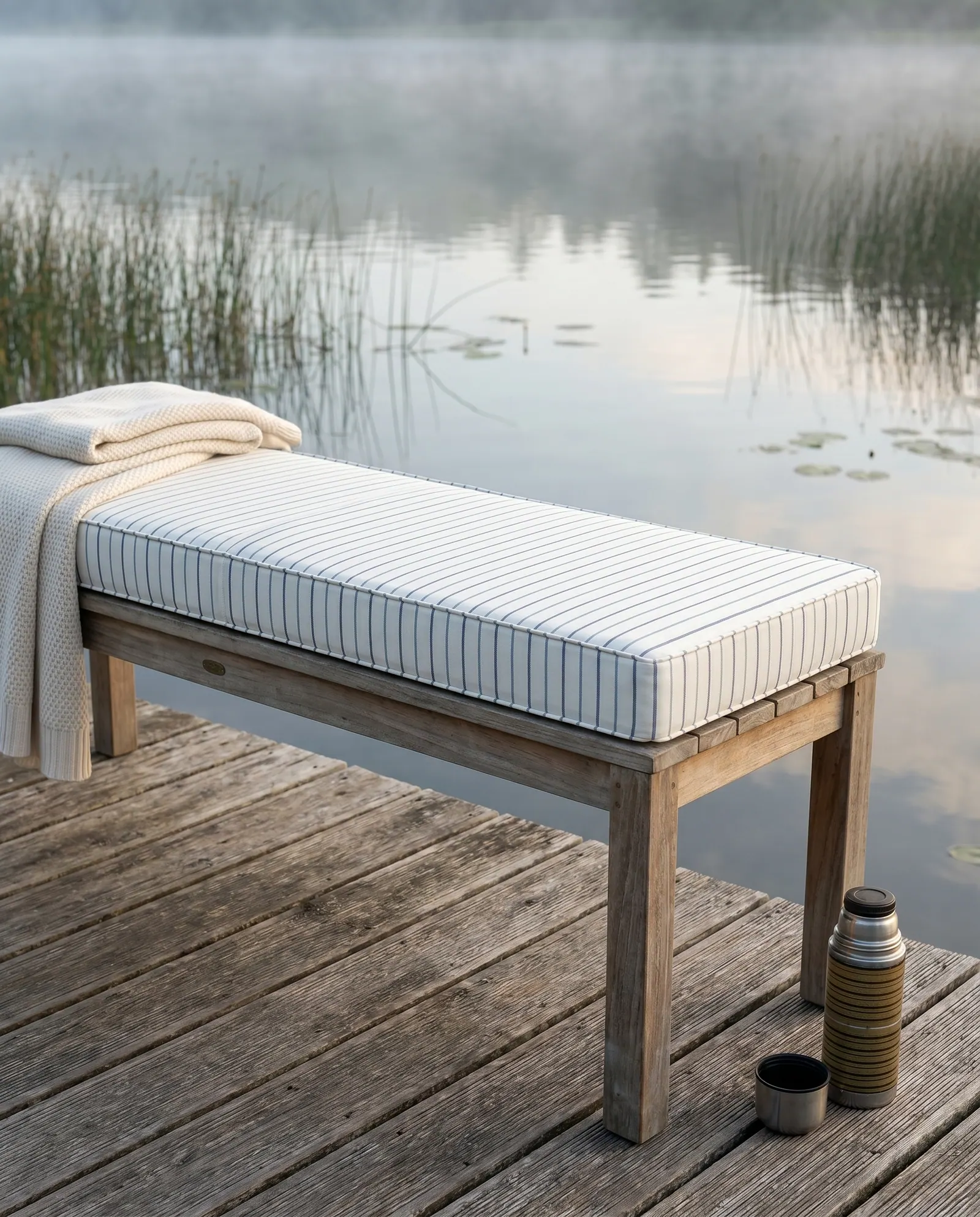
Lake Balaton is summer. It is 48 mi (78 km) long and averages just 11 ft (3.3 m) deep; in summer the water averages about 77°F (25°C), and in winter the lake freezes over. Summer houses have lined its shores since the late 1800s, when landowners began building them to rent. Porch benches, jetty benches and loungers there want outdoor cushions that go indoors when the season ends.
Hungarian seats and what to cut for each
| Seat | Fabric | Thickness | Detail |
|---|---|---|---|
| Box-window sill seat | Linen blend or velvet | 1¼-2 in (3-5 cm) under an opening sash; 3-4 in (8-10 cm) if clear | Measure at the glass and at the room edge |
| Courtyard gallery chair | Outdoor fabric | 2 in (5 cm) | Two ties at the back corners |
| Balcony bench | Water-repellent outdoor fabric | Seat 4 in (10 cm), back 2 in (5 cm) | Non-slip base; indoors for winter |
| Balaton porch or jetty bench | Outdoor fabric in a mid-tone | 3-4 in (7.5-10 cm) | Never tufted; stand on edge after rain |
| Summer-house garden armchair | Outdoor fabric over HR foam wrapped in wadding | 3-4 in (8-10 cm) | Ties at the back corners |
Cranberry, not tomato: matching a red to a rug
A buyer in Europe wanted a solid red bench cushion to match the red in a rug, with cream or beige piping. Before showing a single swatch, the workshop asked two questions: indoor or outdoor, solid or pattern. The answers decide which chart to open, because indoor and outdoor fabrics live on separate charts.
Then it sent photos of two solid indoor reds, and suggested choosing the cream or beige piping from the same chart so the tones would agree. The buyer chose a cranberry red, and it looked right beside the rug.
This is how I would approach any folk red, my friends. Name the thing you're matching, say indoor or outdoor, ask for daylight photos of two or three candidates, and take the piping from the same chart. See piping: matching, contrast or none.
Folk embroidery reds and blues, translated for a modern room
Hungarian embroidery is a family of styles. Kalotaszeg work is sewn chiefly in a single color, red, blue or black, and was made for pillowcases, altar cloths and sheets. Flowers and leaves are the main motifs, sometimes a bird or a spiral, and one frequent flower has a center like the eye of a peacock feather. Matyó embroidery, made in Mezőkövesd and two neighboring villages, is counted among the finest Hungarian folk art.
The eye sits down first, and on a window seat it sits on color. So take one color from the embroidery and let it carry the cushion: a paprika red body with cream piping on a deep sill, or an ink blue with a thin red welt on a kitchen bench. Keep the flowers for a throw pillow, where they can be the one loud thing in the room.
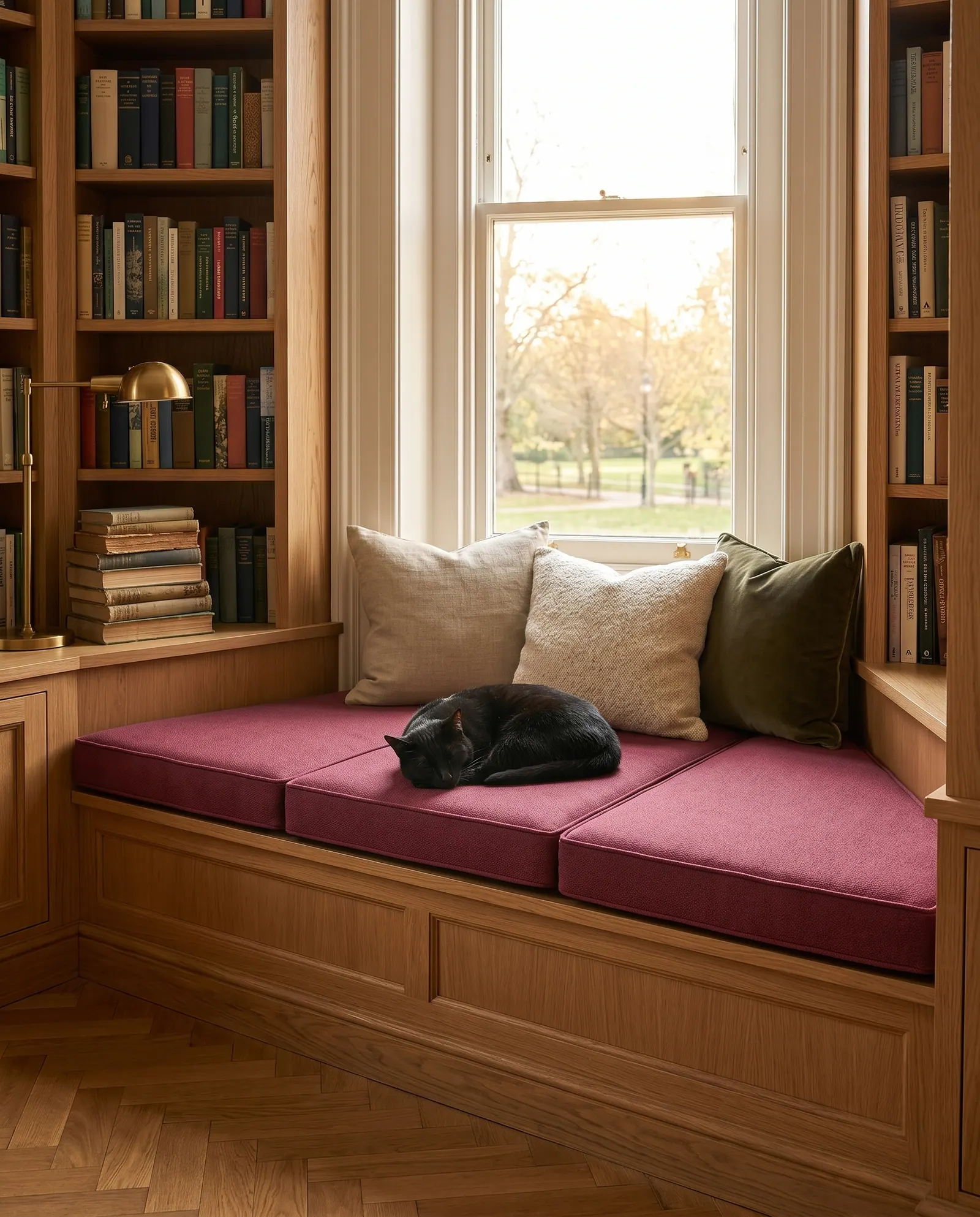
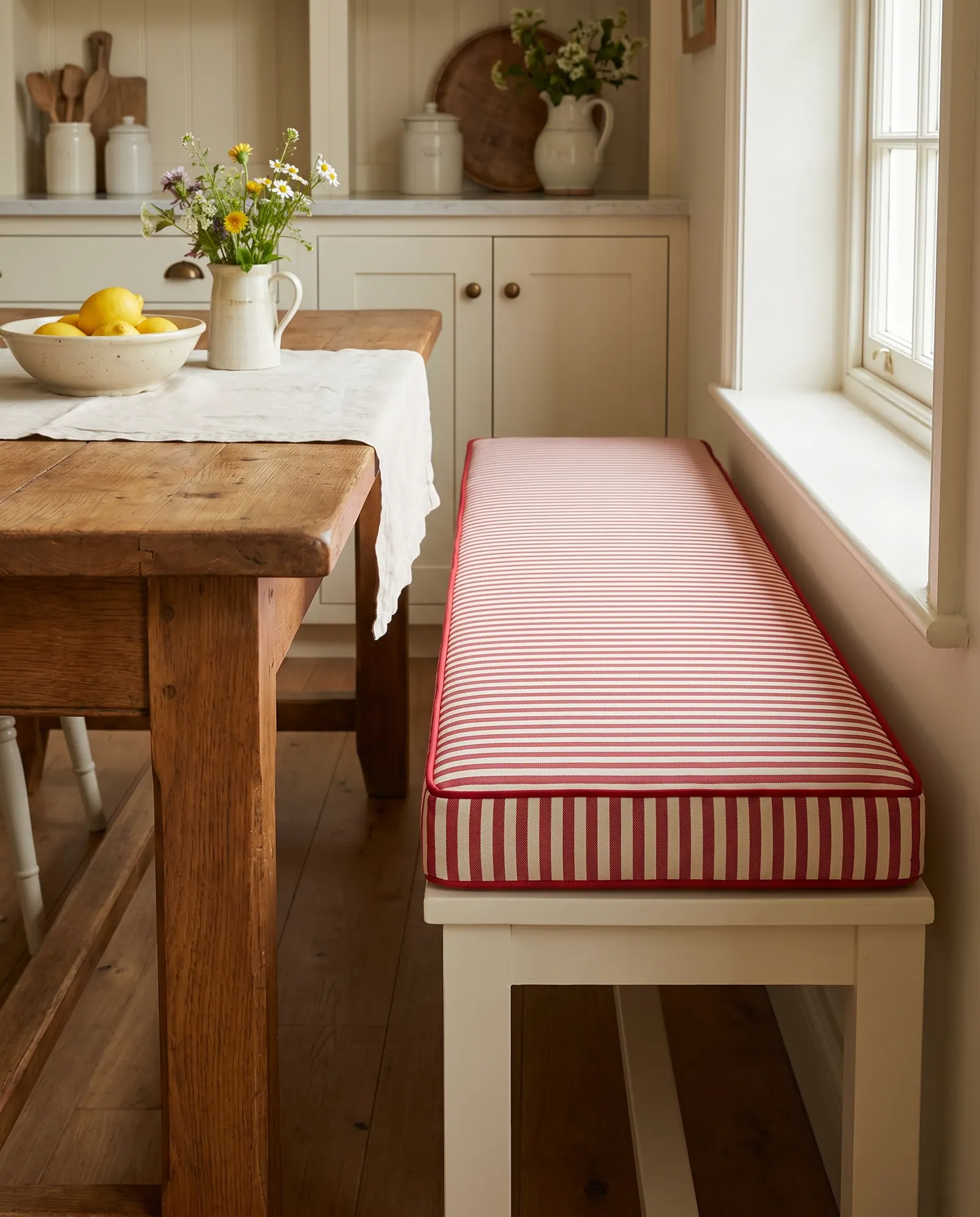
Check the red in daylight at your own window. Warm lamps push reds toward brown; cool north light pushes them toward blue. Velvet gives a red its depth; a matte performance weave, like the berry-red window seat at the top of this page, keeps it calm. What red is already in your rug, your curtains or your grandmother's tablecloth?
Photographs for homes like these
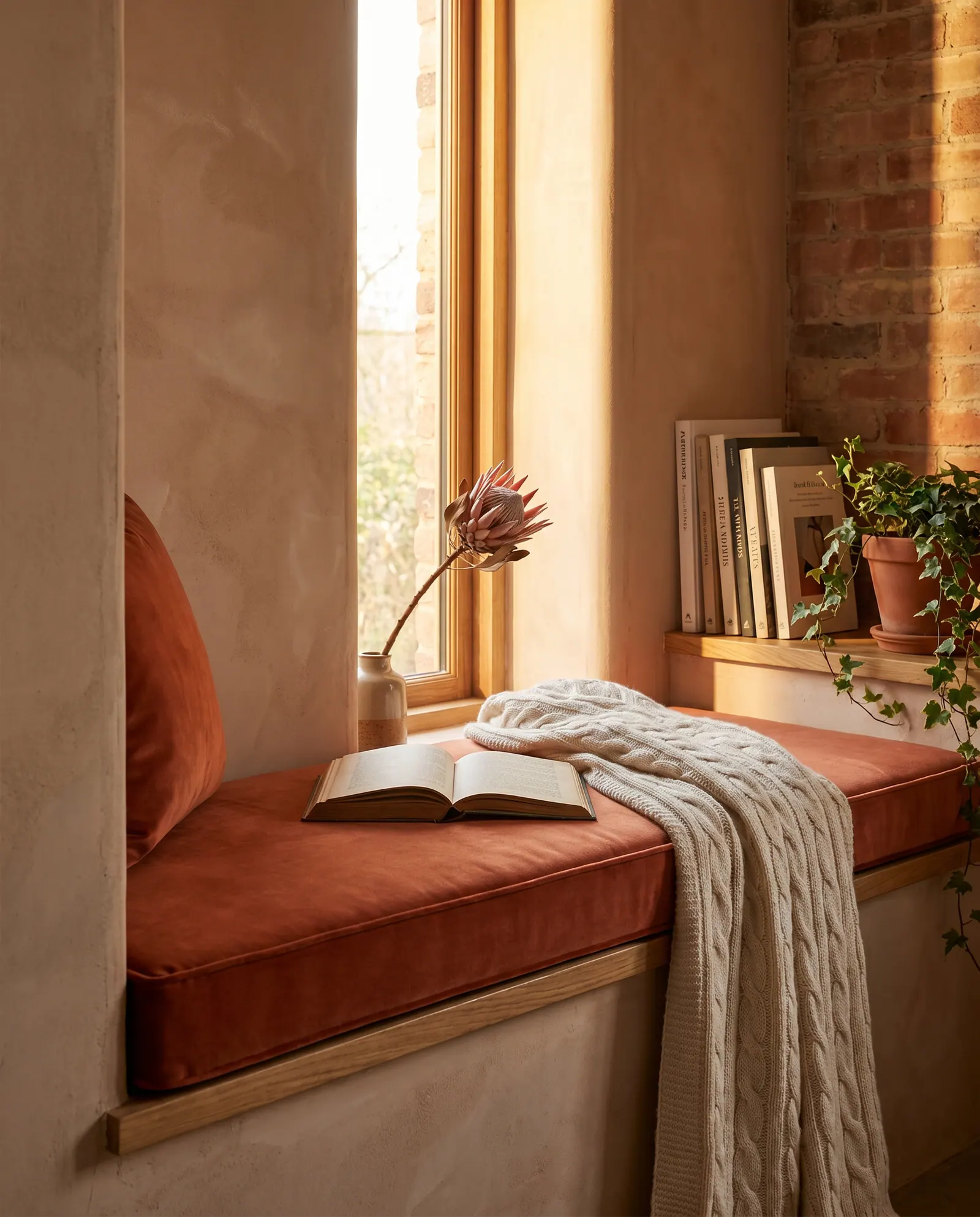
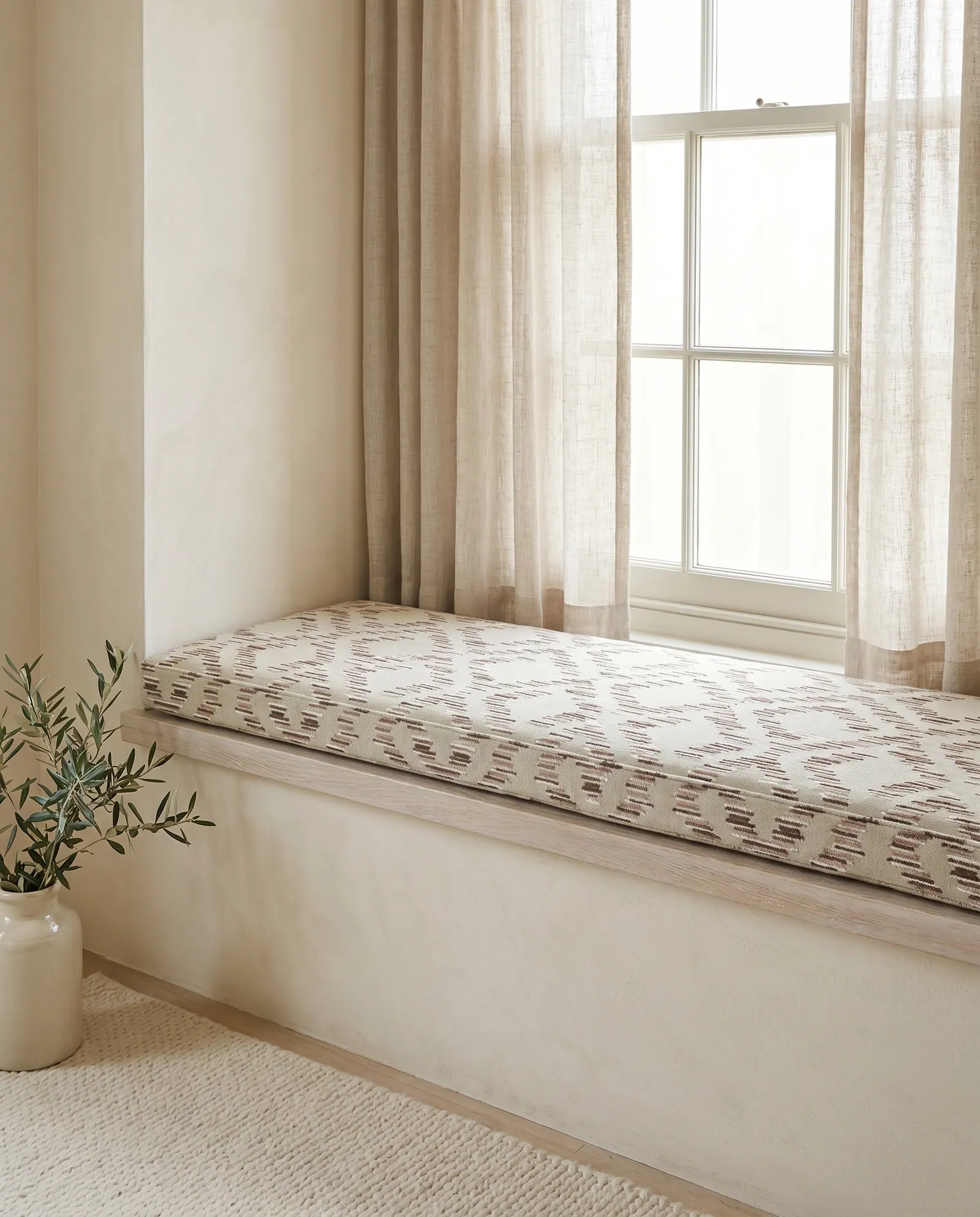
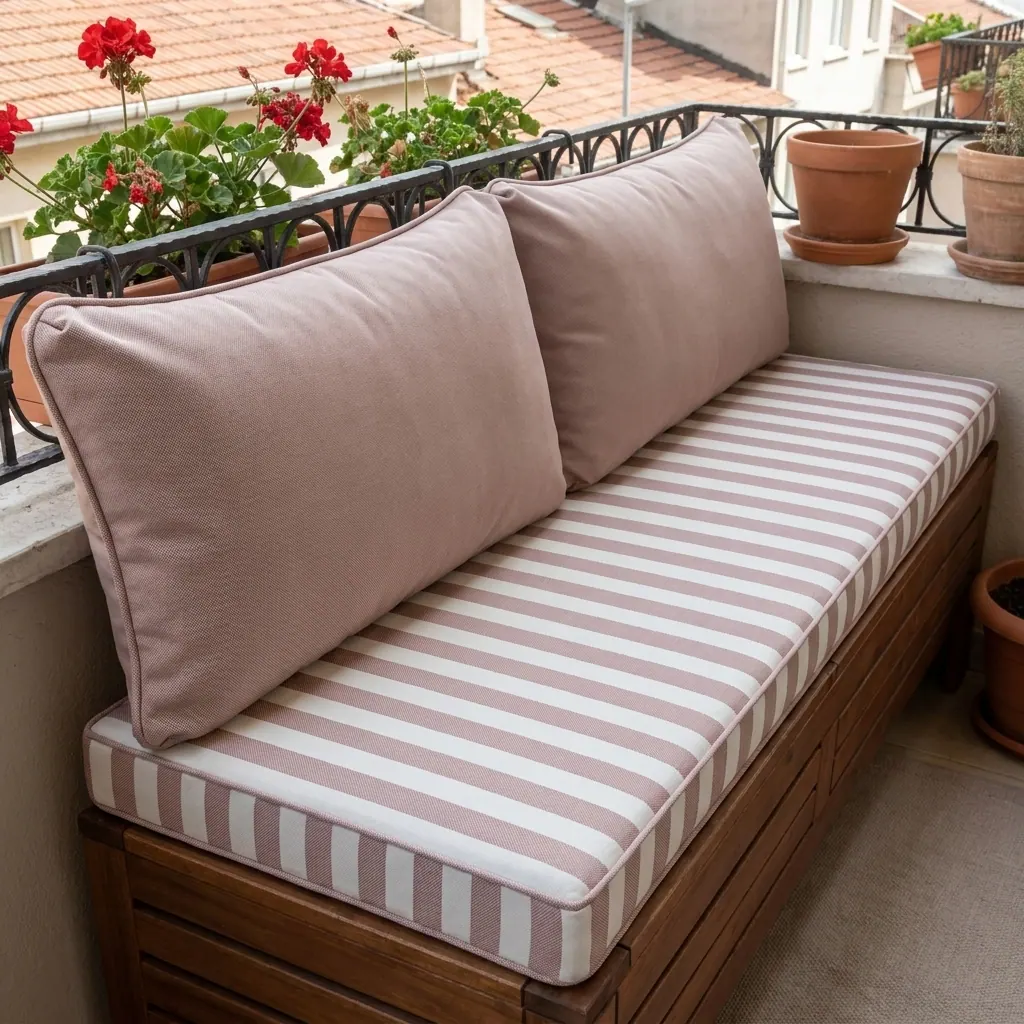
Open any photograph large; each one has its own link and a Save button.
 Save
 Save
 Save
 Save
 Save
From Budapest to Balaton: a cushion year
- April: wash the winter covers at 86°F (30°C) on a gentle cycle, no bleach, and air dry them.
- May: carry gallery and balcony cushions out, and tie chair pads at the back corners.
- June to August: rotate window-seat cushions and draw a sheer at midday; Budapest's July highs average 84°F (28.8°C).
- After rain at the lake: stand wet cushions on edge in moving air and get them dry within 24 to 48 hours.
- September: bring the Balaton cushions home or store them indoors, dry and off the floor, before the lake's freezing winter.
- October: gallery and balcony cushions come in before the first frost.
- Winter: keep window-seat cushions off cold, damp glass.
Take one red from the embroidery and let it carry the whole cushion. The flowers can stay on the pillow.
Élodie
Buyer questions: long runs, garden chairs and daylight
- A common question
Should a 103 in (262 cm) window bench cushion be one piece or two?
The workshop's answerBoth work: one 103 in (262 cm) piece or two of about 51.5 in (131 cm). The workshop recommends two pieces, but it made one long piece at the buyer's request, later adjusted to 103.5 in (263 cm) long and 15.75 in (40 cm) wide.
- A common question
Can each face of the cushion have a different piping color, so I can flip it for a new look?
The workshop's answerYes. Four 7.5 ft (2.3 m) linen-look cushions, 3 in (7.5 cm) thick, were made with one piping color on one face and a different one on the other, so the look changes when they're turned over.
- A common question
I only have the overall size of my garden armchairs. Is that enough for seat and back cushions?
The workshop's answerNot for a good fit. Measure the width between the armrests, the seat depth and the back-cushion height you want. The workshop recommends a 3-4 in (8-10 cm) seat in 32-density HR foam wrapped in polyester wadding, with ties at the back corners. Boxed cushions with piping are no problem.
- A common question
Will the color look the same in person as on my screen?
The workshop's answerThere can be small differences in daylight. That's why the workshop sends real-life photos of the fabric on finished cushions and suggests ordering samples.
- A common question
How do I measure for replacement covers on shaped chair pads?
The workshop's answerDraw the foam insert with every side labeled, for example a slight trapezoid with rounded front corners at 17.75 x 17 x 19.75 x 17 in (45 x 43 x 50 x 43 cm), and give the thickness, 1.5 in (4 cm) in that case. Measure the bare foam, not the old cover. When a first set came out about ¾ in (2 cm) short, the remake was made ½-¾ in (1-2 cm) larger.

Have it made
Have it made for your home — ask Élodie’s workshop
Describe the room at four in the afternoon: the floor, the wall, the one color you love. That is where a good fabric choice begins. — Élodie
Leave your details and the workshop will call you to confirm measurements, fabric, foam and piping. No prices, dates or payment on this page: it is a request, not an order.
Window seat and balcony cushion questions from Hungary
How thin can a cushion be on a deep sill if the window opens over it?
A 2 in (5 cm) cushion has been made for exactly that, so the window above could still close, and thinner is possible: 1¼ in (3 cm) can still take piping, while ¾ in (2 cm) is made without it. Measure the clearance under the handle and state it as an absolute maximum, cover included.
Can Lake Balaton cushions stay at the summer house over winter?
Better not. Outdoor fabric is water-repellent, not waterproof, and the lake freezes over in winter, so damp foam in an unheated house freezes and thaws without drying. Wash the covers, dry everything fully and store it indoors, off the floor, in something breathable.
How do I use folk-embroidery colors without the room looking like a costume?
Pick one color from the embroidery, usually a red or a blue, and make it the cushion body. Use cream or the same color for the piping, and keep embroidered or patterned fabric to a single throw pillow. Check the red in daylight at your own window before ordering.
What fabric suits a Budapest courtyard gallery or balcony?
Outdoor fabric, even under a gallery roof, because courtyards hold damp and July highs average 84°F (28.8°C). Add two ties at the back corners of chair pads or a non-slip base on benches, choose zip-off covers that wash at 86°F (30°C), and bring cushions in before the first frost.
With color and care — Élodie
The atelier
Keep going
Across the Map
Nearby places
Close by on the map