Across the Map · Europe
Custom cushions for Czech apartments, window seats and weekend cottages
In an old Prague building the window can be two windows deep. Measure the sill, then measure what swings over it, and the cushion fits both.
- Sun & UVModerate
- HumidityModerate
- WinterCold
- SettingInland
- Typical seatsDeep window sill seat, box-window niche, panel-flat balcony bench

 Save
The quick answer
Custom cushions in Czechia usually go in three places: the deep sill of an older Prague apartment, the balcony of a panel-block flat, and the bench at a weekend cottage. Measure the sill in centimeters and check any sash that opens over it, choose 2 in (5 cm) for balcony chairs and 4 in (10 cm) for long sitting, and store outdoor cushions dry over winter.
Field notes
Weather and light in Czechia
- Sun & UVModerate (level 2 of 4)About 229 sunshine hours in a Prague July
- HumidityModerate (level 2 of 4)Continental, neither very dry nor very damp
- Rain & stormsModerate (level 2 of 4)About 17.9 in (454 mm) a year in Prague
- Snow & freezeSome (level 2 of 4)January nights average just below freezing
Watch for
- Inner sashes that swing over the sill
- Balcony cushions left out into the cold months
- Cottage cushions in a closed, unheated house
Plain-language levels from general climate patterns, not measurements. Your own porch, shade and window exposure matter more.
Prague weather, read as a spec sheet
The Czech Hydrometeorological Institute's 1991–2020 normals for Prague's Klementinum station read like tolerances. January averages 39.0°F (3.9°C) by day and 31.1°F (−0.5°C) by night. July averages 79.7°F (26.5°C) and 61.9°F (16.6°C).
Precipitation is modest: 17.9 in (453.9 mm) a year. Sun is the bigger variable. July brings about 229 hours of sunshine; on December 21 the sun is up for roughly 8 hours 8 minutes.
For the workshop that means: - Fading happens in summer, on south-facing sills and open balconies. - Nights near freezing mean outdoor foam should not sit wet on a balcony through the cold months. - A sill cushion spends winter next to cold glass, so a washable zippered cover matters more than extra thickness.
Box windows, deep sills and the sash that sets the limit
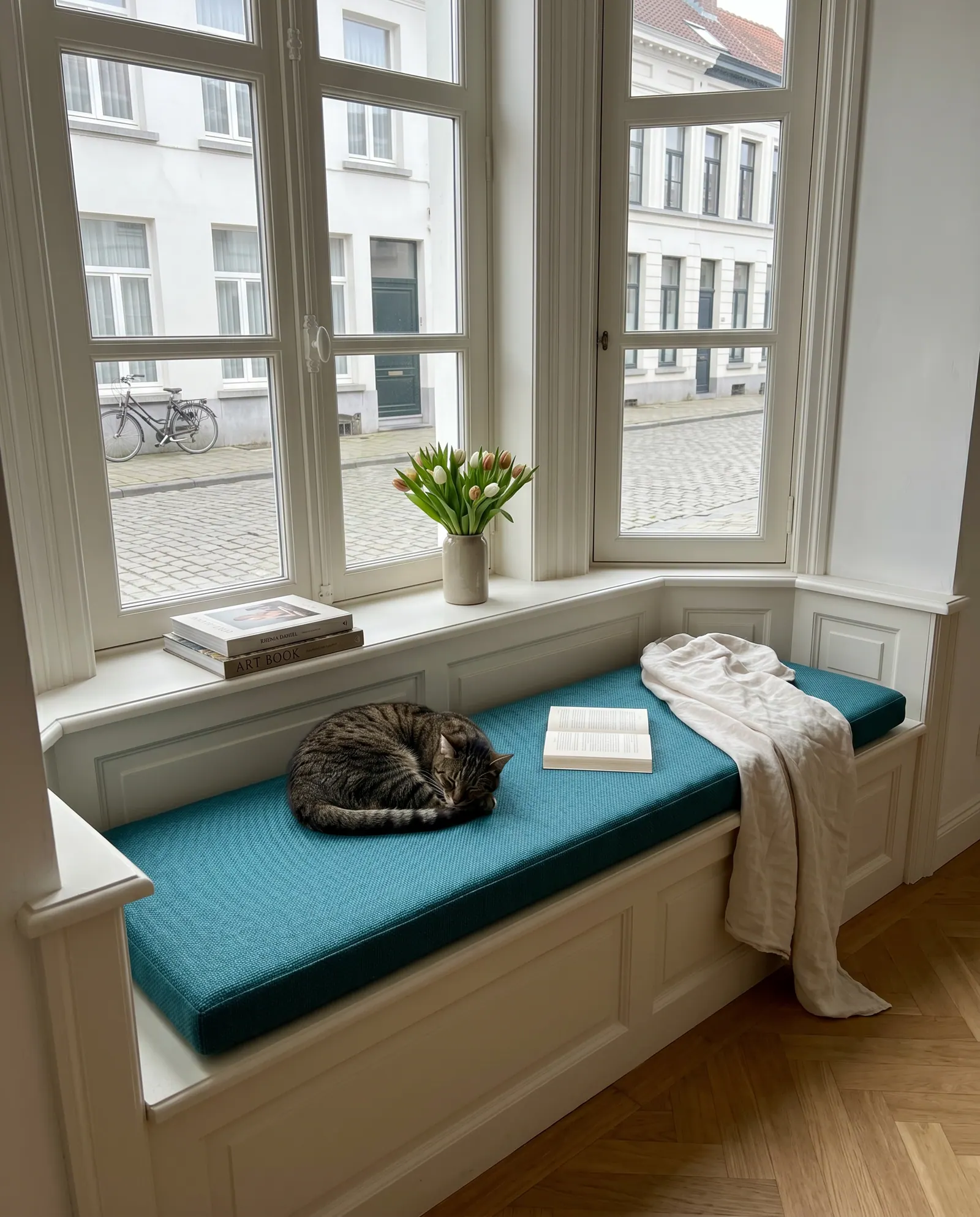
Many older Czech apartments have the kastlové okno, the box window: two sashes one behind the other, with an air gap between. Czech sources call it the most common window in Central Europe for two hundred years. In the older version the frames sat at the outer and inner edges of the wall, so the sill inside can be deep enough to sit on.
One catch. If the inner sash opens over the sill, the cushion has to stay under it. Open the sash, measure from the sill to its lowest edge, and treat that as a hard ceiling, partner.
A buyer got in touch needing 0.75 in (2 cm) corduroy cushions for exactly this. The first foam measured 1 in (2.6 cm) and bulged to 1.5 to 2 in (4 to 5 cm) inside the cover. The fix: foam cut under the limit, and a cover that cannot balloon.
Panel-block flats are the other half of the story. Between 1959 and 1995, 1.17 million panelák flats were built; in 2005 they housed about a third of the population. Their windows are shallower, so the seat to measure is usually on the balcony.
The method is in the Pattern on measuring a window seat. How deep is your sill, and what swings over it?
Chata or chalupa, the bench asks the same questions
Czech has two words for the weekend place. A chata was built for seasonal recreation; a chalupa is an older rural house adapted for it. Cottaging grew from the 1960s, with city life, rising living standards and limited chances to travel.
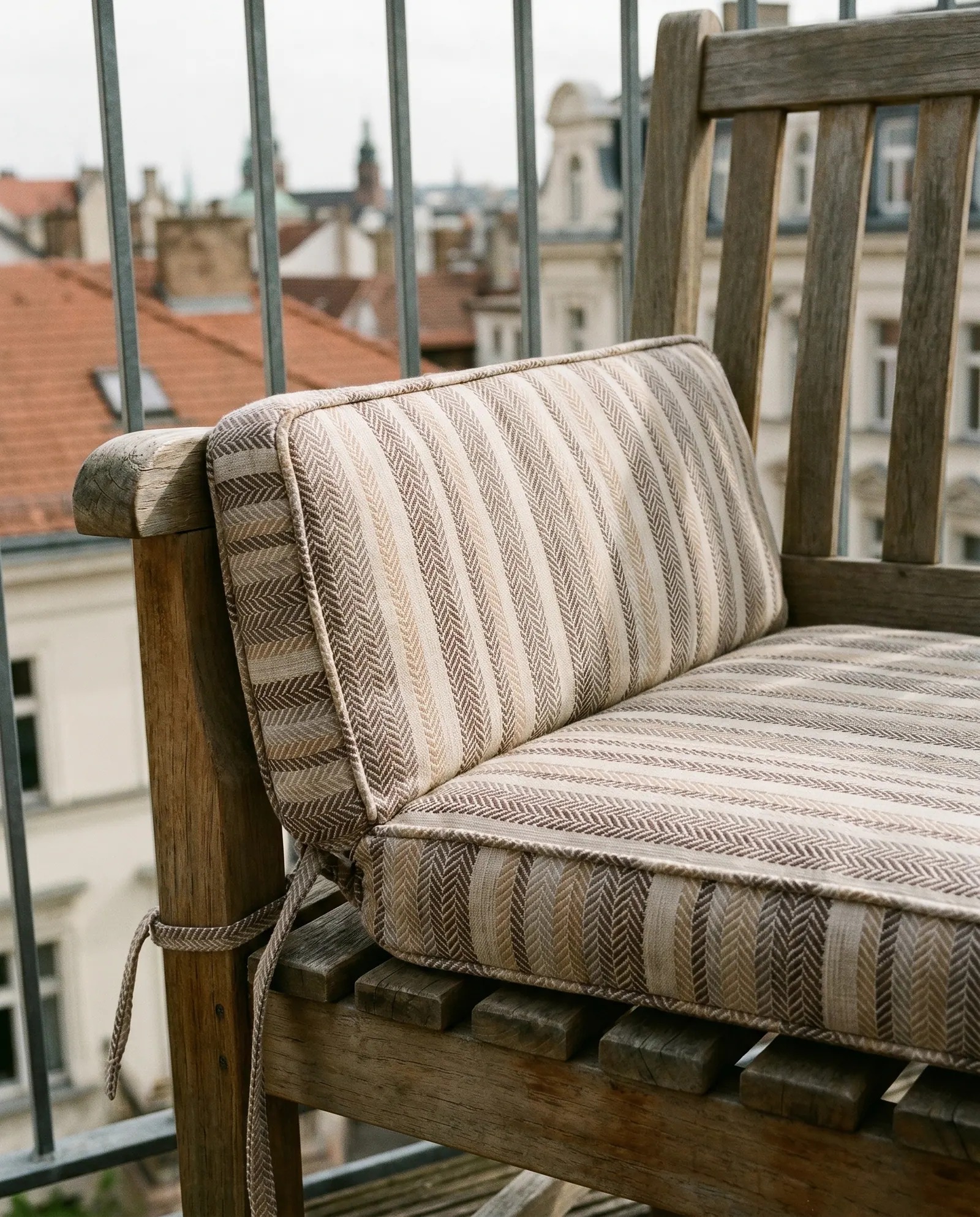
Either way, the seat is usually a wooden bench, in the garden or around the kitchen table. Measure length and depth, and if a backrest cushion sits on the seat cushion, subtract the seat thickness from the backrest height.
Outdoors, use outdoor acrylic, UV-resistant and water-repellent. Cotton ticking stays in the house. The bench cushion builder turns your numbers into a drawing, and the bench cushion hub shows the edges. Weekend-cottage logic is much the same at Great Lakes cottages.
Sill, balcony, cottage: the numbers side by side
| Seat | Fabric | Thickness | Build and fastening |
|---|---|---|---|
| Deep sill under an opening sash | Corduroy or linen-look | about 1 in (2 to 3 cm); piping from 1.25 in (3 cm) up | Foam cut under the limit, non-slip base |
| Deep sill, clear headroom | Linen-look or velvet | 2 to 3 in (5 to 7.5 cm) | Box edge, non-slip base |
| Panel-flat balcony bench | Outdoor acrylic | 4 in (10 cm) seat, 2 in (5 cm) back | Ties at the back corners |
| Balcony chair pads | Outdoor acrylic | 2 in (5 cm) | Ties; indoors for winter |
| Cottage garden bench | Outdoor fabric, never cotton ticking | 3 to 4 in (7.5 to 10 cm) | Ties or anti-slip bottom |
| Cottage kitchen corner bench | Corduroy or linen | 2 to 4 in (5 to 10 cm) | Trapezoid corner piece |
Seat foam is 32 kg/m³, about 2.0 lb/ft³. Handmade sizes land within about ±0.5 in (1 cm).
Picked for Czechia
Seats to start from
Fabric families
Try it in the Studio
The holiday-home window seat that didn't close
A buyer messaged the workshop about a window seat in a holiday home: long side 48 in (121.5 cm), short side 37 in (94 cm), depth 16.25 in (41 cm), linen-look with contrast piping.
The workshop drew it before cutting anything. The numbers did not make a closed shape. Two parallel sides and a depth describe many trapezoids; they need an angle to describe one. Angles are just lengths in disguise.
The workshop asked for a sketch. It showed one 90-degree corner, and from that the workshop worked out the slanted edge. The buyer kept 16.25 in (41 cm) for the depth because of a small wood protrusion they could not re-measure while away. The zipper went on the 48 in (121.5 cm) side, and the order carried a note: ±0.5 in (1 cm) handmade tolerance.
The cottage seat is never in front of you when the question comes. Photograph it with the tape lying on it and mark every right angle. The trapezoid calculator checks that your sides close.
- Measured
- Trapezoid: long side 48 in (121.5 cm), short side 37 in (94 cm), depth 16.25 in (41 cm), one right angle
- What it taught
- Mark right angles and obstructions on your sketch so the maker's geometry matches reality.
A Czech year, cushion by cushion
- Spring: check cottage cushions for damp spots before the first weekend out.
- Summer: turn sill cushions on south-facing windows; July is Prague's sunniest month.
- Autumn: bring balcony cushions in before the nights turn freezing.
- Wash covers at 86°F (30°C), gentle cycle, no bleach; air dry, no tumble dryer.
- Dry the foam completely, on edge where air moves. Never bag it damp.
- Closing the cottage: take the good cushions back to the flat.
- Winter: if the glass sweats, wipe the sill dry under a box-window seat.
Photographs for homes like these
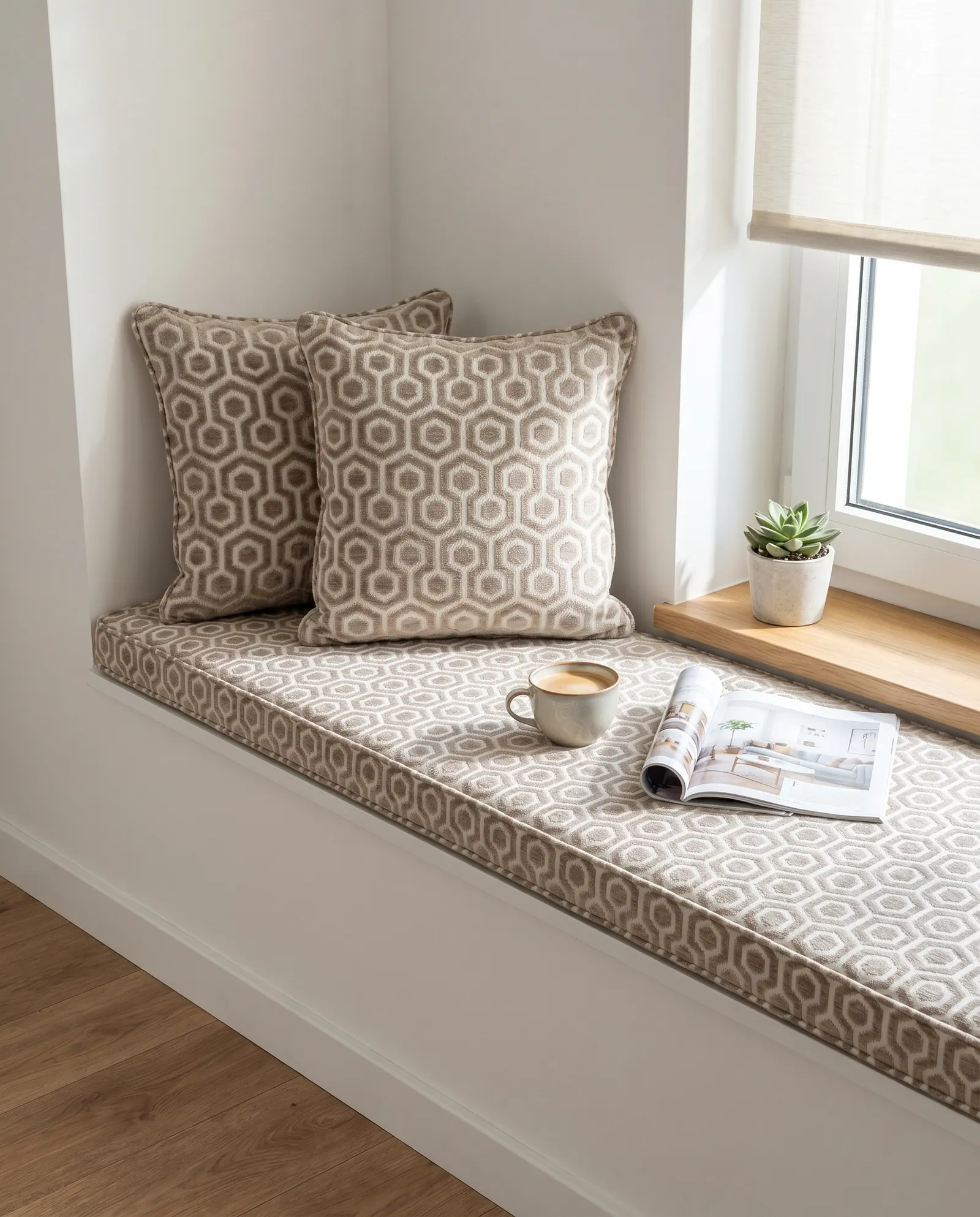
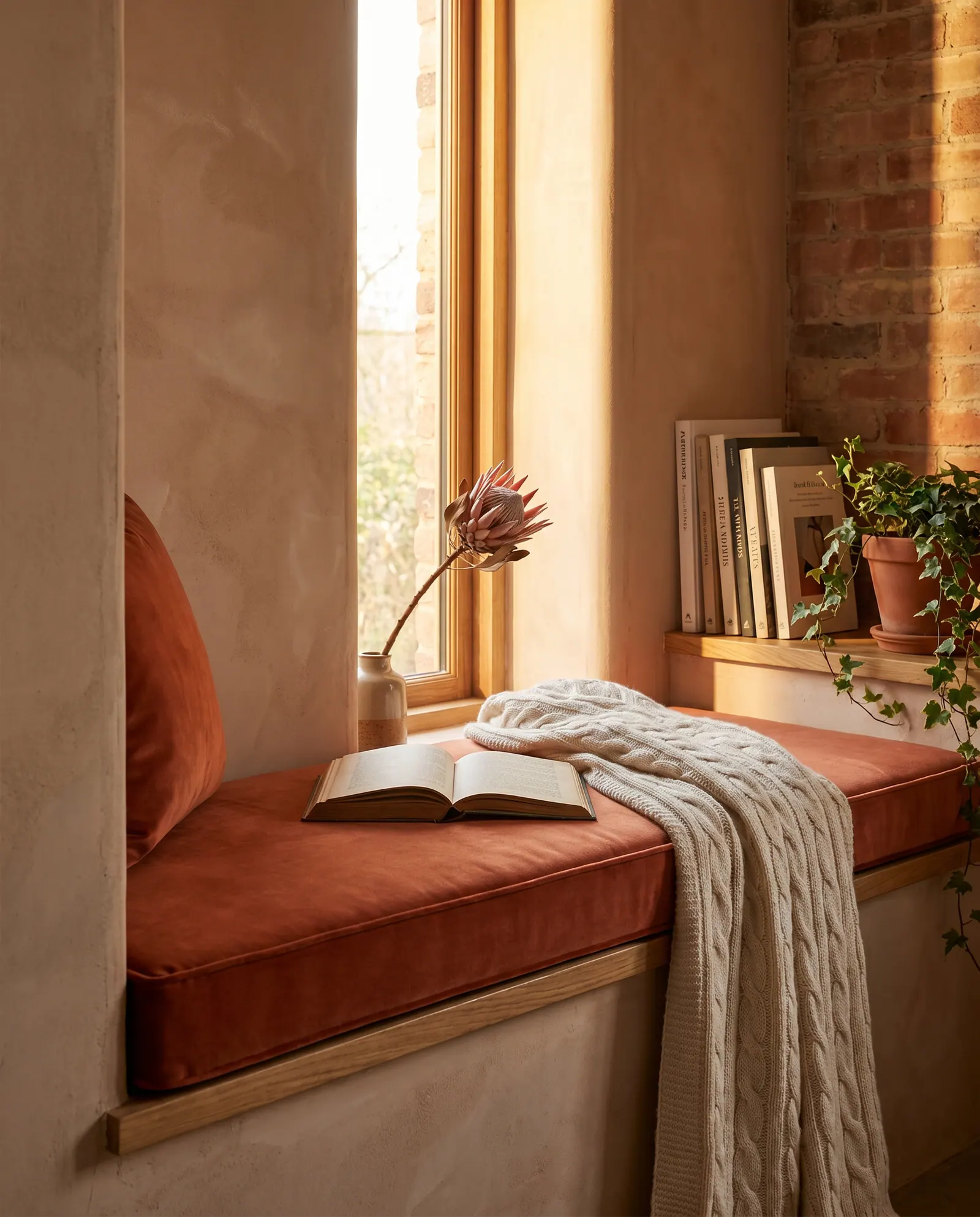
Open any photograph large; each one has its own link and a Save button.
 Save
 Save
 Save
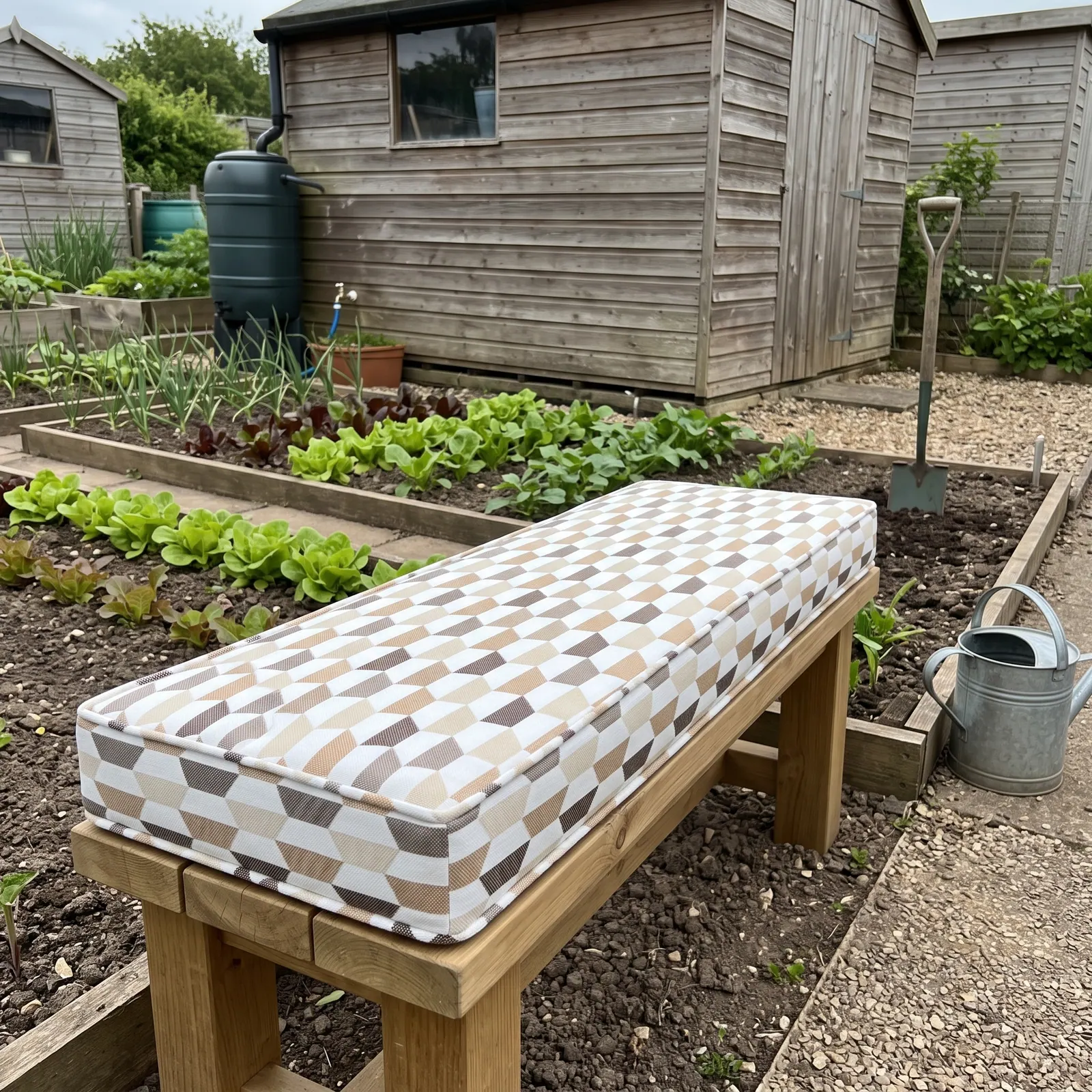 Save
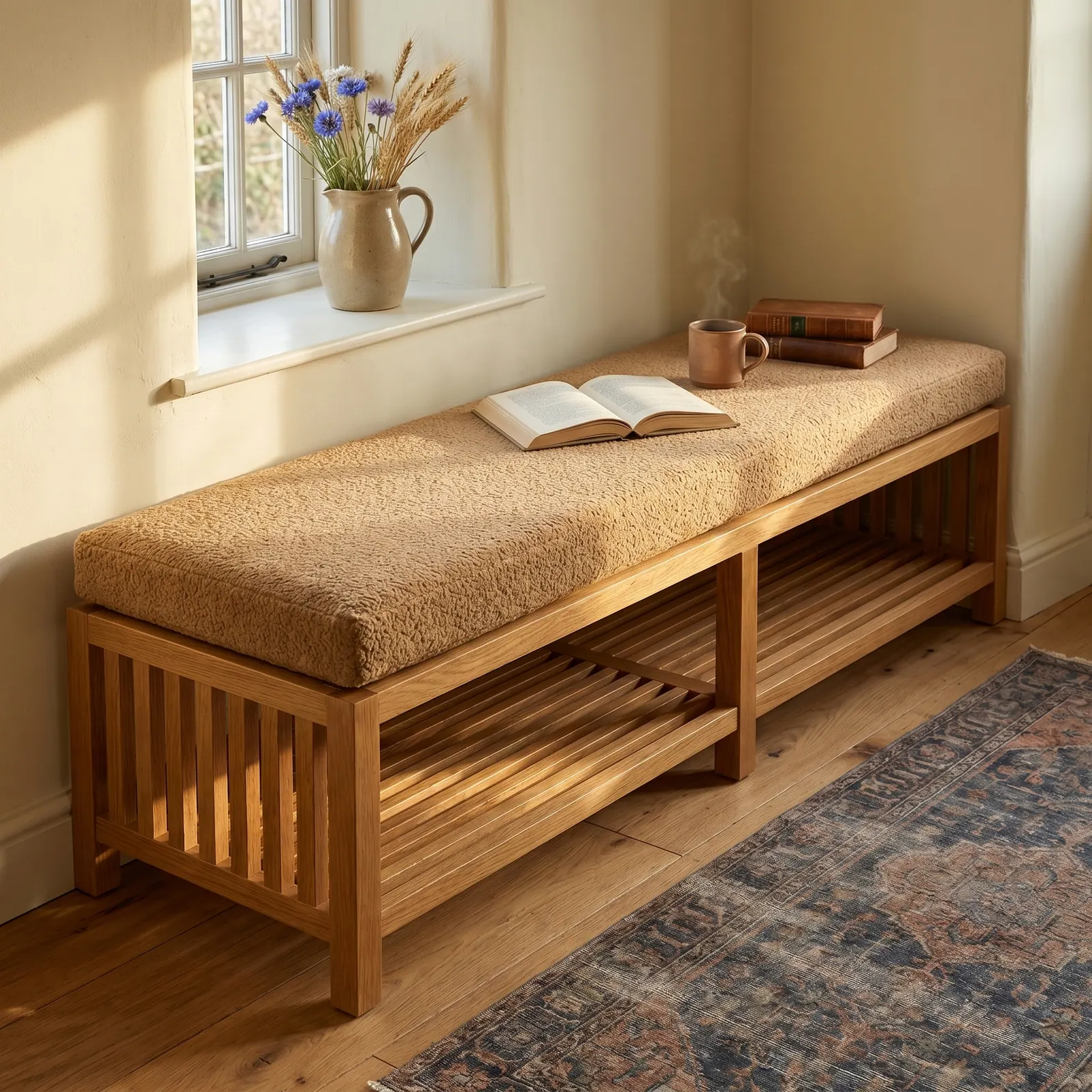 Save
Color for plaster walls and pine boards
Tall windows and white plaster make a Prague room bright but cool; a warm oat or tobacco linen-look keeps the sill from reading gray. Piping one shade darker than the body traces the edge without shouting.
The cottage is the opposite: pine boards, a wood stove, darker corners. A rust or bottle-green corduroy holds its own there and forgives muddy weekends. Look at two or three swatches in the room, in daylight, before the fabric code goes on the order.
A deep sill is a seat with a ceiling. Measure the ceiling first.
Nate
Buyer questions: sills, benches and tolerances
- A common question
Should I order the cushion a little smaller than the niche so it drops in?
The workshop's answerOrder your real measurements, for example 59 x 23 in (150 x 59 cm); fit allowance is handled in production. Some buyers still take about 0.5 in (1 cm) off each side for a snug fit with piping, ordering a 34.5 x 28.5 in (87 x 72 cm) niche as 34 x 28 in (86 x 71 cm).
- A common question
Can you make a 0.75 in (2 cm) window seat cushion so the window can still open over it?
The workshop's answerYes, 0.75 in (2 cm) cushions are made to order. At that thickness the foam has to be cut evenly and sized to the cover, or it bulges above the limit, so give your absolute maximum height including the cover.
- A common question
How thick should balcony chair pads and a bench cushion be for an older person?
The workshop's answer2 in (5 cm) suits chairs best, with 3 or 4 in (7.5 or 10 cm) possible. For a bench used for long sitting, 4 in (10 cm) gives the best support, and back cushions can be thinner, around 2 in (5 cm).
- A common question
I'm adding back cushions above the seat cushion on our bench. Do I subtract the seat thickness?
The workshop's answerYes. Take the seat cushion's thickness, for example 4 in (10 cm), off the backrest height so the pieces don't push each other out. A quick sketch confirms the final sizes.
- A common question
What stops a seat cushion sliding on a wooden bench?
The workshop's answerCorner ties, an anti-slip bottom fabric, or a non-slip pad underneath. Tufted cushions generally stay put; the workshop has had no complaints about them sliding.

Have it made
Have it made for your home — ask Nate’s workshop
Precision starts on the phone. Give the workshop your measurements and they will read them back to you, edge by edge. — Nate
Leave your details and the workshop will call you to confirm measurements, fabric, foam and piping. No prices, dates or payment on this page: it is a request, not an order.
Questions buyers ask next
Do old Prague box windows leave room for a window seat cushion?
Often, yes. The older box window sets its two frames at the outer and inner edges of a thick wall, leaving a deep sill. Measure the sill depth and, if the inner sash opens over it, the clearance under the open sash. That clearance is the maximum cushion height.
What thickness works for a panel-flat balcony?
For balcony chairs, 2 in (5 cm); 3 or 4 in (7.5 or 10 cm) is possible. For a bench where someone sits a long time, 4 in (10 cm), with a back cushion around 2 in (5 cm). Use outdoor fabric and ties.
Should cottage cushions stay at the chata over winter?
Better not. A chata was built for seasonal stays, and a closed, unheated house is hard on foam and covers. Wash the covers at 86°F (30°C), dry the foam completely, and store everything in the flat or another dry, ventilated place until spring.
Can I send cushion sizes in centimeters?
Yes. Give length, depth and thickness in centimeters, plus every side of any odd shape. Metric sizes avoid rounding from inch conversion, and handmade pieces land within about ±0.5 in (1 cm).
± 1/4 in — Nate
Concept Sketches
Sketches for homes like these
Real projects, drawn up as ideas you can borrow.
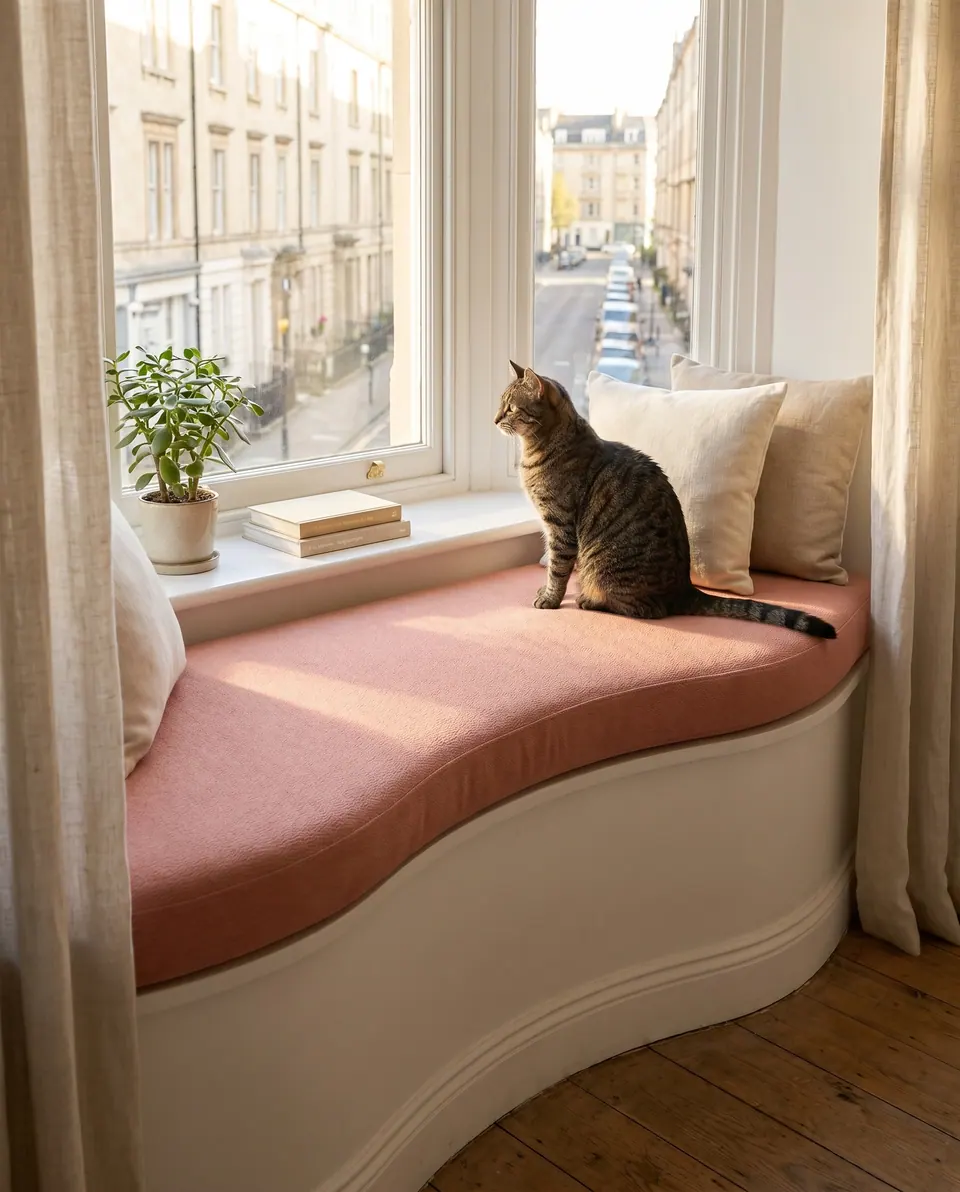
The atelier
Keep going
Across the Map
Nearby places
Close by on the map