Across the Map · Europe
Custom cushions for Slovak apartments, cabins and village houses
On the High Tatra summits, snow lies more than 120 days a year. A cabin cushion up there needs two things: cloth that's warm to the hand, and a cover that comes off when the boots come in wet.
- Sun & UVModerate
- HumidityModerate
- WinterCold
- SettingInland
- Typical seatsTatra cabin bench by the stove, entry bench for wet boots, village log-house window seat

 Save
The quick answer
Custom cushions in Slovakia do their hardest work in winter: on the bench of a Tatra cabin, the window seat of a village log house and the balcony of a Bratislava flat. Choose corduroy or velvet indoors, keep cushions outside the wood stove's clearance, give balcony cushions outdoor fabric and ties, and bring them in before the snow.
Field notes
Weather and light in Slovakia
- Sun & UVModerate (level 2 of 4)About 2,075 sunshine hours a year in Bratislava; under 1,600 in Kysuce and Orava
- HumidityModerate (level 2 of 4)About 70% a year at Bratislava Airport
- Rain & stormsFrequent (level 3 of 4)Under 20 in (500 mm) around Galanta and Senec, about 79 in (2,000 mm) in the High Tatras
- Snow & freezeLong winters (level 4 of 4)Under 30 days of snow cover in the south, over 120 on the Tatra summits
Watch for
- Wood stoves in cabins and chalets
- Snowmelt from boots at the cabin door
- Balcony cushions left out into the windy months
Plain-language levels from general climate patterns, not measurements. Your own porch, shade and window exposure matter more.
Under 30 days of snow in the south, over 120 on the peaks
Slovakia is a small country with a tall one standing inside it. The Slovak Hydrometeorological Institute (SHMÚ) puts the average year above 50°F (10°C) on the Danube Plain and below 43°F (6°C) in the highest basins. Precipitation runs from under 20 in (500 mm) around Galanta and Senec to about 79 in (2,000 mm) in the High Tatras.
Snow tells it plainest: under 30 days of snow cover a year in the south, 50 to 70 in the basins, more than 120 on the Tatra summits. At Štrbské Pleso, 4,327 ft (1,319 m) up, January nights average 17°F (−8.3°C). The sun has an edge up there too; the WHO puts the rise in UV at about 10% per 3,300 ft (1,000 m), and fresh snow almost doubles exposure.
Bratislava is the gentle end: July days of 82.4°F (28.0°C), January nights of 27°F (−2.8°C) and about 2,075 hours of sun a year at the airport.
What that means for a cushion: - Warm to the hand beats thick. In a cold cabin, cloth you want to touch matters more than another inch of foam. - Wet boots are the real weather. The bench by the door takes snowmelt all winter; give it a zip-off cover. - Balcony cushions come in early. SHMÚ's windiest months are February, March and November.
Panel flats, log houses and the cabin under the Tatras
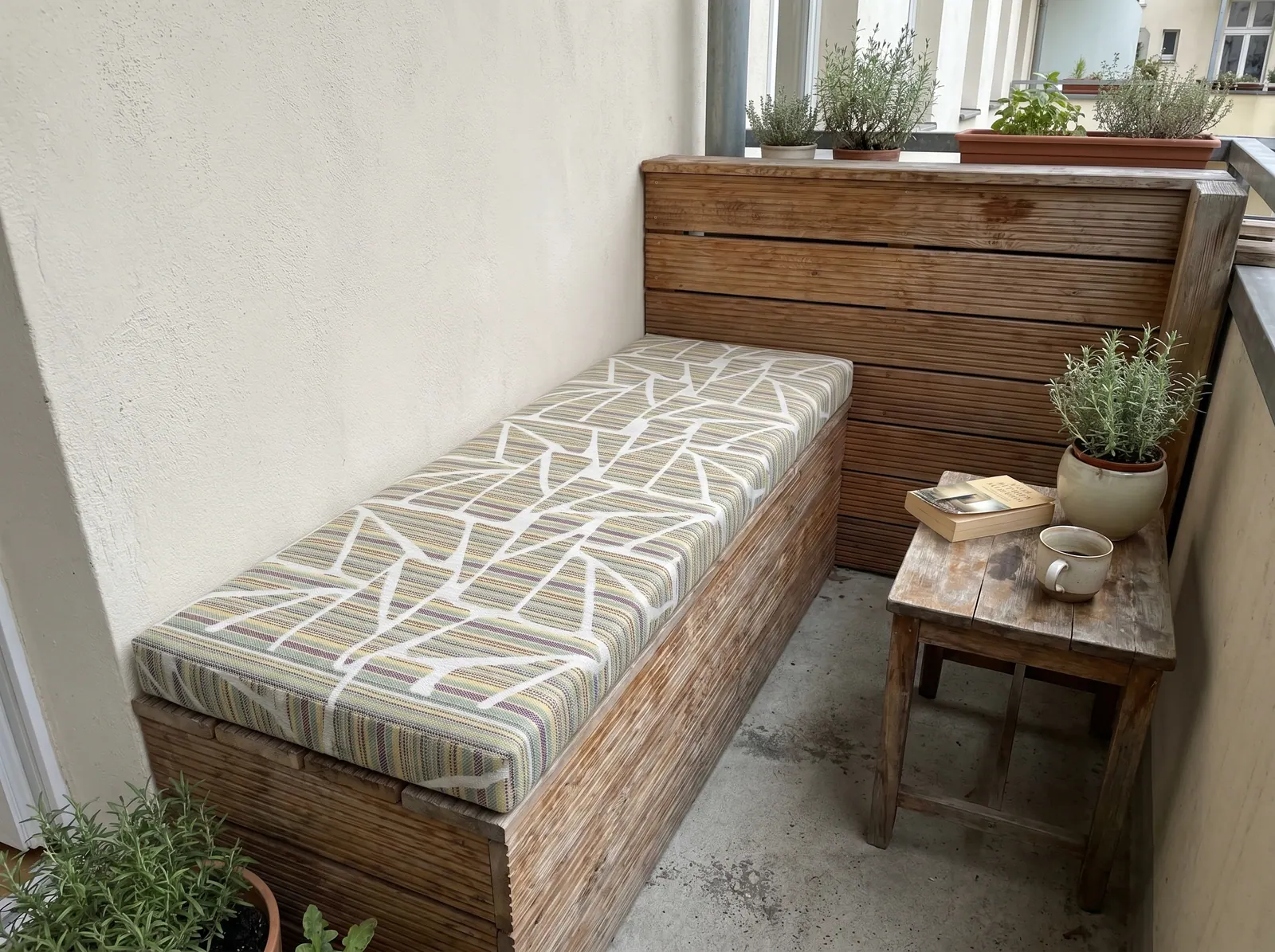
For a cushion maker, Slovak homes come in three kinds. The first is the panel block: Bratislava's Petržalka and Dúbravka went up in high-rise prefabricated panels, and in a flat like that the balcony is where the seat is, and where the weather gets at it. Czechia next door has the same panel flats and weekend cottages, and Poland shares the Tatras.
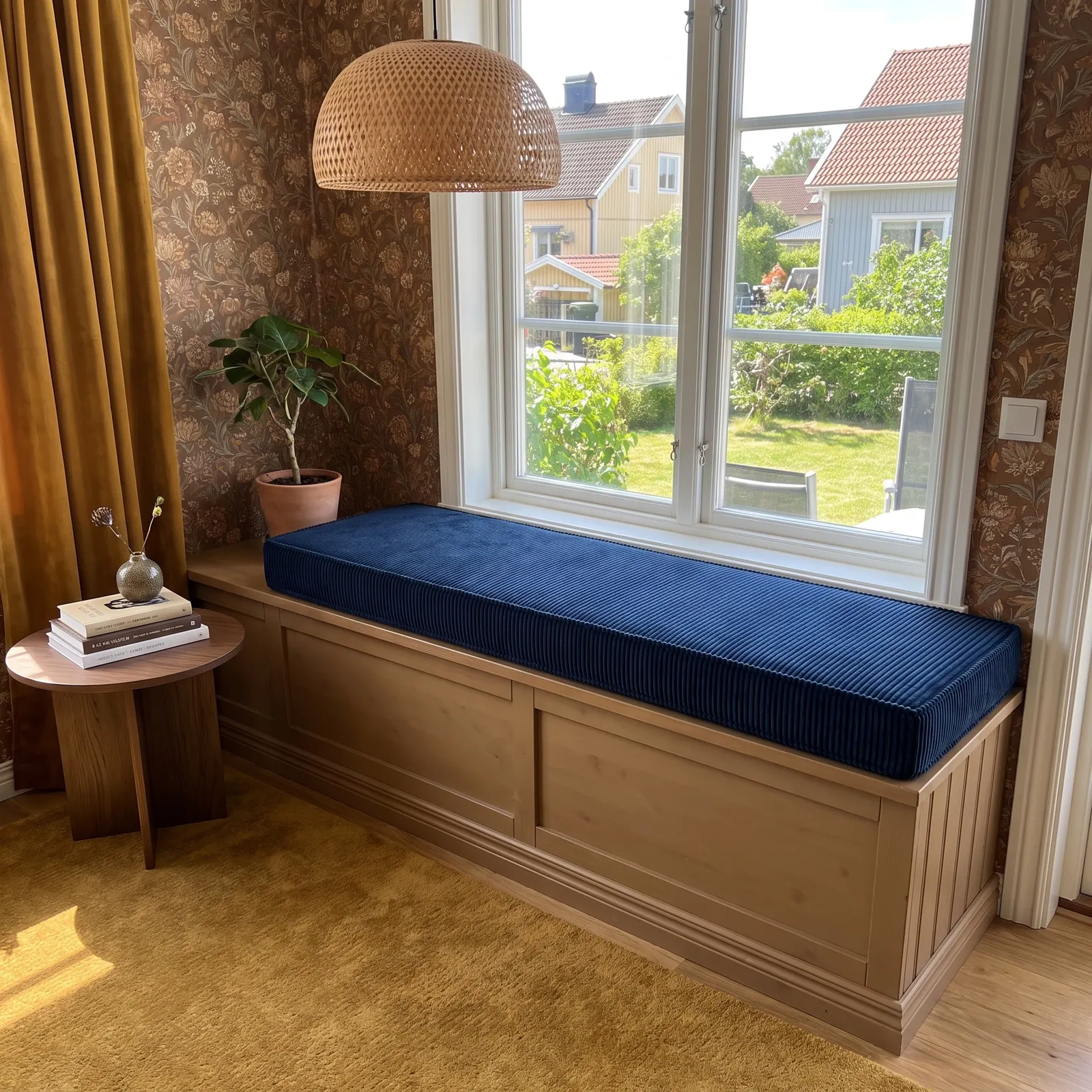
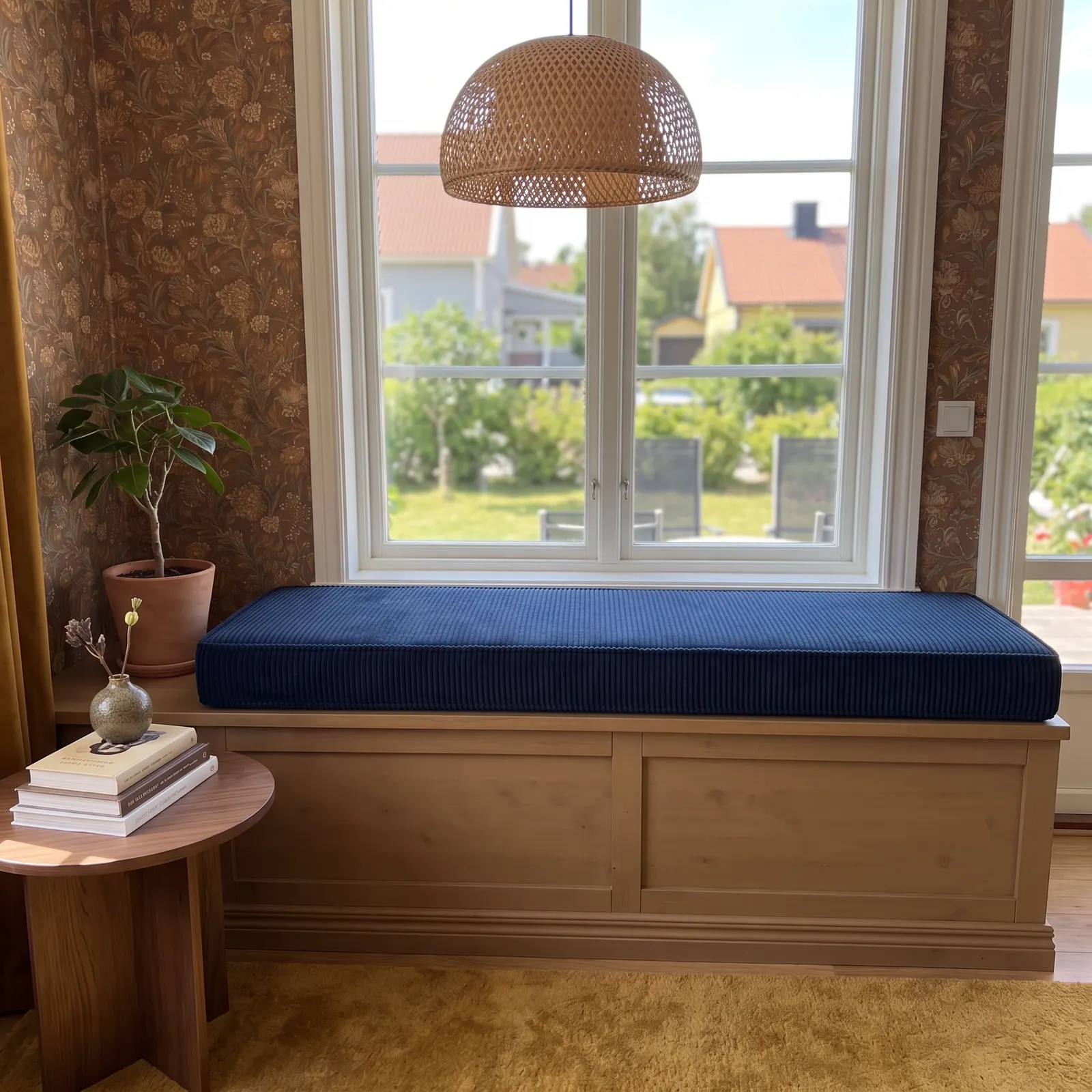
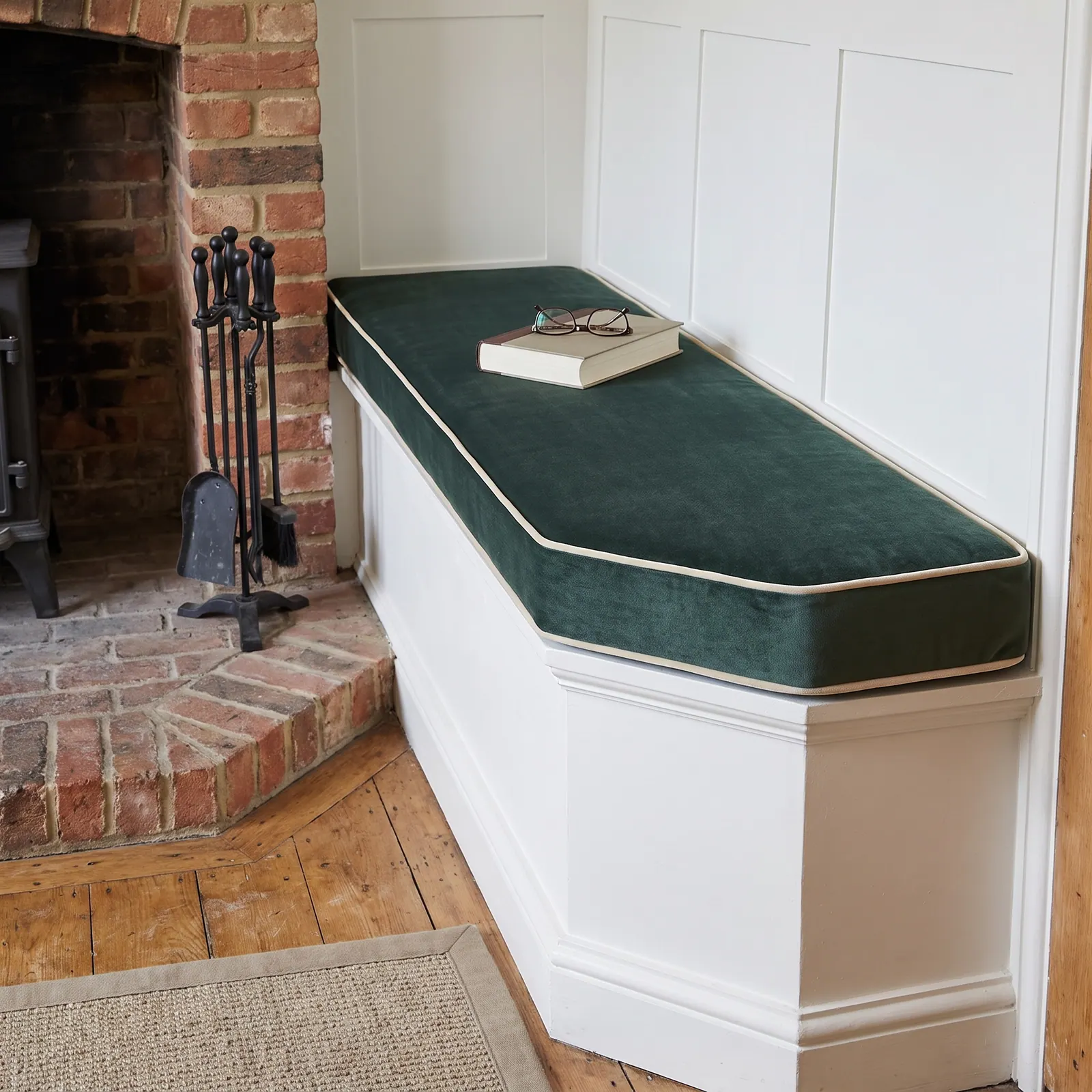
The second is the village house. Vlkolínec keeps more than 45 log houses of two or three rooms and has been on the UNESCO list since 1993. In Čičmany, a folk-architecture reserve since 1977, the timbered houses wear white patterns on their outside walls. Wood everywhere and deep sills: that's a house that wants a cushion with some warmth in it. Measure the seat board itself, and in a tight niche order a few millimeters under your reading so the cushion drops in.
The third is the cabin. Mountain huts are common in the High Tatras, and a family chata has the same bench by the same stove. That stove sets the rules. The workshop's standard foam has no added flame retardants and its fabrics carry no fire-retardant treatment, so read the clearance to combustibles on the stove's plate or in its manual and keep every cushion outside it. Buy the cushion once, cry once; don't buy it twice because it sat too close to the fire.
Cabin, village, balcony: the cut list
| Seat | Fabric | Thickness | Build |
|---|---|---|---|
| Cabin bench by the stove | Corduroy or velvet | 4 in (10 cm) | Outside the stove's clearance; zip-off cover |
| Entry bench for wet boots | Wipeable performance weave | 2 to 3 in (5 to 7.5 cm) | Non-slip base; a spare cover |
| Log-house window seat | Corduroy, velvet or linen-look | 3 in (7.5 cm) for a neat line | Measured on the seat board; a few millimeters under in a tight niche |
| Panel-flat balcony chairs | Outdoor fabric, water-repellent and UV-resistant | 2 in (5 cm) | Two ties at the back corners; indoors by November |
| Kids' reading corner | Polyester corduroy | Quarter-round, about 40 in (102 cm) along each wall | Tufted; wipe clean in place |
Corduroy and velvet are indoor fabrics with no water resistance. Seat foam is about 2.0 lb/ft³ (32 kg/m³). Zippered covers wash at 86°F (30°C) on a gentle cycle.
Picked for Slovakia
Seats to start from
Fabric families
Try it in the Studio
A toddler's corner under a canopy
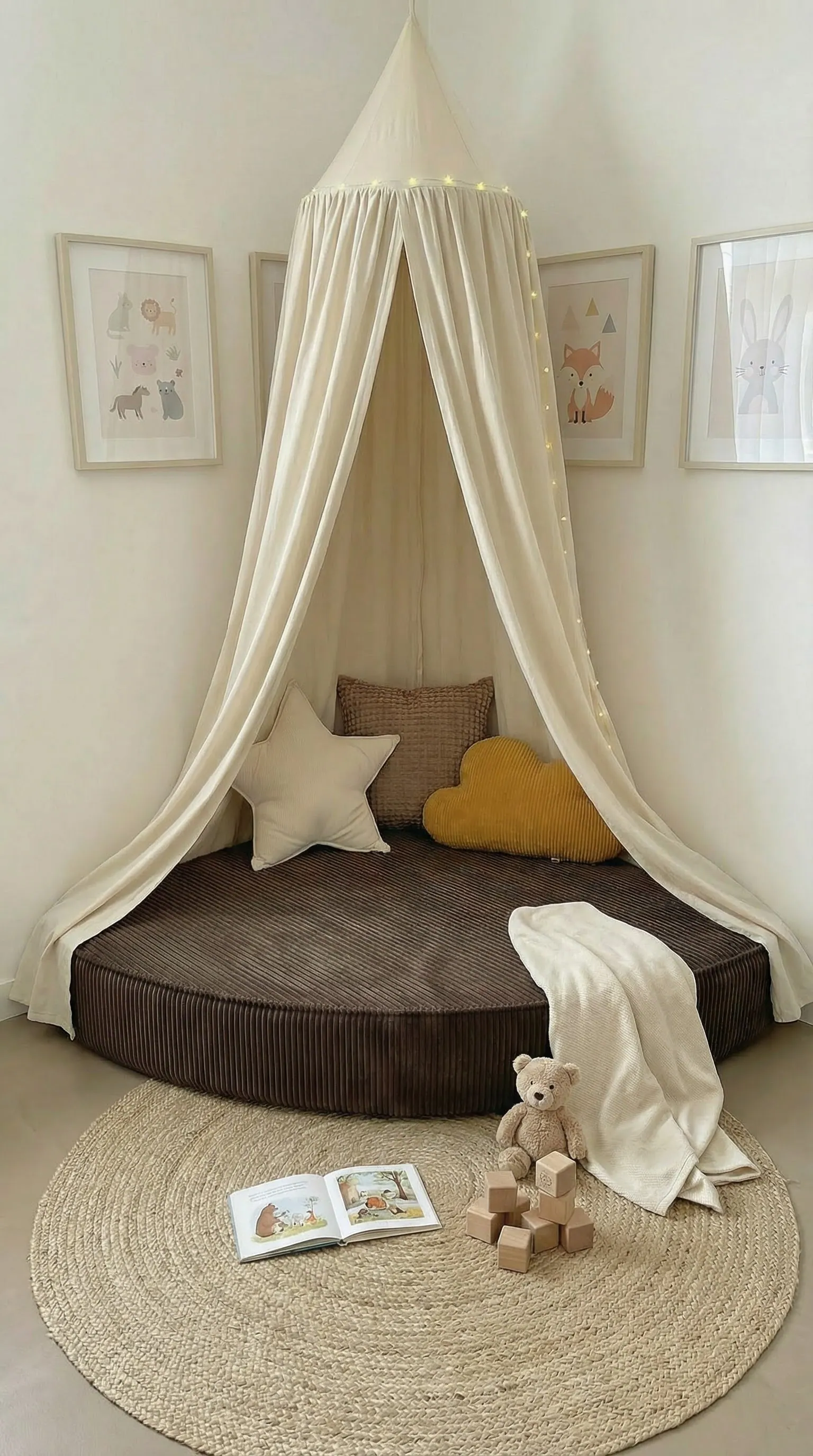
A parent in Slovakia wrote to the workshop about a reading corner for a toddler, tucked under a canopy. Two questions: what size quarter-tufted floor cushion would suit it, and were there more colors than the listing showed?
The answer was 40 x 40 inches, about 102 x 102 cm, and the workshop sent its extended color chart.
I like that size for small children. It fills a corner without swallowing the room; a child can sprawl on it, and a grown-up can still perch on the curved edge and read aloud. A quarter-round is measured along the two walls from the back corner, never across the diagonal, so check you have 40 in (102 cm) of clear wall each way. The corner floor cushion hub and its sizing Pattern show how the curve runs.
In a Slovak winter that corner gets used hard. Pick a darker corduroy than you think you want; tufted cushions don't unzip, so they get wiped clean in place.
- Measured
- Quarter-round corner floor cushion, 40 x 40 in (about 102 x 102 cm)
- What it taught
- Measure a corner cushion along each wall from the back corner, and ask for the full color chart.
When the chata sleeps a crowd
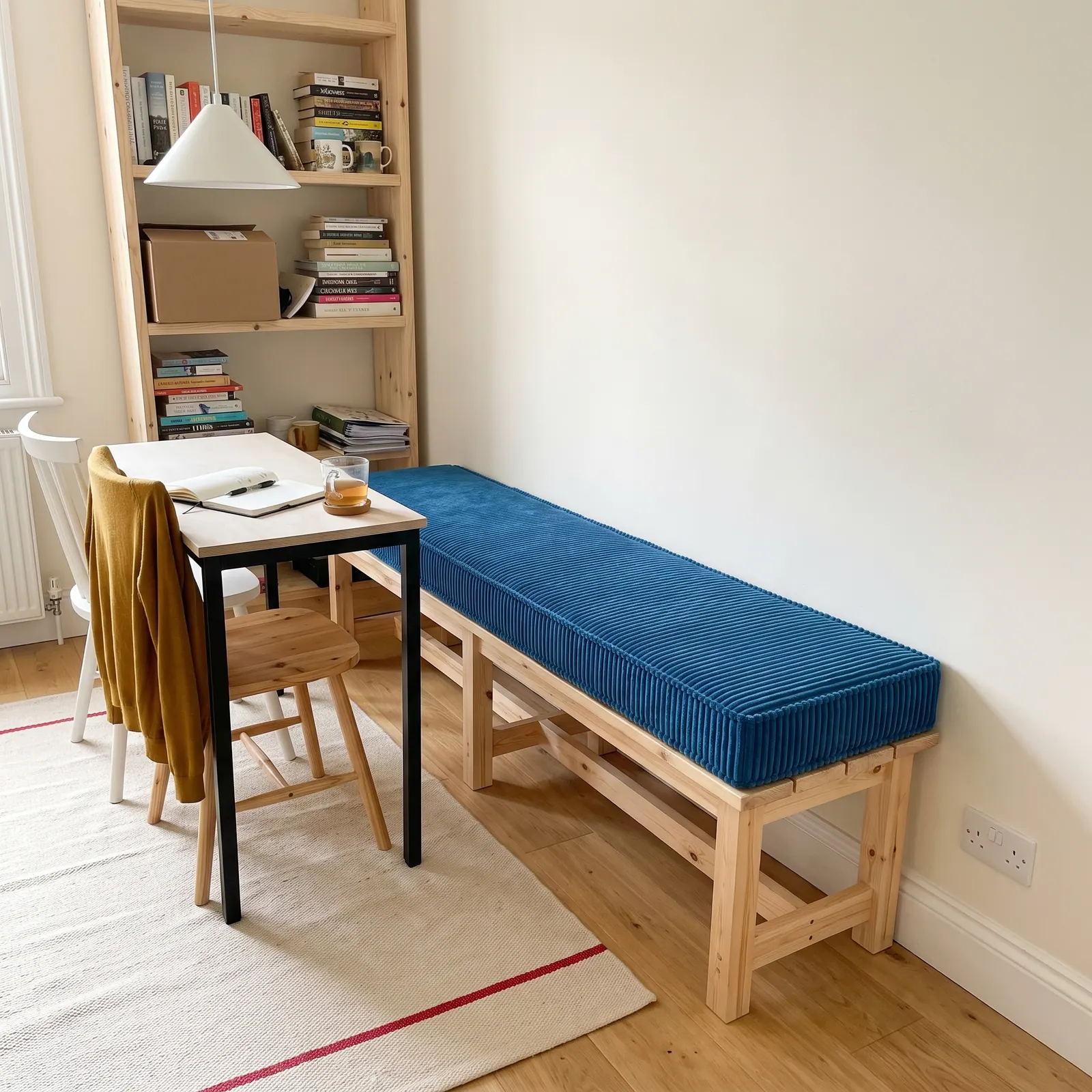
Cabins fill up. Benches turn into beds, and one seat takes six at supper and two sleepers after. A buyer in Europe once asked the workshop for five matching bench sets for a busy room: 31½ x 78¾ in (80 x 200 cm) mattresses, 8 in (20 cm) thick, each with a 12 in (30 cm) bolster, in washable, pre-shrunk fabric.
The workshop's standard for that bench is a 4 in (10 cm) mattress with an 8 in (20 cm) bolster, and 39¼ in (100 cm) of total depth for 31½ in (80 cm) of seat. Doubling the thickness and enlarging the bolster raised the price a good deal, so settle those two numbers before comparing quotes. The bench cushion hub shows the edges, and the bench cushion builder sketches yours first.
Blueprint indigo and white on dark timber
Slovakia has two color stories worth borrowing. One is modrotlač, blueprint: a resist paste printed onto cloth with wooden blocks, some up to 300 years old, then dyed in indigo so the pattern stays pale; UNESCO listed it in 2018. The other is Čičmany's white patterns on dark timber.
Both are the same idea, a deep ground and a light line, and it translates well to a cushion. In a pine-paneled cabin, an ink-navy or deep-brown corduroy lets the wood do the warming and hides the boots. In a white panel-flat living room, turn it around: a pale oat body and one dark pillow. Velvet catches low winter light, too. What color is the wood in your cabin, my friend: honey pine, or dark and old?
Photographs for homes like these
Open any photograph large; each one has its own link and a Save button.
 Save
 Save
 Save
 Save
 Save
A Slovak cushion winter, and the months either side
- October: bring balcony cushions in before the first hard frost, dried right through first.
- November: one of SHMÚ's windiest months. Anything still on the balcony should be tied down or brought in.
- Opening the cabin: air the cushions before the first night and check the foam for damp.
- All winter: move cushions outside the stove's clearance before you light it, not after.
- After a ski day: if boots soaked the entry-bench cover, unzip it and wash it at 86°F (30°C) on a gentle cycle, no bleach, then air dry.
- Closing the cabin: take the good cushions home rather than leaving them in a cold, shut house.
In a cold house, warm to the hand beats thick every time.
Harlan
Buyer questions: corduroy, kids' corners and spare covers
- A common question
Is the corduroy on the kids' corner floor sofa cotton or polyester, and is it certified?
The workshop's answerIt's polyester, durable and easy to care for. The fabrics come under the weaving mill's OEKO-TEX Standard 100 certificate, number 03.T.3239, which can be checked on the OEKO-TEX website.
- A common question
Can the corduroy ribs on the side of a corner floor cushion run up and down, like in the photos?
The workshop's answerThe side band is normally cut with the ribs running horizontally because of the fabric roll length, which keeps the sides free of seams. Vertical ribs can be made as a special request, but the band may then need joins along the way.
- A common question
What's in the foam and filling for a cushion in a child's room?
The workshop's answerA standard furniture-grade foam with no added flame retardants or chemical treatments. Many families use these cushions in kids' rooms and play corners.
- A common question
The cushions arrived looking flat and smaller than the photos. Is that normal?
The workshop's answerYes. Everything is vacuum-compressed for shipping and needs a few days after opening to reach full size. Buyers often worry when they first see the compressed pieces.
- A common question
Can I order a spare cover, now or later on?
The workshop's answerYes. The workshop can make an extra cover at any time, in the same fabric or a different one. One buyer ordered a second set in another color to rotate while the first was in the wash.

Have it made
Have it made for your home — ask Harlan’s workshop
Fabric has a temper and foam has a memory. Better to settle both in a conversation than to guess at them alone. — Harlan
Leave your details and the workshop will call you to confirm measurements, fabric, foam and piping. No prices, dates or payment on this page: it is a request, not an order.
Questions buyers ask next
How far from the stove should a cushion sit in a Tatra cabin?
At least as far as the stove's own clearance to combustibles, printed on its plate or in its manual. The workshop's standard foam has no added flame retardants and its standard fabrics are not fire-retardant, so treat that clearance as a firm line for cushions, floor cushions and throws.
Can balcony cushions stay out through a Slovak winter?
Better not. Snow cover lasts up to a month or more in the lowlands and for months in the mountains. Bring outdoor cushions in during October or November, dry them right through, and store them on edge somewhere dry and airy, not in a sealed bag.
Which fabric feels warmest on a cabin bench?
Corduroy and velvet feel warmest to the hand and suit indoor cabin benches and window seats. Both are indoor fabrics with no water resistance, so for the bench by the door, where boots drip, a wipeable performance weave is the practical choice.
Is corduroy a good choice for a cabin I rent out?
For rentals and very hard use, the workshop leans toward velvet or its soft performance weave, which are durable, wipeable and machine washable at 86°F (30°C). Corduroy is lovely in a family cabin, but under heavy use velvet or linen wears better.
Sit well. — Harlan
The atelier
Keep going
Across the Map
Nearby places
Close by on the map