Corner floor cushions, measured along the two walls
A corner is the one spot in a room nobody knows what to do with, until a child climbs into it with a book. Here is how to size, fill and dress the quarter-round cushion that belongs there.
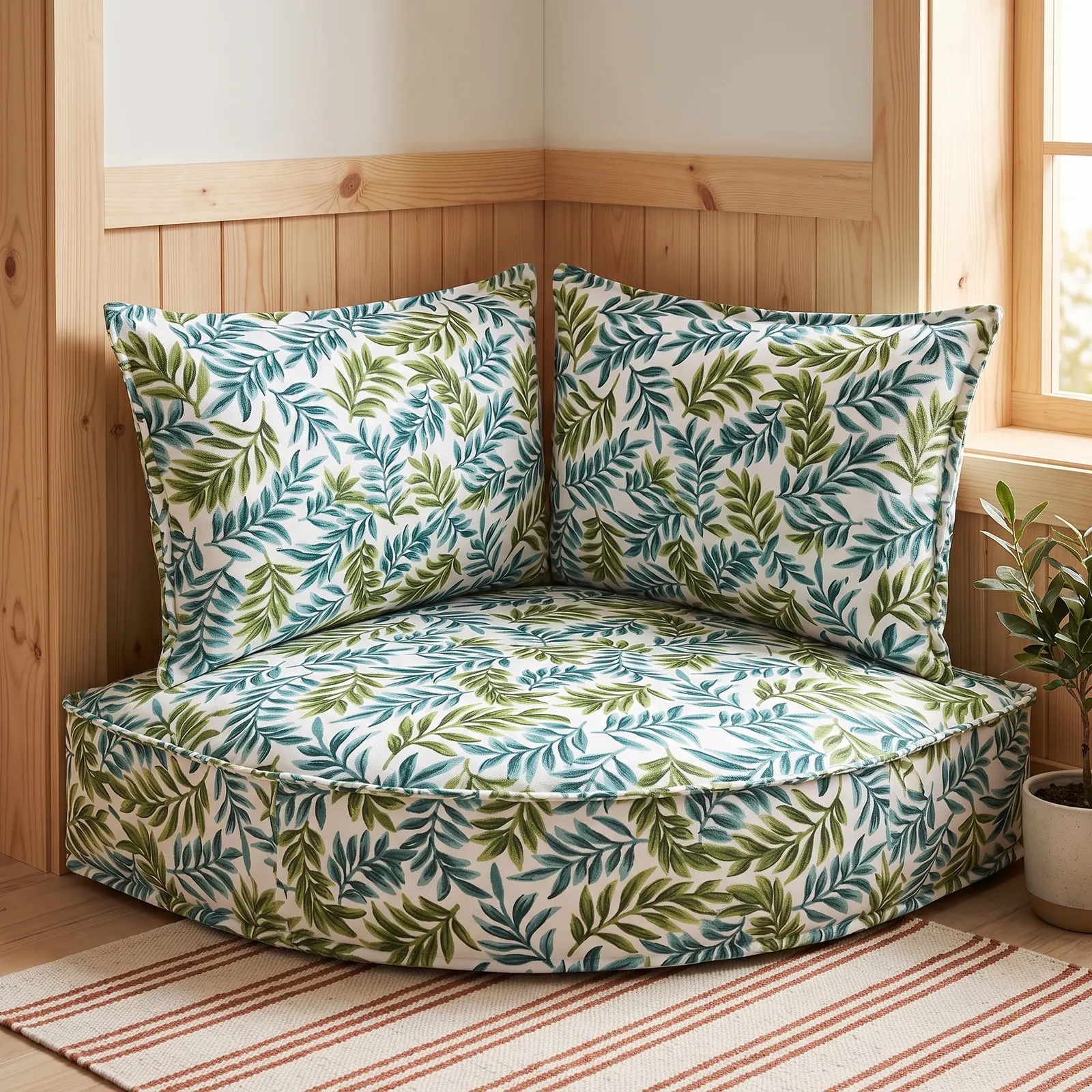
SaveFern-like leaves in teal and moss green brighten a pine-clad corner, with a rust-striped rug and a small olive tree.
The quick answer
A corner floor cushion is sized by its two straight sides, the ones that run along the walls from the back corner, never by the curve or the diagonal. The default is 34 x 34 in and the standard maximum is 48 in per side. Tufted corners are 4 in thick, with 5 or 6 in on request; foam kids' corners are 8 in (20 cm).
What a corner floor cushion is, and who sits in it
Forty-eight inches along each wall and about 75.4 in around the front curve: that is the largest quarter-round corner cushion the workshop makes as standard, and it fills a corner the way water fills a bowl.
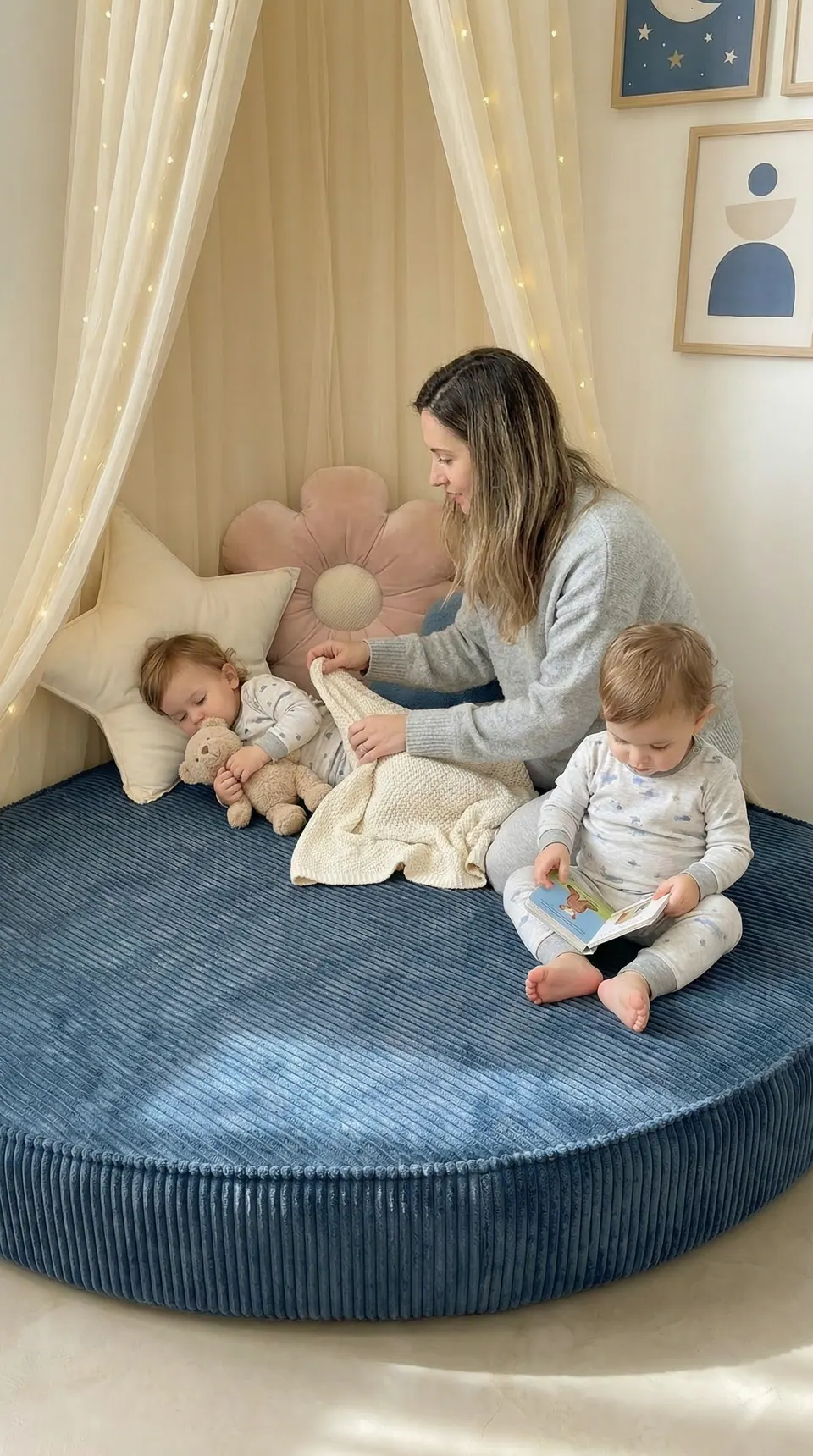
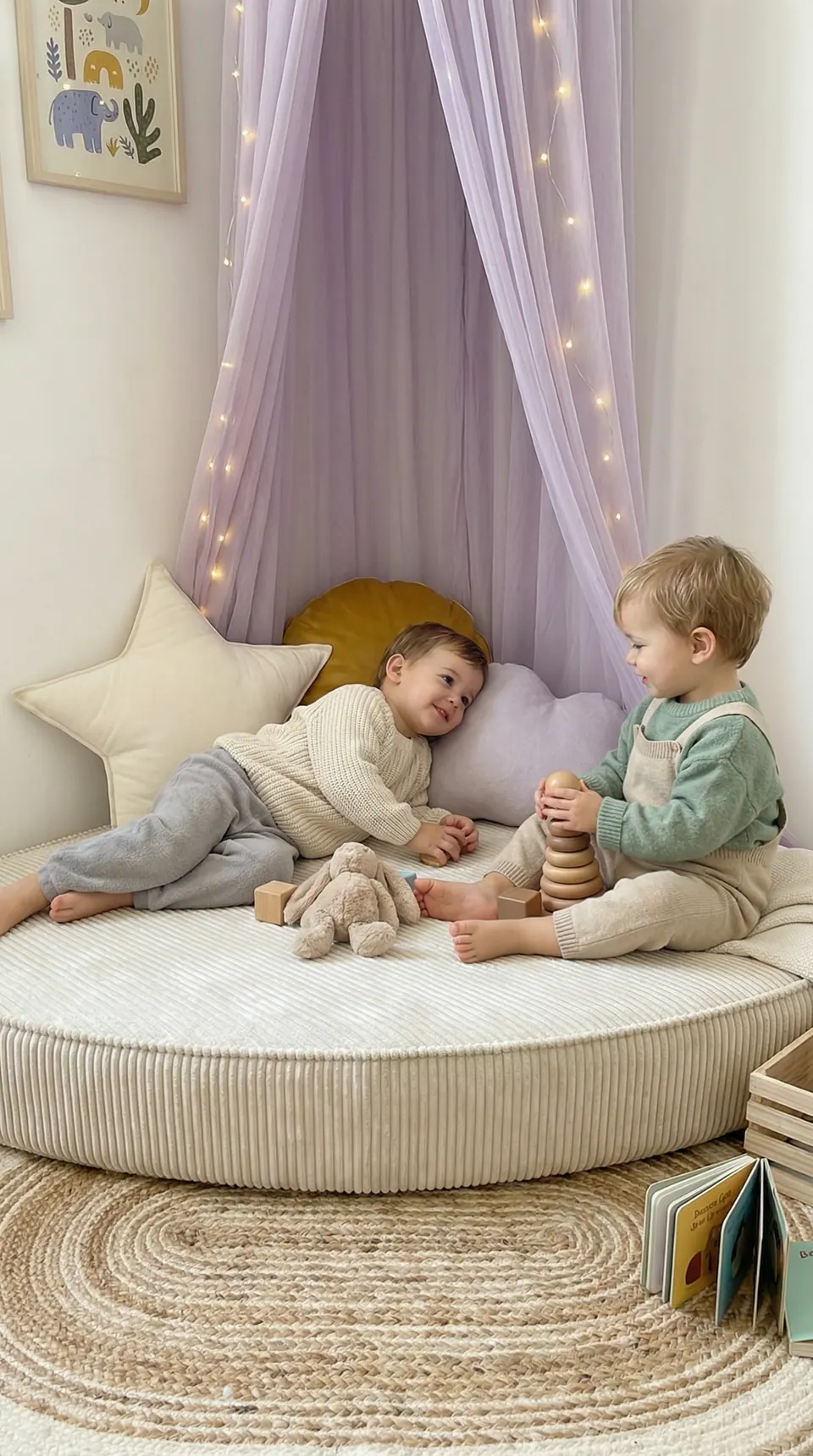
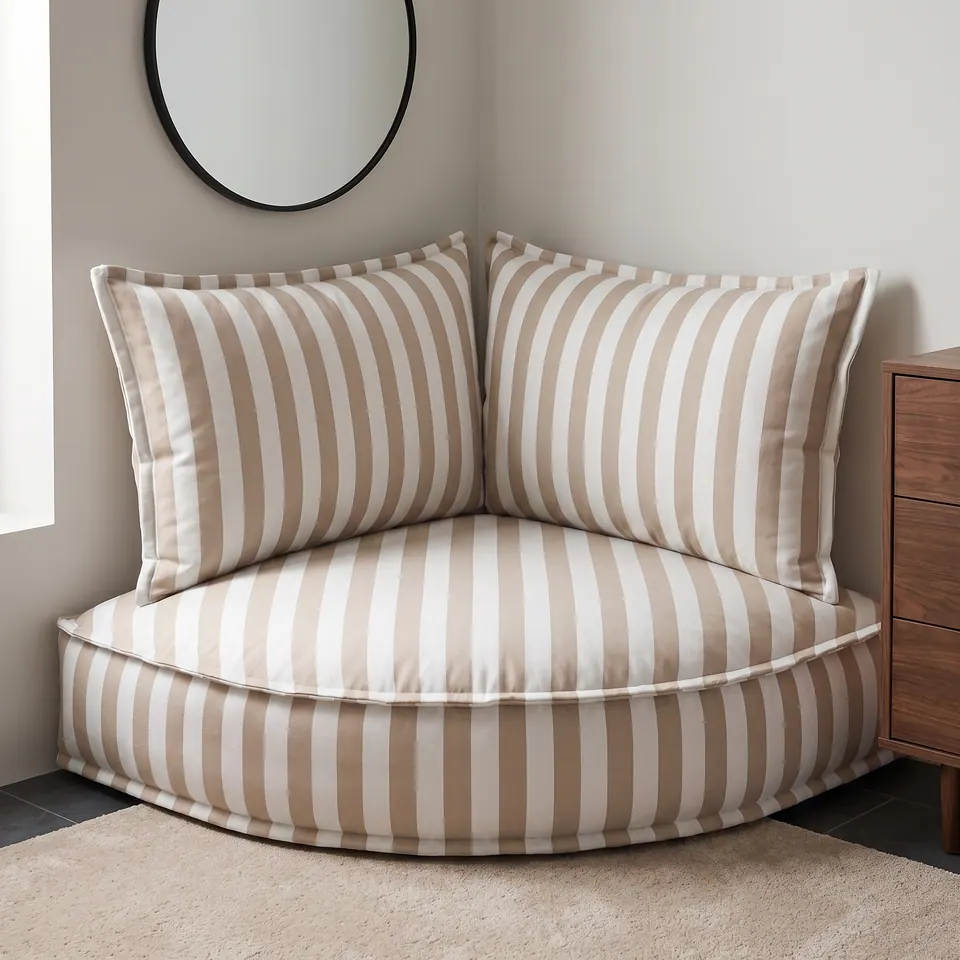
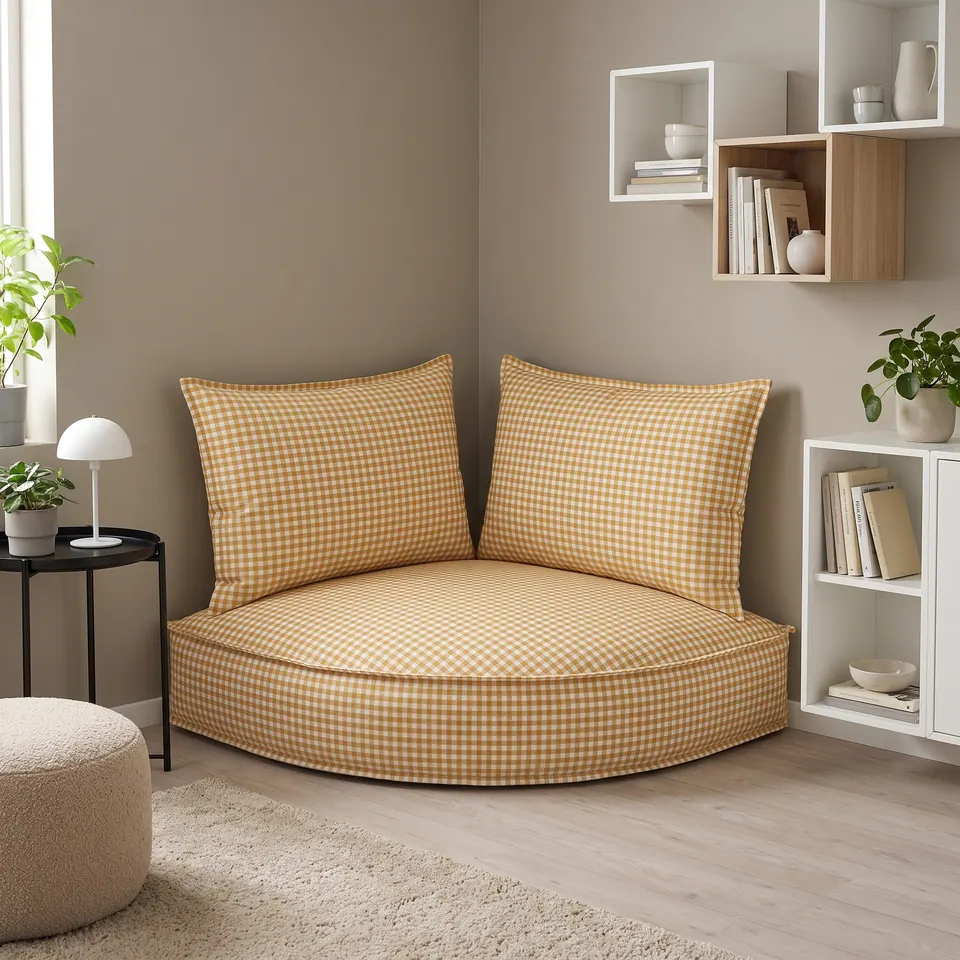
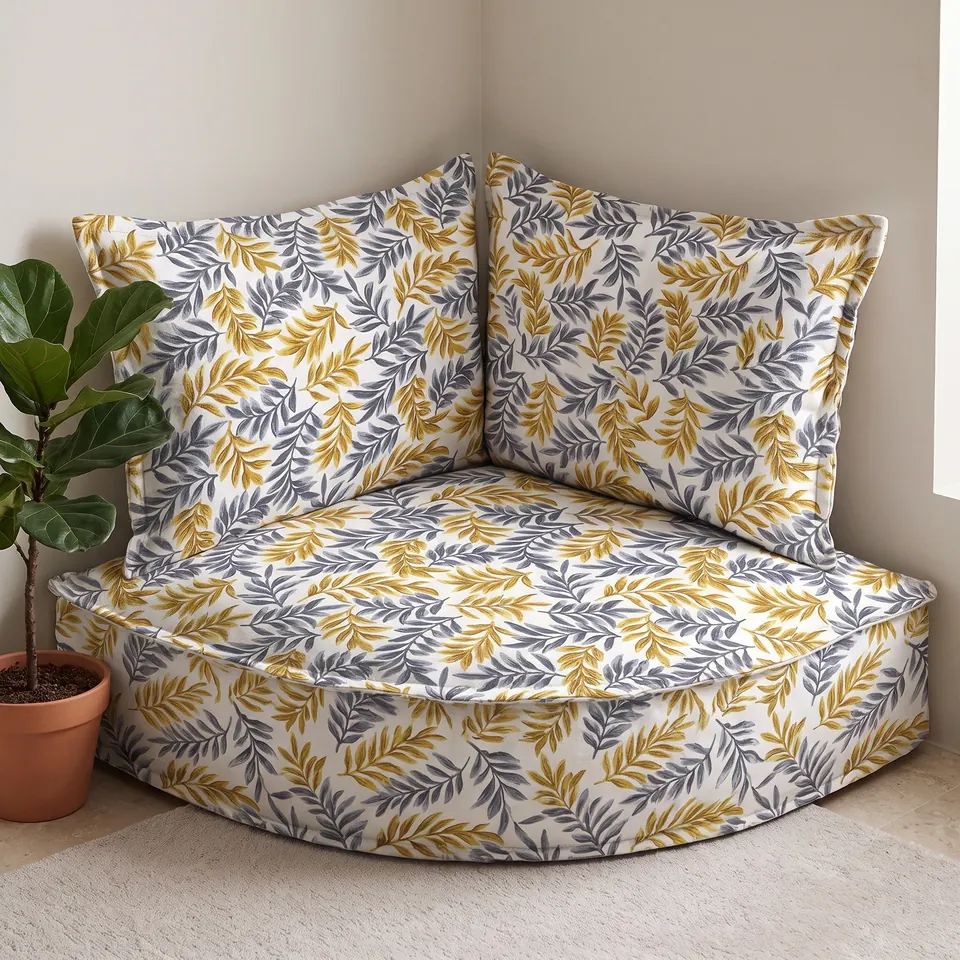
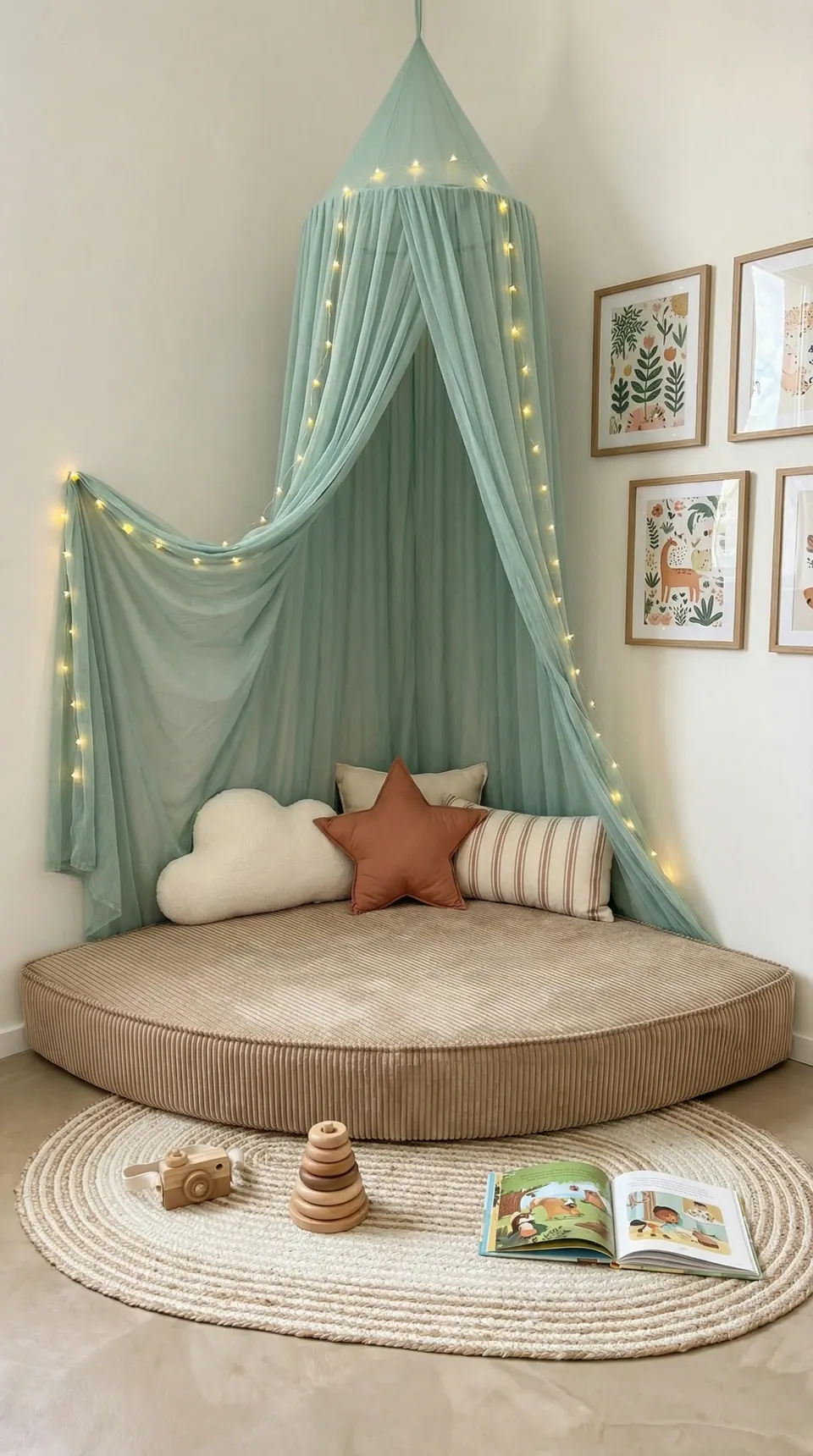
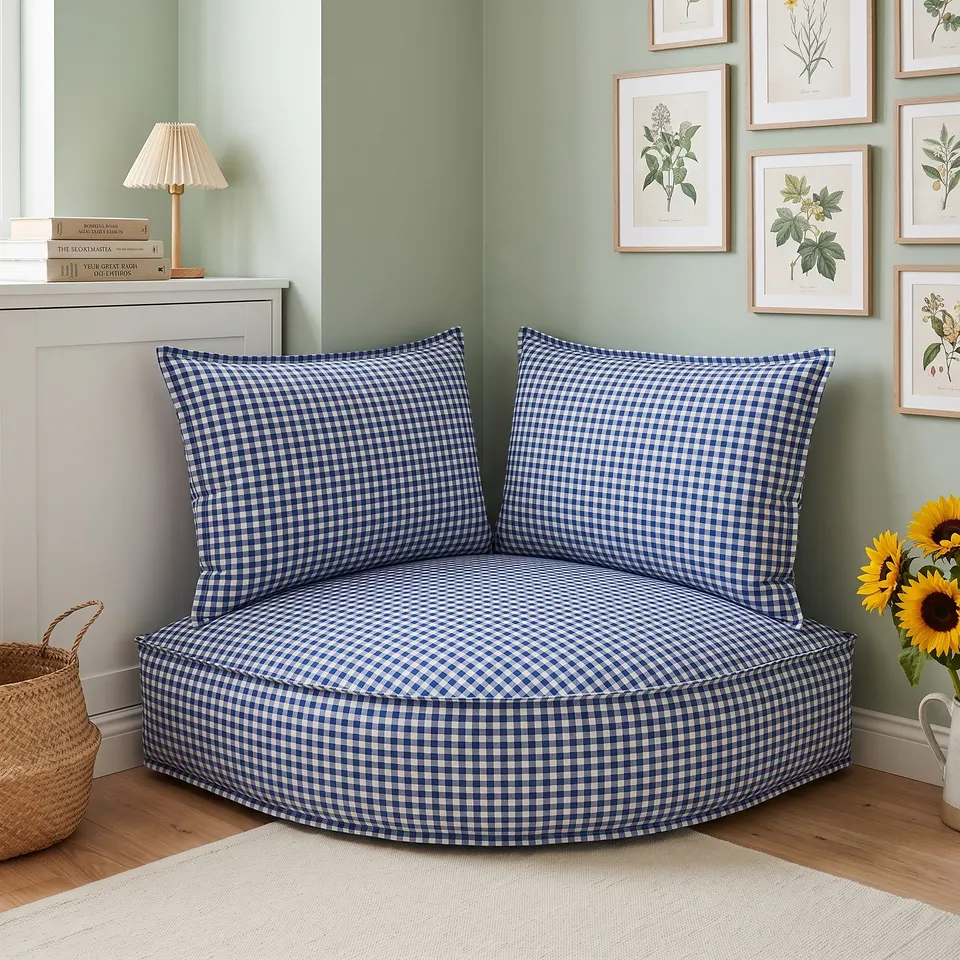
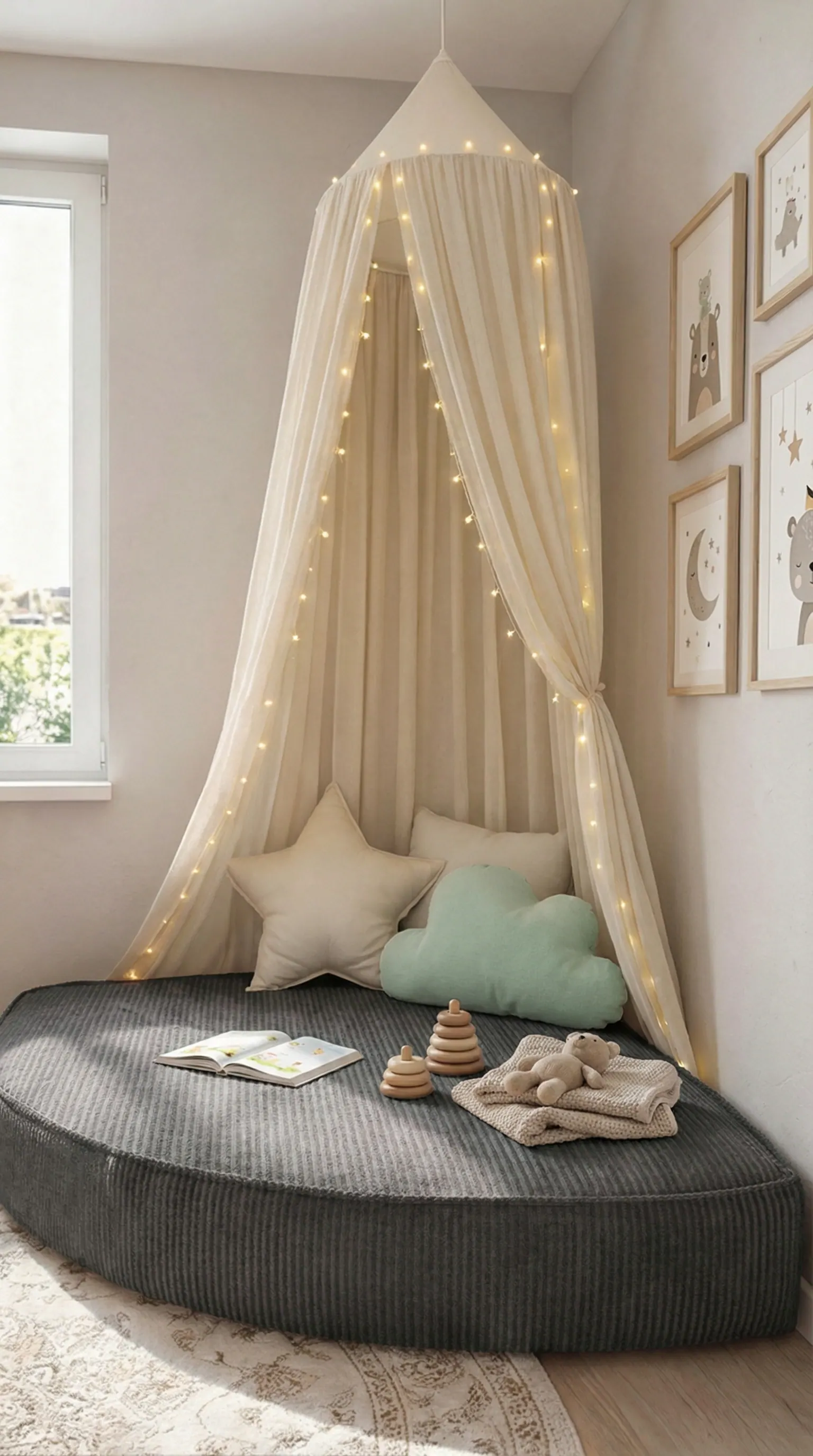
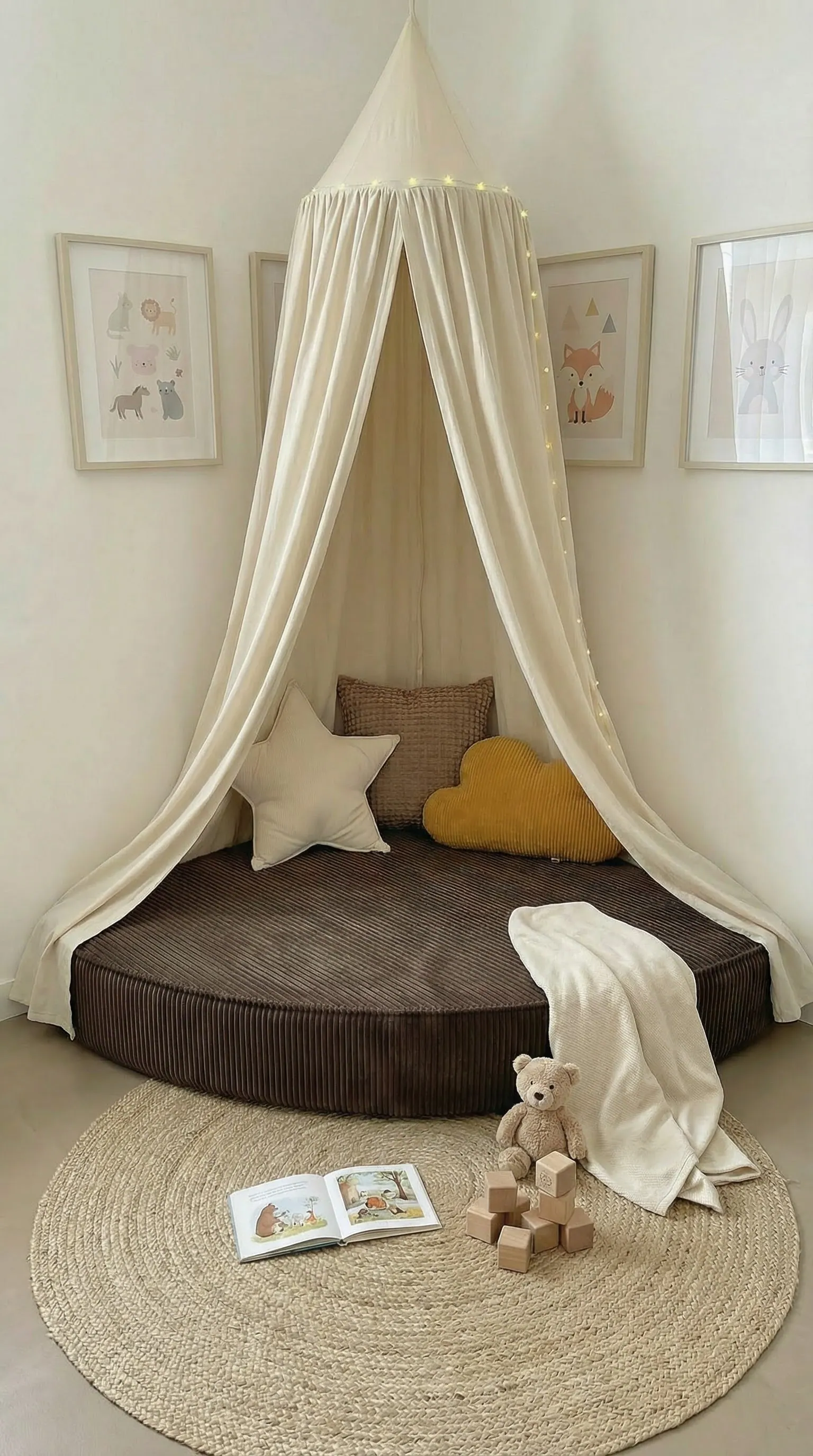
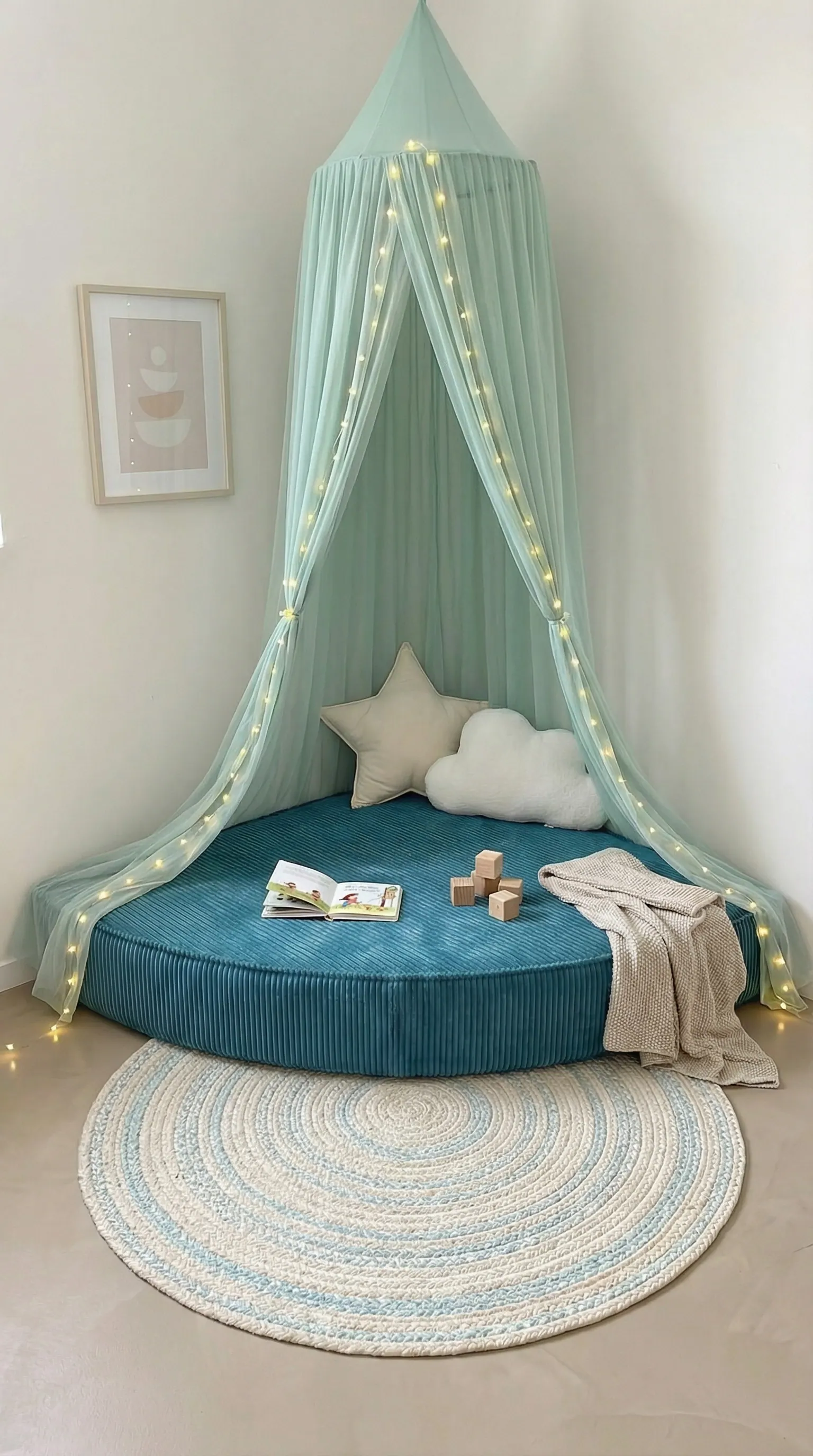
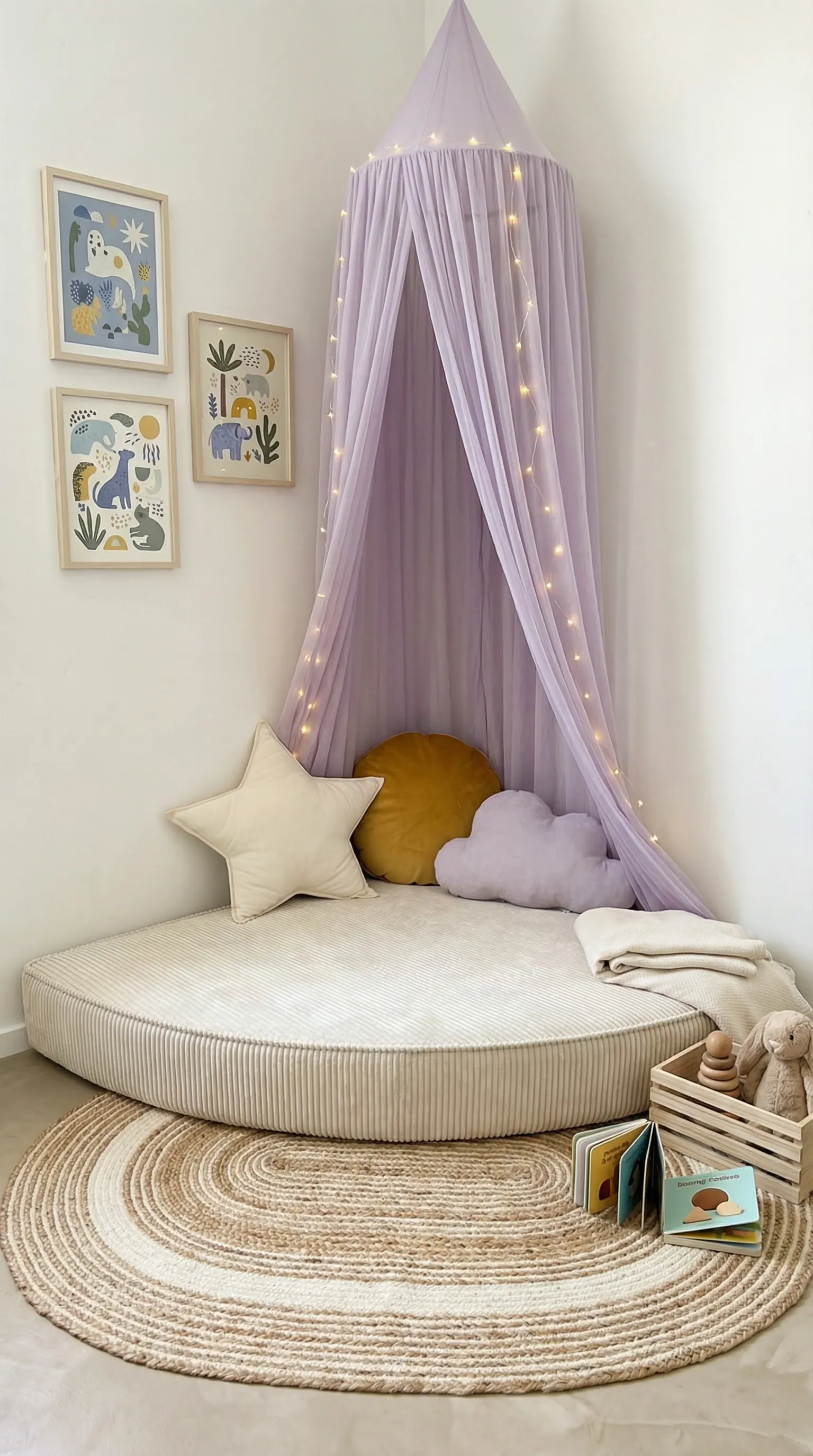
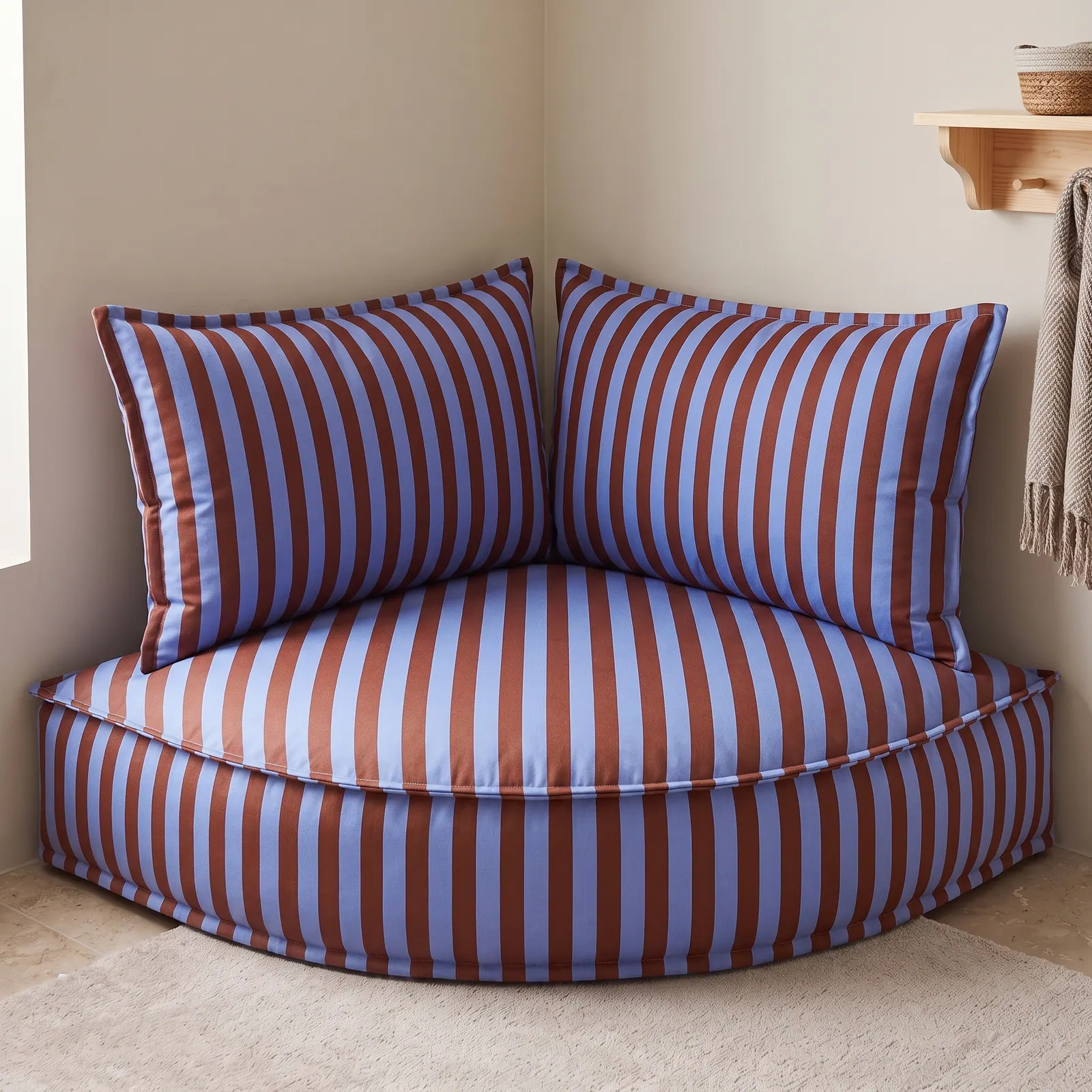
A corner floor cushion is a quarter circle of seat for a 90-degree corner. Two straight sides go against the walls; one rounded edge faces the room. Most in the photographs live in children's rooms under a canopy, heaped with star and cloud pillows. Others sit in a knotty pine nook by a window, or at the end of a plaster hallway with two backrest pillows against the walls.
They suit a story corner for small children, a reading nook, or a grown-up who likes to sit low with a cup of coffee. The two questions buyers ask most about them: how to measure one, and whether it comes in a size between the standard sizes. For square and round seats on the floor, see floor cushions and floor seating.
Quarter circle, triangle or half circle
The quarter circle is cut from a fixed pattern, and that is a mercy: the curve comes out true every time. It also means the curve is hard to reshape. If your corner wants a different arc, draw it and give every measurement: the straight line across the curve, the distance from the middle of the curve back to the corner, and both straight sides. Measuring a curved cushion shows where each number goes.
Put two quarter circles side by side against a flat wall and you have a half circle. That is the workshop's answer when someone wants a corner bigger than 48 in: two cushions, not one giant one.
The tufted corner comes with buttons, and it can be made without them. Ruffles are not made. What the workshop can do is a double layer in two fabrics and two colors, which gives a soft, finished edge without a frill to crush.
Fabrics for a corner that gets climbed on
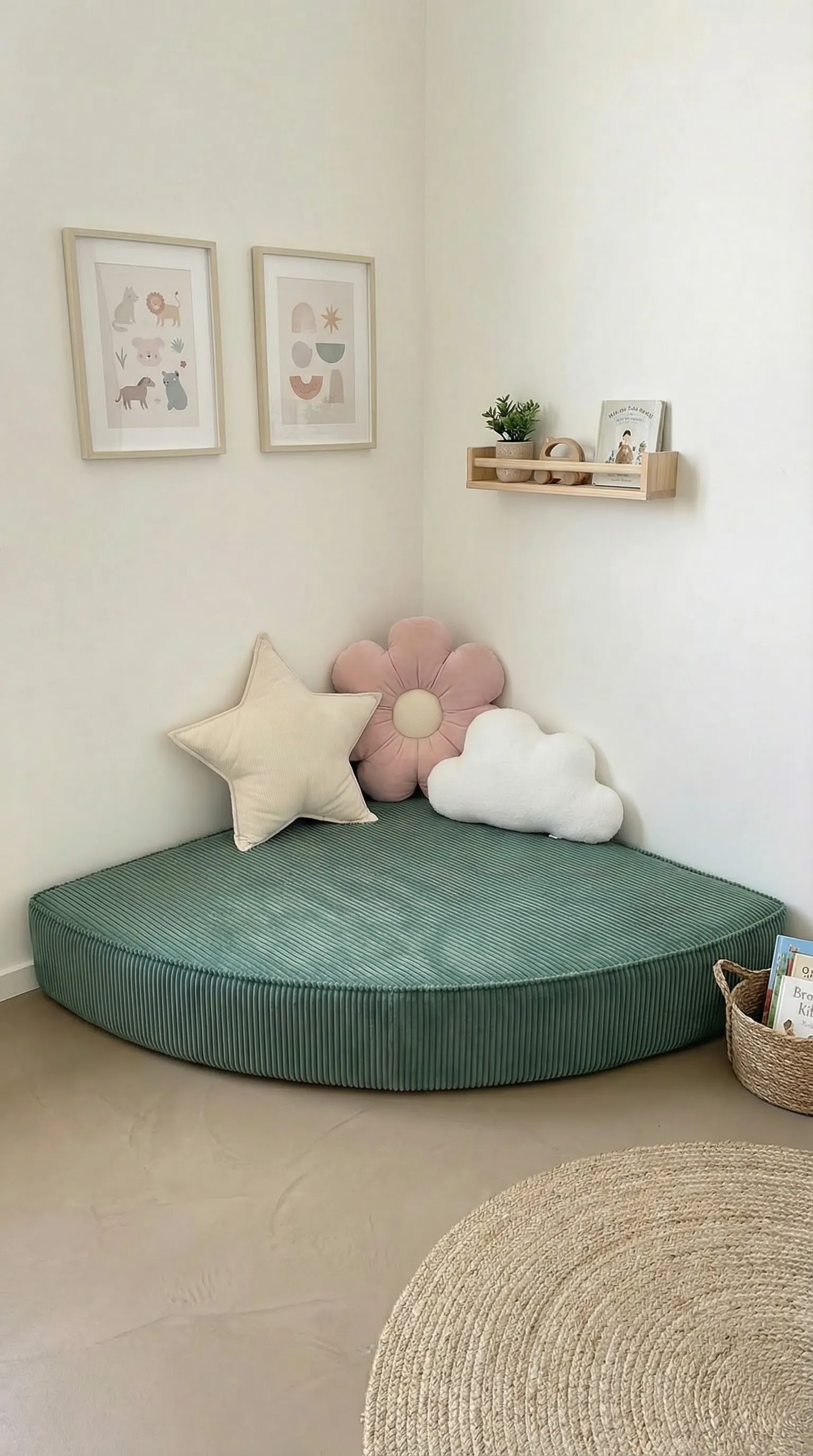
Look through the photographs and you will see mostly corduroy: slate, sage, chocolate, navy, dusty pink, teal. Corduroy has a nap, a direction to its pile, so it shades lighter or darker as the light and the hand cross it. In a child's corner it is warm to the touch.
Velvet is the richer choice. Velvet remembers; it keeps the track of every palm that smooths it, and some of us love it for that. Know one limit, though: velvet rolls are narrower than the workshop's soft fabric roll of about 55 in (140 cm), so the very largest one-piece corners are cut in soft fabric.
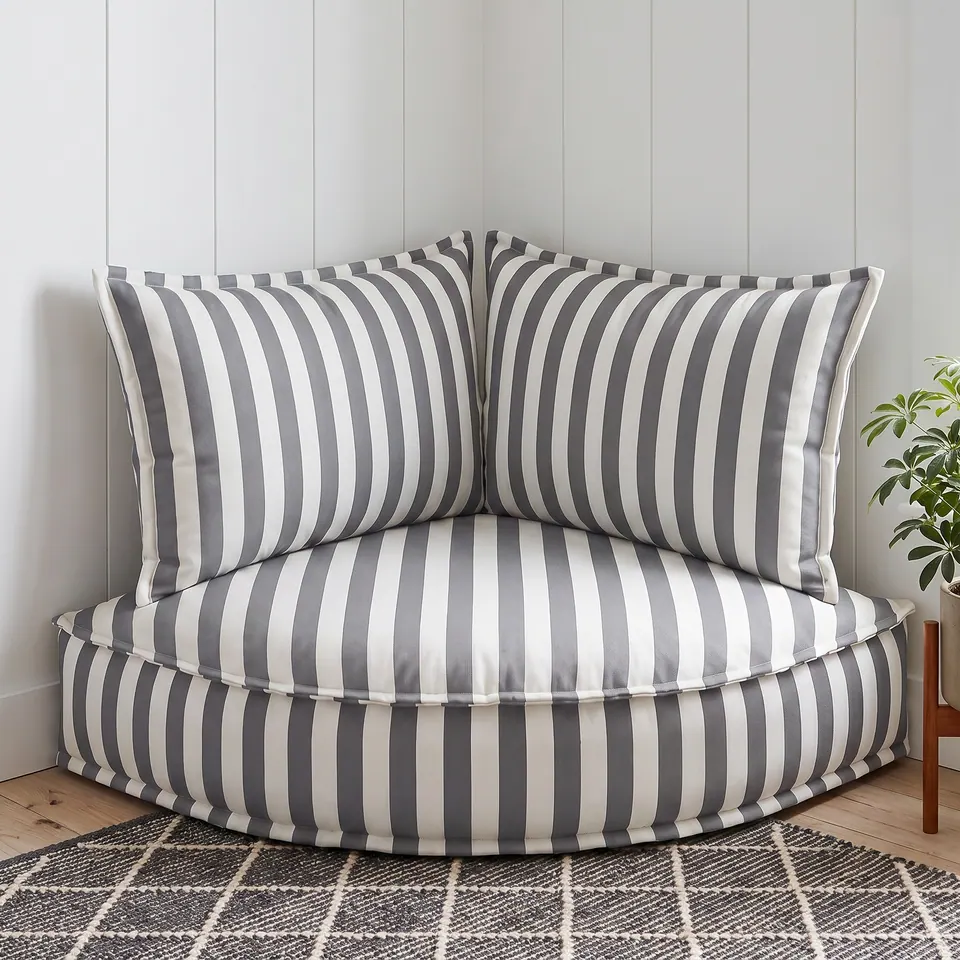
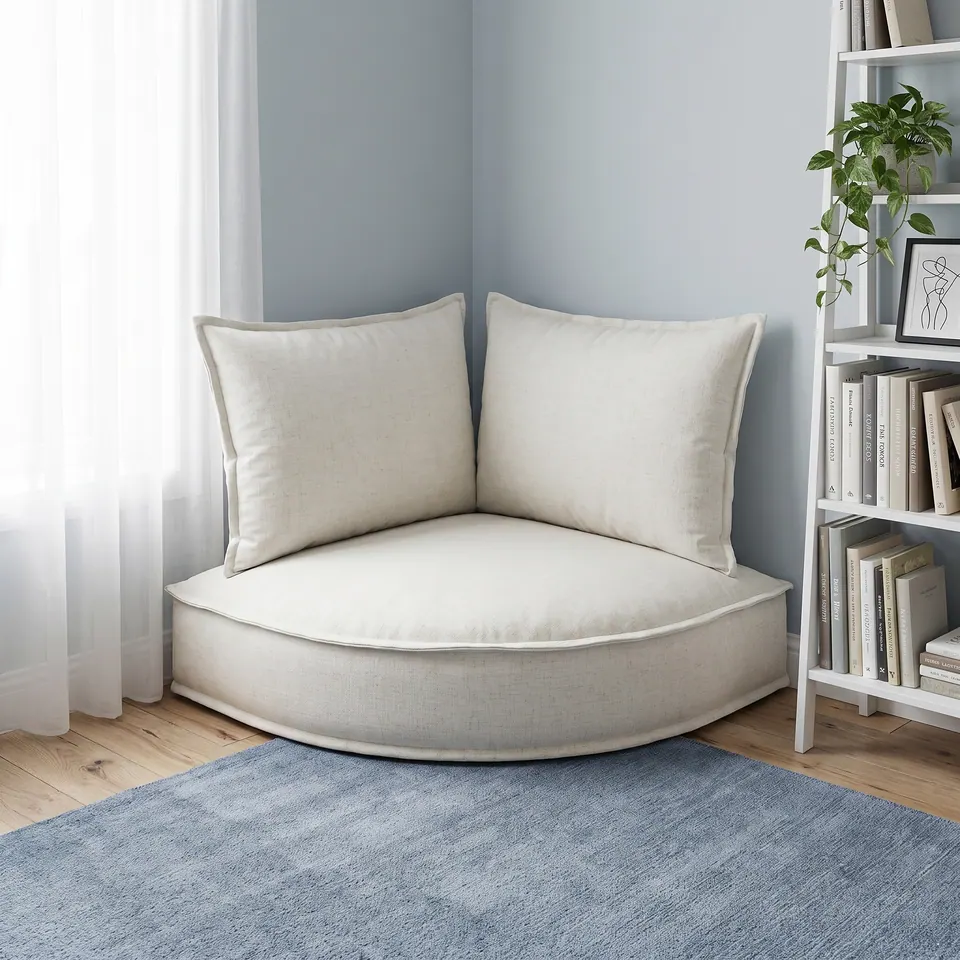
For a grown-up nook, an oatmeal linen-look weave or a charcoal-and-white stripe reads more like furniture than a nursery.
The count is how many published readings use each family. Open a family for its swatch book, care notes and neighbors.
Fill and thickness: fiber for tufted, foam for kids
Two kinds of corner cushion leave the workshop, and they are built differently inside.
The tufted corner has no foam core. It is packed tight with siliconized polyester fiber balls and deliberately overfilled, so it stays firm and does not press flat. It comes 4 in (10 cm) thick. Ask for 5 or 6 in if grown-ups will sit there too; a set of three once went out at 6.5 in.
The kids' corner floor sofa is foam-filled, 8 in (20 cm) thick, with a removable cover, and its best seller is the 39 x 39 in (100 x 100 cm). Each step up in size or thickness costs more, because every step is more fill and more fabric. Floor cushion thickness walks through how deep is deep enough.
A real project
Two little girls and a 46-inch corner
A parent in the US asked the workshop about a reading corner for two little girls. The walls gave 46 in on each side, and the deciding question was thickness: the default 4 in, or something deeper.
The workshop quoted 5 in and 6 in, and sent photographs of cream, beige and smoke fabric side by side, because a screen flatters every gray. The parent chose smoke at 5 in. One inch over standard, for comfort when a grown-up folds down beside them for the bedtime chapter.
Measured
46 x 46 in (117 x 117 cm), 5 in thick
What it taught
For a corner nook, give the length along each wall and choose 5 to 6 in thick if grown-ups will sit there too.
Mistakes we see at the corner
Measuring diagonally from the back corner to the front. The size is the two wall sides.
Measuring the curve. A 48 in corner has a front arc of about 75.4 in, and that number is not its size.
Planning the room around a 56 in corner. The standard maximum is 48 in per side; one couple in the US settled on 48 in, and two cushions can make a half circle.
Describing a custom curve in numbers alone. Draw it, with the chord, the depth and both straight sides.
Adding backrests or a second cushion months later. Each roll is dyed in its own batch, so order the whole set at once, or send a photo of the original for a batch match.
Expecting the canopy from the photographs. It is styling; the cushion comes on its own.
Leaving it late for a room reveal. Give a custom corner at least two to three weeks.
Photographs from the workbench
Open any photograph large; each one has its own link and a Save button.
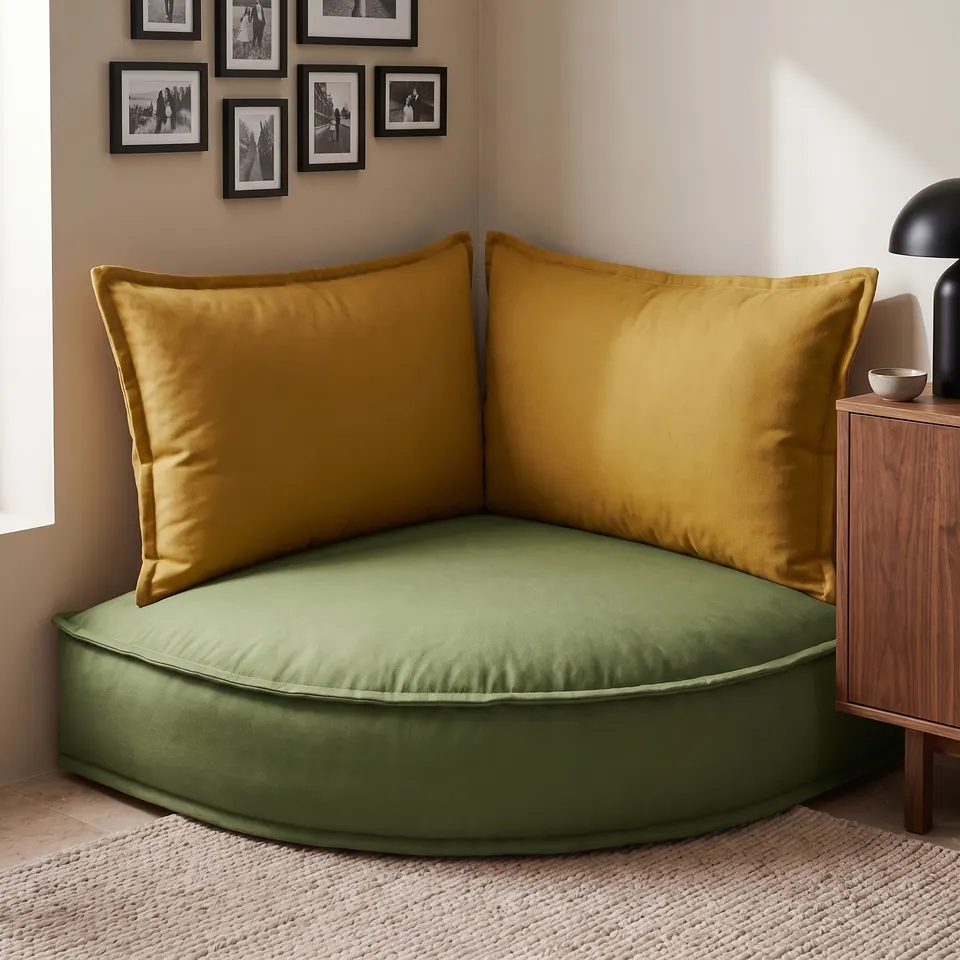
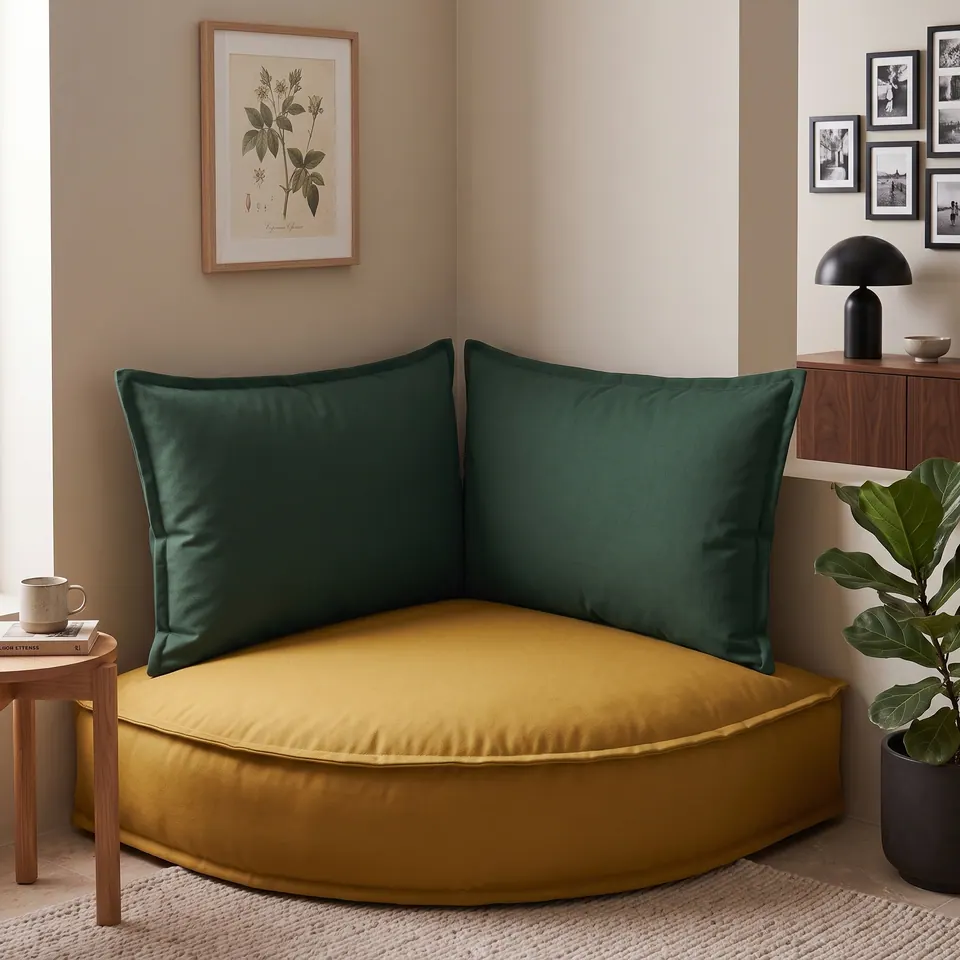
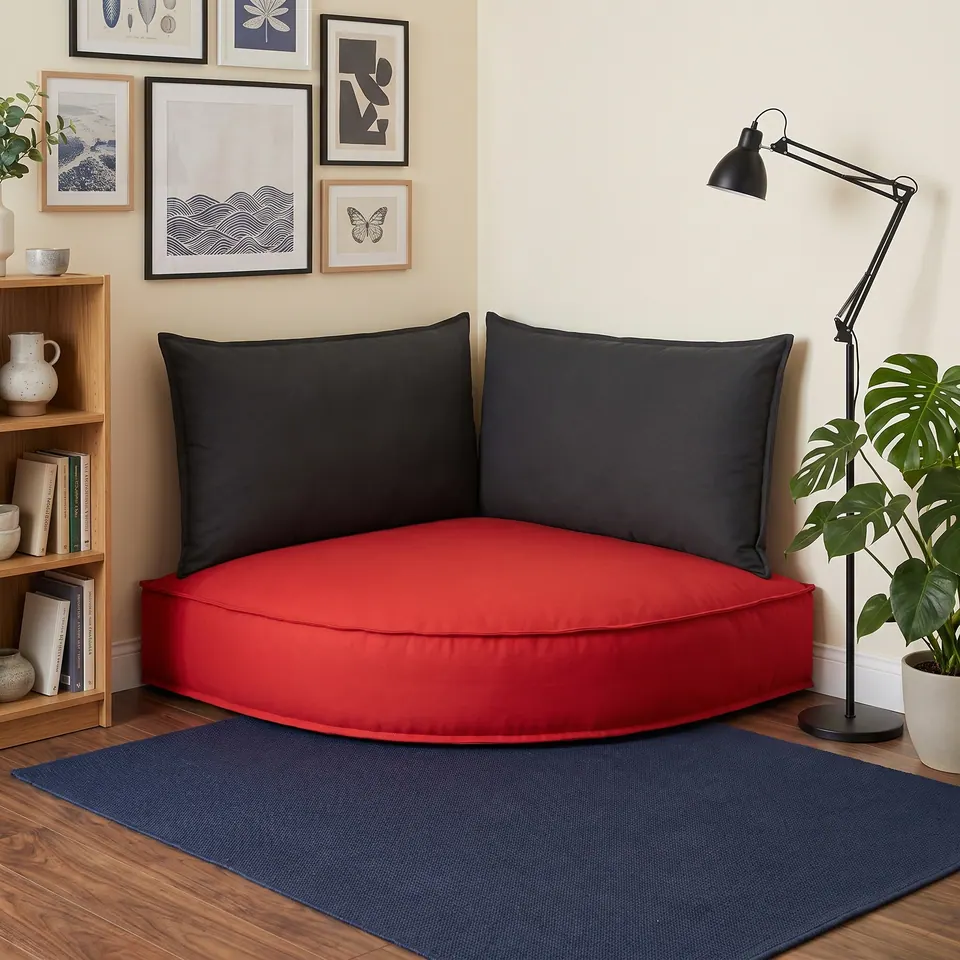
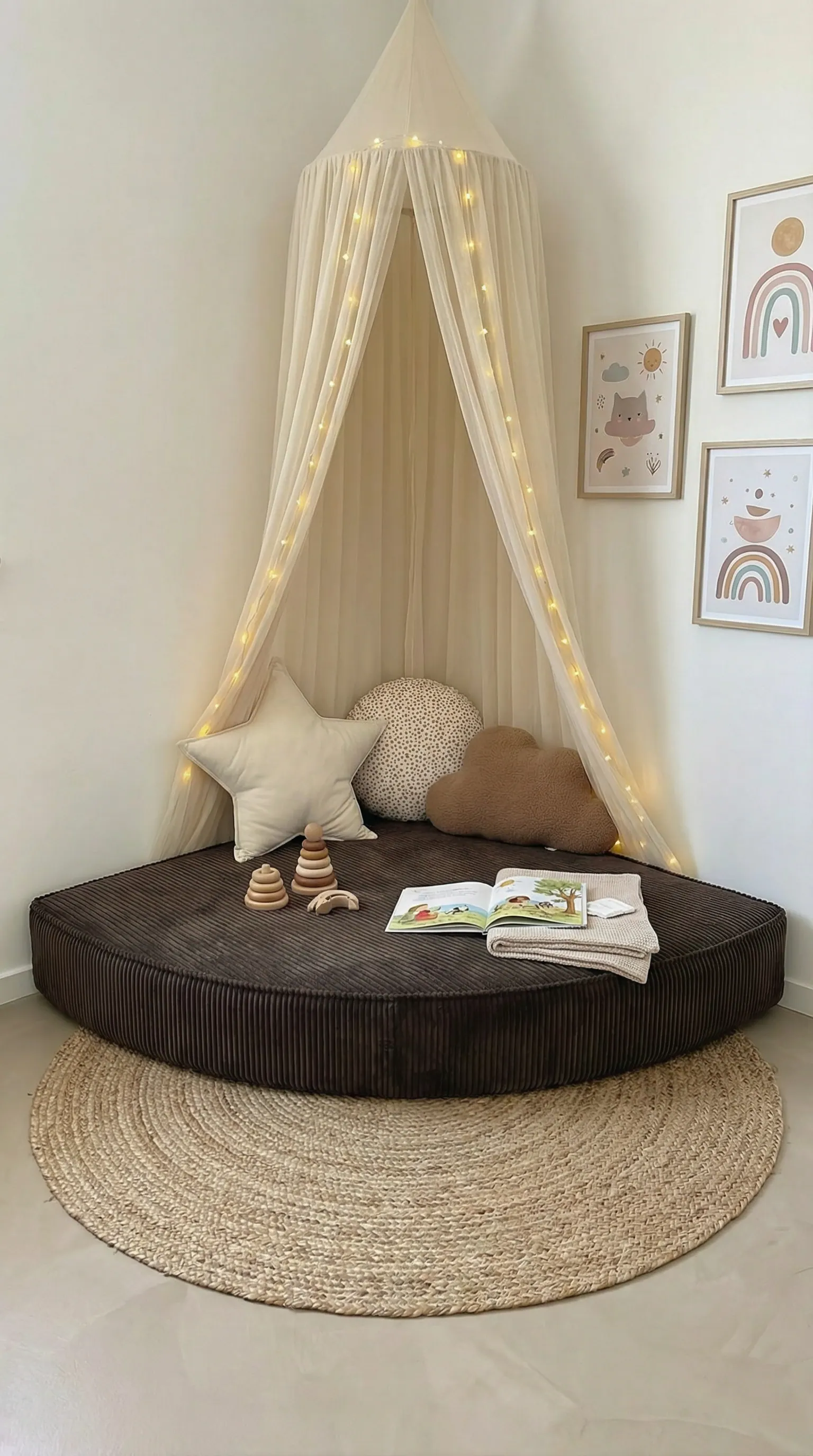
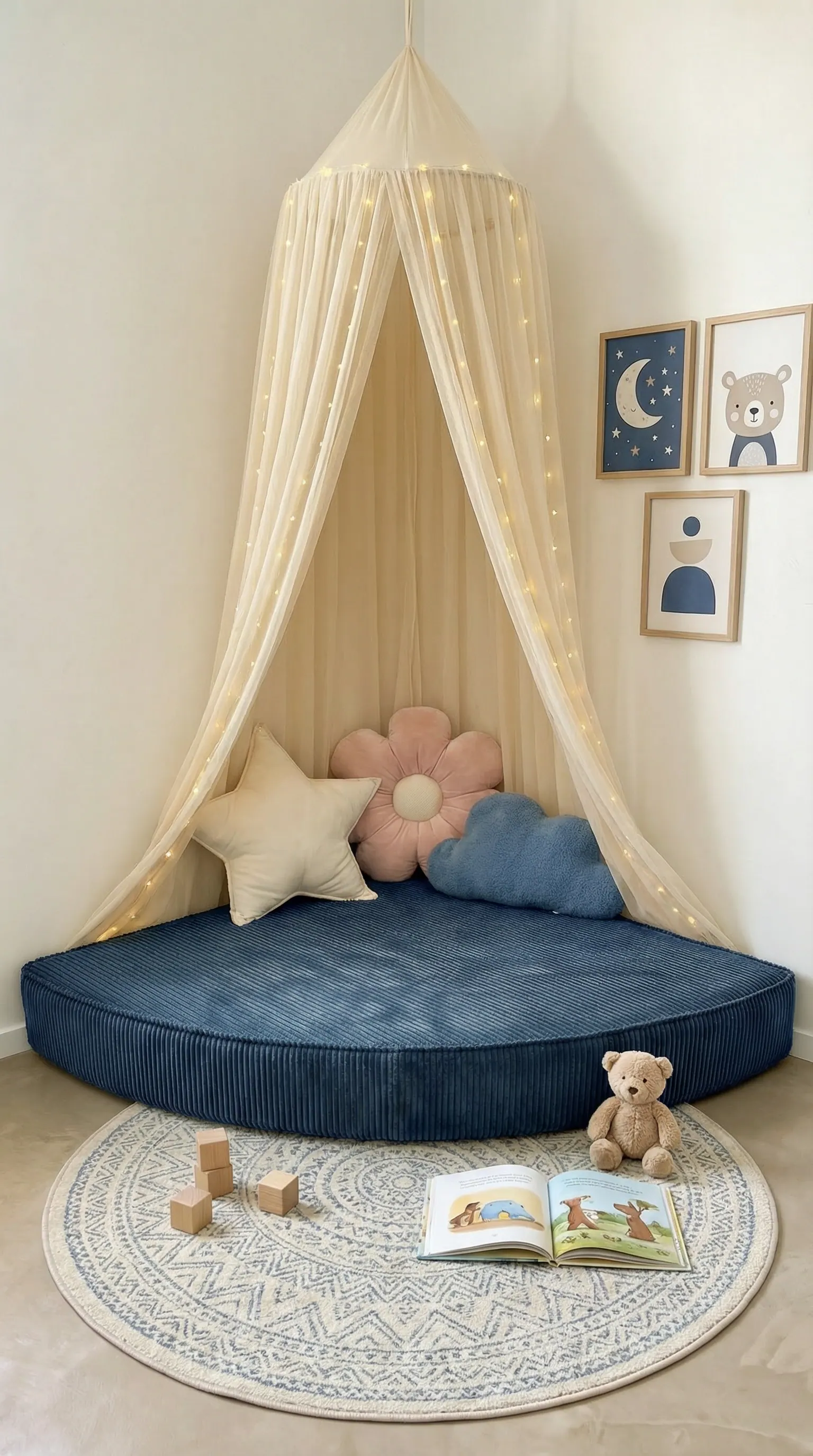
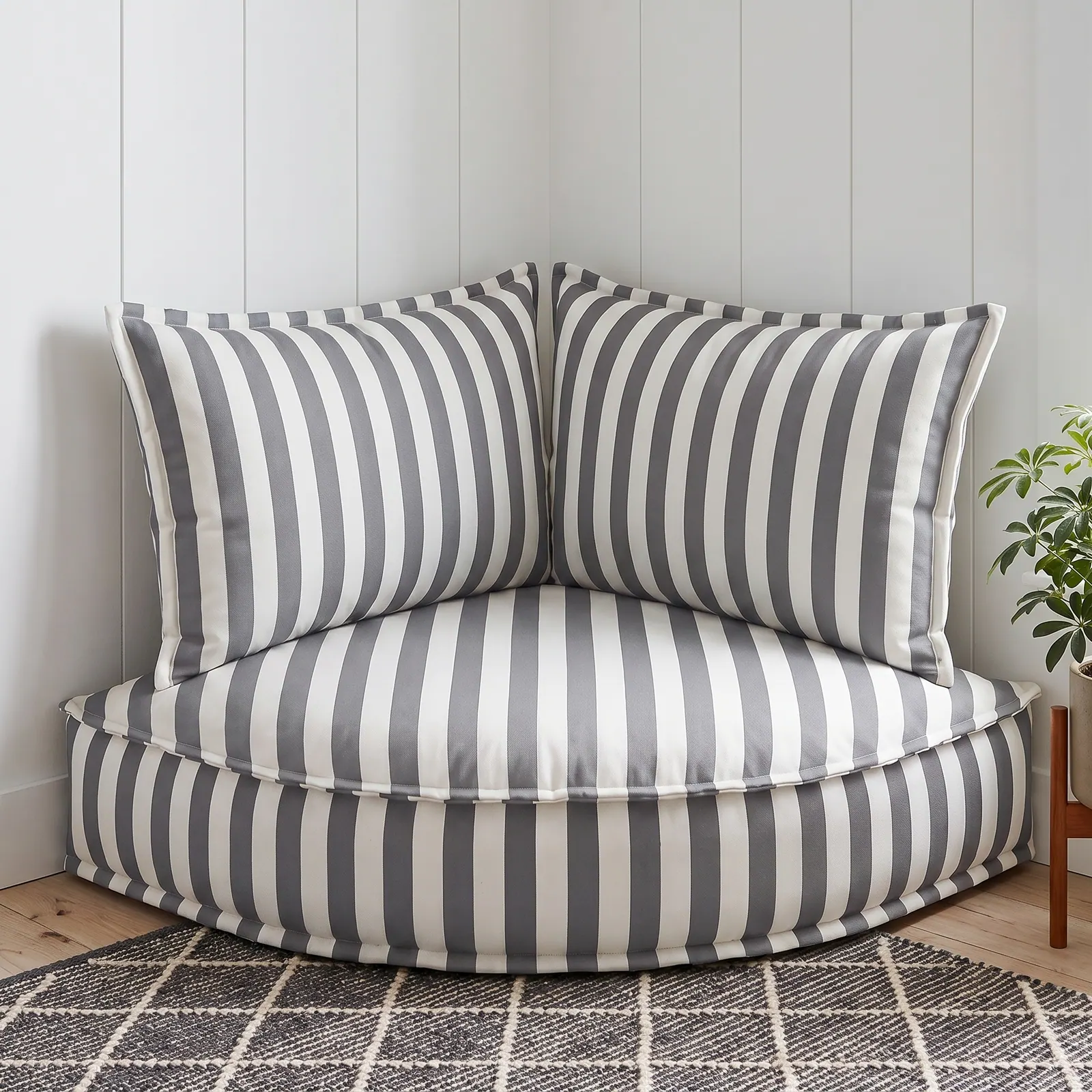
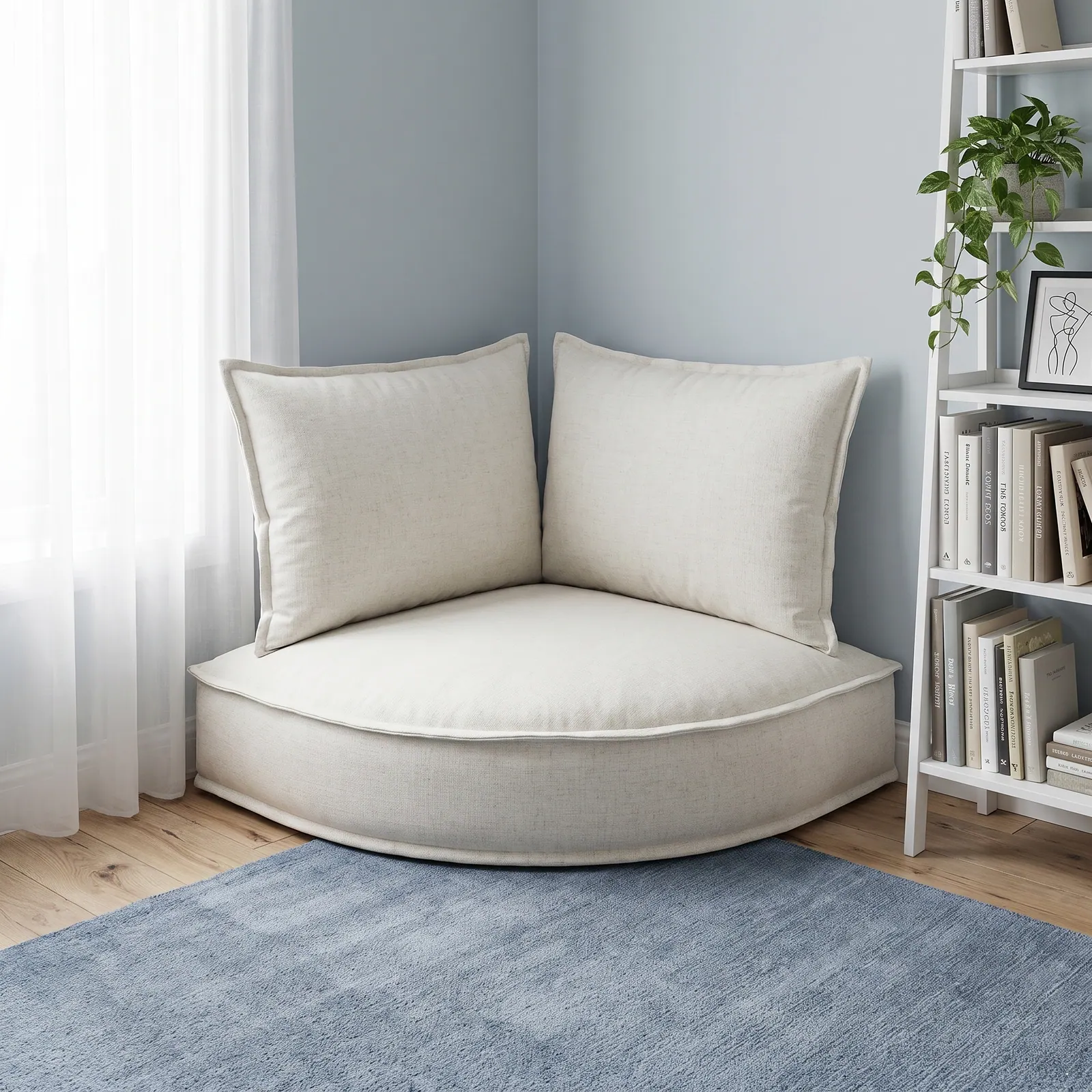
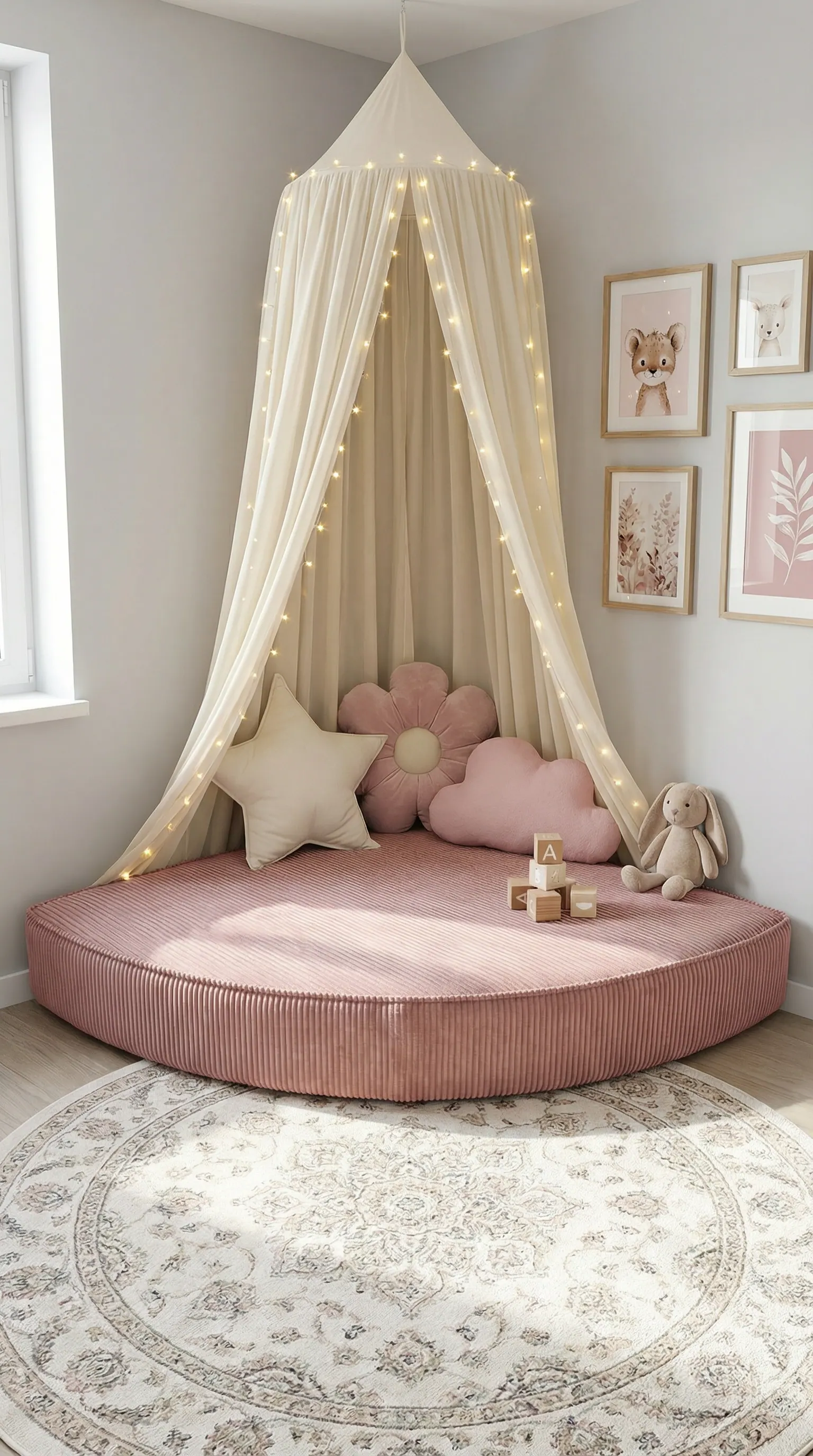
SaveSet up for story time, the slate gray corner pad holds an open book, a stacking toy and a teddy within reach.SaveSage corduroy, a wooden ledge with a plant and two framed prints turn a bare corner into a proper reading nook.SaveDeep brown corduroy anchors a pale canopy and cream pillows, so the reading corner looks like furniture rather than a pile of cushions.SaveNavy gives the corner real weight, and the ivory canopy and moon print turn it into a bedtime-story spot.SaveGray-and-white stripes line up with white tongue-and-groove boards, while a lattice rug adds a second pattern underfoot.SaveAn all-oatmeal floor seat sits in soft window light between sheer curtains and a white ladder bookcase.SaveTone-on-tone pink, from gusset to flower pillow to botanical prints, gives this corner a soft, finished look.SaveChocolate brown cord with a cream knit throw and jute rug gives this corner nook a cozy, cabin-like weight.SaveA saturated teal base under a paler mint canopy makes a two-step color gradient that keeps the corner fresh.SaveLilac and mustard are near-opposites, and on an ivory base they look playful rather than loud.SaveA two-tone stripe in lilac-blue and rust gives a stone-floored hallway a soft place to pause, with a peg rail and throw beside it.
A corner floor cushion is sized by the two sides along the walls, not by the curve. A 48 in corner measures about 75.4 in around the front.
Dress the corner in layers, the way the photographs do. Two backrest pillows against the walls, then small shapes in front: a star, a cloud, a flower. A round jute rug under the curve softens the floor line, and a canopy overhead turns the corner into a room of its own.
Backrests can be made in the same fabric and color, one along a wall or one on each side. For a set with backs, the workshop checks that your numbers are wall sizes and asks for the height from the floor to the top of the backrest.
How do I measure for a corner floor cushion? Along the walls or across?
The workshop's answer
Along the walls. The size is the two straight sides that meet at the 90-degree corner, so 39 x 39 in means 39 in down each wall. Measure from the back corner to where you want the cushion to end. Don't measure diagonally, and skip the curve and the long front edge. If your corner has three sides, like a corner window, send a photo with measurements and the depth taken in the middle; that shape is cut specially and quoted separately.
A common question
My corner needs something between your sizes. Can you make 35 x 35 in?
The workshop's answer
Yes. Choose the next standard size up, 39 x 39 in in that case, and write your exact size in the note. The price stays at the size you picked, because a custom size is extra work, not less. Smaller corners down to 25 x 25 in, a rectangular version and a taller cushion to match an ottoman have all been made. Message the workshop after ordering so it can confirm the size.
A common question
Is it really a quarter circle? Could two of them make a half circle?
The workshop's answer
It is a quarter circle, and the listed size is the length of each straight edge, not the curve. Two corner cushions placed side by side against a flat wall make a half circle. Send a photo of the space and the workshop will confirm it works. It can also send photos of colors side by side if you are torn between shades.
A common question
What size corner cushion do two toddlers need, and can it be thicker?
The workshop's answer
For two children around 3 years old, the workshop suggested 40 x 40 in. The tufted corner is 4 in thick as standard and can be made 5 or 6 in; the plush corner and the kids' corner floor sofa are 8 in (20 cm) thick. Price rises with each step in size and thickness, and larger or thicker pieces are quoted individually.
A common question
Can you add back cushions to a corner floor cushion?
The workshop's answer
Yes, in the same fabric and color. A 38 x 38 in (97 x 97 cm) corner has had one 38 x 16 x 4 in (97 x 40 x 10 cm) backrest along one side, and a 34 x 34 in corner was made with two. Order with the custom option and the set is quoted together.
Have it made
Have your corner floor cushion made — ask Harlan’s workshop
Fabric has a temper and foam has a memory. Better to settle both in a conversation than to guess at them alone. — Harlan
Leave your details and the workshop will call you to confirm measurements, fabric, foam and piping. No prices, dates or payment on this page: it is a request, not an order.
Fabric · Foam · Pipingwhat the workshop will confirm with you
What is the biggest corner floor cushion you can make?
The standard maximum is 48 in per side, which gives a front curve of about 75.4 in. For a larger footprint against a flat wall, two quarter-round cushions side by side form a half circle. Very large requests are looked at case by case with measurements and a photo.
Does the canopy in the pictures come with the corner cushion?
No. The canopy in the photographs is styling, and the cushion is sold on its own. Pillows styled in listing photos are decorative and sold separately, unless the listing is a floor-cushion or French set that includes its backrest and bolsters.
How do I order a corner shape that isn't a true quarter circle?
Send a drawing with every measurement before you order: both straight sides, the straight line across the curve and the distance from the middle of the curve to the corner. A few room photos taken from a distance help. The workshop tells you up front if a customization fee applies.
Is a tufted corner cushion filled with foam?
No. Tufted floor cushions have no foam core. They are packed tightly with siliconized polyester fiber balls and deliberately overfilled, so they stay firm instead of pressing flat. The foam-filled option is the kids' corner floor sofa, 8 in (20 cm) thick with a removable cover.
How far ahead should I order for a room makeover date?
Ask the workshop for current production and delivery times in writing, my friend, and leave yourself a margin. One interior designer in the US, installing a child's bedroom just before the holidays, asked for a rush, and the workshop committed to delivery within 15 days of the order.
Square or quarter circle: which corner cushion suits a reading nook?
A quarter circle fills the corner and leaves a soft curved front edge, sized by its two straight sides along the walls. A square is the simplest shape, sold widely in 24 to 40 in sizes, and gives more room to sprawl but reaches further into the room. Tape each outline on the floor first to see which fits the room and the door swing.
Sit well. — Harlan
Share this atlas entry
Readings
Photographs read by the masters: corner floor cushions & poufs
Real cushions made for real rooms, each read for proportion, fabric and fit.

 Save
 Save
 Save
 Save
 Save
 Save
 Save
 Save
 Save
 Save
 Save
 Save