 Save
A Reading by HarlanCorner Floor Cushions & Poufs
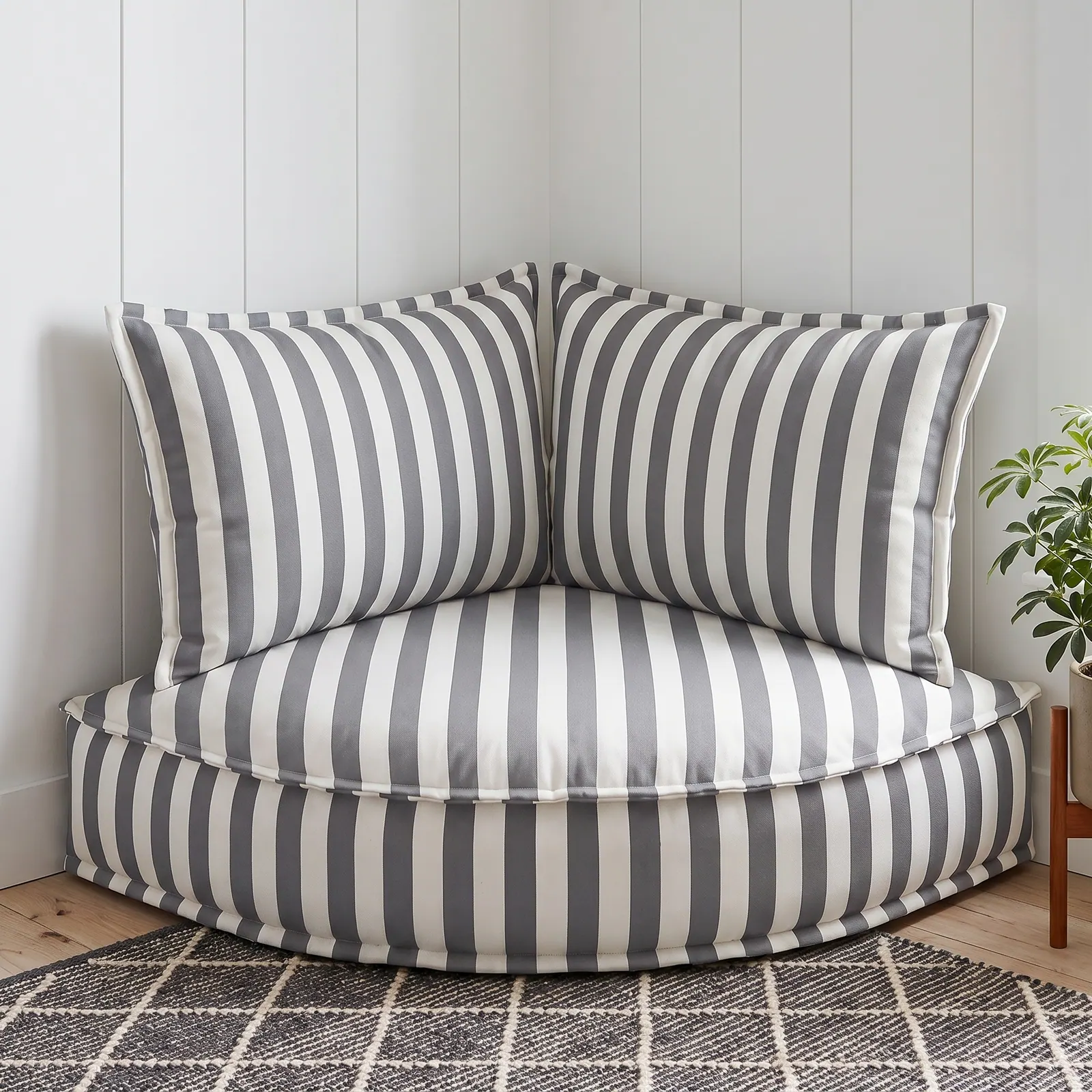
A charcoal and white stripe corner floor cushion against white paneling
Gray, white and black, and one green plant. A room this quiet lives on line, not color, and the stripe on this seat had to be chosen with a ruler as much as an eye.

Swatch strip measured from the photograph
- taupe#97908d25%
- umber#645c5923%
- pebble#bbb9b622%
- mist#cac9c815%
- mist#e2e3e414%
The quick answer
A charcoal and white stripe corner floor cushion suits a white paneled room because the stripe repeats the vertical boards while staying clearly different from them. Choose a stripe at least twice the width of your wall boards, keep the gray mid-toned rather than black, and let pale oak floors and one plant supply the only warmth.
Gray on white, told by the wood and the light
An old upholsterer I swept floors for used to say a gray room is a room that forgot to eat. He was wrong about this one. Here gray does not starve the corner; it gives it bones.
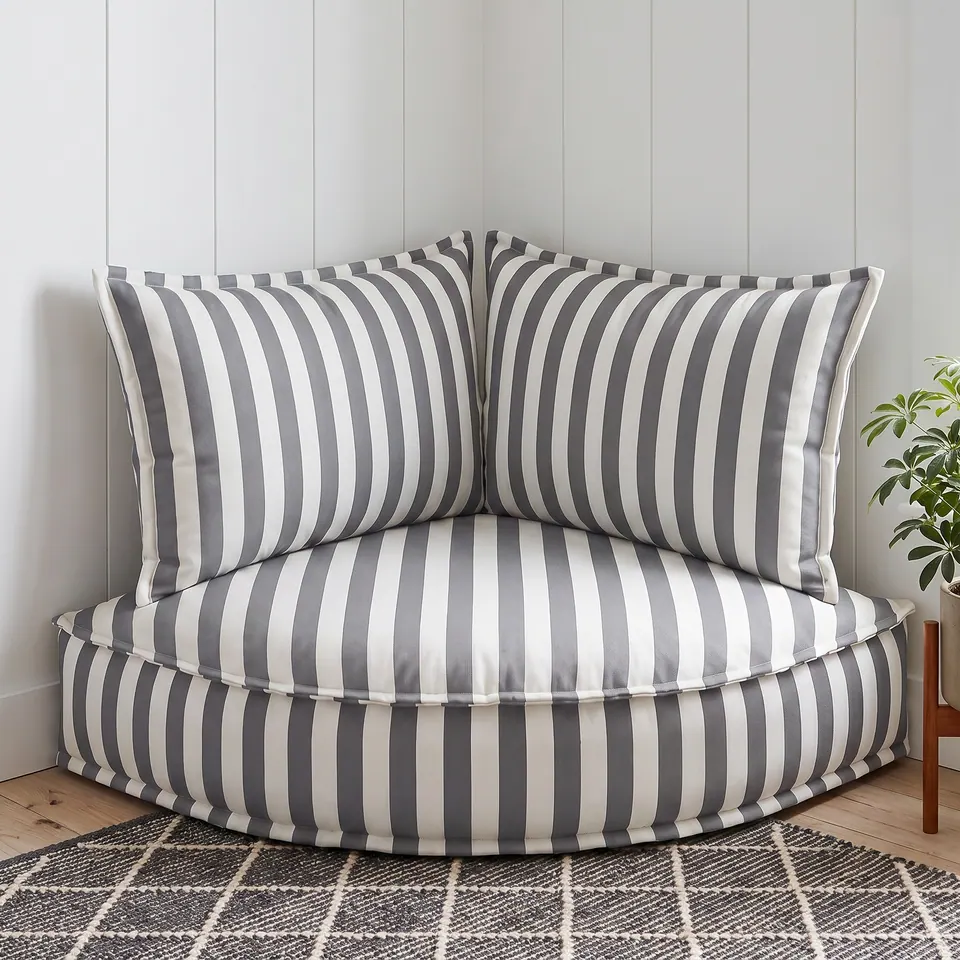
The walls are white tongue-and-groove paneling, boards standing upright. The seat's boxing carries a charcoal and white stripe, also upright. If the stripe matched the boards, the cushion would melt into the wall like a second coat of paint. It is cut wider, so the eye reads it as a second voice singing the same tune. My rule from this picture: choose a stripe at least twice the width of your boards.
Charcoal instead of black matters too. Black and white stripes shout in bright daylight, and this corner gets plenty of it. A mid-gray stripe gives pattern without the glare. The two backrest pillows are flanged, their flat borders keeping the corners sharp where they lean together.
Now the warmth. There is not much, and it is placed with care. Pale oak floorboards run under everything like a low hum. The umbrella plant stands on its wooden stand at the very edge, the only green in the room, framing rather than crowding. The black and cream lattice rug brings a diagonal grid, a second pattern that argues politely with the stripes.
Stripes like these live in striped cotton and ticking, the direction question is answered in stripe direction, and seats of this kind sit under corner floor cushions. I will say it plain, my friend: in a white room, measure your boards before you pick your stripe. What width are yours?
The whole palette fits on one hand
- Charcoal gray#4A4C4FThe stripe, mid-toned so it never glares in bright light.
- Board white#F6F5F1Paneling and stripe ground, the paper the room is drawn on.
- Lattice black#1E1E1EKept to the rug, a diagonal grid underfoot.
- Rug cream#EDE6D6The rug's second color, softening the black.
- Pale oak#D8C3A0Floorboards, the quiet warmth under everything.
- Umbrella plant green#4F7A3AThe one color, kept at the edge.
Pinned by Harlan along the boards
Five pins, from the upright paneling to the lattice rug that answers the stripes with diagonals.
- Vertical paneling
Upright boards repeat the stripe direction so the seat blends into the wall.
- Charcoal stripe seat
A mid-gray stripe gives pattern without the starkness of black and white.
- Pillow flange
The flange keeps pillow corners sharp where the two pillows lean together.
- Umbrella plant
One plant on a stand is enough green for a monochrome scheme.
- Lattice rug
A diamond grid underfoot contrasts the straight stripes with a second graphic.
- Vertical panelingUpright boards repeat the stripe direction so the seat blends into the wall.
- Charcoal stripe seatA mid-gray stripe gives pattern without the starkness of black and white.
- Pillow flangeThe flange keeps pillow corners sharp where the two pillows lean together.
- Umbrella plantOne plant on a stand is enough green for a monochrome scheme.
- Lattice rugA diamond grid underfoot contrasts the straight stripes with a second graphic.
Corner questions
- A common question
Could the corner sofa be made in a bold fabric, like a cheetah or zebra print?
The workshop's answerYes, if you pick it from the workshop's fabric chart; send inspiration photos and the shop will help match. The L-shaped corner sofa measures 79 x 118 in (201 x 300 cm) overall.
- A common question
Do you make round floor cushions?
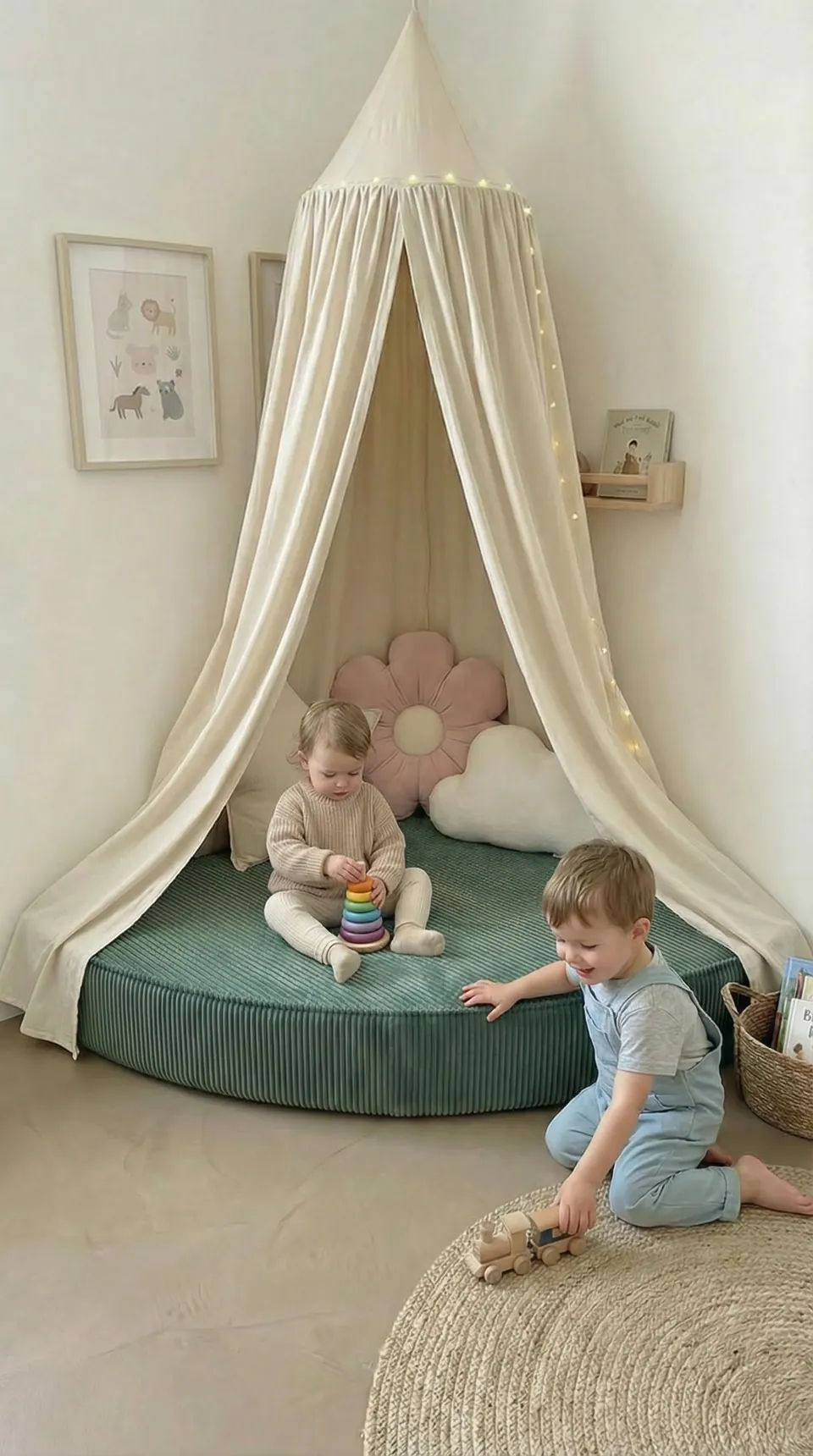
The workshop's answerYes. One buyer ordered a 41 in (104 cm) round cushion to fit inside a play tent.
- A common question
The white fabric under my floor sofa sheds a little dust. Will that stop?
The workshop's answerThat white layer is the anti-slip base that keeps the cushion from sliding. The workshop expects the shedding to stop over time.
Resized twice, delivered right
A buyer ordered a floor cushion, then wrote to change it to 19 3/4 x 27 1/2 in (50 x 70 cm). A little later came a second message: make it 15 3/4 x 27 1/2 in (40 x 70 cm). Each time, the shop passed the change straight to the tailor, hoping the cutting had not begun.
It had not. The final size arrived, the buyer was delighted and promised a review. Lucky, and quick. Buy the cushion once, cry once, as we say, and send your size change the minute you know it. The earlier the message, the likelier the change. The honest numbers on fit are in size tolerance.
On the cutting table
| Cushion | Corner floor seat with two backrest pillows |
|---|---|
| Edge | Box edge |
| Fabric | Charcoal gray and white stripe, cotton |
| Piping | Self piping |
| Pillows | Flanged, in the gray stripe |
| Stripe rule | At least twice the width of the wall boards |
| Walls | White vertical tongue-and-groove paneling |
| Floor | Pale oak boards, black and cream lattice rug |
| Best for | White paneled living rooms and beach-house corners |

Have it made
Have this made — ask Harlan’s workshop
Fabric has a temper and foam has a memory. Better to settle both in a conversation than to guess at them alone. — Harlan
Leave your details and the workshop will call you to confirm measurements, fabric, foam and piping. No prices, dates or payment on this page: it is a request, not an order.
In a white paneled room, pick a corner floor cushion stripe at least twice the width of the wall boards, or the seat melts into the wall.
Harlan
Questions buyers ask next
Why choose charcoal instead of black for a striped floor cushion?
A mid-gray stripe gives pattern without the glare of black on white, which can look harsh in bright daylight. It also sits more gently beside white paneling and pale oak floors.
Can a striped cushion work with a patterned rug?
Yes, if the two patterns differ in direction or scale. Here upright stripes on the seat meet a diagonal lattice rug, so the eye reads two separate graphics instead of a clash.
How wide should a cushion stripe be against paneled walls?
As a rule of thumb from this room, at least twice the width of a single wall board. Narrower stripes blend into the paneling; wider ones read as a separate, deliberate pattern.
Sit well. — Harlan