The Pattern Room · a measuring pattern
Corner floor cushion sizes: reading the quarter circle
Two straight sides against two walls, and a curve that looks after itself. Here is how an old upholsterer reads a corner before a single stitch goes in.
 Save
The quick answer
A corner floor cushion is sized by its two straight sides, the ones that sit against the walls, so 48 x 48 in means 48 in along each wall from the back corner. The default is 34 x 34 in and 48 in is the standard maximum, where the curved front runs about 75.4 in. Never measure diagonally or along the curve.
Two wall sides, and the curve looks after itself
A 48 in corner floor cushion carries a curved front edge about 75.4 in long, and you will never need to lay a tape on that curve. Corner floor cushion size is read from the two straight sides alone.
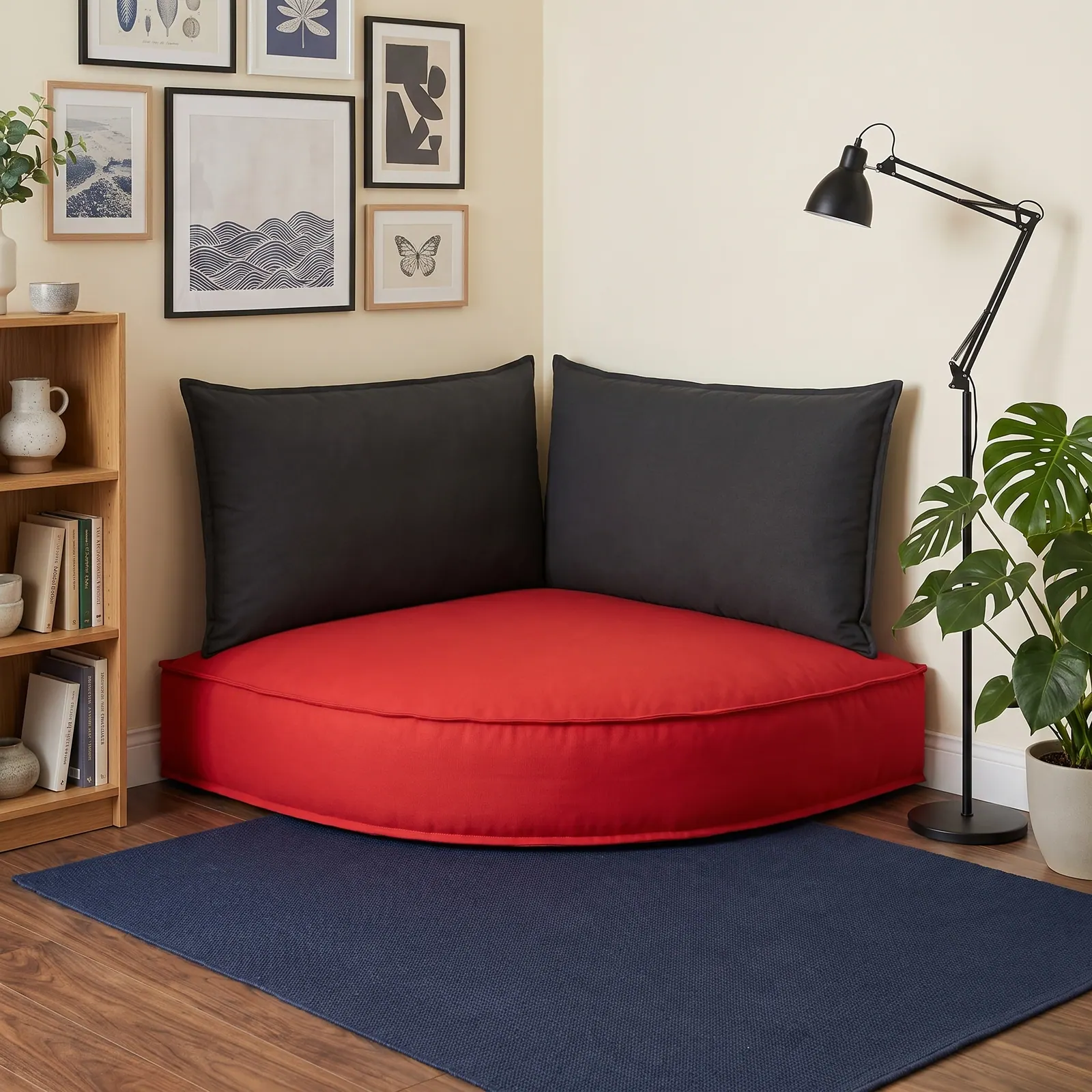
Picture a slice of pie set into the corner of a room. The point sits in the back corner where the walls meet. One straight side runs along the left wall, the other along the right, and they meet at 90 degrees. The size on the order is those two sides, so 48 x 48 in means 48 in along each wall. The trade calls the shape a quarter-round cushion, and the workshop cuts it from fixed patterns, which is why the sizes come in such tidy steps.
That is why the curve takes care of itself: give the maker two honest wall sides and the arc is already decided, for every corner floor cushion from a toddler's picture-book spot to a grown reader's floor cushion corner.
Quarter-circle sizes, side by side
| Wall side | Curved front, about | Who it tends to suit | From the workshop |
|---|---|---|---|
| 25 in (64 cm) | 39 in (100 cm) | A small child or a tight nook | Among the smallest corners made |
| 32 in (80 cm) | 50 in (127 cm) | One small reader | Called a cozy size for a 4-year-old |
| 34 in (86 cm) | 53 in (136 cm) | A single reading corner | The default corner size |
| 39 to 40 in (100 cm) | 62 in (157 cm) | Two little ones side by side | Suggested for two toddlers around 3; 39¼ in (100 cm) is the best-selling kids' corner |
| 48 in (122 cm) | 75.4 in (192 cm) | An adult who wants to stretch out | The standard maximum, suggested for adults about 5 ft 2 in to 5 ft 7 in |
Curve lengths are plain geometry, the wall side times about 1.57, rounded. The workshop's own figure is the 75.4 in on a 48 in corner.
Tape the quarter circle on your floor before you order
Find the true back corner
Start where the two walls meet at floor level. If baseboards stand proud of the wall, measure from their face, because that is where the cushion stops.
Run the tape along each wall
Measure along the left wall from the back corner to where you want the cushion to end, then do the same on the right. Do not measure diagonally from the corner out to the front; that line is not what the size means. A quarter circle has two equal sides, so if a door or a vent interrupts one wall, the shorter clear run sets the size.
Swing the curve with string and a pencil
Tie a string to a pencil at your wall-side length, hold the loose end in the back corner and swing an arc from wall to wall. Lay painter's tape along the pencil line. Now the whole footprint sits on the floor instead of in your imagination.
Check the curve, for your own eyes only
Lay a soft tape along the taped arc. On a 48 in corner it reads about 75.4 in. The maker doesn't need that number, but you need to see how far the front edge reaches into the room.
Live with the tape for a day
Walk past it, sit inside it, lie down in it. Photos carry no sense of scale, so compare the inches with a chair or rug you already own.
Choose the height and the backrests
Settle the thickness, then decide whether you want back cushions along one wall or both. For backrests, measure from the floor to where you want the top of the backrest to sit.
Write the order in plain numbers
Write wall side x wall side x thickness, for example 35 x 35 x 10 in, plus any backrest sizes. For an in-between size, choose the next standard size up and put your exact size in the note; the price stays that of the size you select.
Have it made
Measured it? Have Harlan’s workshop make it
Fabric has a temper and foam has a memory. Better to settle both in a conversation than to guess at them alone. — Harlan
Leave your details and the workshop will call you to confirm measurements, fabric, foam and piping. No prices, dates or payment on this page: it is a request, not an order.
Key facts
- Quarter-circle corner floor cushions are sized by the two straight wall sides, not by the curve.
- A 48 x 48 in corner cushion has a curved front edge of about 75.4 in.
- 34 x 34 in is the default corner size, and 48 in per side is the standard maximum.
- In-between sizes are ordered under the next size up, with the exact size written in the note.
- Tufted corner cushions are fiber-filled and sewn closed; the kids' corduroy corner cushion is 8 in (20 cm) of foam under a removable cover.
From pouf to lounger: thickness and the two builds
Thickness changes what a corner is. At the standard 4 in, a tufted corner cushion reads like a big pouf, a place to sit cross-legged with a book. At 5 or 6 in it starts to feel like a seat, and quarter-rounds have been made in 6.5 in foam. At 8 in (20 cm), the height of the plush and kids' corner cushions, it becomes somewhere to curl up and nap, and the largest 48 x 48 in corner has been quoted as thick as 10 in. The floor cushion thickness guide walks through every step.
Then there is the build, and it matters more than folks expect.
- Tufted: filled with silicone balls, which are small polyester fiber clusters, and sewn closed, so the cover does not come off. The buttons can be left out for a plain top. A fully tufted cushion can also finish 1 to 2 in off the ordered size, because the tufts draw the fill in.
- Zippered: the kids' corduroy corner cushion is soft foam, 8 in (20 cm) deep, under a removable cover that washes at 86°F (30°C) or below. In a kids' room, that zipper earns its keep.
Velvet remembers the hand that brushed it, and a tufted corner remembers every child who bounced on it. Choose the build for the life the corner will lead.
Backrests along the walls, or a different shape altogether
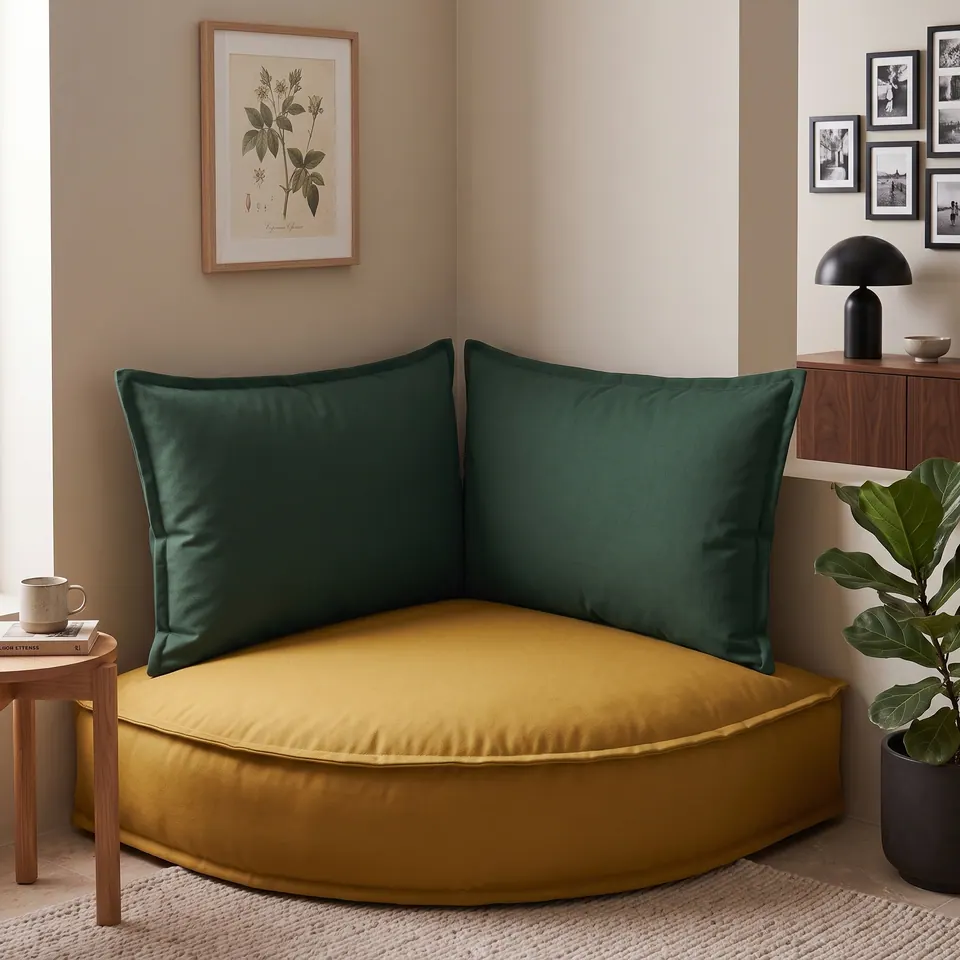
Back cushions for a corner are separate rectangles that lean on the walls. They are not freestanding; the wall does the holding. A 34 x 34 in corner has been made with two custom back cushions, one per wall, and a 38 in (97 cm) corner with a single 38 x 16 x 4 in (97 x 40 x 10 cm) backrest on one side only. When you ask for backrests, the maker checks that your numbers are wall sizes and takes the height from the floor to the top of the backrest. Order the seat and the backs together, so they come off the same roll.
Sometimes the quarter circle is simply the wrong answer. A corner window with three sides needs a photo, every measurement and the depth taken exactly in the middle; that cushion is cut to your space from a measured drawing and quoted on its own. Against a flat wall, two quarter circles side by side make a half circle. And if you want square corners, the tufted square floor cushion also tops out at 48 x 48 in, while a rectangular version has been made at about 31.5 x 39.5 x 8 in (80 x 100 x 20 cm).
The corner reading nook sketches show more ways to dress the spot. But first: what does your corner measure along each wall?
The 44 in corner that arrived as two rectangles
A buyer in the US wrote to the workshop about a floor corner reading spot: 44 in along each wall, 66 in across, and 14 in high to the top of the backrests, in velvet chosen by color number. A clear set of numbers.
The trouble was the picture. The style photo that came with the request showed rectangular tufted cushions, and the cut followed the photo rather than the shape of the room. Two rectangular seats arrived. The backrests were perfect. The seats were too big for the corner.
The workshop made a single 44 x 44 in corner seat to take their place, and the buyer covered the shipping. It ended well, but it cost a second parcel that one sketch would have saved.
So here is the lesson I would hang over the workbench, my friend: send a floor-plan sketch and point to the exact shape you want. A style photo alone can lead to the wrong cut.
Common mistakes at the corner
- Measuring diagonally from the back corner to the front. The size is the two wall sides and nothing else.
- Measuring the curve and ordering by it. A 75 in curve belongs to a 48 in cushion, not a 75 in one.
- Ordering from a style photo instead of a sketch. That is how one corner request became two rectangles.
- Adding backrests months later. Each fabric roll is dyed in its own batch, and velvet sheen makes a small gap in tone look bigger.
- Leaving the layout out of the order note. Write each piece and its size: seat, backrest on the left wall, backrest on the right.
A corner floor cushion is sized by its two wall sides, not the curve: 48 x 48 in means 48 in along each wall from the back corner.
Harlan Pruitt
Corner cushion troubleshooting
| Problem | Likely cause | Fix before ordering |
|---|---|---|
| Doesn't sit flush to the walls | Baseboards or a corner that isn't square | Measure along both walls from the corner; note baseboard depth |
| Empty gap at the back corner | Rounded plaster corner or trim | Check with a full-size paper outline |
| Front edge looks uneven | Walls of different lengths | Measure each wall side; a quarter circle needs two sides |
| Blocks a door or outlet | Footprint larger than it looked | Tape the outline on the floor first |
| Side band looks two-toned | Velvet or corduroy nap running two ways | Ask how the band is cut |
| Feels too thin for lounging | Play thickness chosen for adults | 3 in on carpet, 4 in middle ground, 6 in for long sits |
Buyer questions: corners, curves and in-between sizes
- A common question
How do I measure for a corner floor cushion?
The workshop's answerBy the two straight sides that sit against the walls and meet at the 90-degree corner. Measure along each wall from the back corner to where the cushion should end, so 39 x 39 in means 39 in on each wall. Don't measure diagonally, and don't measure the curve: on a 48 x 48 in quarter circle it runs about 75.4 in on its own. The default corner cushion is 34 x 34 in. For a corner with three sides, such as a corner window, send a photo, the measurements and the depth taken exactly in the middle; that piece is cut to your space and quoted separately.
- A common question
My corner falls between two of your sizes. Can you make it in between?
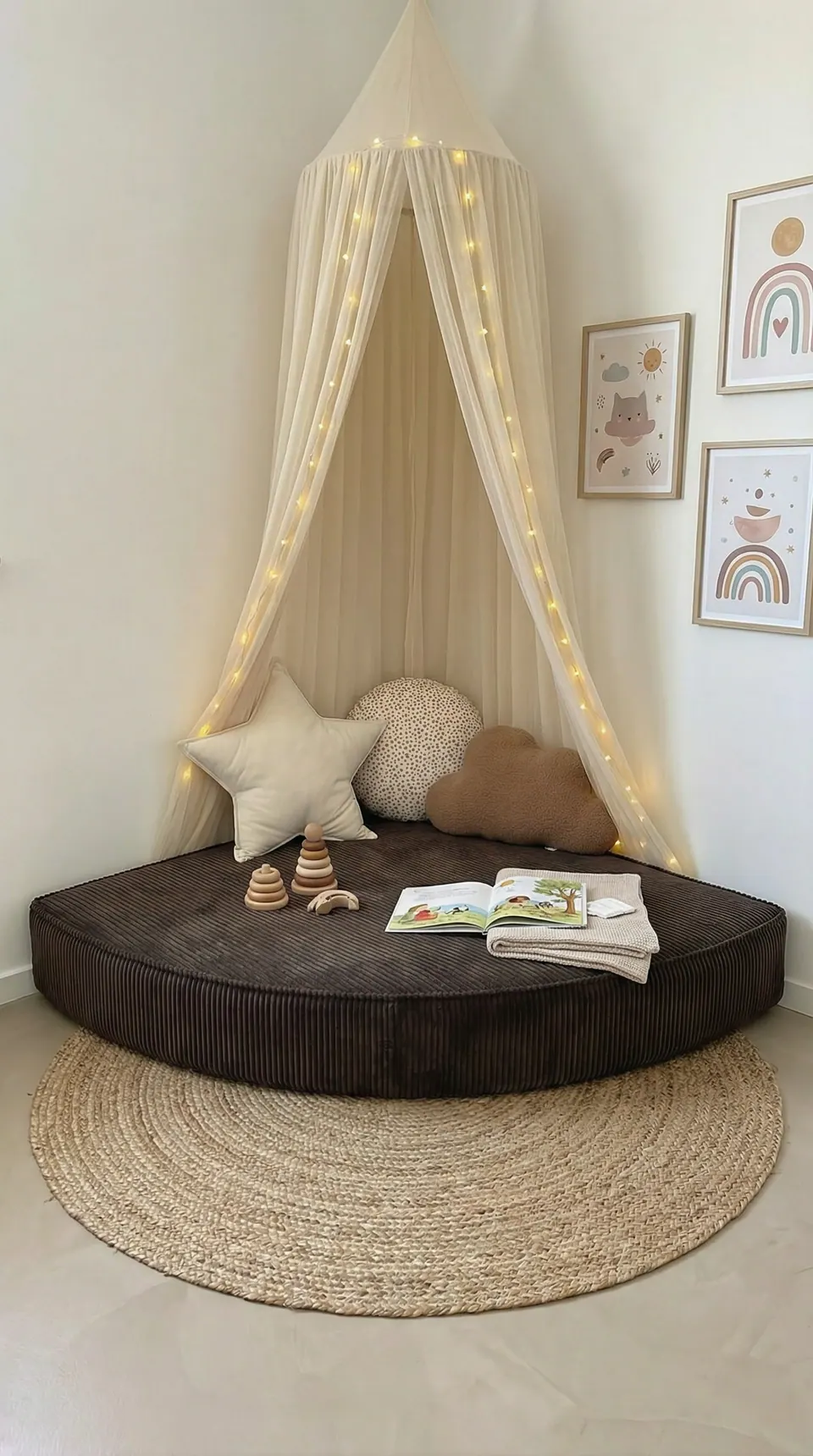
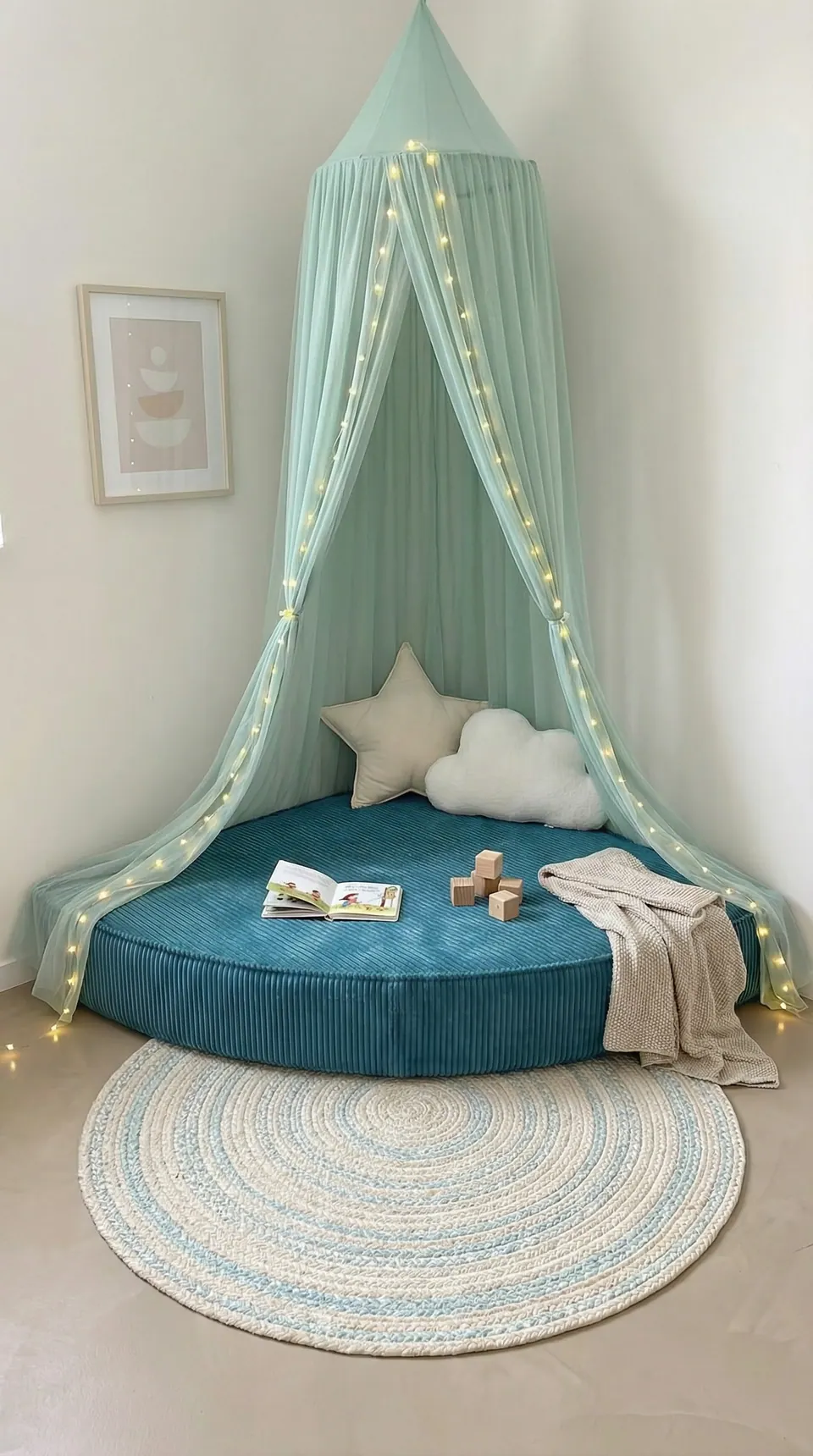
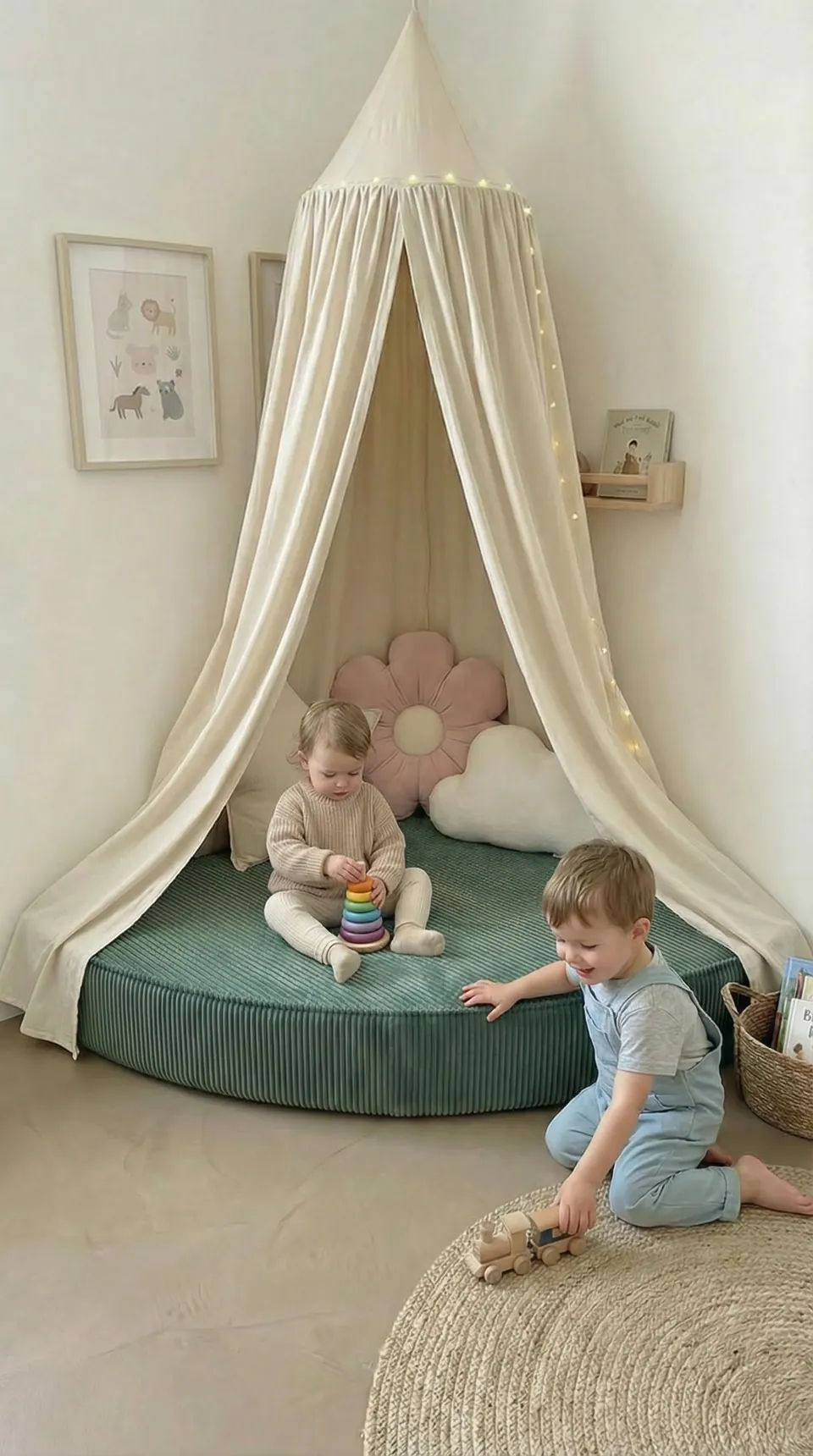
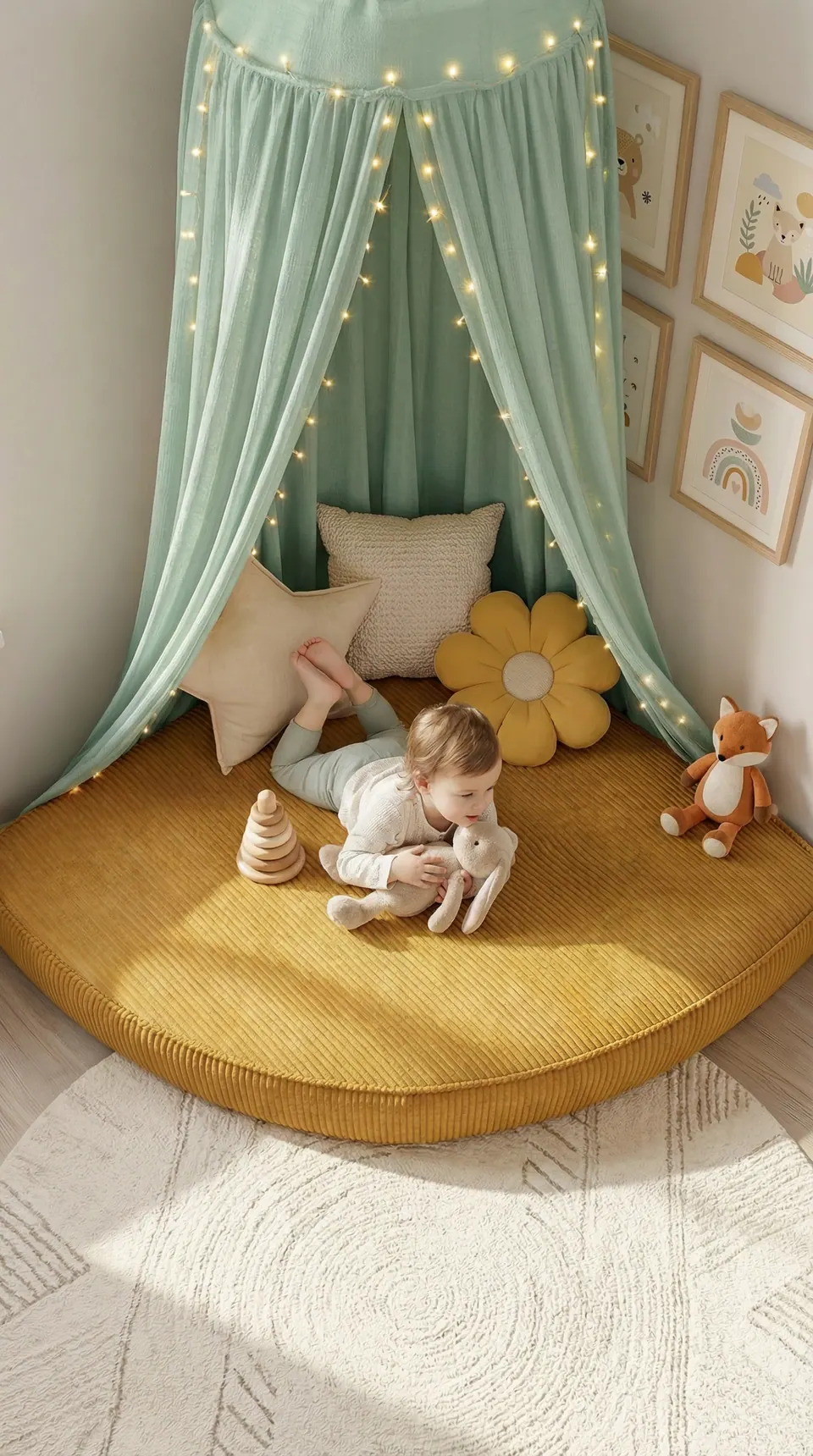
The workshop's answerYes. Order the next standard size up and write your exact size in the note, for example a 35 x 35 in, 10 in high corduroy corner ordered under the 39 x 39 in option. Smaller corners such as 25 x 25 in or 28 to 29 in have been made, and so have a rectangular version and a taller one to match an ottoman. The price stays that of the size you select, since a custom size is more work, not less. Message after ordering so the size can be confirmed. The canopy in the photos isn't included.
- A common question
Can you shape a floor cushion to my reading nook instead of a standard corner?
The workshop's answerYes. Send the shape and measurements before you order, with a few photos of the room taken from a distance and a sketch if you have one, and the workshop tells you whether a customization fee applies for the size. For a quarter-round or curved space it needs the two straight sides to calculate the curve. One end can be widened for an open corner and matching back pillows can be added; for backrests it confirms your numbers are wall sizes and takes the height from the floor to the top of the backrest.
- A common question
How close to my numbers will the finished cushion be?
The workshop's answerSizes are made as written, not rounded. Handmade foam cushions can still vary by about 0.5 to 1 in, and fully tufted cushions by 1 to 2 in. Measure the cushion itself rather than the outer edge of the piping, which adds a little; if the finished size must include the piping, say so in the order. When a cushion came out clearly short, the workshop remade it.
Corner cushion questions, answered at the bench
Is a corner floor cushion the same thing as a corner pouf?
Close cousins. Both sit in a 90-degree corner and are sized by the two wall sides. A tufted corner at the standard 4 in reads like a pouf; at 8 in (20 cm), the height of the plush and kids' versions, it behaves more like a small floor lounger.
What size corner cushion fits two toddlers?
About 40 x 40 in is what the workshop suggests for two children around 3 years old. A 32 x 32 in (80 cm) corner is a cozy spot for one 4-year-old, and the best-selling kids' corner floor sofa is 39 in (100 cm) per side and 8 in (20 cm) thick.
Can a quarter-circle cushion go bigger than 48 inches per side?
48 in per side is the standard maximum. Bigger corners have been quoted case by case, but the shape is cut from fixed patterns, and velvet rolls are too narrow for the largest one-piece corners. Against a flat wall, two corner cushions set together make a half circle instead.
Why tape the footprint when the size is already on the listing?
Because numbers on a screen carry no sense of scale. A taped quarter circle shows how far the 75.4 in front edge of a 48 in corner reaches into the room, and whether a reader can stretch out, before anything is cut.