 Save
- Fiddle-leaf fig
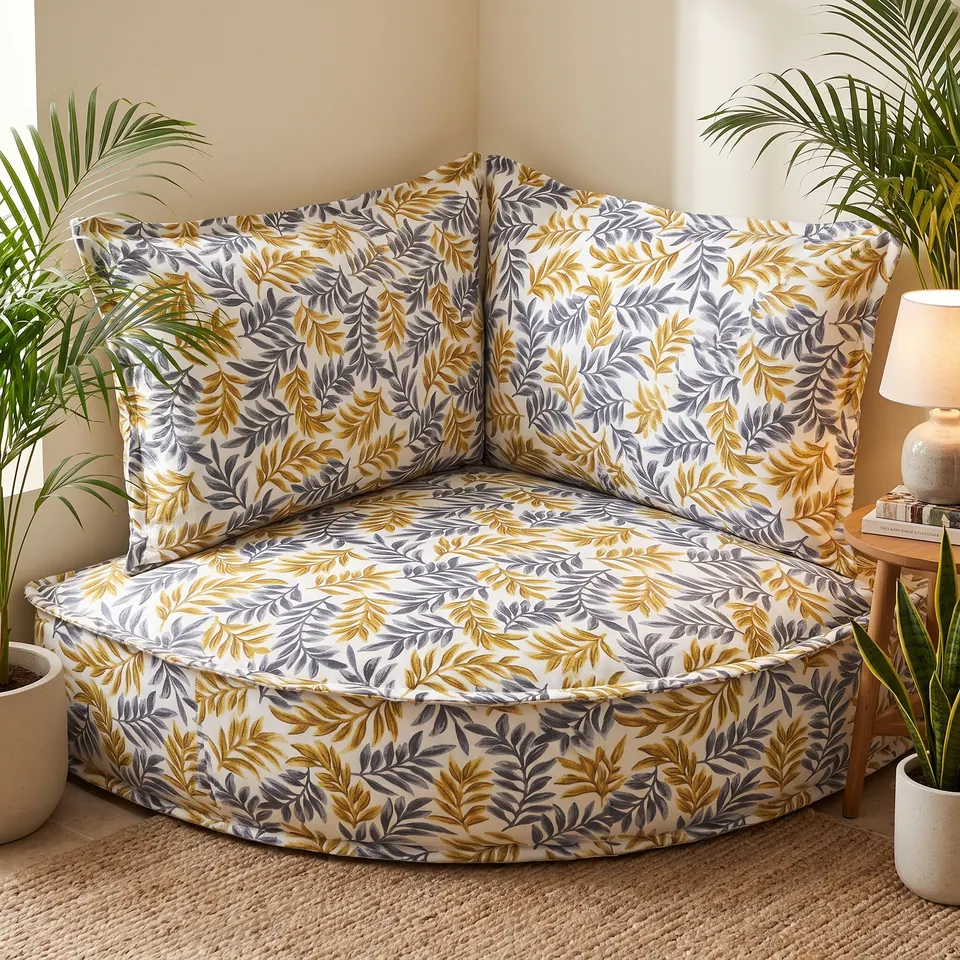
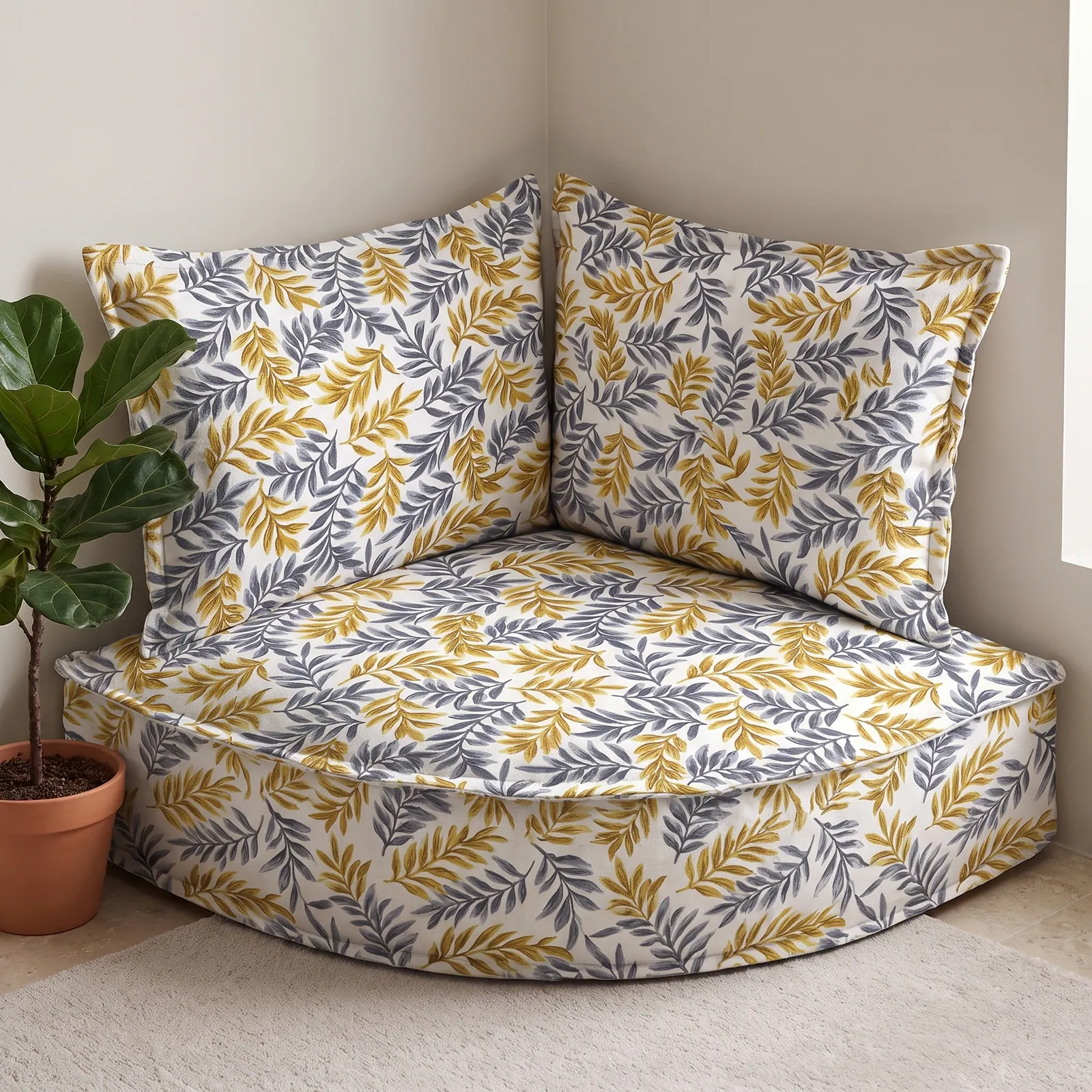
A single fig in terracotta is the only prop, so the print carries the scene.
- Leaf print top
Leaves scatter in every direction, so the print has no up or down to match.
- Flanged backrest
A flange frames the busy print and gives the pillow a clean outline.
- Front piping
Self piping shapes the curve without breaking the leaf pattern.
- Pale gray rug
A gray rug picks up the slate leaves and keeps the floor neutral.
Plate Gray and Gold Leaf-Print Corner Floor Cushion with a Fig Tree
An all-over leaf print in slate and mustard needs nothing more than a fig tree and a pale rug to feel finished.
A Reading by HarlanCorner Floor Cushions & Poufs
A leaf-print corner floor cushion that makes a tight corner feel generous
Harlan reads a slate and mustard corner seat in a plain white room, where two walls, one fig tree and a pale rug make a leftover corner generous.
The quick answer
A corner floor cushion makes a narrow spot feel generous because the two walls become its backrest and nothing else needs to stand in the room. Here a boxed, self-piped cushion in a slate and mustard leaf print sits with two flanged backrest pillows, one fiddle-leaf fig and a pale gray rug, so the print carries the corner on its own.
The plate: one print, one plant, two walls
The smallest corner in a room is usually the one nobody has sat in yet.
This one holds a corner floor cushion, boxed, with a gently curved front and two flanged backrest pillows leaning into the walls. The walls do the work a sofa frame would do. No arms, no legs, no bulk, and every inch of that corner goes to sitting.
Look at how the leaf print behaves on each face. On the top it is dense and busy. On the boxing it stands upright. On the pillows the flanges frame it like a mat around a picture. Because the leaves scatter in every direction, the print has no up or down, and each panel can be cut any way without a single leaf standing on its head.
The piping is self piping, cut from the same cloth. It holds the front curve crisp and never breaks the pattern with a line of another color. Mustard and slate gray are an old pairing, my friend, and a sensible one: mustard warms a cool room and slate cools a warm one, so this cushion would sit happily in either.
Pinned by Harlan: the leaf-print corner
Begin at the fig in its terracotta pot, then follow the pins across the leaf print and the flanges down to the pale rug.
The numbers match the pins on the plate.
- Fiddle-leaf figA single fig in terracotta is the only prop, so the print carries the scene.
- Leaf print topLeaves scatter in every direction, so the print has no up or down to match.
- Flanged backrestA flange frames the busy print and gives the pillow a clean outline.
- Front pipingSelf piping shapes the curve without breaking the leaf pattern.
- Pale gray rugA gray rug picks up the slate leaves and keeps the floor neutral.
How a tight corner borrows room
A small room does not need less seating. It needs seating that asks for less floor. Here is how this corner manages it.
- The walls are the back. Two backrest pillows lean where the walls meet, so there is no frame to walk around.
- The seat stays low. A floor cushion sits below the eye line, and the room above it reads taller and emptier. Give it 4 to 6 in (10 to 15 cm) of filling or more, so nobody feels the floor through it.
- One pattern, one plant. The leaf print is the only pattern in the room. The fig repeats the leaf shape at a bigger scale, and its terracotta pot is the only other warm note.
- The rug draws the border. A pale gray rug picks up the slate leaves and marks out the seat, so the corner looks planned rather than leftover.
A cushion on bare boards looks like it is waiting to be put away. Give it a rug and it lives there.
Before you order, measure the corner itself: both walls from the corner out, and how far into the room you can spare. The corner floor cushion sizing pattern walks through quarter-round and square shapes. The corner floor cushion atlas shows the rest of the family, and the living room cushion atlas the rooms they suit. The cloth here lives on the cotton canvas and ticking shelf. Which corner in your house has nobody sitting in it?
A floor-sofa nook that came back for benches
A parent in the US wrote to the workshop about a floor-sofa nook in their daughter's bedroom. The first order was a fuchsia velvet tufted set: a 42 x 24 in (107 x 61 cm) seat, a 42 x 18 in (107 x 46 cm) back, and round arm pillows sized to match the seat depth. It took one week to make.
They loved it and came back. This time they wanted two French-style tufted bench cushions, 66.5 x 18 x 3 in (169 x 46 x 7.5 cm) and 60.5 x 18 x 3 in (154 x 46 x 7.5 cm), plus two 18 in (46 cm) bolsters 6.5 in (16.5 cm) across, finished with buttons. Many color photos went back and forth, greens with cream piping among them, before the workshop suggested an indigo soft fabric.
The lesson from that letter is plain. For a French tufted bench cushion, give the full bench size. The workshop makes it to the full dimensions so the cushion meets the edge. In a small nook, a cushion that stops an inch short leaves a gap the eye finds straight away. A seam is a promise, and so is a measurement.
On the cutting table: the corner seat
| Piece | Corner floor cushion with two flanged backrest pillows |
|---|---|
| Fabric | Cotton canvas, all-over leaf print, code IN-10 |
| Colors | Slate gray and mustard gold on white |
| Edge | Box edge with a gently curved front |
| Piping | Self piping in the same print |
| Backrests | Flanged pillows leaning into both walls |
| Filling | 4 to 6 in (10 to 15 cm) or more for floor sitting |
| Styling | One fiddle-leaf fig and one pale gray rug |
| Best for | Small living rooms, reading corners and bedroom nooks |
Have it made
Have this made — ask Harlan’s workshop
Fabric has a temper and foam has a memory. Better to settle both in a conversation than to guess at them alone. — Harlan
Leave your details and the workshop will call you to confirm measurements, fabric, foam and piping. No prices, dates or payment on this page: it is a request, not an order.
Buyer questions: corners, pallets and a shallower seat
- A common question
Can I buy just the corner pieces, the ottoman with the corner backrest, without the middle seat?
The workshop's answerYes. The ottoman with a corner back is sold on its own, one at a time or as a pair. Each one folds out and comes with one metal bar, and a second one ordered later will match the first.
- A common question
Do you make cushions to sit on top of standard pallets? I'm setting up a meditation room.
The workshop's answerYes. 40 x 48 in (102 x 122 cm) cushions have been made to fit standard pallets; the production time comes with the quote, so get it before you plan the room.
- A common question
Could the sofa be made shallower, say 30 inches deep instead of 39?
The workshop's answerYes. The buyer wrote the 30 in (76 cm) depth in the personalization box, and the workshop made the sofa to that size instead of the standard 39 in (99 cm).
A corner floor cushion with backrests on both walls needs no frame and no arms, so every inch of a tight corner goes to sitting.
Harlan
Questions buyers ask next
Does an all-over leaf print need pattern matching on a corner cushion?
Not the way a stripe does. A scattered leaf print with no up or down can be cut in any direction, so the top, the boxing and the pillows never show an upside-down motif. One-way prints and stripes need careful placement and extra fabric.
How much filling should a corner floor cushion have?
Enough that you never feel the floor through it, which usually means 4 to 6 in (10 to 15 cm) or more. Firm foam keeps the square edge and the corner shape, while fiber fill feels softer and plumper.
Why are the leaf-print backrest pillows flanged instead of piped?
A flange is a flat border of fabric around the filled part of a pillow. On a busy print it works like a mat around a picture, giving the pillow a clean outline without adding another line of color.
Sit well. — Harlan