 Save
- Pine wainscot
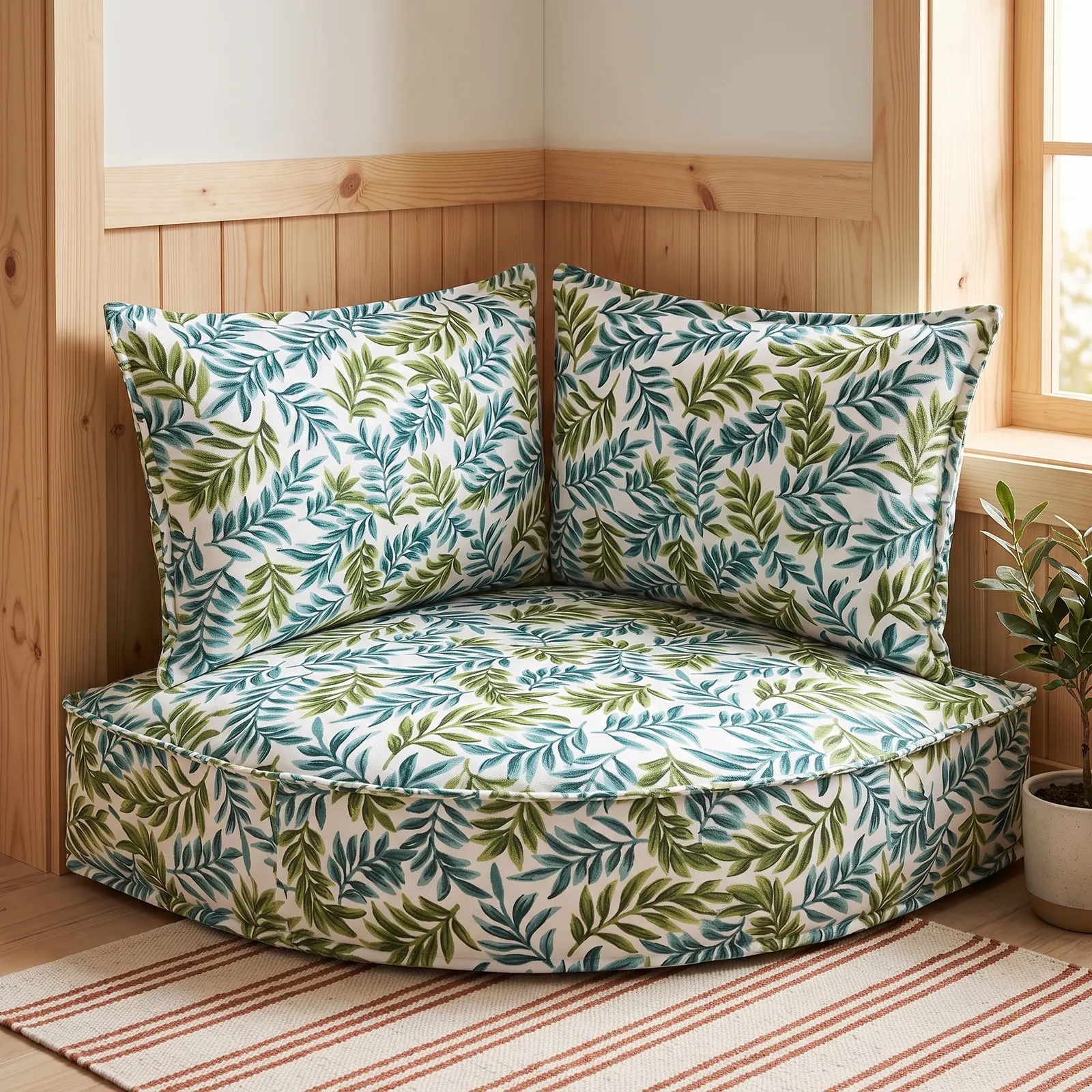
Golden pine warms the cool teal leaves and gives the print a cabin feel.
- Leaf print seat top
An all-over leaf print hides wear and needs no pattern matching at the seams.
- Self-piped boxing
Piping cut from the same print lets the edge disappear into the leaves.
- Potted olive tree
A live plant beside a botanical print makes the fabric feel part of the view.
- Rust stripe rug
Rust stripes pick up the pine tone and contrast the greens.
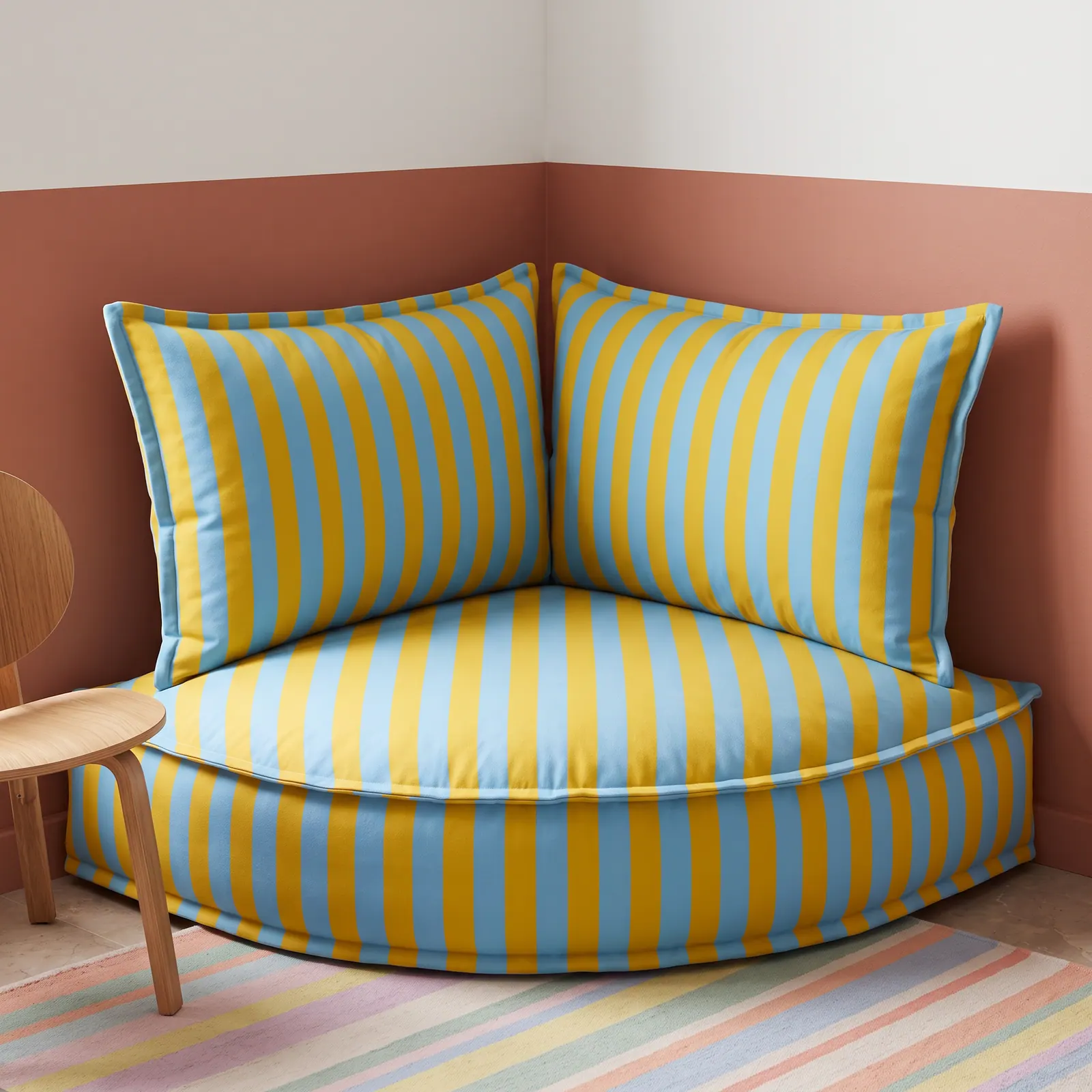
Plate Teal Leaf-Print Corner Floor Cushion in a Knotty Pine Nook
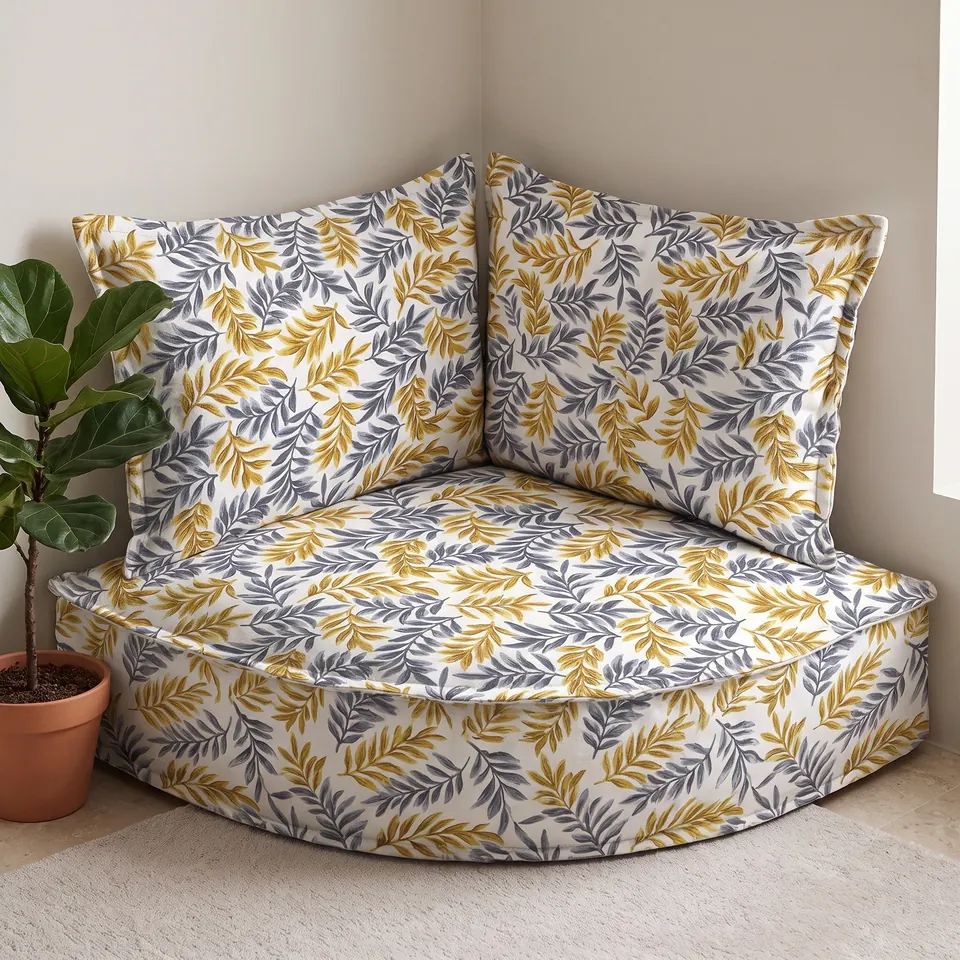
Fern-like leaves in teal and moss green brighten a pine-clad corner, with a rust-striped rug and a small olive tree.
A Reading by HarlanCorner Floor Cushions & Poufs
A teal leaf-print corner floor cushion, and five mistakes it sidesteps
Golden pine on two walls, a window, and a cushion that could have gone wrong five different ways. It didn't, and the photograph shows you why.

The quick answer
The corner floor cushion mistakes to avoid are measuring the diagonal, matching wood paneling instead of balancing it, and ordering too close to an install date. Measure from the back corner along both walls, so 39 x 39 in (100 x 100 cm) means 39 in on each wall. In knotty pine, pick a cool teal or green print, and order 2 to 3 weeks ahead.
What the pine does to the teal
Walk into a room paneled in knotty pine and the wood talks first. It runs orange in the afternoon and honey by lamplight, and it will swallow any cushion that tries to agree with it. That is the first mistake folks make with a corner floor cushion in a cabin-style room: they choose tan or rust to go with the wood, and the seat vanishes into the wall.
Whoever made this corner went the other way. Teal and moss-green leaves on a white ground are cool colors, and cool against orange makes the pine look golden instead of heavy. The window light lands across the top panel, so the print carries the brightness while the paneling carries the warmth.
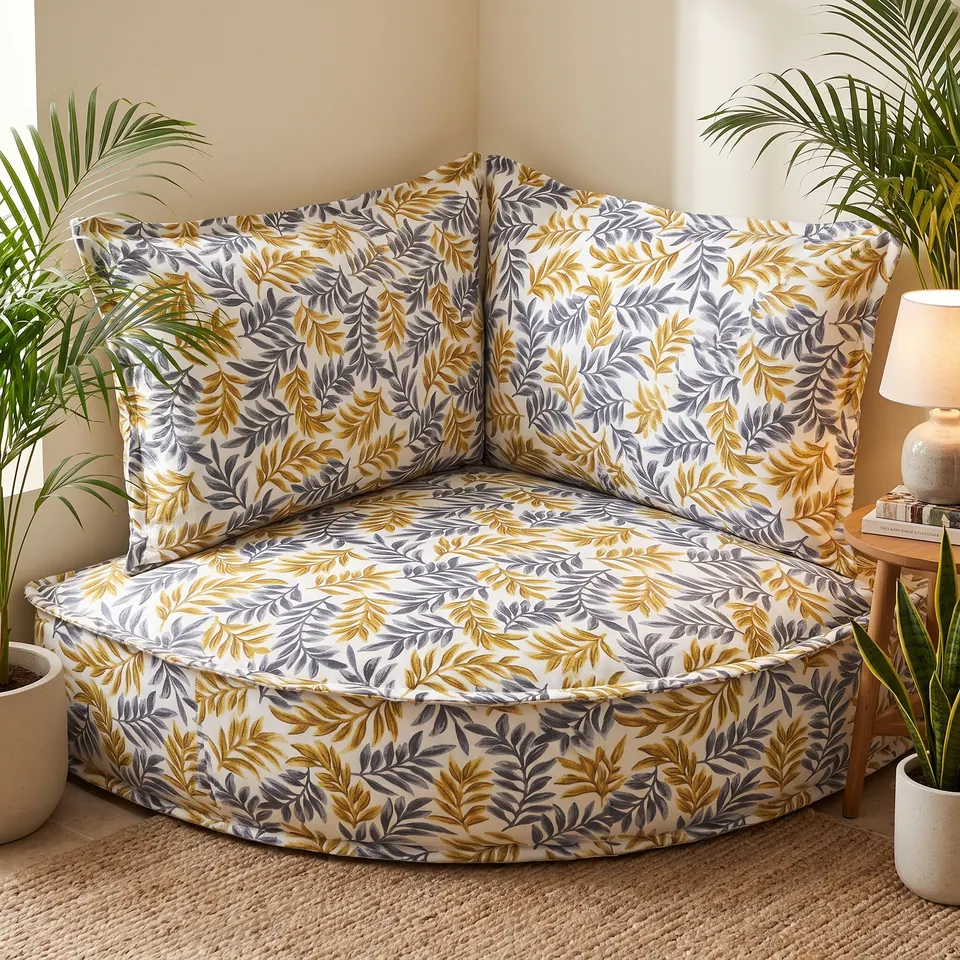
Look at the edge. The side band is piped in the same print, so the cord disappears into the leaves and the cushion reads as one soft block. The print forgives, too. A floor seat gets kicked, knelt on and dragged across the room, and leaves hide all of it.
Two flanged leaf-print pillows lean into the corner as a backrest. They need those walls; floor-cushion backrests are made to lean, not to stand alone. The olive tree in its white pot sits at the edge of the frame so the botanical print feels like part of the view, and the rust-striped rug repeats the pine's own color on the floor. Walls and floor agree with each other, which leaves the cushion free to be itself.
So tell me, my friend: what wood is in your room, and does it lean orange or gray? That answer picks your fabric before any swatch does.
Pinned by Harlan
Five spots in this pine corner where a choice was made on purpose.
The numbers match the pins on the plate.
- Pine wainscotGolden pine warms the cool teal leaves and gives the print a cabin feel.
- Leaf print seat topAn all-over leaf print hides wear and needs no pattern matching at the seams.
- Self-piped boxingPiping cut from the same print lets the edge disappear into the leaves.
- Potted olive treeA live plant beside a botanical print makes the fabric feel part of the view.
- Rust stripe rugRust stripes pick up the pine tone and contrast the greens.
Five corner-cushion mistakes, and the fix for each
- Measuring the diagonal. Measure from the back corner along each wall to where the cushion should stop. A 39 x 39 in (100 x 100 cm) cushion is 39 in on both walls. More in corner floor cushion sizes.
- Matching the wood. Pine, oak and cedar swallow a wood-toned fabric. Pick a cool print, or a clear color your walls don't have.
- Choosing a stripe you must line up. Cotton stripes and ticking are matched on one face only. An all-over print needs no matching at all.
- Assuming the pillows come with it. The small pillows in corner-cushion photos are styling. Matching ones can be made if you send the sizes, how many and the color.
- Ordering the week of the install. A made-to-order cushion wants 2 to 3 weeks before the room has to be finished.
The designer's Christmas deadline
An interior designer in the US was finishing a bedroom for a client's daughter, due to be installed just before Christmas, and wrote to ask whether a corner floor cushion could be rushed. The workshop looked at the calendar and committed to delivery within 15 days of the order.
I tell that story because a yes like that should never have to be asked for. December crowds every cutting table. Anyone working to an install date, designer or parent, should order well ahead and let the tailors work at a sane pace. A seam is a promise, and promises keep better when nobody is rushing them.
- Sizes
- Standard corner floor cushion
The lesson: Order custom cushions at least 2 to 3 weeks before an install date.
Buyer questions: floor sofas, sizes and parcels
- A common question
How long is the L-shaped corner floor sofa from end to end, and can it be resized to fit my wall?
The workshop's answerThe standard L-shaped corner floor sofa is 79 x 118 in (200 x 300 cm). Each section is about 79 in wide and 39 in deep (200 x 100 cm), so two joined make a 118 in long side. If that doesn't fit your wall, the sizes can be customized.
- A common question
If I order a floor sofa this week, when will it actually get here?
The workshop's answerPreparation comes first, then UPS or FedEx delivery after dispatch; ask the workshop for the current total in writing. In very busy weeks a few orders waited on the carrier to collect them.
- A common question
My couch arrived, but the metal bars and backrests aren't here. Where are they?
The workshop's answerOrders ship as several parcels, each with its own tracking number, and they can arrive on different days. The cushions come in two roll-packs and the bars in a small separate box; one corner-sofa order came in 5 packages. In summer 2025, while improved bars were being made, bars shipped up to 7 to 8 business days after the cushions.
In a knotty pine room, a cool teal or green print keeps a corner floor cushion visible; a wood-toned fabric disappears into the walls.
Harlan
On the cutting table
| Cushion | Corner floor cushion with two backrest pillows |
|---|---|
| Fabric | Teal and leaf-green botanical print on cotton canvas |
| Piping | Self piping, cut from the same print |
| Edge | Box edge with a side band |
| Standard sizes | 32, 39 or 47 in square (80, 100 or 120 cm), about 8 in (20 cm) thick |
| Measure | Along each wall from the back corner, never the diagonal |
| Backrest | Leans on the walls; pillows are ordered separately |
| Care | Zip-off cover, 86°F (30°C) gentle wash, air-dry |
| Best for | Pine-paneled nooks, reading corners, kids' rooms |

Have it made
Have this made — ask Harlan’s workshop
The best cushions I have known began with somebody asking one more question. Ask yours here. — Harlan
Leave your details and the workshop will call you to confirm measurements, fabric, foam and piping. No prices, dates or payment on this page: it is a request, not an order.
Questions buyers ask next
What size corner floor cushion suits a young child?
A 32 x 32 in (80 x 80 cm) cushion is a cozy size for a four-year-old. The best seller is 39 x 39 in (100 x 100 cm), and the largest standard size, 47 in (120 cm), suits a parent lying down to read alongside. Tape the square on the floor first.
Is a cotton print a good fabric for a corner floor cushion?
For a living room or reading nook, yes. Cotton prints and ticking are indoor fabrics, though they stain more easily than performance weaves. In a house with toddlers or a dog, soft performance fabric or velvet is the easier everyday choice, since both are durable and wipeable.
Will the backrest pillows stand up without a wall behind them?
No. Floor-cushion backrests are made to lean against a wall, which is why a corner suits them so well. If the seat has to float in the middle of a room, a back-supported version or a metal frame can be arranged.
Can the cover of a corner floor cushion go in the washer?
On the foam-filled corner cushions, yes. Unzip the cover, turn it inside out and wash at 86°F (30°C) maximum on a gentle cycle with mild detergent and no bleach. Air-dry it, and never wash the foam itself.
Sit well. — Harlan
More photographs to read
 Save
 Save
 Save
 Save
 Save
 Save