A Reading by NateWindow Seat Cushions
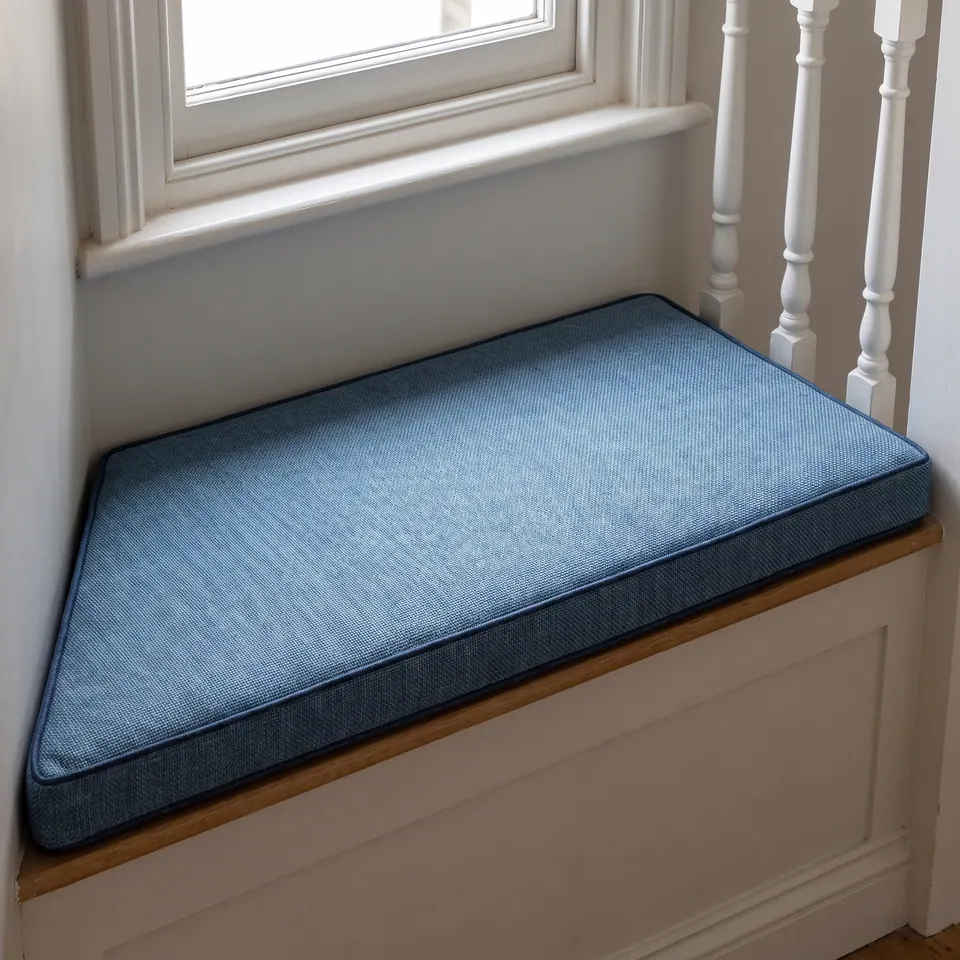
A rust trapezoid window seat cushion that makes a narrow landing feel generous
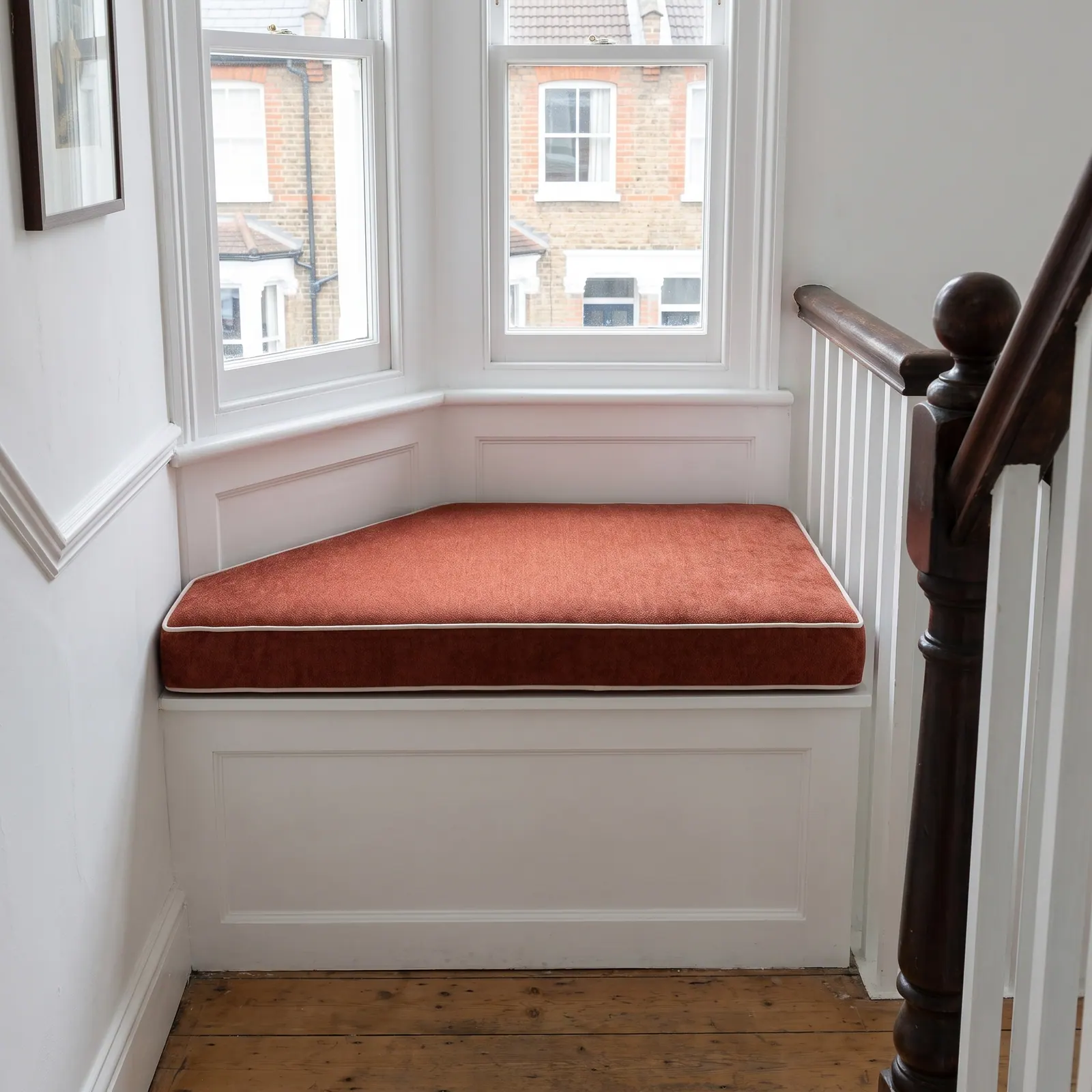
A two-sided bay halfway up the stairs may be the smallest seat in the house. Cut right, it reads as a real perch, and every reason for that is a measurement.

 Save
The quick answer
A small landing window seat feels generous when the cushion fills the whole trapezoid, wall to wall, with no bare board at the angled ends. Outline it with contrast piping, give it enough thickness to read as a seat, and pick a warm mid-tone. Measure depth straight from the angled sections to the long edge, and have a second person check.
The cushion, cut open
Cover fabric. A removable, zippered cover. Machine wash at 86°F (30°C) on a gentle cycle and air dry.
Piping. A fabric-covered cord sewn into the seams. It sits on the seam line, so it does not change the size.
Fiber wrap. Polyester fiber (Dacron) batting around the foam: it fills the cover out and softens the edges.
Foam core. About 2.0 lb/ft³ (32 kg/m³) high-resilience foam, firm to medium-firm, cut to the ordered size.
Zipper. Along the back band, as hidden as possible. The zipper side faces down or toward the wall.
Base panel. The underside of the cover. A non-slip fabric backing can cover the whole of it instead.
Pinned by Nate: seat, piping, newel, frame and floorboards
Five pins, top to bottom, and each one marks a decision that makes a landing bay look bigger than its footprint.
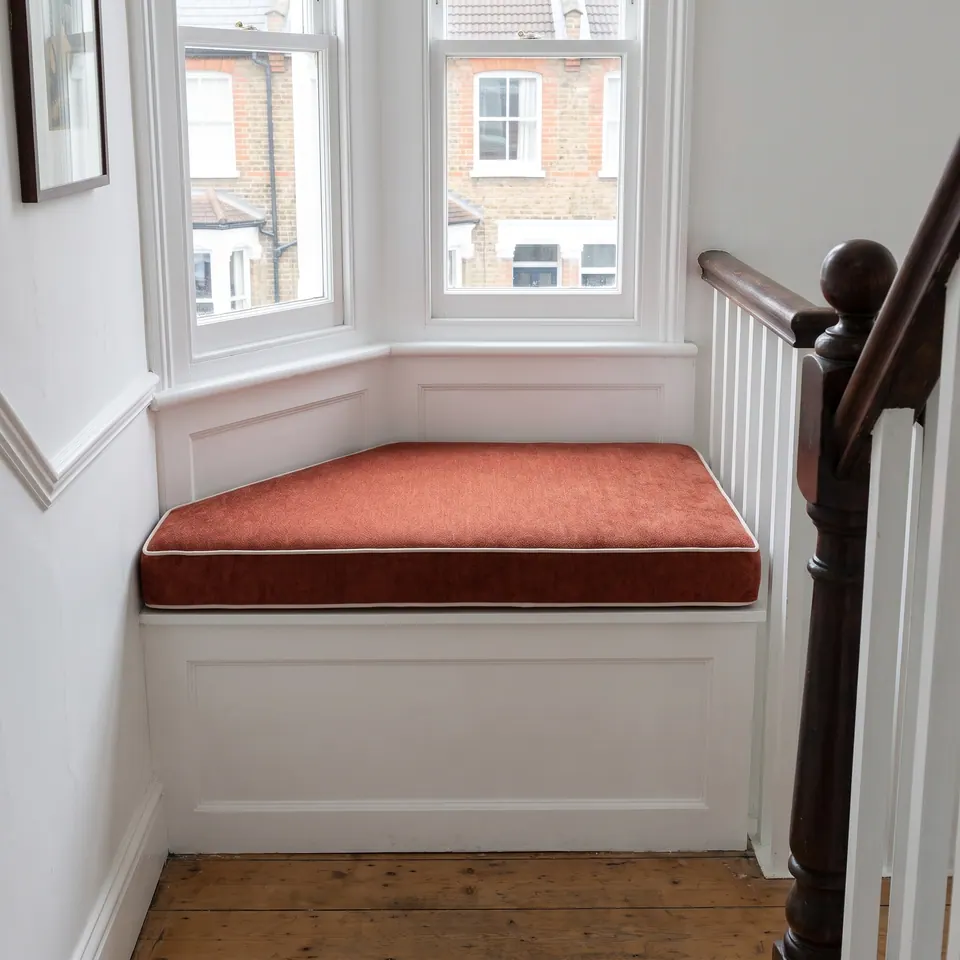
- Rust trapezoid seat
Rust links the mahogany newel with the brick houses outside.
- Ivory piping
Repeats the white spindles and paneled plinth.
- Newel post
Dark wood next to a warm mid-tone looks chosen, not accidental.
- Framed picture
A single frame is enough on a narrow landing.
- Stripped floorboards
Honey boards pick up the orange in the fabric.
- Rust trapezoid seatRust links the mahogany newel with the brick houses outside.
- Ivory pipingRepeats the white spindles and paneled plinth.
- Newel postDark wood next to a warm mid-tone looks chosen, not accidental.
- Framed pictureA single frame is enough on a narrow landing.
- Stripped floorboardsHoney boards pick up the orange in the fabric.
Cross-section of a small seat: four layers of generosity
Angles are just lengths in disguise, partner, and a landing bay is nothing but angles. This one is a small two-sided sash bay halfway up the stairs, next to a dark turned newel post. The cushion is a trapezoid: one long edge, two angled sides, cut to follow the bay exactly.
Read it in layers.
Footprint. The cushion reaches both angled walls. No bare triangle of board at either end. Leave one and the eye measures the gap, not the seat, and the landing shrinks.
Outline. Ivory contrast piping runs around the top edge and repeats the white spindles and the paneled plinth below. On a small seat, a pale line traces the whole shape, so you read the full footprint in one glance.
Depth. The box edge is deep compared with the plinth. That is what turns a pad into a seat. A thin cushion on a small bay looks like a place to park a plant.
Color. Rust linen-look weave sits between the mahogany newel and the red brick row houses outside the glass, so the seat looks chosen for this spot. Honey pine floorboards pick up the orange again. A warm mid-tone also behaves on a landing: pale fabric shows hand marks where people steady themselves, and very dark fabric vanishes in low light.
The single framed picture is the only extra. On a narrow landing, one frame is enough. How wide is the landing you walk past every day?
Measuring a two-sided bay the listing's way
Long edge
Measure the straight long edge corner to corner. In the bay below it was 54.5 in (138 cm). Note it to the nearest 1/4 in.
Angled sections
Measure each angled side along its edge. Both were 25.5 in (65 cm). If yours differ by more than 1/4 in, write both down: the bay is not symmetric.
Depth, straight
Measure depth from the angled sections straight to the long edge, at a right angle, never along the slant. The slant is always the longer number.
Length across the outer corners
The listing takes length across the outer corners. Enter all three numbers in the trapezoid calculator to see the shape before you order.
A second pair of hands
Have someone else re-measure everything before you type a number. Two readings that match beat one careful reading.
A 54.5 in bay, four swatches and a second opinion
A couple in the US sent a photo of their bay window seat with dimensions in inches: two angled sections of 25.5 in (65 cm) and a long edge of 54.5 in (138 cm). The workshop walked them through the trapezoid listing: depth from the angled sections straight to the long edge, and length across the outer corners. The trapezoid cushion calculator follows the same convention.
Then came fabric. They were torn between K-18, 926, L-07 and N04 and wanted easy cleaning above all. All four wash at 86°F (30°C) on a delicate cycle, the workshop said, with 926 or L-07 slightly better for spot cleaning.
Before ordering, a second person double-checked the measurements. They ordered in L-02, and there were no further questions. That is the best kind of order: the kind with no follow-up email. The method is laid out in trapezoid cushion measurements, and more shapes live under window seat cushions.
On the cutting table: the landing trapezoid
| Product | Window seat cushion, trapezoid |
|---|---|
| Shape | One long edge, two angled sides following a two-sided sash bay |
| Fabric | Linen-look weave in rust |
| Piping | Ivory contrast piping |
| Edge | Box edge, deep against the plinth |
| Fit | Wall to wall, no bare board at the angled ends |
| Measure to | Nearest 1/4 in, twice, by two people |
| Best for | Stair landings, small bays and reading perches |

Have it made
Have this made — ask Nate’s workshop
Every edge and both diagonals, to the nearest 1/4 in. If the numbers do not close, the workshop will say so on the call. — Nate
Leave your details and the workshop will call you to confirm measurements, fabric, foam and piping. No prices, dates or payment on this page: it is a request, not an order.
Buyer questions: a color code, a shipping box and a banquette quote
- A common question
My order lists color 910, but on the chart that code looks dark blue, not the lavender I picked. Does it matter?
The workshop's answerThe listing's default color field doesn't always match what you agreed in messages. The workshop confirms the agreed color and sends a production plan before cutting, so put your fabric code in the order notes and check it on that confirmation.
- A common question
How big is the box a large cushion ships in?
The workshop's answerSmaller than most people expect. A 111.5 x 34 in (283 x 86 cm) cushion shipped compressed in a white package of about 24 x 20 x 8 in (60 x 50 x 20 cm).
- A common question
Can you give me a price for custom banquette cushions?
The workshop's answerYes. Send the sizes first; the workshop replies with a quote and a custom purchase link.
A trapezoid window seat cushion should reach both angled walls; a bare triangle of board at each end makes a small landing seat look smaller.
Nate
Questions buyers ask next
How do I make a small window seat cushion look bigger?
Fill the whole shape to the walls, outline it with a pale contrast piping, and give it enough thickness to read as a seat rather than a pad. A warm mid-tone that links to the wood nearby keeps it from shrinking into the corner.
Is a two-sided bay window cushion a trapezoid?
Usually, yes. A seat with one long edge and two angled sides is a trapezoid. Bays with three or more sides are measured as a bay shape instead, and the bay window calculator is built for those.
What color works best on a dim stair landing?
A warm mid-tone such as rust. Pale fabrics show hand marks where people steady themselves on the way up, and very dark ones disappear in low light. Tie the color to something nearby, like a wood newel post or brick outside.
± 1/4 in — Nate