The Cutting Table · a question, worked through
What if my window seat measurements don't add up because the corners aren't square?
Old houses don't do right angles, partner. The drawing gets checked before the fabric does, and the check has a number.

Pinned by Nate
The quick answer
If your window seat measurements don't add up, nothing is cut: the workshop draws the cushion to scale, checks that the shape closes, and asks you to re-measure named edges, measure both diagonals or fill in a lettered outline. A drawing that closes within 1/4 in (6 mm) is accepted, and production waits for your confirmation.
Get a quote for a window seat cushion
Key facts
- Every shaped cushion is drawn to scale and checked for closure before cutting.
- A drawing that closes within 1/4 in (6 mm) is accepted.
- Both diagonals, measured corner to corner, show whether the seat is square.
- The workshop can send a blank outline with each edge lettered A, B, C.
- With imperfect corners, the cut follows the long edge, depth and end sections; the slanted edges follow the geometry.
- Depth can be set separately for each section.
- Nothing goes into production until you confirm.

Have it made
Have Nate’s workshop cut this for you
Send the numbers in inches: length × depth × thickness, plus any angle. The workshop checks them with you, because foam has no undo button. — Nate
Leave your details and the workshop will call you to confirm measurements, fabric, foam and piping. No prices, dates or payment on this page: it is a request, not an order.
Reply one: nothing is cut until the drawing closes
Before any shaped cushion is cut, the workshop draws it to scale and checks that the outline closes. If it doesn't, the reply names the edges in question. A drawing that closes within 1/4 in (6 mm) is accepted as is.
Angles are just lengths in disguise; a wrong angle usually means one wrong length.
Reply two: what might you be asked to send?
Re-measure the named edges
The reply says which ones.
Measure both diagonals
Corner to corner, both ways. See diagonal measurement in the glossary.
Send clear photos
One wide-angle shot of the whole seat, plus a sharp top-down photo of your sketch, or the numbers typed as text.
Fill in the lettered outline
A blank drawing with each edge marked A, B, C; you write a number beside each letter.
A 112 in seat whose slants wouldn't agree
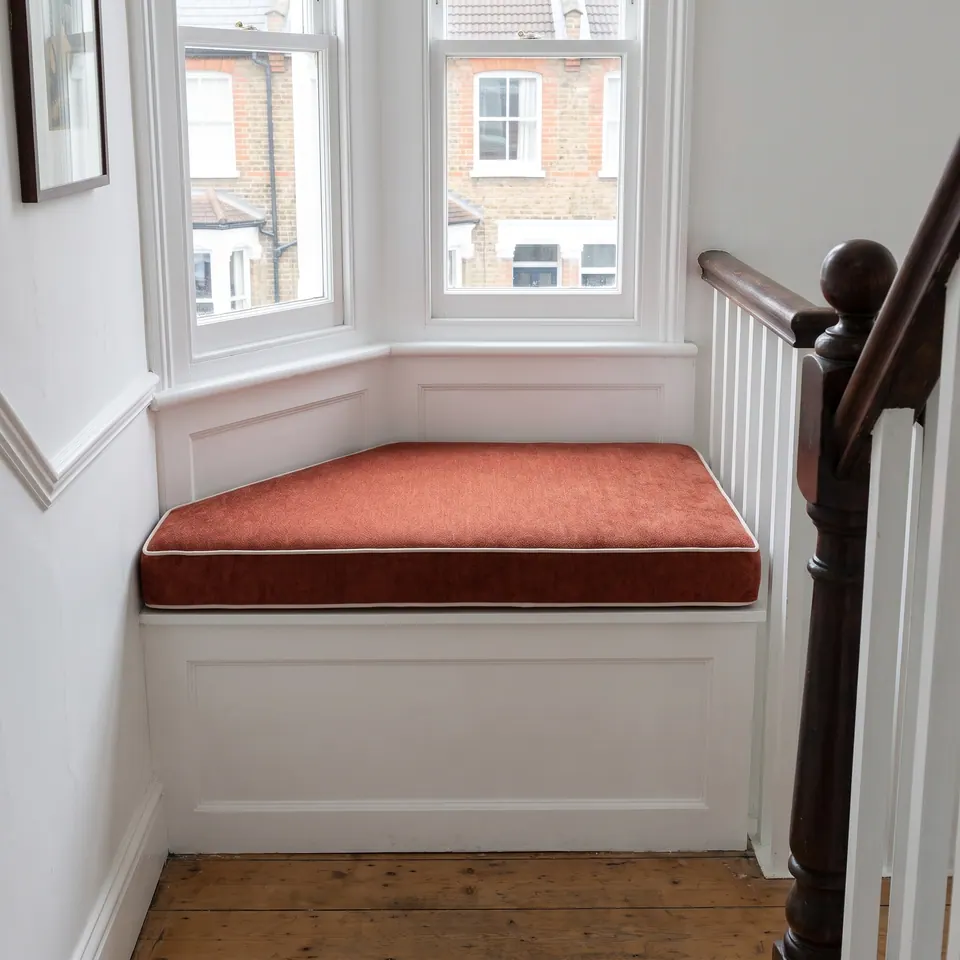
A long angled seat came in with a 112 in long edge, 18 in of depth, and end sections of 32.5 in and 31 in. The slanted edges were written as 35 in. Drawn to scale, they came out at 37.2 in and 35.9 in.
The corners weren't square, so the cut followed the main dimensions, giving about 48.5 in on the short edge, and the slanted edges followed the geometry. The small differences went into the foam and the sewing tolerance.
- Measured
- 112 in (284.5 cm) long edge · 18 in (45.7 cm) deep · end sections 32.5 in (82.5 cm) and 31 in (78.7 cm) · short edge about 48.5 in (123 cm)
- What it taught
- When corners aren't square, trust the long edge, the depth and the end sections; let the slants follow.
Follow-up: a 30 in and a 40 in figure that swapped places
On another angled seat the sides worked out to 34 in instead of the 40 in written down. The buyer went back with the tape and found a 30 in and a 40 in figure had traded places.
If your walls lean, you can also set the depth for each section. Run the numbers through the bay window calculator first, and read how to measure a window seat. Which corner of your seat do you trust least?
A shaped cushion drawing that closes within 1/4 in is accepted; a bigger gap means re-measuring before any fabric is cut.
Nate
Buyer questions
- A common question
My house is old and nothing is square. What if my measurements don't quite add up?
The workshop's answerThe drawing is checked for closure before cutting. If it doesn't close, you're asked to re-measure specific edges and both diagonals, or to fill in a blank outline lettered A, B, C. Within 1/4 in is accepted, and depth can be set per section.
- A common question
Which number is the depth on an angled window seat?
The workshop's answerDepth runs straight from front to back at 90 degrees at the deepest point, not along the angle. Length is the total between the outer corners.
- A common question
How do I measure a bay window seat for a cushion?
The workshop's answerSketch the seat from above, write every edge (back, front, each angle) plus the depth, and type the numbers too. Upload the sketch and a photo.
Questions buyers ask next
Why compare the two diagonals of a seat?
In a true rectangle the two corner-to-corner diagonals are equal. If yours differ, the corners aren't square, and the cut follows the main edges while the slants follow the geometry.
Can each section of a bay seat have its own depth?
Yes. With out-of-square walls you can set the depth you want for each section, and it is agreed before anything goes into production.
Should I type my measurements or just send the sketch?
Both help. Replace a blurry sketch photo with a sharp one taken straight from above, or type the numbers with each edge named.