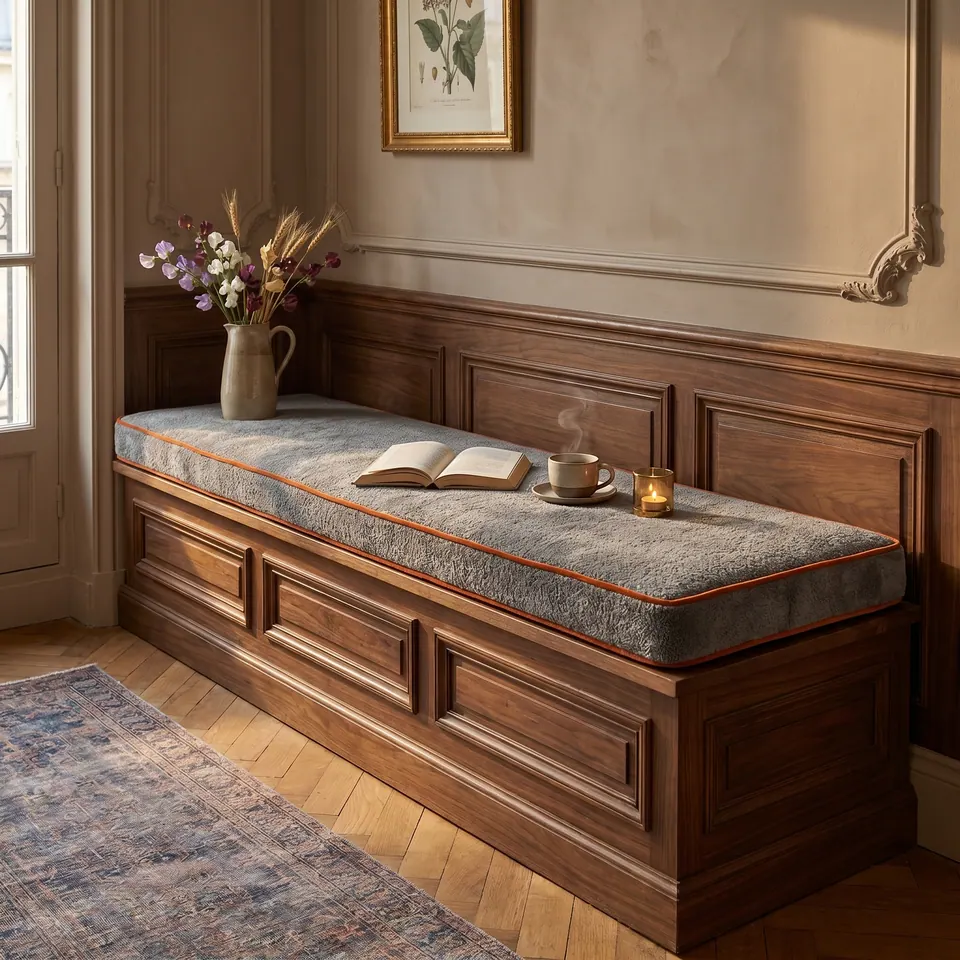
A Reading by ÉlodieBench Cushions
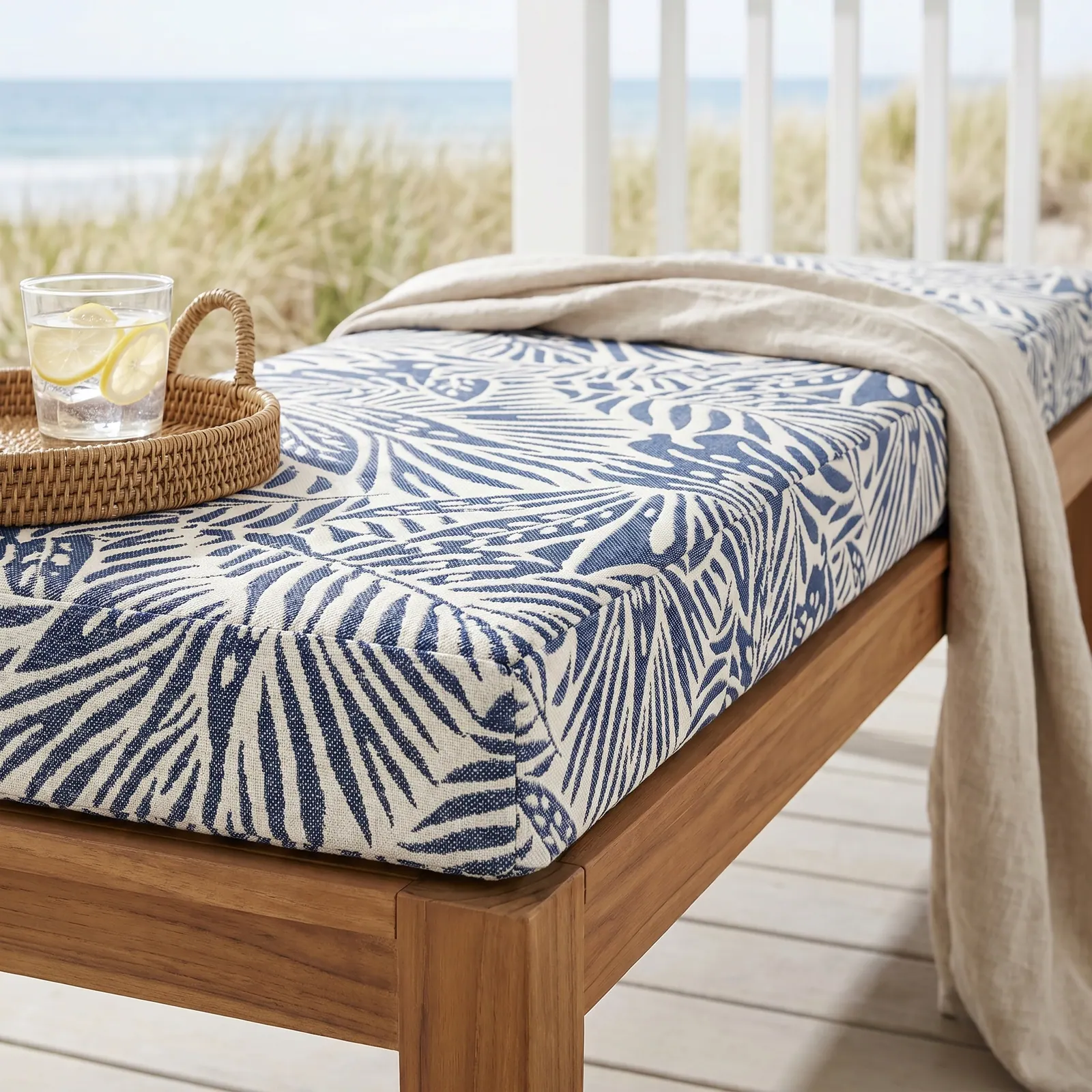
An unpiped navy palm bench cushion on a beach-house porch, read edge first
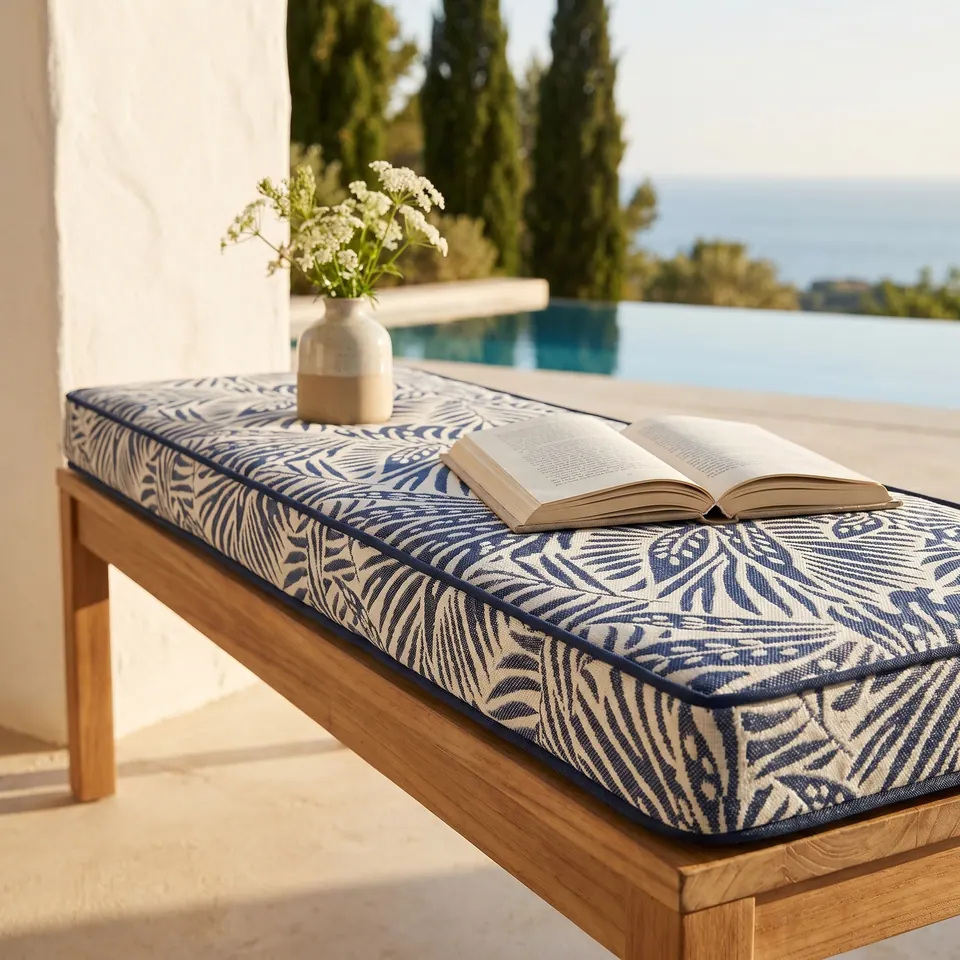
A jacquard leaf wraps over a soft box edge with no welt to stop it. The porch borrows ease from outdoor cushions and richness from indoor cloth, and here is what to take from each.

 Save
The quick answer
A custom bench cushion without piping has a softer, more relaxed corner, which suits a porch or beach house better than a tailored welt. It works best with a busy pattern, like this navy palm jacquard, that hides the seams. Unless the cloth is outdoor-rated, keep it on a covered porch and let outdoor acrylic take the rain.
The cushion, cut open
Cover fabric. A removable, zippered cover. Machine wash at 86°F (30°C) on a gentle cycle and air dry.
Piping. A fabric-covered cord sewn into the seams. It sits on the seam line, so it does not change the size.
Fiber wrap. Polyester fiber (Dacron) batting around the foam: it fills the cover out and softens the edges.
Foam core. About 2.0 lb/ft³ (32 kg/m³) high-resilience foam, firm to medium-firm, cut to the ordered size.
Zipper. Along the back band, as hidden as possible. The zipper side faces down or toward the wall.
Base panel. The underside of the cover. A non-slip fabric backing can cover the whole of it instead.
Pinned by Élodie: five points from the soft corner to the dunes
Five pins, from the unpiped corner out to the sea, show what this porch took from the house and what it took from the beach.
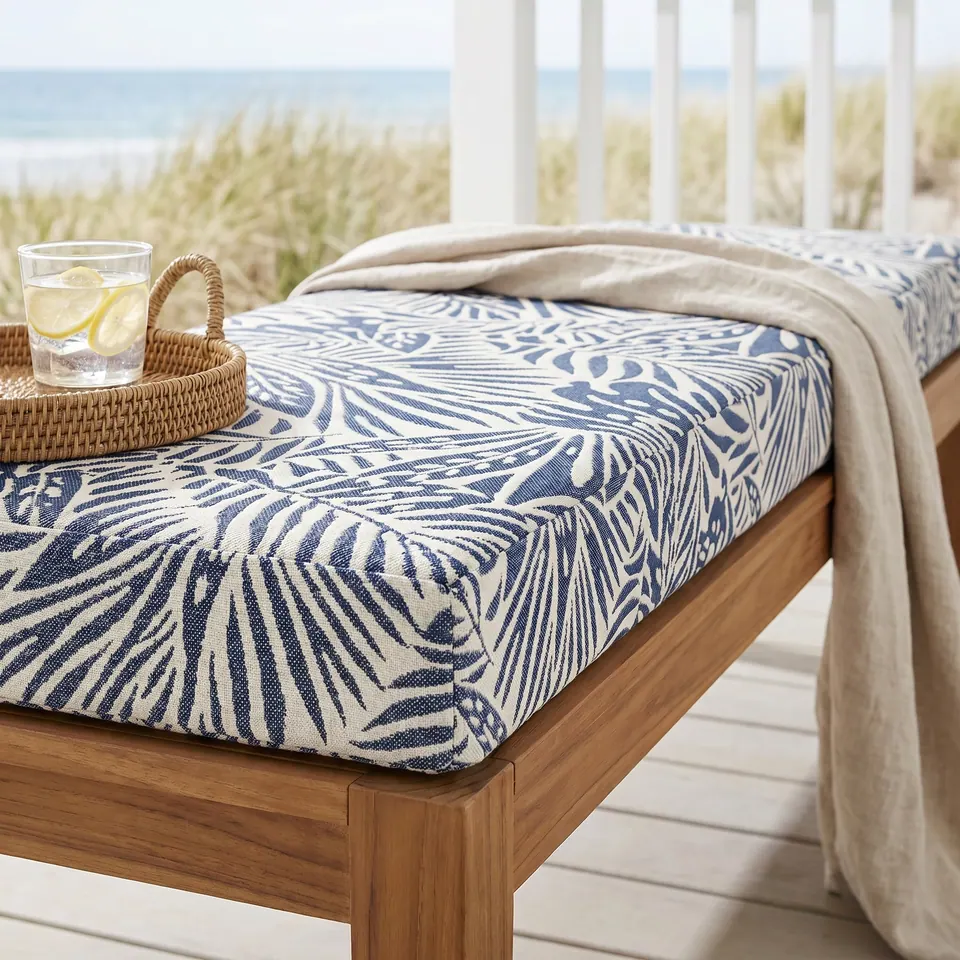
- Unpiped corner
Without piping, the corner is soft and relaxed, which suits a beach porch.
- Wrapping pattern
The large leaves run over the top and down the sides without a break.
- Rattan tray
A woven tray adds natural texture and gives the drink a stable place.
- Linen throw
Oatmeal linen draped over the end softens the look.
- Dunes and sea
The beach view explains the navy and sand palette.
- Unpiped cornerWithout piping, the corner is soft and relaxed, which suits a beach porch.
- Wrapping patternThe large leaves run over the top and down the sides without a break.
- Rattan trayA woven tray adds natural texture and gives the drink a stable place.
- Linen throwOatmeal linen draped over the end softens the look.
- Dunes and seaThe beach view explains the navy and sand palette.
Anatomy of a corner with no welt
Start at the corner, my friends, because that is where this bench cushion made its choice. There is no piping. The box edge is there, with a side panel all the way around, but the top seam is a plain one, so the corner rounds a little under the fill instead of standing sharp.
That softness is the beach talking. A tailored welt is an indoor habit, a line drawn for a dining room. On a porch where people sit down with sand on their feet, a relaxed corner looks right, and it forgives the small wanderings a piped edge would show.
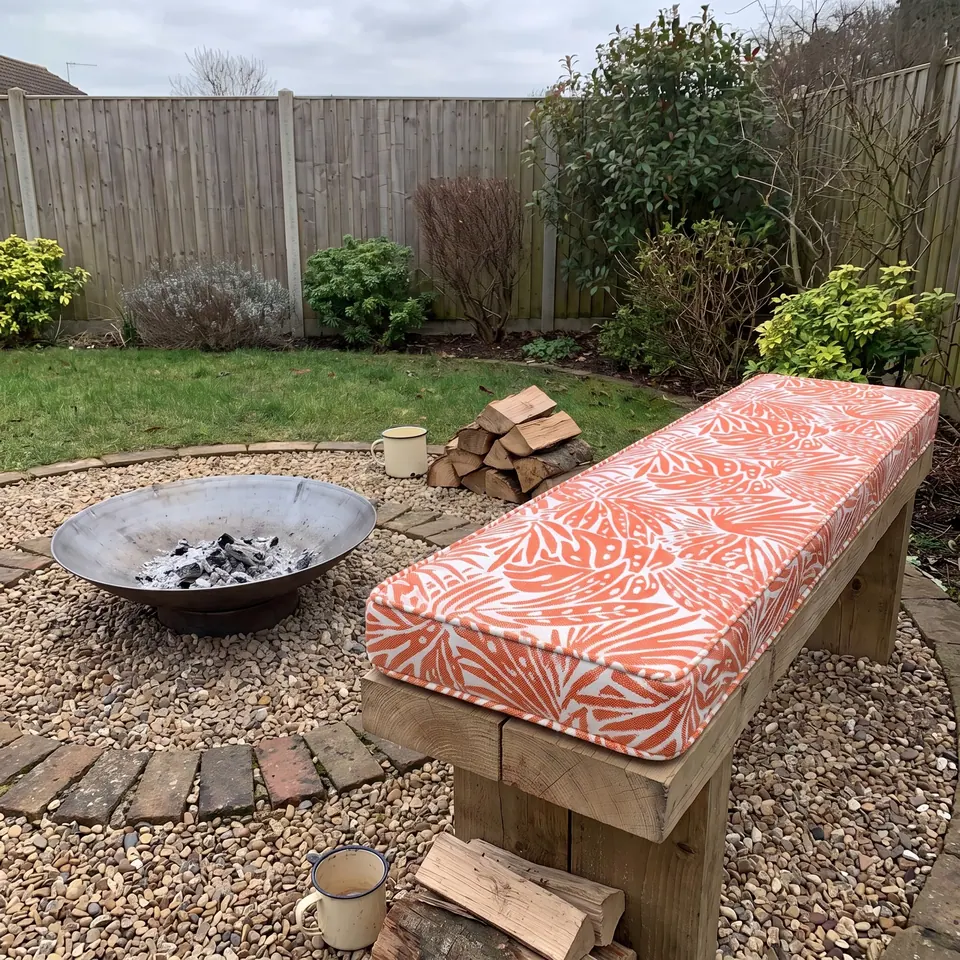
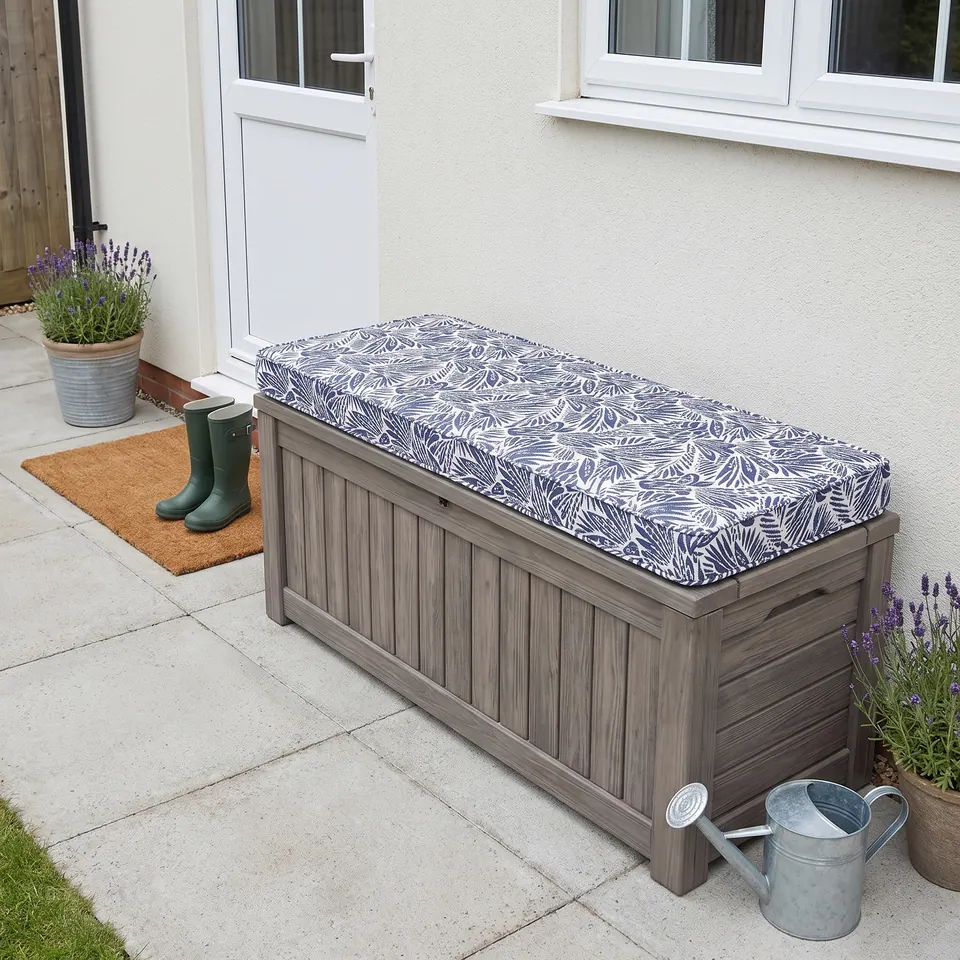
The pattern makes it possible. Large navy palm leaves on cream run from the top down the sides without a break, and the busy repeat swallows the seams. On a plain cloth an unpiped box edge can look unfinished; on a leaf this generous nobody hunts for the seam. Our Pattern on piping: matching, contrast or none sets out when to leave it off.
The color comes straight from the view. Ink navy is the sea at the horizon, cream is the dune, and the teak bench and rattan tray are the driftwood. An oatmeal linen throw hangs over the end, one soft layer against the crisp white railing. The glass of lemon water on the tray says what the bench is for.
Daylight never lies; your screen sometimes does. At the shore the light is bright and a little blue, and a deep navy holds its depth in it where a pale print would look washed out. Before you choose, look at a jacquard swatch outdoors in the light it will live in.
Borrow from outdoor, borrow from indoor
| Detail | Take from outdoor cushions | Take from indoor cushions |
|---|---|---|
| Edge | An unpiped box edge with a relaxed corner | Piping, when you want a tailored line |
| Pattern | A big repeat that hides sand and seams | The depth of a woven jacquard instead of a flat print |
| Fabric | Outdoor acrylic wherever rain reaches | Jacquard under a porch roof |
| Color | Navy and sand taken from the view | A throw in a room color to link porch and house |
| Care | Bring the cushions in before a storm | A zippered cover that comes off to wash |
A futon, three cushions and a four-inch deduction
A buyer wrote in with a futon frame and a problem with words: which number was length and which was width? The workshop sorted it out on paper. One seat, 67 x 23 in (170 x 58 cm). Two backrests, each 33 in (84 cm) wide.
Then it asked for the total back height, and reminded the buyer that the 4 in (10 cm) seat cushion would take up part of it. The back cushions came out 24 in (61 cm) tall. The set, with side pillows, was made in green khaki and arrived vacuum-packed. The buyer wrote back that the cushions turned out exactly as hoped.
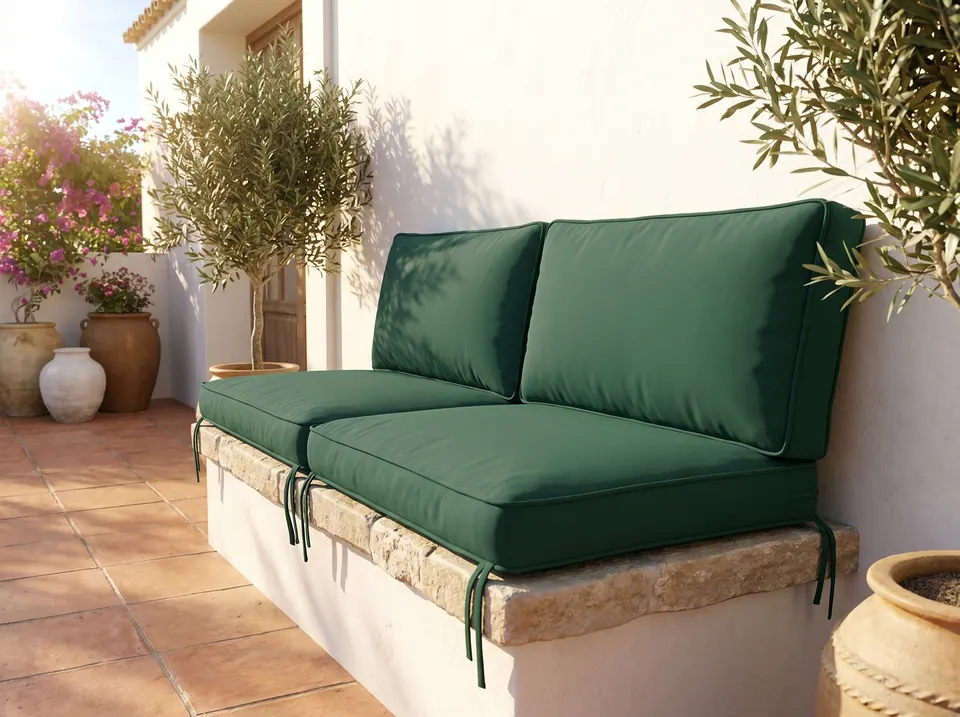
The lesson travels well from a futon to a porch bench: measure the back height from the frame, then take off the seat thickness before you order backrests. Our back cushion height Pattern shows the arithmetic, and the bench cushions in the Atlas show seat-and-back sets.
Does your porch bench have a back that wants a cushion too?
Buyer questions: seat and back, a short cushion, piping colors
- A common question
Can I order the same cushion for the seat and the back, and how should the back be sized?
The workshop's answerYes, many buyers order both. Back cushions are usually a little thinner and slightly narrower than the seat, so they stand better and don't eat into seat depth. If the back rests on the seat cushion, subtract the seat's thickness: a 17 in (43 cm) back on a 4 in (10 cm) seat fills a 21 in (53 cm) frame. Seat and back can be separate or joined to fold.
- A common question
My cushion came 2 in (5 cm) shorter than I ordered. What happens now?
The workshop's answerYou can keep it with a partial refund, or the workshop makes a new one at the correct size. In one case it remade a 20 x 40 in (51 x 102 cm) cushion.
- A common question
Can the piping be a different color from the cushion, and which colors can I pick?
The workshop's answerYes. Contrast piping is chosen from the same range as the fabrics. Pairings made so far include L-04 with L-16, L-02 with L-53, green corduroy COR-207 with cream COR-201, the n33 stripe with 110 brown, and linen with velvet piping.
On the cutting table: the beach porch bench
| Product | Bench cushion, one piece |
|---|---|
| Fabric | Jacquard with a large palm-leaf pattern |
| Colors | Ink navy on cream |
| Edge | Box edge with a plain top seam |
| Piping | None |
| Pattern | Wraps over the top and down the sides |
| Frame | Teak bench on a white porch |
| Placement | Covered porch; outdoor acrylic where rain reaches |
| Best for | Beach houses and relaxed coastal porches |

Have it made
Have this made — ask Élodie’s workshop
Describe the room at four in the afternoon: the floor, the wall, the one color you love. That is where a good fabric choice begins. — Élodie
Leave your details and the workshop will call you to confirm measurements, fabric, foam and piping. No prices, dates or payment on this page: it is a request, not an order.
An unpiped bench cushion needs a busy pattern: a big leaf repeat hides the seams, while on a plain cloth the same soft corner can look unfinished.
Élodie
Questions buyers ask next
Can a jacquard bench cushion stay on an open porch?
Only if the cloth is outdoor-rated. Rain and hard sun are the job of outdoor acrylic. Under a porch roof a jacquard gives a pattern depth that flat prints lack, and the cushion is easy to carry inside when weather turns.
Does a cushion without piping still hold a box shape?
Yes. The side panel gives a box edge its depth; piping only defines the seam line. Without it the corners round slightly under the fill, which reads relaxed rather than tailored, and suits a porch or a beach house.
Which colors suit a cushion on a beach-house porch?
Colors taken from the view: ink navy for the sea, cream or sand for the dunes, with teak and rattan as the warm notes. A deep navy also holds its depth in bright shore light, where pale prints can look washed out.
With color and care — Élodie