The Cushion Atlas · Chairs, swings & rockers
Custom couch cushions for the frame you already love
A well-built couch frame can wear out two or three sets of cushions in its life. This is where a new set starts: the seats, the backs and the T-shaped cushion that wraps around an armchair's arms.

- 6photographs
 Save
The quick answer
Custom couch cushions are new loose seat and back cushions cut to the frame you already own: box seats, T-cushions, back pillows and bolster arms for sofas, loveseats, settees and armchairs. Seats use firm, about 2.0 lb/ft³ (32 kg/m³) high-resilience foam in a polyester fiber wrap, with a softer 28-density option. If the foam is still sound, zippered covers alone will do.
Shapes to choose from
- Chair pad88 readings
- Rocker & glider2 readings
- Porch swing12 readings
- Papasan1 readings
- Ottoman3 readings
- Custom Seat
- Sofa
- Round, Oval
Every one is cut to your measurements. The number is how many readings the atelier has published for that shape.
Sizes & measuring
On the cutting table: measuring a couch for cushions
Measure where the cushion sits, not the outside of the frame, and label every number.
| Seat length | Inside the arms, arm to arm; divide by the number of seats |
|---|---|
| Seat depth | Front edge of the deck to the back frame, straight |
| Seat thickness | Match the old cushion to keep the look; published guides put most couch seats at 4 to 6 in (10 to 15 cm) |
| Back height | From the top of the seat cushion up, or the frame height minus the seat thickness |
| Back thickness | Often thinner and softer than the seat |
| T-cushion | Trace it on paper, including the step in front of each arm |
| Covers only | The bare foam: length, width and thickness |
| Tolerance | Cut to your exact numbers; handmade foam can vary by about 1/2 in (1 cm) |
| Ordering | Choose the nearest size, then write the exact one in the personalization box |
Most couches outlive their cushions
Most couches outlive their cushions. The frame stays square for decades; the seats sink, the backs slump, and the store that sold them changed its line long ago. A seam is a promise, and a good frame has earned a second set of them.
This part of the Atlas covers custom couch cushions: the loose seat and back cushions on indoor sofas, loveseats, settees and armchairs. Box seats, T-cushions, back pillows and bolster arms; seat only or seat and back; new foam, or new cushion covers over foam that is still sound. The workshop cuts them from your measurements, or copies the old ones from photos and dimensions. For the full routine on tired seats, start with replacement sofa cushions.
What the workshop doesn't do matters as much. It doesn't sew drape-over slipcovers for a whole sofa or re-upholster fixed backs or arms; if it is stapled to the frame, it belongs to an upholsterer. Floor sofas are their own product, under modular floor sofas.
Box seats, T-cushions, backs and bolster arms
A box seat is the plain one: a top, a bottom and a boxed band, usually piped. Three on a three-seat sofa, two on a loveseat, perhaps one long one on a settee. One long seat gives an unbroken line, but past about 79 in (2 m) a single piece gets hard to make, ship and lift.
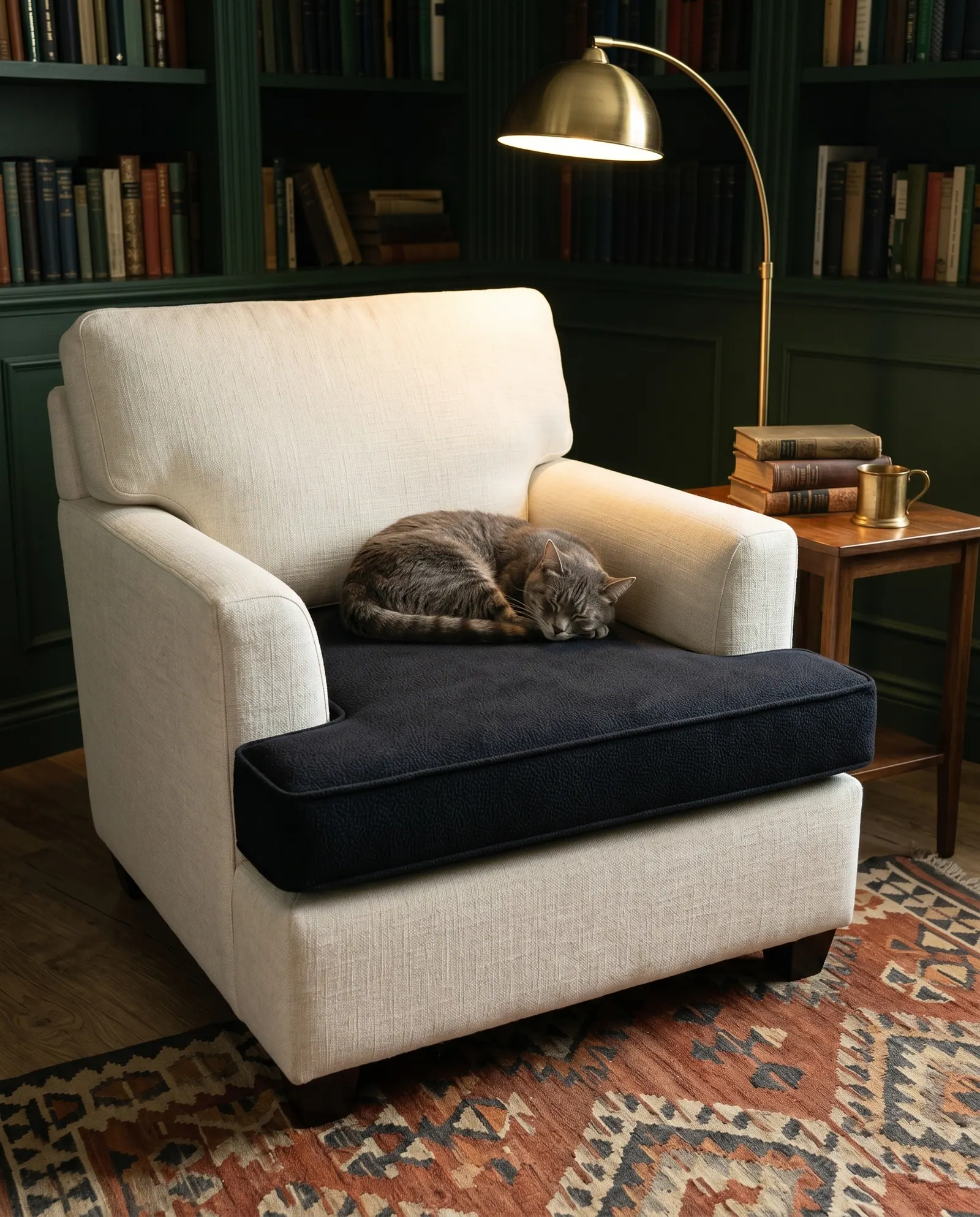
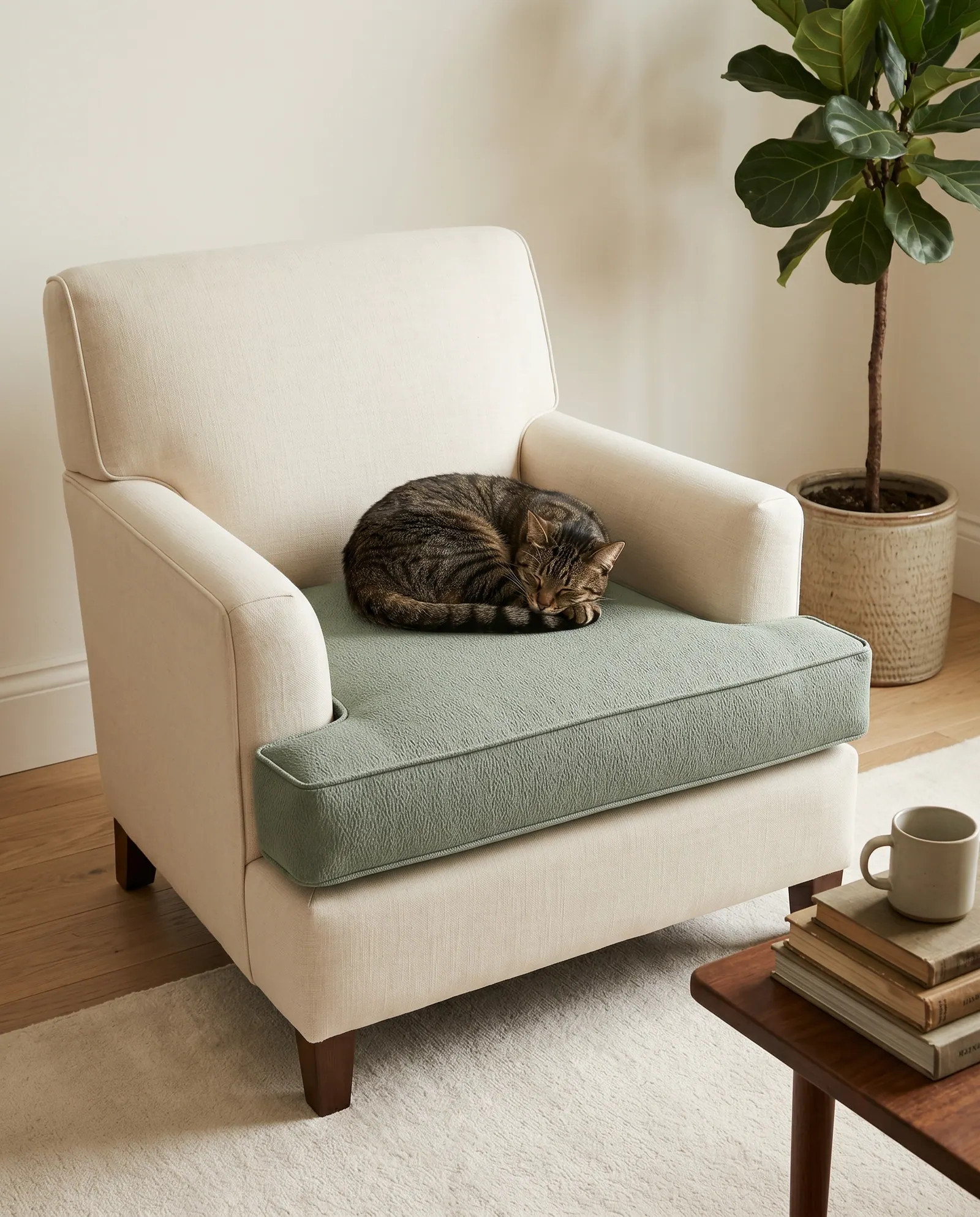
A T-cushion widens in front of the arms so the seat reaches edge to edge. The black and sage replacements in the gallery sit on cream armchairs, their steps fitted snugly around the arms. Trace a T rather than guessing the notch; published replacement guides even letter its edges A to F. The T-cushion measuring Pattern has the tracing.
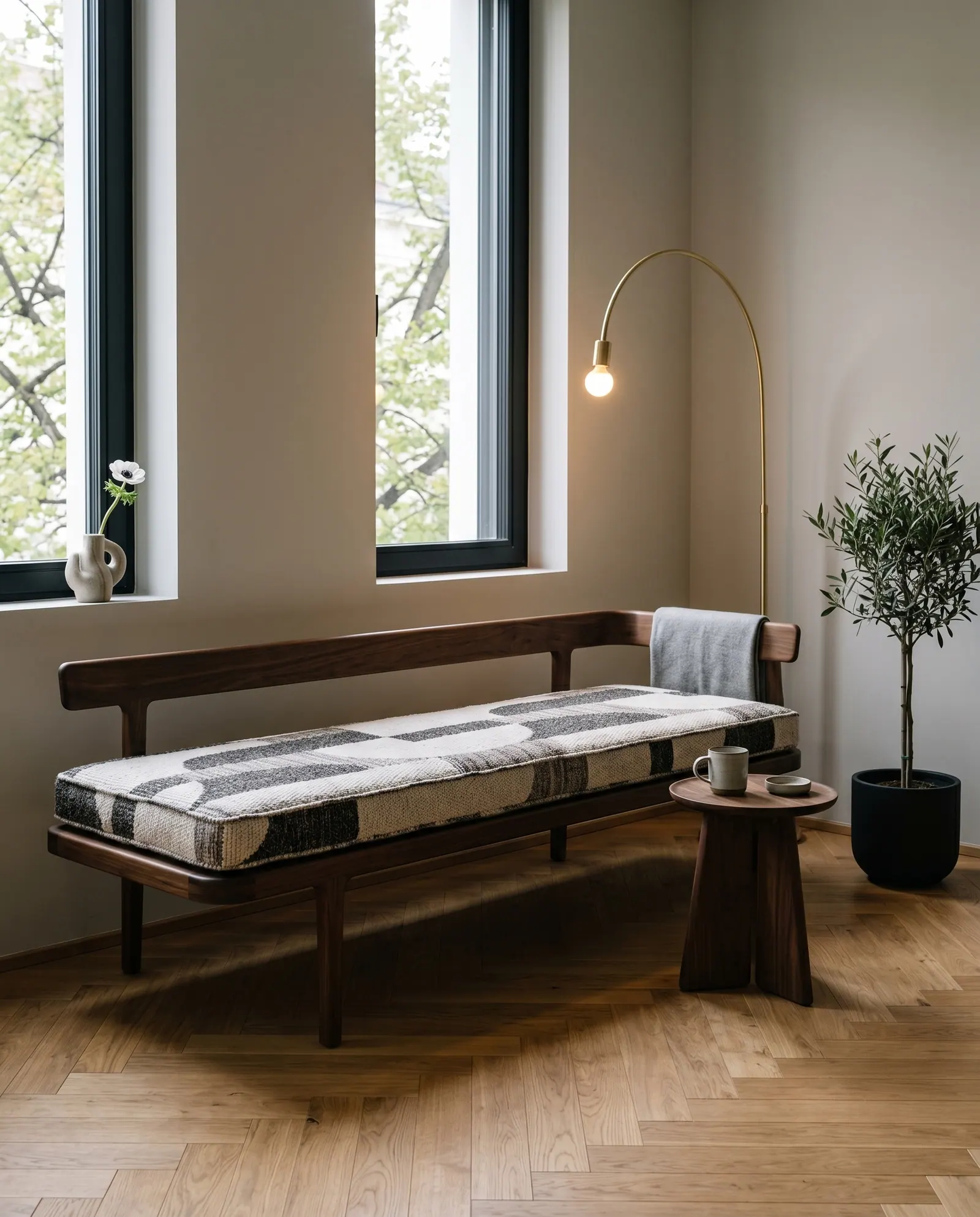
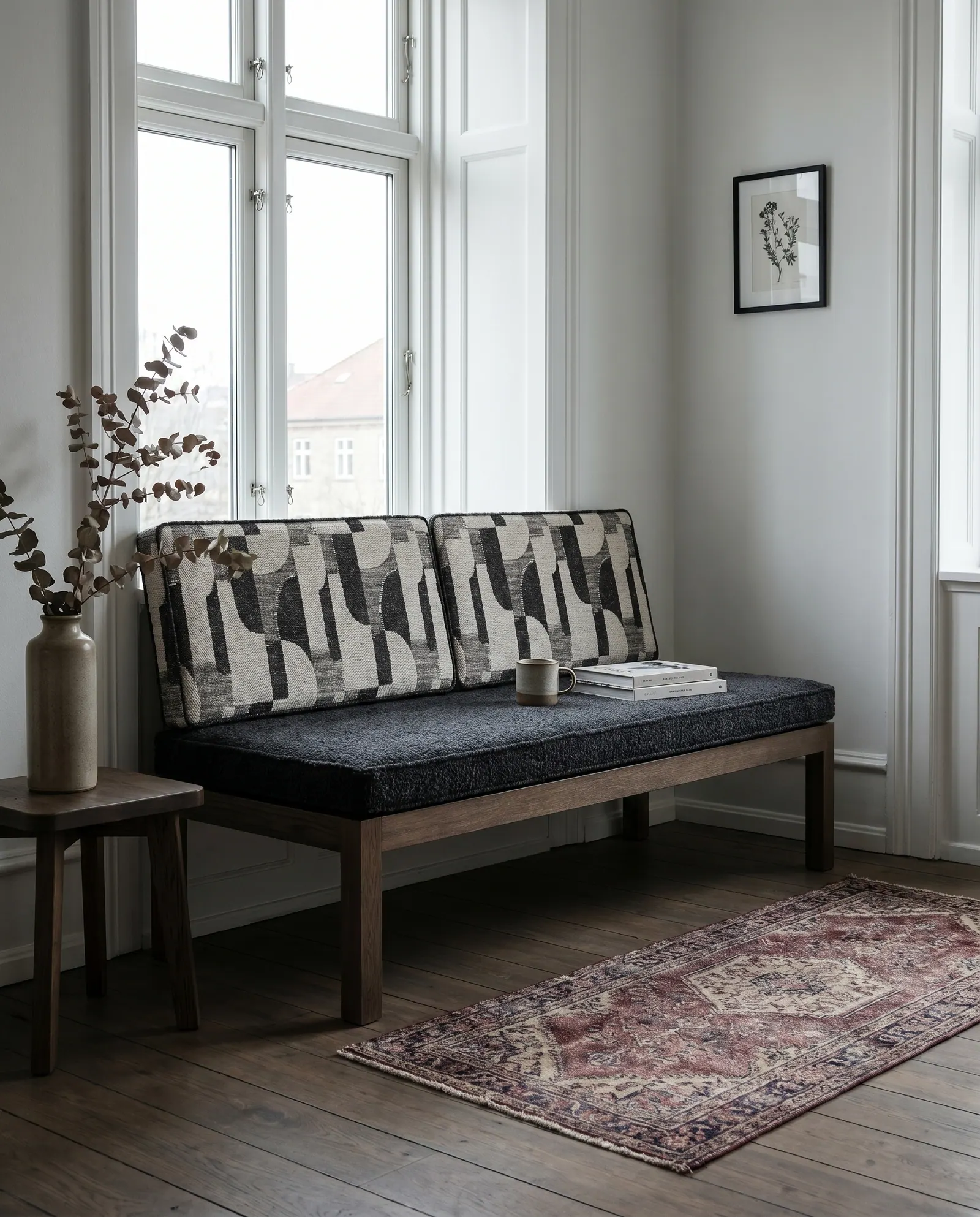
Backs come as separate rectangles made to the seat's length, or split into two or three along a long wall so they sit upright. The walnut bench in the gallery wears two short backs instead of one long one, and reads like a small two-seater for it. Round arm rolls are in bolster pillows, backs in backrest cushions.
One buyer in the US sent photos of an armchair with its seat and back measured at 22 x 22 in (56 x 56 cm) each. The workshop copied both in charcoal linen, and word came back that they fit perfectly.
What goes inside: firm seats, softer backs
Seats get 32 kg/m³ foam, about 2.0 lb/ft³: a high-resilience foam with a medium-firm feel that holds its shape for years. Each block is wrapped in polyester fiber wadding, which rounds the edges and fills the cover out. If you like to sink in a little, write 28-density foam in the personalization box; it sits noticeably plusher. Feather-wrapped foam isn't on the menu, so ask the workshop before planning anything down-filled.
Backs are usually softer: shredded foam, cut on the workshop's own machine, or fiber, in a separate inner case so the outer cover comes off for washing. A solid-foam back can be made too. Many buyers pair a firmer seat with a slimmer back, such as 4 in (10 cm) backs on an 8 in (20 cm) seat, which also lowers the quote.
New firm foam is cut a touch larger than its cover so it fills the fabric; don't trim it. More in fiber-wrapped foam, shredded foam or wedge backs, foam inserts and the foam firmness finder.
Plain cloth for the seat, pattern for the back
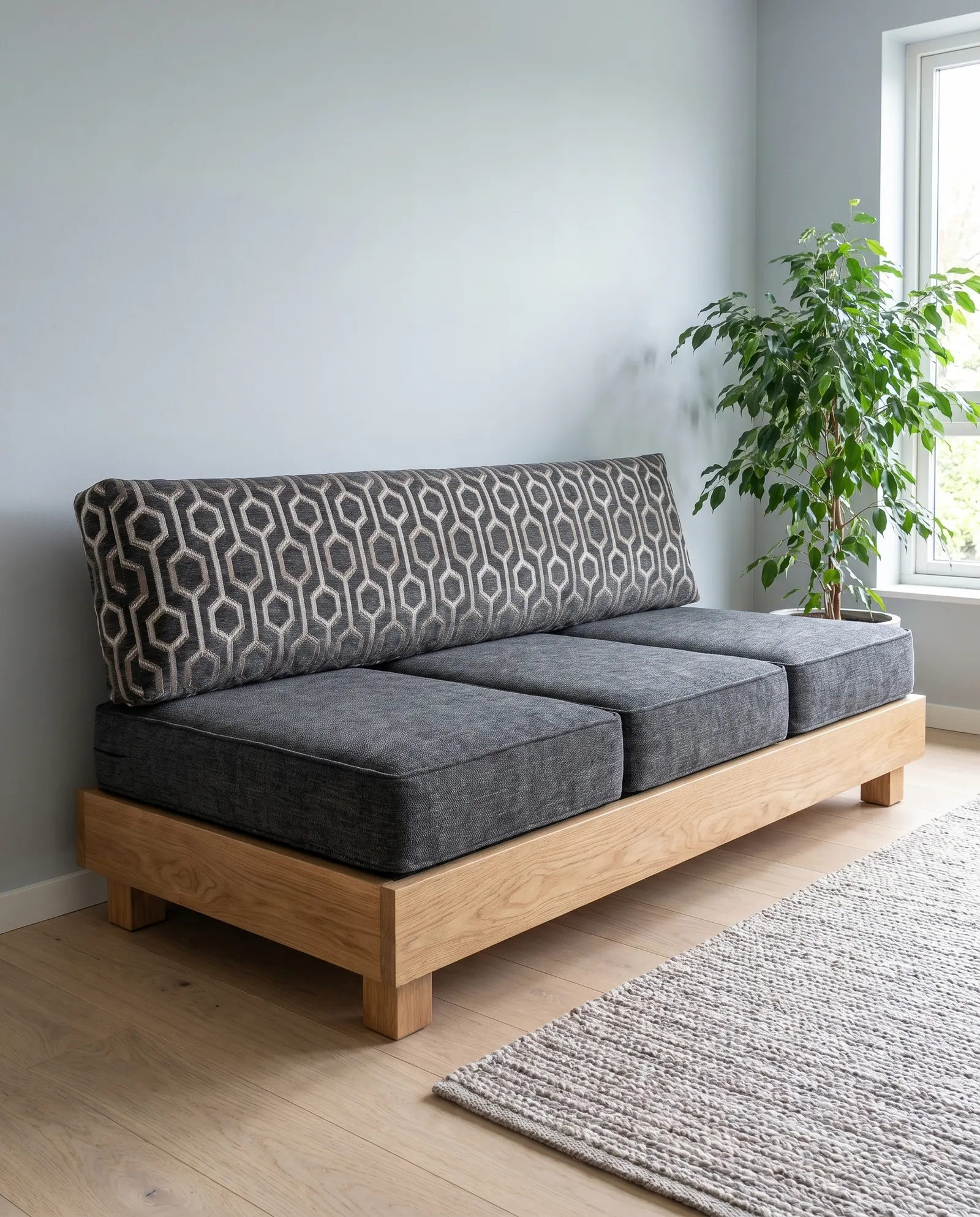
The seat takes the denim, the crumbs and the dog. The back gets looked at. The low oak platform sofa at the top of this page understands that: three plain charcoal seats, self-piped so each throws a neat shadow line, under a charcoal and cream hexagon jacquard back that carries the pattern at eye level.
For seats, choose a tight weave that forgives. Velvet takes daily wear better than people expect, linen-look fabrics are the quiet workhorse, and the performance and pet-friendly weaves suit busy households. Bouclé is soft, though its loops can snag where claws land. On the walnut loveseat in the gallery, an unpiped black and cream block weave wraps the edge unbroken, like a woven mat laid on the frame.
Order every cushion that sits side by side at once, so they share one dye batch and age together.
A bare frame, three seats and three backs
A buyer in the US wrote with a sofa frame and no cushions at all: 67.5 in (171 cm) long, 27.5 in (70 cm) deep and 21 in (53 cm) high at the back. That frame lived outdoors, so its cushions came from the outdoor range, but the arithmetic is the same in any living room.
The length divided evenly into three seats of 22.5 x 27.5 in (57 x 70 cm), each 4 in (10 cm) thick, filling the frame. The backs stand on the seats, so their height is the frame height less the seat: 21 minus 4 leaves three backs of 22.5 x 17 in (57 x 43 cm), also 4 in thick. Before anyone cut, the buyer and the workshop settled which number was which: length side to side, width front to back.
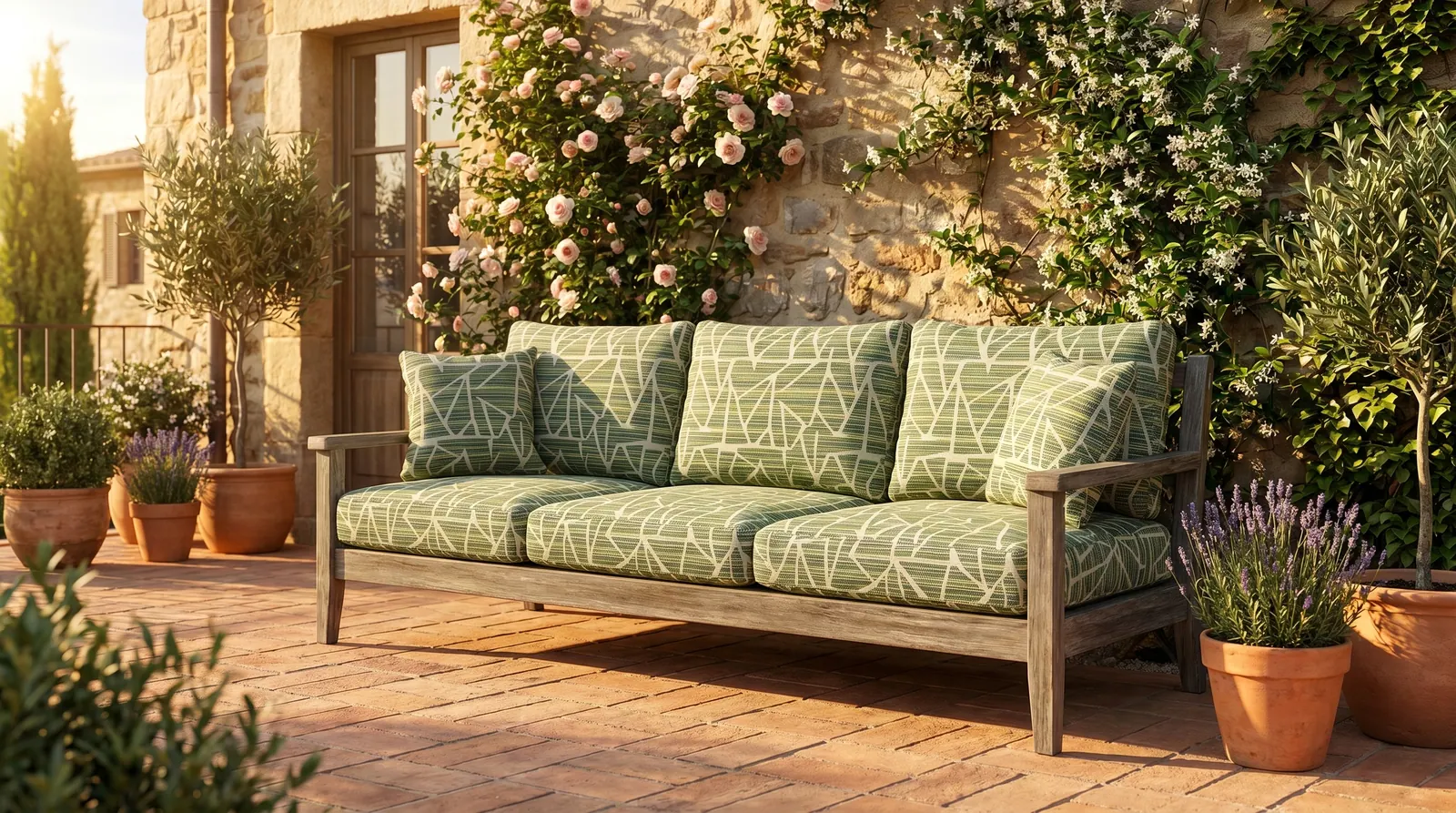
The weathered teak sofa in the gallery wears the same three-and-three split. More frames rebuilt this way are in sofa frame cushion rebuilds and loveseat and settee cushions. What does your frame measure inside the arms, my friend?
- What it taught
- Divide the frame length evenly, and size the back from the frame height minus the seat thickness.
New cushions, covers only, or a copy of the old set
| New cushions | Covers only | Copy the old set | |
|---|---|---|---|
| Choose it when | The foam has sagged, or there are no cushions | The foam is still firm and square | The old cushions fit the way you liked |
| What to send | Frame measurements and photos | Bare foam length, width and thickness | Photos plus each cushion's dimensions |
| What you get | Foam, fiber wrap and a zippered cover | Zippered covers, no filling | New foam and covers at the same sizes |
| What drives the quote | Size, thickness, shape and fabric | Size and fabric, piece by piece | Size, thickness and fabric |
| Watch for | Measuring the outside of the frame | A new cover over slouchy foam stays slouchy | Copying a cushion that never fit |
Open a swatch family
- VelvetDense pile, deep color
- Linen-Look WeavesWoven texture, easy care
- Performance & Pet-Friendly WeavesTight weaves for busy homes
- Bouclé & TeddyLooped, cloud-soft texture
Open a family for its swatch book, care notes and neighbors.
Where couch cushion orders go wrong
- Measuring the outside of the frame instead of inside the arms and in front of the back.
- Giving one size for seat and back. They are separate pieces; send each.
- Sizing backs from the bare deck. A back standing on a 4 in seat is 4 in shorter than the frame opening.
- Mixing up length and width. Write down which number runs side to side.
- Ordering covers for foam that has gone soft. The new cover keeps the old slouch.
- Asking for a stretch cover over soft, rounded cushions. It won't sit snugly, and the workshop will say so before you commit.
- Adding one new seat to a faded set. A fresh dye batch rarely matches older neighbors.
Photographs from the workbench
Open any photograph large; each one has its own link and a Save button.
 Save
 Save
 Save
 Save
 Save
Measure a couch where the cushion sits: inside the arms and in front of the back. The outside of the frame never held anybody up.
Harlan
Buyer questions
- A common question
Can you copy the seat and back cushions on my armchair?
The workshop's answerYes. Send photos of the chair with the dimensions of each cushion and the workshop replicates them, quoting per chair; ask it to spell out shipping in the quote. One armchair got a 22 x 22 in (56 x 56 cm) seat and a matching 22 x 22 in back in charcoal linen, and the buyer said they fit perfectly. Thinner foam costs less than thick, and same-color piping costs nothing.
- A common question
Do the back cushions have to be as thick as the seats?
The workshop's answerNo. Each cushion is its own piece, so seat and back can match or differ. Many buyers choose a thicker, firmer seat with a thinner or softer back, such as 4 in (10 cm) backs on an 8 in (20 cm) seat, which also lowers the price. Backs are usually a little narrower too, so they stand upright without eating into the seat. If the back rests on the seat, subtract the seat thickness: a 17 in back on a 4 in seat fills a 21 in frame.
- A common question
My sofa foam is still good. How much do covers alone save?
The workshop's answerA good deal, because no foam is included. In real quotes a cover came to roughly a third to two-thirds of the same cushion with foam, with the biggest saving on large, thick pieces. Covers are quoted per piece by size and fabric, several covers in one order often get a better rate, and piping and ties can be included. Six zippered covers took one to two weeks from order to delivery in one case.
- A common question
Could you make one stretchy elastic cover for my sofa seat and back instead?
The workshop's answerA one-piece elastic cover over an existing seat and back can be quoted, but the craftsmen warn it may not sit snugly on cushions that aren't square with crisp edges, and the workshop shares that risk before you commit. Mattress covers are made with a zipper only. For a daybed used as a sofa, an open-bottom skirted cover has been made instead.
- A common question
Will the back cushion be the same length as the seat?
The workshop's answerOn sets, yes: the back is made to the seat's length. The standard back is 16 in (40 cm) tall and 4 in (10 cm) thick. Height can be set anywhere from about 8 in (20 cm) up to 16 in or taller, the top can be rounded, and a long back can be split into two pieces or made to custom dimensions.
- A common question
What size topper pad should I order for my couch seat?
The workshop's answerGo slightly larger than the seat. For a 54 in (137 cm) couch, a 55 in (140 cm) pad fits more naturally and covers the sides, while an exact 54 in can end up tight. Toppers are made to exact size, their real finish is flatter than a heavy quilted look, and several whites exist, so give the color code.

Have it made
Have your couch cushions made — ask Harlan’s workshop
The best cushions I have known began with somebody asking one more question. Ask yours here. — Harlan
Leave your details and the workshop will call you to confirm measurements, fabric, foam and piping. No prices, dates or payment on this page: it is a request, not an order.
Couch cushion questions, answered plainly
Can you re-cover a sofa whose back is attached to the frame?
No. Fixed backs and arms are upholstery work, and drape-over slipcovers for a whole sofa are outside the workshop too. What can be made is anything loose: seat cushions, back cushions, bolsters and zippered covers for each of them, in your sizes.
How firm will new couch seat cushions feel?
Medium-firm. The standard seat foam is about 2.0 lb/ft³ (32 kg/m³) high-resilience foam in a polyester fiber wrap, which holds its shape without sitting like a board. For a plusher sit, ask for 28-density foam in the order note.
Is a finished couch cushion exactly the size I ordered?
It is cut to your exact numbers, not rounded, but handmade foam cushions can vary by about 1/2 in (1 cm). Measure the cushion itself rather than the outer edge of the piping, and if the finished size must include the piping, say so in the order.
Where does the zipper sit on a sofa seat cushion?
On the back edge, facing the frame, or on the underside, and you can choose the side. Every foam cushion gets a fully removable zippered cover at no extra cost, so the foam can come out and the cover can go into a gentle 86°F (30°C) wash.
Sit well. — Harlan
The Pattern Room
Patterns and sketches
- The Pattern RoomDown-wrapped or all-foam? Choosing the top of a seat cushion
- The Pattern RoomMeasuring a T-cushion for an armchair or sofa, ear to ear
- The Pattern RoomSlipcover, new covers or new cushions: pick the right fix
- Concept SketchesLoveseat cushions: one long seat or two, from real two-seaters
- Concept SketchesA sofa frame with no cushions: eight rebuilds from past orders