The Cushion Atlas · Chairs, swings & rockers
Round seat cushions, ovals and geometric shapes, cut to your seat
A circle needs two numbers. An oval needs a drawing. A hexagon needs two numbers again, if you pick the right two. Here is which shape wants what, and where the limits are.

- 7photographs
 Save
The quick answer
Round seat cushions are ordered by diameter and thickness, for example 16 in (41 cm) across and 4 in (10 cm) thick for a café bar stool. Ovals, half-rounds and D-shapes need a measured drawing or a paper template, hexagons need point-to-point and flat-to-flat widths, and round floor cushions go up to about 49 in (125 cm). Strong curves are reviewed before anyone promises a fit.
Shapes to choose from
- Chair pad88 readings
- Custom Seat
- Corner pouf64 readings
- Floor cushion4 readings
- Trapezoid18 readings
- Bay window43 readings
- Papasan1 readings
Every one is cut to your measurements. The number is how many readings the atelier has published for that shape.
Sizes & measuring
On the cutting table: rounds and shaped orders
| Round seat pad | Diameter and thickness; custom diameters welcome |
|---|---|
| Round floor cushion | Custom diameter up to about 49 in (125 cm); 59 in (150 cm) isn't possible |
| Quarter-round corner | Two wall sides; 48 in (122 cm) is the standard maximum |
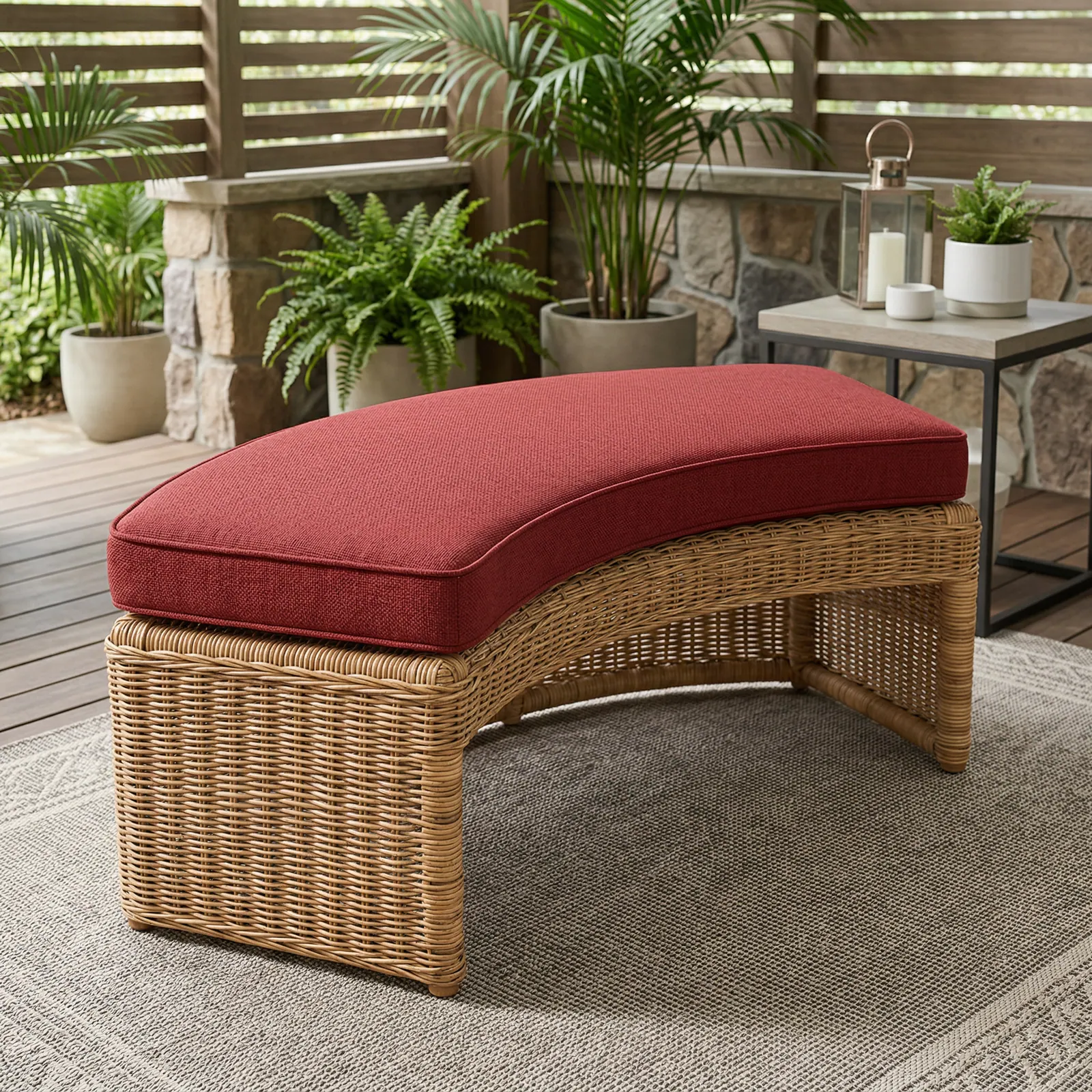
| Thickness | 2 in (5 cm) is the thinnest standard; 2 to 3 in (5 to 8 cm) suggested for curved benches |
| Zipper | On the edge facing the chair back or wall, or underneath; you choose the side |
| Drawing | One per shaped cushion, redrawn by the workshop for your approval |
| Time | Curved and complex shapes take longer than plain rounds; ask for current times |
| Not supplied | Stool bases, chair frames and legs |
Fabrics that work
- Linen-Look WeavesWoven texture, easy care
- VelvetDense pile, deep color
- Bouclé & TeddyLooped, cloud-soft texture
- Jacquard & DamaskWoven pattern, chenille
- Outdoor Acrylic & Solution-DyedMade for sun and weather
- CorduroySoft ribs, cozy hand
Open a family for its swatch book, care notes and neighbors.
Sixteen by sixteen is a square
Write '16 x 16 in' on an order and you will get a square. Write 'round, 16 in diameter, 4 in thick' and you get the circle you meant. That is most of what round seat cushions ask of you: name the shape in words, then give the numbers that define it.
Each shape has its own short list. A circle is one number plus thickness. An oval needs its outline. A half-round is a chord and a rise. A regular hexagon is two widths. Anything that bows unevenly is a paper template. Angles are just lengths in disguise; curves are lengths that won't sit still.
Slanted rectangles live under trapezoid cushions, quarter-rounds under corner floor cushions, and every family sits side by side in the cushion shapes chart. What shape is the seat in front of you, partner?
Seven shapes, and the numbers each one needs
| Shape | Order it by | from past orders | Watch for |
|---|---|---|---|
| Round | Diameter and thickness | Café bar-stool rounds, 16 in (41 cm) across, 4 in (10 cm) thick | Two different widths mean an oval |
| Oval | A traced template with the widest width and the depth on it | An oval wicker loveseat cushion with rounded corners | Length and width alone can't fix the curve |
| Half-round or D-shape | Chord and rise, or width, depth, straight sides and the arc's diameter | A D-shaped seat about 66.9 x 47.2 in (170 x 120 cm), drawn as a rectangle plus an arc | Mark where each curve starts and ends |
| Quarter-round corner | The two straight sides along the walls | 48 x 48 in (122 x 122 cm), arc about 75.4 in (191.5 cm) | Never the diagonal, never the curve |
| Hexagon | Point to point and flat to flat, on a reference drawing | About 4 x 4.6 ft (122 x 140 cm) for a play structure | Flat to flat is about 0.87 of point to point |
| Octagon or odd polygon | Every side, plus the depth at each break | Pentagon- and hexagon-shaped bay seats, made regularly | Octagons: send the drawing and ask the workshop |
| Curved bench | Inner and outer curve, end-to-end length, depth at ends and middle | Long curves made as matching segments | Kidney and banana curves may be declined |
Small rounds: bistro chairs, bar stools, rope seats
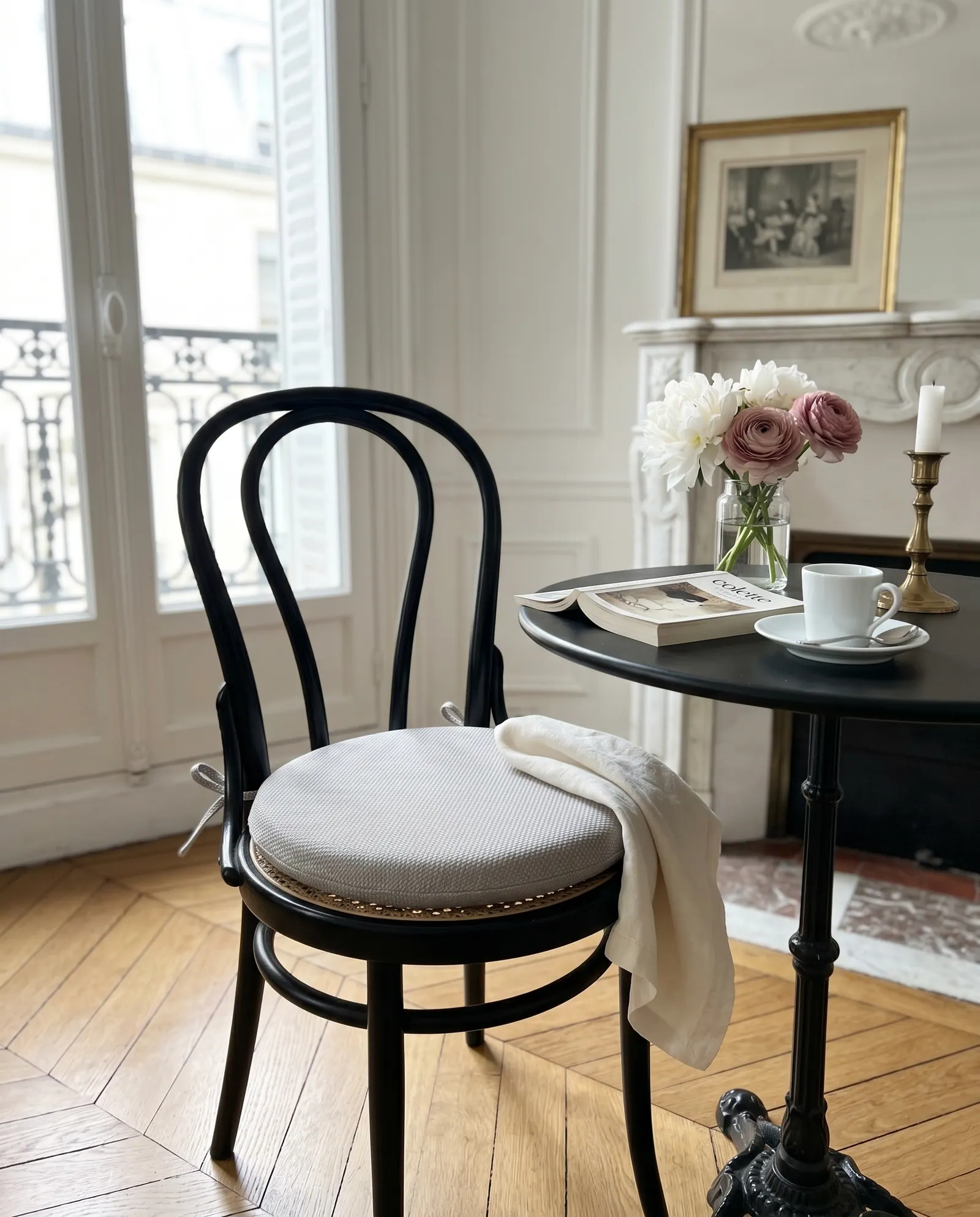
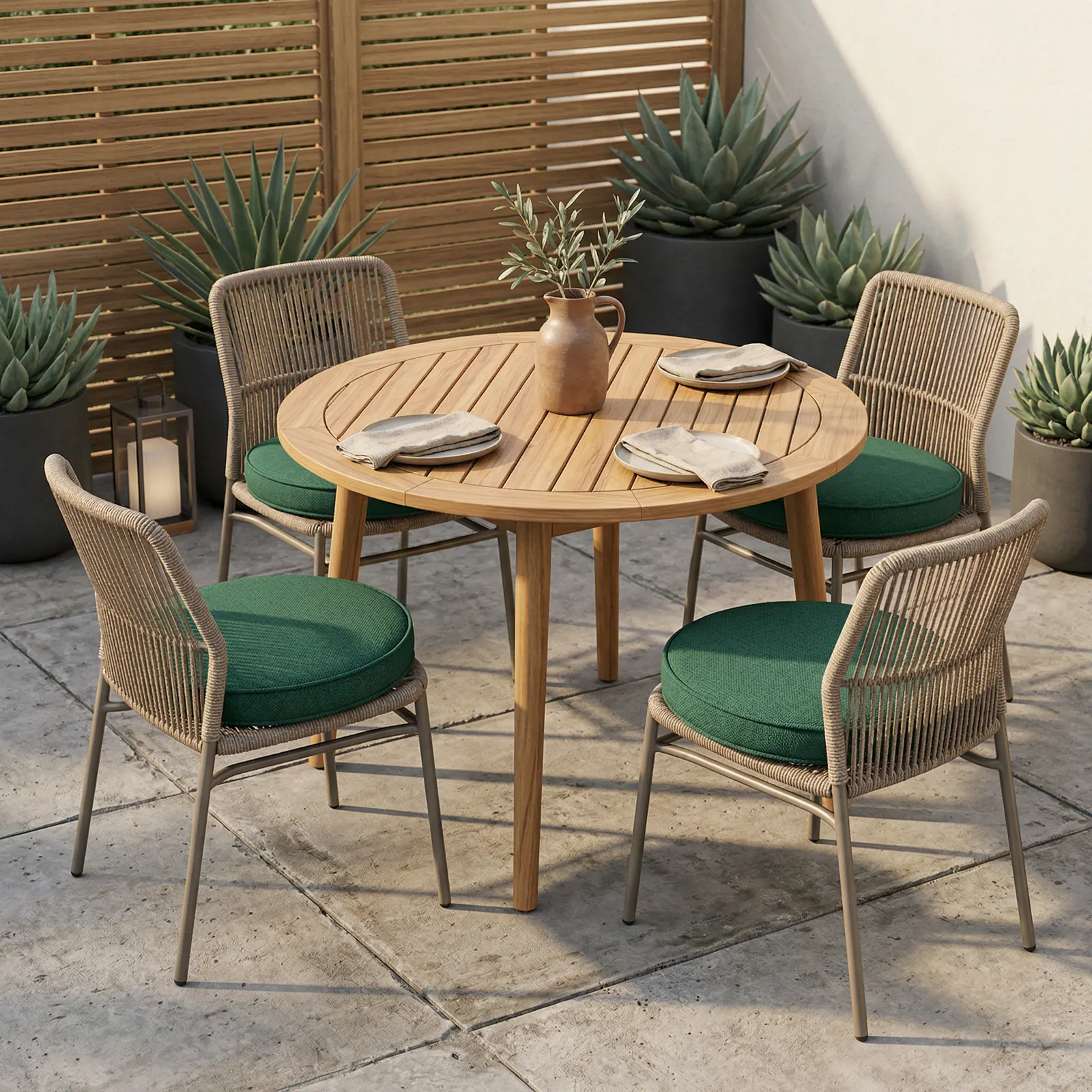
The dove gray pad in the lead photo shows the rule for a bentwood chair: the circle stops just inside the wooden rim, so the cane still shows, and pale ties at the back hold it. The forest green rounds in the gallery sit inside rope-woven dining chairs, where a square pad would push its corners through the weave.
Measure across the widest point, then again at 90°. Equal numbers: a circle. Unequal: an oval, and an oval gets a template. One custom maker's guide suggests 2 to 4 in (5 to 10 cm) for bar and counter stools and 3 to 5 in (8 to 13 cm) for bistro chairs. Café owners here ordered 16 in (41 cm) rounds 4 in (10 cm) thick for heavy daily use.
More small seats are in the bistro chair and bar stool sketches, and the chair cushion builder draws a round pad in 3D.
Big rounds, quarter-rounds and the 49-inch ceiling
Round floor cushions are cut to your diameter up to about 49 in (125 cm); a 59 in (150 cm) request got a plain no. Order the nearest listed size and write the exact diameter in the note: a 33 in (84 cm) round went through the 32 x 32 in option. See custom round diameters and the largest round and corner sizes.
A quarter-round is a quarter circle, so its arc is π × r ÷ 2. At 48 in (122 cm) a side, that is 75.4 in (191.5 cm) of curved front edge. Check it against the room: one buyer with a 58 in (147 cm) corner priced the larger size, then kept 48 x 48 in because it suited a small room better.
Past the ceiling, think in pairs. Two corner cushions side by side against a flat wall read as a half circle, and the workshop makes them into that shape. The quarter-circle sizing Pattern has the arithmetic.
Hexagons, octagons and a pattern that isn't a shape
A regular hexagon needs two numbers: point to point across the corners, flat to flat across the sides. A buyer in the US wanted one about 4 x 4.6 ft (122 x 140 cm) for a play structure roughly 55 x 55 in (140 x 140 cm), and the workshop sent a reference drawing with those two places to mark. Check: 48 ÷ 55.2 = 0.87, what a regular hexagon gives. Nothing else was needed.
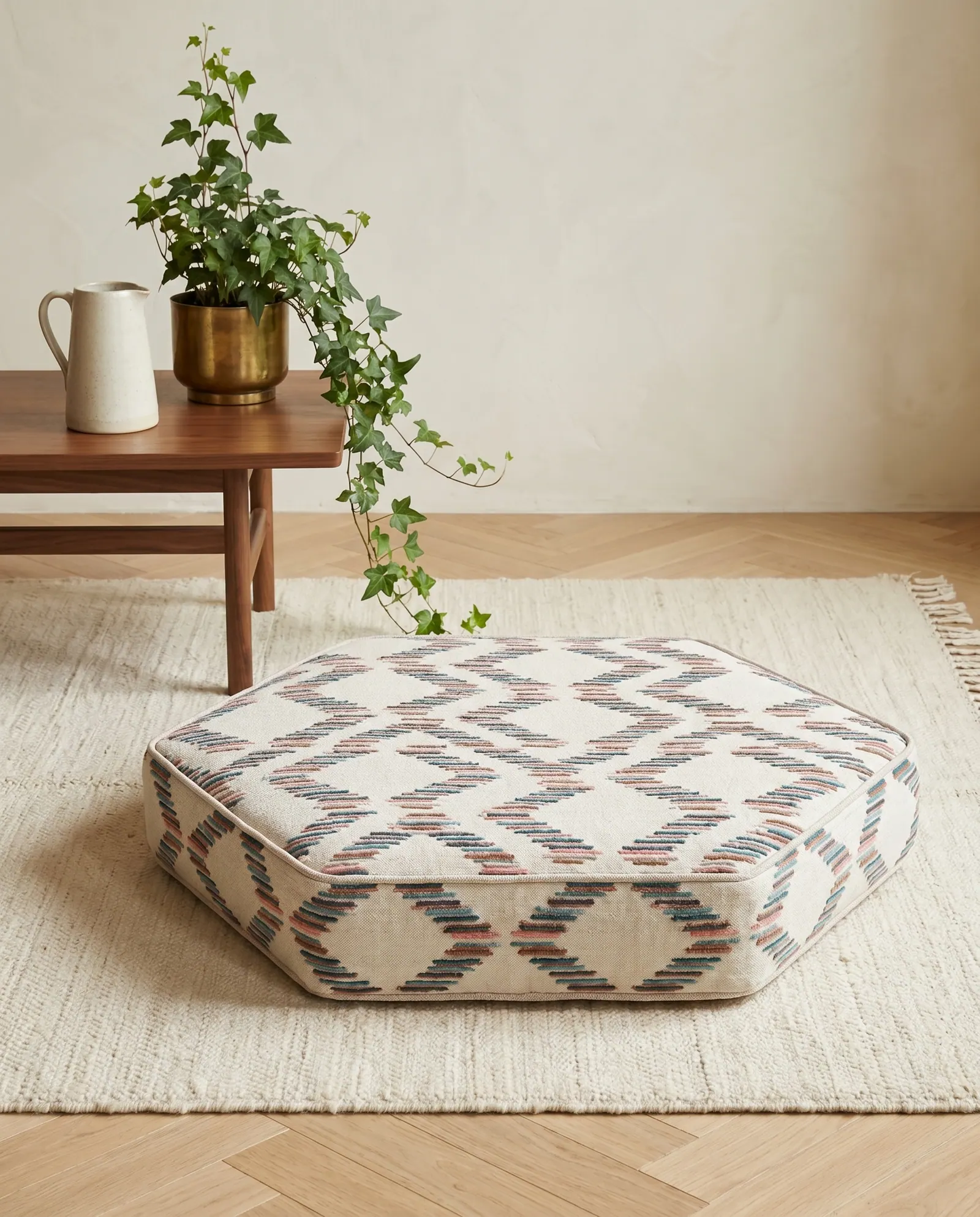
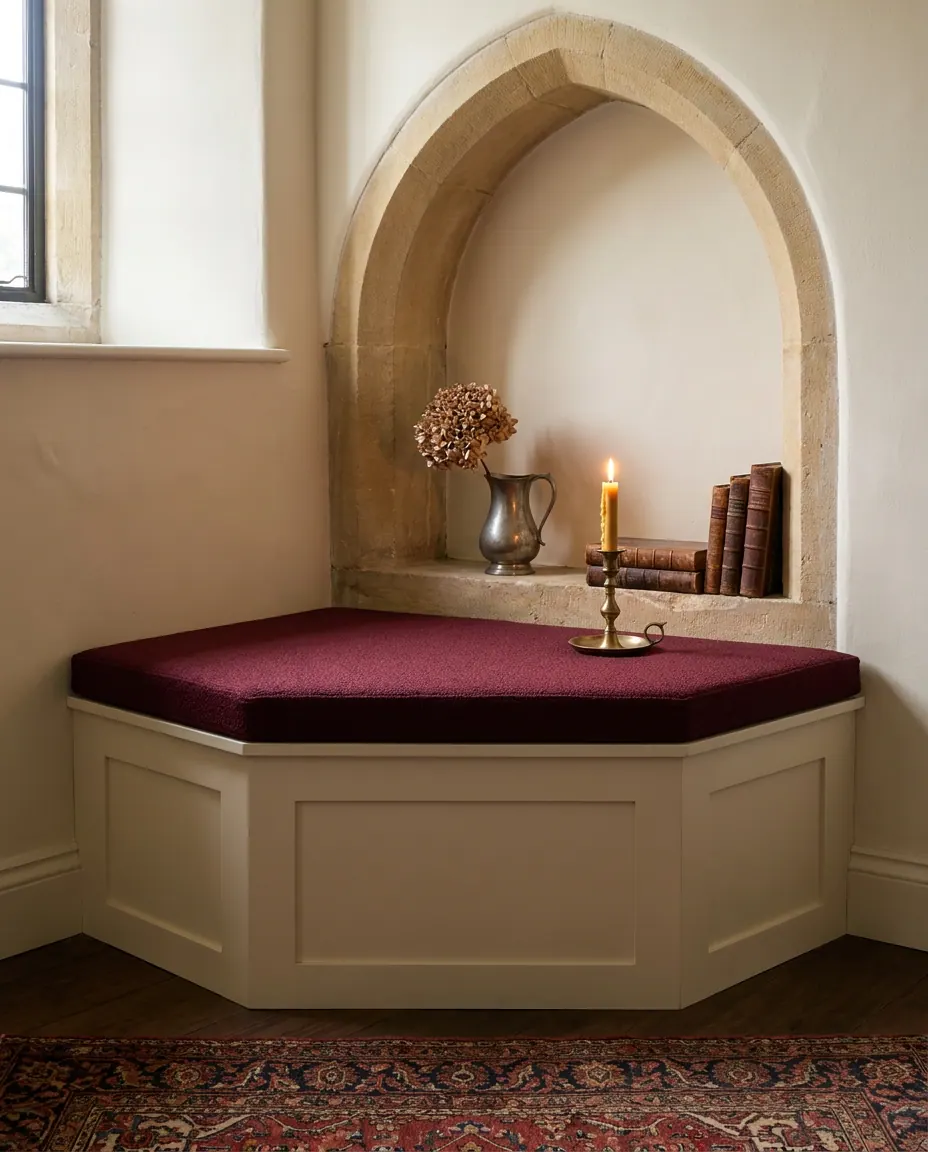
The cream zigzag floor cushion in the gallery is the six-sided idea at living-room scale: no corner to catch a shin. The burgundy bouclé seat under the stone arch is a half-hexagon cut to its paneled base. Big custom makers' shape menus list five- and six-sided polygons and semicircles; here each one starts as a drawing. The hexagon and octagon Pattern covers octagons, and chord, rise and radius covers half-rounds.
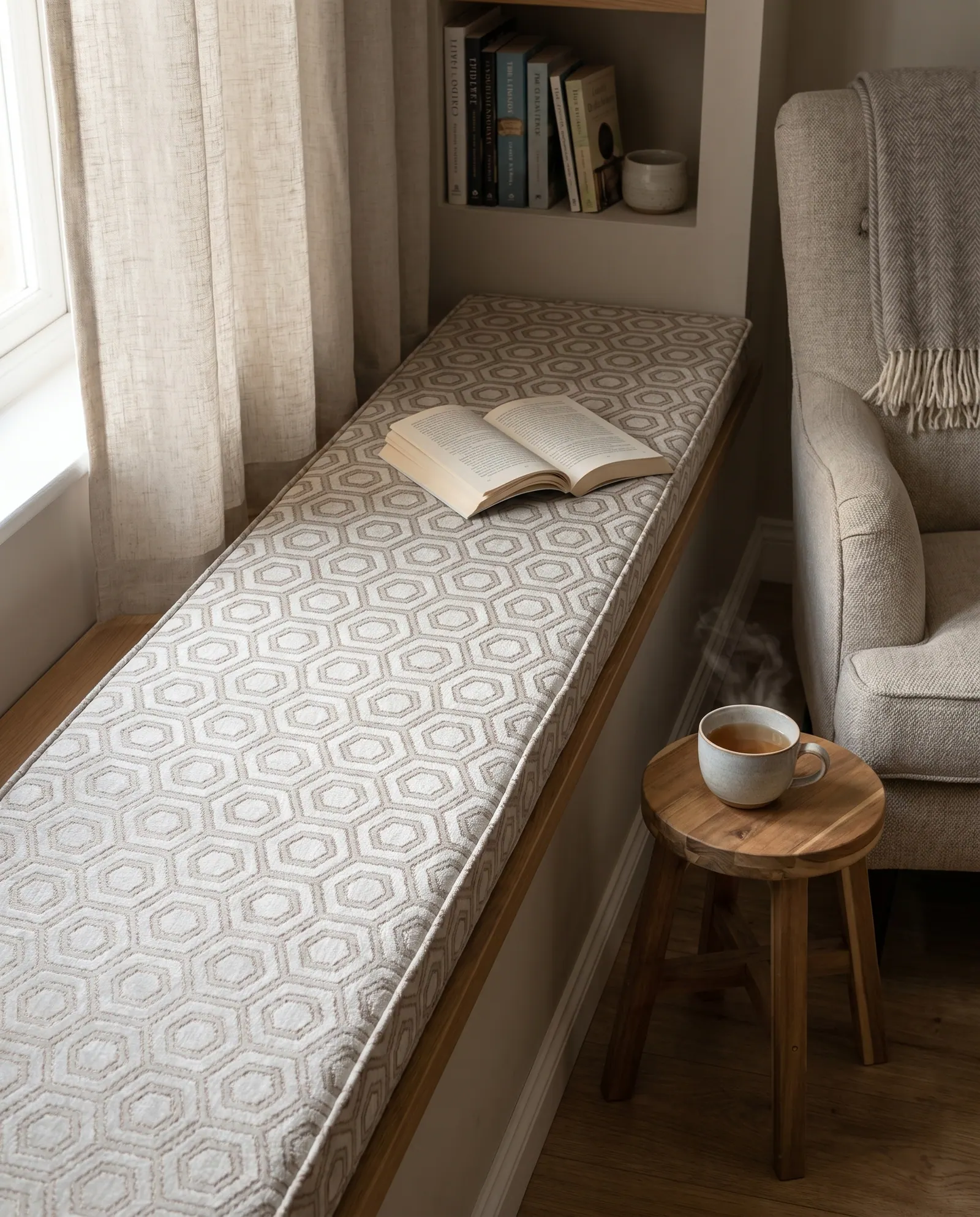
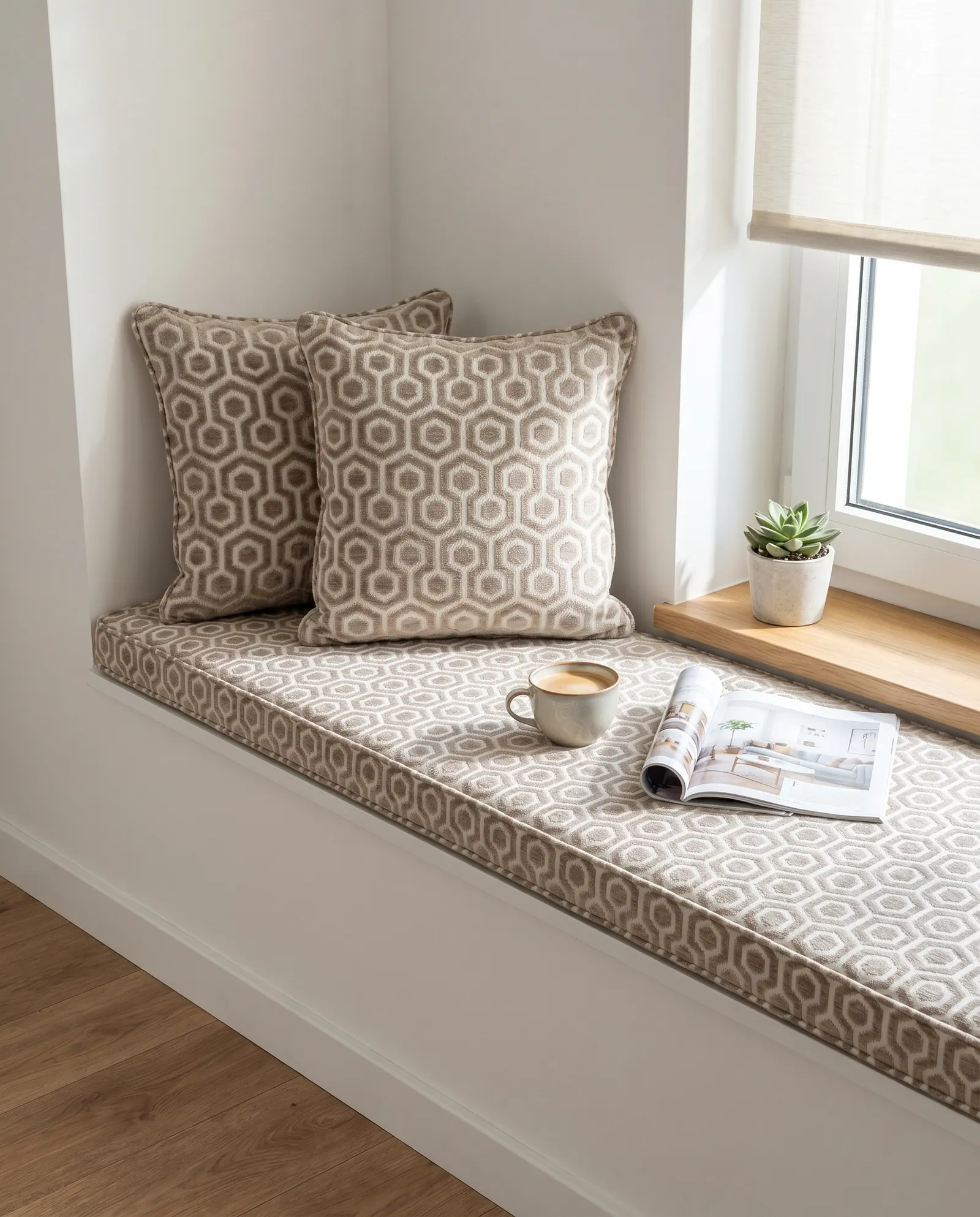
One warning. The oatmeal and taupe window seats in the gallery wear a honeycomb jacquard: a hexagon pattern on a plain rectangle. Rectangular seat, rectangular order.
An oval loveseat cushion that became a whole patio
A buyer in the US started with one piece: a cushion for an oval wicker loveseat, rounded at the corners. Then came a chair cushion. Then a full outdoor couch.
The final order was one green-and-white stripe with piping throughout: a 17 x 20 in (43 x 51 cm) chair seat, a 37 x 19 in (94 x 48 cm) loveseat cushion, three 17 in (43 cm) pillows, and six couch pieces, three at 20 x 20 in (51 x 51 cm) and three at 22 x 20 in (56 x 51 cm). Quoted as one set, it arrived before her party. She wrote that she cried, because they looked so beautiful.
In a set like that the straight pieces go by numbers alone. The oval is the one to trace, because its rounded corners decide the fit.
- Measured
- Chair 17 x 20 in; loveseat 37 x 19 in; pillows 3 x 17 x 17 in; couch 3 x 20 x 20 in and 3 x 22 x 20 in
- What it taught
- Quote a whole outdoor room as one set, trace the curved piece, and put the event date on the order.
Photographs from the workbench
Open any photograph large; each one has its own link and a Save button.
 Save
 Save
 Save
 Save
 Save
 Save
Round-and-curve mistakes, caught before cutting
- Writing '16 x 16' for a round. It reads as a square; write 'round, 16 in diameter'.
- Giving an oval one length and one width. The curve lives between those numbers; trace it.
- Sending one arc length for a curve. It can't tell a shallow bow from a deep one; give chord and rise.
- Measuring a quarter-round corner along the diagonal. The size is the two wall sides.
- Confusing a honeycomb-pattern fabric with a hexagon-shaped seat.
- Treating a back cushion against a curved rattan frame like the seat. A 24 x 21.25 in seat pad was easy; the back against the curve was flagged as risky until measurements and a straight-on photo came in.
- Ordering a shaped seat on the rectangle listing. If checkout never asks for a drawing, you're on the wrong one.
A round seat cushion needs two numbers, diameter and thickness. An oval needs a drawing. If the two widths of your circle don't match, you own an oval.
Nate
Rounds and curves
- A common question
Do you make round cushions, like for bar stools?
The workshop's answerYes. Round cushions are specified by diameter and thickness: send a drawing or reference photo with both, and the workshop tells you how to order. Café bar-stool rounds were made 16 in (41 cm) across and 4 in (10 cm) thick for heavy commercial use, and a 41 in (104 cm) round was cut to fit inside a play tent. Several custom sizes can share one cart. Stool bases aren't made.
- A common question
My chair seat curves like a horseshoe. How do I get its shape to you?
The workshop's answerMake a paper template: lay paper on the seat, trace the edge, cut it out, write the widest width and the front-to-back depth on it, and photograph it flat from above with a tape measure in the shot; no need to mail it. Without one, send the width and depth, where the curve starts and ends on each side, how deep it runs, and a top-down photo. The craftsmen confirm the shape before you order.
- A common question
How is a quarter-round corner floor cushion measured?
The workshop's answerBy the two straight sides against the walls, where they meet at the right angle. Measure along each wall from the back corner to where the cushion should end, so 48 x 48 in means 48 in along each wall. Don't measure diagonally or along the curve; on that size the curved front runs about 75.4 in. A three-sided corner needs a photo and the depth measured in the middle.
- A common question
Can you make a hexagon floor cushion to fit inside a play structure?
The workshop's answerYes. Send the shape, the measurements and a few photos of the room taken from a distance before ordering, so everything is agreed first; the workshop says up front if a size-based customization fee applies. For a hexagon it sends a reference drawing on which you mark two key measurements. A quarter-round or curved space needs the two straight sides so the curve can be calculated.
- A common question
How do I measure a curved fire-pit bench or a round sofa section?
The workshop's answerLay a flexible tape or a string along the inner curve at the front and the outer curve at the back, then take the straight end-to-end distance and the depth at both ends and the middle. A wedge of a round sofa also needs the curve depth, from the middle of the straight inner line to the arc. Long curves are made as matching segments, and pronounced kidney or banana curves may be declined.

Have it made
Have your round seat cushions made — ask Nate’s workshop
Every edge and both diagonals, to the nearest 1/4 in. If the numbers do not close, the workshop will say so on the call. — Nate
Leave your details and the workshop will call you to confirm measurements, fabric, foam and piping. No prices, dates or payment on this page: it is a request, not an order.
Round, oval and hexagon questions
Why doesn't a small round cushion cost much less than a rectangle?
Because the handwork doesn't shrink with the fabric. Four 18 in (46 cm) rounds planned beside a set of tufted linen floor seats were quoted at nearly what rectangles cost, and the buyer found that too steep. Ask for the quote with your diameters before you set a budget.
Can a round floor cushion be button-tufted?
Yes. Round tufted floor cushions are made in custom diameters; 38 in (97 cm) and 43.25 in (110 cm) rounds are on record. Order the nearest listed size and note the exact diameter. The price rises with the diameter, and the workshop confirms it before you order.
Where does the zipper go on a round seat cushion?
Where nobody looks. Every foam cushion gets a zippered, fully removable cover at no extra cost, hidden on the edge that faces the chair back or wall, or on the underside. You can choose the side; write it in the order note.
Can you supply the stool or chair along with the cushion?
No. The workshop makes the cushion and the foam only, not stool frames, metal bases or chair legs. Send the seat's diameter, the thickness you want and a photo of the stool, and the round is cut to sit on what you already own.
± 1/4 in — Nate