Concept Sketches · 8 scenes
A sofa frame with no cushions: eight rebuilds from past orders
A bare frame is a sofa that is only missing its soft parts. Eight frames from past orders, each measured from the wood, not from a catalog.
 Save
The quick answer
Cushions for a sofa frame are cut to the frame you have, not to a catalog sofa. Measure the inside length, the seat depth and the back height above the deck. Divide the length into equal seats, one back per seat. If the back stands on the seat, subtract: a 21 in frame over 4 in seats takes 17 in backs.
The frame is finished. The sitting is not.
Seventeen inches. That was the right back cushion for a frame 21 in tall, because the seat under it was 4 in thick. Most of the arithmetic of cushions for a sofa frame is that small, and that easy to miss.
Bare frames come in many kinds: built at home, bought without cushions, poured in concrete, even a mattress asked to become a sofa. The questions return to three numbers: how deep the seat is once a back leans on it, how tall the back is once it stands on the seat, and where the seams fall.
Below are eight rebuilds, sizes kept exactly. Shapes and fabrics live under sofa and couch cushions; backs on their own under backrest cushions. For built-ins and mattresses, see cushions for a built-in couch or daybed.
What does your frame measure at the back?
Eight bare frames, measured and cushioned
 Save
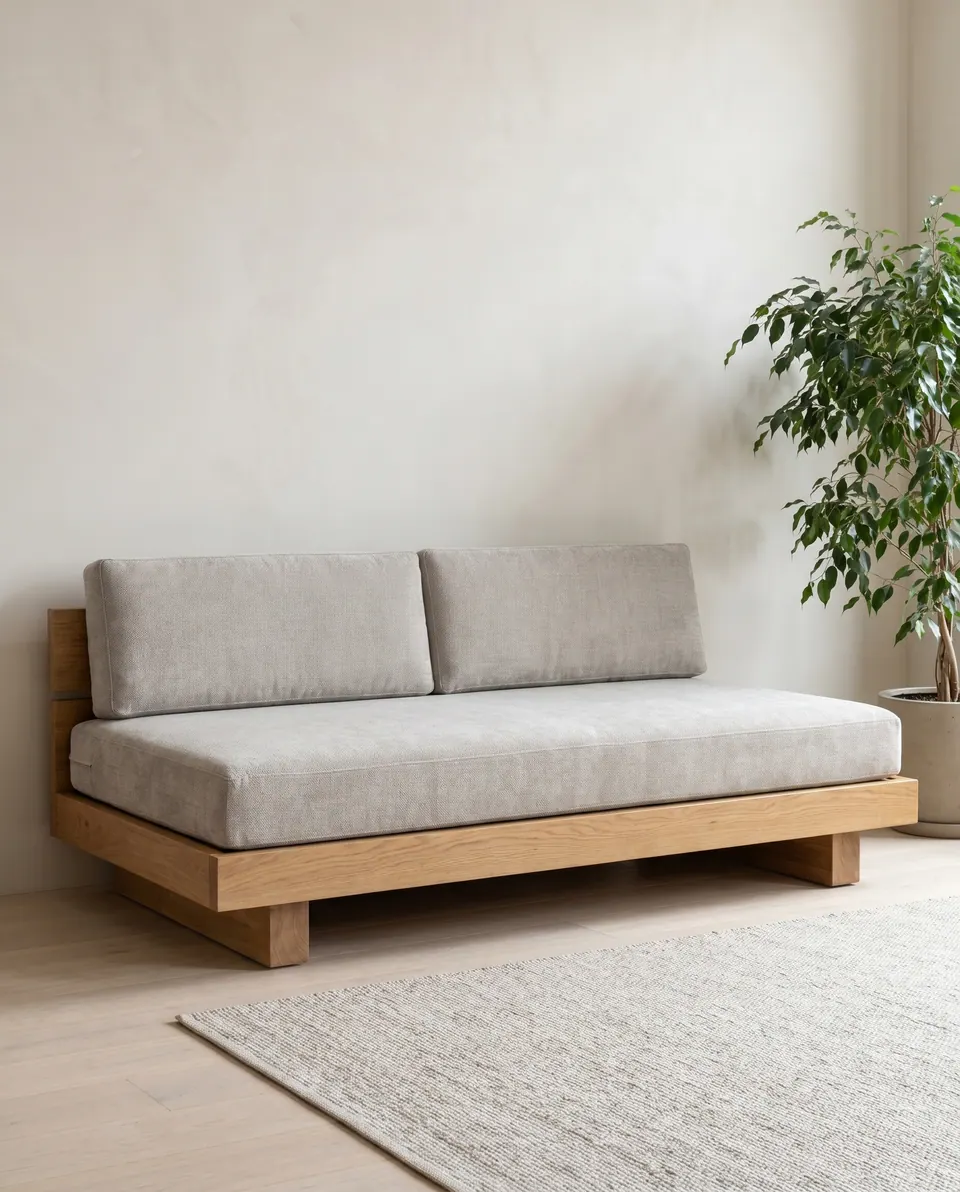
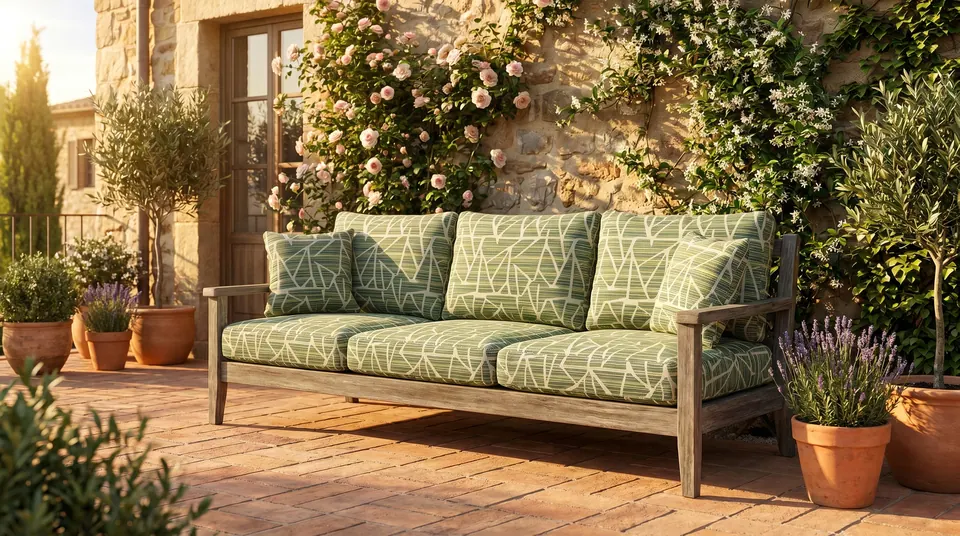
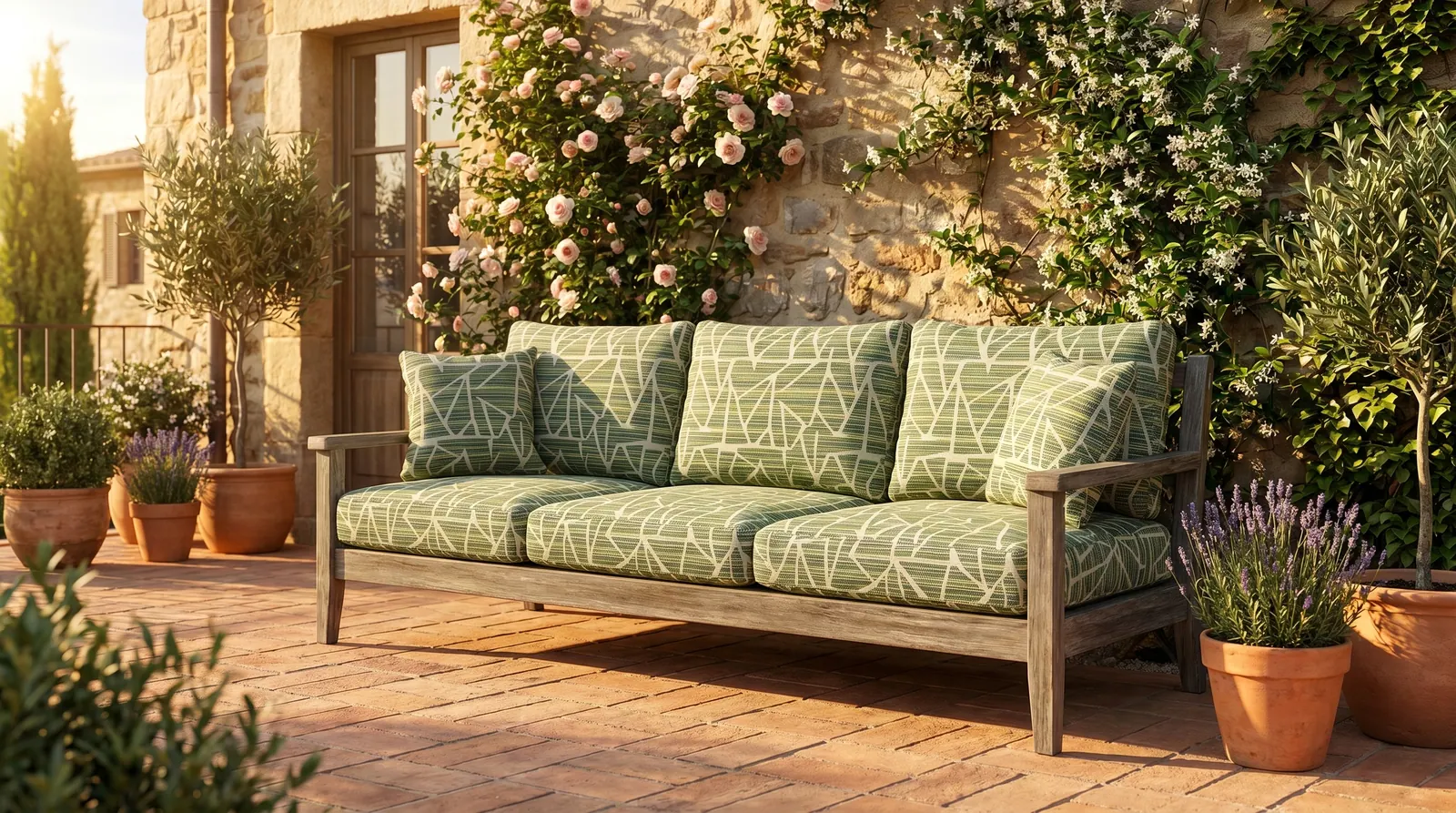
For illustration: a three-seat teak sofa. 01A past project
A 67.5 in frame: three seats, three backs
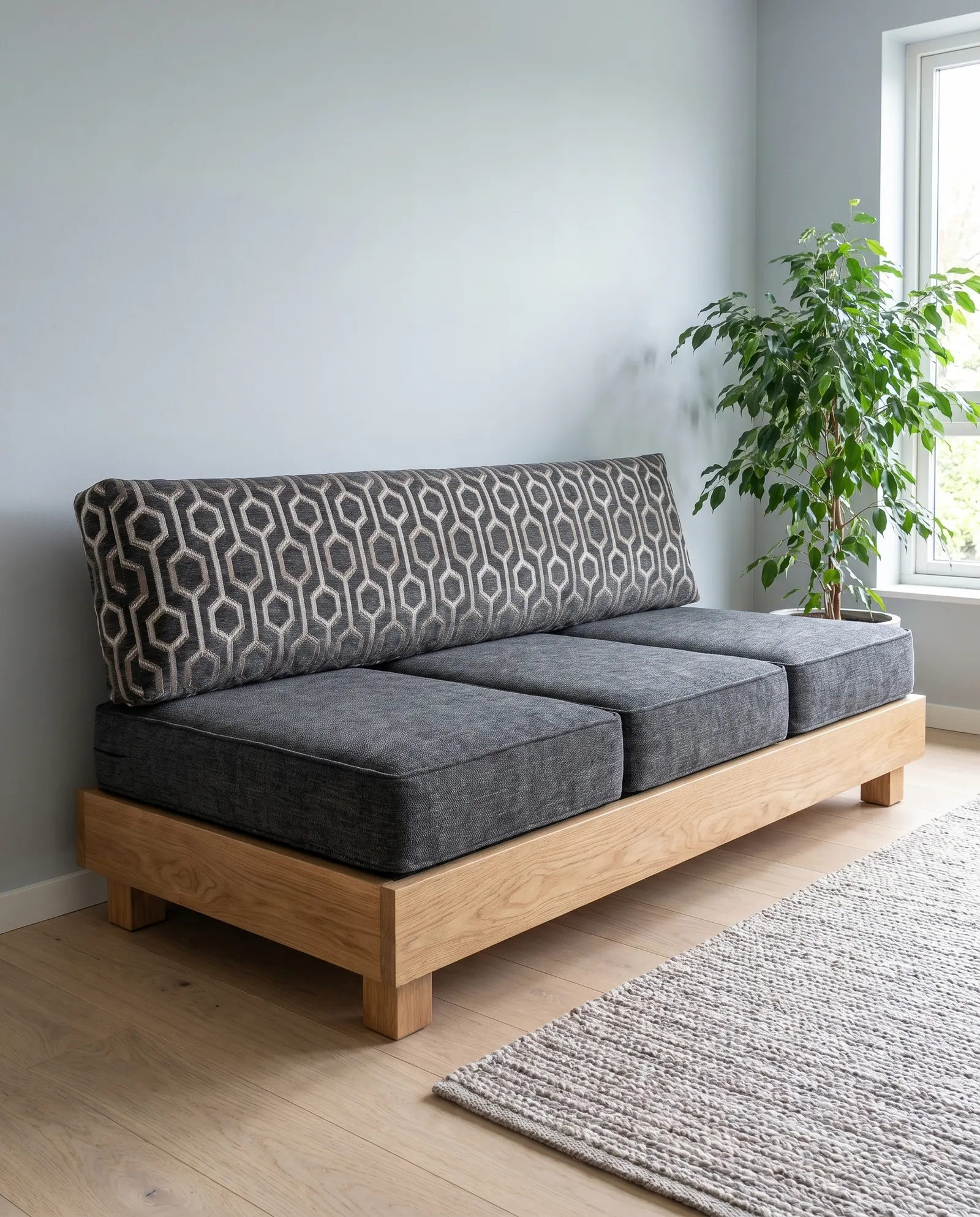
A buyer in the US had an outdoor sofa frame 67.5 in (171 cm) long, 27.5 in (70 cm) deep and 21 in (53 cm) high at the back. Nothing on it.
The workshop confirmed three seats of 22.5 x 27.5 x 4 in (57 x 70 x 10 cm) and three backs of 22.5 x 17 x 4 in (57 x 43 x 10 cm). The seats fill the frame. The backs stand on the seats, and 17 plus 4 reaches the 21 in top. Both sides first agreed on the words: length runs side to side, width front to back.
The takeaway: Divide the length evenly. Then take the seat off the back.
Pattern sheet Side view. The back cushion stands on the seat cushion, so its height is the frame height minus the seat thickness: 21 − 4 = 17 in. 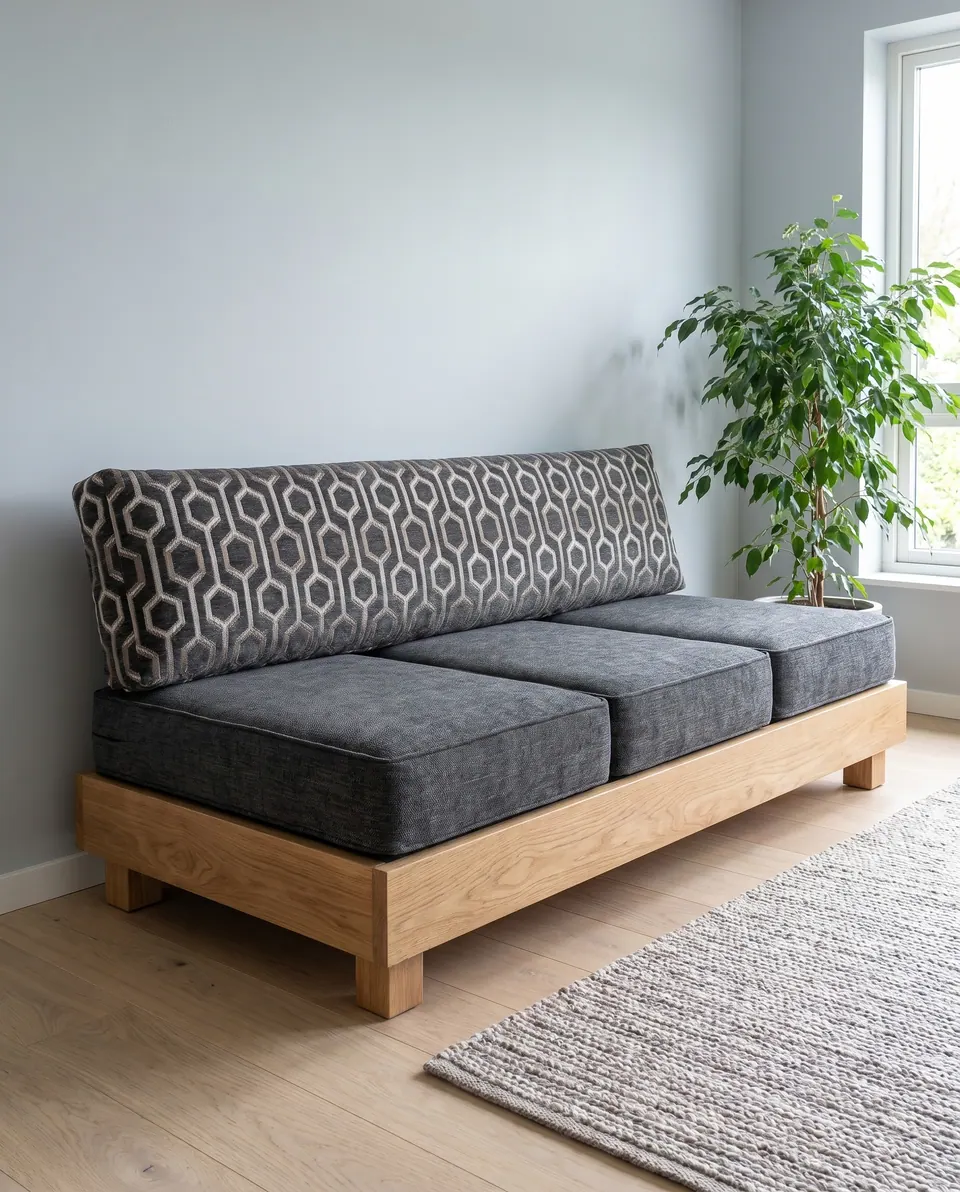 Save
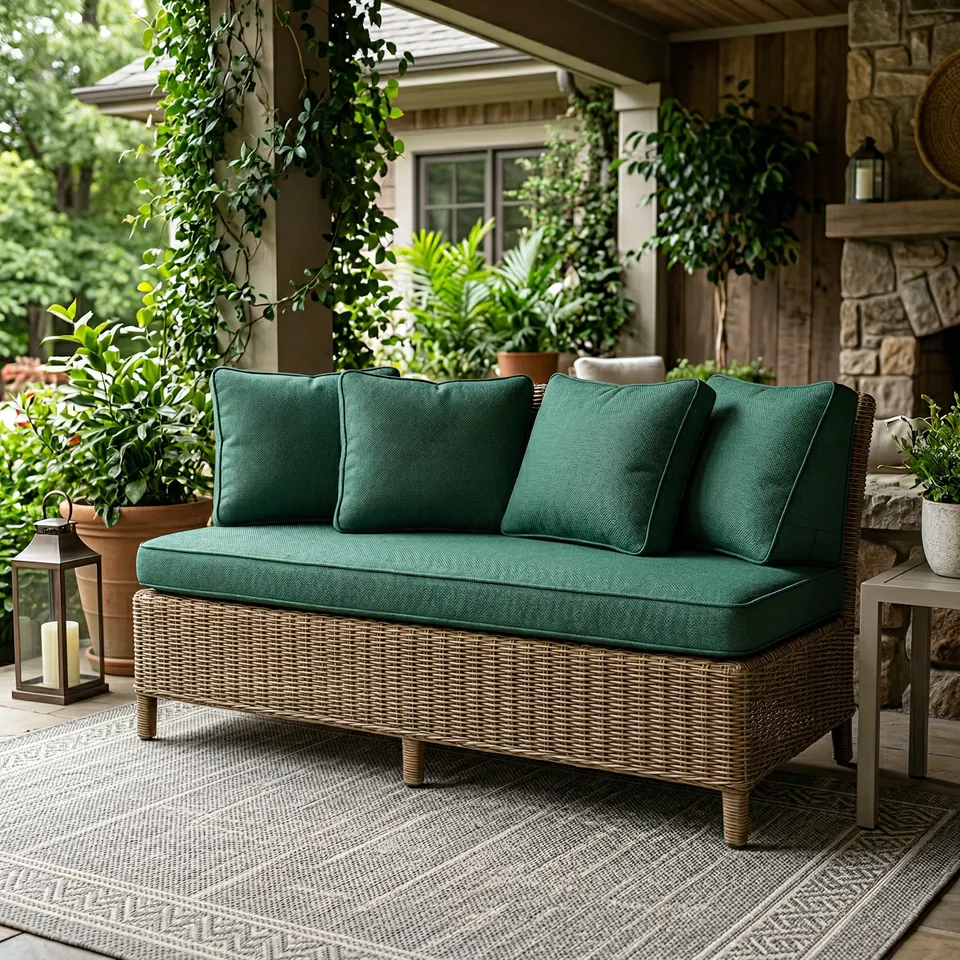
For illustration: a low oak sofa frame. 02A past project
Three long seats, a back for each
One buyer wrote in for a low sofa of three seats, each about 63 x 24 x 4 in (160 x 60 x 10 cm), with a matching back for every seat, quoted as one figure with foam, covers and delivery.
Three pieces, not one long mattress. Each can be lifted, turned and washed by one person. But look at the depth. A 4 in back standing on a 24 in seat leaves about 20 in to sit on. Upright sitting, not sprawling.
The takeaway: Before you settle the seat depth, take the back's thickness away from it.
 Save
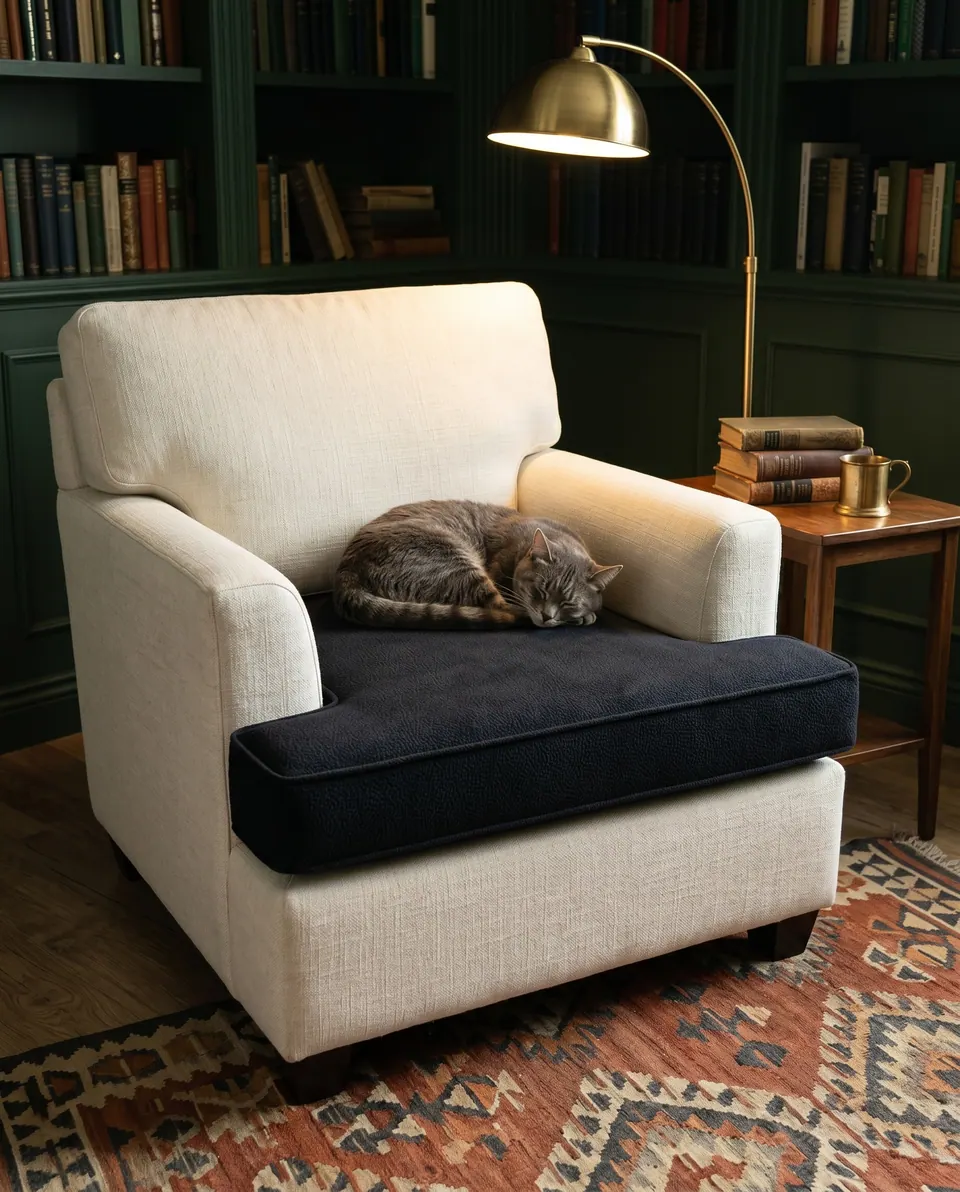
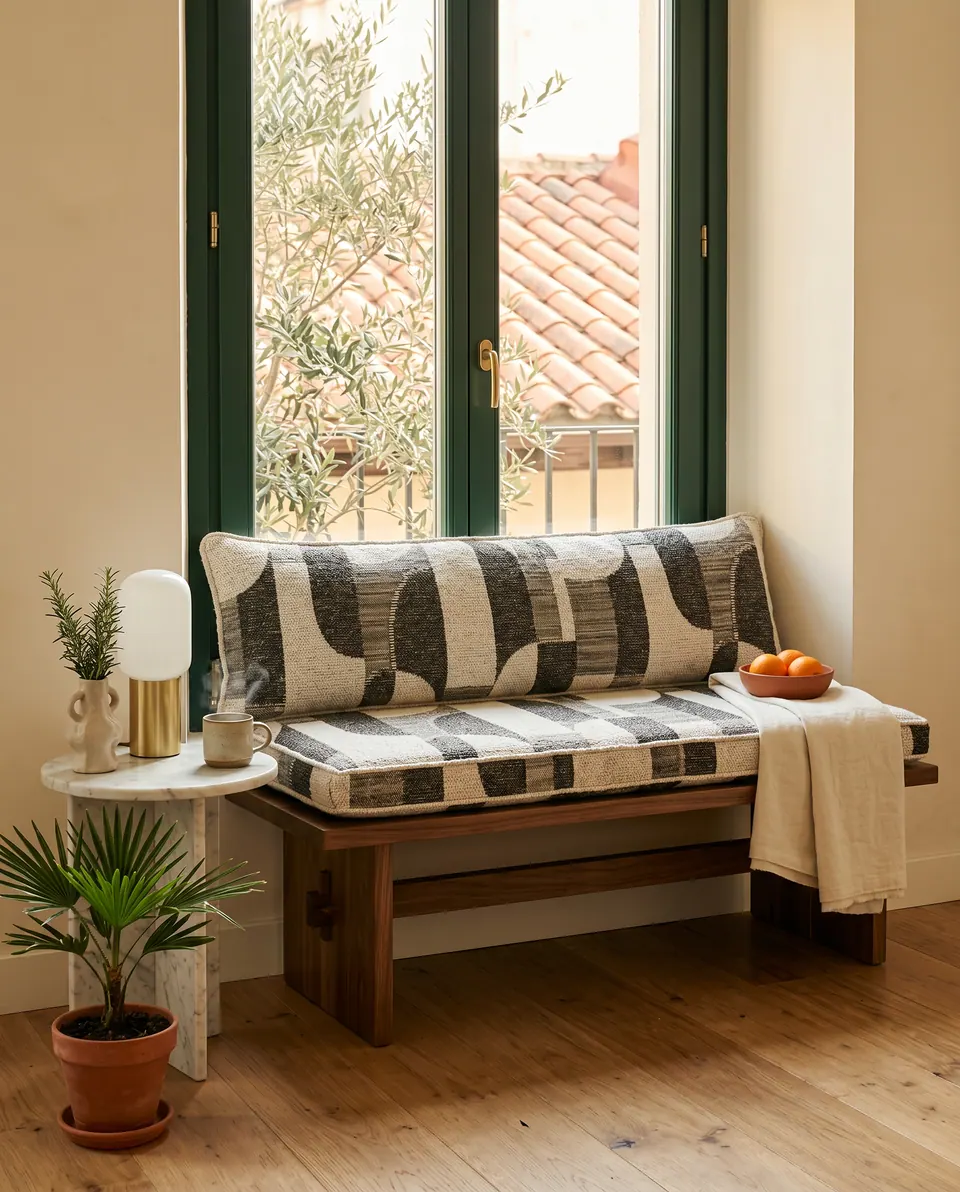
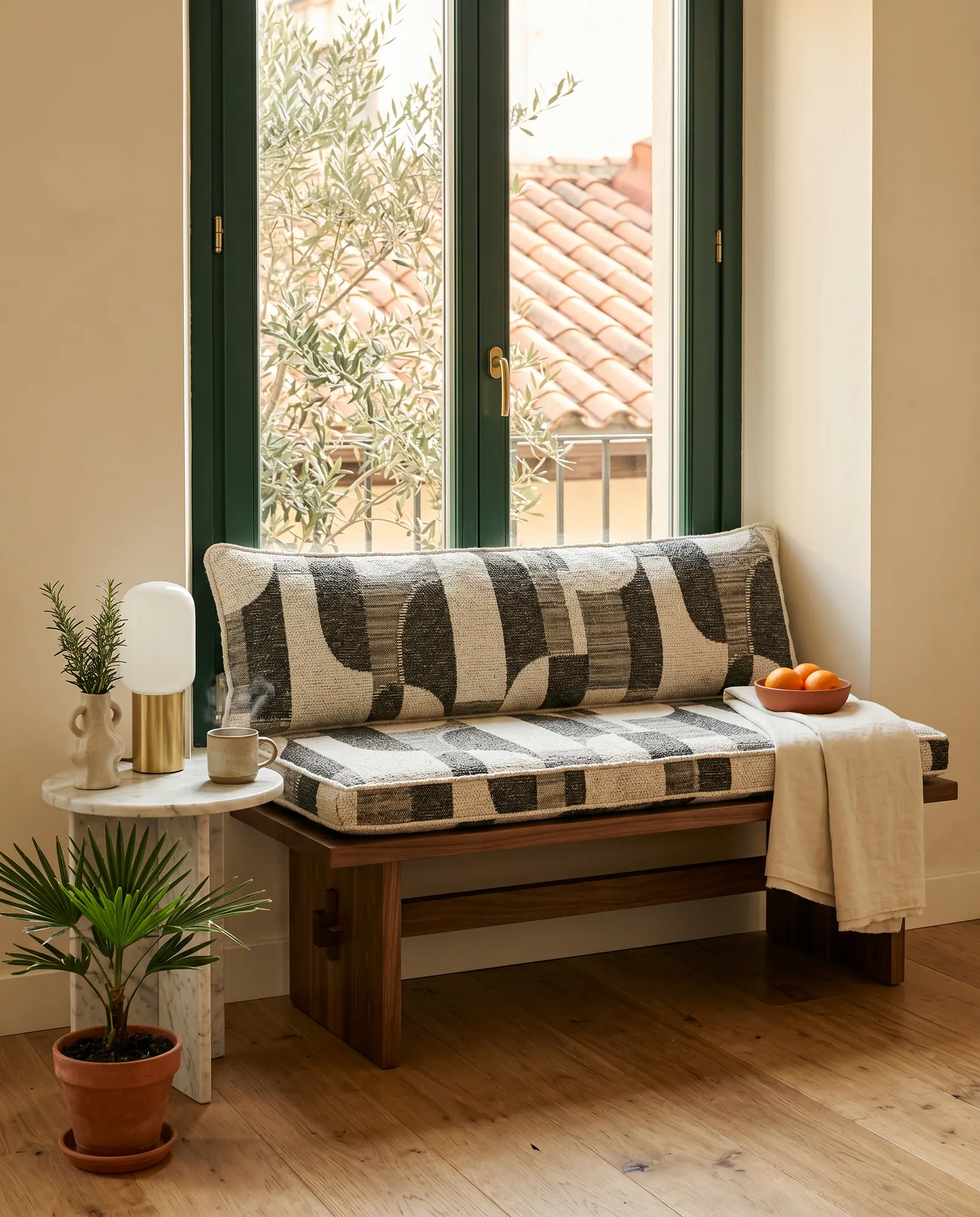
For illustration: a walnut bench with a backrest. 03A past project
Curved seats, and no cushions left to copy
One buyer wrote in with an empty two-seat sofa frame. The original cushions were gone. They wanted curved seats in seaweed green velvet. The photos would not upload, so they came separately, by message.
The workshop asked for two numbers: the straight length of each side before the curve begins, and the depth or radius of the front curve. With nothing to copy, the production team worked the sizes out from the frame itself. A paper template of the deck carries the same information.
The takeaway: No old cushion to measure? Trace the seat deck instead.
Pattern sheet Lay paper on the seat and trace the edge, write the widest width and the front-to-back depth on the template, then photograph it flat from directly above with a tape measure in the picture. 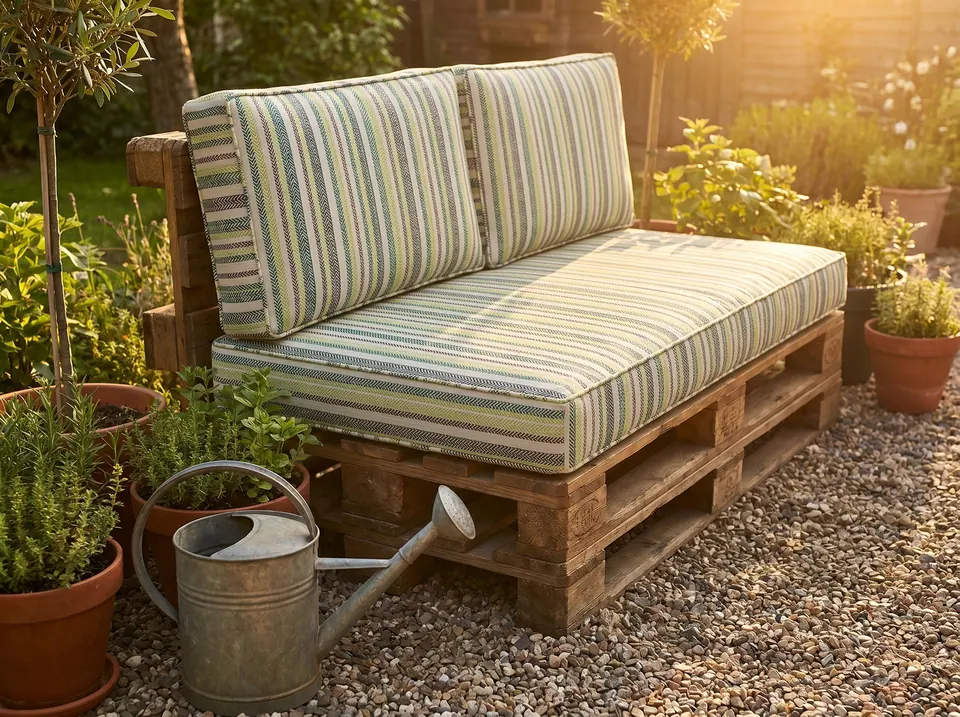 Save
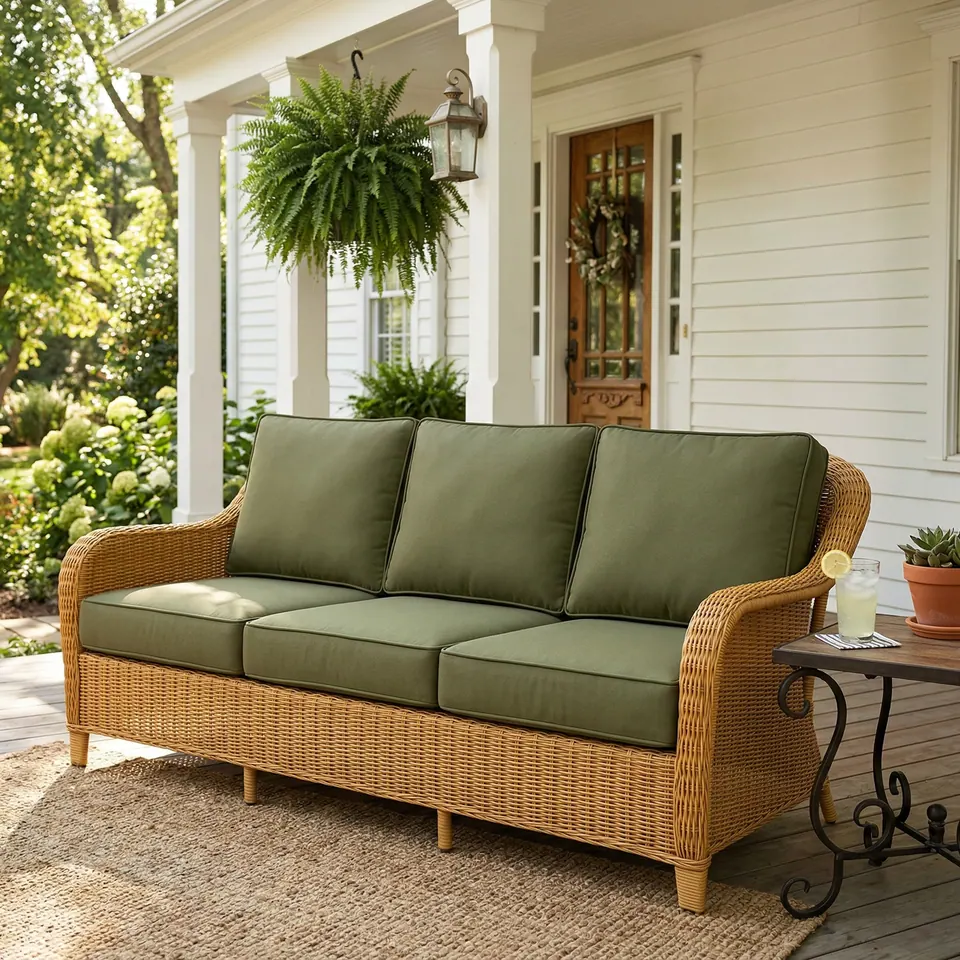
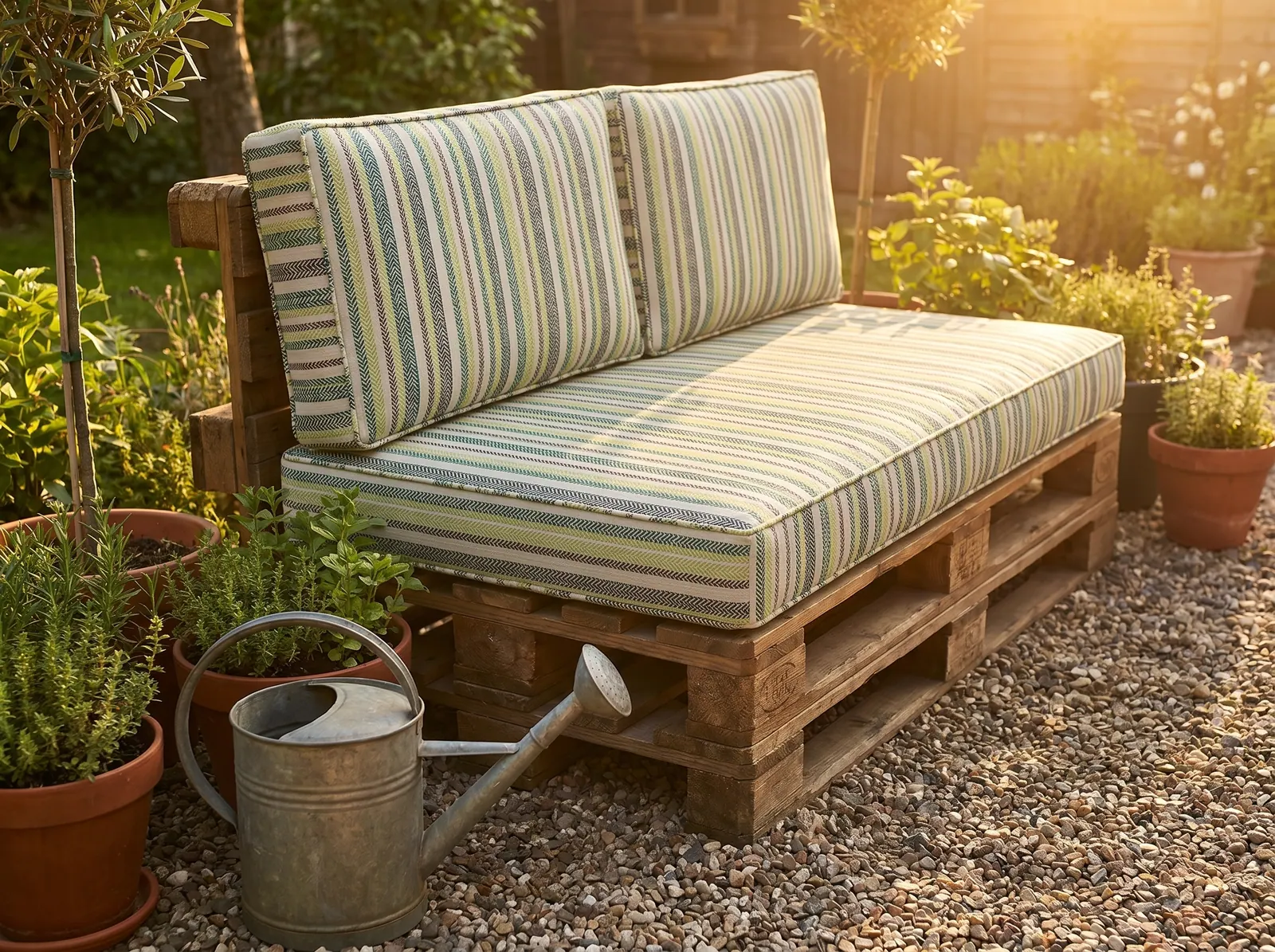
For illustration: a pallet-built sofa. 04A past project
A concrete couch, and one back across three seats
A buyer messaged the workshop with a couch cast in concrete. Three seats of 23.6 x 27.6 x 4 in (60 x 70 x 10 cm). One back of 83 x 13.8 x 2 in (211 x 35 x 5 cm). Two cylinder armrests, 23.6 in (60 cm) long. Light green linen, picked from daylight photos.
The seats break into three. The back does not. One long back ties the seats into one sofa, with no seam behind the gaps between them.
The takeaway: On a hard frame, split the seat and keep the back whole.
- Save
For illustration: a low oak sofa frame. 05A past project
A queen mattress asked to be a sofa
A couple wrote to the workshop with a queen mattress, about 60 x 80 in (152 x 203 cm). They wanted a sofa. The first plan was a cover sewn closed like a French quilted mattress, flat or tufted, with a buttoned backrest and armrests.
Then they refined it. A fitted base cover, four bolsters and two rectangular cushions, in three fabrics: green velour for the base, black and white for the cushions. Only the base was tufted.
The takeaway: Decide, piece by piece, which parts are tufted and which stay plain.
- Save
For illustration: a walnut bench with a backrest. 06A past project
A futon retired, its wool filling kept
A buyer in the US no longer slept on their futon. They wanted a sofa, and they wanted to keep the wool filling from the old mattress.
So: two zippered linen covers, no foam. A seat cover 72 x 23 in (183 x 58 cm) with 4 in (10 cm) of fillable depth, and a back cover 72 x 21 in (183 x 53 cm) with 3 in (7.5 cm). The linen is a linen and polyester blend chosen for seats. After ordering, they saw the covers needed ties at all four corners to hold to the frame, and the ties were added.
The takeaway: Reusing filling? Give the fillable depth of each cover, and ask for ties when you order.
- Save
For illustration: a pallet-built sofa. 07A past project
Two twin mattresses, two corner backs
A buyer in the US who sews had two twin mattresses and did not care for most daybed frames. She bought only two L-shaped corner backrest inserts and four metal brackets. The covers she sewed herself.
Each L-shaped backrest covers a 39 x 39 in (100 x 100 cm) corner and stands about 15 in high. Mattresses she already owned became a floor sofa.
The takeaway: If you already own the mattresses, the backs are the only missing part.
- Save
For illustration: a three-seat teak sofa. 08A past project
A new frame, and a wish to sink in
A buyer got in touch about a new sofa frame and two seats of 41 x 26 x 5 in (104 x 66 x 13 cm). They wanted to sink in, not perch.
The workshop offered its 28-density foam, softer than the standard 32-density medium-firm, in the same polyester fiber wrap: write '28-density foam' in the personalization. The firmness scale Pattern sets the two side by side.
The takeaway: For a lounging seat, ask for softer foam before you ask for more inches.
Three numbers every bare frame asks for
The same arithmetic, eight times over. The back cushion height Pattern has the long version, and thinner backs the reasons.
| The number | How to get it | From the rebuilds |
|---|---|---|
| Back height | Frame back above the deck, minus the seat, when the back stands on the seat | 21 in minus 4 in: 17 in backs on the 67.5 in frame |
| Depth you sit on | Seat depth minus the back's thickness | About 24 in seats under 4 in backs leave about 20 in |
| Seat depth you order | Deck depth minus back thickness, when the back stands on the deck behind the seat | Say which way your back sits |
| Where the seams fall | Divide the length evenly; keep the back whole where you can | Three 22.5 in seats; one 83 in back over three concrete seats |
| Seat against back | Seat thicker and firmer, back thinner and softer | 4 in seat, 2 in back on concrete; 4 in and 3 in fillable on the futon |
What a bare frame needs from you
- The inside length, arm to arm or wall to wall.
- The seat depth, front rail to back rail.
- The back height above the deck, and whether the back stands on the seat or behind it.
- A photo with the tape along each number.
- Covers only or with foam, and the fillable depth if you reuse filling.
- Ties, with their position, if the cushions must hold to the frame.
One frame, measured once
Measure the frame once it is built, not from its drawing. Height is a feeling, but it starts as a subtraction.
The frame holds the shape. The cushions hold the person. Measure both from the same line.
A back cushion stands on the seat, so it is always shorter than the frame: a 21 in frame and a 4 in seat make a 17 in back.
Hana Lindqvist
Bare-frame questions
- A common question
Do the back cushions on my sofa frame have to be as thick as the seats?
The workshop's answerNo. Seat and back are separate pieces, so they can differ. Many buyers choose a thicker, firmer seat and a thinner or softer back, such as 4 in backs on an 8 in seat, and the thinner back costs less. Backs are usually a little slimmer so they stand upright without eating seat depth. If the back rests on the seat, subtract the seat: a 21 in frame takes a 17 in back over a 4 in seat.
- A common question
Will the back cushion be made the same length as the seat?
The workshop's answerYes. The back matches the seat's length and is 16 in (40 cm) high and 4 in (10 cm) thick as standard. Height can run from about 8 in to 16 in or taller, the top can be rounded, and a long back can be split in two or made to its own size. Round armrests are made 4 in shorter than the seat depth.
- A common question
Can I buy only the L-shaped corner backrests and use my own mattresses?
The workshop's answerYes. Each L-shaped backrest covers a 39 x 39 in (100 x 100 cm) corner and stands about 15 in high. Two span a 39 x 79 in sofa, or turn a twin or a 75 x 38 in daybed into a sofa. They have no attachments and sit as standalone cushions. Metal bars are sold separately, and covers alone are available.
- A common question
Can you make covers to fit mattresses I already have?
The workshop's answerYes, covers-only orders are cut to your sizes: covers have been made at 80 x 39 x 8 in with 40 x 39 x 15 in backrest covers, against a standard 78.5 x 39 x 7 in. Send the exact size of your own foam, such as two 31.5 x 78.7 x 7.9 in (80 x 200 x 20 cm) mattresses. The workshop first checks whether your seat is one tall mattress or two stacked.
- A common question
Could the back be as big as the seat?
The workshop's answerYes, it can be made square like the seat or the same size. But a back as wide as the seat is effectively a second mattress, priced as one, so the set costs noticeably more than one with the standard 16 in back. Ask for a quote with both sizes first.

Have it made
Have an idea like this made — ask Hana’s workshop
Measure once, slowly. Write the numbers here. The workshop will go over them with you. — Hana
Leave your details and the workshop will call you to confirm measurements, fabric, foam and piping. No prices, dates or payment on this page: it is a request, not an order.
Before you cushion a frame
Do cushions for a wooden sofa frame need ties?
Often, yes. Fabric ties can be sewn into the seams on request, at the corners or along the back, to hold a cushion to the frame or a back to its seat. Ask for them in writing with their position, and look for them on the photo before dispatch.
How firm are the seat cushions for a sofa frame?
The standard seat is 32 kg/m³ foam, about 2.0 lb/ft³: high-density, medium-firm and not memory foam. A softer 28-density foam is available on request. Backs are softer by default, filled with shredded foam in their own inner cover.
Should a long sofa frame get one seat cushion or several?
Several, divided evenly. A 67.5 in frame became three 22.5 in seats. Pieces longer than about 75 in are usually split anyway, for fit, handling and shipping, and one long back can still run behind them all.
What if my sofa frame is not finished yet?
Wait for the wood. Measure the built frame, not the plan, because built-ins change as they go up. The workshop can hold an order until the final sizes are sent.