 Save
A Reading by MaggieBench Cushions
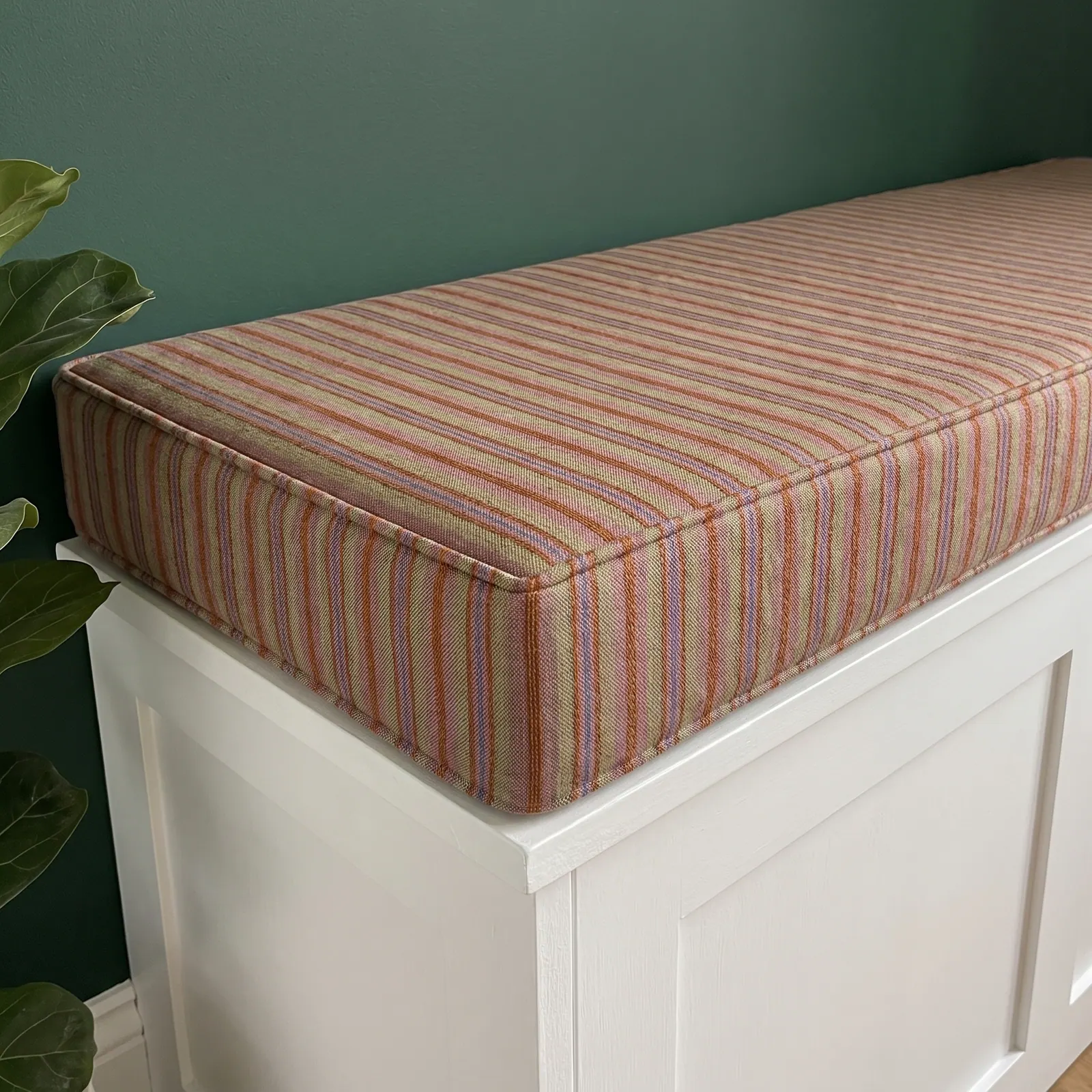
An olive and mauve striped bench cushion, measured by its corner
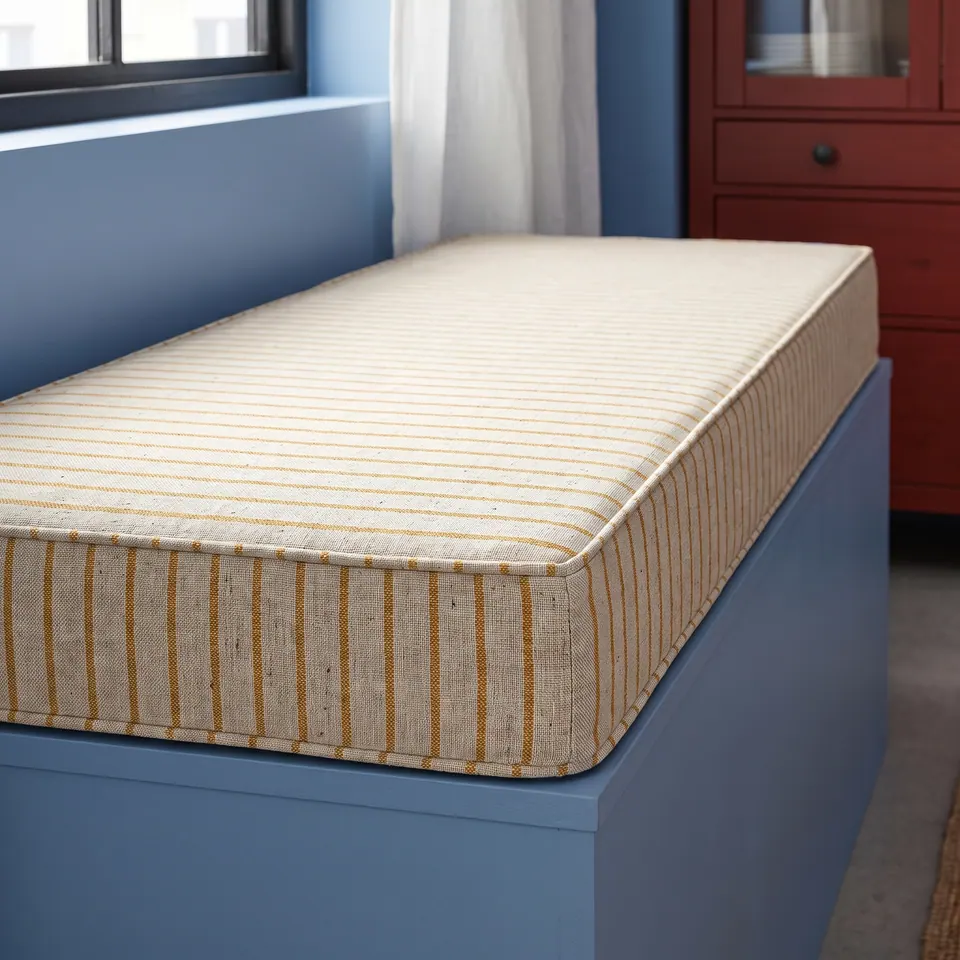
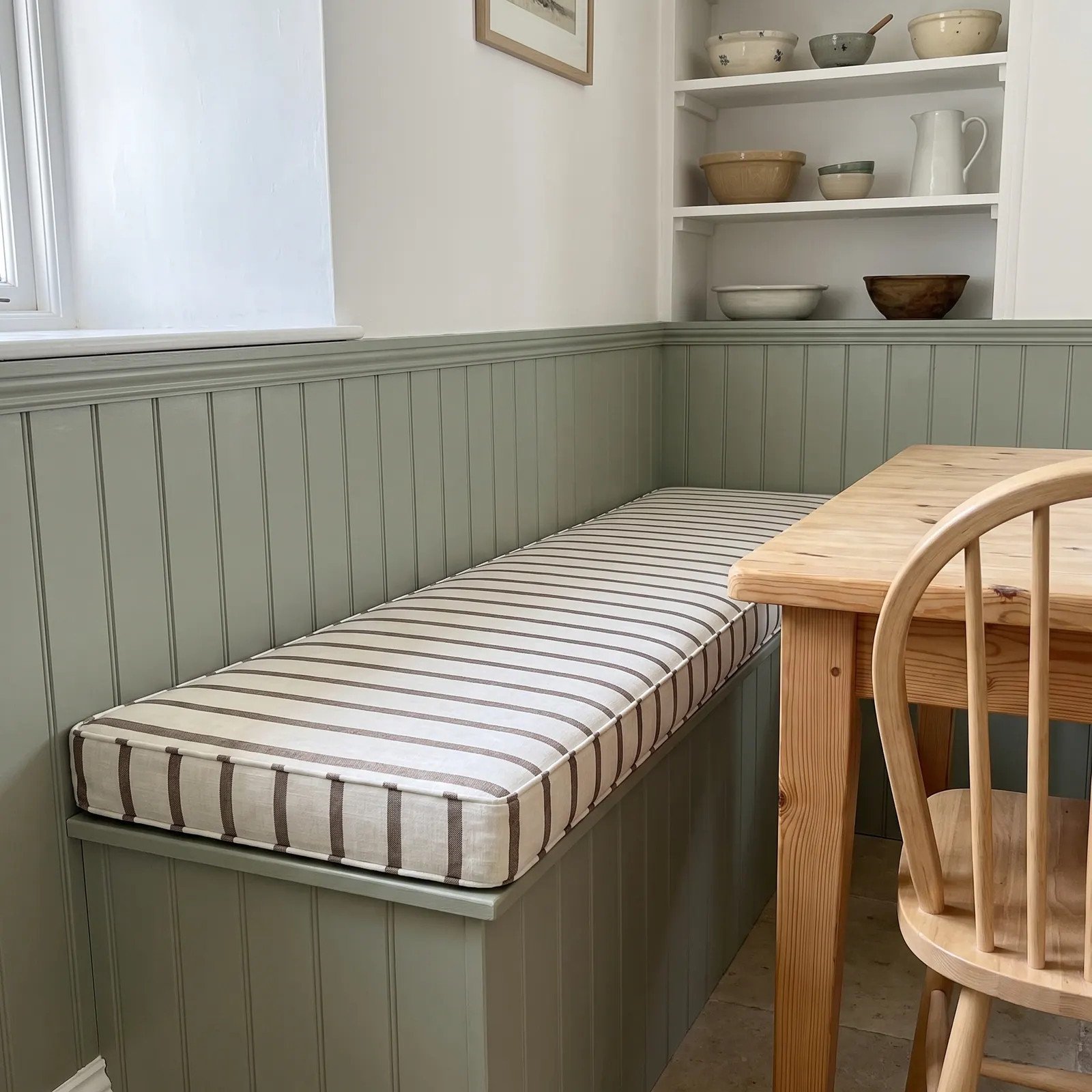
One close-up corner holds more information than a wide shot of the whole kitchen. This one shows the stripe, the welt and the thickness question in a single frame.
A daylight close-up shows the self-piped corner and the soft multi-color stripe against dark green paint.

The quick answer
For a kitchen bench cushion, add the thickness to the bench height and aim for a finished seat of about 18 in (46 cm), with 10 to 12 in (25 to 30 cm) left to the tabletop. That usually means 3 in (7.5 cm) for most nooks and 4 in (10 cm) for a low bench. On lift-up lids, round the length down.
What a close-up corner gives away
Skip the whole room and look at one corner. It tells you more.
The stripe runs olive, mauve, burnt orange and sand, and it turns the rounded corner without losing its rhythm. That's cutting, not luck: the side band (the gusset) is laid out so the stripes meet where front and end join. A straight welt is a kind of honesty, and a stripe that breaks at a corner is a small fib.
The piping is self piping, so the edge stays soft and the stripe runs right up to the seam. Against a bottle-green wall, a contrast cord would have drawn a hard frame.
Moody daylight falls on dark green paint that would swallow a plain beige cushion. Warm and cool threads let this stripe sit happily on the green and still stand out from the white shaker base. The fig leaves in the foreground pull the wall color forward. What color are your kitchen walls, and does your stripe carry a thread of it?
Then proportion. Up close, the box edge reads as a band between two lines of piping. Too thin and it vanishes; too thick and a bench cushion looks like a sofa that wandered into the kitchen. More stripes in linen and cotton-linen.
Five details only a close-up shows
The corner, the welt, the weave, the leaves and the base, one pin each.
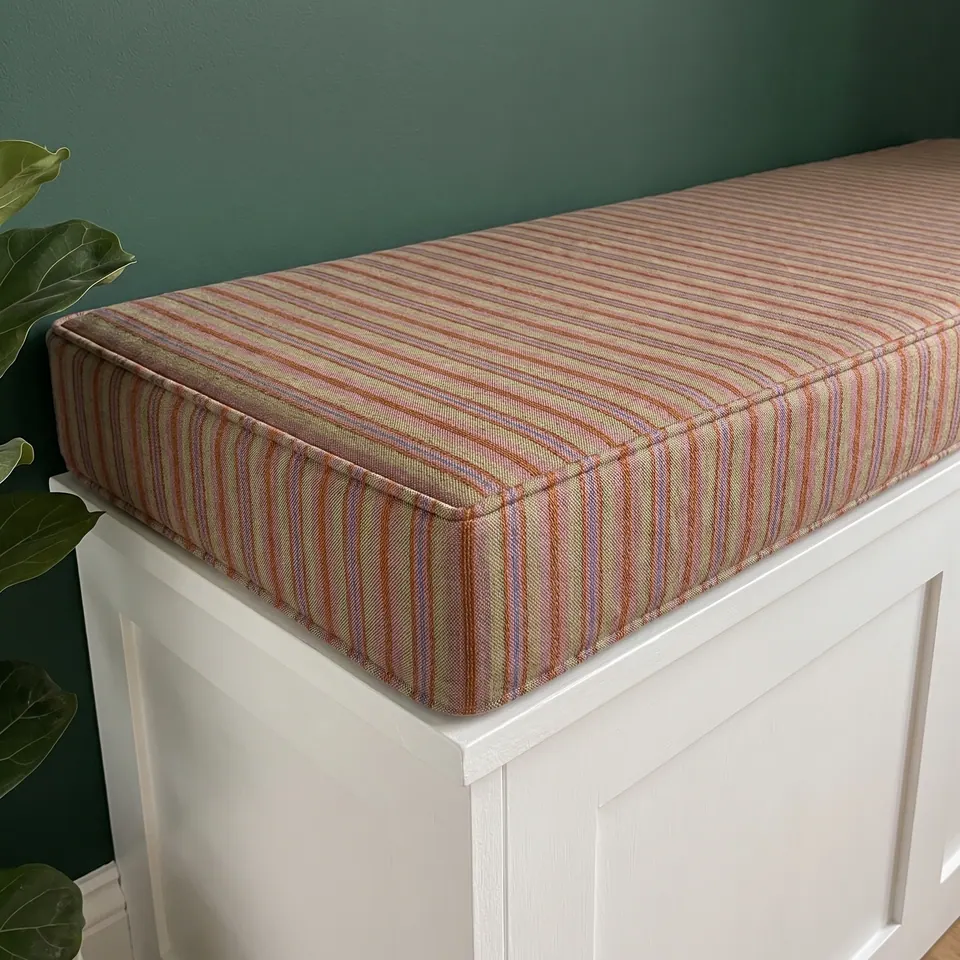
- Stripe-matched corner
The stripe turns the rounded corner without a break in rhythm.
- Self-piped top edge
A matching welt keeps the edge soft and the multi-stripe uninterrupted.
- Olive and mauve weave
The mix of warm and cool threads lets the cushion sit happily on dark green.
- Fig leaves
Foreground leaves bring the wall color forward into the shot.
- White shaker base
A white base makes the striped cushion stand out from the dark wall.
- Stripe-matched cornerThe stripe turns the rounded corner without a break in rhythm.
- Self-piped top edgeA matching welt keeps the edge soft and the multi-stripe uninterrupted.
- Olive and mauve weaveThe mix of warm and cool threads lets the cushion sit happily on dark green.
- Fig leavesForeground leaves bring the wall color forward into the shot.
- White shaker baseA white base makes the striped cushion stand out from the dark wall.
Thickness against the rest of the kitchen
Finished seat height is the bench top plus the cushion. Work down from the table, then pick the foam.
| Thickness | How it reads | Choose it when |
|---|---|---|
| 2 in (5 cm) | A flat pad | A high bench top, or occasional use |
| 3 in (7.5 cm) | Neat, low profile | Most kitchen nooks and window benches |
| 4 in (10 cm) | The standard, fuller box edge | A low bench, or long dinners |
| 5 in (12.5 cm) | Plump, sofa-like | Only with room to spare under the table |
Foam settles a little in use: a 3 in cushion may sit at about 2 1/2 in.
Two lift-up lids, rounded down on purpose
A buyer had a hinged storage bench with two seats that lift. The cushions were 40 1/2 x 17 3/4 in (103 x 45 cm) and 57 1/2 x 17 3/4 in (146 x 45 cm), and the request was sensible: round down if needed, so the lids open without catching.
The buyer also worried about sliding, which is fair: a lid is a slope waiting to happen. The workshop suggested the non-slip base. For the piping on a mid-tone linen, it shared a photo of matching piping, then suggested one shade darker for a subtle outline.
Note the depth, 17 3/4 in. A back cushion takes about 3 in (7.5 cm) off it. The seat height calculator does that sum for you.
- Sizes
- 40 1/2 x 17 3/4 in (103 x 45 cm) and 57 1/2 x 17 3/4 in (146 x 45 cm)
- Fabric
- Linen, piping one shade darker
The lesson: On lift-up benches, round down and add a non-slip base.
What kitchen-bench buyers asked
- A common question
Can the cushion body be linen and the piping velvet?
The workshop's answerYes. Any mix works, including a linen body with velvet piping. Write both codes in the personalization note when you order, for example 'Body: linen code, Piping: velvet code', and it is made that way.
- A common question
My phone can't photograph the navy I'm trying to match. How do I choose?
The workshop's answerPhone photos rarely show navy accurately, so the workshop can't read the exact tone from them. Each chart has one or two navy blues. The safest route is a sample order of those codes, or ask for close-ups of any code that catches your eye.
- A common question
We have kids. Will linen on a kitchen banquette be a mistake?
The workshop's answerIt's a practical choice, because the covers are fully removable and washable, so stains don't have to be permanent. Mid and darker tones hide everyday marks better than light ones; skip pure white with kids. Linen holds up well in busy family kitchens.
A kitchen bench cushion should leave 10 to 12 in between its top and the tabletop; measure that gap before choosing 3 in or 4 in of foam.
Maggie
On the cutting table
| Cushion | Bench cushion, box edge, rounded corner |
|---|---|
| Fabric | Multi-stripe linen: olive, mauve, burnt orange, sand |
| Piping | Self piping, top and bottom edges |
| Stripe | Matched around the corner |
| Thickness | 3 in (7.5 cm) for most nooks; 4 in (10 cm) standard |
| Seat height target | About 18 in (46 cm) with the cushion on |
| Grip | Optional non-slip base for lift-up lids |
| Best for | Kitchen benches against dark painted walls |

Have it made
Have this made — ask Maggie’s workshop
I once cut a lovely cushion two inches short, and I have not forgotten it. That is why the workshop goes over your measurements with you on the phone. — Maggie
Leave your details and the workshop will call you to confirm measurements, fabric, foam and piping. No prices, dates or payment on this page: it is a request, not an order.
Questions buyers ask next
How does bench cushion thickness add up at a kitchen table?
One for one. Bench top plus cushion thickness equals finished seat height, and about 18 in (46 cm) is the usual dining target, with 10 to 12 in left to the tabletop. Foam settles slightly, so 3 in may sit closer to 2 1/2 in.
Can a striped cushion keep its stripe around a rounded corner?
Yes, when the side band is laid out so the stripes meet where the front and end join, as in this close-up. If stripe matching matters, say so in your order note and ask for a photo of the finished cushion.
Why would a seat cushion need rounding down?
On lift-up storage benches, a cushion cut to the exact lid size can catch on the wall or the next lid as it opens. Rounding the length down slightly lets each lid lift freely. Say so in the order note.
Stitch straight — Maggie
More striped kitchen benches, corner by corner
 Save
 Save
 Save
 Save
 Save
 Save