The Pattern Room · a side-by-side pattern
Linen bench cushions: which 'linen' is on your bench, and how it wears
The bench cushion ordered most here is a 'linen' one, and the word promises more flax than most charts hold. Here is each linen, named honestly, and how it behaves on a seat that is sat on every day.

- Linen-look
- Linen-polyester blend
- Cotton-linen
- Pure linen
 Save
The quick answer
Most linen bench cushions are covered in a linen-look weave, which is mostly polyester, or in a 50/50 blend of linen and polyester or of cotton and linen. Pure linen sits on a separate chart, costs more and creases faster on a seat. Linen-look wrinkles less, resists stains better and machine washes at 86°F (30°C) on a gentle cycle; press it only on low.
Three linens that aren't quite linen, and one that is
Ask for a linen bench cushion and you are usually offered three fabrics that are not entirely linen, and one that is. All four come in the same oatmeal, flax and warm cream. Under the hand, they are different cloths.
The linen bench cushion is the one people order most, and 'is it real linen?' is the question that follows it. The honest answer is usually no, and that is not bad news. The standard chart is a linen-look weave, mostly polyester. One natural chart is 50% linen and 50% polyester, one range is 50/50 cotton-linen, and pure linen lives on its own chart, by request.
The eye sits down first, then the body, then the coffee cup. A bench cushion has to please all three. So the useful question is not 'is it linen?' but 'which linen suits this bench?' The label story, fiber by fiber, is in real linen vs linen-look.
The four linens on a bench, side by side
| On a bench cushion | Linen-look | Linen-polyester blend | Cotton-linen | Pure linen |
|---|---|---|---|---|
| Fiber | Mostly polyester; L-codes such as L44 are polyester | 50% linen, 50% polyester | 50% cotton, 50% linen in one range | Linen only, on a separate chart |
| Creasing on a daily seat | Yes Wrinkles least | Yes Wrinkles little | Ask for the code's care note | Partly Creases fastest |
| Spills and marks | Yes Resists stains better than pure linen | Yes Better than pure linen | Ask by code | Partly The least stain-resistant of the four |
| Price | Standard chart price | Above the standard charts | Ask by code | Above the standard charts |
| Washing | 86°F (30°C), gentle cycle | 86°F (30°C), gentle cycle | 86°F (30°C), gentle cycle | 86°F (30°C), gentle cycle |
| Pressing | Partly Steam or the lowest iron only; heat can melt it | Low iron if needed | Low iron if needed | Low iron if needed |
| Best bench | Kitchen, entry and family benches | An everyday bench with a natural hand | A home avoiding synthetics | A bedroom or reading bench with gentle use |
Charts are named for how a fabric looks, not what it is made of. Check the composition of your exact color code before you order.
Key facts
- The standard 'linen' chart is a linen-look weave, mostly polyester; L-codes such as L44 are polyester.
- One natural chart is 50% linen and 50% polyester; another range is 50% cotton and 50% linen.
- Pure linen costs more and creases faster on a seat than the blends.
- Every cover unzips and machine washes at 86°F (30°C) on a gentle cycle; air dry and press on low.
- Piping is included, can be cut from any chart, and a contrast color costs nothing extra.
- Ask for the fiber content of your exact color code in writing before you order.

Have it made
Measured it? Have Élodie’s workshop make it
A fabric reads one way at noon and another at dusk. Mention your light, and the workshop will weigh it with you. — Élodie
Leave your details and the workshop will call you to confirm measurements, fabric, foam and piping. No prices, dates or payment on this page: it is a request, not an order.
Which linen for which bench
Choose this if
The bench meets a kitchen table every morning
Take linen-look. It wrinkles less, shrugs off spills better than pure linen and goes through a gentle 86°F (30°C) wash without drama. It is also the standard-price chart.
Choose this if
You want slub you can feel, with easy care
Take the 50/50 linen-polyester blend. The linen brings texture and breathability; the polyester brings strength and shape. It costs more than the standard chart.
Choose this if
Synthetics bother you
Ask for cotton-linen or the 100% linen chart by name. Neither is the default, so say it in your first message.
Choose this if
The bench is for sitting gently and watching the light
Take pure linen, and love its creases. It wrinkles quickly on a seat; on a bedroom bench under sheer curtains, that rumpled softness is the point.
How linen-look lives on a seat: creases, spills and the iron
Every cover here has a zipper on the underside and comes off the foam completely. Linen-look, the blends and pure linen all machine wash at 86°F (30°C) on a gentle cycle. Air dry them; never tumble dry.
Linen-look has one weakness, and it is heat. It is synthetic, so a hot iron can melt it in a second. Steam it, or press on the lowest setting through a cloth, after testing a hidden seam allowance. A cover that arrives creased from vacuum packing needs patience more than an iron; those folds usually fade within about a week.
Pure linen has the opposite temperament. It forgives the iron and wrinkles the moment someone sits. On a mudroom bench that meets wet boots and backpacks, choose linen-look and keep your mornings calm. Button-tufted cushions are the exception to all of this: their covers are sewn through and stay on. The cover washing Pattern has the full routine.
Warm cream, oatmeal, and what the piping says
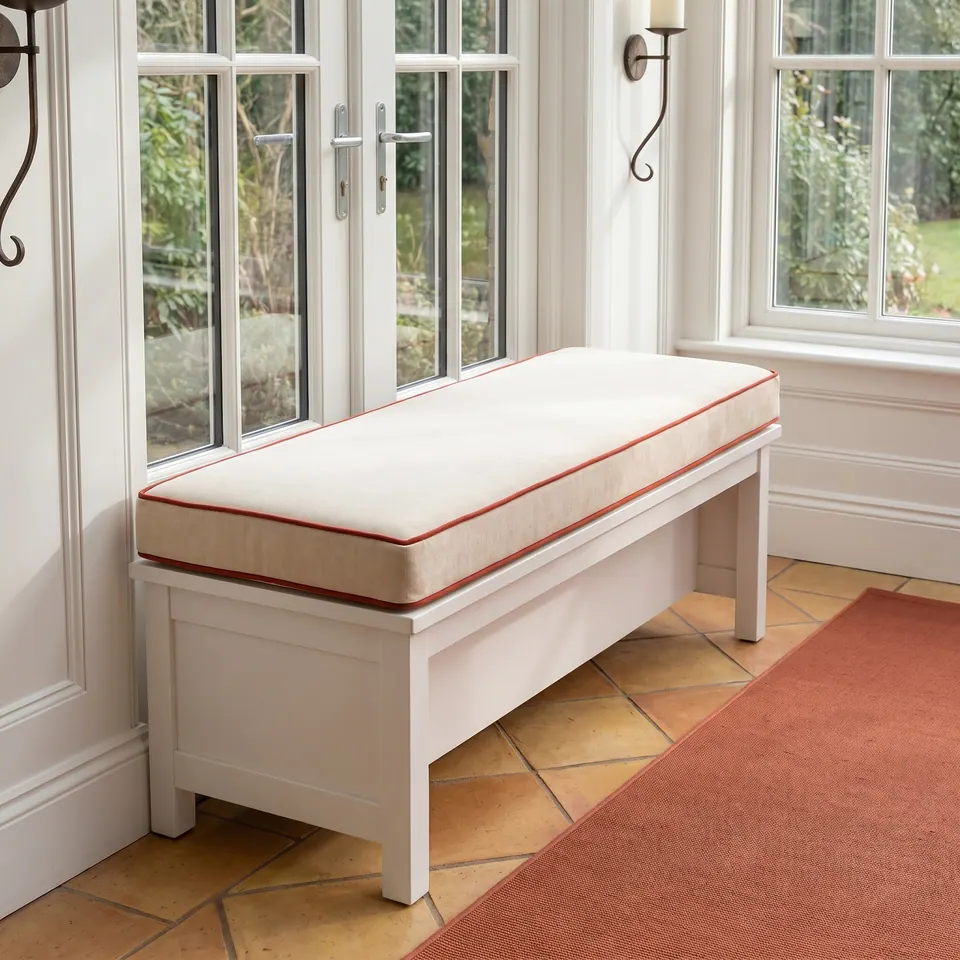
The warm cream on the linen chart is the most-ordered neutral here, and it is easy to see why. It sits between ivory and oatmeal, warm enough for oak, pale enough for white paneling, and it takes almost any piping without argument. For neutrals that lean beige rather than gray, see greige and beige linen codes.
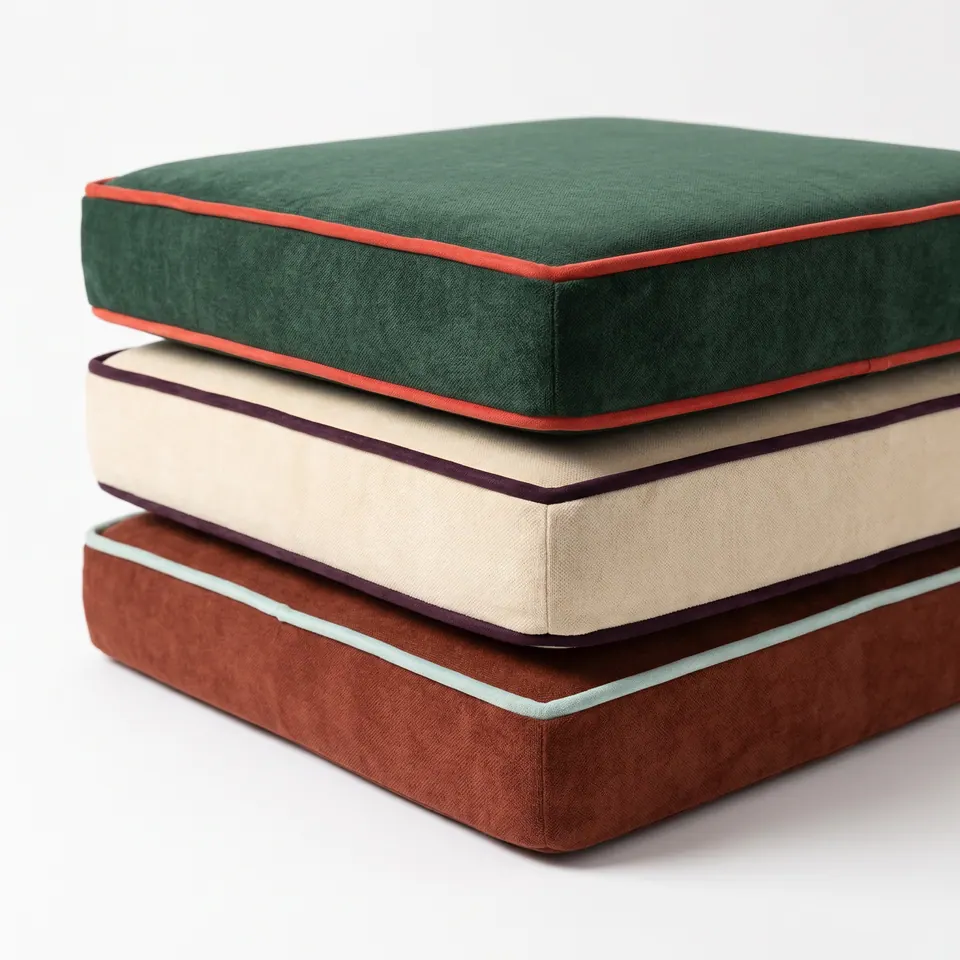
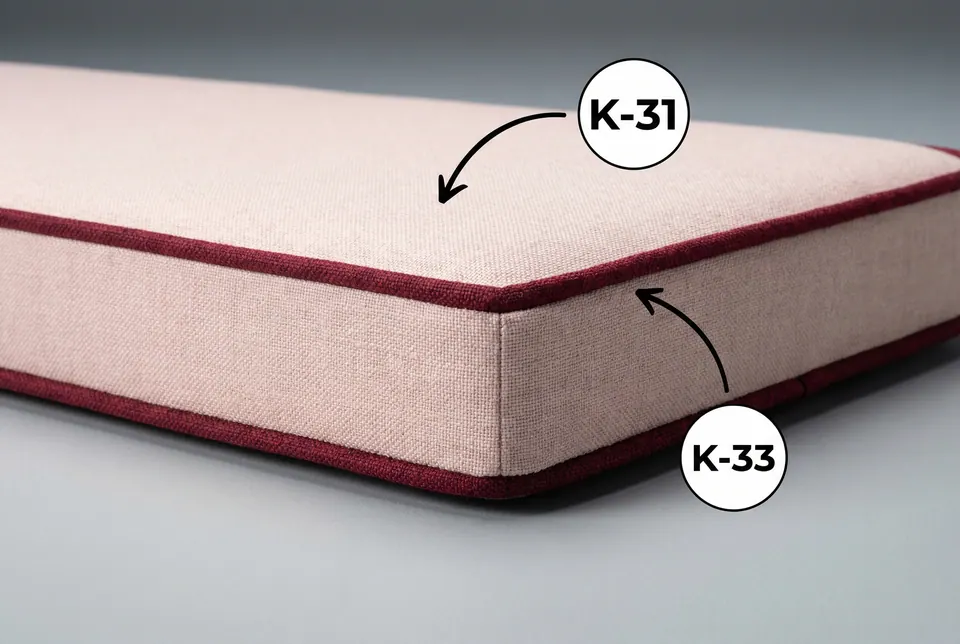
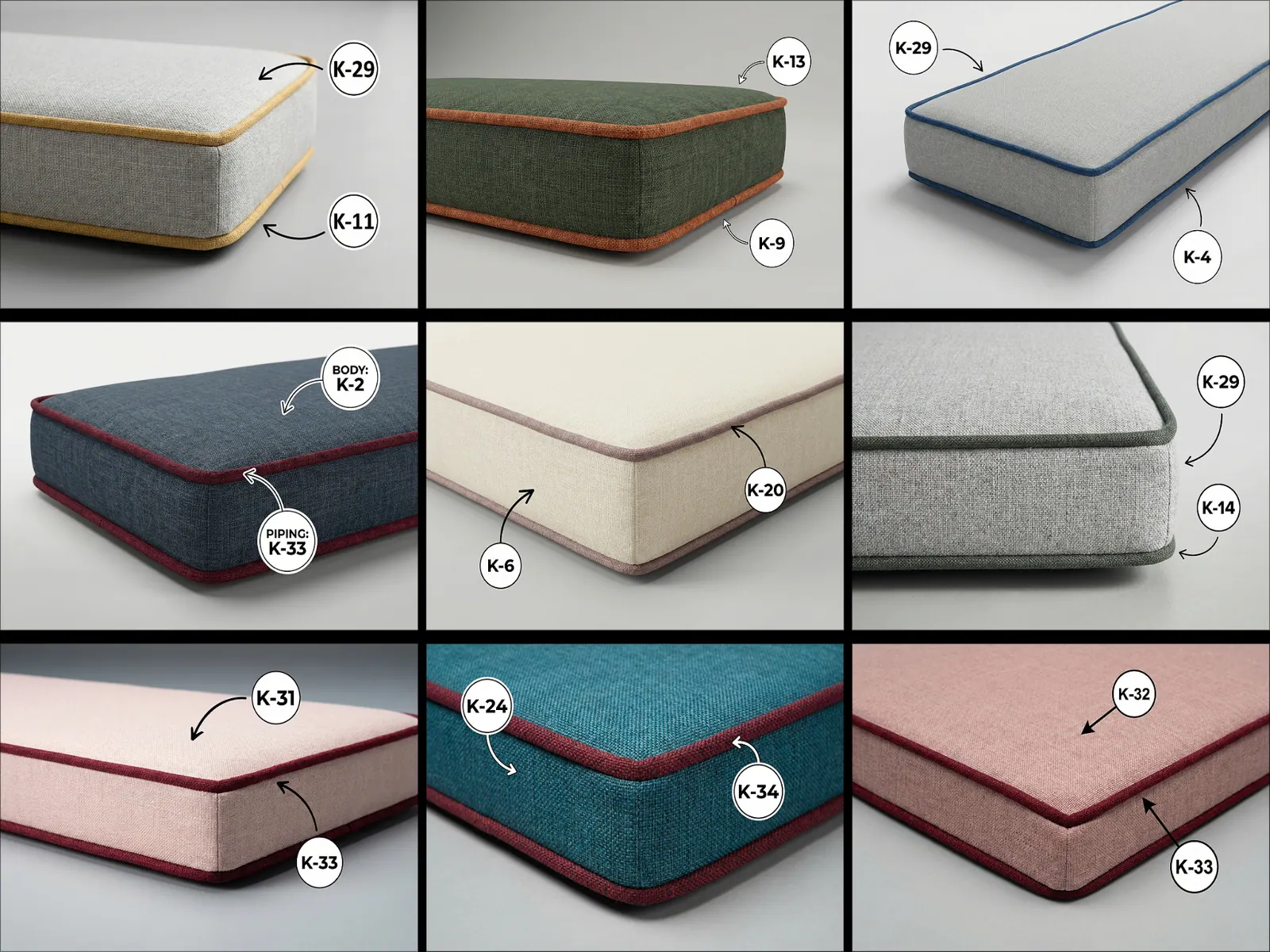
Piping is where a linen bench cushion finds its voice. There is no separate piping chart: the welt can be cut from any fabric on any chart, velvet included, and it costs nothing extra, matching or contrast. The first photograph lines up nine pairs on one box corner: pale gray with an ochre cord, forest green with burnt orange, heathered navy with burgundy, teal with a raspberry red. Pale bodies take a darker cord that traces the edge; dark bodies need a brighter one, or the line disappears. Blush with wine, in the second photograph, is the gentlest contrast of all: one hue, two depths. Matching, contrast or no piping goes further.
Then check the color where the bench lives, my friends. Listing photos shot in bright light can make blues look paler than they are, and two colors that match under one light can part ways under another, an effect called metamerism. Ask for your body and piping swatches photographed side by side, and hold the real ones at your own window. Screen versus daylight explains why.
Two window sills, one sample order
A parent in the US was buying window-sill cushions for a daughter's apartment and did it in the right order: samples first. With the swatches in hand she chose K-31 for the body and K-1, a light blue, for the piping, both from the linen-look chart. Then she photographed the rug and sent it, so the workshop could confirm the pairing against something real.
The two sills were different sizes, so the cushions were too. Both stayed 2 in (5 cm) thick, because an air-conditioning unit under one sill limited the height.
Three small decisions, each made before a single cut: the fabric in daylight, the pairing against the room, the thickness against the obstacle.
- Measured
- Two sill sizes, both 2 in (5 cm) thick
- What it taught
- Check for obstructions such as AC units before choosing thickness; 2 in keeps the profile low.
Before you order a linen bench cushion
- Ask for the fiber content of your exact color code. Assume linen-look upholstery is synthetic until the code says otherwise.
- Order swatches of your two or three finalists, then ask for body and piping photographed side by side.
- Measure the bench, not the old cushion, and say if the size is a hard maximum inside a frame. Handmade cushions vary by roughly 1/2 to 1 in (1 to 2 cm), so order the depth about 1 in under a fixed frame.
- On a long bench, decide between one continuous piece and two equal ones. A 90 x 18 in (229 x 46 cm) one-piece has been quoted; one piece or two covers the rest.
- Tell the maker who sits there. For kids and pets, a tight, washable weave in a mid-tone with zip-off covers; for a rental, linen-look over pale pure linen.
- Try the bench cushion builder to see thickness and piping together before you write the order note.
Most linen bench cushions are linen-look or a 50/50 blend. Pure linen creases faster on a seat, and a linen-look cover must never meet a hot iron.
Élodie Marchand
Buyer questions: linen, piping and the wash
- A common question
Before I order a 'linen' bench cushion: what is the fabric actually made of?
The workshop's answerUsually not pure linen. The standard linen charts are blends or linen-look weaves: the L-coded linen-look fabrics, such as L44, are polyester; the natural linen chart is described as 50% linen and 50% polyester; another range is 50% cotton and 50% linen. They're used because they're durable, easy to clean and the best sellers, and a sturdy acrylic linen is suggested for hard-working benches. For pure fiber, ask for the separate 100% linen chart or the 100% cotton fabrics.
- A common question
Where do I find the piping colors for my bench cushion?
The workshop's answerThere is no separate piping chart. Piping can be cut from any fabric on any chart shown in the listing images, more than 150 options, and charts can be mixed, velvet piping on a linen-look body for example. The linen bench cushion listing carries the widest set of charts, so it's the place to find brighter piping. Use the body's code for matching piping or another code for contrast, and write both in the personalization, as 'Body: code, Piping: code'.
- A common question
Does contrast piping add to the price of a bench cushion?
The workshop's answerNo. Piping is included, and a contrast color from the fabric charts costs nothing extra; the price is the same with or without piping. Single piping is standard and double piping can be requested. Ties and a non-slip bottom are separate optional extras, and the only piping surcharge is leather piping in a non-stock color. If you leave the piping blank, the workshop checks with you before production, usually assuming matching.
- A common question
Can you show me my linen and the piping together before I commit?
The workshop's answerYes. The workshop photographs your chosen swatches side by side, as many combinations as you need, with extra shots in different light on request. It can't show a finished cushion in every pairing, since there are hundreds of colors, and it doesn't make AI mockups, because they misstate real tones. Close-ups look a little darker and coarser than daylight shows, so for exact tone, physical samples are the safest judge.
- A common question
Can a linen bench cushion cover go in the washing machine?
The workshop's answerYes. Every cover has a hidden zipper on the underside and comes off the foam completely. All the fabrics, linen and velvet included, machine wash at 86°F (30°C) on a gentle or delicate cycle, for full cushions and cover-only orders alike. Air dry rather than tumble dry, and iron on low only if needed. Button-tufted covers are the exception: they are sewn through and stay on.
More about linen on a bench
Can one linen cushion cover a long bench, or does it need two pieces?
Either. A long bench can take one continuous piece, and a 90 x 18 in (229 x 46 cm) one-piece has been quoted, or two equal pieces. Past roughly 98 to 118 in (2.5 to 3 m), equal pieces are recommended for fit, durability and easier handling.
Where does 'soft fabric' fit next to the linens?
Soft fabric, codes 901 to 946, is the best-selling everyday weave: thick, durable and wipeable, described as a polyester-cotton blend. It has a linen-look texture but isn't linen, and it washes at 86°F (30°C). It is the usual pick for kids, rentals and heavy daily use.
Is a cream linen-look bench cushion a bad idea with kids?
Not with the right habits. Linen-look resists stains better than pure linen, and the cover zips off for a gentle 86°F (30°C) wash. For small children and pets, the workshop suggests a tight, washable weave in a mid-tone, which forgives more than pale cream.
Are there striped or patterned linens for a bench?
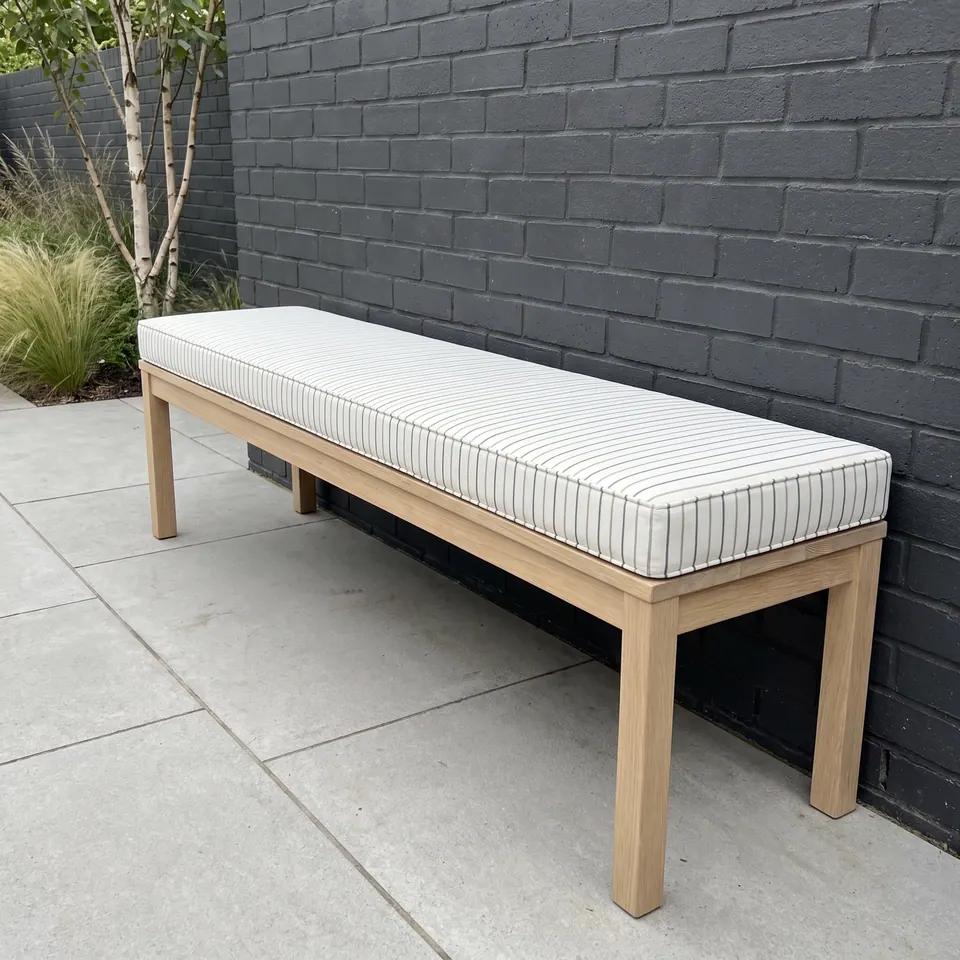
A few. The range is mostly plain, but there are beige-and-white and black-and-white stripes, plaids and patterned velvets, at no price difference among the workshop's own fabrics. Natural-fiber patterns are limited to the stripes and one other design. On a long bench, check stripe direction against the roll width before cutting.