The Pattern Room · a measuring pattern
From your drawing to your doorstep: how a custom cushion is made
Folks picture a machine. What actually happens is slower and plainer: a message, a drawing, a pair of shears, and somebody checking the numbers twice before the cloth is touched.
 Save
The quick answer
A custom cushion is made in order: your measurements and fabric code arrive, shaped pieces get a drawing you approve, then the fabric is cut, the foam is cut slightly oversize and wrapped, and the cover is sewn with piping and a zipper. It is measured, photographed, vacuum-packed and shipped. Ask the workshop for production and delivery times in writing.
The first tool is your own tape measure
The first tool that touches a custom cushion isn't a pair of shears. It's the tape measure in your own hand, and the numbers you write down with it.
I swept floors in an upholstery shop at fourteen, and the old men there had one rule: nobody cuts cloth on a guess. That rule still runs the whole process, and it is the honest answer to how are custom cushions made. Slowly at the start, where mistakes are cheap. Steadily at the end, where they aren't.
Here is the route a cushion takes, station by station, with the questions buyers ask at each stop and the workshop's answers. Where a step has its own Pattern or Answer, I've pointed you to it. A seam is a promise, my friend. Everything before the seam is making sure it's a promise worth keeping.
Ten stations between your message and your porch
Your message and your numbers
Length, depth and thickness, all in inches or all in centimeters, never both on one drawing. A fabric code for the body and one for the piping. A photo of the seat if you have it. Every separate shape gets its own drawing, with a measurement on every edge.
The size bracket, and the size in your note
At checkout you pick the nearest size option, usually the one just above yours, and type your exact size in the note. The option only sets the price bracket; the workshop sews the size in the note. If the real size is bigger, you pay the difference through a payment link. If it's smaller, the difference comes back to you.
A drawing you approve before anything is cut
For trapezoids, notches, curves and multi-piece sets, the workshop draws the shape to scale, works out any missing sides, converts inches to centimeters, flags an edge that can't be right and sends the drawing to you. Production waits for your yes. The Answer on drawing approval shows what that looks like.
Pattern sheet Front 106 in (269 cm), back 56 in (142 cm), two 35 in (89 cm) sides. The numbers closed at about 24 1/2 in (62 cm) deep, so no paper template was needed. Cutting the fabric
The fabric comes off rolls at most about 55 in (140 cm) wide. On long pieces that width decides where a seam falls and which way a stripe can run: across a long cushion, stripes run front to back unless you accept a join. When a panel is wider than the roll, the join goes toward the back, where it's least seen.
Cutting and wrapping the foam
The standard core is about 2.0 lb/ft³ (32 kg/m³) high-resilience foam. It is cut a touch larger than its cover and wrapped in polyester-fiber (Dacron) batting before it goes in, which is why a new cushion crowns on top and fills its corners. The Pattern on Dacron-wrapped foam explains the oversize.
Sewing the box and the piping
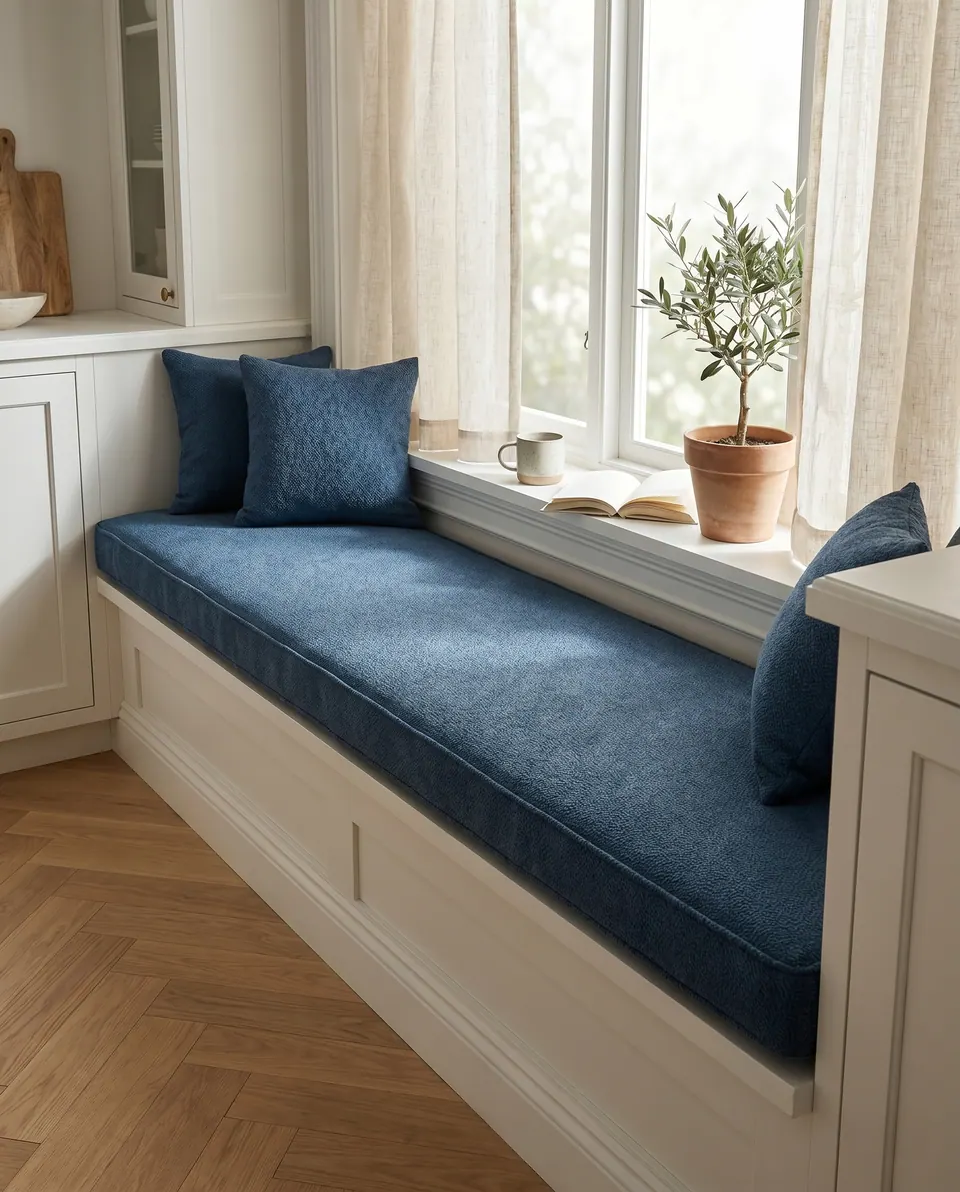
A box cushion is a top, a bottom and a side band between them. Piping, a fabric-covered cord, runs along the top and bottom seams, in the body fabric or a contrast code; it's included either way, and "no piping" costs the same. In trade drafting, each panel carries a 1/2 in (1.3 cm) seam allowance.
 Save
One stack, eight velvet colors. The teal and mustard pieces carry contrast piping; the rest are piped in their own color. The zipper, or the tufting, but never both
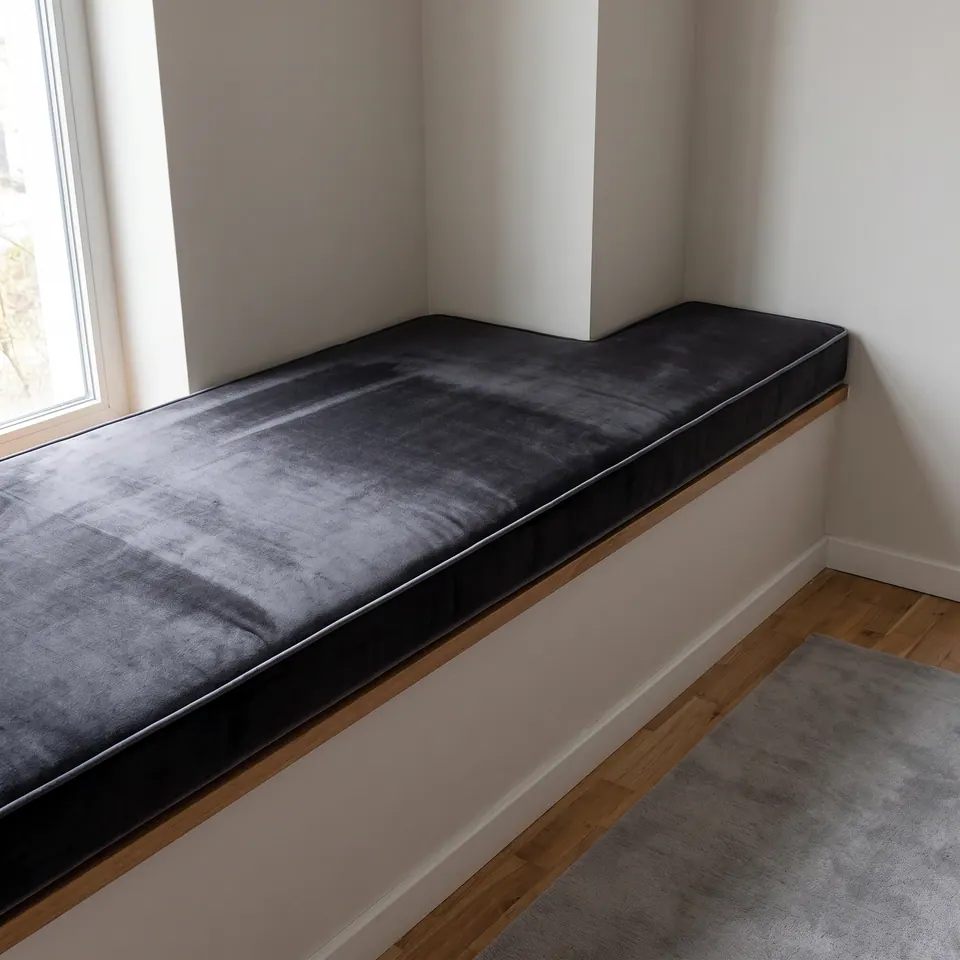
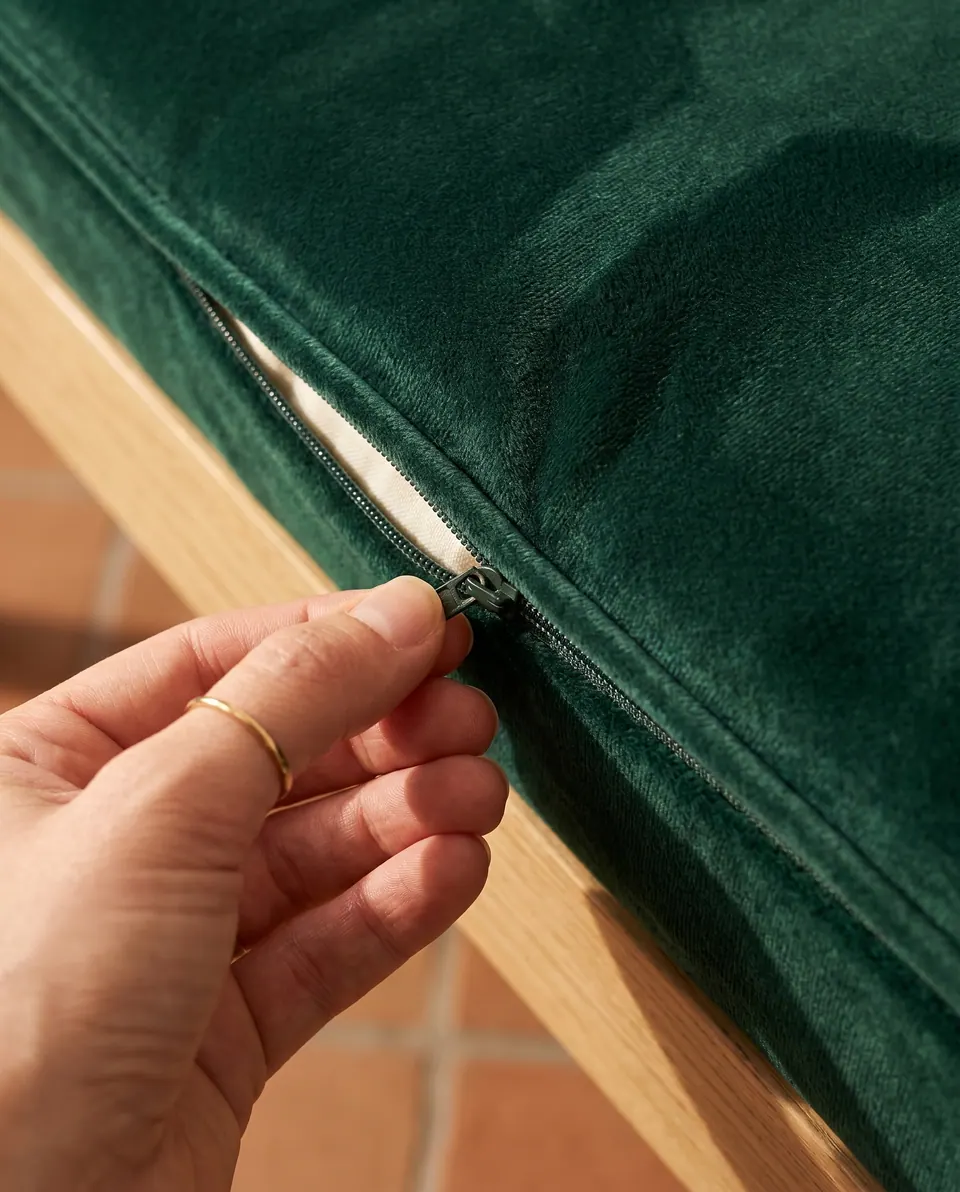
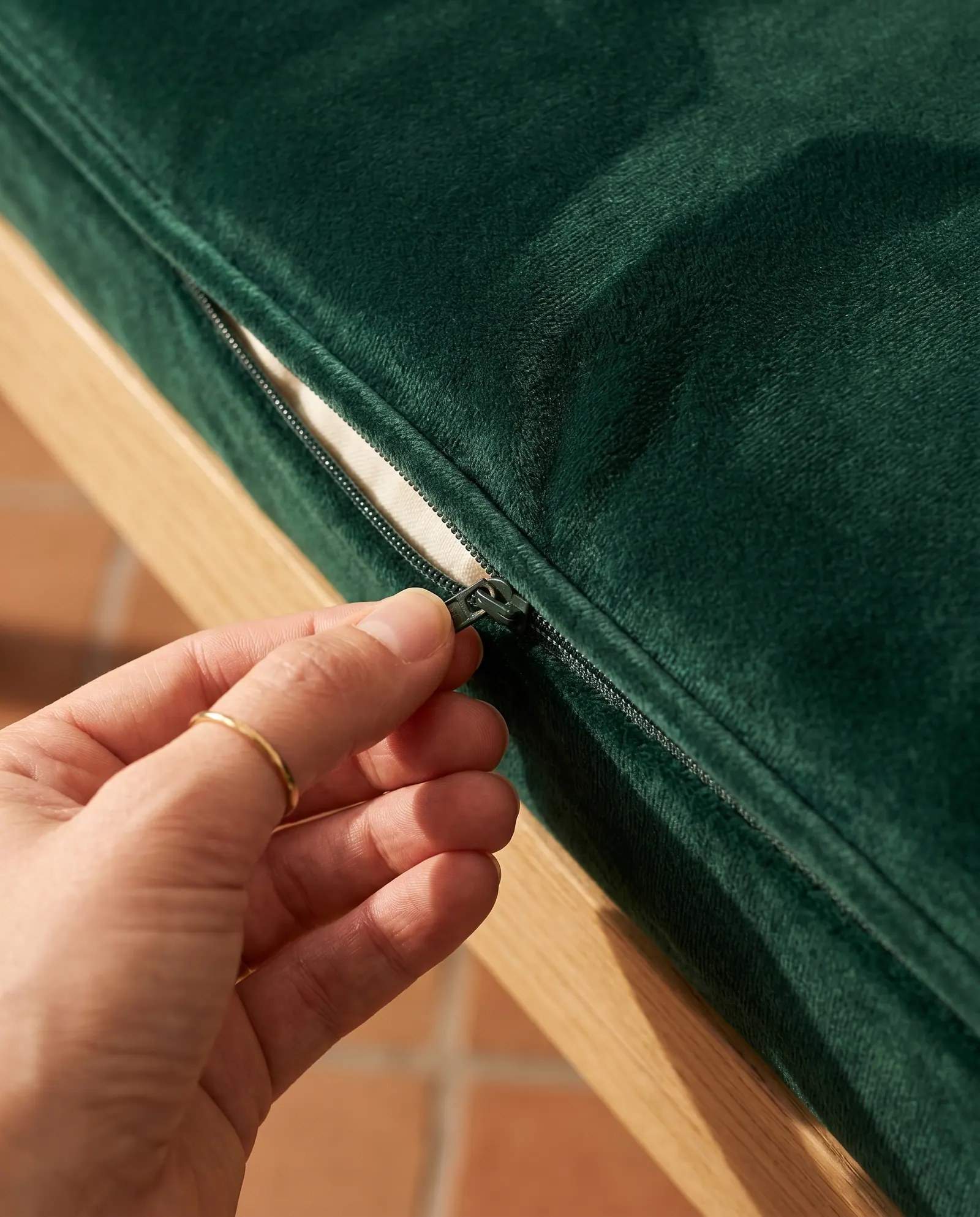
Every untufted foam cushion gets a zippered, removable cover, hidden on the back edge or the underside. On benches it often runs around two corners in an L so the insert slides out. Tufting passes through the filling, so tufted pieces are sewn closed, with no zipper, and are cleaned in place.
 Save
A concealed zipper on the side band lets the velvet cover come off for cleaning while staying out of sight. Measuring and photographing
Every cushion is measured after sewing, and every order is photographed before it ships; packing is often filmed. You can ask for those photos, including ones with a tape on a custom shape. Check them for the small extras: ties, a non-slip base, the zipper side.
Vacuum packing, and why
Full-size foam is bulky, and shipping bulk costs a great deal. Pressed flat in plastic, a cushion travels in a far smaller box. Foam recovers well when it's opened within a few weeks; the workshop advises no more than 2 to 3 weeks sealed and never promises recovery past a month.
The first 72 hours at your house
Cut only the outer plastic, with the scissors pointed away from the fabric. The foam rises over 48 to 72 hours, often keeps growing for 3 to 5 days, and can take a week to reach full shape. Measure after that, not on delivery day. The Pattern on the first 72 hours walks you through it.

Have it made
Measured it? Have Harlan’s workshop make it
Old upholsterers will tell you the real cutting happens in the conversation, long before the shears come out. Tell the workshop what you sit on, and they will talk it through with you. — Harlan
Leave your details and the workshop will call you to confirm measurements, fabric, foam and piping. No prices, dates or payment on this page: it is a request, not an order.
On the cutting table: what makes an order quicker or slower
| Simple bench cushion | Quickest: one rectangle, one set of numbers, one cut |
|---|---|
| Typical custom order | Longer: each shape is drawn and approved before cutting |
| Custom bench cushion, order to door | Making, then carrier transit; the quote covers both |
| Curved or complex shapes | Longest production, by the most experienced craftsman |
| Bulk batches | Quoted per batch, with delivery shown on the quote |
| Delivery after dispatch | Tracked from the workshop to your door |
| Busy weeks and holidays | Allow extra margin |
| Changes to size, fabric or piping | Possible until the fabric is cut; after that, a remake |
Three rounds of measuring in a 120-year-old house
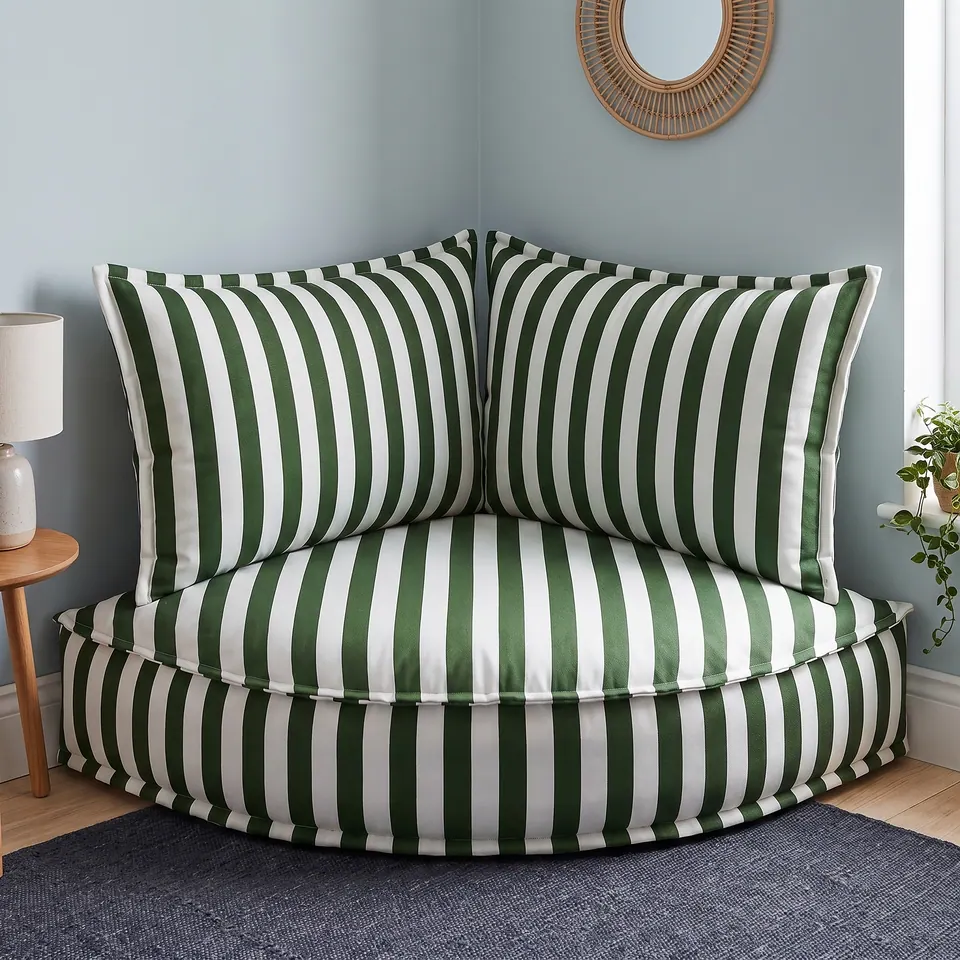
A buyer wrote to the workshop about a corner window seat in a house about 120 years old: four seat pieces and two square pillows, with one corner piece notched around a window column and nicked again where the trim hung over.
The drawing didn't close. The sides and the depths couldn't all be true at once, so the workshop asked for certain edges again, and for both diagonals, corner to corner. The numbers came back, still off. They went out again.
On the third round the buyer found the cause: the inner corner wasn't a true right angle. Old houses settle, and after a century few corners stay square. The buyer set the two seat depths at 18 3/4 in (47.6 cm) and 19 in (48.3 cm), the drawing closed within 1/4 in (6 mm), and the whole set was cut, sewn and shipped together.
Three rounds sounds slow. It's a good deal faster than a cushion that won't sit down in its corner.
- Measured
- About 50 7/8 x 50 3/4 in (129 x 129 cm) overall; diagonal 71 1/8 in (181 cm); seat depths 18 3/4 and 19 in; 2 in (5 cm) foam
- What it taught
- In an old house, measure both diagonals. A drawing that closes within 1/4 in is ready to cut.
When the order is waiting on you
Some delays start on the workshop's side of the table and some start on yours. It's worth knowing which is which.
Production waits for your fabric code. The foam can be cut and standing by, but no cover gets sewn until the code arrives. A listing may promise an earlier ship date and then the date moves, because nobody cuts a shaped piece until the sketch confirming the shape is in hand. Once it comes, the work starts right away.
Two small habits save a week. Send the drawing with the order, not after it. And put a backup fabric code in the order note: if your first choice has run out, the mill weaves it again from scratch, which adds time, and a backup keeps the shears moving. The Answer on custom bench cushion lead time has the rest of the clock, and the custom seat cushions page in the Atlas is where a new order starts.
Which number on your drawing are you least sure of? Measure that one again before you send it.
Where a custom order loses days
- Choosing a general color instead of a chart number, so the workshop has to write back for the exact code.
- Sending the sketch after checkout instead of with the order.
- Mixing inches and centimeters on one drawing.
- Typing ties or a non-slip base into the dimension box, where it's easily overlooked. Write extras in the note and confirm by message.
- Asking for a change after the fabric is cut. Until then it's a simple change; after, it's a remake.
- Leaving the cushion sealed in its plastic for weeks.
- Measuring on delivery day, before the foam has risen.
Nobody should cut cloth on a guess. The drawing you approve is the last cheap moment to be wrong.
Harlan
Buyer questions: questions from the waiting week
- A common question
My cushion isn't a rectangle. How do I order a shaped one?
The workshop's answerUse the custom-shape listing, not the rectangle one. Pick the size range from the longest length and the deepest depth; that only sets the price bracket. At checkout, upload a drawing with a measurement on every edge, plus a photo of the seat if you have one, and put the thickness and fabric code in the personalization. The cushion is cut to the drawing, not the totals. You can message the drawing first and the makers will check it.
- A common question
I ordered the wrong size. Do I have to cancel and start over?
The workshop's answerNo. Before production, the order is simply made at the correct size. If the new size is bigger than the option you paid for, you pay only the difference through a payment link; if it's smaller, the difference is refunded. Small corrections already covered by what you paid, like 16 x 44 in to 16 x 46 in (41 x 112 to 41 x 117 cm), are just updated, and the final sizes are confirmed by message.
- A common question
Can you get my cushions to me by a specific date?
The workshop's answerOften, if you order right away and the date is realistic. Write the deadline in the order note and message just after ordering, so production can flag it as urgent, say whether the date works and ship it express. One urgent bench cushion was made the next day and shipped within two days. Deadlines very close to a holiday may not be possible, and add-ons ordered later can miss the date.
- A common question
How do I measure a bench with a rounded end?
The workshop's answerSketch it or trace it. For a sketch, give the total length and depth, the straight length of each edge before the curve starts, where each curve starts and ends, and how deep it runs. For a tricky curve, lay paper on the seat, trace it, cut it out and photograph the template flat beside a tape measure. Each cushion needs its own drawing, and the shape is confirmed with you before production.
- A common question
Can I leave the cushion in its vacuum packaging until we move?
The workshop's answerNot for long. Open it when it arrives. Foam recovers fine within a few weeks, but keep it compressed no more than 2 to 3 weeks; recovery is never promised past a month, and a couch left sealed for a year and a half came out crumbly. If you're storing it, unpack it, let it rise, then store it uncompressed, or order closer to when you need it.
Before the shears come out: custom cushion questions
Can I see my cushion before it ships?
Yes. Every order is photographed before shipping, and packing is often filmed. Ask for the photos, including ones with a tape measure on a custom shape. Look for the extras too: ties, a non-slip base and the zipper side are far easier to fix before the box is sealed.
Why would a long cushion have a seam on top?
Because the fabric roll is at most about 55 in (140 cm) wide. A panel bigger than that needs a join, placed toward the back where it's least visible, and sometimes it can be avoided altogether. On long striped cushions, the same limit decides which way the stripes run.
Can a tufted cushion be re-covered later?
No. Tufting runs through the filling, so the cover is sewn closed with no zipper and can't be swapped on its own; the whole cushion has to be remade. If washable covers matter in your house, order the plain, untufted build with a zipper.
Who makes the difficult shapes?
Curved and complex pieces go to the most experienced craftsman, which is part of why they take longer to make. A paper template helps: one S-curved bench edge was agreed to only after the buyer supplied a full template of the seat.