The Pattern Room · a measuring pattern
Porch swing cushion sizes: measuring a 4, 5 or 6 ft swing
A swing is sold by its length, but its cushion is cut to the space between the arms. Get that one number right and the rest of the porch falls into place.
 Save
The quick answer
Size a porch swing cushion from inside the arms; the label length is the frame, not the seat. Stock pads for 4 ft and 5 ft swings run about 45 and 55 in (114 and 140 cm) long, and swing seats 18 to 24 in (46 to 61 cm) deep. Choose 3 to 4 in (8 to 10 cm) for everyday sitting and order the back separately.
The label says 5 ft. The cushion doesn't.
A porch swing is sold by its length. The cushion is cut to the space between its arms, and on most swings those two numbers are not the same.
That is the whole secret of porch swing cushion size, neighbor, and it is the step people skip. A 2-seat swing runs about 48 in (122 cm) wide and a 3-seat about 60 in (152 cm). One swing maker's own pads for its 4 ft and 5 ft swings are about 45 and 55 in (114 and 140 cm) long; a custom cushion for a roomy 5 ft swing can reach 58 to 60 in (147 to 152 cm). Seats run 18 to 24 in (46 to 61 cm) deep. Your arms, your slats and your old cushion's squash will all nudge that number, so the tape decides.
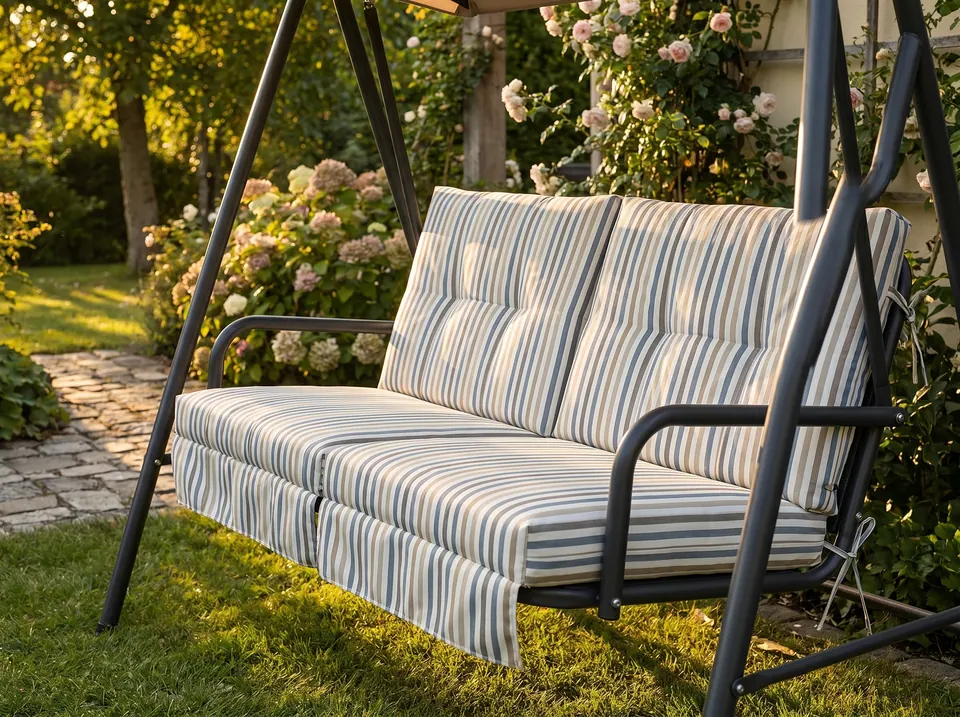
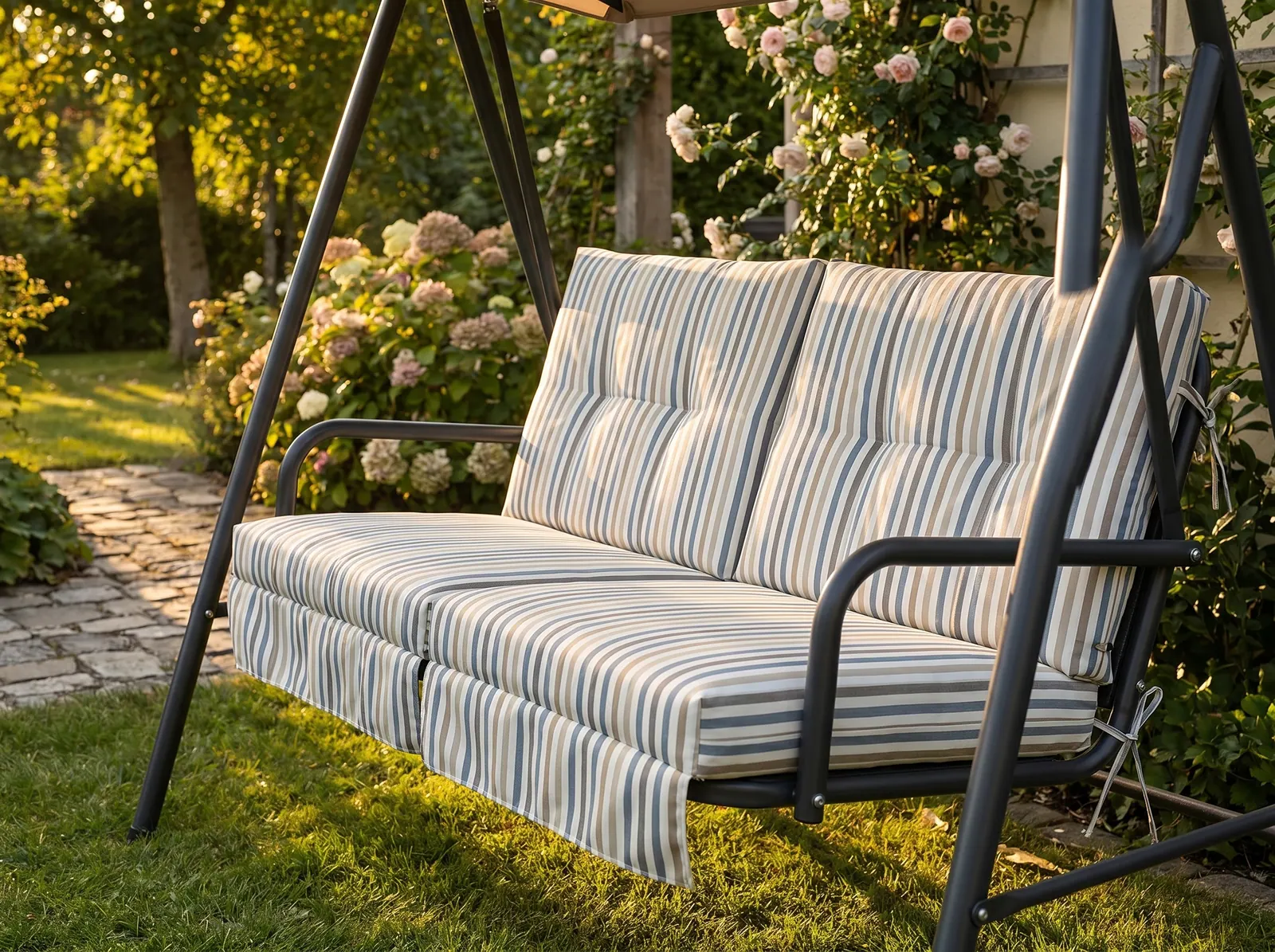
The photo up top shows a two-seat swing out by the roses, with a gray, taupe and ivory striped seat and a quilted back. Two pieces, not one. That is how a porch swing cushion set should be ordered too: a seat and a back, each with its own three numbers.
What does your swing measure between the arms?
Swing sizes at a glance
| Swing | Swing width | Seat cushion length | Seat depth | Thickness |
|---|---|---|---|---|
| 4 ft, 2-seat | about 48 in (122 cm) | stock pads about 45 in (114 cm); measure between the arms | 18 to 24 in (46 to 61 cm) | 3 to 4 in (8 to 10 cm) for everyday |
| 5 ft, 3-seat | about 60 in (152 cm) | stock pads about 55 in (140 cm); one custom guide gives 58 to 60 in (147 to 152 cm); measure between the arms | 18 to 24 in (46 to 61 cm) | 3 to 4 in (8 to 10 cm) for everyday |
| 6 ft | about 72 in (183 cm) | measure between the arms; custom swing cushions run up to 72 in (183 cm) | 18 to 30 in (46 to 76 cm); deep-seat styles more | 4 in (10 cm), or 6 in (15 cm) for lounging |
| Swing bed | the platform | the platform itself, wood to wood; one real platform was 51 x 82 in (130 x 208 cm) | the platform depth | 4 in (10 cm) recommended; 6 or 8 in (15 or 20 cm) on request |
Measuring a porch swing for its cushions, in nine steps
Measure between the arms, at the slats
Run the tape across the seat slats from the inside of one arm to the inside of the other. Do it at the front edge and again at the back, because arms lean. Keep the smaller number. Ignore the length on the box and the old cushion; a squashed pad is the wrong size by now.
Pattern sheet Plan: the cushion fills the inside of the frame, 58 by 20 in, measured wood to wood. Front view: 4 in thick. Measure the depth, front edge to back
Measure from the front edge of the seat slats straight back to where the back slats meet the seat. Most swings land between 18 and 24 in (46 and 61 cm) deep. If the back leans, measure along the seat, not up the back.
Choose the thickness by how you sit
2 to 3 in (5 to 8 cm) suits a swing used now and then, 3 to 4 in (8 to 10 cm) suits everyday sitting, and 6 in (15 cm) turns a swing into a lounger.
Measure the back from the top of the seat cushion
The back pillow stands on the seat pillow, so its height is taken from the top of the seat cushion, not from the slats. Swing backs usually stand 18 to 24 in (46 to 61 cm) tall. The workshop's standard back pillow is about 16 in (40 cm) tall and 4 in (10 cm) thick, and it won't go lower than that, for support.
Pattern sheet Side view. The back cushion stands on the seat cushion, so its height is the frame height minus the seat thickness: 22 − 4 = 18 in. Pick one long back or several short ones
Several usually sit better and stay put. For one swing about 71.5 in (182 cm) long, four back cushions about 18 in (45.5 cm) wide and 21.5 in (55 cm) tall cost the same as one full-length back. Backs can be firm foam like the seat, or soft and pillow-filled.
Mark the ties where the slats are
A swing cushion should never slide when you laugh. Four corner ties let opposite pairs knot together under the seat; two on the back edge tie around a rail or the back slats. Mark the exact spots on a photo, such as 2 in (5 cm) in from each end, and ask for them in writing.
Draw the seat and the back as two pieces
Each listing covers one cushion, so the back is its own item. Draw two rectangles, write length, depth and thickness inside each, label them 'seat' and 'back', and put 'backrest' plus the fabric code in the note. Say which way any stripes should run.
Check the approval drawing line by line
Before production the workshop turns your numbers into a drawing, often converted to centimeters, and makes the cushions exactly to it. It builds to your numbers and won't choose them for you. Check every length on that drawing, not just the shape.
For a swing bed, measure the platform
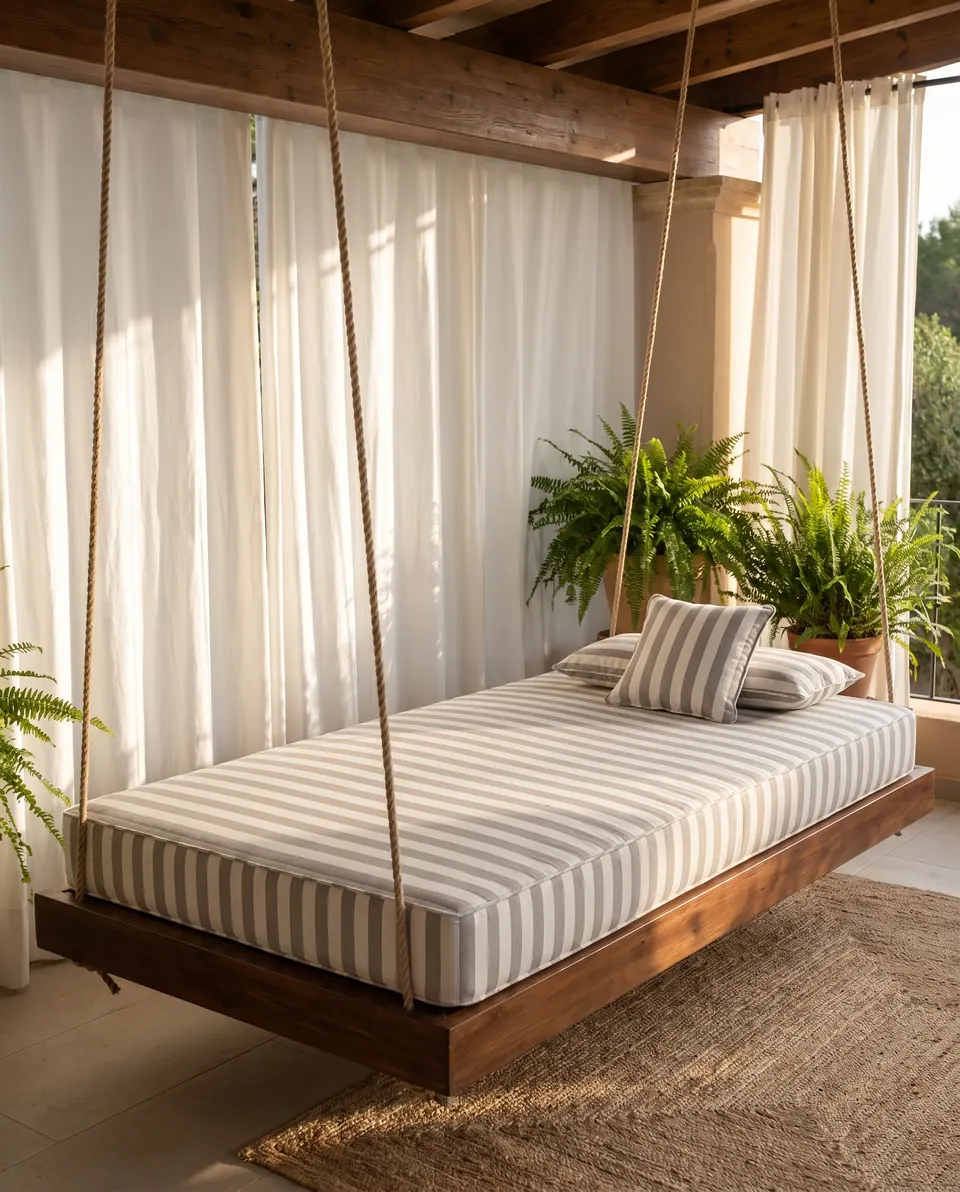
A swing bed takes a mattress-style cushion cut to its platform, wood to wood. One 51 x 82 in (130 x 208 cm) platform with a backrest was quoted at 4 in, the thickness most buyers prefer, and at 8 in. Swing bed cushions shows more real builds, some with two matching cylinder armrest pillows.

Have it made
Measured it? Have Rosa’s workshop make it
Swings sway, rockers rock, dogs circle three times. Tell the workshop what your seat goes through, and they will plan for it. — Rosa
Leave your details and the workshop will call you to confirm measurements, fabric, foam and piping. No prices, dates or payment on this page: it is a request, not an order.
Key facts
- Measure a porch swing seat between the arms at the slats; the label length is the frame, and stock pads for 4 ft and 5 ft swings run about 45 and 55 in long.
- Swing seats run about 18 to 24 in deep; 3 to 4 in of thickness suits everyday sitting and 6 in suits lounging.
- The back cushion is its own item with its own length, height and thickness, measured from the top of the seat cushion.
- Four corner ties knot together under the seat; two ties on the back edge tie around a rail or spindles.
- Water-repellent outdoor fabric suits an open porch, but the standard foam is not quick-dry, so bring swing cushions in for winter.
The back pillow that came up 23 inches short
A buyer in the US ordered a porch swing set in a striped fabric: a seat pillow, and a back pillow that sits on top of it. The back pillow arrived 23 in (58 cm) shorter than the seat.
Once everyone looked, the cause was plain. The workshop had misread the measurement diagram. At first it pointed to the approved schematic, the way you would point to a signed permission slip. Then it looked again, owned the mistake, let the buyer keep the first pillow and remade the back for free: 63 3/4 in long, 18 in deep and 3 in thick (162 x 46 x 8 cm), with the stripes running top to bottom.
The new one fit perfectly and looked great out on the patio. The lesson is one I would sew into every swing order if I could: label every number on your diagram, give the seat and the back their own lines, and say which way the stripes go.
Fabric for the porch you have, and covers for foam you already own
Start with the roof. Under a closed roof where rain and direct sun never reach, regular fabrics such as linen, velvet and the soft standard weaves are fine, though none of them is waterproof. On a screened porch with pollen, dust and humidity, or anywhere open to the sky, choose outdoor fabric. The covered porch pattern goes deeper, and patio and porch cushions gathers the rest.
The outdoor fabrics are water-repellent and UV-resistant, made for sun and rain. The foam inside is not quick-dry, and there is no mesh drainage bottom as standard, so swing cushions shouldn't sit out uncovered through rain and snow. Bring them in for winter. Water-repellent vs waterproof explains the difference in plain words.
If your swing foam is still good, you only need covers. A buyer in the US had foam for a hanging porch swing and ordered zippered covers alone, with extra-strong zippers, in cinnamon: a 55.25 x 27.75 x 4 in (140 x 70.5 x 10 cm) seat and a 50 x 13 x 4 in (127 x 33 x 10 cm) back pad. Measure the bare foam, not the tired old cover.
Label a porch swing seat and back as two pieces, each with its own three numbers; one misread diagram sent a back pillow 23 in short.
Rosa Delgado
Common mistakes with porch swing cushions
- Ordering the swing's nominal length instead of the space between the arms.
- Measuring the old, squashed cushion instead of the swing.
- Putting the seat and back on one diagram without labeling each number.
- Expecting the seat listing to include the back; each cushion is its own item.
- Typing a tie request into the size box, where it gets overlooked, instead of asking by message with positions.
- Skipping ties or a non-slip base on a narrow, smooth seat.
- Using indoor fabric where rain or damp can reach.
- Leaving cushions out through rain and snow when the foam is not quick-dry.
- Approving the drawing after checking only its shape, not every length.
Build the swing set before you send it
Open the bench cushion builder and treat the swing seat as a rectangle: enter the size between the arms, the depth and the thickness, then add ties and back cushions. It draws the set in 3D and writes a cutting ticket with every edge in inches and centimeters. Send that ticket with a photo of your swing.
For keeping a swing cushion in place, the tie placement pattern marks the spots, and porch swing cushions that stay put collects real swings from past orders.
Buyer questions: swings, backs and ties
- A common question
Will you send me a drawing to confirm my swing cushion size before you make it?
The workshop's answerYes. The workshop turns your numbers into a drawing of the agreed dimensions, often converted to centimeters for production accuracy, and makes the cushion exactly to that approved layout. It builds strictly to the figures you give and can't choose your final measurements for you, so sketch them on paper, send a photo of the sketch, then check the drawing that comes back.
- A common question
Does the swing cushion include the back, and is one long back cheaper than several?
The workshop's answerThe outdoor bench listing covers the seat only; backs are quoted separately. One long backrest isn't cheaper: for a swing about 71.5 in (182 cm) long, four back cushions about 18 in wide and 21.5 in tall cost the same as one full-length back. Several shorter backs also sit better and stay in place.
- A common question
Where should the ties go on my swing or bench cushion, and how many do I need?
The workshop's answerIt depends on how you fix it. To knot the cushion under the seat you need a tie at each corner, four in all, so opposite ties can be tied together. Two ties on the back edge only is the other common setup, for tying around a back rail or spindles. Ties go wherever you specify, such as 2 in from the ends; mark them on a sketch or photo, and check the pre-shipment photo.
- A common question
I already have good foam for my swing. Can I order just the covers?
The workshop's answerYes. Covers only, with no foam or filling, are ordered through the zippered cover listing: write the exact length, width, thickness and fabric code of your foam in the personalization box, and the covers are sewn to those numbers. Porch swing covers have been made this way, and extra-strong zippers can be requested. The workshop double-checks that you really want covers only.
- A common question
My porch has a roof. Do I still need outdoor fabric?
The workshop's answerUnder a closed roof where rain and direct sun don't reach, regular fabrics such as linen, velvet and the soft standard weaves are fine, though they aren't waterproof. For a screened porch exposed to pollen, dust and humidity, or any open-air spot, choose outdoor fabric. Samples can be sent first, and any piece, seat, back or bolster, can be made in it.
- A common question
Can I leave my swing cushions outside all year, rain and snow included?
The workshop's answerThey handle sun and showers: the outdoor fabrics are water-repellent and UV-resistant, and the covers zip off for washing. But the foam isn't a quick-dry outdoor foam and there's no mesh drainage bottom as standard. In a climate with hot summers and snowy winters, keep them on a covered porch or store them indoors over winter.
Porch swing questions, answered on the front step
How do I order a swing seat and back so they match?
Add each piece to the cart as its own item at its own size, write 'backrest' and the same fabric code in the personalization note, and the pieces are made as one matching set. One seat plus two back pillows is three items, each priced by its own size.
How thick should a swing bed cushion be?
4 in (10 cm) is the recommendation, and most buyers prefer it for sitting and napping. Thicker is possible on request: a 51 x 82 in (130 x 208 cm) swing platform with a backrest was quoted at both 4 and 8 in. Measure the platform wood to wood first.
Should a swing back cushion be firm or soft?
Either works. A foam-filled back is structured and holds its shape upright like the seat; a pillow-filled back is plumper and more relaxed. By default backs are softer than seats, but a back can be made just as firm. Say which look you want when you send your sizes.
Can I add bolsters or armrest pillows to a swing cushion later?
Yes. Fabric stock is kept, so matching pieces can be made later in the original fabric. One swing buyer was offered a back pillow plus two soft-filled bolsters, and a daybed swing got two matching cylinder armrest pillows. Send the diameter, length, quantity and your original fabric code.
What happens if my swing cushion arrives the wrong length?
Send the workshop a photo with the tape across it. In one case it had misread a diagram and remade the piece, the back pillow that came 23 in (58 cm) short. When the approved drawing itself carried the wrong number, a remake has been offered at production cost.
Why do stock cushions for a 5 ft swing measure only about 55 in?
Because the label describes the swing, not the seat. A swing sold as 5 ft measures about 60 in overall, but the arms and end posts take several inches; one swing maker's own cushions are 45 in long for its 4 ft swing and 55 in for its 5 ft. Measure between the arms at the slats, and order that number.
How deep should a porch swing seat cushion be?
As deep as the seat, measured from the back slats to the front edge. Stock swing pads are often about 17 in deep, while many swings take 18 to 24 in. If you'll add back pillows, remember they take several inches of that depth, so a shallow swing may suit a thin back cushion, or none at all.