 Save
A Reading by RosaPorch Swing & Swing Bed Cushions
Five porch swing cushion mistakes this burnt orange velvet swing avoids
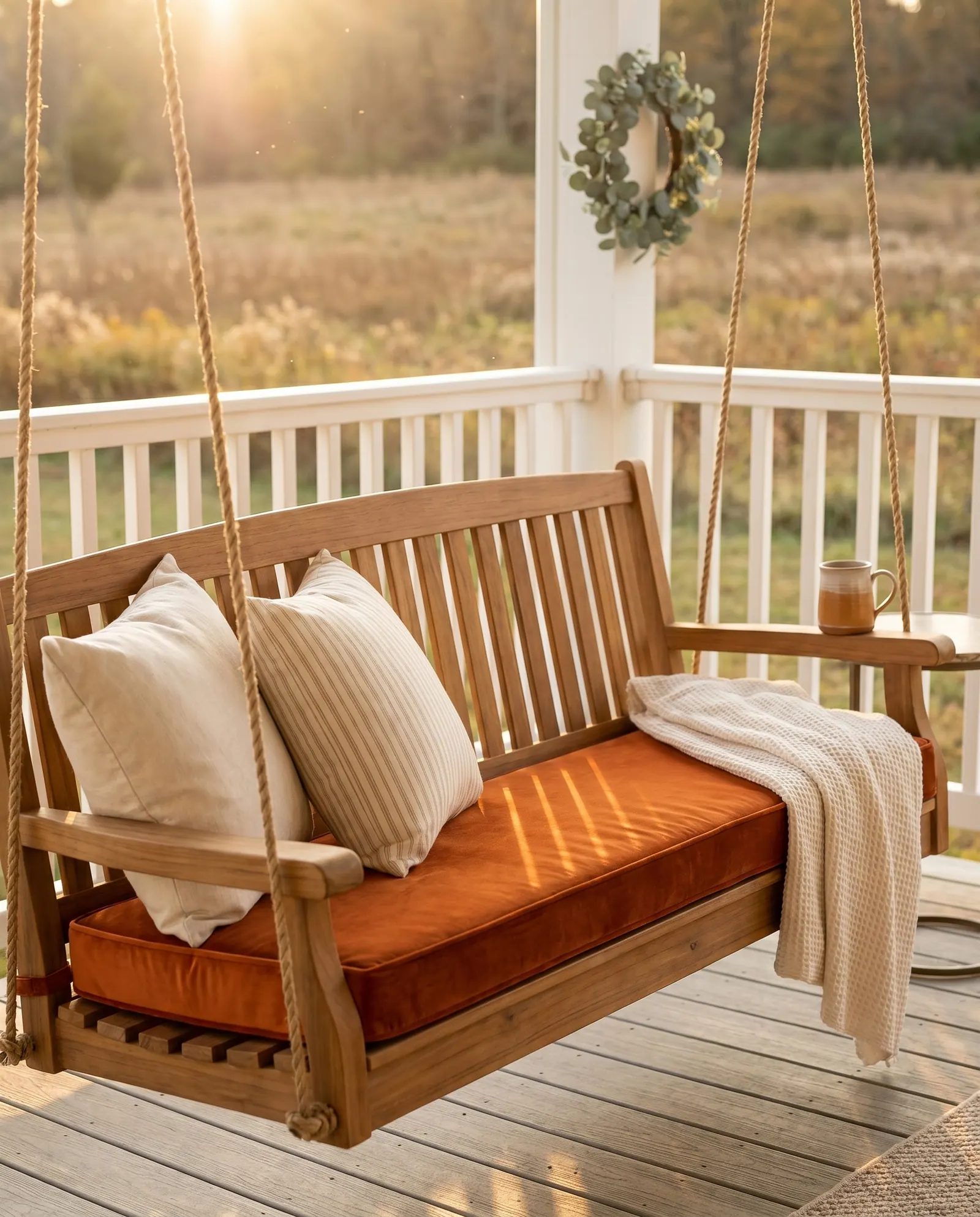
Rosa reads a rope-hung teak swing at golden hour and lists the errors she has watched porches make for years, and how this photo steps around each one.
Burnt orange velvet picks up the color of the evening sun on a teak swing, softened with cream pillows and a knit throw.
The quick answer
The classic porch swing cushion mistake is measuring across the outer frame instead of inside the arms, which gives a cushion that cannot sit flat. Others: velvet left out on an open porch, a seat too thin for long sitting, bolsters ordered months later from a new batch, and a tapered seat ordered as a plain rectangle.
Golden hour on a teak swing, and what it gets right
Every swing on my grandmother's porch had a cushion that was wrong in some small way, and every one got sat on anyway. This one gets nearly everything right, which makes it a good teacher.
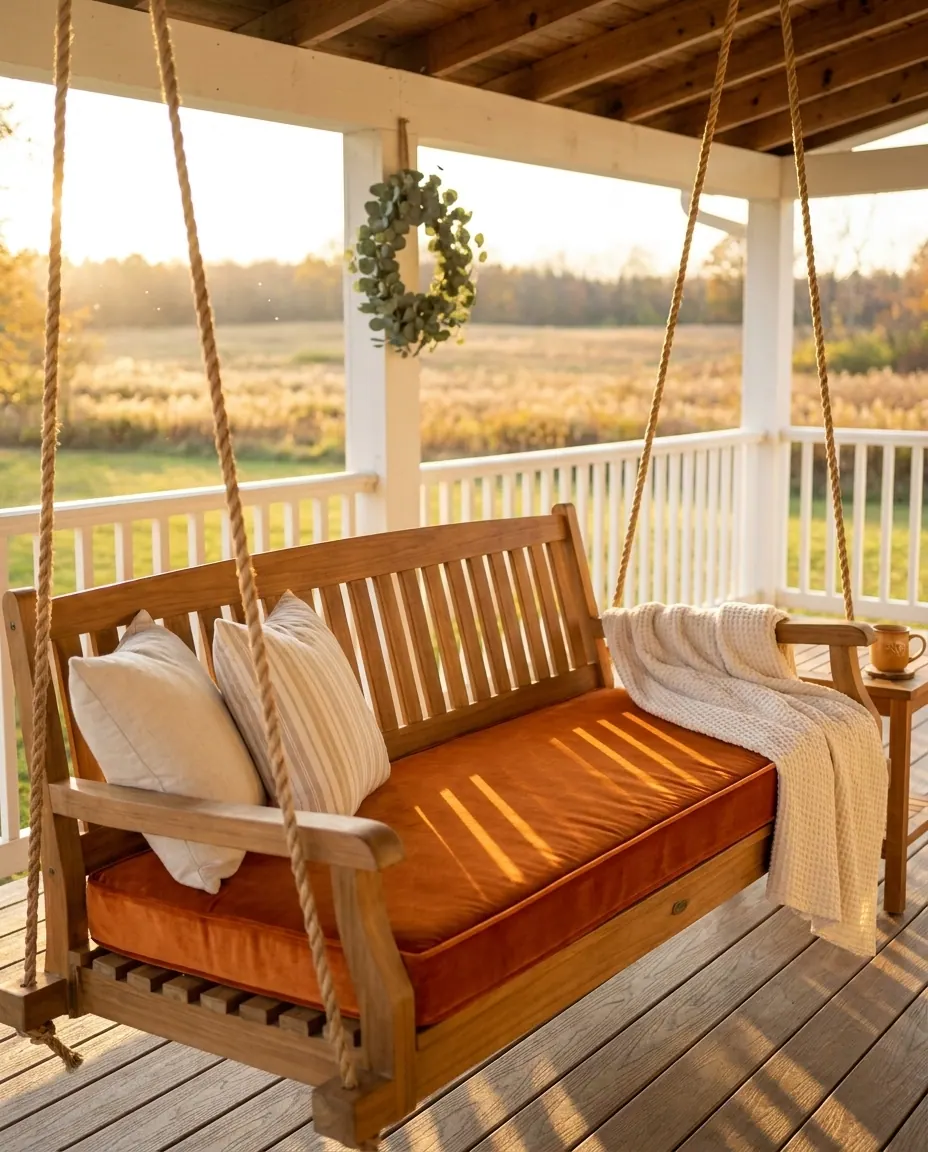
It is a teak swing hung on jute ropes on a white-railed farmhouse porch, looking out over a meadow in low autumn sun. The seat cushion runs the full width of the swing and is deep enough to hide the slats. The back is left bare and softened by two pillows instead of a second cushion.
Burnt orange velvet was chosen for the light. In low sun it glows, and it sits easily with honey teak. The pillows stay quiet: one plain cream, one cream ticking stripe whose narrow lines echo the swing's back slats. A cream cable-knit throw over the arm breaks the long orange line and hints at cool evenings. The eucalyptus wreath on the post is the gray-green counterweight to all that warm orange and wood, and a mug on a little side table says somebody lives here.
A swing cushion should never slide when you laugh; porch swing cushions that stay put shows how people solve that. Sizes for common swings are in porch swing cushion sizes, and if your porch has a roof but no walls, read indoor cushions on a covered porch first. More seats live in porch swing cushions and patio and porch cushions. What color does your porch turn in the evening?
Five porch swing mistakes, and the fix for each
- Measuring across the outer frame. Measure inside the arms, so the cushion sits flat between them instead of buckling.
- Leaving velvet out on an open porch all year. Keep velvet for the dry months, or ask for the same shade in a water-repellent outdoor fabric.
- Ordering the armrest bolsters later. Bolsters ordered with the seat are cut from the same fabric batch; months later, the shade can drift.
- Going too thin for long sitting. On a bench seat people linger on, 4 in (10 cm) supports best, with 3 in (7.5 cm) as the alternative.
- Treating a tapered seat as a rectangle. If the seat is wider at the front, send the depth plus both widths so the workshop can sketch it for your okay.
Pinned by Rosa on the porch
Five pins, from the burnt orange seat between the arms to the eucalyptus wreath on the post.
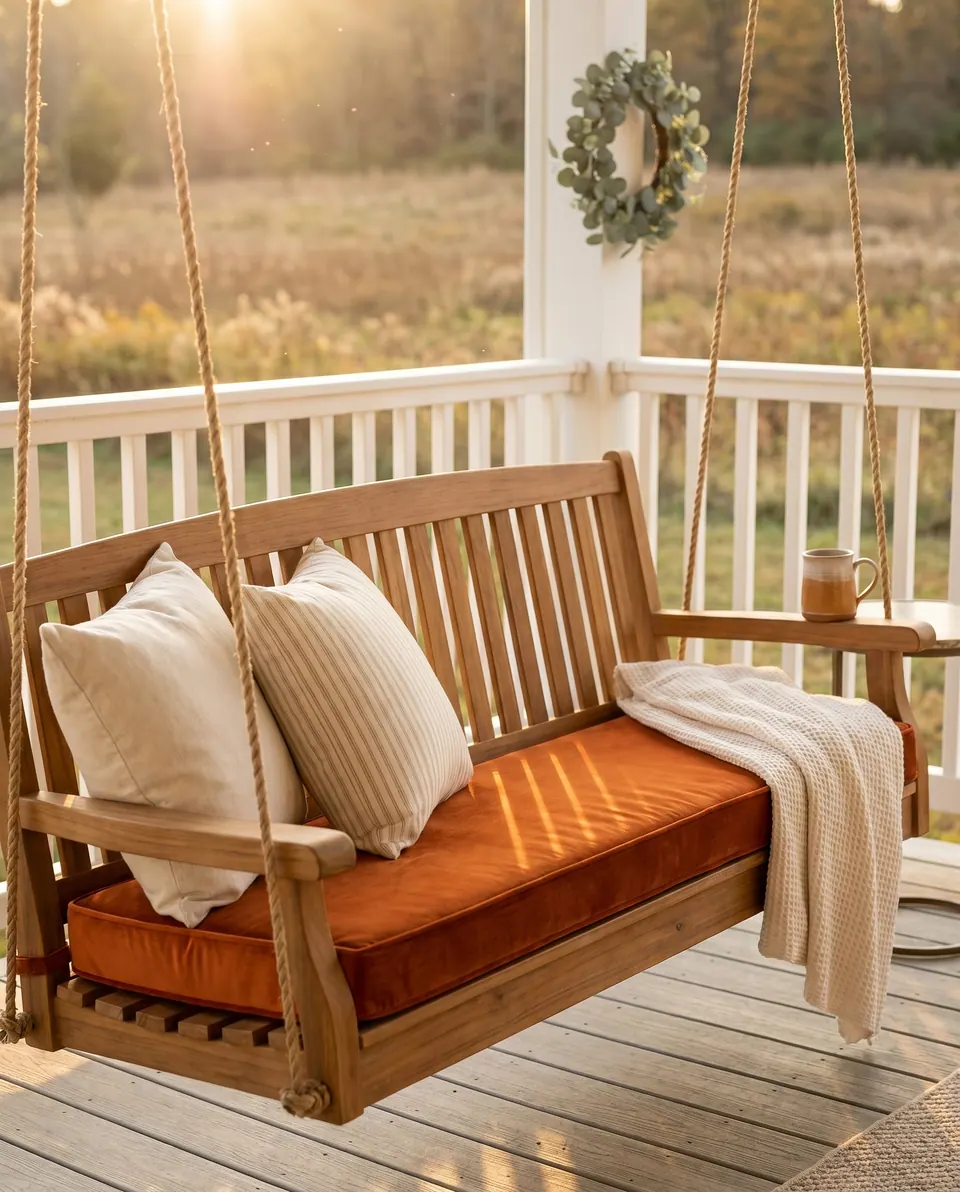
- Burnt orange seat
Measure inside the arms, not across the outer frame, so the cushion sits flat between them.
- Plain cream pillow
A plain pillow in the corner gives the eye a rest next to the stripes.
- Ticking stripe pillow
Narrow stripes echo the slats of the swing back without shouting.
- Knit throw over the arm
Cream knit breaks the long orange line and hints at cool evenings.
- Eucalyptus wreath
Gray-green leaves are the cool counterweight to all the warm orange and teak.
- Burnt orange seatMeasure inside the arms, not across the outer frame, so the cushion sits flat between them.
- Plain cream pillowA plain pillow in the corner gives the eye a rest next to the stripes.
- Ticking stripe pillowNarrow stripes echo the slats of the swing back without shouting.
- Knit throw over the armCream knit breaks the long orange line and hints at cool evenings.
- Eucalyptus wreathGray-green leaves are the cool counterweight to all the warm orange and teak.
Two armrest bolsters, ordered with the cushion on purpose
A buyer ordering an outdoor back cushion for a daybed swing asked, in the same message, for two cylinder armrest pillows to match. The workshop quoted the pair and sent a custom payment link so the bolsters could travel with the main order.
That is the whole story, and I love how short it is. The bolsters were cut from the same fabric at the same time as the cushion. Order them half a year later and you are matching against a new batch, and on a swing, where the bolsters sit right against the back cushion, any difference shows. The dye lot Pattern explains why.
- Sizes
- Sizes not given; outdoor back cushion plus two cylinder armrest pillows
The lesson: Order bolsters with the main cushion so they are cut from the same fabric batch.
Buyer questions: thickness for long sits, small cushions, tapered seats
- A common question
How thick should outdoor chair pads and a bench cushion be for an older person who sits a long time?
The workshop's answerFor chairs, 2 in (5 cm) is the most suitable, with 3 or 4 in (7.5 or 10 cm) possible. For a bench used for long sitting, 4 in (10 cm) gives the best support and 3 in (7.5 cm) is the alternative, while back cushions can be thinner, around 2 in (5 cm).
- A common question
Why is a single small seat cushion, about 14 x 14 inches, still fairly pricey? Any discount?
The workshop's answerMuch of the cost is fixed, shipping above all, so even a 13 3/4 x 13 3/4 in (35 x 35 cm) seat comes at a certain price. For one or two cushions the listed price is the best available; several pieces can get a small discount, and better prices were offered for future multi-piece projects.
- A common question
My chair cushions are tapered, wider at the front than at the back. How do I order them?
The workshop's answerSend the depth, the rear width and the front width, for example 21 in deep, 19 in at the back and 20 1/2 in at the front (53, 48 and 52 cm). The workshop draws a measurement sketch and waits for your confirmation before cutting.
On the cutting table: the golden-hour swing
| Cushion | Porch swing seat cushion, full width, deep enough to hide the slats |
|---|---|
| Fabric | Burnt orange velvet, or the same shade in an outdoor fabric |
| Piping | Self piping |
| Edge | Box edge |
| Back | Left bare, softened with two cream pillows |
| Thickness | 4 in (10 cm) for long sitting; 3 in (7.5 cm) alternative; backs around 2 in (5 cm) |
| Measure | Inside the arms, not across the outer frame |
| Extras | Armrest bolsters ordered with the seat, same batch |
| Best for | Farmhouse porches and rope-hung swings in the dry months |

Have it made
Have this made — ask Rosa’s workshop
Tell the workshop who sits there: grandkids, the dog, a cup of coffee at six. The right fabric and foam follow from the people. — Rosa
Leave your details and the workshop will call you to confirm measurements, fabric, foam and piping. No prices, dates or payment on this page: it is a request, not an order.
Measure a porch swing cushion inside the arms, not across the outer frame; that difference keeps the seat flat instead of buckled.
Rosa
Questions buyers ask next
Can a velvet cushion stay out on an open porch?
Keep velvet for the dry months on an open porch and bring it in when the weather turns, or ask for the same shade in a water-repellent outdoor fabric. A roof helps, but rain still blows in sideways.
Why leave a swing back bare instead of adding a back cushion?
A bare slatted back with two pillows keeps the swing light and lets the teak show. Pillows move to wherever someone leans and change with the season, while the seat cushion does the real work.
What color works on a teak porch swing?
Warm, deep colors like burnt orange glow in low evening sun and sit well with honey teak. Keep the pillows cream or finely striped so one strong color leads, and add a gray-green touch, like eucalyptus, to cool it.
Should a swing seat cushion cover the slats completely?
On a slatted swing, yes. A seat cushion deep enough to cover the slats front to back sits flatter and feels better than one that stops short and leaves a hard slat edge under your legs.
Porch light's on — Rosa
More photographs to read
 Save
 Save
 Save
 Save
 Save
 Save