The Pattern Room · a measuring pattern
Replacing patio swing cushions on canopy swings and vintage metal gliders
A canopy swing hangs from its own frame and a metal glider rocks on its own feet. Neither one takes the cushion you'd buy for a porch swing on chains, so we start with the tape, not the catalog.
 Save
The quick answer
For a patio swing cushion replacement on a canopy swing or metal glider, measure the seat deck and the back as two separate pieces, then decide whether they join at a fold or stay apart. A mid-century three-seat glider runs about 64 to 66 in (163 to 168 cm) long with an 18 to 22 in (46 to 56 cm) seat. Mark every tie point on your drawing.
Two cushions pretending to be one
A canopy swing cushion is really two cushions pretending to be one: a seat and a back that meet at a fold. Measure it as two and you'll get it right.
That's where most patio swing cushion replacement stories begin. Pull up a chair, neighbor, because the fix is simpler than the search. A porch swing hangs from the ceiling on chains, a canopy swing hangs from its own frame with shade overhead, and a metal glider glides on a base. Each wants its cushion measured on its own terms.
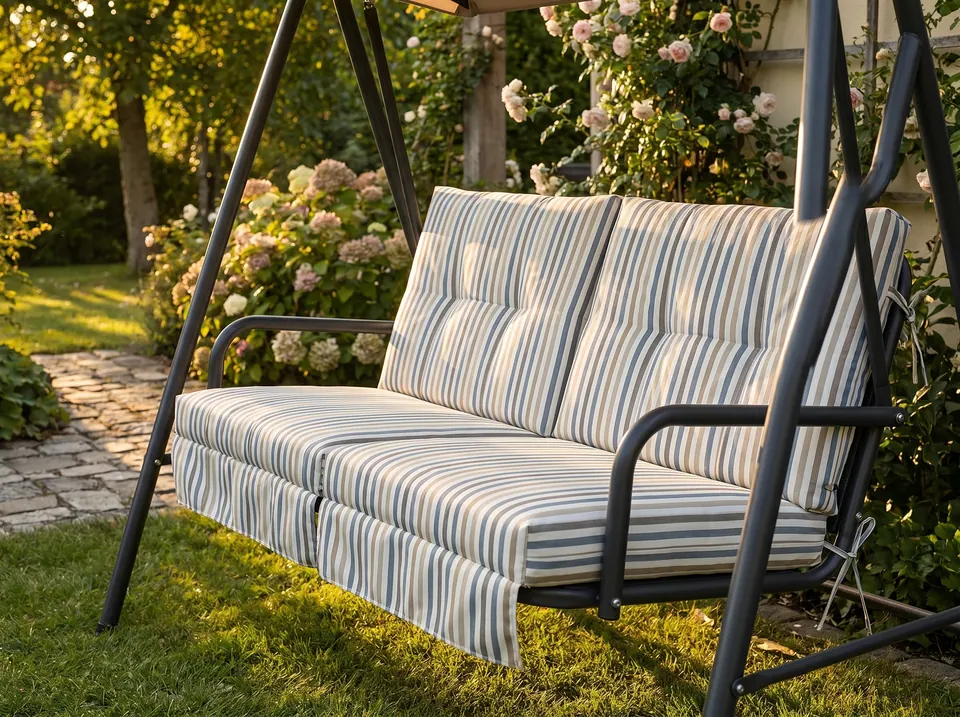
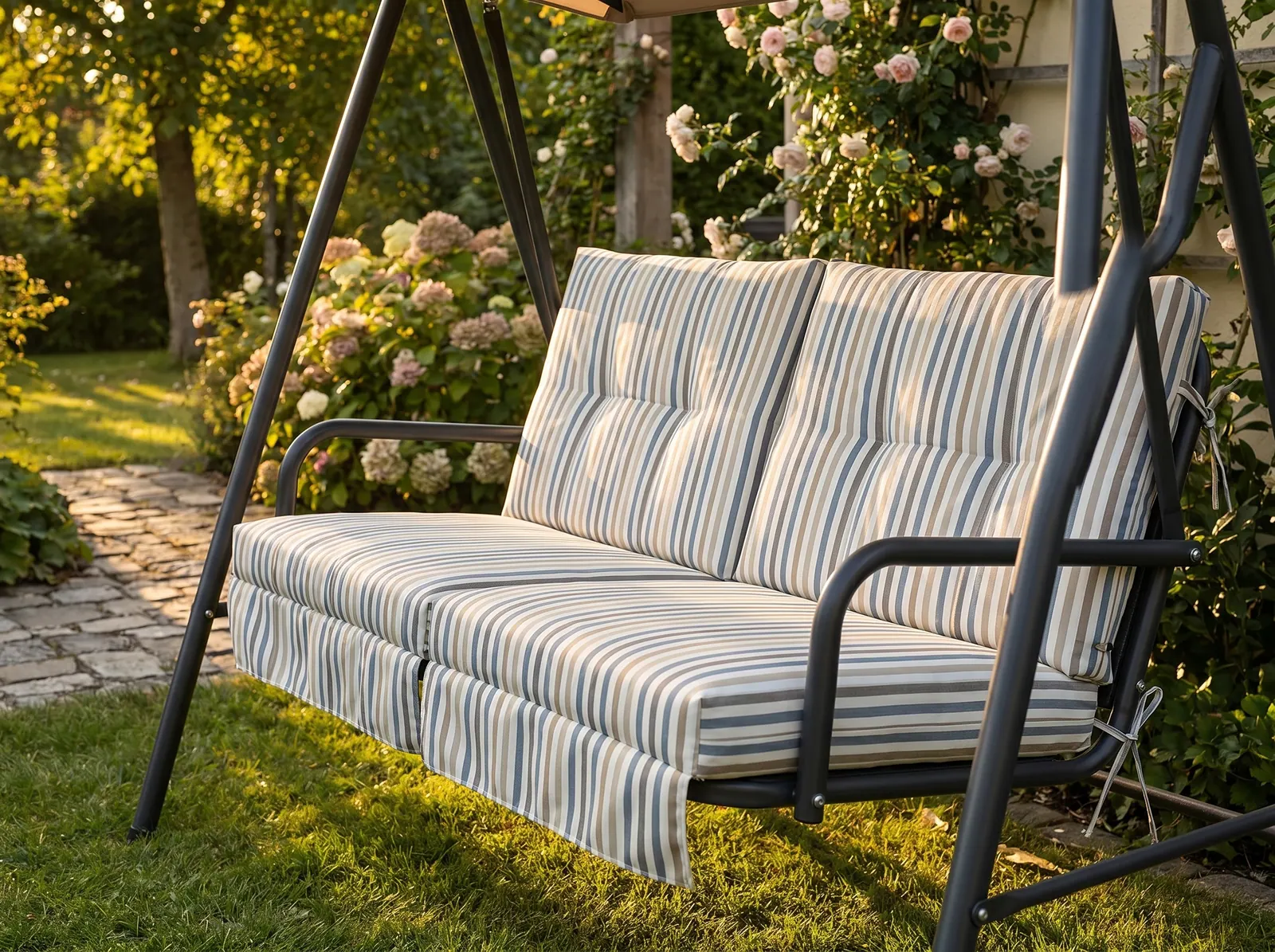
The photo up top is a two-seat garden swing on its own steel frame, with a striped seat and two quilted backs made as separate pieces. Many canopy swings come instead with one long cushion that bends where the seat meets the back. Vintage metal gliders usually take a seat, a back and, on some frames, a pad for each arm.
For a classic hung swing, porch swing cushion sizes has the table and porch swing cushions has the rest. What does your seat measure between the arms?
Hung, framed or gliding: three frames, three cushion plans
Starting points only; the tape on your frame has the last word.
| Frame | How it moves | Usual cushion set | Sizes to know |
|---|---|---|---|
| Porch swing on chains | Hangs from the porch ceiling | A seat plus a separate back pillow that rests on it | 2-seat about 48 in (122 cm) wide, 3-seat about 60 in (152 cm); stock pads for 4 ft and 5 ft swings run about 45 and 55 in (114 and 140 cm), so measure inside the arms |
| Canopy swing | Hangs from its own frame, shade overhead | Often one piece that bends where seat meets back; two pieces work too | Measure the seat deck and the back separately, then mark where the fold falls |
| Vintage metal glider, 1930s to 1970s | Glides on its own base | Seat, back, sometimes arm pads; backs are often curved | Three-seaters about 64 to 66 in (163 to 168 cm) long, seats about 18 to 22 in (46 to 56 cm) deep |
| Newer porch glider | Glides on its own base | A bench-style pad, often with ties or a non-slip back | Stock pads come about 45, 55 and 68 in (114, 140 and 173 cm) wide; your frame may not match any of them |
Measuring a canopy swing or glider, one piece at a time
Measure the seat deck between the arms
Run the tape from the inside of one arm to the inside of the other, at the front and again at the back, and keep the smaller number. On a glider, measure the flat deck the cushion sits on, not the outside of the frame or the squashed old cushion.
Pattern sheet Plan: the cushion fills the inside of the frame, 47 by 17.5 in, measured wood to wood. Front view: 4 in thick. Measure the depth to where the back begins
Measure from the front edge straight back to where the back rises. Older gliders often run deeper than new ones, so don't borrow a number from a catalog.
Measure the back on its own
Take the back's height from the seat deck, and its width at the top and at the bottom; backs are rarely the same width as the seat. If a separate back cushion will stand on the seat cushion, subtract the seat's thickness. One outdoor frame in the US with a 21 in (53 cm) back took 17 in (43 cm) back cushions over 4 in (10 cm) seats.
Pattern sheet Side view. The back cushion stands on the seat cushion, so its height is the frame height minus the seat thickness: 21 − 4 = 17 in. Trace a curved glider back on paper
Many old glider backs curve. Lay paper against the back, trace the edge, cut it out and photograph it flat beside a tape measure. Mild curves are fine; stronger ones are reviewed by the craftsmen before anyone promises a fit. The paper template Pattern shows how.
Choose one piece or two, and mark the fold
For a one-piece canopy cushion, draw seat and back as one long strip: seat depth plus back height, with a line across it where the frame bends. Seats and backs have been made both separate and fold-connected, so ask the workshop how the fold will be sewn for your frame before you order.
Mark the tie points from a named end
Ties go where the frame gives them something to hold: a slat, a rail, a crossbar. Measure each spot from one named end, such as "from the left arm," and write it on the drawing. Ties near the top of a back can sit on its back face, out of sight.
Pick ties or a non-slip base
Ties suit anything that leans on a frame, a railing or slats. A non-slip base suits a flat, solid surface. Hook-and-loop tabs and snaps aren't made, though a two-sided strip has been sewn on by request. The tie placement Pattern marks the usual spots.
Order every piece at once
Seat, back, arm pads and bolsters are each their own item at their own size, and each fabric roll is dyed in its own batch. Order the set together so it comes off one roll.
Check the approval drawing line by line
Before production your numbers come back as a drawing, and the cushions are made exactly to it. Check every length on the seat and on the back, not just the overall shape.
Have it made
Measured it? Have Rosa’s workshop make it
Tell the workshop who sits there: grandkids, the dog, a cup of coffee at six. The right fabric and foam follow from the people. — Rosa
Leave your details and the workshop will call you to confirm measurements, fabric, foam and piping. No prices, dates or payment on this page: it is a request, not an order.
Key facts
- A canopy swing hangs from its own frame; a porch swing hangs from the porch ceiling on chains.
- Mid-century three-seat metal gliders run about 64 to 66 in (163 to 168 cm) long with seats about 18 to 22 in (46 to 56 cm) deep, and their backs are often curved.
- Measure the seat deck and the back separately, even when the cushion will be one piece that folds.
- A back cushion that stands on the seat cushion is the frame's back height minus the seat thickness: 21 in less 4 in leaves 17 in.
- Ties are sewn only on request, so give each position in writing, measured from a named end.
Twenty-three inches, twice: why every line gets a label
It has happened with two different buyers in the US, and I tell it on every swing order now.
The first ordered a striped seat and a back pillow meant to run the same length. Between her diagram and the workshop's reading of it a number slipped, and the back pillow came out of the box 23 in (58 cm) shorter than the seat. That was the workshop's misreading, so the back was remade free and fit.
The second approved the workshop's schematic for an outdoor seat and back, and one piece again arrived 23 in short, because the short number was on the approved drawing itself. That remake was offered at production cost.
Two porches, one lesson: give the seat and the back their own lines, write every length on each, and read the approval drawing number by number.
Hinges, hardware and a buyer who came back
Frames with moving parts have hardware in the way: glider brackets, canopy bolts, the hinges on a lid. Ties have to land between them.
A buyer in the US who had loved her patio swing cushion came back for a 77 in (196 cm) cushion on a quilt box with a hinged lid. She wanted ties on the hinge side only and gave the workshop the four hinge positions: 8 5/8, 29, 48 and 68 1/4 in (22, 74, 122 and 173 cm). The workshop asked which end she had measured from, for photos, and for each hinge's width, so the ties would clear the metal. On a glider or a canopy swing, those same three things tell the workshop where ties can go.
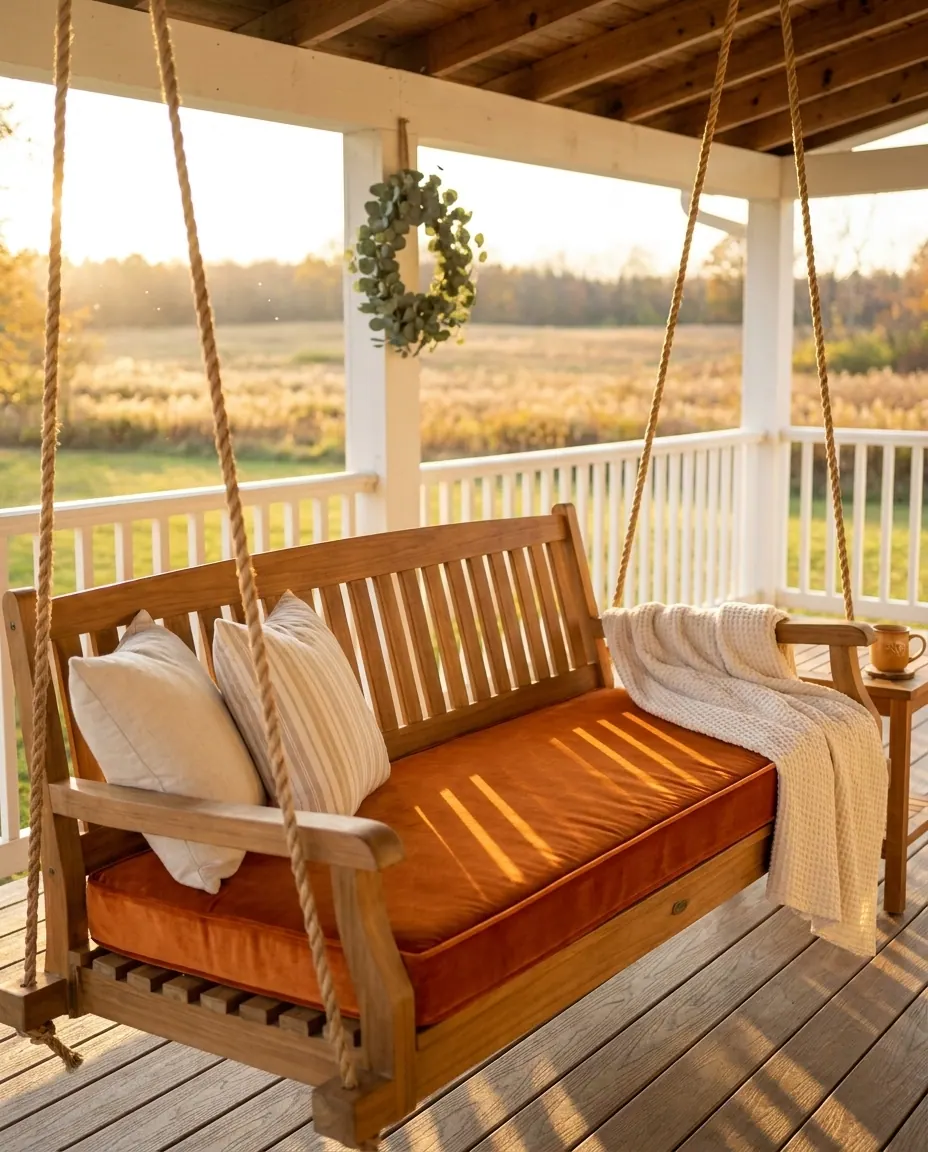
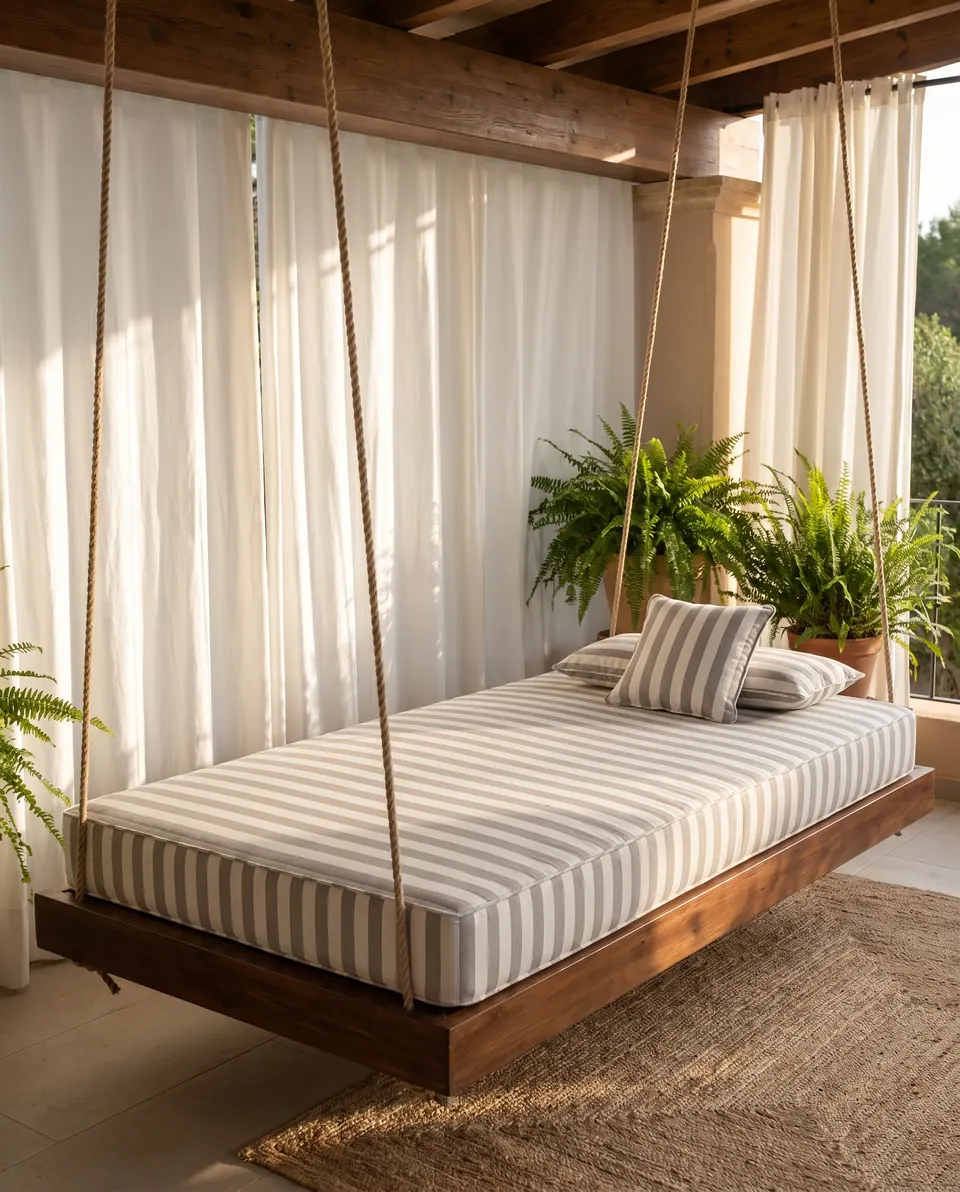
Matching pieces follow one rule: do it once. A buyer who loved a swing cushion got a back pillow and two soft-filled bolsters made as a set in the same fabric. Another ordered two cylinder armrest pillows with the back cushion for an outdoor daybed swing. The teak swing and little side bench in the gallery share one gray stripe for the same reason.
Fabric under a canopy, and where the cushions spend the winter
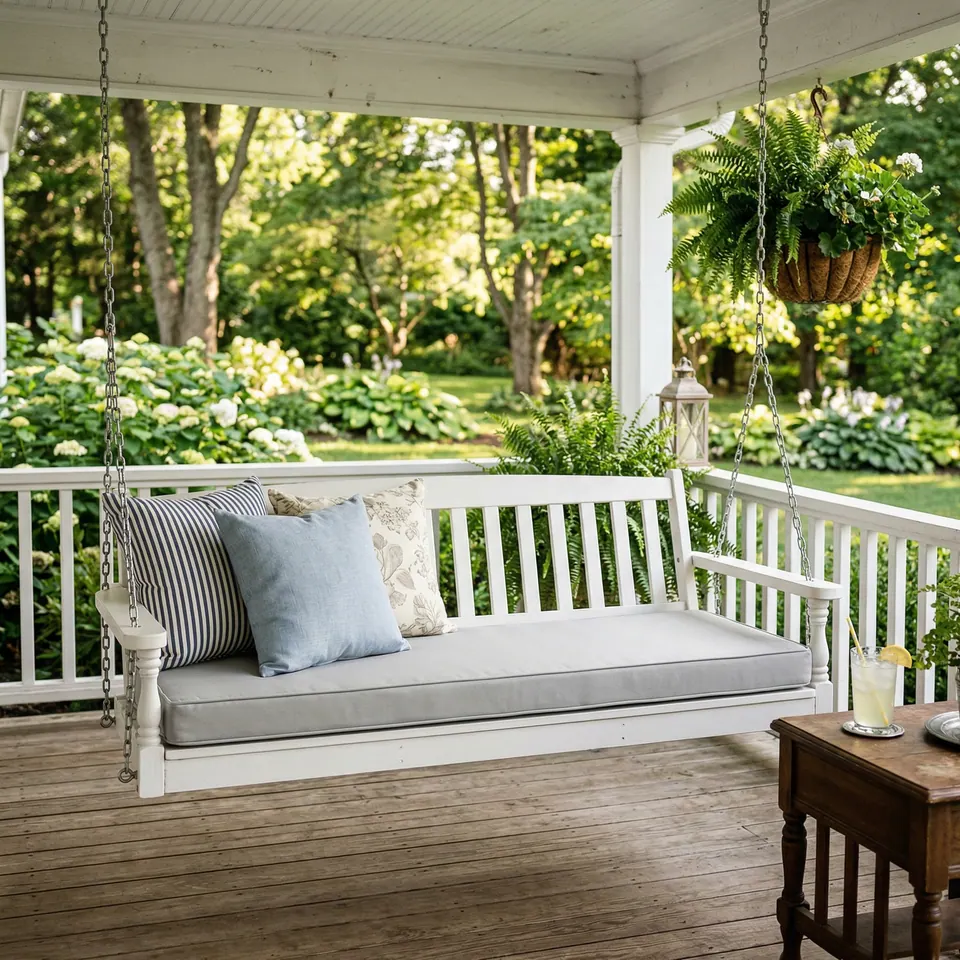
A canopy throws shade, not a roof. Rain blows in sideways and the sun finds the seat by afternoon, so a canopy swing or glider wants outdoor fabric. Ours is water-repellent and UV-resistant, in outdoor acrylic and water-repellent membrane weaves; a fine pinstripe like the one on the white swing in the gallery keeps a painted porch quiet.
Water-repellent is not the same as sealed. The foam inside isn't quick-dry and there's no mesh drainage bottom as standard, so bring the cushions in through wet spells and for the winter. Winter storage covers the rest.
If your old foam still springs back, you may need only zippered covers sewn to the bare foam's length, width and thickness. Porch swing cushions that stay put collects more real swings.
Measure a canopy swing cushion as a seat and a back, even if it's sewn as one piece; the fold only goes where your drawing puts it.
Rosa Delgado
Where canopy swing and glider orders go wrong
- Buying by the swing's nominal size instead of measuring between the arms.
- Measuring the old, squashed cushion instead of the frame.
- Drawing a one-piece cushion without marking where it folds.
- Assuming the back is as wide as the seat.
- Guessing at a curved glider back instead of tracing it.
- Typing a tie request into the size box, where it gets overlooked.
- Ordering the back or arm pads months later, from a different dye batch.
- Leaving cushions under a canopy through winter rain and snow.
Buyer questions: backs, ties and pieces sold alone
- A common question
Can I order just a back cushion for my swing, without a new seat?
The workshop's answerYes. Back cushions are made on their own in any size and color: one order was seven banquette back pillows 14 in (36 cm) high and 3 in (8 cm) thick in three lengths, another a single 13 x 50 in (33 x 127 cm) back. Seats are sold alone too.
- A common question
Does the back cushion have to be as thick as the seat?
The workshop's answerNo. Each piece is its own cushion, so they can match or differ. Many buyers choose a thicker, firmer seat and a slightly thinner back, such as 4 in (10 cm) backs on an 8 in (20 cm) seat, which also costs less. Backs usually run a little narrower than the seat.
- A common question
Should the swing back be firm foam or soft like a pillow?
The workshop's answerEither is made. Foam backs look like a shorter seat cushion, hold their shape outdoors, come in one, two or three pieces, and stay put without hook-and-loop when cut as a wedge. Pillow backs are softer and the less costly choice. A firm foam seat pairs well with a softer back; either way, a back needs something to lean on.
- A common question
How do I keep the back cushions from sliding off the swing?
The workshop's answerIt depends on what they lean against. Against a frame, railing or slats, ties sewn near the top on the back face hold them and stay hidden. Against a flat, solid back, a non-slip backing works better, and it can go on backs as well as seats, on the pieces you name. Double-piped outdoor backs often stay put without straps.
- A common question
Can you use hook-and-loop instead of ties?
The workshop's answerTies or a non-slip bottom are the usual answer. Hook-and-loop tabs and snaps aren't made, but a two-sided strip has been added on request at extra cost: one side sewn under the cushion, the other sent for the frame. Write it in the personalization box and wait for confirmation.
Canopy swing and glider questions, answered from the porch step
Will a stock cushion fit my vintage metal glider?
Often not. Mid-century three-seat gliders run about 64 to 66 in (163 to 168 cm) long with 18 to 22 in (46 to 56 cm) seats, while stock glider pads come in widths near 45, 55 and 68 in (114, 140 and 173 cm). Measure your own deck between the arms and order that number.
Is a canopy swing cushion the same as a porch swing cushion?
Not quite. A porch swing hangs from the ceiling on chains and usually takes a seat plus a separate back pillow. A canopy swing hangs from its own frame, and many come with one long cushion that bends where seat meets back. Measure both parts either way.
Can I get arm pads for my metal glider?
Armrest pieces and round bolsters are sold separately and can be quoted with the seat and back. For flat pads shaped to a glider's metal arms, send each arm's length and width with a photo and ask the workshop to confirm.
Do ties cost extra on a swing or glider cushion?
Sometimes. On many orders ties are sewn on free, often at the two back corners; on others there's a small charge per cushion, paid through a separate link. Write the request with your exact size and the tie positions, such as 6 in (15 cm) in from each short end.