 Save
- Self-piped box edge
The welt is cut from the same print, so the spots run over the seam and the edge reads crisp without a hard outline.
- Black lumbar pillow
A solid black oblong takes the darkest tone of the spots and stops the busy print from floating.
- Round caramel pillow
The only curve on a very straight bench; its tan links the birch lip and the straw tote.
- Drawer-base bench
The cushion stops at the birch lip so both drawers slide out without catching the fabric.
- Straw tote on hook
Natural straw repeats the jute rug and warms the cool gray paneling.
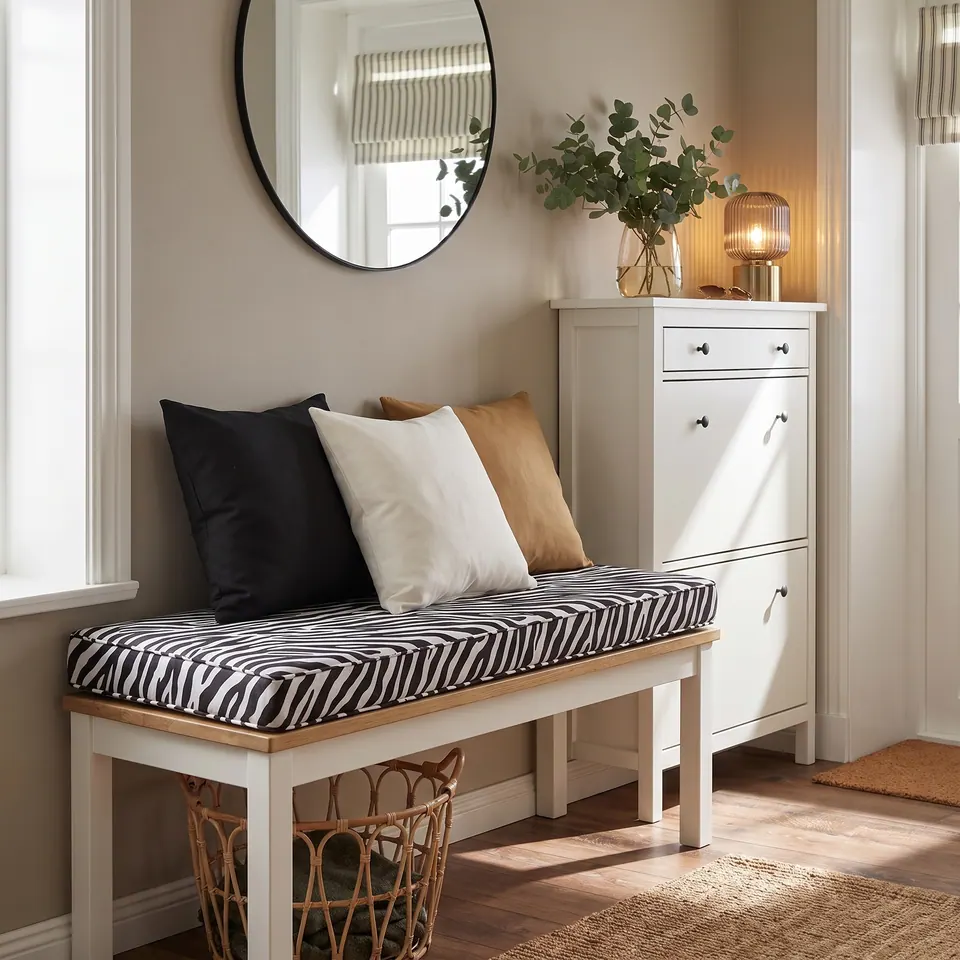
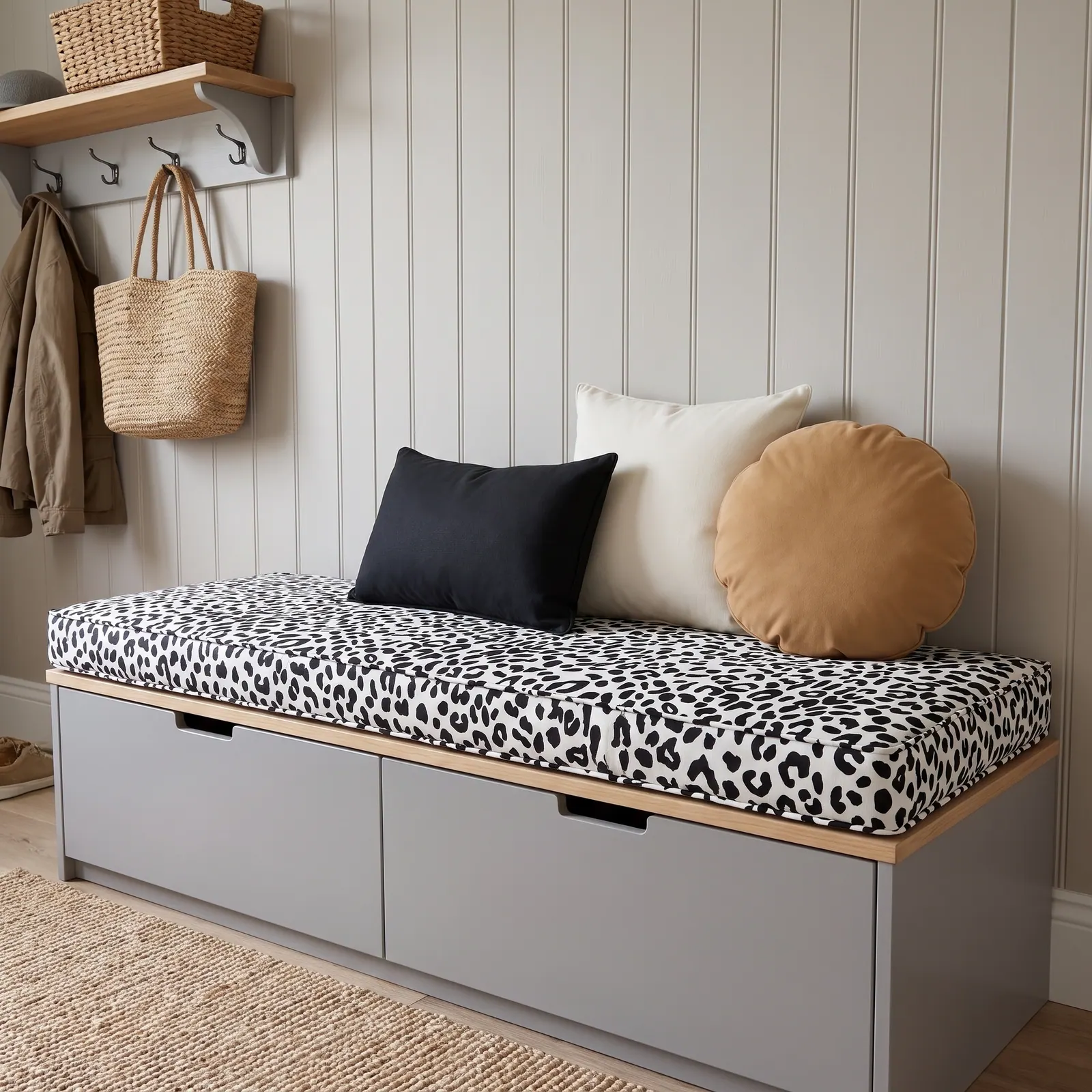
Plate Snow-Leopard Print Cushion on a Gray Mudroom Drawer Bench
A monochrome leopard print makes a plain gray drawer bench the first thing you see at the door, and the round caramel pillow keeps it from feeling stark.
A Reading by NateBench Cushions
A snow-leopard mudroom bench cushion that seats the whole crowd at the door
When guests arrive, the mudroom turns into a waiting room. Nate reads a gray drawer bench as hosting equipment, with the measurements to match.

The quick answer
A custom bench cushion on a mudroom drawer bench should end at the bench's top lip so both drawers still open, and use firm foam so two guests don't sink toward the middle. In this photo the cushion is about a third of the drawer height thick. A busy print hides boot traffic, and pillows at the ends keep the center free.
Pinned by Nate: five measurements at the front door
Five pins, from the self-piped box edge to the birch lip that tells the cushion where to stop.
The numbers match the pins on the plate.
- Self-piped box edgeThe welt is cut from the same print, so the spots run over the seam and the edge reads crisp without a hard outline.
- Black lumbar pillowA solid black oblong takes the darkest tone of the spots and stops the busy print from floating.
- Round caramel pillowThe only curve on a very straight bench; its tan links the birch lip and the straw tote.
- Drawer-base benchThe cushion stops at the birch lip so both drawers slide out without catching the fabric.
- Straw tote on hookNatural straw repeats the jute rug and warms the cool gray paneling.
Reading the plate: why the cushion stops at the birch lip
Start with the one measurement that runs this photo. The cushion ends exactly at the birch lip of the bench top. Push it 1/2 in (1.3 cm) past that lip and both drawers catch fabric every time somebody reaches for a scarf. On a drawer bench, the lip is the boundary. Tolerance is kindness to your future self, so measure to the inside of the lip and let any extra land on wood.
Thickness: about a third of the drawer height. Thick enough to sit on while pulling boots on, thin enough that the birch lip still shows as a frame line.
The print is a black-and-white snow leopard on cotton canvas with self piping, so the spots run over the box edge without a hard outline. Printed cotton sits on the same shelf as striped cotton and ticking, and a busy pattern forgives muddy traffic the way a pale solid never will.
Three pillows, three sources. The black oblong takes the darkest tone in the spots and stops the print from floating. The ivory square repeats the light paneling. The round caramel pillow, the only curve on a very straight bench, picks up the birch lip and the straw tote on its hook. The olive jacket, the woven basket on the peg shelf and the jute rug finish it: every warm note in this gray room is a natural fiber.
Hosting at the door: four checks before a crowd takes its boots off
Count bodies, then inches
Sit the people who really use the bench side by side on the bare wood and mark the outer hips. That span, not the bench length, tells you whether one piece or two works better.
Choose foam that won't hammock
Two adults on one cushion push the middle down. Firm about 2 lb/ft³ (32 kg/m³) high-resilience foam stays level, so nobody slides toward the next guest.
Keep the drawers clear
If the cushion wanders, add ties or a non-slip base only where they won't block a drawer front.
Leave the middle open
Group pillows at the ends. The center stays a seat, not a display.
One missing depth and a lampshade to match
A buyer wrote in with a trapezoid drawing for an angled window seat: edges of 28 1/2 in (72.5 cm) and 60 5/8 in (154 cm), 14 5/8 in (37 cm) deep. The workshop asked for one more depth measurement, calculated the missing sides and sent back a finished diagram to upload with the order.
Then came the color hunt. The buyer went through large photos of seven fabrics looking for a match to a lampshade in the room, and settled on one with self piping in the same color.
Two good habits in one order, partner: a confirmed diagram before any cutting, and a color taken from an object already in the room. The caramel pillow in this photo does the second job. The trapezoid cushion calculator handles the side math, and more seats for the door live under mudroom and entryway bench cushions and bench cushions.
Buyer questions: warm tones, curved pews and a greige match
- A common question
The cover looks warmer and more tan than the fabric chart. What can you do?
The workshop's answerThe workshop checks its production records to confirm the fabric code. Chart scans tend to push warm neutrals cooler and warm indoor light brings the warmth out, so compare in daylight by a window. It offered a physical swatch, then a replacement cover in any other fabric at production cost, keeping the foam you already have.
- A common question
Could you make a curved cushion, say for an old church pew or a round fire-pit bench?
The workshop's answerYes. Measure the inner curve along the front edge and the outer curve along the back with a flexible tape, or lay a string along each and measure it flat. Add the seat depth at both ends and the middle, the straight end-to-end distance and a photo. The workshop draws the curve for your approval, and very long curves are made as matching segments that are easier to handle and wash.
- A common question
Which of your linens comes closest to a light warm greige or khaki I already own?
The workshop's answerFor a light warm greige or dove gray, the closest linens are L-03, a light warm greige, and L-02, a cream to light beige; L-11 runs a touch cooler. Screens shift subtle tones, so when matching existing upholstery, order physical samples first, up to five codes per order.
On the cutting table: the drawer-bench cushion
| Product | Mudroom drawer-bench cushion |
|---|---|
| Fabric | Black and white snow-leopard print on cotton canvas |
| Piping | Self piping in the same print |
| Edge | Box edge |
| Depth | Ends at the birch lip so both drawers clear |
| Thickness | About a third of the drawer height |
| Foam | about 2 lb/ft³ (32 kg/m³) high-resilience foam |
| Tolerance | About ±3/8 in (±1 cm) on handmade sizes |
| Best for | Busy entries where guests sit to swap shoes |

Have it made
Have this made — ask Nate’s workshop
Every edge and both diagonals, to the nearest 1/4 in. If the numbers do not close, the workshop will say so on the call. — Nate
Leave your details and the workshop will call you to confirm measurements, fabric, foam and piping. No prices, dates or payment on this page: it is a request, not an order.
A mudroom bench cushion on a drawer bench stops at the top lip: 1/2 in past it and both drawers catch the fabric every time they open.
Nate
Questions buyers ask next
How many people can share one long mudroom bench cushion?
As many as the foam can keep level. Sit your usual crowd on the bare bench, mark the outer hips and size from that span. Very long benches are often easier to live with as two matching cushions that lift and wash separately.
Will a thick cushion stop the drawers of a storage bench from opening?
Thickness rarely blocks a drawer; overhang does. A cushion that runs past the top lip drags on the drawer fronts every time they open. Keep the front edge on the wood and choose thickness for seat height and boot-pulling comfort.
Is a bold animal print practical by the back door?
Often more practical than a solid. A busy print hides mud, grit and the odd wet paw between washes, and self piping in the same print keeps the edge from outlining every mark the way a contrast cord would.
± 1/4 in — Nate