A Reading by NateBench Cushions
A tribal-band custom bench cushion in a sage kitchen nook, and five mistakes it sidestepped
Nate reads a black and white kitchen bench like an engineering drawing that closes, then lists the five errors that make other drawings fail.

 Save
The quick answer
The most common custom bench cushion mistakes are measuring the length only once, ordering by color name instead of fabric code, and guessing the thickness. On a wall-to-wall kitchen bench, measure the length at the front and at the back, write the exact size and code in the order note, and start from 3 in (7.5 cm), the thickness most buyers choose.
The drawing that closes: a banded cushion on a white bench
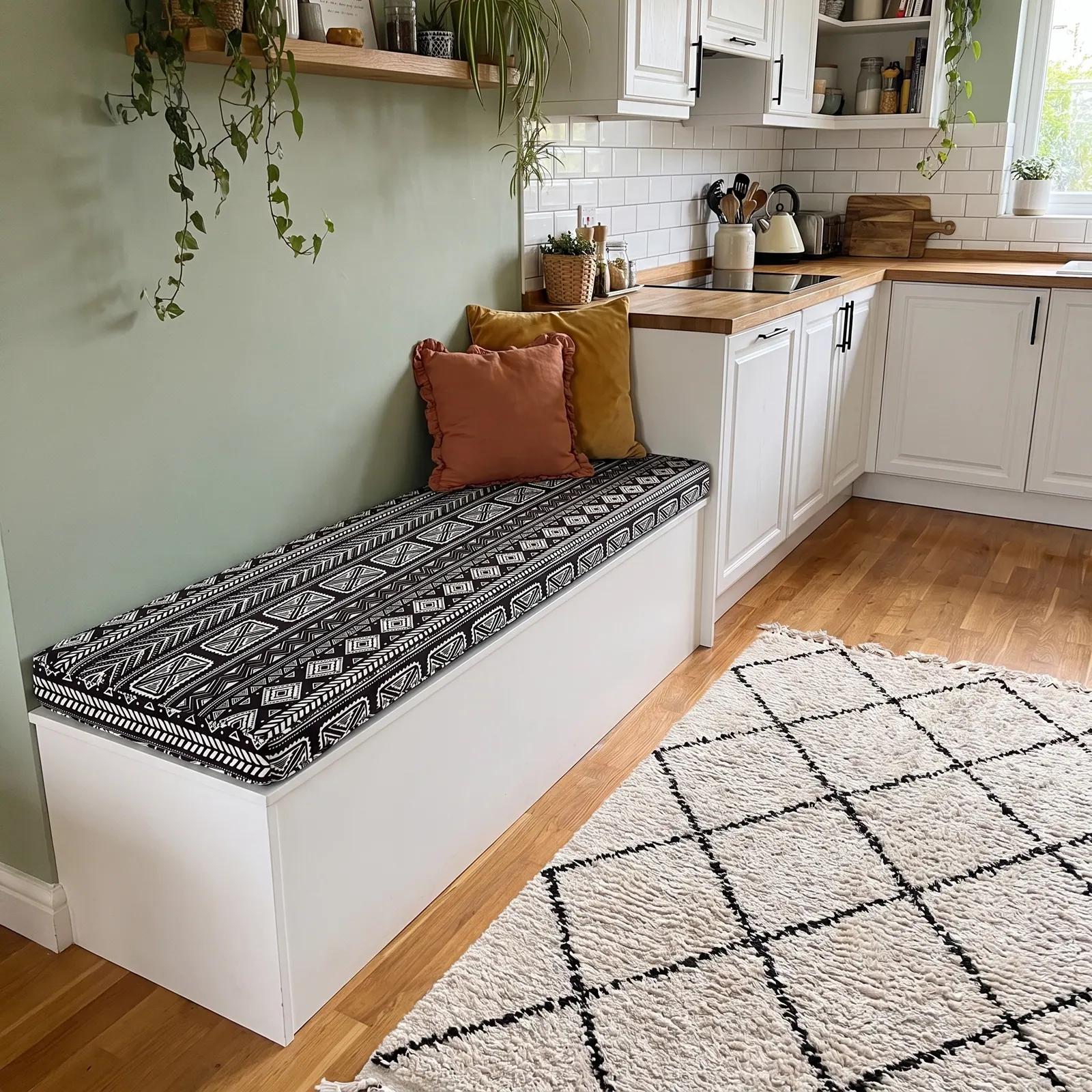
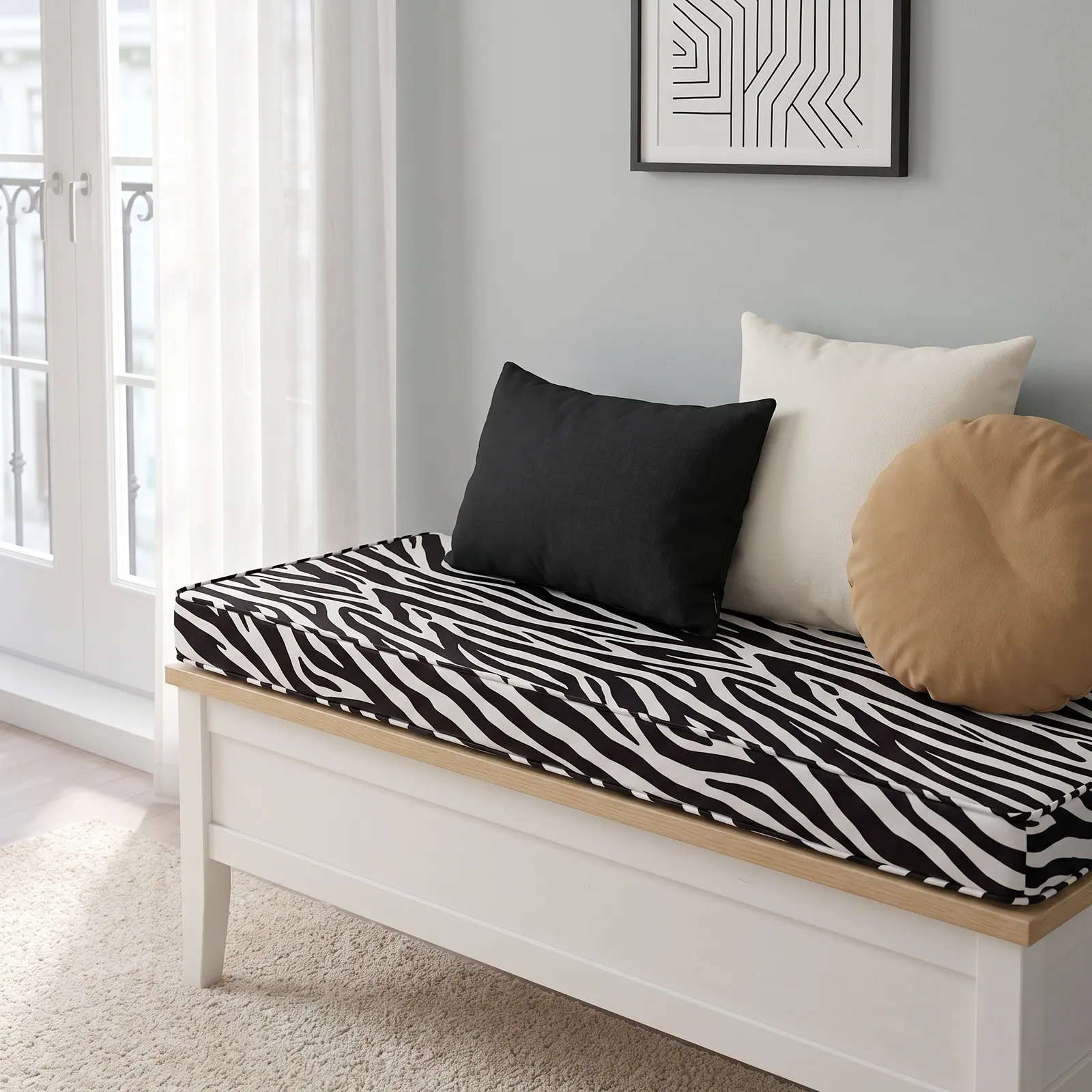
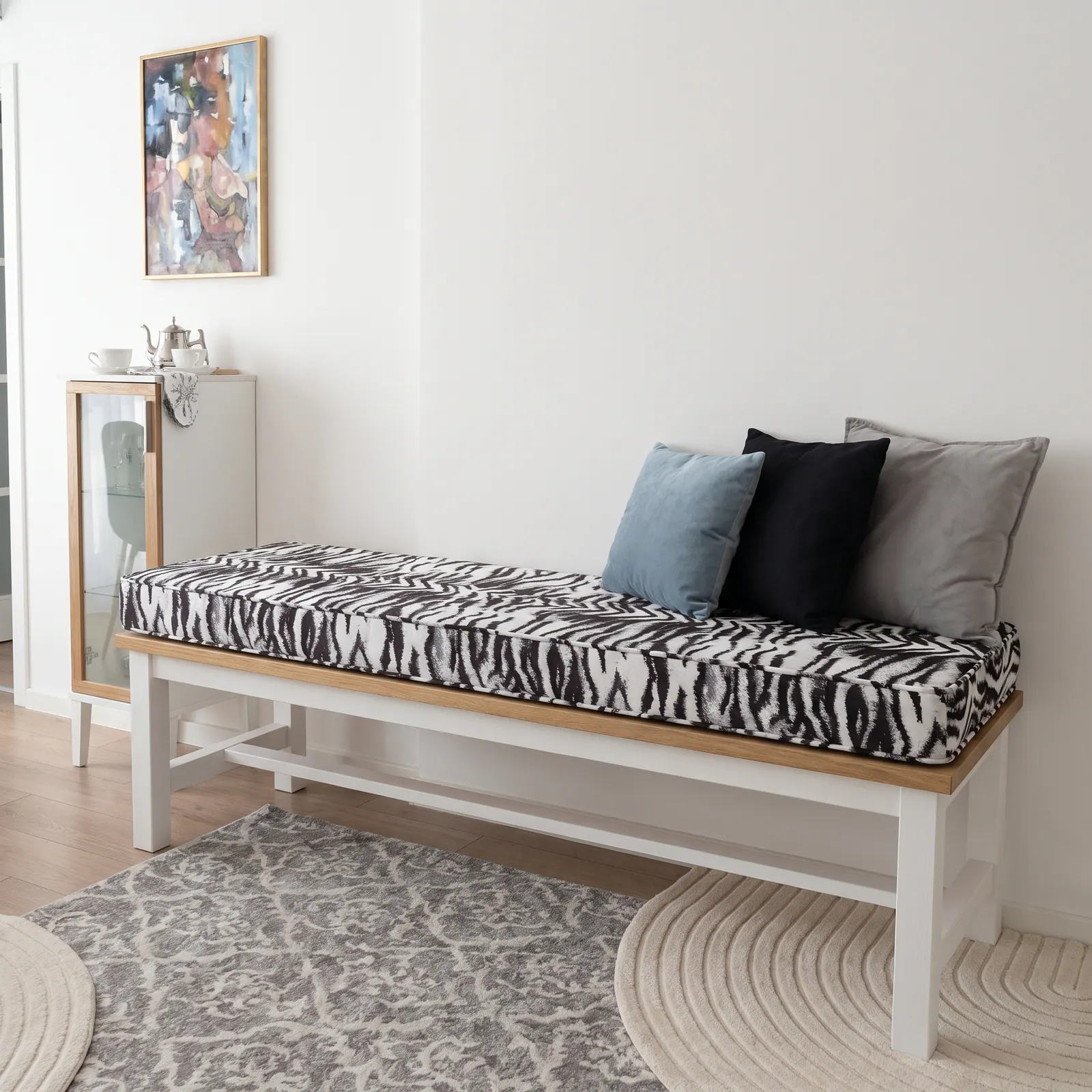
Most kitchen bench cushions go wrong on paper, weeks before anyone sits down. This custom bench cushion, a black and white tribal-band box cushion on a white storage bench at the end of a shaker kitchen, reads like a drawing where every number closed.
Start with proportion. The box edge sits square on the bench top with no overhang, and the self piping runs in the same banded cloth. The outline stays one line. On a print this busy, a contrast welt would draw a second border around every band.
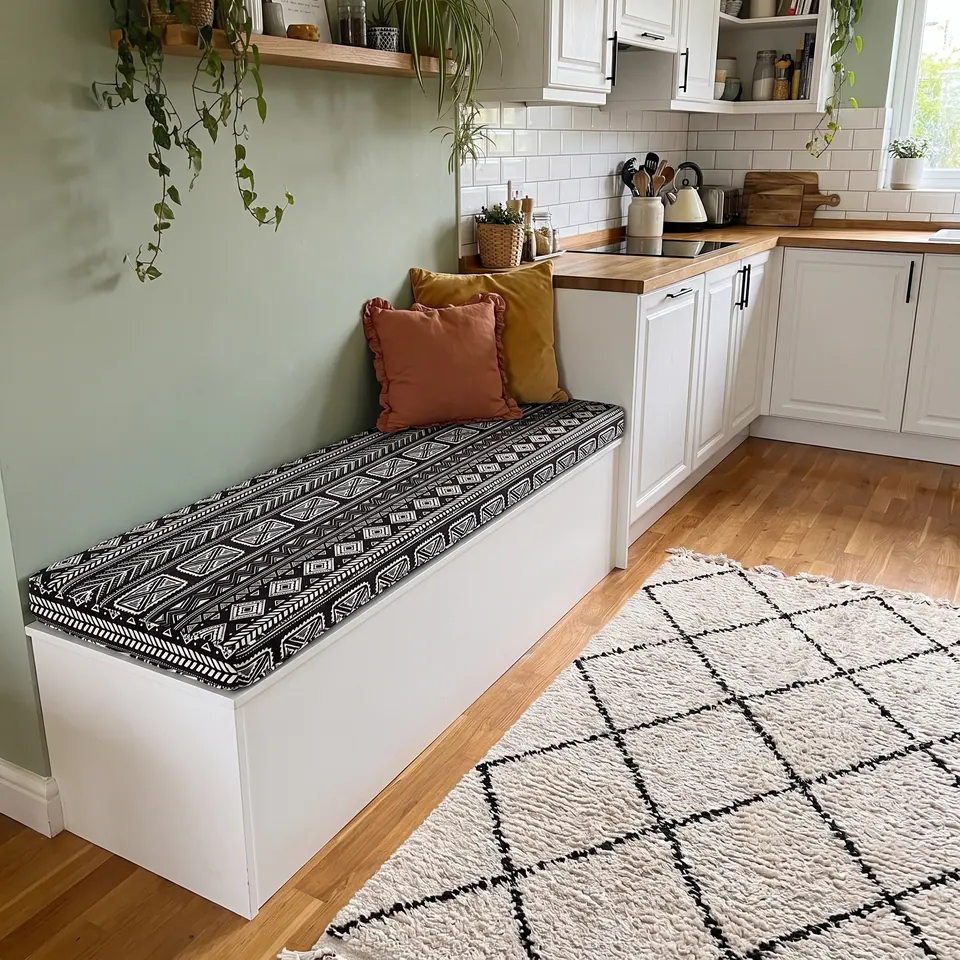
Now the materials. Oak worktop, oak floorboards, white metro tiles, white shaker doors with black handles. The cushion borrows black from the handles and white from the tiles. The terracotta ruffle pillow and the mustard pillow borrow the oak, and the mustard sits behind the terracotta so both warm tones show. That is layering by height, not by luck.
The Beni-style rug repeats the black lines as diamonds on the floor, so bench and floor look drafted on the same sheet. Trailing pothos on the oak shelf keeps the black and white from going stark against the sage wall, and fresh daylight from the kitchen window does the rest.
The print is doing a job, too. A kitchen bench takes crumbs and splashes, and a banded pattern forgives them far better than a pale plain. Measure twice; the fabric remembers. So, partner: what does your bench measure at the back wall, and does it match the front? The bench measuring Pattern has the full sheet, and more seats live among our kitchen nook cushions and bench cushions.
Five mistakes this bench avoided
- Measuring the length once. A bench that runs flush to a wall needs a front length and a back length; out-of-square walls are a common reason past drawings did not add up.
- Ordering by color name. Black and white is not a spec. Each color comes in several shades, and the workshop holds the order until it has the code, here P-35.
- Guessing between two thicknesses. Most buyers land on 3 in (7.5 cm) for a bench cushion, and it is the number to beat.
- Putting a pale plain in a kitchen. Crumbs and drips show on it first; a busy print keeps them quiet until wash day.
- Burying the size in a message thread. Exact measurements and the fabric code go in the Personalization or Notes box at checkout.
Pinned by Nate: five marks on the drawing
Five pins, from the banded cushion to the diamond rug that repeats its lines on the floor.
- Tribal-band kitchen cushion
A busy print forgives crumbs and splashes far better than a pale plain.
- Terracotta ruffle pillow
Terracotta picks up the oak worktop and floor.
- Mustard pillow
Placed behind the terracotta so both warm tones show.
- Diamond-pattern rug
The rug's black lines echo the cushion, so floor and bench look planned together.
- Trailing plant shelf
Greenery against the sage wall keeps the black and white from feeling stark.
- Tribal-band kitchen cushionA busy print forgives crumbs and splashes far better than a pale plain.
- Terracotta ruffle pillowTerracotta picks up the oak worktop and floor.
- Mustard pillowPlaced behind the terracotta so both warm tones show.
- Diamond-pattern rugThe rug's black lines echo the cushion, so floor and bench look planned together.
- Trailing plant shelfGreenery against the sage wall keeps the black and white from feeling stark.
Five or seven centimeters? The answer was neither
A buyer wrote in about a boxed velvet bench cushion, about 84 1/2 x 23 5/8 in (214.5 x 60 cm), in a warm caramel with same-fabric piping. The brief was precise: firm and structured, high-density foam with a Dacron wrap, a hidden zip, and a cover that could live with pets. One number was open. Thickness, somewhere between 2 and 2 3/4 in (5 and 7 cm).
The workshop went just past the range and recommended 3 in (7.5 cm), the thickness most of our buyers choose for a bench. It gives a firm, tailored box that still sits comfortably. Production was quoted at 7 to 8 days, delivery at 3 to 5.
The engineering note: when you are stuck between two thicknesses, decide how the edge should look first, then check the height against your table with the seat height calculator.
- Sizes
- 84 1/2 x 23 5/8 x 3 in (214.5 x 60 x 7.5 cm)
The lesson: 3 in (7.5 cm) gives a firm, tailored bench cushion that still sits comfortably.
Buyer questions: charts, notes and liners
- A common question
Where do I find your fabric charts, and can I just write 'navy' in my order?
The workshop's answerThe charts are in the listing photos: on the bench cushion listing they are the 3rd, 4th and 5th photos, and the indoor and outdoor listings each have their own chart. Write the exact fabric code, not a color name. Every color comes in several shades, and the order waits until the code arrives.
- A common question
Do I just send you my exact measurements for the cushion?
The workshop's answerYes. Put your exact measurements and your color choice in the Personalization or Notes section when you order, and the workshop takes it from there.
- A common question
Is the backrest filling stuffed straight into the cover, or does it have its own liner so I can still wash the cover?
The workshop's answerThe filling comes in its own inner cover. Slide the filled insert into the outer cover you already have, and the outer cover comes off for washing whenever you like.
On the cutting table: the sage-wall bench
| Cushion | Box-edge bench cushion, flush on a white storage bench |
|---|---|
| Fabric | Black and white tribal-band print, code P-35 |
| Piping | Self piping in the same print |
| Length | Measured twice: at the front edge and at the back wall |
| Thickness | Start from 3 in (7.5 cm), the most-chosen bench thickness |
| Cover | Removable, with a hidden zipper |
| Pillows | Terracotta ruffle in front, mustard behind |
| Order note | Length x depth x thickness plus fabric code, in Personalization or Notes |
| Best for | Kitchen nooks and breakfast benches that see crumbs |

Have it made
Have this made — ask Nate’s workshop
Precision starts on the phone. Give the workshop your measurements and they will read them back to you, edge by edge. — Nate
Leave your details and the workshop will call you to confirm measurements, fabric, foam and piping. No prices, dates or payment on this page: it is a request, not an order.
A kitchen bench cushion that runs wall to wall needs two length measurements, front and back, because kitchen walls are rarely square.
Nate
Questions buyers ask next
Why does a busy print suit a kitchen bench cushion?
A kitchen bench takes crumbs, drips and sticky hands. A banded or patterned fabric breaks up small marks so they read as part of the print, while a pale plain shows every spot until the cover is washed.
How do I measure a bench that sits between two walls?
Measure the length along the front edge and again at the back against the wall, plus the depth at both ends. Walls are rarely square, and a difference between front and back is a common reason a drawing doesn't add up. Send every number.
Is 2 in (5 cm) thick enough for a kitchen bench cushion?
It can work, but most buyers choose 3 in (7.5 cm) for a bench. When one buyer weighed 2 to 2 3/4 in (5 to 7 cm) for a firm, tailored box cushion, the workshop recommended 3 in (7.5 cm) instead.
Should throw pillows on a kitchen bench match the cushion?
Not exactly. Here a terracotta ruffle and a mustard pillow pick up the oak worktop and floor rather than the black and white print, so the corner looks warm instead of graphic. Set the taller pillow behind so both colors show.
± 1/4 in — Nate
More photographs to read
 Save
 Save
 Save
 Save
 Save
 Save