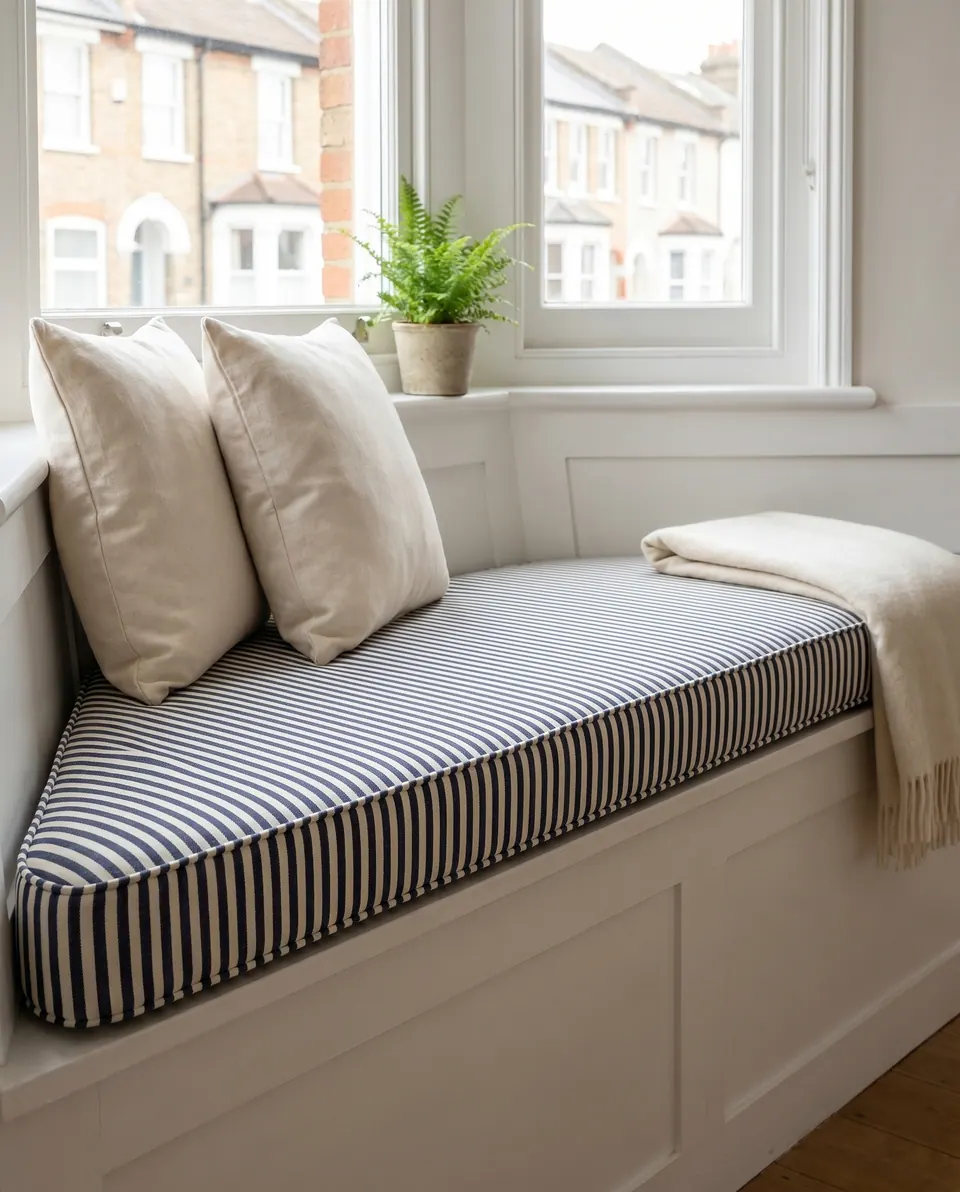
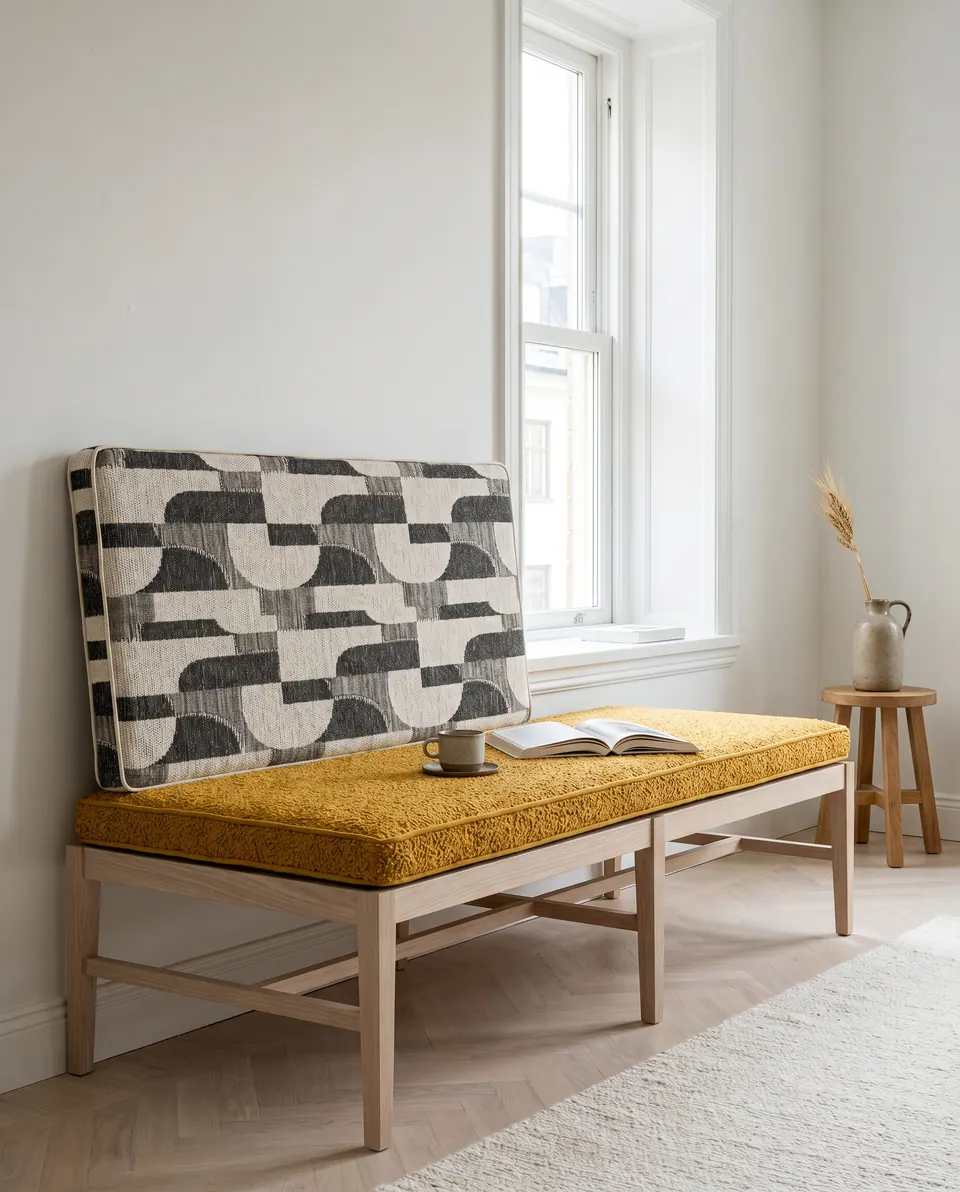
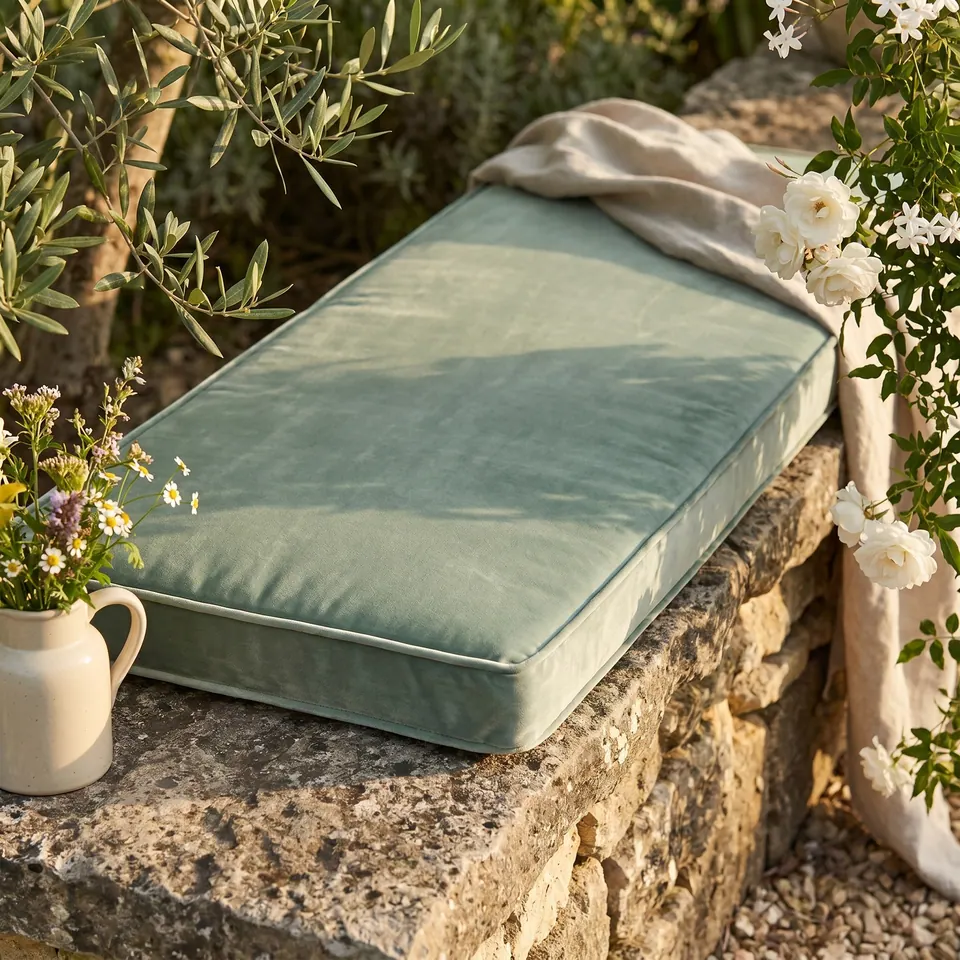
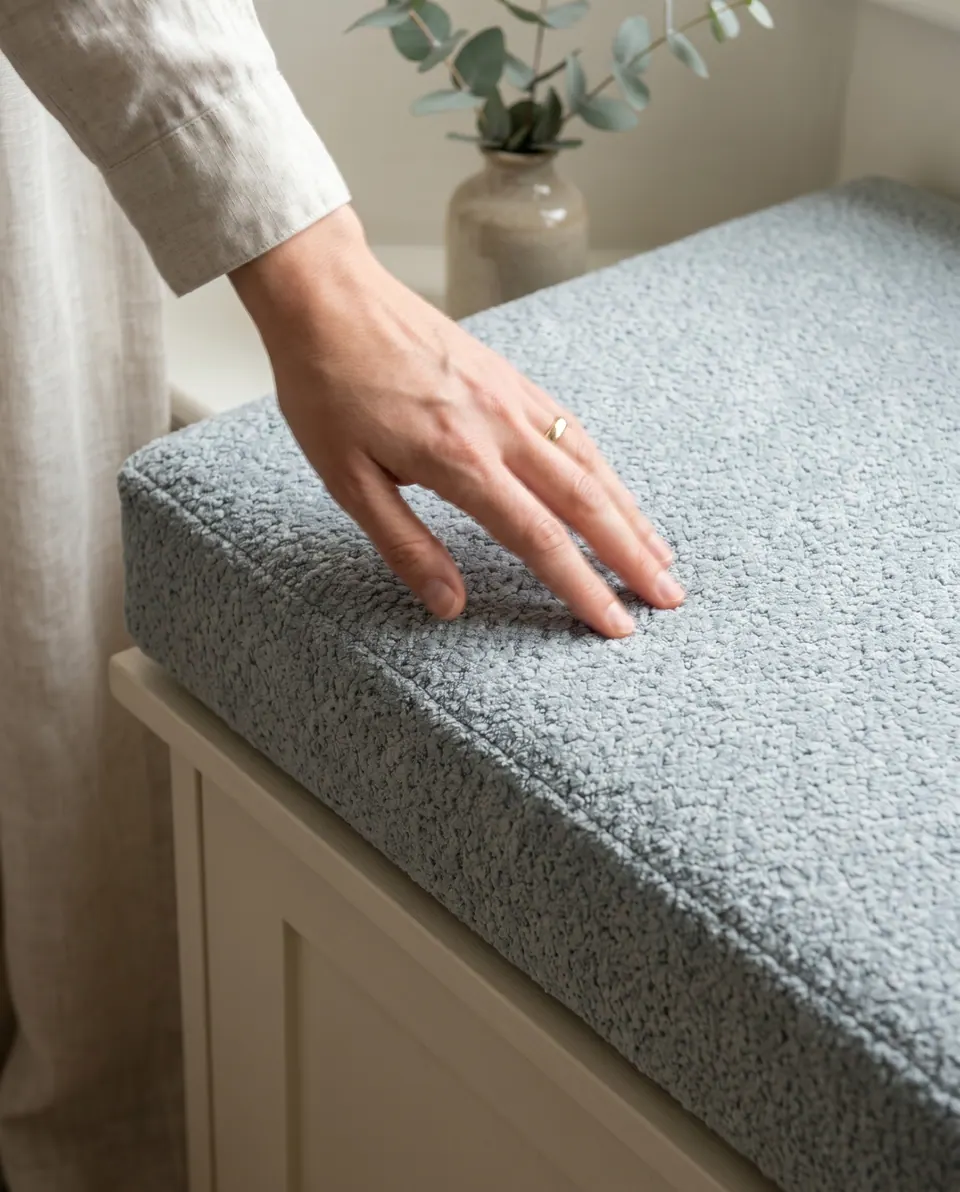
The Pattern Room · a side-by-side pattern
Cut-to-size foam vs a finished cushion: the honest comparison
A block of foam is half a cushion. The other half is fit: wrap, crown, zipper and a cover sewn to the same numbers. Here is where each half of the job lands, tolerances written down.

- Cut-to-size foam
- Finished cushion
- Covers only, your foam
 Save
The quick answer
Cut-to-size foam is enough when you already own a cover you love or plan to sew one: you specify length, depth, thickness, density and firmness, and the fit is yours. A finished cushion adds fabric, edge, piping, zipper and the insert-to-cover fit, the part most DIY jobs get wrong. The workshop makes finished cushions and also sells foam inserts and covers separately.
Half a cushion, in a box
A foam block is half a cushion. The other half is fit, and fit is where home projects go sideways.
Many of the biggest foam sellers in the US and UK are foam cutters first: you pick a shape, a grade, a wrap, and a cover only if you want one. That model serves two buyers well. One owns a cover they love and needs new cut to size foam to fill it. The other plans to sew. Almost everyone else is better off with a finished cushion, where one maker owns both halves and the insert-to-cover fit stops being your problem.
The workshop does all three jobs: finished cushions with the foam inside, foam inserts and fillings on their own through a dedicated link, quoted per set, and empty covers for foam you already own. The foam inserts and cushion covers atlases hold the details. Here's the comparison, partner, line by line.
What you specify: foam only, finished, or covers only
| Cut-to-size foam | Finished cushion | Covers only, your foam | |
|---|---|---|---|
| Length and depth | Yours, to the 1/8 in; add the oversize yourself when refilling a cover | The seat's size; foam and cover are sized to each other | The bare insert, seam to seam, lying relaxed |
| Thickness | Match the old cover's side band | Chosen with the order; 2 in (5 cm) is the thinnest standard | The insert's true thickness, never rounded |
| Density | Yes Ask for it in lb/ft³ | Partly Set for you: 32 kg/m³, about 2.0 lb/ft³; a softer 28 kg/m³ on request | No Not needed |
| Firmness | Yes Ask for the ILD as well | Partly About 6 to 7 on a 1 to 10 scale | No Not needed |
| Wrap and crown | Partly Optional; it changes how much oversize you need | Yes Foam wrapped in polyester fiber, cut slightly larger than the cover | No Whatever your insert already has |
| Fabric, edge, piping | No Your job | Yes Fabric code, box edge, piping or none | Yes Fabric code and piping |
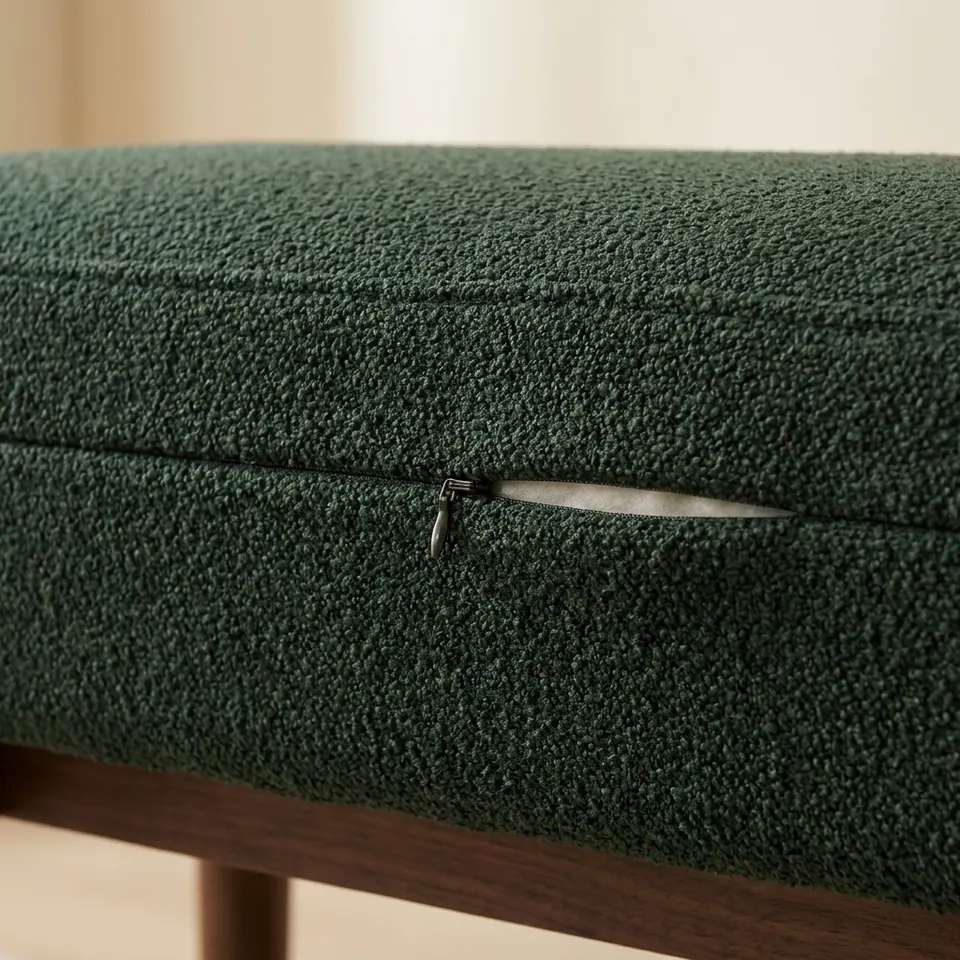
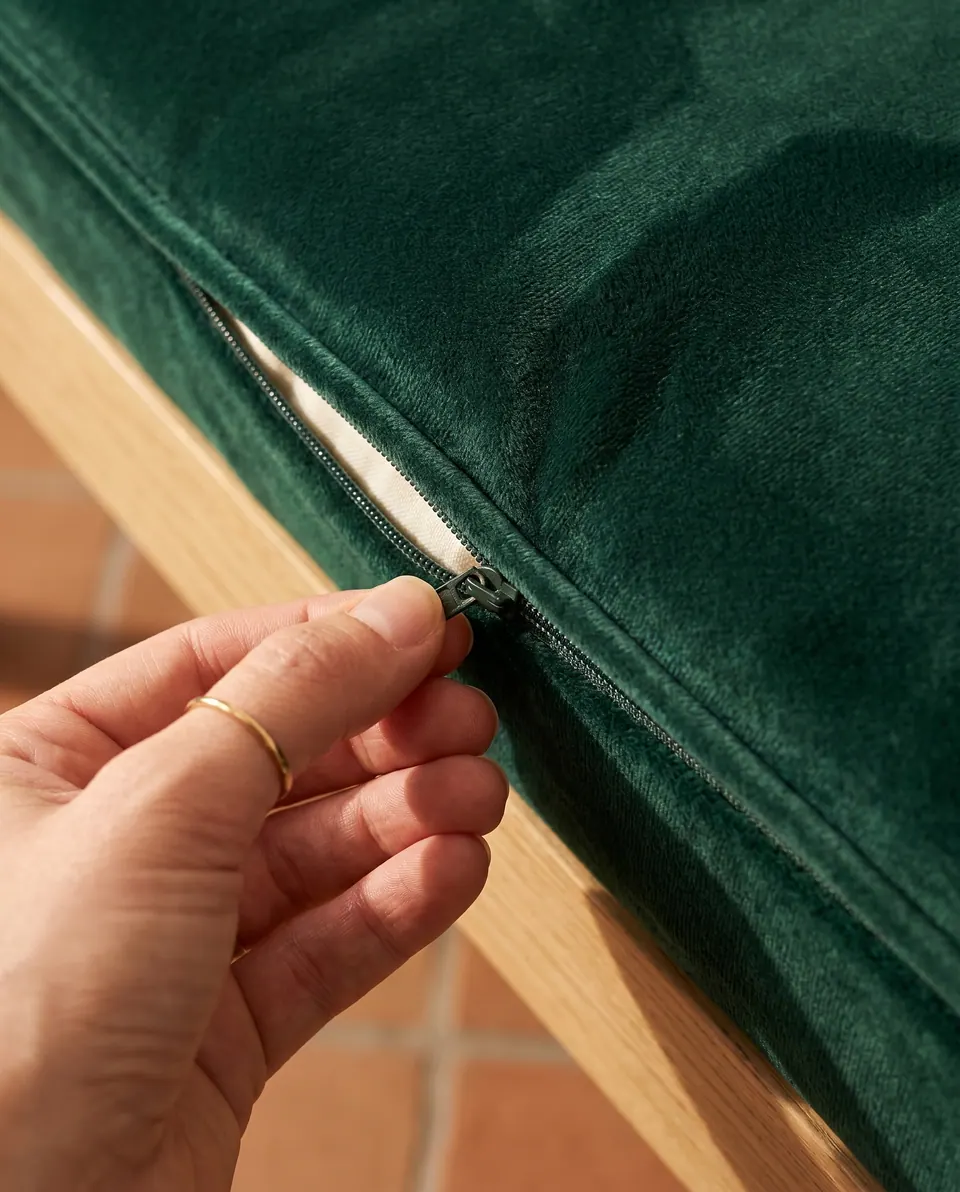
| Zipper | No Your job | Yes Hidden on the back edge or underside; you pick the side | Yes The same, with extra-strong zippers on request |
| Ties and non-slip base | No Your job | Yes On request, in writing | Yes On request, in writing |
| Shaped pieces | Partly Cutters take patterns, but the cover is still yours | Yes Drawn to scale and approved before cutting | Partly Reviewed first; some curved covers-only jobs are declined |
| Who owns the fit | You | The maker | Shared: your numbers, the maker's sewing |
Covers only means empty covers: no foam and no filling. The workshop messages every covers-only buyer to confirm that is the plan.
The oversize rule, or why good foam looks too big
A buyer once asked the workshop whether their foam was the wrong size, because it looked bigger than its cover. It wasn't. Firm foam is cut slightly larger than its cover on purpose, so the fabric stays taut and the top crowns a little. A slight bulge at the zipper opening is the sign of a cover that will look full. Very firm foam can take two people: fold it in half, feed it in, and never trim it.
Buying foam to refill a cover you own? Here is the arithmetic most cutters work to:
- Measure the cover, not the old foam. Seam to seam, with the old foam still inside.
- Bare foam: add about 1/4 in (6 mm) per side, roughly 1/2 in (13 mm) over the cover's length and depth.
- Wrapped foam: a fiber wrap adds about 1/2 to 1 in of loft by itself, so ask the cutter how much of the oversize the wrap already supplies.
- Thickness: match the cover's side band.
Now the reverse case, which catches people. When you order a cover here for foam you own, send the insert's true size and add nothing. The cover is cut to your numbers for a snug fit, and fitted mattress covers even run about 3/8 to 3/4 in (1 to 2 cm) under the measured thickness because the fabric stretches. Add your own half inch and the allowance goes in twice. Tolerance is kindness to your future self; double tolerance is a baggy cover.
Fiber-wrapped foam and covers for foam you already own go deeper.
Density is a durability number; firmness is a feel number
Foam-only orders ask you for two numbers that a finished cushion quietly chooses for you.
Density is weight per cubic foot, and it predicts how long foam holds its height. The workshop's standard seat foam is 32 kg/m³, about 2.0 lb/ft³; divide kg/m³ by 16.02 to convert. Its softer grade is 28 kg/m³, about 1.75 lb/ft³.
Firmness is a separate number, the ILD: the pounds of force it takes to press a 4 in sample down 25%. A dense foam can be medium or firm, so a cutter who asks only for density has asked half the question. The standard seat foam lands around 6 to 7 on a 1 to 10 scale; back cushions get softer shredded foam instead.
Buying foam alone? Write both numbers on the order, and try the foam firmness finder first. Density vs firmness and converting lb/ft³ and kg/m³ have the long version.
Six velvet covers for foam that was still good
A buyer in the US ordered velvet samples in brown, dusty mauve and mustard, and chose the brown for six sofa cushions: three at 23 x 24 x 4 1/2 in (58 x 61 x 11.5 cm) and three at 23 x 20 x 3 1/2 in (58 x 51 x 9 cm), with the zippers on the 23 in side.
The full quote with foam came in at about twice their budget. Then the useful fact surfaced: they already had inserts, and the inserts were fine. The shop switched the order to covers only and discounted the set of six, which brought it close to what they had planned to spend.
Look at what made that work: two thicknesses, six covers, each sewn to its own insert's true size. Swap a 3 1/2 in cover onto a 4 1/2 in insert and you get one cover too tight to close and another that bags. What's the thickness of the foam you're keeping, measured, not remembered?
- What it taught
- If your foam is still good, say so up front: covers only can cut the price substantially.
Where foam-only orders go wrong
- Measuring the wrong part. Refilling a cover? Measure the cover. Re-covering foam? Measure the bare foam. Measure the part you're keeping.
- Adding an allowance to a covers-only order. The maker already builds it in; yours puts it in twice.
- Asking for density without firmness. 2.0 lb/ft³ can be medium or firm.
- Putting thinner foam in an old cover. 2 in (5 cm) foam in a cover made for 4 in (10 cm) sits loose and baggy; reorder thinner with its own cover.
- Forgetting the fill type. A soft fiber insert needs about 1 in (2.5 cm) more than its cover; firm foam needs only a fraction of that.
- Leaving out the height. One buyer's floor sofa backrest covers seemed a couple of inches too big. The covers matched the listed sizes; her fillings were the wrong height.
- Trimming foam that looks too big. It's meant to. Compress it and ease the cover on.
- Assuming covers only includes something. It doesn't: no foam, no filling, and no metal bars for a floor sofa.
Which one is yours
Choose cut-to-size foam if
you own a cover you love, or you plan to sew
Measure the old cover seam to seam with the old foam inside, order density and firmness by number, and add the oversize yourself: about 1/2 in over the cover for bare foam.
Choose a finished cushion if
the fit matters more than the foam
Shaped pieces, a new seat with nothing to copy, or a first cushion: one maker cuts the foam, wraps it and sews the cover to the same numbers, zipper where you want it.
Choose covers only if
your foam is good and your fabric is tired
Send the bare insert's true length, width and thickness, add nothing, and write covers only, no foam in plain words.
Firm foam is cut slightly bigger than its cover on purpose. A replacement block that looks too big is usually the right size.
Nate
Buyer questions: foam, covers, and which is which
- A common question
Can I buy only the foam inserts, without any covers?
The workshop's answerYes. Pillow fillings such as 14 x 14 in (36 x 36 cm) and 10 x 10 in (25 x 25 cm), foam-only L-shaped backrest inserts, and full sofa foam sets of two seat mattresses and two armrest foams, plus the 4 metal supports if you need the frame, are sold without covers through a dedicated link and quoted as a set for your sizes.
- A common question
Can I order just the cover, with no foam?
The workshop's answerYes. On the zippered cover listing, pick the nearest size range and write your foam's exact length, width, thickness and the fabric code in the personalization box; the cover is sewn to those numbers to fit snugly. The workshop double-checks that you really want covers only, and for shaped pieces asks for a measured drawing and a photo of the space. Covers wash at 86°F (30°C) on a delicate cycle.
- A common question
Does a custom bench cushion come with the foam, or only the cover?
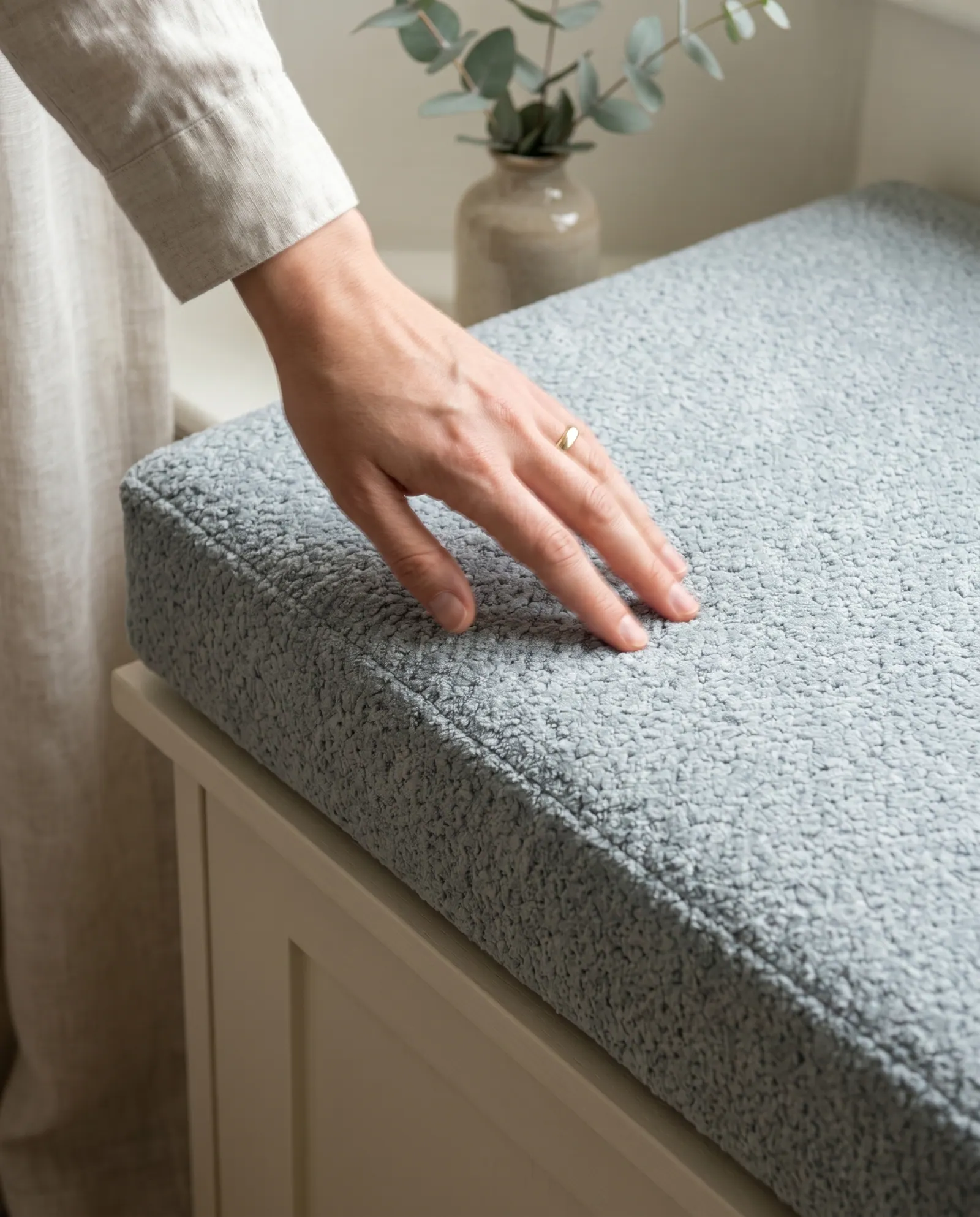
The workshop's answerThe foam is included. A standard custom cushion ships complete: a high-density foam insert inside a removable, machine-washable zippered cover. If you already have inserts, covers only is a separate, cheaper option with no filling, and the shop messages covers-only buyers to confirm.
- A common question
If I send my insert's measurements, how snug will the new cover be?
The workshop's answerSnug, if the numbers are right. The cover fabric has a little stretch, so fitted covers are made about 3/8 to 3/4 in (1 to 2 cm) under the measured thickness. Photograph the tape on every dimension, measure over any old cover you're keeping, and say whether the insert is foam or fiber, since the two fill a cover differently.
- A common question
Does the covers-only floor sofa include the foam and the metal frame?
The workshop's answerNo. Covers only means empty fabric covers, with no foam and no metal support bars. The set of 5 bars and the foam are sold separately, and foam bought alone costs most of the price of a filled sofa. The workshop messages every covers-only buyer before production and cancels a mistaken order so the filled version can be ordered instead.

Have it made
Measured it? Have Nate’s workshop make it
Every edge and both diagonals, to the nearest 1/4 in. If the numbers do not close, the workshop will say so on the call. — Nate
Leave your details and the workshop will call you to confirm measurements, fabric, foam and piping. No prices, dates or payment on this page: it is a request, not an order.
Foam and cover questions, to the quarter inch
How much bigger than its cover should replacement foam be?
For bare foam, about 1/4 in (6 mm) per side, roughly 1/2 in over the cover's length and depth, so the fabric stays taut and the top crowns. A fiber wrap adds its own loft, so ask the cutter how much of that oversize the wrap already covers.
Can a tufted cushion be made around my own foam?
No. Tufting works only when the workshop makes the filling, because tufted cushions are filled, buttoned through and stitched closed. Empty covers come as plain zippered covers without tufting, and your own foam can go in those.
What is the thinnest foam cushion the workshop makes?
The thinnest standard foam cushion is 2 in (5 cm). Cushions 1 in (2.5 cm) or 3/4 in (2 cm) thick are made only without piping, while one a little over 1 in (3 cm) thick can take piping. Tufted cushions can't be made as thin as 1 in.
Is the foam inside a finished cushion wrapped?
Yes. The core is wrapped in polyester fiber batting before it goes into the cover. The wrap fills the cover out, softens the surface and rounds the edges, while the firm core, about 2.0 lb/ft³ (32 kg/m³), does the supporting.