The Pattern Room · a pattern with a calculator
How much fabric do you need for a bench cushion? Yardage worked out
I cut canvas by the yard for lobster boats before I cut it for benches. Same rule on both: count every panel before you unroll a thing.
 Save
The quick answer
A piped box cushion for a 48 x 18 x 3 in bench needs about 2 yd of 55 in wide fabric, counting top, bottom, boxing strip, zipper plaque and piping. Add 1/2 in of seam allowance to every edge, lay the pieces across the roll, total the inches and divide by 36. Stripes and large prints need extra for matching.
Five pieces, not two
Five pieces of fabric go into one box cushion, and most people only count two. The boxing strip, the zipper plaque and the piping are where yardage quietly runs out.
I cut canvas by the yard for lobster boats before I cut it for benches, friend. The rule never changed: lay every piece out on paper before you unroll the cloth. A short count is like a short anchor line; you find out at the worst moment.
Start with the roll. Most of the workshop's fabrics are about 55 in (140 cm) wide, a few 79 in (2 m); US retail upholstery is typically 54 in. That width decides how many yards your bench cushion takes. The glossary keeps the short version under fabric yardage.
Worked example: a 48 x 18 x 3 in box cushion with piping
| Piece | Cut size | Pieces | Roll used, 55 in wide |
|---|---|---|---|
| Top and bottom panels | 49 x 19 in (124 x 48 cm), 1/2 in seam allowance on every edge | 2 | 38 in (97 cm), each panel laid across the roll |
| Boxing strip, front and both sides | 92 x 4 in (234 x 10 cm): front + sides + 8 in | 2 strips, joined | 8 in (20 cm) |
| Zipper plaque, back | 52 x 4 3/4 in (132 x 12 cm): back + 4 in long, boxing + 3/4 in wide | 1, split for the zipper | 5 in (13 cm) |
| Piping strips, top and bottom seams | about 264 in (671 cm) of strip, about 1 1/2 in wide | 6 | 9 in (23 cm) |
| Total | 60 in (152 cm), about 1 2/3 yd: buy 2 yd (1.8 m) |
Working out your own yardage
Write down the finished size and the edge
Length, depth, thickness and edge style. A box edge has a boxing strip around the sides; a knife edge sews top straight to bottom.
Add seam allowance to every panel
Add 1/2 in (1.3 cm) on every edge. A 48 x 18 in top is cut 49 x 19 in, and so is the bottom.
Lay the panels on the roll
If a cut panel is no longer than the roll is wide, lay it across; it then costs only its cut depth. Longer panels run along the roll and cost their full length, though two narrow ones can often sit side by side.
Add the boxing and the zipper plaque
The boxing strip is the front plus both sides plus 8 in long, and the thickness plus 1 in wide. The zipper plaque is 4 in longer than the back and 3/4 in wider than the boxing, so the zipper wraps both back corners.
Count the piping twice
Piping runs in the top seam and the bottom seam, so you need twice the perimeter in strips, cut on the bias so the cord turns corners cleanly.
Add for stripes and prints
Stripes here run front to back by default, so a striped piece longer than about 54 in needs a seam, and stripes match on one face only. Large prints need at least one extra pattern repeat per panel.
Divide by 36 and round up
Total the inches of roll, divide by 36 and round up to the next half yard. The spare covers squaring off the cut end, and the mistake you haven't made yet.
Have it made
Measured it? Have Callum’s workshop make it
Sun, rain, salt. Say which of them your cushion will meet, and the workshop will plan around it. — Callum
Leave your details and the workshop will call you to confirm measurements, fabric, foam and piping. No prices, dates or payment on this page: it is a request, not an order.
Run it in the Studio
The fabric yardage calculator runs these sums with your own numbers: cushion size, thickness and roll width. The first time, check its total against the worked table above, the way you'd check a new compass against a bearing you already trust.
Rounds, bolsters and the long ones
Big rounds follow a chair maker's rule of thumb: diameter plus thickness, times two, divided by 36. A 51 in papasan cushion 4 in thick comes to 110 in, about 3 yd; the papasan sizing Pattern covers the measuring.
For scale, from past orders: about 2 3/4 yd (2.5 m) of 45 in wide fabric covered a 60 x 14 in piped cushion, and about 4 3/8 yd (4 m) covered a 21 x 109 x 4 in tufted bench cushion. A teddy floor sofa takes about 13 yd.
Bolsters add a tube and two end circles of their own. The bolster sizing Pattern has the diameters, and the stripe direction Pattern shows how the lines run on each piece.
A 90 in bench and the bolster that came later
A buyer in the US first asked the workshop for a 102 x 18 in cushion for a long built-in bench. The workshop offered two 51 in halves and confirmed one piece could be made too.
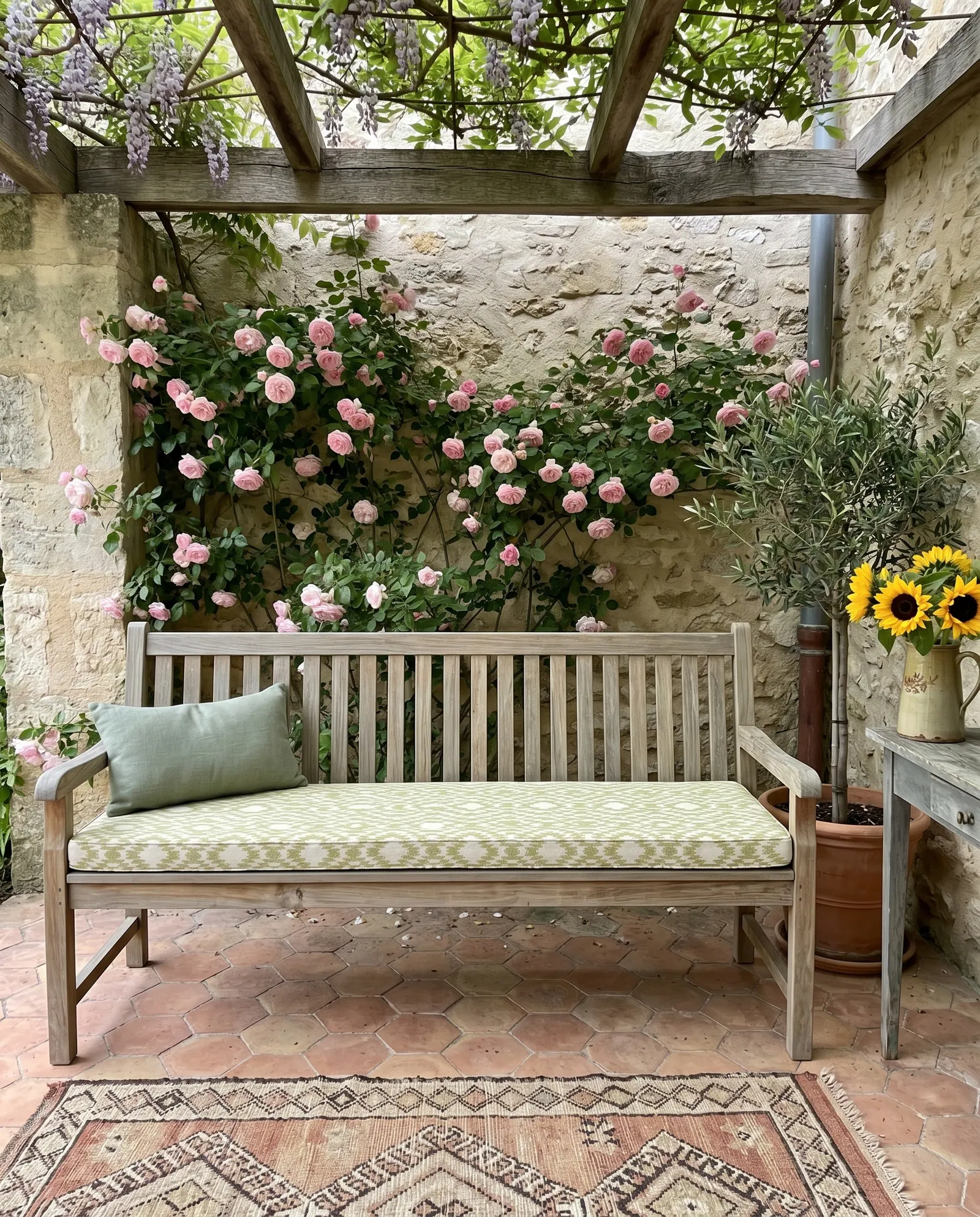
They ordered samples first, then chose a light green linen a shade lighter than its neighbor on the chart, and a single 90 x 18 in (229 x 46 cm) cushion.
Then they came back for a matching round bolster, 6 in across and 67.5 in long. That's the yardage lesson: if a bolster or pillows are likely, say so at the start, so everything comes from one run of cloth. The dye lot Pattern explains why.
Yardage mistakes that cost a second order
- Counting top and bottom, and forgetting the boxing, zipper plaque and piping.
- Assuming a 60 in roll. Ours are mostly 55 in (140 cm).
- Writing 44 x 44 for a round cushion. Write "round, diameter 44 in."
- Ordering stripes without asking which way they run.
- Sending dress fabric to be made up. It must be upholstery-grade; silk has been turned down.
- Using upholstery fabric alone as a throw. It's thin on its own; sew it to a backing.
- Buying matching yardage months later, after the dye lot has moved on.
On a 55 in roll, a striped bench cushion longer than about 54 in needs a seam, because the stripes run front to back.
Callum
Buyer questions: buying fabric by the yard
- A common question
Can I buy your fabric by the yard so my pillows and ottoman match the cushions?
The workshop's answerYes. Samples and cut lengths come through the fabric listing, and larger pieces through a custom order link. Send the fabric code and how much of each you need for a quote, and the fabric can ship with your cushions.
- A common question
Could I get extra fabric to upholster matching chairs, or to make a throw?
The workshop's answerYes. Extra lengths are sold by the meter, up to 55 in (140 cm) wide, for jobs like matching chairs. For a throw, the upholstery fabric is thin on its own, so sew it onto a blanket or a backing.
- A common question
How much fabric should I send if you're making the cushion in my own fabric?
The workshop's answerIt depends on the size, the piping and the fabric's width, so send a direct photo of the fabric, its material and your dimensions, and the workshop works out the amount. As a guide, about 2 3/4 yd (2.5 m) of 45 in wide fabric covered a 60 x 14 in piped cushion. It must be upholstery-grade; silk was turned down.
- A common question
Can you send me a photo of the cushion before it ships, so I can check the stripes?
The workshop's answerUsually, yes. Ask and the workshop photographs finished pieces before dispatch, and custom shapes get final-check photos with measurements for your approval. One angled bay cushion was remade at that stage so its corduroy stripes ran vertically on the edges. Photos depend on the day's production schedule, so they can't always be promised.
Short answers on cushion yardage
How many yards of fabric does a standard bench cushion take?
For a plain 48 x 18 x 3 in box cushion with piping, about 2 yd of 55 in wide fabric. A long 60 x 14 in piped cushion took about 2 3/4 yd of narrower 45 in fabric, because its panels had to run along the roll.
What does railroaded fabric mean?
Railroaded fabric has its pattern running across the roll's width instead of along its length. That lets a long bench cushion be cut in one piece without a seam, while up-the-roll stripes on a long cushion need a join somewhere along the top.
How much extra fabric does a striped or patterned cushion need?
Plan for more than a plain. Stripes are matched on one face only and run front to back by default, which can add a seam on long pieces. Large prints need at least one extra pattern repeat per panel so the motif sits centered.
Is the yardage rule different for round cushions?
Yes. A common rule for large rounds is diameter plus thickness, times two, divided by 36. A 51 in cushion 4 in thick works out to 110 in, about 3 yd. Small rounds can often sit side by side across the roll and need less.