A Reading by CallumBench Cushions
A taupe woven bench cushion in a potting shed, and how it stands up to the dirt
Potting sheds are hard on fabric: soil, damp gloves, dust in the sun shafts. This cushion was chosen to look like an heirloom coverlet and wear like an outdoor weave.

 Save
The quick answer
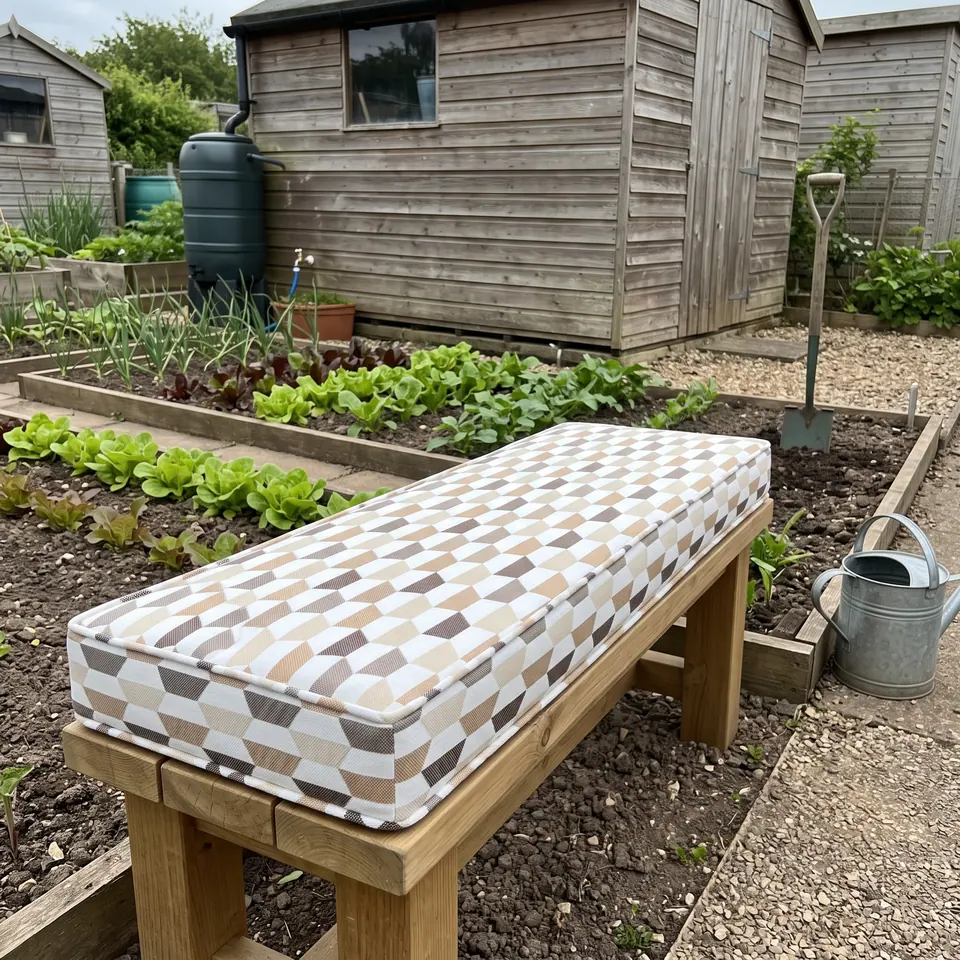
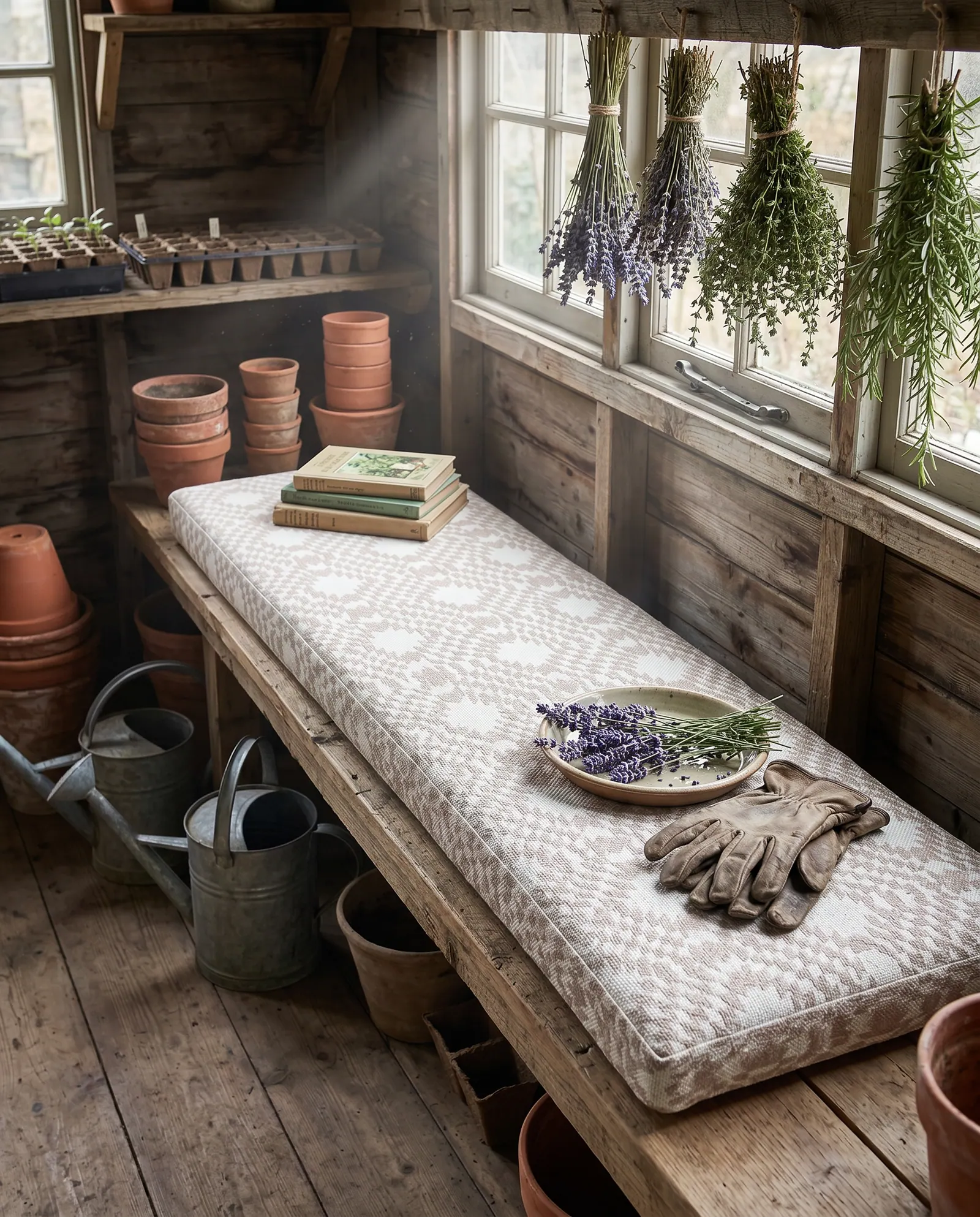
For a garden or potting shed bench cushion, choose a mid-tone woven pattern in an outdoor fabric over a pale solid, because it hides soil and dust between washes. This one is a taupe and off-white geometric box cushion, about 3 in (8 cm) thick, running nearly the full length of a deep plank workbench. On an open bench, tie it to the frame.
The cushion, cut open
Cover fabric. A removable, zippered cover. Machine wash at 86°F (30°C) on a gentle cycle and air dry.
Piping. A fabric-covered cord sewn into the seams. It sits on the seam line, so it does not change the size.
Fiber wrap. Polyester fiber (Dacron) batting around the foam: it fills the cover out and softens the edges.
Foam core. About 2.0 lb/ft³ (32 kg/m³) high-resilience foam, firm to medium-firm, cut to the ordered size.
Zipper. Along the back band, as hidden as possible. The zipper side faces down or toward the wall.
Base panel. The underside of the cover. A non-slip fabric backing can cover the whole of it instead.
Pinned by Callum: books, lavender, gloves and cans
Five pins cover the woven cushion, the garden books, a plate of lavender, the leather gloves and the watering cans, and each says something about dirt, sun or use.
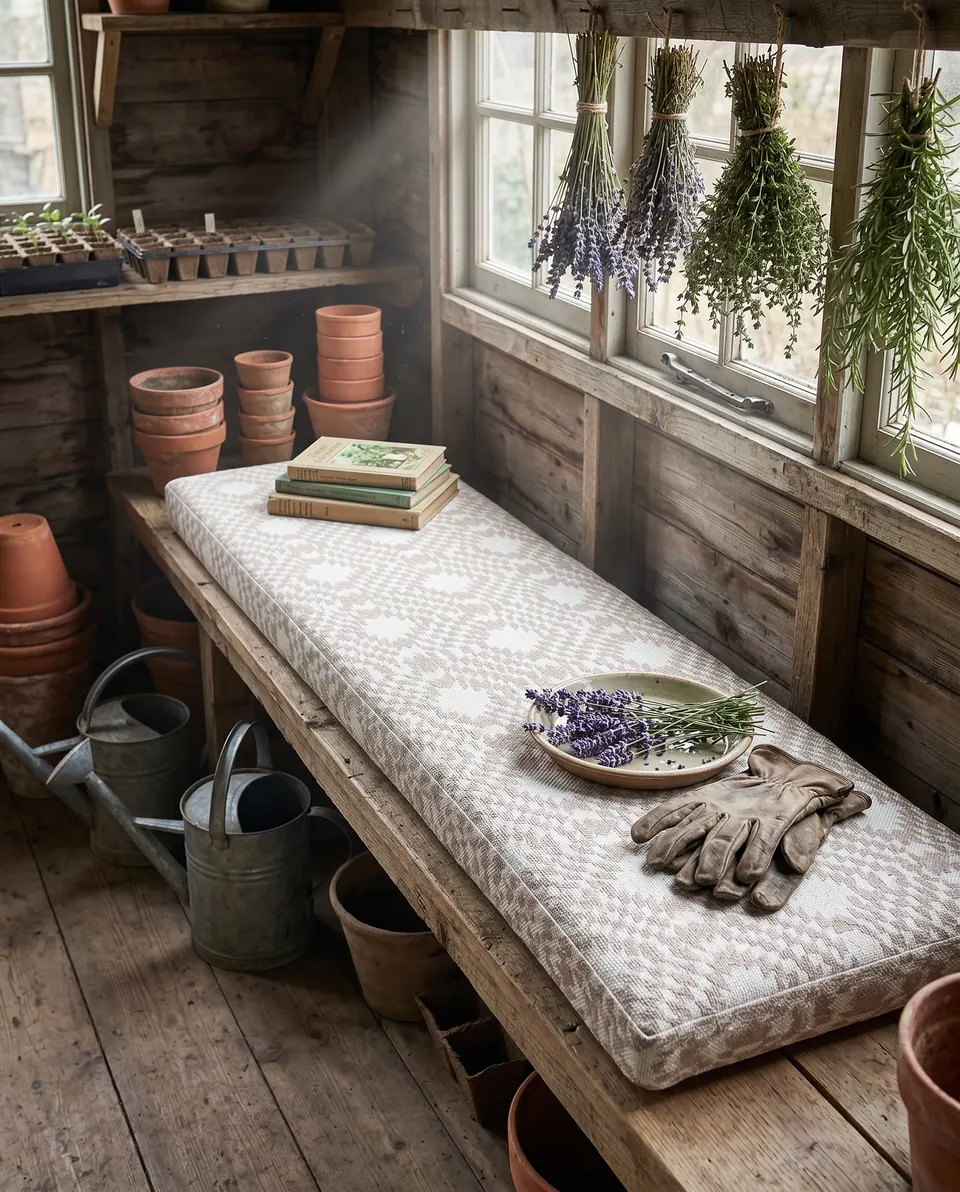
- Woven geometric cushion
A coverlet-style geometric looks like an heirloom blanket but is a hard-wearing outdoor weave.
- Stack of garden books
Books sit at the far end so the cushion reads as a seat, not a work surface.
- Plate of lavender
Purple lavender is the one accent, and the taupe weave keeps it from looking sweet.
- Leather gloves
Worn gloves add a lived-in story and the same warm brown as the shed boards.
- Galvanised watering cans
Gray metal repeats the cool tone in the cushion's pale pattern.
- Woven geometric cushionA coverlet-style geometric looks like an heirloom blanket but is a hard-wearing outdoor weave.
- Stack of garden booksBooks sit at the far end so the cushion reads as a seat, not a work surface.
- Plate of lavenderPurple lavender is the one accent, and the taupe weave keeps it from looking sweet.
- Leather glovesWorn gloves add a lived-in story and the same warm brown as the shed boards.
- Galvanised watering cansGray metal repeats the cool tone in the cushion's pale pattern.
Anatomy of a working bench cushion
Some cushions sit in parlors. This one sits in a potting shed, between seed trays and stacked terracotta pots, under a window hung with drying lavender and rosemary. Hazy morning light comes through in shafts, and you can see the dust in it.
The build is plain and right. A long box cushion with self piping, about 3 in (8 cm) thick, running almost the full length of a deep plank bench. That is enough to turn a workbench into a seat for a tea break while keeping a square front edge in line with the boards.
The fabric does the heavy lifting. It is a woven geometric in stone taupe and off-white, patterned like an old coverlet but made as a hard-wearing outdoor acrylic. Taupe sits between the pale weathered boards and the dark terracotta, so it neither glares nor vanishes. A cream solid would show every smear of soil; a mid-tone pattern keeps its looks between washes.
The props are small and useful. Three gardening books at the far end, so the cushion reads as a seat and not a potting surface. A plate of cut lavender, the one purple accent. Worn leather gloves in the brown of the boards. Two galvanized watering cans that repeat the cool gray in the pattern. More bench cushions for porches and sheds are in the Atlas.
Water-repellent is a promise; waterproof is a contract. In a shed with the door propped open, friend, know which one you bought. What gets set down on your bench more often, a person or a pot?
The daily-life test for a shed bench
- Garden soil and dust: a mid-tone woven pattern hides marks between washes, where a pale solid shows them the same day.
- Damp gloves and wet boots: let the cushion dry standing on its edge before it goes back on the bench.
- A roof but open sides: standard indoor fabric is fine under cover but is not waterproof, so pick a water-repellent outdoor fabric if rain can blow in.
- Pets and kids: a patterned weave forgives pawprints and small hands better than a smooth, pale solid.
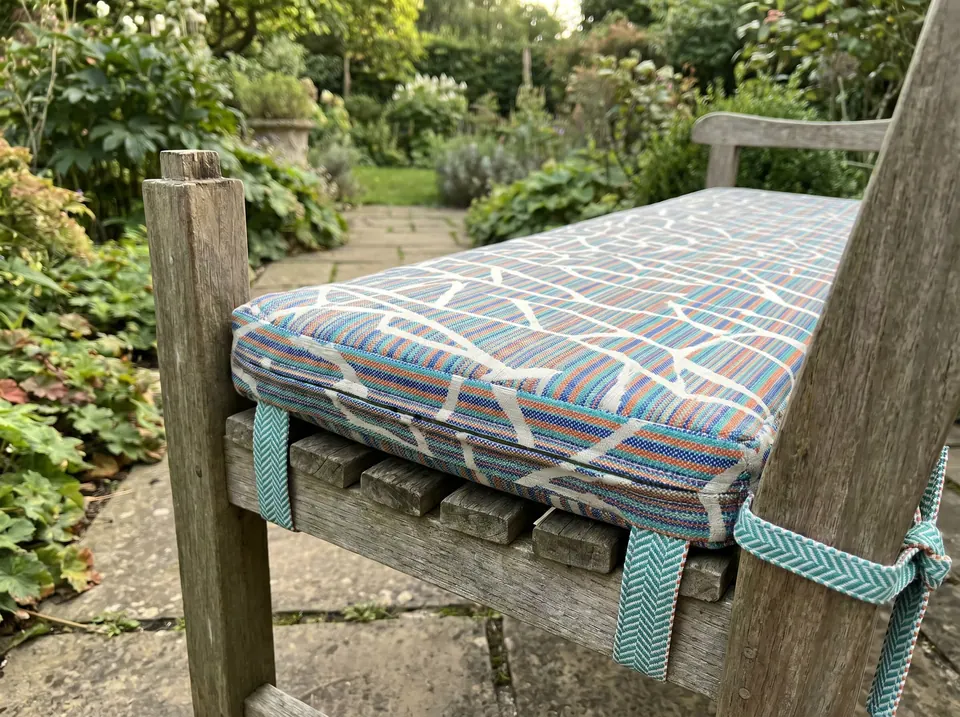
- Sliding: on an open bench, ties keep the cushion square, placed from a photo of the frame so each one meets a rail.
Two 62-inch cushions, eight ties, one photo of the bench
A buyer in the US ordered two bench cushions, each 62 x 14 in (157 x 36 cm), in a brown corduroy. Each one got four ties, set 2 in (5 cm) in from the ends.
Before anything was sewn, the workshop asked for a photo and a sketch of the bench. Ties only help if they land on the frame; a tie that meets a gap in the slats is decoration.
When the covers were sewn, the buyer got a photo of them to approve. The high-density foam went in the next day, and then they shipped. That is the right order of work: approve the cover while it is still empty. Our notes on ties and non-slip bases and on tie placement show where ties belong.
On the cutting table: the potting shed bench
| Product | Garden bench cushion, one long piece |
|---|---|
| Edge | Box edge |
| Thickness | About 3 in (8 cm) |
| Piping | Self piping |
| Fabric | Outdoor acrylic, woven geometric in stone taupe and off-white |
| Fit | Nearly the full length of a deep plank workbench |
| Fastening | Ties on open frames, placed from a photo of the bench |
| Best for | Potting sheds, porches, mudrooms and other dusty spots |

Have it made
Have this made — ask Callum’s workshop
Short list: size, sun hours, how fast it has to dry. The workshop goes through it with you. — Callum
Leave your details and the workshop will call you to confirm measurements, fabric, foam and piping. No prices, dates or payment on this page: it is a request, not an order.
Buyer questions: extra thickness, a wall backrest and fabric under a roof
- A common question
Could you make a bench cushion 9 7/8 in (25 cm) thick?
The workshop's answerYes. Add two 4 7/8 in (12.5 cm) thickness cushions to the cart and write in the personalization box that you want one 9 7/8 in (25 cm) cushion, or ask for a custom order link.
- A common question
Can you make a thinner matching cushion to fix to the wall as a backrest, or just sell me the fabric?
The workshop's answerBoth, and extra fabric can be supplied by length. One back cushion of 59 x 15 3/8 x 2 in (150 x 39 x 5 cm) was made in the same corduroy as the seat, and a 1 in (2.5 cm) thick version of 11 3/4 x 59 in (30 x 150 cm) without piping was quoted as well.
- A common question
Is the regular fabric fine for a covered outdoor area?
The workshop's answerYes, if the area is covered, but the standard fabric is not waterproof. Water-repellent outdoor fabrics are available, and one buyer chose a cream. If you don't specifically need rain protection, the workshop says the soft fabric is the nicer one to sit on.
A garden bench cushion in a mid-tone woven pattern hides soil and dust between washes. A pale solid on the same bench shows every mark the same day.
Callum
Questions buyers ask next
What fabric suits a potting shed or garden bench cushion?
An outdoor woven fabric in a mid-tone pattern. It copes with damp and hides soil between washes, and a geometric in taupe or stone reads warm against weathered boards. Avoid pale solids and 100% cotton if the shed door stays open to the weather.
How thick should a workbench cushion be?
Thick enough to sit on for a break, firm enough to keep a square front edge. This one is about 3 in (8 cm). Add the thickness to the bench height and check that your feet still rest flat on the floor.
Where should ties go on a long garden bench cushion?
Where they meet the frame. One pair of 62 in (157 cm) cushions had four ties each, set 2 in (5 cm) from the ends, placed from a photo and sketch of the bench so each tie reached a rail.
Fair winds — Callum
More photographs to read
 Save
 Save
 Save
 Save
 Save
 Save