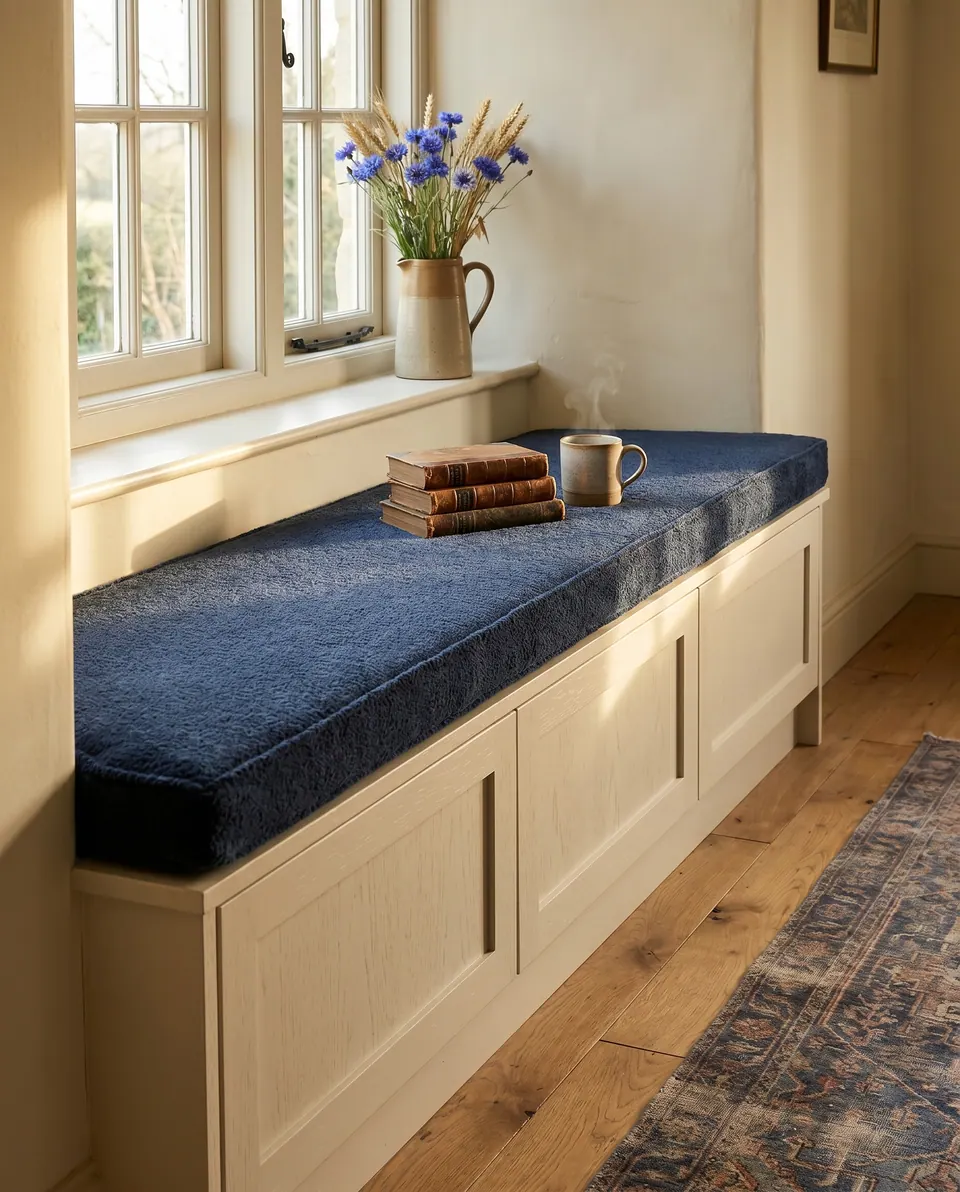
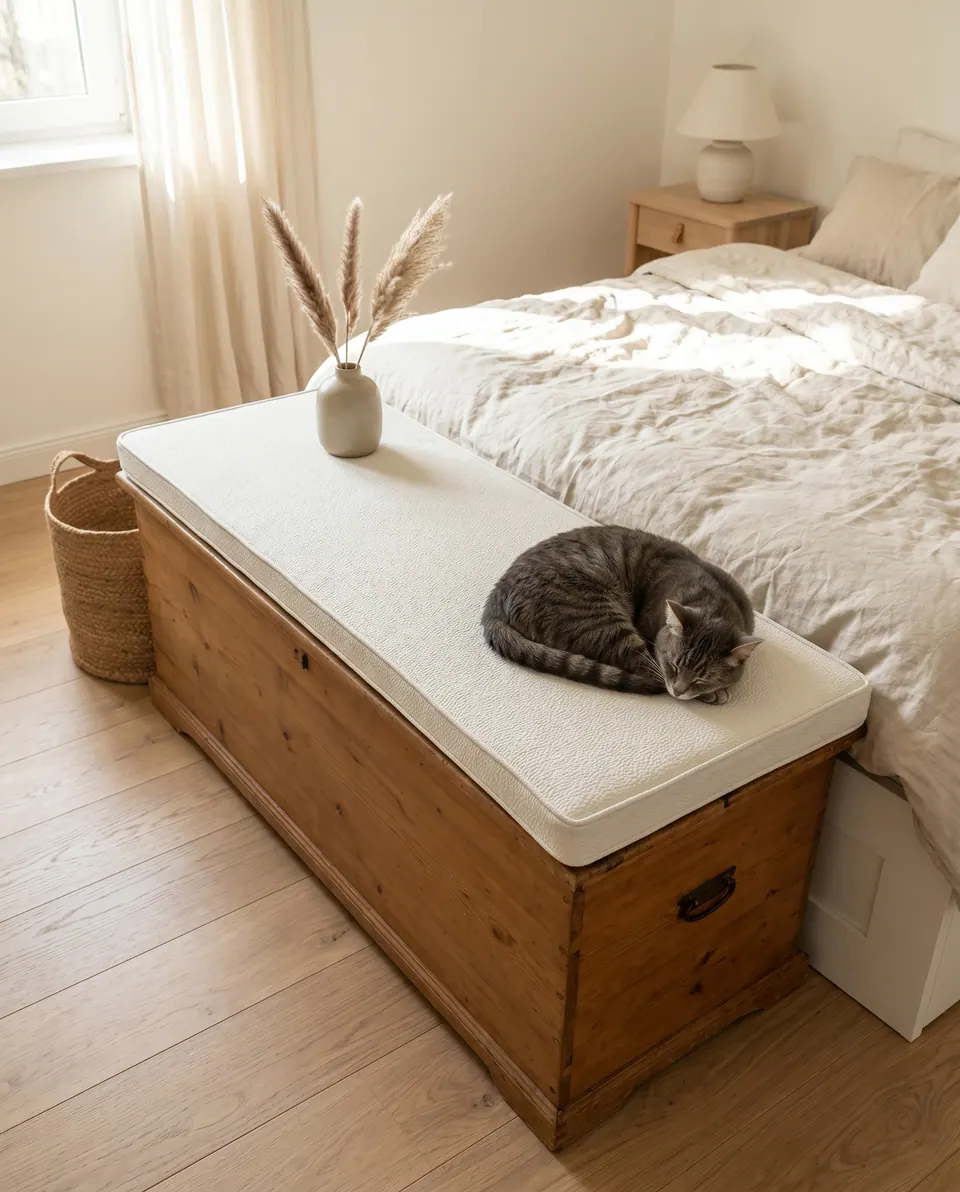
The Pattern Room · a measuring pattern
Cushion measurements explained: length, depth, thickness and units
Depth is the most overloaded word in my trade, partner: buyers use it for how far a seat runs back and for how tall the foam stands. Here are the three letters every Pattern on this site uses, and how to write numbers a workshop can't misread.

 Save
The quick answer
Every cushion size is three numbers: length (A), measured side to side along the front; depth (D), from the front edge back to the wall; and thickness (T), how tall the cushion stands. Label each number and write the unit after it, such as 60 in across x 20 in deep x 3 in thick, and give the true seat size without subtracting anything.
One word, two meanings, and a Kallax top that is 'wide'
Cushion measurements come down to three numbers, yet one word causes most of the back-and-forth. Measuring questions come up again and again, and 'depth' can mean two things: how far the seat runs front to back, and how thick the cushion is.
Product pages add a second tangle. Many write sizes width x length, where 'width' means seat depth: a 28 x 52 in (71 x 132 cm) cushion is 28 in deep and 52 in long. The top of an IKEA Kallax used as a bench is 15 3/8 in (39 cm) deep, and a size chart may still call that its width. So on this site we use letters instead.
9 steps to cushion measurements nobody can misread
Learn the three letters
A is length, along the front, side to side. D is seat depth, front edge to wall or backrest. T is thickness, how tall the cushion stands. Every measuring Pattern here reuses them; bays and trapezoids add letters, never different ones.
Pattern sheet A = 60 in (152 cm) across the front, D = 20 in (51 cm) back to the wall, T = 3 in (7.5 cm) thick. Measure the seat, never the old cushion
Old foam slumps and old covers shrink, so measure the wood, frame or ledge itself, inside the frame. Measure the real top of flat-pack furniture, not the catalog figure, and wait until built-ins are built; a workshop can hold an order for final sizes.
Take D square to the front edge
Hold the tape at a right angle to the front edge and run it straight back. Against a window or an old wall, take D at both ends and give both if they differ. A tape laid at a slant always reads long.
Read the tape to the nearest 1/8 in
Measure to the nearest 1/8 in (3 mm), twice. Write fractions as they read: 15 3/8 in, or 15.375 in; 15.3 in is a different number. Halves, quarters, eighths and decimals such as 51.25 in are all accepted.
Pick one unit and write it after every number
Inches or centimeters, never both. Write the unit after every figure and keep the order in the unit you measured in; late conversions add rounding. Where a size chart shows both units, the cushion is made to the centimeter size unless you write your inch size in the note.
Label every number with its word
Write '20 in deep x 60 in across x 3 in thick', not '20 x 60 x 3'. With the words attached, the order of the numbers stops mattering and nobody has to guess which one is thickness.
Type the numbers; send the photo for context
Photos of a tape get misread: the angle, the hook, the tiny fraction marks. Send a photo of the space with the tape in it for scale, then type the numbers underneath, and retype any handwritten figures.
Give the true size and subtract nothing
Send the real seat size; the workshop adds its own allowances and cuts to your figures, not rounded. Handmade foam cushions can vary by about 1/2 in (1 cm), tufted ones by 1 to 2 in (2.5 to 5 cm). Measure a finished cushion at the seam, not the piping.
Put the whole spec in the order note
Production reads the order, not the chat. A buyer in the US agreed by message that a 79.25 x 23.25 in (201 x 59 cm) window seat would be 4 in (10 cm) thick. The order note didn't say so, and the cushion arrived 2 in (5 cm) thick.

Have it made
Measured it? Have Nate’s workshop make it
Send the numbers in inches: length × depth × thickness, plus any angle. The workshop checks them with you, because foam has no undo button. — Nate
Leave your details and the workshop will call you to confirm measurements, fabric, foam and piping. No prices, dates or payment on this page: it is a request, not an order.
On the cutting table: fractions, decimals and centimeters
| 1/8 in | 0.125 in = 3 mm |
|---|---|
| 1/4 in | 0.25 in = 6 mm |
| 3/8 in | 0.375 in = 9.5 mm |
| 1/2 in | 0.5 in = 1.3 cm |
| 5/8 in | 0.625 in = 1.6 cm |
| 3/4 in | 0.75 in = 1.9 cm |
| 7/8 in | 0.875 in = 2.2 cm |
| 15 3/8 in (Kallax depth) | 15.375 in = 39 cm |
| 20 in | 20 in = 50.8 cm (round it to 51 cm, never down to 50 cm) |
| 4 in (standard thickness) | 4 in = 10.2 cm (usually written 10 cm) |
Three trapezoids, read in the wrong unit
A buyer in the US sent measurements for three trapezoid window seats, in inches. The workshop quoted, then realized it had read the inches as centimeters. Corrected, the quote more than doubled. That's what a missing unit weighs: 2.54 times on every edge, about 6.5 times on the area.
After some back-and-forth the order went ahead with inserts, 3 in (7.5 cm) thick instead of the 2.5 in (6.5 cm) first discussed, in a tan linen with ivory piping. The buyer later loved the result. The cushions were never the problem; the unit was the near miss.
- What it taught
- State the unit on the drawing; centimeters and inches change a quote dramatically.
Measuring mistakes that end in a remake
- Measuring the old cushion, the outside of the frame or the catalog size instead of the seat.
- Swapping length and depth. Write the long side as length.
- Sending numbers with no unit. '80 x 30 x 5' reads both ways.
- Converting at the last minute instead of sending the unit you measured in.
- Skipping a second check by whoever will actually use the seat.
- Agreeing a detail in chat but leaving it out of the order note.
Depth means front edge to wall; thickness means how tall the foam stands. Label every number: 20 in deep x 60 in across x 3 in thick.
Nate
The one-line spec to copy into your order
Here is the line I'd paste into any order note, with your numbers in place of mine:
Bench cushion, rectangle: 60 in across (A) x 20 in deep (D) x 3 in thick (T), inches, body: code, piping: code or none, zipper on the wall side.
Then enter A, D and T in the bench cushion builder and see the cushion at your thickness before anything is cut. Window seats use the same letters in how to measure a window seat cushion; angled seats add a few more in trapezoid cushion measurements. What does your seat measure, front edge to wall?
Buyer questions: which number is which
- A common question
On a cushion size, which number is the length and which is the width?
The workshop's answerLength is the long side, left to right across the front. Width is the short side, front to back, the same as seat depth; thickness is how tall the cushion stands. A 105 x 29 in sill takes a cushion 105 in long and 29 in wide.
- A common question
My size is 18.5 x 51.25 in and the size menu doesn't list it. Can I still order it?
The workshop's answerYes. Pick the range covering your widest and deepest measurement; it only sets the price. Type the exact size, thickness and fabric code in the order note, which is what gets made. Fractions such as 19 3/8 x 75 5/8 in are fine.
- A common question
How close to my numbers will a handmade cushion come out?
The workshop's answerSizes are made as written, not rounded: 22 x 99.5 in was made exactly so. Handmade foam cushions can vary by about 1/2 in (1 cm), tufted ones by 1 to 2 in, and piping adds a little to the outer size.
- A common question
How do I send measurements for an odd-shaped bench?
The workshop's answerPhotograph the space and draw it with every side measured and labeled A, B, C. Add the wall height above the seat for a back cushion, and any trim that sticks out. The workshop sends back its own drawing and waits for your OK.
Quick checks before you measure
Should I round my measurements to whole inches?
No. Give the nearest 1/8 or 1/4 in, or a decimal such as 51.25 in. Custom cushions are cut to the figures you write, so rounding them yourself only adds error.
Is thickness measured before or after the cushion is sat on?
T is the new cushion's uncompressed thickness. In use, foam settles a little: a 3 in (7.5 cm) cushion may sit closer to 2.5 in (6.5 cm), worth knowing when a window or table limits the height.
My cushion arrived thinner than ordered. Should I measure it right away?
Not right away. Vacuum-packed foam needs 48 to 72 hours to recover its full thickness. Let it breathe on a flat surface, then measure T before raising a size question.
How do I convert inches to centimeters for an order?
Multiply by 2.54: 20 in is 50.8 cm, and 4 in is about 10 cm. Better still, don't convert. Send sizes in the unit you measured in, with the unit after every number.