 Save
- Left back cushion
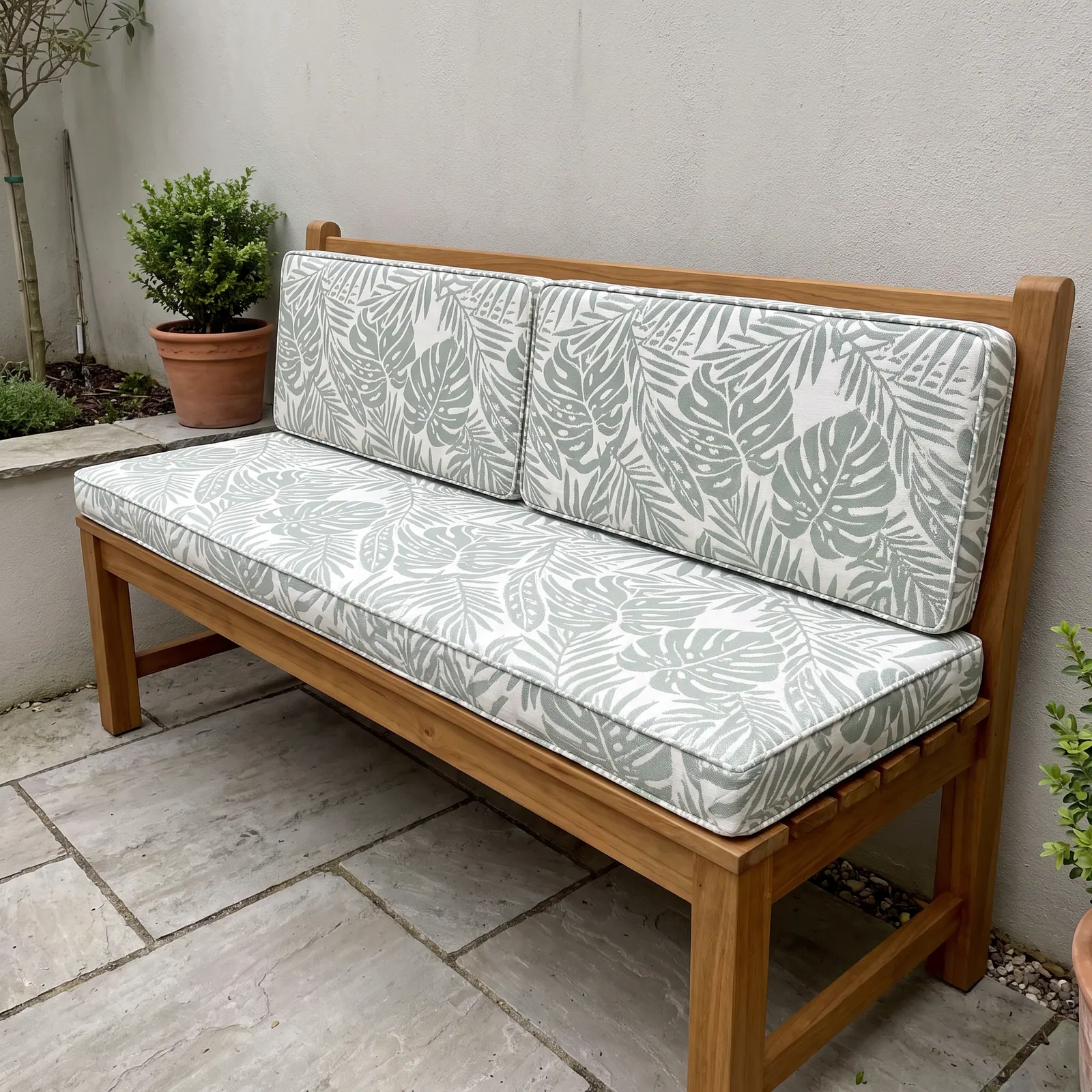
Two separate backs follow the bench and are easy to lift in when it rains.
- Piped seat edge
Fine pale piping keeps the leaf print from blurring at the edge.
- Box ball in pot
The clipped shrub repeats the sage of the leaves.
- Teak end post
The backs are cut to stop just inside the raised end posts.
Plate Sage monstera leaf cushions on a teak garden bench
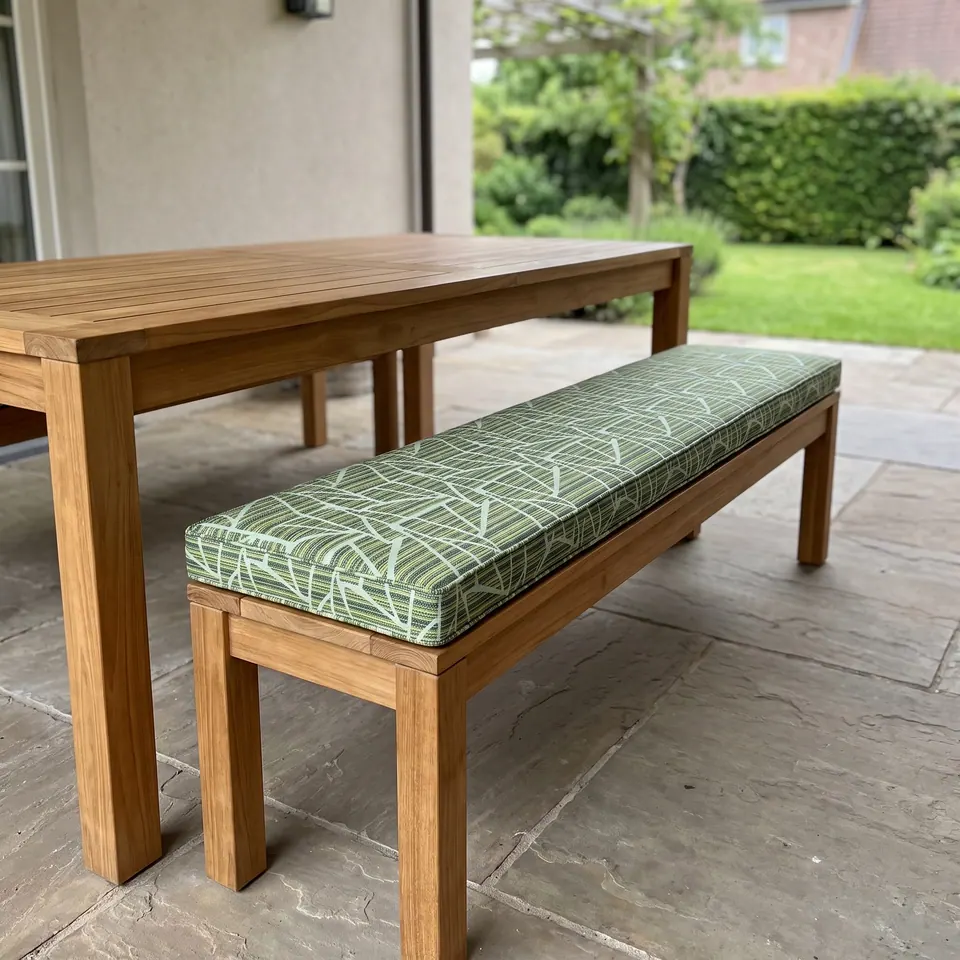
A leafy sage-on-white print covers a box seat cushion and two back cushions, softening a straight teak bench in a small paved courtyard.
A Reading by CallumBench Cushions
A sage monstera print on a teak garden bench, read against gray stone and cloud
Gray sky, gray render, sandstone underfoot and a teak bench in the middle. Callum reads how one leafy print carries the planting onto the seat.

The quick answer
A large sage-and-white leaf print works on an outdoor bench cushion when the surroundings are flat and quiet, such as a gray rendered wall and plain paving, because the pattern then reads as planting rather than clutter. On a teak bench the warm wood softens the cool green, and fine pale piping keeps the print from blurring at the edge.
Gray on three sides, green in the middle
Overcast morning, no shadows. Best light there is for reading a color honestly.
Everything around this bench is gray or sand. Rendered wall behind, sandstone slabs underfoot, a strip of gravel. That is why a big leaf print works on this outdoor bench cushion. On a busy patio it would be noise. Against flat stone it is the planting, carried onto the seat.
The sage is not a random green. Look left at the clipped box ball in its terracotta pot: same muted green, near enough. The young tree in the raised bed repeats it again. When the print matches the shrubs, a narrow courtyard reads wider, because the eye does not stop at the bench.
Then the teak. Warm brown under a cool green is an old sailor's pairing, varnished rail and weathered canvas. The wood takes the chill off the print. Keep teak oiled and it stays honey; leave it bare and it silvers toward the gray of the wall. Either way the sage holds.
The white ground matters as much as the leaves. It keeps the cushion light against a heavy wall. Fine pale piping traces the box edge so the pattern does not smear into the frame. Without it, a leaf print loses its outline from ten feet (3 m) away.
Light moves all of this. Under cloud, sage reads soft and gray-green. In hard July sun it goes paler and the white throws glare. Pick a print on a gray day and a bright one before you commit. If sage is your color, the Concept Sketch on sage, olive and khaki cushions has more.
Rain doesn't negotiate. Outdoor acrylic is made for weather, but the real storm decision here is the two separate back cushions. Each one lifts off in seconds when a squall comes over the wall. Outdoor cushion care covers the rest.
Swatch strip: a courtyard in five colors
- Leaf sage#9CAF88The print's green, matched near enough to the clipped box ball.
- Cushion white#F2F1EAThe ground that keeps a big print light against a heavy wall.
- Oiled teak#9A6A3FWarm brown under cool green; it takes the chill off the print.
- Render gray#9B9A96Flat and quiet, which is what lets a leaf pattern work.
- Sandstone#CDBB9AThe paving, a sand note that links teak to wall.
Pinned by Callum: backs, piping, box ball, end post
Four pins: the left back cushion, the piped seat edge, the box ball that sets the green and the teak end post the backs stop short of.
The numbers match the pins on the plate.
- Left back cushionTwo separate backs follow the bench and are easy to lift in when it rains.
- Piped seat edgeFine pale piping keeps the leaf print from blurring at the edge.
- Box ball in potThe clipped shrub repeats the sage of the leaves.
- Teak end postThe backs are cut to stop just inside the raised end posts.
Seat one way, back the other
A buyer wrote in about a U-shaped dining banquette. One long seat, 92 x 19 3/4 in (234 x 50 cm), plus two 39 3/8 x 25 1/2 in (100 x 65 cm) sections, all 3 in (7.5 cm) thick.
The color plan was clever. Seats in fabric 909 with 924 piping. Backrests reversed: 924 body, 909 piping. The order went in through the listing with the combination written in the note.
Two colors, swapped between seat and back, and the whole U reads as one set. Try it on a patio bench, friend: a sage seat with white piping, white-ground backs with sage piping.
On the cutting table: the courtyard bench
| Pieces | One box seat cushion, two separate back cushions |
|---|---|
| Sage-and-white monstera leaf on outdoor acrylic | |
| Piping | Fine pale piping on the seat edge |
| Seat fit | Flush with the front rail; box depth about the height of that rail |
| Backs | Cut to stop just inside the raised teak end posts |
| Why two backs | Easier to lift in when rain comes |
| Contrast idea | Swap body and piping colors between seat and backs |
| Best for | Teak garden benches in small paved courtyards |

Have it made
Have this made — ask Callum’s workshop
Short list: size, sun hours, how fast it has to dry. The workshop goes through it with you. — Callum
Leave your details and the workshop will call you to confirm measurements, fabric, foam and piping. No prices, dates or payment on this page: it is a request, not an order.
Buyer questions
- A common question
I love a cushion in one of your buyer review photos. Can you tell me which fabric it is?
The workshop's answerYes. The workshop can look up the fabric code used in a specific review photo, for example N03, so you can order the same look.
- A common question
A fabric code I saw in your photos, L54, isn't on the chart anymore. Is it discontinued?
The workshop's answerNo. It came off the current chart only because fewer people choose it, not for quality reasons. The fabric is still in stock and can still be ordered.
- A common question
I need a black window seat cushion 11 3/8 x 50 3/8 in (29 x 128 cm). Which option do I pick?
The workshop's answerChoose the nearest larger listed size, 11 3/4 x 55 in (30 x 140 cm), and place the order with your exact numbers. The cushion is made to the measurements you give.
A big leaf print belongs on an outdoor bench cushion only when the wall and paving behind it are flat gray, so the pattern has room.
Callum
Questions buyers ask next
Do large leaf prints suit a small patio?
They can, when the surfaces around them are plain. A big leaf print against a flat gray wall or plain paving reads like planting. Against patterned tiles, busy rugs or mixed furniture it turns into clutter, so keep to one pattern per corner.
Why split the back of a garden bench into two cushions?
Two shorter backs are easier to lift and carry indoors when rain comes, they fit neatly between raised end posts, and one can dry without disturbing the other. A single long back is heavier and harder to keep straight.
What piping color works on a leaf print?
Take it from the print's ground or its lightest tone. Fine pale piping on a sage-and-white print outlines the box edge so the leaves don't blur into the frame. A dark cord would draw a heavy line through a light pattern.
Does teak change how a green cushion looks?
Yes. Oiled teak is warm and honey-toned, which softens a cool green. Bare teak weathers to silver-gray over the seasons, which makes the same green look fresher and cooler. Choose a sage that works with both stages of the wood.
Fair winds — Callum