 Save
A Reading by CallumChaise Lounge & Sunbed Cushions
A sunbed cushion that woke up a beach house deck: chevron bands up top, teal where the sand lands
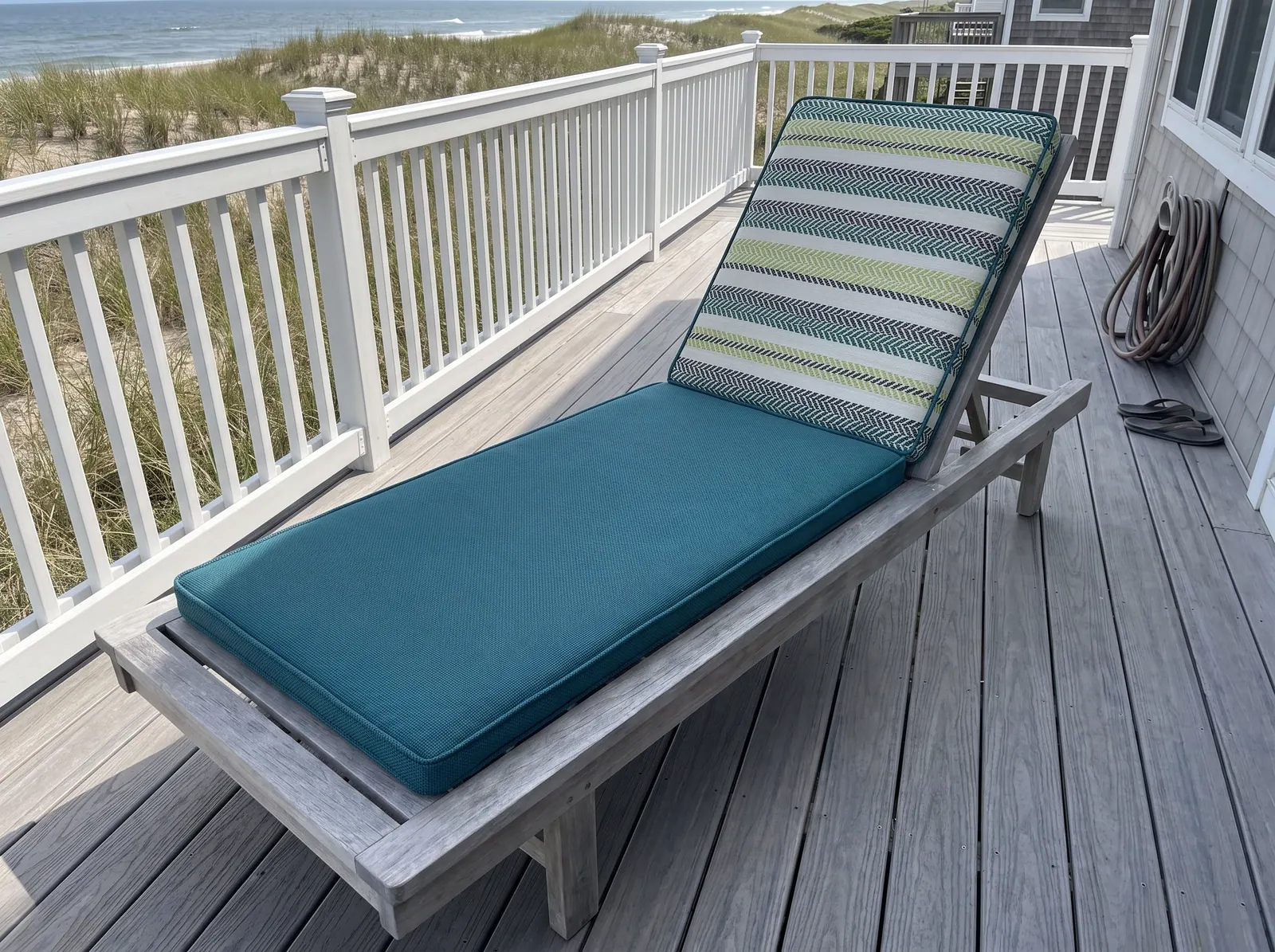
Before: a silvered teak lounger on a gray deck, honest and weathered and half asleep. After: one cushion in two fabrics, and the whole deck finally has somewhere to look.
On a dune-top deck, the teal seat picks up the sea and the banded backrest brings in the greens of the grass.
The quick answer
A two-fabric sunbed cushion can remake a plain deck: put the lighter pattern on the backrest and a darker solid on the seat, where wet, sandy legs land. Here a lime, green and navy chevron band tops a teal box seat with self piping, so the pattern picks up the dune grass and the seat picks up the sea.
Before: silver wood, gray boards, no color at all
Picture this deck without the cushion. Weathered teak gone silver, gray composite boards, a white railing, dune grass, the Atlantic under an overcast sky. Everything is the color of driftwood. It's handsome, and it's asleep.
Now put one sunbed cushion on the lounger. Nothing else changes. No new rug, no planters. The deck wakes up because the cushion borrows its colors from the view: teal from the sea, lime and green from the grass, navy from the deeper water farther out.
That's the before-and-after thinking I'd ask you to copy, friend. Before buying anything else, find the one piece the eye lands on first and make it carry the palette. The rest of the deck can stay exactly as the weather left it.
Pinned by Callum on the dune deck
Five pins, from the chevron-band backrest and teal seat to the hose and flip-flops that keep the scene honest.
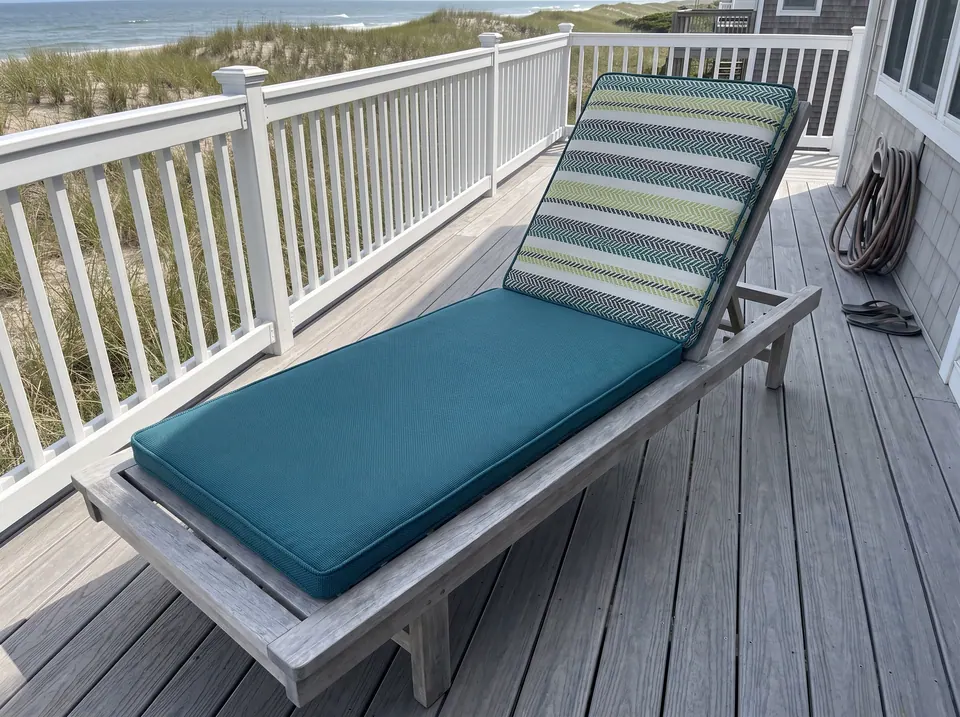
- Chevron-band backrest
Horizontal bands of lime, green and navy chevron read like a beach towel over the headrest.
- Teal solid seat
A darker solid where sandy, wet legs land hides salt and sand.
- Dunes and sea
Teal picks up the sea, the greens pick up the dune grass.
- Coiled hose
A real rinse-off spot, so the cushion must cope with water.
- Flip-flops
Everyday beach details keep the scene honest.
- Chevron-band backrestHorizontal bands of lime, green and navy chevron read like a beach towel over the headrest.
- Teal solid seatA darker solid where sandy, wet legs land hides salt and sand.
- Dunes and seaTeal picks up the sea, the greens pick up the dune grass.
- Coiled hoseA real rinse-off spot, so the cushion must cope with water.
- Flip-flopsEveryday beach details keep the scene honest.
After: why the pattern climbs and the solid sits
The backrest wears horizontal bands of chevron in lime, green and navy. It reads like a beach towel thrown over the headrest, which is exactly the mood. Pattern at eye level, where it's seen from the house.
The seat is a plain teal box cushion with self piping. Darker, quieter, and placed where wet legs and sand arrive straight off the beach. A pale seat would show salt within a week. Both halves are outdoor acrylic.
Two props tell you this deck gets used. A coiled hose sits against the shingle wall, so there's a rinse-off spot and the cushion had better cope with water. A pair of flip-flops lies nearby. Neither looks staged, and both belong. For the season's end, read outdoor cushion care and winter storage. What's the first thing your eye lands on when you step onto your deck?
A whole boat saloon, one labeled sketch at a time
The biggest before-and-after I've seen was below deck. A boat owner wanted dark green velvet covers for the saloon, the nav station, a corner seat and the bedroom berths. Some pieces were shaped: four-sided bases, and backs 5 in (13 cm) thick at the ends and 8 1/4 in (21 cm) in the middle.
The existing foam already carried hook tape along the back, and every new cover needed a zipper. So the shop asked for the exact length, width and thickness of each piece, plus photos and a sketch marking where the tape sat. One base ran 23 1/4 x 13 3/4 x 4 3/4 in (59 x 35 x 12 cm), another 27 1/2 x 23 1/4 x 4 3/4 in (70 x 59 x 12 cm).
For any refit, label every cushion and mark every fastening on the drawing, and the new covers will line up with the old boat. Shaped marine pieces are covered in boat cushion templates.
Deck and dock questions
- A common question
Our terrace is covered. Could the piping on outdoor cushions be an indoor fabric?
The workshop's answerIndoor fabrics aren't recommended outdoors, but a covered terrace that gets no rain or direct sun is a different case, so yes. Order through the outdoor listing, since the outdoor fabric sets the price, and write 'piping:' followed by the code in the personalization.
- A common question
What kind of zippers and stitching go into your covers?
The workshop's answerDurable, high-quality hidden zippers, concealed as much as possible for a clean look, and double-stitched seams. Outdoor projects can have a concealed heavy-duty zipper and UV-resistant thread. The shop didn't name a zipper brand.
- A common question
Could you sew on Velcro instead of ties so the cushions stay on the frame?
The workshop's answerVelcro isn't offered at the moment. Ties can go wherever you want them, and a non-slip bottom is another way to stop cushions moving.
On the cutting table: the dune-deck lounger
| Cushion | Two-part sunbed cushion, seat and backrest |
|---|---|
| Backrest | Horizontal chevron bands in lime, green and navy |
| Seat | Solid teal box cushion |
| Piping | Self piping |
| Fabric family | Outdoor acrylic |
| Frame | Weathered teak lounger on gray composite decking |
| Zippers | Hidden; concealed heavy-duty option for outdoor builds |
| Thread | UV-resistant option for outdoor projects |
| Best for | Beach decks, pool terraces, dune-top porches |

Have it made
Have this made — ask Callum’s workshop
Short list: size, sun hours, how fast it has to dry. The workshop goes through it with you. — Callum
Leave your details and the workshop will call you to confirm measurements, fabric, foam and piping. No prices, dates or payment on this page: it is a request, not an order.
On a beach deck lounger, put the pattern on the backrest and a darker solid on the seat, where wet, sandy legs land first.
Callum
Questions buyers ask next
Which part of a sunbed cushion should carry the pattern?
The backrest. It sits at eye level, where the pattern is seen from the house, and it stays cleaner. Keep the seat a darker solid, since that's where sandy, wet legs and damp towels land.
Can one sunbed cushion use two different fabrics?
Yes. This lounger pairs a chevron-band backrest with a solid teal seat. Pick both from the same outdoor family so the two halves take the same care, and link them with colors taken from the view.
Why is teal a good seat color by the sea?
Teal is dark enough to hide sand and salt marks, and it repeats the sea, so the cushion looks like part of the view. A pale seat on a beach deck shows every rinse-off and salty towel.
What should I measure for a sunbed cushion with a backrest?
Measure the seat and the backrest as separate pieces, each with length, depth and thickness. Note where the backrest bends and whether the frame has posts or slats for ties, and label each piece before sending the numbers.
Fair winds — Callum