The Pattern Room · a measuring pattern
Making templates for boat cushions, V-berths and cockpit benches
Nothing on a boat is square, and the old cushion has been lying to you for years. Trace the base, label every piece, and let the drawing do the arguing.

 Save
The quick answer
To get boat cushions that fit a V-berth or curved cockpit bench, trace each plywood base in paper or thin plastic, mark 'top side up' and 'bow' on every piece, and photograph it flat with a tape measure in frame. The workshop cuts from that drawing in its seat foam and water-repellent outdoor fabric, a build that suits cabins and covered cockpits best.
A boat has no square corners, so trace the plywood
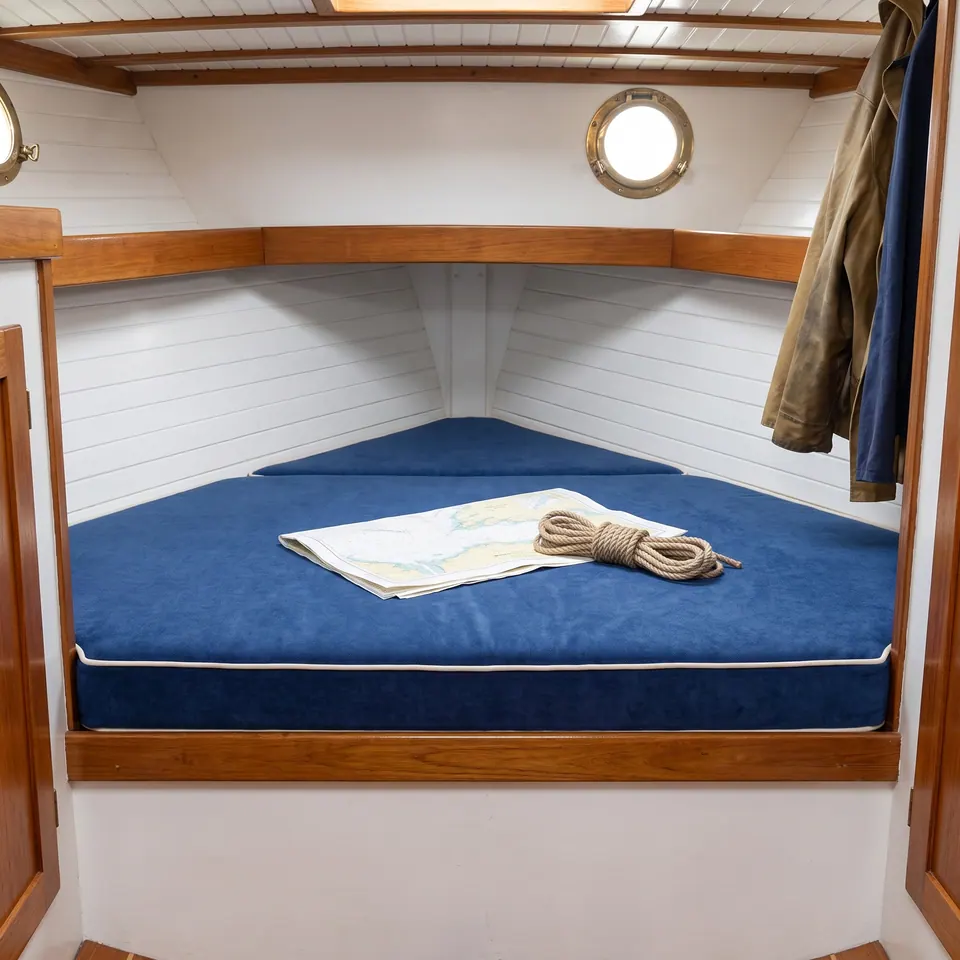
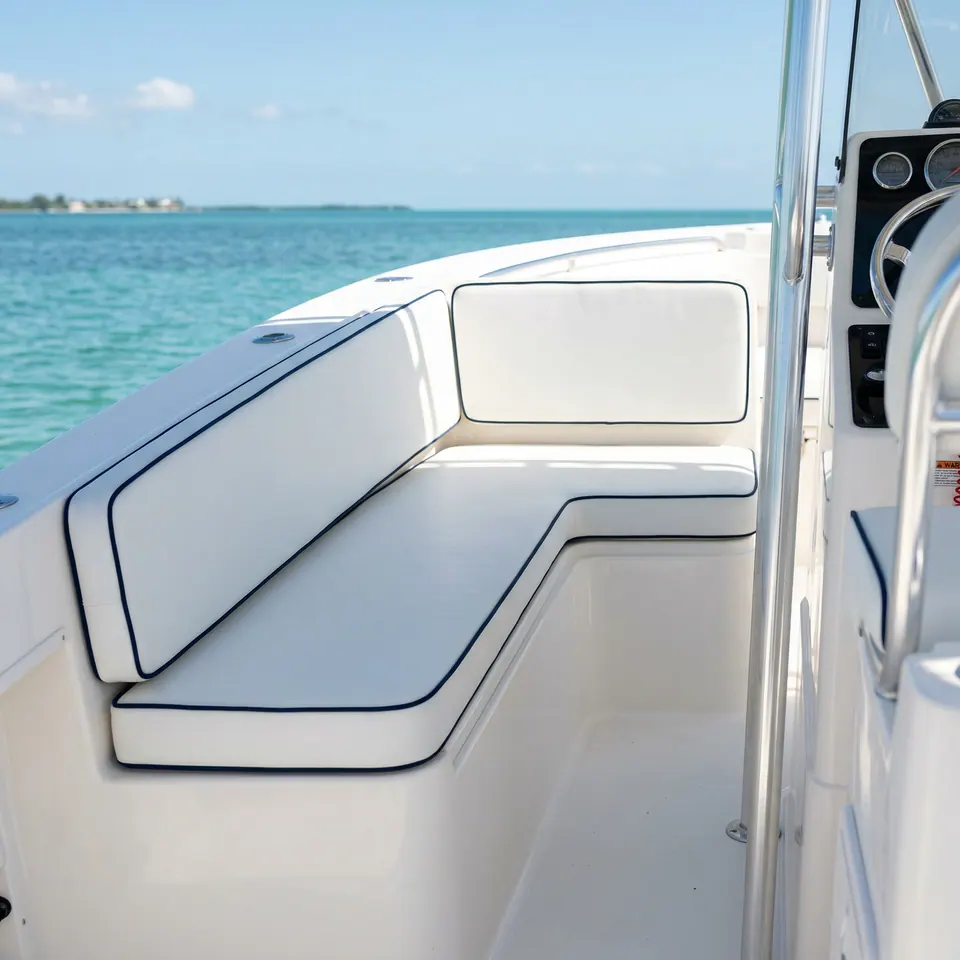
A V-berth narrows toward the bow. A cockpit bench follows the curve of the hull. A saloon seat hides a locker lid underneath. That is why good boat cushions start with a template, not a tape and a guess.
I cut canvas for lobster boats before I ever cut foam. The rule carried over: trace the thing itself. Lift the old cushions out and template the plywood base. Old foam has been sat on, squeezed and trimmed for years. The base hasn't moved.
A paper template turns a curve into a list of honest lengths. Paper works. Thin plastic sheet works too, and holds its shape in a damp cabin. For the simpler tapered pieces, the trapezoid cushion calculator helps you check the numbers before you draw. The paper template Pattern covers the craft for house furniture; below is the boat version.
Templating a V-berth or cockpit bench in eight moves
Clear the berth down to the base
Take every cushion out and wipe the plywood dry. Note hatches, drain holes, hinges and anything that stands proud of the surface. The cushion sits on this, so this is what you trace.
Lay the sheet and trace the hull side
Tape paper or thin plastic flat over the base. Run a pencil along every edge, pressing into the joint where the berth meets the hull. Go slowly on the curve; a wobble in the pencil becomes a wobble in the foam.
Pattern sheet Lay paper on the seat and trace the edge, write the widest width and the front-to-back depth on the template, then photograph it flat from directly above with a tape measure in the picture. Write 'top side up' and 'bow' on every piece
V-berth halves are mirror shapes. Flip one and the cushion fits the other side of someone else's boat. Mark top side up, draw an arrow toward the bow, and number the pieces in the order they sit.
Mark the fastenings and cut-outs
Draw where hook-and-loop strips, snaps or a hatch sit. One sailboat owner's foam already carried hook strips along the back, so the new covers needed matching loop strips sewn on the bottom. The workshop asked for a sketch showing exactly where the strips ran, so everything would line up.
Measure every edge and write it on the sheet
Measure each straight edge, the depth at the widest and narrowest points, and the thickness you want. Write the numbers on the template. Odd shapes go on the custom-shape listing, where the size range is picked by total length at the widest point and the deepest depth.
Photograph it flat with a tape in frame
Lay the template on the floor with a tape measure along one edge and shoot from directly above, the whole piece in one frame. Add a photo of the berth itself. The workshop doesn't take paper templates by mail; it cuts from a dimensioned drawing or a photographed template, and production follows the drawing, not the photos.
Decide where the joins fall
Very long pieces, around 75 to 142 in (1.9 to 3.6 m), can run past the longest single piece the workshop cuts, so they're made in sections and you choose where the joins go. On a V-berth I'd put the join on the centerline, so each half lifts out alone to reach the lockers below.
Ask for the measured photos before it ships
Every cushion is measured after sewing, and every order is photographed before it goes out. For a custom shape, ask for the photos that show the tape on each edge, and check them against your template, labels and all.

Have it made
Measured it? Have Callum’s workshop make it
Tell them where it lives. Porch, deck or boat: the weather picks the fabric and the foam before anyone else does. — Callum
Leave your details and the workshop will call you to confirm measurements, fabric, foam and piping. No prices, dates or payment on this page: it is a request, not an order.
Marine foam, plainly: which one belongs where
| Foam | What water does to it | How it sits | Where it belongs |
|---|---|---|---|
| Reticulated (dry-fast) open-cell | Drains nearly as fast as it enters; dry in 1 to 3 hours with airflow | Typical grade about 1.8 lb/ft³ (29 kg/m³); needs a mesh or breathable base and no fiber wrap | Open cockpits and decks that take spray and rain |
| Closed-cell | Doesn't absorb water, and it floats | Hard and firm; used thin, as a base or barrier under softer foam | A bottom layer on wet decks |
| Standard seat foam (the workshop's build) | Soaks up water and takes 24 to 48 hours to dry | Medium-firm, about 2.0 lb/ft³ (32 kg/m³) | Cabins, covered cockpits, cushions carried below when it rains |
| Latex | Keep it dry | A cabin comfort foam | Below deck only |
What the workshop builds, and why cabins suit it best
Here's the straight answer. The workshop's standard build is its regular seat foam in outdoor fabric. There's no quick-dry foam, no mesh drainage bottom and no sealed seam as standard. Covers have normal stitching and full zippers, so they come off for washing.
The outdoor fabric is water-repellent. It sheds showers, spray and spills. But water gets into a cushion through needle holes, zippers and the dips around tufting buttons, not only through the cloth. Water-repellent is a promise; waterproof is a contract.
So these cushions belong in a cabin, under a hard top or a covered cockpit, or on a seat you carry below when weather comes in. For a cockpit that lives in the rain, read the dry-fast foam Pattern and ask for reticulated foam by name. The water-repellent versus waterproof Pattern covers the fabric side, and the outdoor fabrics in the Swatch Library show what sheds water best.
One more thing, said plainly. A decorative cushion is not a flotation device unless it is labeled as one. Keep your labeled flotation gear aboard as well.
The buyer who asked for sealed seams
One buyer wrote in about eleven replacement covers: a couch, dining armchairs, stools, button-tufted high backs and slanted footstools. The foam underneath was still good. The request was marine-grade: fully waterproof fabric, sealed seams and mesh vents.
The workshop didn't pretend. It sent its water-repellent outdoor neutrals, cream, beige, taupe and oatmeal, offered a sample pack whose cost came off the order, and said sealed seams and mesh vents aren't something it makes.
The buyer thought it over and settled on the standard water-repellent outdoor canvas. The cushions go into storage every winter anyway. Sealing would have paid for protection against weather they never meet.
That's the trade I'd make too. Build for the worst day the cushion actually sees, then bring it in before the season turns.
Mistakes that come back from the dock
- Tracing the old cushion instead of the base. Measure the plywood or the bare foam, never the tired cover around it.
- Leaving 'top side up' off a mirror-shaped piece. A V-berth half cut face-down fits the wrong side of the boat.
- Typing ties or a non-slip base into the size box. Add-ons written there get overlooked; ask in writing with position and length, and confirm by message after ordering.
- Choosing fabric for looks where damp reaches. Tell the maker indoor or outdoor first, so the color search starts in the right chart.
- Tufting a cockpit cushion. Tufted cushions let water in even in outdoor fabric; keep outdoor pieces plain and foam-filled.
- Approving shipment without checking the small extras. Look for the ties, strips and base in the pre-dispatch photo.
Laying the cushions up for winter
Bring the cushions home when the boat comes out. The foam is flexible, so a long cushion can be folded or rolled for the ride without creasing or damage.
Unzip the covers and wash them on a gentle cycle at 86°F (30°C), then air dry. Store the foam dry, with air around it, never sealed in a plastic bag. Damp trapped over a winter is how mildew starts. The outdoor cushion care Pattern has the full seasonal routine, and the V-berth Concept Sketch shows how other owners split their berths.
What does your V-berth measure along the centerline, friend? Write it on the template now, while the boat is on the hard.
Water gets into a boat cushion through needle holes, zippers and tufting dips, not just the fabric, so a water-repellent cover still wants a covered cockpit.
Callum
Buyer questions: covers, strips and long benches
- A common question
I need new covers for the cushions on my boat. Can you sew velcro on the bottom so they meet the strips already there?
The workshop's answerYes. Send the exact length, width and thickness of each cushion, and the workshop makes fitted covers with soft loop strips sewn on the bottom to meet the hook strips you already have. Include photos and a simple sketch of where the strips sit, and measure every cushion on its own.
- A common question
Our bench is really long. Can the outdoor cushion be made as one single piece?
The workshop's answerOften not. Pieces around 75 to 142 in (1.9 to 3.6 m) can exceed the longest single piece, so they're made in sections; a 142 in (360 cm) bolster was made as two 71 in (180 cm) halves. You choose where the joins fall, and the foam folds or rolls for storage without damage.
- A common question
Does the outdoor fabric feel like plastic, or like real cloth?
The workshop's answerReal cloth. It isn't a coated, tarp-like material. It is firmer and less velvety than indoor upholstery, closer to a good sun-lounger cushion, and buyers have consistently found it comfortable. It's made for outdoor durability first.
- A common question
Can I use the linen or velvet cushions outside?
The workshop's answerNo. Linen, velvet, chenille and the other indoor-listing fabrics aren't made for open air, and chenille especially struggles in humid climates. Order through the outdoor listing instead: 100+ colors, all outdoor-rated, water-repellent and UV-resistant, with any piping combination.
- A common question
If a tufted cushion is made in outdoor fabric, can it live outdoors?
The workshop's answerIt can be made, but tufting lets water inside even in outdoor fabric. Where cushions get wet, by a pool or a fire pit, the workshop recommends a plain foam-filled cushion in outdoor fabric; its zippered outdoor versions are made without tufting.
Boat cushion templates, briefly
Can I mail my paper template to the workshop?
No. The workshop doesn't accept physical templates by mail. Send a dimensioned drawing, a photo of your paper template laid flat with a tape measure in frame, or its measuring diagram filled in. A hand sketch is fine if every edge is measured.
What foam should an open cockpit cushion have?
Reticulated open-cell foam with a mesh or breathable base and no fiber wrap, sometimes over a thin closed-cell layer. The workshop's standard build is its regular seat foam, so for an uncovered cockpit ask any maker in writing whether reticulated foam is included.
Should I measure the old covers or the foam inside?
The bare foam, or better, the plywood base it sits on. Old covers stretch and old foam compresses. Measure the length, width and thickness of each piece at its widest and thickest point, and photograph the tape against it.
How thick should a V-berth cushion be?
Most buyers choose 3 to 4 in (7.5 to 10 cm), and outdoor quotes assume 4 in (10 cm). In one sailboat refit, the saloon seats were about 4 3/4 in (12 cm) and the backs ran from about 5 in (13 cm) at the ends to 8 1/4 in (21 cm) in the middle.